

Empiricism (Locke, Berkeley, Hume): Theory of Knowledge; Substance and Qualities; Self and God; Scepticism.
Official Syllabus: Paper I, Section A, Unit 3
Locke the empiricist did not give up the self or God. He held that we know our own existence by intuition, that God’s existence can be demonstrated, and that the world of bodies is known by sensation. But he changed the questions. Instead of asking what the soul is made of, he asked what makes a person the same person over time — and answered: sameness of consciousness, reaching back through memory, not sameness of soul or body. Instead of claiming an inborn idea of God, he showed how the idea is built from experience and then argued, step by step, that an eternal, all-powerful, all-knowing Being must exist. Around these two themes stand his accounts of relations, identity and diversity, and causation as power — the ideas through which the mind connects one thing to another.
In simple words
Imagine you wake up tomorrow in a completely different body, but you remember your childhood, your friends and what you did yesterday. Most people feel: “That would still be me.” Now imagine your body stays the same, but every memory is wiped out and a new set put in. Many feel: “That is someone else in my body.” Locke built his theory on this feeling: you are where your consciousness and memory go.
Context & Problem
Why Locke Had to Rethink the Self
- The Cartesian picture. Descartes said the self is a thinking substance (res cogitans) whose essence is thought; it is known by intuition and is the same soul throughout life. Personal identity would then be identity of soul-substance.
- Locke’s difficulty. Locke had shown that substance, material or spiritual, is a “something, I know not what.” If we do not know the soul-substance, we cannot use it to tell whether the person in front of us is the same person as yesterday. Identity must rest on something we can know.
- A practical problem. Law, morality and religion all need an answer to “is this the same person?” — to punish the guilty, reward the good, and make sense of the resurrection and Last Judgment. Locke added his chapter “Of Identity and Diversity” to the second edition of the Essay (1694) to meet this need.
- God. Rationalists proved God from an innate idea (Descartes) or from the concept of a perfect being (the ontological argument). Locke rejected innate ideas, so he had to show how the idea of God arises from experience and how God’s existence can be proved without it.
Core Doctrine
1. The Soul (Spiritual Substance)
- Known through reflection. Reflection gives us ideas of mental operations — thinking, perceiving, willing, remembering, doubting. These operations are commonly referred to a soul or mind.
- An unknown substratum. Just as matter is the unknown support of physical qualities, the soul is the unknown support of mental qualities. Our idea of spirit is the idea of “a substance wherein thinking, knowing, doubting, and a power of moving, etc., do subsist.” Its inner nature is no better known than that of matter.
- The soul’s primary qualities. Locke gives the mind two primary qualities: thinking (perception) and motivity — the power to begin motion in the body by will. Other mental activities are their modes.
- There must be a knower. If there is knowledge, there must be someone who knows, and the knower cannot be merely the body as we perceive it. We cannot deny the place where ideas arise and knowledge happens.
- Known intuitively. Like Descartes, Locke holds that we know that we exist by intuition — the most certain knowledge we have. But for Descartes the idea of the self is innate; for Locke it is empirical, given in reflection.
- Thinking is the soul’s action, not its essence. Against Descartes, Locke says “the soul thinks not always.” In deep, dreamless sleep we are aware of nothing; to say the soul is thinking then, without knowing it, is to claim something no experience shows. Thinking is to the soul what motion is to the body — an activity, not its essence.
- Could matter think? Locke even allowed that God could give a system of matter the power to think; we cannot prove that the thinking thing in us is immaterial. Its immortality therefore rests on faith, not demonstration.
- Against Cartesian dualism in practice. Since soul-substance is unknown, Locke did not ground personal identity in it. This is his decisive break with Descartes.
2. Identity and Diversity in General
Identity is found when we compare a thing existing at one time and place with itself at another, and find it the same. Diversity is when we find it different.
- The principle of individuation. “Existence itself” fixes a thing to a particular time and place. Two things of the same kind cannot be in the same place at the same time, and one thing cannot have two beginnings. “That which had one beginning is the same thing; and that which had a different beginning in time and place … is not the same, but diverse.”
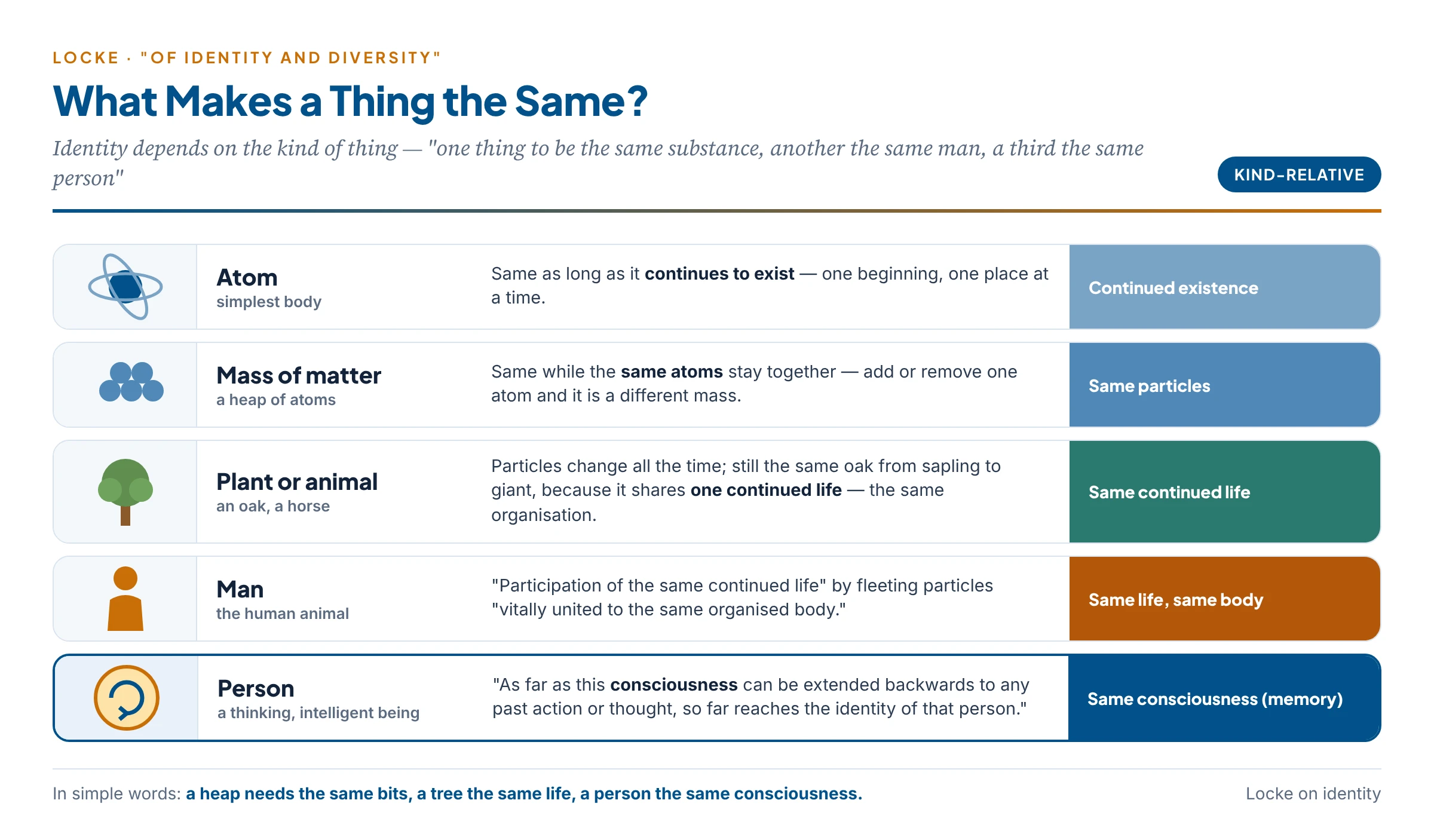
- Identity depends on the kind of thing. “It being one thing to be the same substance, another the same man, and a third the same person.” What counts as “the same” differs for each kind — identity is kind-relative.
Identity across kinds:
- Atoms — an atom is the same as long as it continues to exist; it is identical with itself at every moment.
- Masses of matter — a heap of atoms is the same mass as long as the same atoms stay together, however they are arranged. Add or take away one atom, and it is no longer the same mass.
- Plants and animals — here sameness of matter does not matter. An oak grows from a sapling to a great tree and its particles change constantly; a colt grows into a horse, fat or lean. Each remains the same because it shares one continued life — the same organisation of parts, kept up by constantly changing particles.
- Man — the identity of a man (the human animal) is “nothing but a participation of the same continued life, by constantly fleeting particles of matter, in succession vitally united to the same organised body.” Locke adds that a baby and an old man are the same man; but if the same soul were in Heliogabalus and later in a hog, no one would call the hog the same man.
- Person — identity of a person rests on sameness of consciousness, explained below.
3. Personal Identity: Consciousness, Not Substance
What a person is. A person is “a thinking intelligent being, that has reason and reflection, and can consider itself as itself, the same thinking thing, in different times and places.”
- Consciousness makes the self. Consciousness always accompanies thinking; by it each of us is “self” to himself. “As far as this consciousness can be extended backwards to any past action or thought, so far reaches the identity of that person.”
- Memory is the test. If I can remember doing an action — from the inside, as my own — that action belongs to me. I am the same person who did it. The man who fought at a battle long ago and now remembers it is the same person who fought.
- Not sameness of substance. Whether consciousness is carried by one soul-substance or many, or even by changing material particles, does not matter. Personal identity “consists not in the identity of substance, but … in the identity of consciousness.”
- Not sameness of body or man. The man (the living human animal) and the person can come apart, as the thought experiments show.
- The body we feel is part of the self. Our limbs are part of ourselves because we feel what happens to them. If a little finger is cut off and consciousness goes with it, the finger would be the person; the rest of the body would no longer be part of that self.
Locke’s thought experiments:
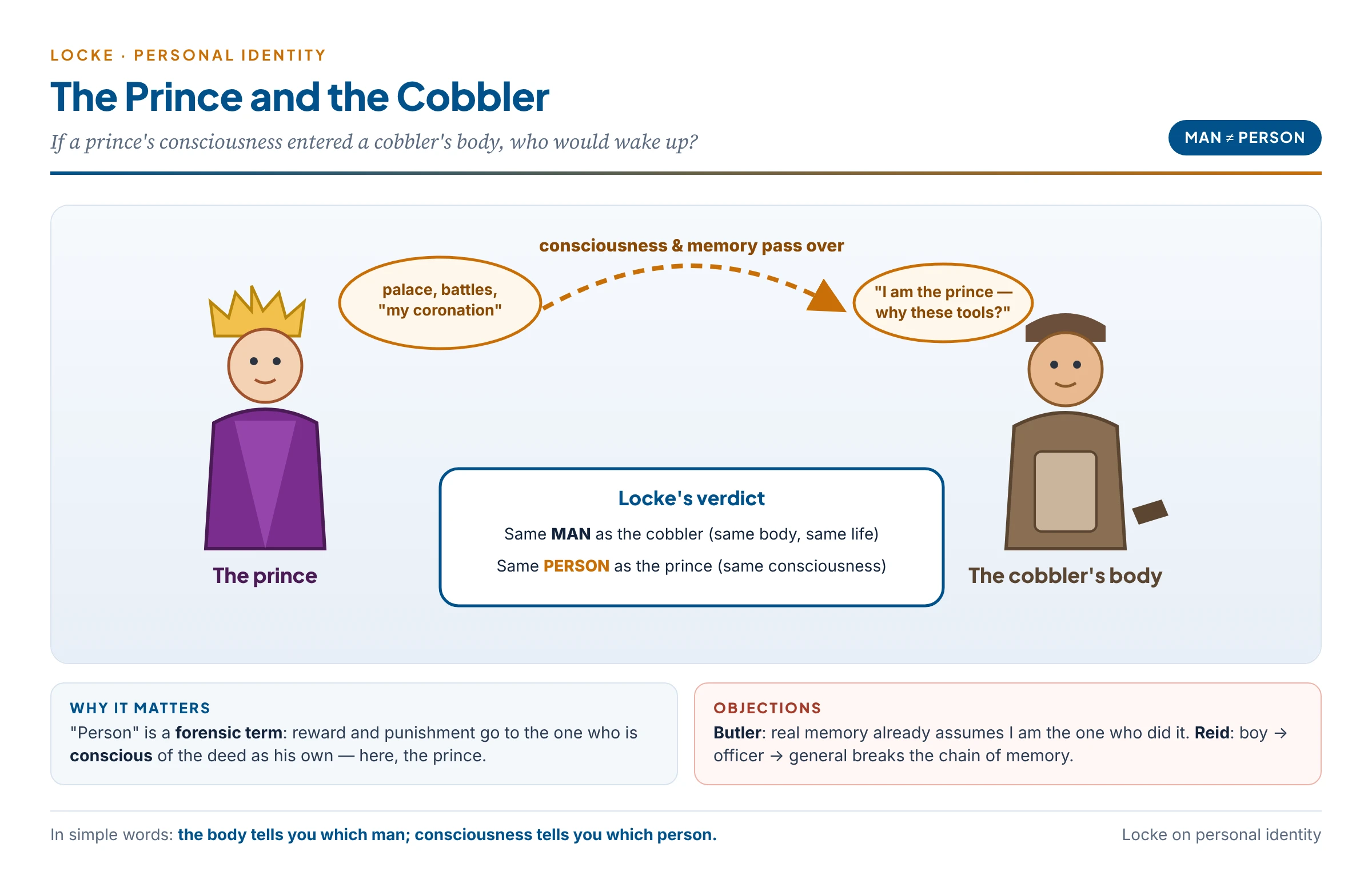
- The prince and the cobbler. Suppose the soul of a prince, carrying the consciousness of the prince’s past life, enters and informs the body of a cobbler as soon as the cobbler’s own soul departs. Everyone sees the cobbler’s body; but the man in it remembers the prince’s life. He would be “the same person with the prince,” though the same man as the cobbler.
- The day-man and the night-man. If the same man had one consciousness by day and a completely different, incommunicable one by night, there would be two persons in one man — as distinct as Socrates and Plato.
- The soul of Nestor. Suppose a man today has the very soul that was once in Nestor or Thersites at the siege of Troy, but has no consciousness of their actions. He is not the same person as Nestor — any more than if the particles that once formed Nestor’s body now formed part of his.
- Socrates waking and sleeping. If Socrates asleep and Socrates awake did not share consciousness, they would not be the same person; to punish waking Socrates for what sleeping Socrates thought would be like punishing one twin for the deeds of the other.
In simple words
Your phone breaks and you move all your data — photos, chats, notes — to a new phone. You say, “This is my phone now,” because everything that made it yours came across. Locke thinks of a person this way: the body is the handset; the person is the continuing “data” of consciousness and memory. Move the memories, and the person moves with them.
4. “Person” Is a Forensic Term
Locke calls “person” a forensic term — a word belonging to law and morality.
- Responsibility follows consciousness. Praise and blame, reward and punishment, attach to the person who is conscious of the action as his own. It would be unjust to punish someone for actions of which he has no consciousness at all.
- The drunkard. Human courts punish a man for what he did while drunk, even if he does not remember it. Locke explains: human judges cannot tell whether the lack of memory is real or pretended, so they punish to be safe; at the Last Judgment, when “the secrets of all hearts shall be laid open,” no one will answer for what he knows nothing of.
- Concern for the future. Because I am conscious of my past and anticipate my future, I care about my own happiness and misery. Personal identity grounds self-interest, moral accountability and the hope of reward.
- The resurrection. Locke’s theory explains how the same person can rise again with a new body: what matters is that the same consciousness is carried over.
5. Relations
Besides modes and substances, the third kind of complex idea is relation.
- How relations arise. The mind compares two or more ideas and considers them “with respect to one another” rather than in isolation. A relation is not given directly in sensation; it is a product of comparison.
- Mind-made but not arbitrary. Relations are apprehended by the mind, but they rest on real features of the things compared. “Caius is a husband” tells us something about Caius only in relation to someone else.
- No new simple ideas. Relations do not add any new simple idea; they re-arrange and re-view ideas we already have. All relations end in simple ideas of sensation and reflection.
- Relations can be clearer than the things related. I may have a very clear idea of “father” while my idea of the man himself (as a substance) is confused.
- Knowledge is relational. Since knowledge is the perception of agreement or disagreement of ideas, knowing is fundamentally seeing relations.
The main relations Locke discusses:
| Relation | What it compares | Examples |
|---|---|---|
| Cause and effect | What produces and what is produced | Fire and melted wax; will and bodily motion |
| Identity and diversity | A thing with itself at different times | Same oak, same man, same person |
| Time and place | Events by duration; objects by location | Older, younger; near, far |
| Proportional | Quantities and degrees | Greater–less, equal–unequal, whiter, sweeter |
| Natural | Origin and birth | Father–son, brothers, cousins, countrymen |
| Instituted (social) | Agreement and right | Ruler–subject, general–army, master–servant, citizen |
| Moral | Voluntary actions and a rule | Good and evil, duty, virtue and vice |
In simple words
Ravi is a father, a teacher, taller than his son and older than his wife. None of these is a new thing inside Ravi — you could study Ravi alone forever and never find “father” in him. Each word appears only when the mind compares Ravi with someone else. That is what Locke means by a relation: a view the mind takes by putting two ideas side by side.
Moral relations. Moral good and evil are the agreement or disagreement of our voluntary actions with a law, which brings reward or punishment. Locke names three laws:
- The divine law — set by God, known by the light of nature or by revelation; the measure of sin and duty.
- The civil law — set by the commonwealth; the measure of crime and innocence.
- The law of opinion or reputation (fashion) — the approval or disapproval of one’s society; the measure of virtue and vice as people actually use these words.
Because moral ideas are mixed modes made by the mind, and relations among them can be seen precisely, Locke held that ethics could be demonstrated like mathematics.
6. Causation and the Idea of Power
- From the experience of change. We observe that qualities and things begin to exist — wax melts in fire, wood turns to ashes. What produces a new idea or thing is a cause; what is produced is an effect.
- Power. The idea of causation is inseparable from the idea of power — the capacity of a substance to make a change (active power) or to receive one (passive power). Fire has the power to melt gold; gold has the power to be melted.
- The clearest idea of active power comes from the will. Watching bodies collide, we see one ball move after another strikes it, but we never see the activity passed between them. In willing, however, we experience our mind beginning a motion of the body or a train of thought. So our clearest idea of active power is taken from reflection on our own volition.
- Particular causes. Locke is concerned mainly with particular changes and particular causes known by experience.
- “Everything that begins must have a cause.” Locke treats this as certain: the idea of beginning to be is necessarily connected with the idea of some operation, and that with something operating.
- But the connection is unintelligible. That one thing causes change in another is undeniable; how it does so is “unintelligible.” We do not see why the particles of fire must melt wax; the regularities of nature depend on laws God has set, which we cannot penetrate. Our knowledge of particular causes is “experimental” — only probable.
- An inconsistency critics point out. Locke accepts universal causal truths — where there is smoke there is fire — while calling the ground of the connection unintelligible. If we cannot see the connection, by what right do we call it universal and necessary? Hume, the consistent empiricist, argued that induction can never establish such a connection.
- Anticipating scepticism. Locke admits that we do not perceive the necessary connection between cause and effect directly. Berkeley concluded that there is no causal power in bodies at all (only God acts); Hume concluded that “necessary connection” is a habit of the mind. Locke still keeps causation as a practical and explanatory relation, essential to science and moral agency.
Liberty. In the same chapter “Of Power,” Locke asks whether the will is free. He replies that the question is badly put — freedom belongs to the agent, not to the will. A man is free when he has the power to act or forbear according to the choice of his mind; a man locked in a room who stays there willingly acts voluntarily but is not free, since he could not leave if he chose. Our main liberty lies in the power to suspend a desire and consider before acting.
Common confusion
Does Locke say causation is “constant conjunction”? Some notes write that, for Locke, “we infer causal relations from constant conjunctions observed in experience.” That is Hume’s account, not Locke’s. Locke holds that causes have real power to produce effects, and that our clearest idea of power comes from our own will; he admits only that the manner of causal production is unintelligible to us. Reducing causation to constant conjunction plus habit is Hume’s move, made against Locke.
7. The Idea of God: Built from Experience
Locke denies that the idea of God is innate. It is a complex idea made from simple ideas of experience.
- The ingredients. We take ideas we get from reflection on ourselves — existence, duration, knowledge, power, pleasure, happiness, and others “which it is better to have than to be without.”
- Enlarging to infinity. We enlarge each of these by adding the idea of infinity — itself formed by endlessly adding to a finite quantity, a negative idea of “no limit.”
- Combining. Putting these infinite ideas together, we form the complex idea of God: an eternal, omnipotent, omniscient, infinitely good being.
- Idea, not essence. This explains the genesis of our idea, not God’s real essence, which we do not know. We cannot comprehend the immensity of God’s attributes.
8. Locke’s Demonstrative Proof of God
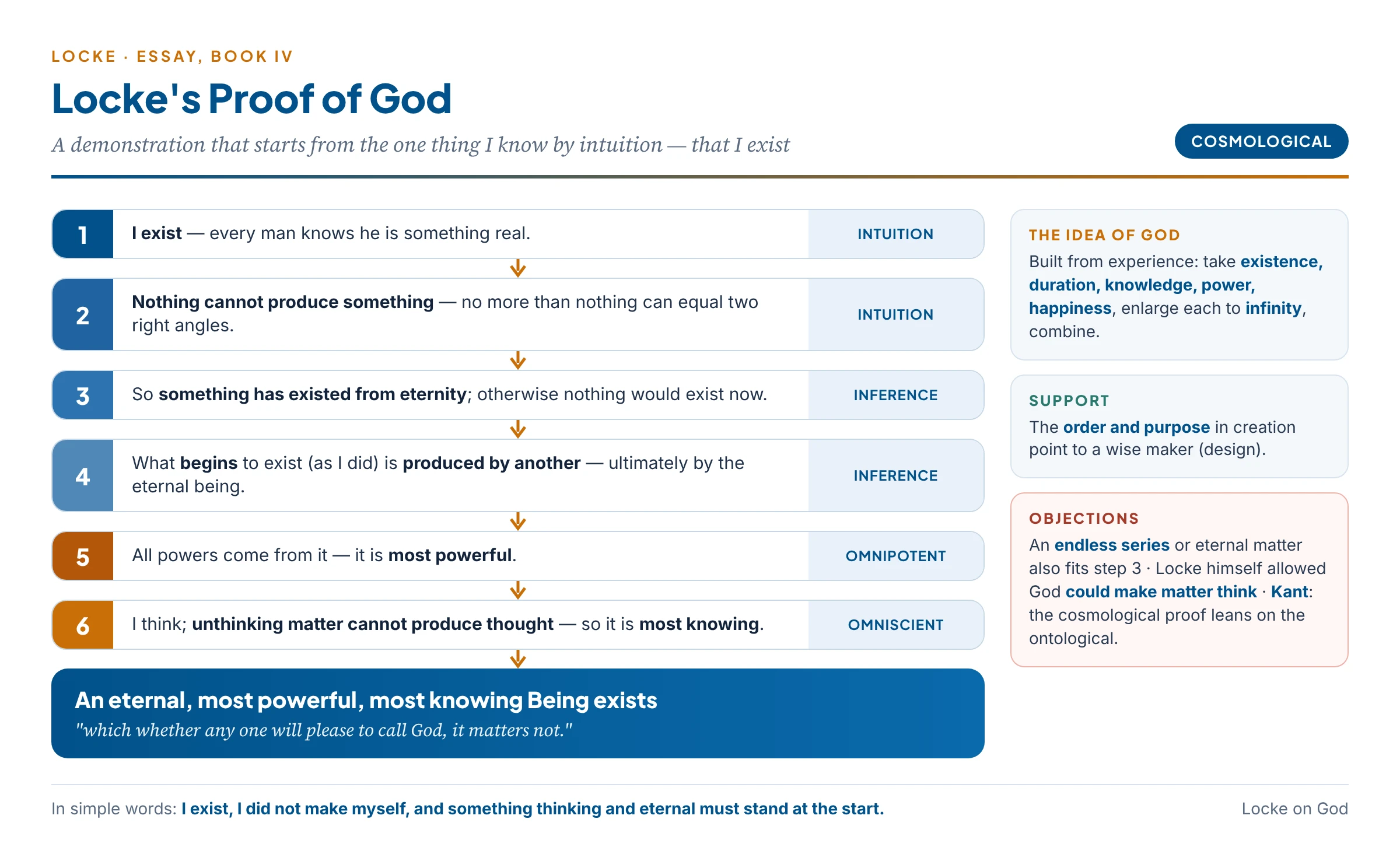
Locke holds that we can demonstrate God’s existence as surely as a theorem of geometry. His proof (Book IV) is a cosmological argument:
- I exist. Every person knows, by intuition, that he is something that actually exists.
- Nothing cannot produce something. “Bare nothing can no more produce any real being than it can be equal to two right angles.” This too is intuitively certain.
- So something has existed from eternity. If ever there was nothing, there would be nothing now; since something exists now, something has always existed.
- What began must have been produced by something else. I began to exist; so I was produced by something before me — and ultimately by the eternal being.
- The eternal being is most powerful. Whatever has a beginning gets all its powers from its cause; so the eternal source of all being is the source of all power — omnipotent.
- The eternal being is most knowing. I find perception and knowledge in myself. Incogitative (unthinking) matter could never produce thought, any more than nothing could produce matter. So the eternal being must be a knowing, intelligent being.
- Therefore there is an eternal, most powerful and most knowing Being — “which whether any one will please to call God, it matters not.”
In simple words
Look at a long line of falling dominoes. Each one fell because the one before it pushed it. But something must have started the push — a line of dominoes cannot set itself going out of nothing. Locke reasons the same way: I exist; I did not make myself; nothing comes from nothing; so at the start there must be an eternal source, and since I can think, that source must be a thinking, knowing being.
- Supporting argument from design. Locke also points to the order and purpose in creation as the work of a wise maker — a teleological support for the same conclusion.
- Inference from the world. Finite things can be explained by finite causes, but the whole series of finite things, and the existence of thinking souls, can only be explained by God. We infer God from the external world as its maker.
- Certainty. Locke says we have more certain knowledge of God’s existence than of anything outside us that our senses do not immediately show.
9. Faith and Reason
- Reason gives certain knowledge (intuition, demonstration) and probable judgment.
- Faith is assent to a proposition “as coming from God” by revelation.
- Above reason, never against it. Some truths are above reason (the rising of the dead) and may be accepted by faith. But nothing contrary to clear reason — “that the same body is in two places at once” — can be accepted as revealed. Reason must judge whether a claimed revelation really comes from God.
- Against “enthusiasm.” Feeling strongly that an idea comes from God proves nothing; strong conviction without evidence is enthusiasm, the source of fanaticism.
- Christianity reasonable. In The Reasonableness of Christianity (1695) Locke argued that the essentials of the faith are few, simple and agreeable to reason. In his Letter Concerning Toleration he pleaded for religious freedom — though he excluded atheists, whose oaths, he thought, could not be trusted.
Critical Evaluation
Criticisms of Locke’s Theory of Personal Identity
- The circularity objection (Joseph Butler). Memory presupposes identity; it cannot constitute it. When I genuinely remember doing something, I remember that I did it — so the same “I” is already assumed. “Consciousness of personal identity presupposes, and therefore cannot constitute, personal identity.”
- The brave officer (Thomas Reid). A boy is flogged for robbing an orchard; as a young officer he takes an enemy standard and remembers the flogging; as an old general he remembers taking the standard but not the flogging. By Locke’s test, the general is the officer, the officer is the boy, but the general is not the boy. Since identity is transitive, this is a contradiction.
- Forgetting. We forget most of our past. On Locke’s view, I would not be the person who did what I cannot remember — the infant I was, or the one who acted while drunk. Yet we think we are those persons.
- False memories. Someone may “remember” doing what he never did. Locke needs genuine memory — but genuine memory is defined by the rememberer being the one who did it, which brings back the circle.
- Duplication. If my memories could be copied into two bodies at once, Locke’s test would make both of them me — but two people cannot be one person.
- Responsibility. If identity depends on memory, a criminal who sincerely forgets his crime escapes guilt. Locke can answer only by appeal to divine justice.
Defences and developments:
- Psychological continuity. Later Lockeans replace single memories with overlapping chains of memory and other psychological links. The general remembers the officer, who remembered the boy — so there is continuity even without direct memory, which answers Reid.
- Quasi-memory. Defining a memory-like state that does not presuppose identity answers Butler’s circle.
- Lasting influence. Locke was the first to define the self through the continuity of consciousness. His view shaped Hume, Kant and the whole modern debate — down to questions about brain transplants, dementia, advance directives in medicine, and uploading minds to computers.
- Hume’s reply. Hume went further: if we never observe a substantial self, then the “identity” we ascribe to the mind is a fiction of the imagination joining resembling and causally linked perceptions.
Criticisms of Locke’s Proof of God
- The cosmological gap. From “something has always existed,” it does not follow that one being has existed eternally. An endless series of finite causes, or eternal matter, would also satisfy the premise.
- Can matter not think? Step 6 assumes that unthinking matter cannot produce thought. Locke himself admitted that God could make matter think; materialists and modern neuroscience press the point.
- Kant’s objection. Every cosmological argument, said Kant, secretly relies on the ontological argument — to show that the “necessary being” is the most real being, God. So Locke’s empirical-sounding proof is a priori at heart, against the spirit of empiricism.
- An inconsistent empiricist. Locke claims demonstrative certainty of God but only sensitive knowledge of the visible world — a rationalist ranking. Berkeley found a different road to God; Hume argued that no argument from experience can establish God at all.
- Ideas of infinity. If infinity is only a negative idea (“no limit”), how can our idea of God be a positive idea of an infinitely perfect being?
Critics and Defenders
Criticism — Critics
- Butler: memory presupposes personal identity and cannot constitute it.
- Reid: the brave-officer case shows that memory-identity breaks transitivity.
- Hume: no impression of a self or of causal power; the self is a bundle of perceptions; God cannot be proved from experience.
- Kant: the cosmological proof depends on the ontological; the self cannot be known as a substance.
- Empiricist consistency: soul, substance and demonstrated God go beyond experience.
Defence — Defenders and lasting value
- Psychological continuity theorists: overlapping chains of memory answer Reid; quasi-memory answers Butler.
- Forensic insight: tying responsibility to conscious agency remains basic to law (insanity, amnesia, diminished responsibility).
- Non-dogmatic self: Locke grounds identity in what we can know — consciousness — not in an unknowable substance.
- Natural theology: the cosmological argument, in improved forms, is still defended.
- Toleration: Locke’s case for reason in religion helped shape freedom of conscience.
Cross-Tradition Comparison
The Self: Locke, Descartes, Hume and Indian Schools
| Point | Descartes | Locke | Hume | Nyāya | Buddhism |
|---|---|---|---|---|---|
| What the self is | A thinking substance | A thinking being; substance unknown | A bundle of perceptions | An eternal substance (ātman) with cognition as a passing quality | A stream (santāna) of momentary states; no permanent self |
| How known | Intuition (innate) | Intuition (empirical, by reflection) | Not found at all | Inferred from desire, aversion, effort, pleasure, pain, cognition | Not found |
| What makes identity | Same soul | Same consciousness (memory) | Imagination’s fiction | Same ātman; memory proves it | Causal continuity of the stream |
| Role of memory | — | Constitutes identity | Produces the illusion of identity | Shows identity (recognition needs one knower) | Explained by the stream passing on its traces |
Indian Connect — Key takeaways
- Nyāya vs Locke. Nyāya argues that memory and recognition (pratyabhijñā — “this is the same Devadatta I saw before”) prove a permanent self: the one who experienced and the one who remembers must be the same. This is Butler’s point — memory presupposes the self. Locke reverses the order: the self is made up by memory.
- Buddhism and Locke. The Buddhist stream of consciousness (santāna), where each moment passes its impressions to the next “like one flame lighting another,” gives identity without substance — closer to Locke than to Descartes, and closest of all to Hume.
- Karma and the forensic self. Locke’s “person” exists for reward and punishment; Indian schools make the self the bearer of karma — the one who acts must be the one who reaps the fruit. The Buddhist must explain karma without a permanent self; Locke must explain justice without a known soul-substance.
- Rebirth and the prince–cobbler. Locke’s soul-transfer cases echo rebirth. For Locke, a reborn soul with no memory of its past life (like Nestor’s soul in a modern man) would not be the same person — a position Indian schools, which accept rebirth without memory, would reject.
God: Rationalists and Empiricists Compared
| Thinker | How God is known | Main argument | Role of God |
|---|---|---|---|
| Descartes | Innate idea; reason | Trademark (causal) and ontological arguments | Guarantees clear and distinct ideas and the external world |
| Spinoza | Reason; intuitive knowledge | God is the one substance existing by necessity | God = Nature; everything follows from God’s nature |
| Leibniz | Reason | Principle of sufficient reason; ontological; pre-established harmony | Chooses the best of all possible worlds |
| Locke | Idea built from experience; existence demonstrated | Cosmological, supported by design | Maker of the world, lawgiver of morality |
| Berkeley | From our passive ideas | Ideas need a cause: an infinite Spirit | Cause and sustainer of all ideas; keeps the world in being |
| Hume | Not by reason or experience; belief only | Criticises design, cosmological arguments and miracles | God is an object of faith, not knowledge |
- The common thread. The rationalists reached God through ideas and reason; the empiricists tried to reach God through experience. Locke stands in between: his idea of God is empirical, his proof is rational.
- The empiricist decline. With Locke, God is demonstrated; with Berkeley, God becomes the only true cause of our ideas; with Hume, no argument from experience reaches God at all — religion rests on faith. Later Hume would use Berkeley’s arguments against substance to undermine God as the “substratum of nature.”
Indian Connect — Locke’s proof and Nyāya’s proof
Locke’s cosmological proof is close to the Nyāya argument for Īśvara: “the earth, sprouts and the like have a maker, because they are effects (kāryāt), like a pot.” Both argue from the world as an effect to an intelligent cause; both insist that unthinking matter cannot by itself produce an ordered result. Both also face the same objection, raised in India by Mīmāṃsakas, Buddhists and Cārvākas and in the West by Hume: experience shows makers of pots, not makers of worlds.
Synthesis (Siddhānta)
Locke’s treatment of self and God shows his method at work. Where experience gives us a clear idea — of our own consciousness, of power in our own willing, of the relations we perceive — he builds firm doctrine. Where experience gives only an obscure idea — of soul-substance, of the inner workings of causes — he admits ignorance. His theory of personal identity is the great innovation: by placing the self in continuity of consciousness, he freed identity from an unknowable substance and tied it to responsibility, which is why he called “person” a forensic term. His proof of God, by contrast, reaches beyond experience by reasoning in the rationalist style.
The tensions passed to his successors. Berkeley kept spirit and God but dropped matter; Hume asked what impression stands behind “self,” “power” and “God,” and found none; Kant turned the unity of consciousness into the transcendental unity of apperception — a condition of all experience rather than a remembered past.
- Law and medicine still use Lockean ideas when they ask whether a person with amnesia or dementia is responsible, or whether an advance directive binds the person someone later becomes.
- Technology: debates about mind uploading and digital memories are prince-and-cobbler cases in modern form.
- Ethics of self-interest: why should I care about my future self? Locke’s answer — because I am conscious of it as mine — remains a starting point.
- Religion and reason: Locke’s “above reason but never against it” is still a working rule in public debates over faith.
For Locke you are not the stuff you are made of but the story you can remember — and God is not an idea you were born with but a conclusion you can reach.
Previous Year Questions
- 2021Examine the concept of personal identity by Locke.
- 2016Discuss the various stances on God taken by Rationalists and Empiricists.