

Empiricism (Locke, Berkeley, Hume): Theory of Knowledge; Substance and Qualities; Self and God; Scepticism.
Official Syllabus: Paper I, Section A, Unit 3
George Berkeley (1685–1753) took Locke’s empiricism and asked a simple question: if all we ever know are ideas, what right do we have to believe in anything beyond them — in a “matter” that no one perceives, or in “abstract ideas” that no one can picture? His answer reshaped empiricism. He argued that abstract general ideas are impossible: every idea is particular, and generality belongs only to words and signs (nominalism). He held that “sensible things are those only which are immediately perceived by sense,” that a thing is nothing but a collection of ideas, that we know spirits not by ideas but by notions, and that Locke’s split between primary and secondary qualities collapses — every quality is mind-dependent. These steps clear the ground for his famous conclusion, esse est percipi, taken up in the next article.
In simple words
Try to picture “a dog” — not a particular dog, just a dog in general: no size, no colour, no breed, neither sitting nor standing. You cannot. Whatever you picture is some dog — a brown Labrador, a white street dog. Berkeley says this is the whole truth about “general ideas”: the mind only ever holds particular pictures; the word “dog” becomes general because we use it for all of them.
Context & Problem
Berkeley: Life and Mission
- Irish philosopher and bishop. Schooled at Kilkenny, he entered Trinity College, Dublin, at fifteen and stayed for about thirteen years as student, tutor and fellow. Trinity was then alive with Newtonian science and the new philosophies of Descartes, Locke and Malebranche.
- Early genius. His major works came before he was thirty: An Essay towards a New Theory of Vision (1709), A Treatise Concerning the Principles of Human Knowledge (1710) and Three Dialogues between Hylas and Philonous (1713). Later came Alciphron (1732), The Analyst (1734) — an attack on the logic of Newton’s calculus — and Siris (1744).
- A practical idealist. He planned a college in Bermuda to educate settlers and native Americans, lived three years in Rhode Island waiting for funds that never came, and became Bishop of Cloyne in Ireland. He married a young woman he chose, he said, “for the qualities of her mind and her unaffected inclination to books.” (The city of Berkeley in California is named after him.)
- Called “immaterialism” by himself, his view was later labelled subjective idealism: familiar objects such as tables and chairs are ideas perceived by minds and cannot exist unperceived.
The Problem Berkeley Inherited
- Locke’s trap. Locke said that sensation and reflection supply all our ideas, and that ideas are all we directly know. Then a world of material bodies outside our ideas can never be known — we cannot compare our ideas with bodies of which we know neither what nor even whether they are.
- Matter and God. If an independent, eternal, unthinking matter existed alongside God, it would limit God — or even make God unnecessary. Berkeley saw that the science of his day, which explained everything — even human consciousness — in mechanical terms of matter and motion, was feeding materialism, atheism and scepticism.
- His aim was religious. As a churchman, Berkeley wanted to defend God and the soul. Since materialism rested on the belief in matter, he set out to show that “matter,” as philosophers defined it, is unnecessary, unintelligible and harmful.
- His method was empiricist. He used Locke’s own principles against Locke — trying to be a more consistent Locke.
Main tenets of Berkeley’s empiricism:
- We always begin with particular sense qualities — heat, colour, smell — given to us directly, or represented by images.
- “There is nothing in the intellect which was not first in the senses”: all knowledge reduces to sensation.
- Things like tables and chairs are collections of ideas that go together and are marked by one name.
- Besides ideas, there are spirits that perceive them.
- Things cannot exist without some mind to perceive them; when no human mind perceives them, they are sustained by the divine mind.
So reality consists of spirits and their ideas — a position sometimes called Berkeley’s spiritualism.
Core Doctrine
1. The Critique of Abstract Ideas
Berkeley thought Locke’s chief error was the doctrine of abstract general ideas. As long as people believe in abstract ideas, they will believe in the most abstract idea of all — matter, existing apart from perception.
Abstraction as Berkeley understood it (Locke’s view):
- We start with particular things, each a mixture of qualities — colour, heat, smell.
- We separate one quality from the rest — the redness of a rose from its smell and softness — and form the abstract idea of red.
- Comparing red, green and yellow, we take what they share and form the more general abstract idea of colour.
- We do the same with compound beings: comparing particular men, we keep what is common — “colour-in-general,” “size-in-general” — and form the abstract idea of man.
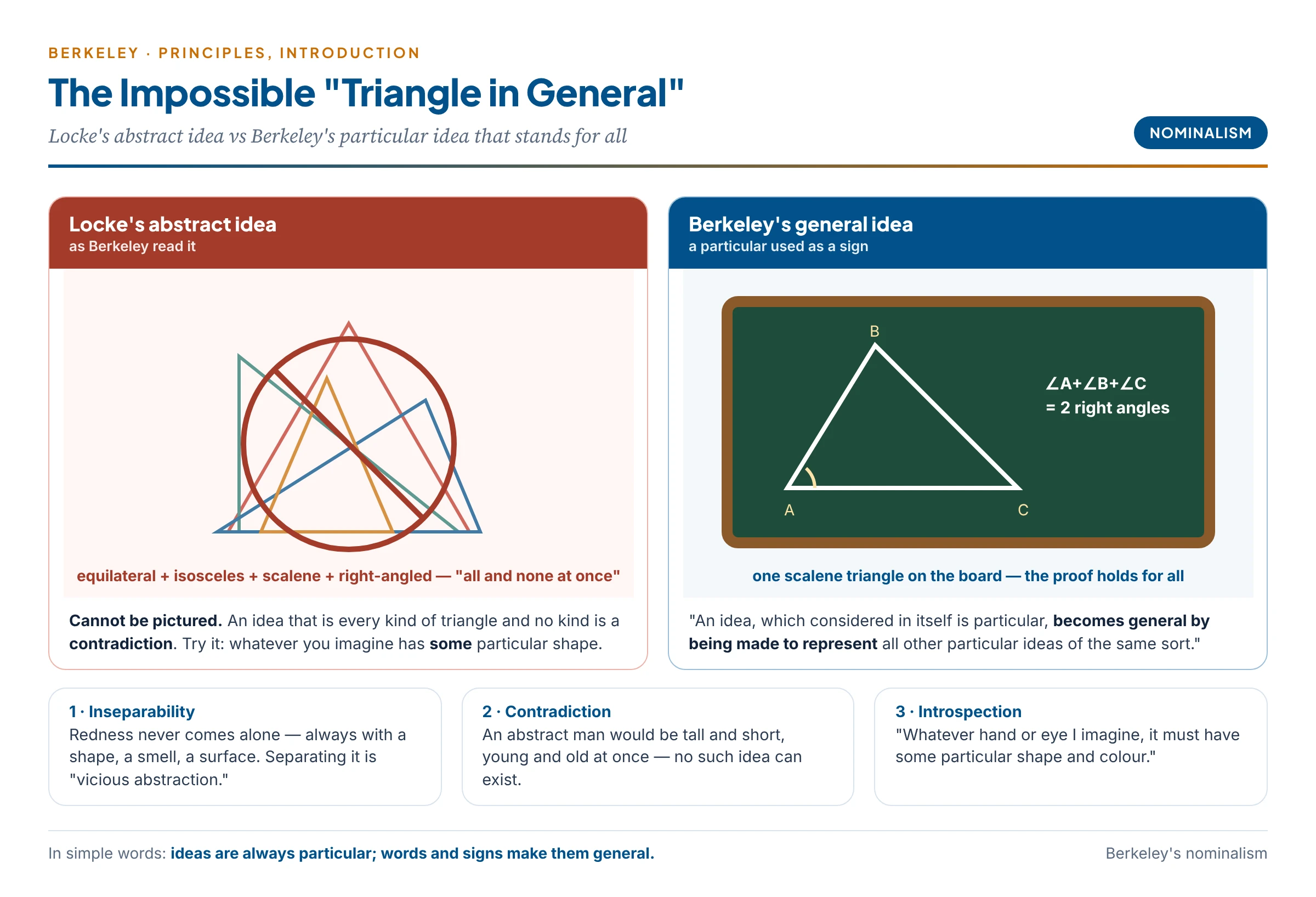
Locke had written that the general idea of a triangle “must be neither oblique nor rectangle, neither equilateral, equicrural, nor scalenon, but all and none of these at once.”
Berkeley’s three objections:
- Vicious abstraction (inseparability). A quality is always found mixed with others. The redness of a rose comes with its smell, softness and shape. We may attend to the redness, but we cannot separate it and think of it existing alone. Treating what is inseparable as separable is “vicious abstraction.”
- Contradiction. An abstract triangle would be equilateral and not equilateral, large and small, all and none at once. An abstract man would be tall and short, fair and dark, young and old together. An idea built of inconsistent parts cannot exist even in the mind.
- Introspection. Look into your own mind. “For myself, I find indeed I have a faculty of imagining … the ideas of those particular things I have perceived … But then whatever hand or eye I imagine, it must have some particular shape and colour.” The idea of man I frame “must be either of a white, or a black, or a tawny, a straight, or a crooked, a tall, or a low, or a middle-sized man.” I cannot frame the idea of motion apart from a moving body, neither swift nor slow, curved nor straight.
“Redness-in-general” is inconceivable. Whenever we imagine red, it is a particular shade, of a particular intensity, on a particular thing — a red apple, a red cloth.
Why it matters — the root of error. Belief in abstract ideas is, for Berkeley, the source of many philosophical errors: matter, absolute space, abstract motion and abstract causation, and above all the idea of existence apart from being perceived. Philosophers turn words into entities, and so fall into scepticism and confusion.
“We need only draw the curtain of words, to behold the fairest tree of knowledge.” — George Berkeley
2. Nominalism: Generality Without Abstraction
Nominalism (from Latin nomen, “name”) is the view that only particulars exist; there are no universal entities, and generality belongs to names or signs.
- Only particular ideas exist. There is no abstract idea of man-in-general or cow-in-general — only this man, that cow.
- A particular made general by its use. “An idea, which considered in itself is particular, becomes general by being made to represent or stand for all other particular ideas of the same sort.”
- The geometer’s triangle. A teacher draws one particular triangle on the board — say, scalene, two inches high — and proves that its angles equal two right angles. The proof holds for all triangles, because nothing in it depended on the particular size or kind. The particular triangle stands for all triangles.
- Words as signs. The word “triangle” is not the name of an abstract idea; it is a sign that can stand indifferently for any of many particular triangles. Its meaning depends on use and context.
- Not the denial of all general ideas. “I do not deny absolutely there are general ideas, but only that there are any abstract general ideas.” Berkeley also agrees that “all knowledge and demonstration are about universal notions.” His quarrel is with ideas that are general because they are abstracted — stripped of every particular feature.
- Generality is semantic, not ontological. Universality lies in the function a particular sign performs, not in any special entity in the mind or the world.
- Language has other ends. Berkeley noticed that words do not always call up ideas: they also raise passions, excite or deter actions, and put the mind in a certain disposition. “Good,” “danger,” “promise” work without our picturing anything — an insight later developed by Wittgenstein’s view of language as use.
How Berkeley’s view developed. Over his life, Berkeley gave several accounts of what carries generality — particular things, particular images, names, meanings, signs and finally notions. In his early notebooks he leaned on names; in the Principles on particular ideas standing for others; in Alciphron on signs; and in Siris, at the end, on intellectual notions.
Common confusion
Did Berkeley deny that there are general ideas or universal knowledge? Many notes say Berkeley rejected “general ideas.” Strictly, he rejected abstract general ideas — ideas formed by stripping away all particular features. He accepted that a particular idea can be general by standing for others, and that knowledge and demonstration concern universal notions. So his nominalism is moderate: it denies abstract entities, not general thinking. He even dropped the extreme view, held in his early notebooks, that every word has one precise meaning.
Indian Connect — Apoha: Buddhist nominalism
The Buddhist logicians Dignāga and Dharmakīrti held a close parallel to Berkeley’s nominalism. For them only momentary particulars (svalakṣaṇa) are real; universals (sāmānya) are mental constructions. A word like “cow” does not name a real universal “cowness” (gotva); it works by exclusion — apoha, “exclusion of the other” — marking off cows from all that is not-cow. Nyāya–Vaiśeṣika replied, like Plato and Aristotle in the West, that the universal (jāti, sāmānya) is real, eternal and perceived in particulars; otherwise we could not explain why we recognise many cows as cows. The Nyāya–Buddhist debate on universals mirrors the Locke–Berkeley debate on abstract ideas.
3. Sensationalism
Berkeley’s nominalism rests on sensationalism — the view that all knowledge reduces to sensation.
- Thought is image; image is a copy of sensation. In his early works, “thinking = imagining = sensing.” Sensation is the alpha and omega of knowledge.
- Particular content only. Since sensation gives only particulars, there can be no abstract concepts or essences.
- Anti-materialist weapon. Sensationalism gave Berkeley a weapon against the sciences, whose concepts (matter, absolute motion) seemed to support materialism.
- Later shift. In Siris Berkeley moved towards the intellect, almost to Kant’s split between sense and understanding: “sense knoweth nothing.” But he never rebuilt his philosophy on this new base.
4. “Sensible Things Are Those Only Which Are Immediately Perceived by Sense”
This line from the Three Dialogues sums up Berkeley’s theory of knowledge.
- Immediate perception only. What we perceive by sense is perceived directly — colours, sounds, tastes, smells, shapes, hardness. We do not perceive by sense anything “mediately,” by inference: when I hear a coach, I hear only a sound; that a coach causes it is a suggestion of experience, not something heard.
- Things are collections of ideas. “A certain colour, taste, smell, figure and consistence having been observed to go together, are accounted one distinct thing, signified by the name apple.” A tree is greenness, hardness, height and roughness as perceived; a table is brown colour, rectangular shape, smoothness and hardness.
- No hidden matter. Since matter itself is never perceived by sense, it cannot be known and should not be assumed. Knowledge begins and ends with what is perceived.
- No abstract ideas. Whatever is not perceivable cannot be an object of knowledge; generality comes from language.
- Appearance = reality. Because sensible things are the ideas we perceive, there is no gap between how things appear and how they are. This, Berkeley claims, gives certainty and defeats scepticism: we cannot be mistaken about a hidden world, because there is none.
- Common sense defended. Berkeley insists that the plain man believes in the things he sees and touches, not in an unseen “matter” behind them. Philosophers, not ordinary people, invented matter.
In simple words
When you watch a cricket match on TV, you might say, “I see the ball.” Locke would say: you see only a picture, which represents a ball somewhere else. Berkeley says: in ordinary life, the ball is what you see, touch and hear — the round red shape, the hardness, the thud. Remove all of these, and nothing is left that you could call “the ball.”
5. Ideas: Their Kinds and Marks
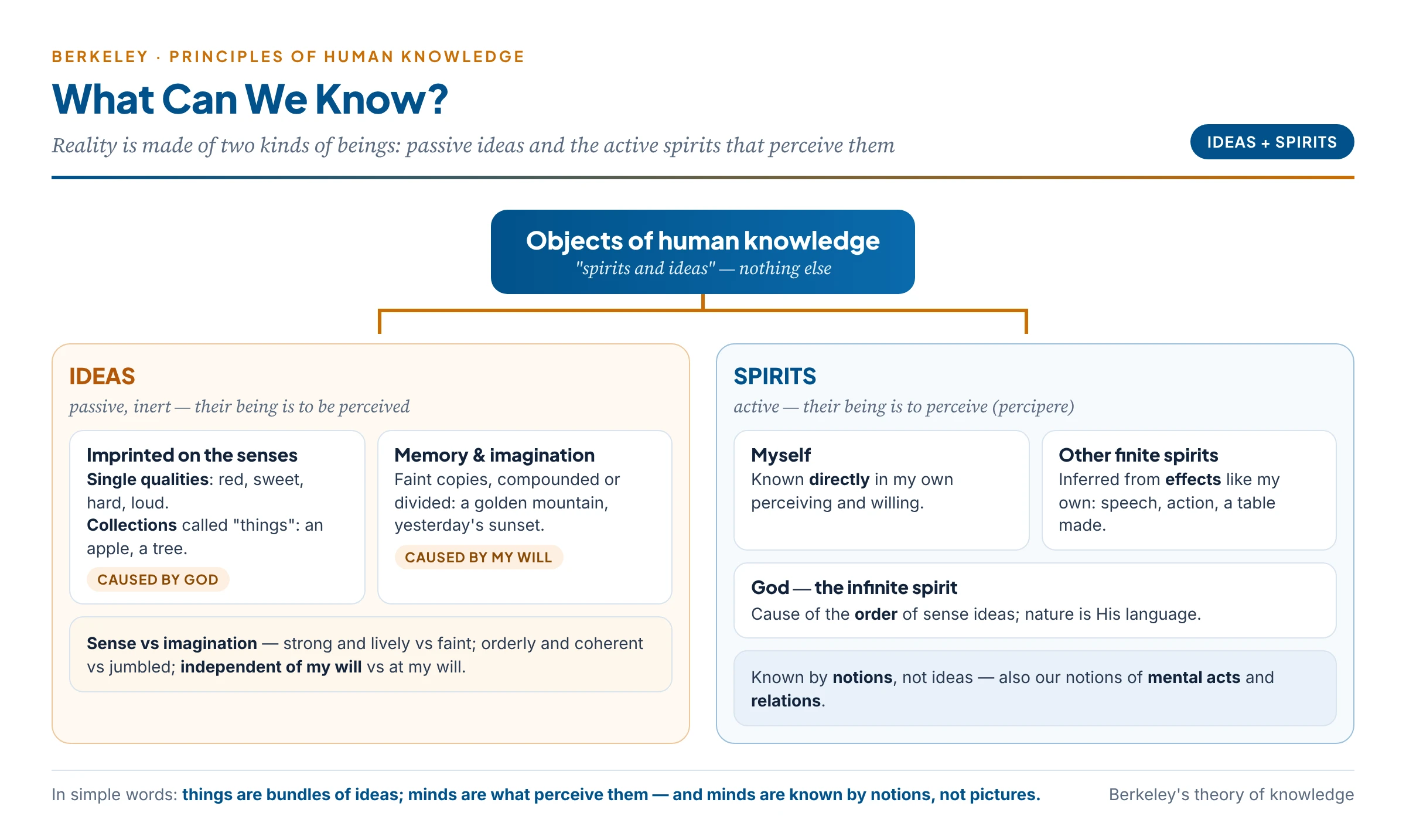
For Berkeley, ideas are the immediate objects of knowledge. The objects of human knowledge are:
- Ideas actually imprinted on the senses — colours, sounds, tastes, smells, shapes, motion, hardness;
- Ideas perceived by attending to the passions and operations of the mind;
- Ideas formed by memory and imagination — compounding, dividing or simply reproducing ideas of the first two kinds.
Ideas of sense vs ideas of imagination:
| Mark | Ideas of sense | Ideas of imagination |
|---|---|---|
| Strength | Strong, lively, distinct | Faint, sketchy |
| Order | Steady, orderly, coherent — follow the laws of nature | Jumbled, loosely connected |
| Will | Independent of my will — when I open my eyes I cannot choose what I see | Depend on my will — I can imagine a golden mountain |
| Cause | God, the infinite spirit | My own mind |
| Status | Make up the real world | Make up fancy and fiction |
Marks of all ideas:
- Passive and inert. Ideas do nothing; one idea cannot cause another. The fire I see is not the cause of the pain I feel when I come near; it is the sign that warns me of it.
- Exist only in a mind. An idea is essentially something perceived; it cannot exist unperceived.
- Represent nothing material. “An idea can be like nothing but an idea; a colour or figure can be like nothing but another colour or figure.” So ideas cannot be copies of unperceived material things.
- Things are stable collections. What we call physical objects are stable bundles of ideas, sustained in their order by God.
6. Notions: How We Know Spirits
If all knowledge were of ideas, we could never know minds — for a mind is not a colour, sound or shape. Berkeley’s answer is the doctrine of notions.
- No idea of the self. The self is active: it perceives, thinks and wills. Ideas are passive. A passive picture cannot represent an active agent. So “we have no idea of spirit.”
- But we have a notion. We are directly aware of ourselves in perceiving, willing and thinking. This awareness is a notion — a non-sensory, intellectual mode of knowing.
- Objects of notions. Notions have three objects: (a) spirits (myself, other minds, God); (b) mental operations (willing, doubting, loving); (c) relations (equality, cause, likeness) — all of which concern ideas but are not themselves ideas.
- Why notions matter. Ideas are variable, fleeting and momentary. If the mind were only a collection of ideas (as Hume later held), there would be nothing but a succession of ideas — complete scepticism. Notions let Berkeley keep permanent, active spirits.
Ideas and notions compared:
| Point | Ideas | Notions |
|---|---|---|
| What they are | Immediate objects of sense, memory, imagination | Awareness of active beings and their acts |
| Character | Passive, inert | Grasp of activity |
| Source | Senses, imagination | Self-consciousness |
| Objects | Sensible qualities: redness, hardness, sound | Spirits, mental operations, relations |
| How known | By perception | By intellect, not sense |
| Status | Objects of knowledge | Concern the subjects of knowledge |
| Shared with animals? | Yes | Only humans have notions |
In simple words
A camera can photograph everything in front of it — but it can never photograph its own act of photographing. Every picture shows an object, never the camera taking the picture. Berkeley says the mind is like this: its ideas are the “photos”; the mind itself, the one who sees, can never appear as one of its own pictures. We know it another way — by being it, in the very act of seeing and willing. That inner awareness is a notion.
- Notion vs Locke’s reflection. Locke’s reflection is a kind of inner sense and gives ideas. Berkeley’s notion is intellectual; it gives no image.
- A weak spot. Berkeley never defined “notion” clearly. The philosopher who wanted us to “draw the curtain of words” ended up relying on a word he did not explain.
Common confusion
Do we have “ideas of reflection” in Berkeley? Some notes list “ideas of reflection — of thinking and willing” as one of Berkeley’s three kinds of ideas, alongside ideas of sense and imagination. Berkeley’s first list in the Principles does mention “ideas perceived by attending to the passions and operations of the mind.” But he goes on to argue that mental operations and the mind itself are active, and that we therefore have notions, not ideas, of them. In the 1734 edition he made this explicit. So the safe statement is: ideas of sense and imagination are ideas proper; the self, its operations and relations are known by notions.
7. Against Representative Realism
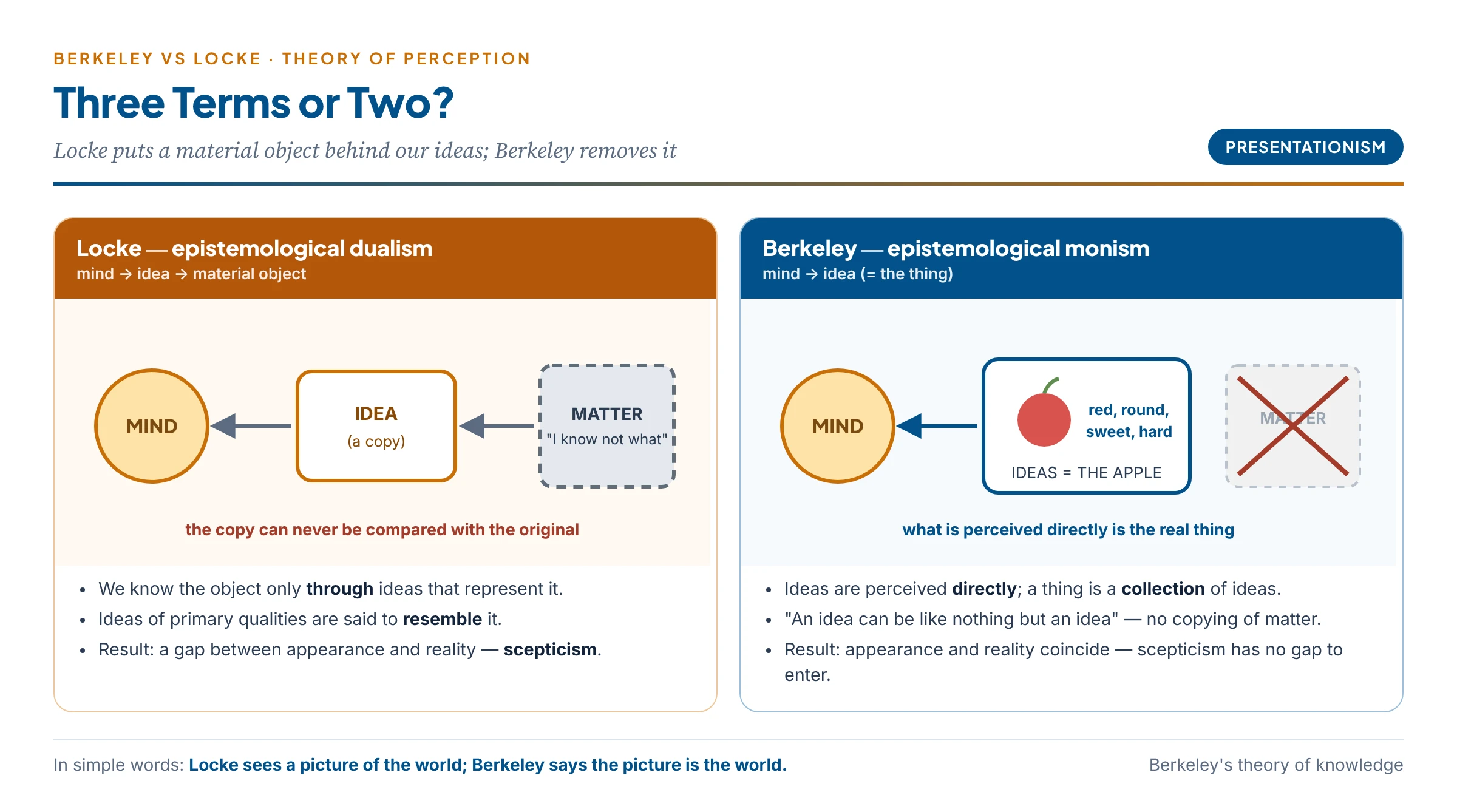
Locke’s theory of perception has three terms: the mind, the idea, and the material object the idea represents. Berkeley attacks the third term.
- A copy needs an original you can see. To know that A represents B, we must know both A and B. If we know only ideas, we can never know that they represent anything — or that anything is there to be represented.
- Infinite regress. If knowing an object always requires an intermediate idea, then knowing that idea would require another idea, and so on. Somewhere knowledge must be direct — and if it can be direct for ideas, the extra layer of objects is idle.
- Representationalism breeds scepticism. As long as we believe in an external world behind our ideas, we are “eternally condemned to scepticism” — for we can never check our ideas against it. Locke’s “I know not what” opens the door to doubt.
- Berkeley’s alternative — presentationism. Ideas are themselves the things, known directly and immediately. Perception has only two terms: the perceiver and the perceived. This is sometimes called epistemological monism, against Locke’s epistemological dualism.
8. The Collapse of Primary into Secondary Qualities
Locke said secondary qualities (colour, heat, taste) exist as we sense them only in the mind, while primary qualities (extension, figure, motion, solidity, number) really belong to bodies. Berkeley accepted the first half and destroyed the second.
Berkeley’s arguments:
- All qualities are perceived alike. Shape and size are known only through sight and touch, just as colour and warmth are. Whatever is perceived is an idea, and an idea exists only in a mind.
- Relativity applies to primary qualities too. Locke used the lukewarm water (cold to one hand, warm to the other) to show heat is not in the water. But:
- Size depends on the distance and the size of the observer: a thing tiny to us is huge to a mite.
- Shape changes with the angle of view.
- Motion is relative: the man on a boat is at rest relative to the boat and moving relative to the bank; and if the succession of ideas in a mind runs faster, the same motion seems slower.
- Number depends on the mind’s unit: the same length is one yard, three feet or thirty-six inches.
- Taste too: what is sweet to a healthy man is bitter to one with fever, though the food is unchanged.
- Inseparability. No one can conceive extension without some colour or tactile quality. If colour exists only in the mind, the extension that cannot be separated from it is in the mind too. Pretending otherwise is vicious abstraction.
- Heat is pain. In the Dialogues, Berkeley argues that intense heat is felt as pain, and pain exists only in a perceiver; so heat, in all its degrees, is in the mind. The same reasoning reaches every quality.
- The senses must learn. In his New Theory of Vision, Berkeley argued that distance is not seen directly; we learn to read visual signs (faintness, confusion, eye-strain) as signs of how far we must walk — ideas of touch. Primary qualities depend on the senses as much as secondary ones.
Conclusion. Primary and secondary qualities have the same status: both are ideas. Take them all away, and nothing remains that could be called material substance. “Matter” as the support of primary qualities is an empty word.
Was this rejection “instrumental” in Berkeley’s idealism? Largely, yes — but it was one pillar among several:
- It removed matter’s last foothold. Locke kept matter as the bearer of primary qualities. Once these too are ideas, matter has nothing to bear.
- It made all sensible reality mind-dependent — the very content of esse est percipi.
- But it was not the only step. Berkeley also needed (a) the critique of abstract ideas (existence apart from perception is an abstraction); (b) the arguments that matter is neither perceived nor inferred nor a cause; and (c) the positive doctrine of spirits and God to explain the order and permanence of the world. The collapse of the qualities shows that matter is unnecessary; the rest of the system makes idealism workable.
In simple words
Locke kept two baskets: in one, things “really in the apple” (size, shape); in the other, things “only in us” (colour, taste). Berkeley tipped the first basket into the second — size and shape also change with the viewer and can’t be pictured without colour. Once both baskets are empty of “real apple,” what is left of the apple? Only what we perceive — and that is all, says Berkeley, the apple ever was.
Critical Evaluation
Objections to the Critique of Abstract Ideas and Nominalism
- Berkeley misread Locke. By “abstraction” Locke meant partial consideration — attending to one aspect, as we can consider the light of the sun without its heat — not forming a picture with incompatible features. Locke’s “all and none of these at once” was an admission of difficulty, not a claim that we picture a contradictory triangle. Berkeley’s later “notions” are close to what Locke meant by general ideas.
- Seeing resemblance is not a sensation. To let one triangle stand for “all others of the same sort,” we must recognise that they are of the same sort — that they resemble each other. Noticing likeness and difference is not given by any sense organ; it is the work of the intellect. Sensationalism cannot explain it.
- Resemblance is itself a universal. Russell pressed the point: if we try to do without universals by saying that particulars “resemble” one another, we must admit resemblance as a universal. Nominalism cannot escape universals entirely.
- Thinking is not imaging. Berkeley assumes that to have an idea is to have an image. But we understand “chiliagon” (a thousand-sided figure) without picturing one, and we use abstract words like “justice” and “number” with no image. Concepts are not pictures.
- Knowledge needs common content. If my ideas are purely particular and private, how can my word mean the same as yours? Communication and science need shared, general content.
Objections to the Theory of Knowledge
- “Immediately perceived” is not so simple. Berkeley’s own analysis of distance shows that perception involves learned signs and judgment. Perception is not just the passive reception of ideas.
- Idea as act and as object. Berkeley uses “idea” both for the perceiving (a mental act) and for what is perceived (the object). The perceiving is certainly mental; it does not follow that the perceived is. Moore and Russell later made this their main objection (see the next article).
- The sound is not the bell. Ordinary people do not think that the sound they hear is the bell; they think it comes from the bell. Berkeley’s claim to speak for common sense is doubtful.
- Relativity proves less than claimed. Variation in how things appear (a coin looks oval from the side) does not show that the thing has no shape of its own. Physics explains the variation — angle, distance, light — by the very primary qualities Berkeley denies. Measuring with a ruler gives the same answer to every observer.
- Notions are vague. Admitting non-sensory “notions” of spirits departs from strict empiricism; Hume would apply Berkeley’s own arguments against matter to the self as well.
What Can Be Said for Berkeley
- A sharp critique of empty abstraction. Berkeley showed how philosophers create pseudo-entities by hypostatising words — a lesson taken up by Hume, the logical positivists and ordinary-language philosophers.
- Meaning and use. His observation that words often work without calling up ideas anticipates Wittgenstein; his view that generality lies in how a sign is used fits modern accounts of concepts as abilities.
- Science. Berkeley’s attack on Newton’s absolute space and absolute motion, and his view in De Motu that “forces” are useful mathematical fictions rather than hidden entities, anticipated Mach and the relativity of motion, and instrumentalism in the philosophy of science.
- Perception research. His New Theory of Vision — that seeing distance is a learned reading of cues — is broadly confirmed by perceptual psychology.
Critics and Defenders
Criticism — Critics
- Lockeans: Berkeley attacked a caricature; abstraction is partial attention, not a contradictory image.
- Russell: nominalism needs resemblance, and resemblance is a universal.
- Moore and the realists: “idea” confuses the act of perceiving with the object perceived.
- Rationalists and Kantians: recognising sameness is an act of intellect; sensationalism cannot account for general knowledge.
- Hume: if spirits are known only by vague “notions,” the self can be dissolved as matter was.
Defence — Defenders and lasting value
- Nominalists and empiricists: there are no “triangles in general”; generality lies in how signs are used.
- Wittgenstein: meaning is use; words need not call up images — Berkeley saw this first.
- Philosophers of science: Berkeley’s critique of absolute space and of occult “forces” anticipated Mach and instrumentalism.
- Perception science: distance and depth are learned from cues, as the New Theory of Vision argued.
- Anti-sceptics: by refusing a world behind appearances, Berkeley removes the gap that representative realism opened.
Cross-Tradition Comparison
The Problem of Universals: Four Answers
| View | Thinker(s) | Where universals are | Example |
|---|---|---|---|
| Realism (transcendent) | Plato | In a separate world of Forms | Triangularity itself, beyond all triangles |
| Realism (immanent) | Aristotle; Nyāya (jāti) | In particular things | Cowness in every cow, perceived with it |
| Conceptualism | Locke | In the mind, as abstract general ideas | The idea of “triangle in general” |
| Nominalism | Berkeley; Buddhist apoha | Nowhere — only particular signs used generally | One drawn triangle standing for all |
Locke and Berkeley on Knowledge
| Point | Locke | Berkeley |
|---|---|---|
| Objects of knowledge | Ideas | Ideas (and notions of spirits) |
| Abstract general ideas | Accepted | Impossible |
| Perception | Indirect — ideas represent bodies | Direct — ideas are the things |
| Terms in perception | Three: mind, idea, object | Two: mind and idea |
| Primary qualities | Really in bodies; ideas resemble them | Ideas in the mind, like secondary qualities |
| Matter | Real, “I know not what” | Does not exist |
| Knowledge of mind | Reflection (an inner sense) | Notions (not ideas) |
| Result | Representative realism | Immaterialism / subjective idealism |
Indian Connect — Key takeaways
- Sautrāntika and Yogācāra. Locke’s representative realism has an Indian twin in the Sautrāntika, who infer external objects from the forms in cognition. The Yogācāra reply — that the inferred external object is unnecessary and only consciousness with its forms is real — parallels Berkeley’s reply to Locke. The next article compares Berkeley and Yogācāra in detail.
- Apoha and abstraction. Like Berkeley, the Buddhist logicians deny real universals and explain general words by the use of signs; like Berkeley’s critics, Nyāya insists that universals are real and perceived.
- Direct perception. Nyāya, though realist, agrees with Berkeley that perception is direct — we see the pot, not an image of the pot. The difference is that Nyāya’s pot exists outside the mind, while Berkeley’s “pot” is a collection of ideas.
Synthesis (Siddhānta)
Berkeley’s theory of knowledge is a series of simplifications of Locke. Abstract ideas go, because no one can frame them; generality is moved to words and signs. The representing material object goes, because a copy that can never be compared with its original gives no knowledge. The primary–secondary distinction goes, because primary qualities are as perceived, relative and inseparable as secondary ones. What remains are ideas, perceived directly, collected into things, and spirits known by notions. Each step brings appearance and reality together and closes the door Locke had left open to scepticism.
The price is high. Berkeley’s sensationalism cannot explain how we recognise sameness or think concepts without images; his “idea” fuses the act of perceiving with what is perceived; and his “notion” of spirit is a weakly defined exception to his own rule. Yet his critique of empty abstraction and his insight into language made him a forerunner of Hume, the logical positivists and Wittgenstein, while his attack on absolute space anticipated modern physics.
- Critical thinking: before asking what a word stands for, ask whether it stands for anything perceivable — Berkeley’s “curtain of words.”
- Science and models: treating forces and fields as useful mathematical tools rather than hidden things is still a live view.
- Cognitive science: concepts as prototypes and abilities, not abstract pictures, echoes Berkeley’s nominalism.
- Virtual reality and perception: the question “is the world just what is presented to us?” is Berkeley’s question in modern form.
Berkeley did not ask us to doubt the table we see; he asked us to stop believing in a table no one could ever see.
Previous Year Questions
- 2025Explain Berkeley’s doctrine of nominalism and his refutation of Abstract ideas.
- 2024Is rejection of Locke’s notion of primary qualities instrumental in Berkeley’s leaning towards idealism? In this context, also discuss how Berkeley’s subjective idealism is different from the absolute idealism proposed by Hegel.
- 2021“Sensible things are those only which are immediately perceived by sense.” Explain Berkeley’s theory of knowledge with reference to the above statement.