

Plato and Aristotle: Ideas; Substance; Form and Matter; Causation; Actuality and Potentiality.
Official Syllabus: Paper I, Section A, Unit 1
Hylomorphism (from Greek hylē, matter, and morphē, form) is Aristotle’s thesis that every physical thing is a compound of matter and form: the stuff it is made of and the structure that makes that stuff a thing of a definite kind. It is his answer to two problems at once — how change is possible without something coming from nothing, and how a thing can be one unified individual rather than a heap. Form and matter are not two things glued together but two aspects of one thing, distinguishable only in thought.
In simple words
A clay pot is clay (its matter) shaped in a certain way (its form). Smash it and the clay remains but the pot is gone; the “pot-ness” was never a separate object — it was the way the clay was organised.
Context & Problem
Two Unsatisfying Extremes
- Parmenides: nothing can come from what is not; so coming-to-be and change are impossible, and the world of change is illusion.
- Democritus (atomism): only matter (atoms and void) is real; a horse is just atoms arranged horse-wise — which leaves the arrangement unexplained and makes kinds and purposes unreal.
- Plato: only form is fully real, and it exists apart; the sensible thing is a copy in a “Receptacle,” and its change is never truly explained.
- Aristotle’s task: keep both matter (against Plato) and form (against Democritus), and show how change happens without anything coming from nothing (against Parmenides).
- The formula: Democritus gave matter (atoms), Plato gave form (Ideas); Aristotle joins them — what exists is formed matter.
Where the Doctrine Comes From
- Aristotle deduced form and matter from his analysis of causation: in making a chair, the wood (material cause) is one factor, and the design, the carpenter’s activity and the purpose (formal, efficient, final causes) all turn out to be aspects of form. So every explanation reduces to two principles: matter and form.
- He assumed that human production and natural production work alike, so what holds for the carpenter’s chair holds for the growing oak.
Two Questions Hylomorphism Answers
- The problem of change: what persists when something becomes something else, and what is gained?
- The problem of unity: why is Socrates one thing and not a pile of flesh, bones and blood?
Core Doctrine
1. The Three Principles of Change
Every change needs three things:
- Substratum (hypokeimenon) — something that persists through the change.
- Privation (sterēsis) — the lack of the feature at the start.
- Form (morphē) — the feature acquired at the end.
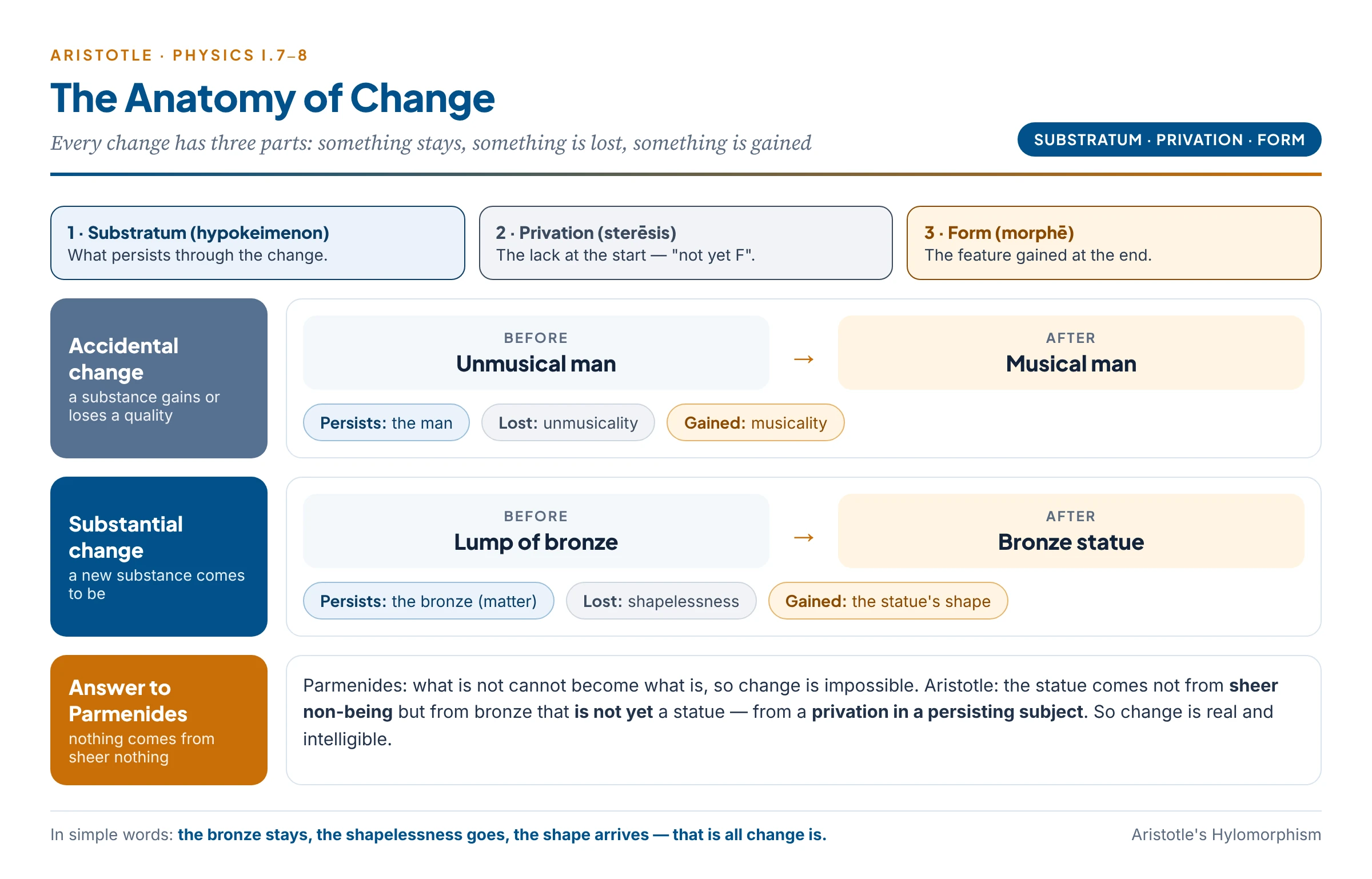
- Accidental change: an unmusical man becomes a musical man. The man persists (substratum), the unmusicality goes (privation), musicality comes (form).
- Substantial change: bronze becomes a statue; bricks become a house; a seed becomes a plant. Here the persisting substratum is matter, and what comes to be is a new substance.
- Answer to Parmenides: Parmenides is right that nothing comes from sheer non-being. But things come from what is not-something only in a limited sense — from a subject that lacks the new feature. The musical man comes from the man (who already is) as unmusical (who is not yet musical). Change is from privation to form, in a persisting subject.
In simple words
The statue does not appear out of nowhere — it comes from bronze that was not yet a statue. Something stays (the bronze), something goes (the shapelessness), something arrives (the shape).
2. What Matter Is
- Definition: matter is “that out of which” a thing comes to be and which persists in it.
- “It appears as good as nothing, but it is not nothing”: matter is not non-being, because it is what form moulds into nature, organisms and man — into physical things, life and consciousness.
- The lump of clay: we say a lump of clay “has no form,” but strictly it has no definite form; what it has is the potentiality to become a plate, a pot or a toy. Formless matter as such is materia prima, which holds all the potentialities that later forms actualise.
Common confusion
Is Aristotle’s “matter” the matter of physics and chemistry? No. Ordinarily “matter” means iron, gold, clay. Aristotle means something deeper: matter in itself has no shape and no quality of any kind — it is neither red nor green, neither heavy nor light, neither smooth nor rough; taken by itself it is formless and purposeless. And “matter” is relative: clay is matter for the pot, but clay is itself already formed earth.
Features:
- Indeterminate — in itself it lacks the character that form gives; it is “unknown.”
- Without quality of its own — if it had qualities of its own it would no longer be simple, bare matter.
- Distinctionless — in itself it has no differences; differences come from form.
- Potentiality — it is able to become many things; bronze can be a statue, a bell or a coin.
- Principle of individuation — two men share the same form; what makes them two is that the form is in different matter (“this flesh and these bones”).
- Known by analogy — never perceived on its own, only as “what bronze is to the statue, wood to the bed.”
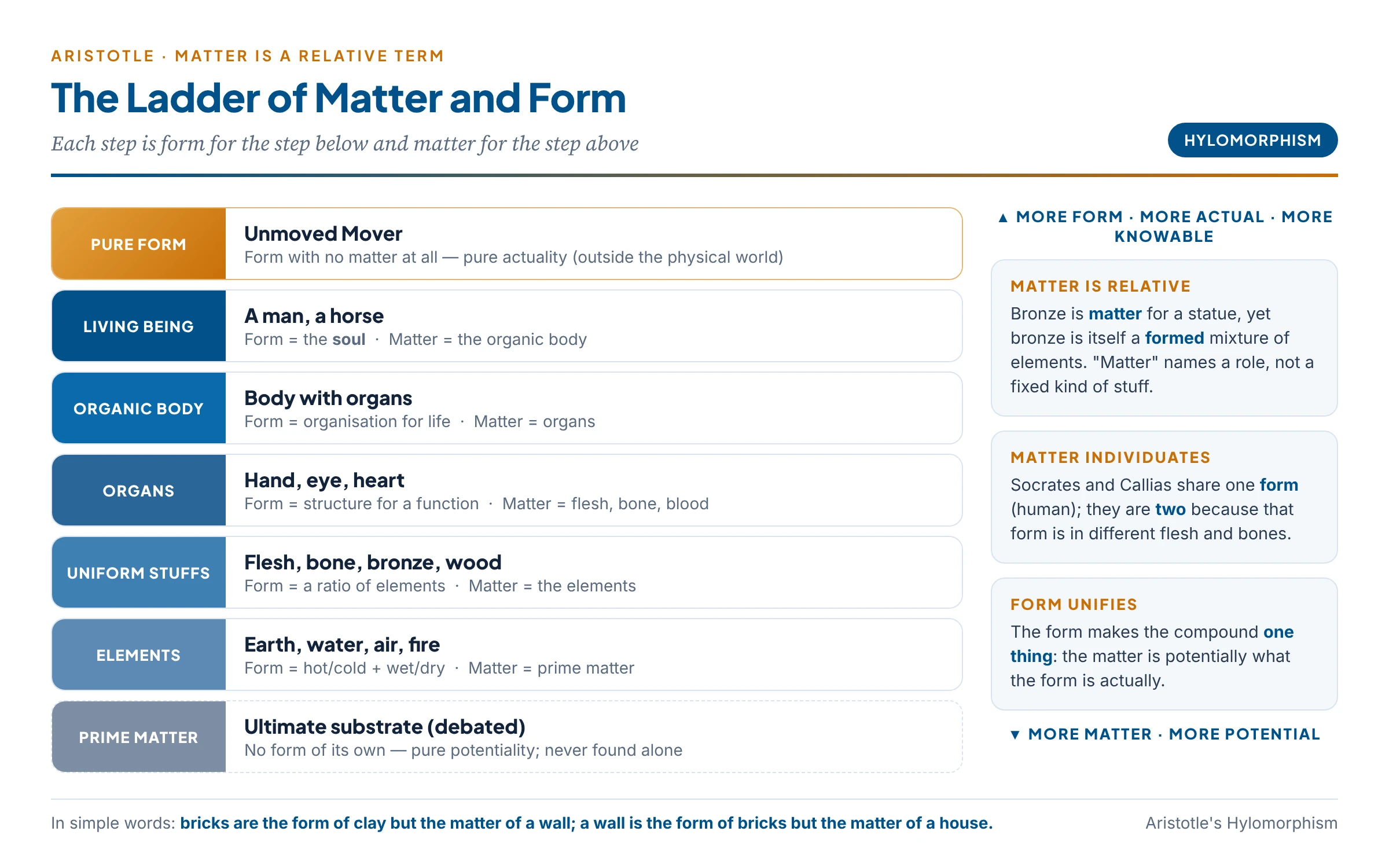
- Matter is relative: it is always the matter of something. Bronze is matter relative to the statue, but bronze itself is a formed compound of the elements.
The levels of matter
- Prime matter (prōtē hylē) — the hypothetical ultimate substrate with no characteristics of its own, underlying the elements’ transformation into one another.
- The elements — earth, water, air, fire (and the celestial aether).
- Uniform stuffs (homoiomerē) — flesh, bone, bronze, wood: every part is the same kind of stuff as the whole.
- Organs (anhomoiomerē) — hand, eye, heart: structured parts made of uniform stuffs.
- The organic body — matter for the soul, which is its form.
In simple words
Bricks are the “form” of baked clay, but they are the “matter” of a wall; a wall is the “form” of bricks, but the “matter” of a house. What counts as matter or form depends on the level you are looking at.
| Thing | Relative to the level below | Relative to the level above |
|---|---|---|
| Soil | — | Matter for clay |
| Clay | Form of soil | Matter for the pot |
| Pot | Form of clay | Matter for a set of kitchenware |
| Wood | — | Matter for the chair |
| Chair | Form of wood | Matter for furniture (a sofa set) |
| Species “man” | Form for individual men | Matter for the genus “animal” |
- W. T. Stace’s formula: “What becomes is matter; what it becomes is form.” Matter and form are fluid, relative terms — which is why there is “an ability to change.”
3. What Form Is
- The most important aspect of a thing: a chair is valuable not because it is wood but because it has the form of a dining chair or an office chair. Form is “the real thing” about anything in the world.
- Form is the universal aspect: redness, greenness, cowness — what all things of a class share. In Aristotle, form is Plato’s universal without separate existence: greenness does not exist apart from green leaves, nor blueness apart from blue books.
- Three aspects of form (the car example): (i) shape and size — the body of the car; (ii) function — travelling; (iii) organisation — the blueprint that arranges the parts.
- Principle of determination: matter is indefinite; form is what matter is made into, its essential quality.
Common confusion
Is “form” just the shape of a thing? No. A rectangle is the same shape in a door, a book and a field, yet these are three different things. Form includes shape, but also function (a car is for travelling), organisation (how the parts are arranged) and essence (what the thing is). A dead hand has the shape of a hand but not its form, because it cannot do what a hand does.
- Shape — the most visible sense: the figure of the statue.
- Structure / arrangement — the order of parts that makes bricks a house rather than a heap.
- Essence (to ti ēn einai) — what the definition states; the answer to “what is it?”
- Function (ergon) — what the thing is for and does: the form of an eye is seeing, the form of an axe is cutting.
- Actuality (energeia) — form is matter’s realised state (developed fully in the article on actuality and potentiality).
- Principle of unity and knowability — form makes the compound one and makes it intelligible; we know things through their forms.
- Form is not made: in the making of a bronze sphere neither the bronze nor the sphericity is produced — what is produced is this bronze sphere. Forms are transmitted (from craftsman’s mind, from parent), not manufactured.
4. How Form and Matter Are Related
- Inseparable in reality: no form without matter (in the physical world), no matter without some form; they are separable only in thought (logos). This inseparability is itself an attack on Plato’s separate Ideas.
- The bronze Apollo: in a bronze statue of Apollo, the bronze is the matter and the shape of Apollo the form — you cannot throw away the bronze and keep the Apollo hanging in mid-air. Put in Kantian style: matter without form is empty, form without matter is blind — with the single exception of God.
- Russell’s gloss: there is such a thing as the game of football, but not without football players; there is redness, but only because there are red things. The form depends on the thing, not the thing on a separate form.
- Correlative: matter is matter for a form; form is form of a matter. Neither is a thing by itself; the compound (synolon) is the thing.
- Matter for the sake of form: the matter is chosen and arranged to serve the form — a saw must be of iron because sawing requires hardness. This is hypothetical necessity: if there is to be a saw, then there must be iron.
- Potential and actual: the proximate matter is potentially what the form is actually.
- The unity problem solved: there is no need for a third thing to glue form to matter, because the proximate matter and the form are “one and the same, the one potentially, the other actually.” A bronze ball is not bronze plus roundness, but bronze being round.
In simple words
You do not need glue to hold “roundness” to a ball — the ball’s roundness just is the way its rubber is.
5. The Priority of Form over Matter
Form is prior to matter in several senses:
- In definition — we define a thing by its form (“a house is a shelter for people and goods”), mentioning matter only as what serves the form.
- In knowledge — we know a thing when we know what it is, i.e. its form; matter as such is unknowable.
- In substance — form is the substance of the compound; matter is substance only potentially.
- In explanation / teleology — matter exists for the sake of form; the form explains why this matter is arranged thus, not the reverse.
- In being and value — the form is the actuality, and actuality is prior to potentiality (an adult is prior to a child, since the child exists for the sake of becoming the adult).
- But matter is prior in time within a single process of coming-to-be (the bronze exists before the statue), and matter is indispensable — the form of a saw cannot exist in wool.
6. The Soul as the Form of the Body
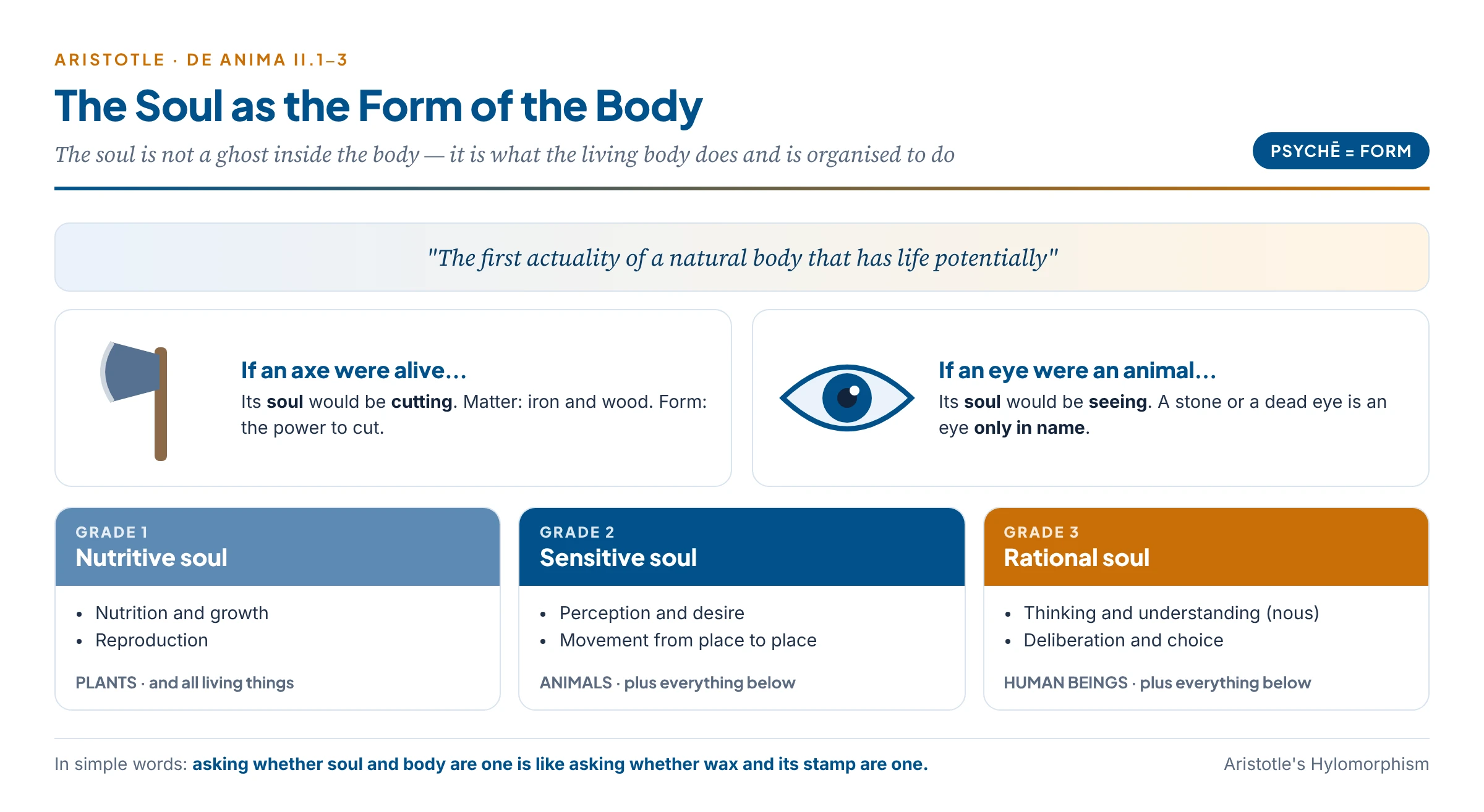
- Definition: the soul (psychē) is “the first actuality of a natural body that has life potentially” — the form of a living body.
- Analogies: if an axe were a natural body, cutting would be its soul; if an eye were an animal, sight would be its soul.
- Homonymy principle: a dead hand or a stone eye is a hand or eye only in name — without the form (the function), it is not really a hand.
- Unity of soul and body: asking whether soul and body are one is like asking whether the wax and its impression are one — the question is unnecessary.
Grades of soul (the scale of nature):
- Nutritive — nutrition, growth, reproduction (plants and all living things).
- Sensitive — perception, desire, locomotion (animals).
- Rational — thought (nous) (human beings).
- Man as matter and form: in a human being, matter is the bodily, psycho-physical side — senses, organs, passions and appetites — and form is reason, man’s distinctive feature. This is why Aristotle rejects both hedonism (appetite as the goal) and asceticism (appetite as evil): appetites are real but must be ordered by reason, as matter is ordered by form.
- Neither Plato nor Democritus: against Plato, the soul is not a separate substance imprisoned in the body; against materialism, the soul is not just the body’s stuff — it is its organisation and life-activity.
- The exception: in De Anima the active intellect is said to be “separable, unaffected, unmixed” — the one point where Aristotle seems to allow a form without a body.
7. Change and Permanence
- Permanence lies in the matter (and, in accidental change, in the substance); change lies in the forms acquired and lost.
- Four kinds of change: in substance (coming-to-be and passing away), quality (alteration), quantity (growth and diminution) and place (locomotion).
- Heraclitus answered: things really change, but change has a structure (privation → form in a substratum), so it is knowable.
- Parmenides answered: change needs no creation from nothing; something always persists.
8. “In the Empirical World, Everything Is a Compound of Matter and Form”
- True of every perceptible substance — plants, animals, artefacts, the elements, even the heavens (made of aether, a matter that admits only movement in place).
- Even mathematical objects have “intelligible matter” — the extension in which a geometrical figure is thought.
Two limits:
- Prime matter is never found without form — it is a limit-concept, not a thing.
- The Unmoved Mover is pure form without matter — but it is not part of the empirical world.
- The continuum: the world is a continuum of formed matter, with materia prima (pure potentiality) at one end and pure form (God, actus purus) at the other. The objective world lies between them; the two extremes are logical possibilities, not actual things we meet in experience.
- Evaluation: the statement is Aristotle’s position, but it holds as a principle of analysis (every empirical thing can be analysed into what-it’s-made-of and what-it-is), not as a claim that form and matter are two physical ingredients.
9. Form and Matter in the Theory of Causation
- The four causes reduce to two: the material cause is matter; the formal cause is form; the final cause is the form as the goal to be reached; the efficient cause is form already active in an agent (the carpenter’s idea, the parent’s form). So material cause = matter; formal + efficient + final = form.
- Why this matters: with only two principles Aristotle can explain all movement, becoming and development in the world — of man, organism and nature.
- Reconciling teleology and mechanism: matter supplies the necessary conditions (iron for the saw), form supplies the purpose (cutting). Science’s mechanical explanation and philosophy’s teleological explanation become two levels of one account.
- Change made logical: matter is the potential to change, form the actuality reached; so change is not a mystery but matter becoming a better-formed thing.
10. Significance of the Doctrine
- It rehabilitates the world: against Plato, the sensible world is fully real; against the Atomists, it is ordered and meaningful.
- It explains change logically: something persists (matter), something is gained (form).
- It explains both similarity and individuality: form makes all men alike (manness), matter makes each man unique.
- It leads to God: the ascending order of more and more form ends in pure form, and human beings strive to approach it.
Critical Evaluation
Internal Difficulties
- Prime matter: is there really a featureless ultimate substrate? Traditionally Aristotle is read as accepting it; some modern scholars argue he never needed it, since the elements can change into one another directly. Either way, a substrate with no properties at all is hard to make sense of.
- Matter as individuator: if matter itself is indeterminate, how can it make Socrates this individual? Medieval thinkers answered with “designated matter” (materia signata, Aquinas) — matter under determinate dimensions.
- Form universal or particular? If form is the species-form, it is shared; if it is Socrates’ own form, form is particular — the same tension as in Aristotle’s theory of substance.
- Form without matter: God and the active intellect break the rule that forms exist only in matter — the Platonic “separate form” returns at the summit.
- Self-contradiction at the extremes: if form and matter are always inseparable and relative, pure matter and pure form cannot exist — yet the scale of nature needs both.
- “Matter” used in two senses: sometimes an unknowable substratum with no form at all, sometimes something already formed (clay is matter for the pot). If we ask what pure matter is, the answer — an unknowable substratum — ends in a kind of scepticism.
- Relativity does not prove unity: calling matter and form “less developed and more developed states” of the same thing describes them but does not show how they coexist in one substance.
- Hard to grasp: the fluid, relative use of “matter” and “form” makes the doctrine difficult to comprehend and easy to misapply.
- Russell’s verdict: the doctrine is plain on the surface — “a common-sense prejudice pedantically expressed” — and difficult underneath, because “Plato and common sense do not mix easily.”
Critics and Defenders
Criticism — Mechanists and empiricists
- The mechanists (Descartes, Hobbes, Boyle) rejected substantial forms: nature is matter in motion, explained by size, shape and motion of particles. To explain why opium causes sleep by its “dormitive form” (Molière’s virtus dormitiva) is to explain nothing.
- Locke: real essences, if they exist, are unknowable; we classify by “nominal essences” we construct.
- Modern physics and chemistry: what Aristotle called form is now described as structure — molecular arrangement, organisation, information — explained by efficient causes.
Defence — Replies and revival
- Form as structure is vindicated: chemistry shows that the same atoms in different arrangements make different substances (isomers) — arrangement matters, just as hylomorphism says.
- Biology: the physicist-turned-biologist Max Delbrück half-seriously proposed that Aristotle deserved a posthumous Nobel Prize for the idea that a form-giving principle (now read as genetic information) shapes developing matter.
- Philosophy of mind: Putnam and Nussbaum saw in the soul-as-form doctrine an ancestor of functionalism — the mind as the organisation and activity of a body, neither a ghost nor mere stuff.
- Contemporary metaphysics: today’s neo-Aristotelian philosophers again use form to explain why a thing is one whole and how it stays the same thing over time.
Cross-Tradition Comparison
Form, Matter and Indian Theories of Causation
| Point | Aristotle | Sāṃkhya | Nyāya-Vaiśeṣika | Advaita Vedānta |
|---|---|---|---|---|
| Material principle | Matter (hylē) | Prakṛti — unmanifest, potential nature with three guṇas | Samavāyi-kāraṇa — inherent (material) cause, e.g. threads of cloth | Upādāna-kāraṇa — Brahman as the material cause |
| Structuring principle | Form (morphē) | Evolution (pariṇāma) of prakṛti; puruṣa is pure consciousness, not form | Asamavāyi-kāraṇa — non-inherent cause, e.g. conjunction of threads | Name and form (nāma-rūpa) superimposed |
| Is the product new? | Yes — a new compound; form realised | No — effect pre-exists in cause (satkāryavāda) | Yes — new creation (ārambhavāda, asatkāryavāda) | Only apparently (vivartavāda) |
| Clay example | Clay (matter) shaped into a pot (form) | Pot is clay made manifest | Pot is a new whole inhering in clay parts | “Clay alone is real; the pot is a name” (Chāndogya Upaniṣad 6.1.4) |
Indian Connect
- Closest to Sāṃkhya: Aristotle’s potentiality of matter resembles the effect pre-existing in latent form in prakṛti (satkāryavāda) — both say nothing comes from nothing.
- Key difference: for Sāṃkhya, puruṣa (consciousness) is a separate principle that does not shape matter; for Aristotle the soul is the form of the body, not a separate witness.
- Advaita contrast: Aristotle treats both clay and pot as real; Uddālaka’s teaching treats the clay (Brahman) as real and the pot as a name and form — the opposite emphasis.
- Nyāya parallel: the analysis of a cloth into inherent cause (threads), non-inherent cause (their conjunction) and efficient cause (the weaver) closely mirrors Aristotle’s matter, form-as-arrangement and efficient cause.
Hylomorphism and Later Western Views
| Aristotle | Plato | Descartes | Spinoza | |
|---|---|---|---|---|
| Matter | Potentiality, real but indeterminate | Receptacle (chōra) | Extension | Mode of extension |
| Form | In the thing, its structure and function | Separate Form | Rejected (only mechanical properties) | Rejected as final cause |
| Soul–body | Soul = form of body | Soul imprisoned in body | Two substances | Two attributes of one substance |
Synthesis (Siddhānta)
Hylomorphism dissolves three ancient dead-ends at once. Against Parmenides, it shows change is the passage from privation to form in a persisting substratum; against Democritus, it insists that arrangement and function are as real as stuff; against Plato, it places form in things, where it makes them both real and knowable. Its weak points — prime matter, individuation, and separate forms at the top — are real, but its core idea, that a thing is matter organised for a function, has proved more durable than the mechanism that once displaced it.
- Science: explanations in chemistry, biology and engineering routinely appeal to structure and function, not just to material constituents.
- Mind and body: the soul-as-form view offers a third path between dualism and reductive materialism.
- Everyday reasoning: we still distinguish what a thing is made of from what it is — a temple and a heap of the same stones are not the same thing.
Matter answers “out of what?”; form answers “what is it?” — and only together do they give a thing.
Previous Year Questions
- 2025“In the empirical world, everything is a compound of Matter and Form.” Evaluate this statement with reference to Aristotle.
- 2020How does Aristotle argue for the priority of Form over Matter and Actuality over Potentiality? Critically discuss.
- 2017Explain Aristotle’s theory of form and matter. How does it help him resolve the problem of change and permanence?
- 2014Explain the significance of Aristotle’s doctrine of form & matter in his theory of causation.
- 2006Write short notes on: Discuss the ‘theory of matter’ according to Aristotle.