

Plato and Aristotle: Ideas; Substance; Form and Matter; Causation; Actuality and Potentiality.
Official Syllabus: Paper I, Section A, Unit 1
Aristotle’s Theory of Substance (Ousia) answers the oldest question of metaphysics — what is it to be? — by pointing not to a separate world of Forms but to the concrete individual thing: this man, this horse, this tree. For Aristotle, substance is what exists in its own right, what everything else (colours, sizes, relations, actions) depends on. The theory grows directly out of his critique of Plato: if the Forms are separate from things, they cannot be the being of things, so the being of things must lie in the things themselves.
In simple words
“white”, “tall” and “running” cannot exist on their own — there has to be something that is white, tall or running. That something — Socrates, a horse, an oak — is what Aristotle calls a substance. Plato looked upward for reality; Aristotle looks at what is in front of him.
Context & Problem
From Student to Critic
- Aristotle (384–322 BCE): son of Nicomachus, physician to the Macedonian king; studied in Plato’s Academy for twenty years; tutor of Alexander the Great; founder of the Lyceum (the Peripatetic school). A true polymath — logic, physics, biology, metaphysics, ethics, politics, poetics, psychology. The West inherited much of its intellectual vocabulary from him.
- Philosophical label: a moderate empiricist — knowledge begins in perception but ends in universal reason; his key ideas are teleology and hylomorphism.
- Academy vs Lyceum: the Academy was devoted to speculative mathematics and political philosophy; the Lyceum took biology and the natural sciences seriously. Plato thought like a mathematician and poet; Aristotle like a biologist and physician.
- Style: Russell says Aristotle is “the first to write like a professor” — systematic, careful, divided into heads, “without any trace of Bacchic enthusiasm.”
- Loyal critic: in the Nicomachean Ethics he says that piety requires us to honour truth above friends — the source of the saying “Plato is dear, but truth is dearer.” Another saying runs: “Wisdom will not die with Plato.” He was not an unfriendly critic: he worked out what was implicit in Plato, and the resemblance between them is deeper than the difference.
- The shared ground: both agree that knowledge is of the universal and the unchanging. The disagreement is about where the universal is.
Plato and Aristotle — Similarities and Differences
| Similarity | What it means |
|---|---|
| Both are idealists in a broad sense | Form over matter, the higher over the lower, thought over things |
| Both crown reality with a perfect principle | Plato’s Idea of the Good; Aristotle’s Actus Purus — God, Prime Mover, Form of forms, the uncaused cause |
| Both see the world as striving | Plato: things strive to participate in the Ideas; Aristotle: things are moved by God as the object of their desire |
| Both reject mechanism | Both explain the world teleologically, by purpose |
| Both are ethical in orientation | Both reject hedonism and make the good life (eudaimonia) the goal |
| Point | Plato | Aristotle |
|---|---|---|
| Temperament | Poet, mystic, mathematician | Scientist, logician, biologist |
| Language | Myths, metaphors, allegories | Precise technical terms |
| View of the world | Static (mathematics) → later inspires Spinoza | Dynamic — growth and decay (biology) → later inspires Leibniz |
| Purpose of life | Release of the soul from bondage | Perfection (actualisation) of the self |
| Highest principle | The Good | God as Prime Mover — Plato’s Good rethought |
The Question Aristotle Inherits
“The question which was raised of old and is raised now and always, and is always the subject of doubt, namely what being is, is just the question, what is substance?” — Aristotle, Metaphysics
- Metaphysics as “first philosophy”: the science of being qua being (being as being) — not of this or that kind of being, but of what it is for anything to be. Substance is its key concept. For Aristotle philosophy is the foundation of all the other sciences, born of wonder and curiosity about the world.
- “Being is said in many ways”: a colour is, a size is, a man is — but not in the same way.
- Focal meaning (pros hen): the many senses of “being” all point to one central sense, as “healthy” said of a diet, a complexion and a body all point to the health of a living body. The central case of being is substance; everything else is by being a quality, quantity or relation of a substance.
- So the question “what is being?” becomes the question “what is substance?” For Plato substance was the universal; for Aristotle it is the concrete individual.
Core Doctrine
1. The Fundamental Problem of Metaphysics — Between the Atomists and Plato
Aristotle’s metaphysics is an answer to one problem: what is the essence of the world — what makes things be, and be what they are, while they change? This is the problem of Being and Becoming. Parmenides denied becoming; Heraclitus denied lasting being. Aristotle found two extreme answers before him and rejected both.
The Atomists (Leucippus, Democritus)
- Their view: reality is only atoms and the void. Atoms are tiny, solid, indivisible, eternal and differ only in shape, size and arrangement. Colours, tastes and warmth exist only “by convention”; change is atoms rearranging; everything happens by necessity and chance, with no purpose.
- Aristotle’s objections:
- Matter alone cannot give the essence — a house is not just its bricks, a man not just his flesh; the same atoms could make a wall or a corpse. What a thing is depends on its form (structure, organisation, function).
- They neglect two causes — they offer material and, loosely, efficient causes, but omit the formal and final causes; they “lazily” ignore the question of where motion comes from.
- Chance cannot explain regularity — teeth grow fit for cutting and chewing “always or for the most part”; what happens regularly is not by chance, so nature acts for an end.
- Indivisible magnitudes and the void are incoherent — magnitude is continuous and divisible without end, and there is no empty void.
- Dire ethical consequences — a purposeless world of colliding atoms leaves no ground for value, virtue or the good life.
Plato
- His view: the essence of things is the Form, which exists apart from them in an eternal world.
- Aristotle’s objections (developed in §2 below): the Forms are separate, so they cannot be the essence of anything; they are static, so they cannot explain change; and they duplicate the world without explaining it.
Aristotle’s answer
- The essence of the world lies neither in matter alone (Atomists) nor in separate form (Plato) but in form in matter: the concrete substance (synolon), whose essence (to ti ēn einai, “what it was to be”) is its immanent form.
- Matter explains individuality and the capacity to change; form explains kind, unity and knowability; potentiality and actuality explain how change happens without anything coming from nothing; the four causes give the complete explanation; and the whole world is ordered towards the Unmoved Mover as its final cause.
- Result: he “rehabilitated the glory of the world” — the sensible world is neither a meaningless whirl of atoms nor a shadow of another world, but real, structured and purposive.
| Atomists | Plato | Aristotle | |
|---|---|---|---|
| Essence of the world | Matter (atoms) | Separate Forms | Form in matter |
| Change | Rearrangement by necessity/chance | Unexplained (Forms are static) | Actualisation of potentiality |
| Purpose | None | The Good, outside the world | Immanent ends + Unmoved Mover |
| Status of sensible world | The only world, but without value | Shadow, less real | Fully real and intelligible |
2. The Critique of Plato’s Forms
Aristotle criticises the Ideas “again and again” in the Metaphysics, and builds his own view out of the criticism. His two master objections are that the Ideas (i) cannot explain the nature and existence of things, and (ii) cannot be related to things. The detailed objections fall into four families.
| Family | Objection | What it shows |
|---|---|---|
| Logical | Third Man (tritos anthrōpos): if Socrates and Man-itself share “man,” a third Man is needed, and so on. Put as likeness: if the sensible is like the Idea, the Idea is like the sensible, and a further pattern is needed for their likeness | Separate Forms generate an infinite regress |
| Logical | Forms of relatives and negations (“not-man,” “absence of something,” “equal”) would be needed, though nothing in the world can share in “not-man” | The one-over-many argument proves too much |
| Logical | Pattern of patterns: the species Man is a pattern for men but a copy of the genus Animal — the same Form is both original and copy | The copy model is incoherent |
| Logical | Self-contradiction: Plato says “man has manness” — so manness is a predicate — yet treats it as a self-standing substance | A predicate cannot be a substance |
| Metaphysical | Separation (chōrismos): the essence of a thing cannot exist apart from the thing whose essence it is; “Idea-cow” outside all cows is absurd | Forms cannot be the substance of things |
| Metaphysical | Indivisibility: if each horse shares the whole of Horseness, Horseness is in many places and divided; if each shares a part, it is divided again | The Form cannot stay one and indivisible |
| Metaphysical | Duplication: positing Forms is like a man who, unable to count a few things, thinks he will do better by doubling them; the Ideas are as many as the things they explain | Forms add entities but explain nothing |
| Metaphysical | A substance has three elements — a universal, qualities and relations, and an underlying substratum. A Platonic Idea has only the first | An Idea without qualities and substratum cannot exist on its own |
| Causal | Forms are static; they cause neither motion nor generation — houses and rings come to be without any Form of house or ring | No efficient cause of change |
| Causal | No logical link to particulars: nothing about Whiteness logically yields white cows and white flowers, nor explains their changes | Forms do not explain the world |
| Causal | “Participation” and “imitation” are empty words and poetic metaphors | No account of how Forms act |
| Epistemic | Separate Forms do not help us know this world — they are not in the things we want to understand. Ideas are abstract, things concrete | Knowledge of sensibles is left unexplained |
| Epistemic | Order of discovery reversed: we reach the idea of manness by seeing men; Plato says men copy Manness | Abstraction, not copying |
| Epistemic | Recollection: if all ideas are already in the soul, there is no need for teaching and learning — yet we plainly learn | Knowledge comes from experience, not memory |
Common confusion
Did Aristotle invent the Third Man argument? No. Plato himself raised a regress of this kind in his dialogue Parmenides (the “Largeness” regress). Aristotle gave it the name “Third Man” and used it as a weapon against separate Forms.
The relation theories fail too:
- Copy: a copy must resemble its original, but particulars (concrete, changing, objects of opinion) and universals (abstract, permanent, objects of knowledge) are opposite in every respect.
- Participation: if many things participate in one Idea, the Idea becomes divisible; and if the Idea and the things form one organic whole, the Idea itself becomes subject to change — which is in fact Aristotle’s own view that form and matter coexist.
- Ockham’s razor (a later, medieval form of the same complaint): Plato multiplies independent entities beyond necessity.
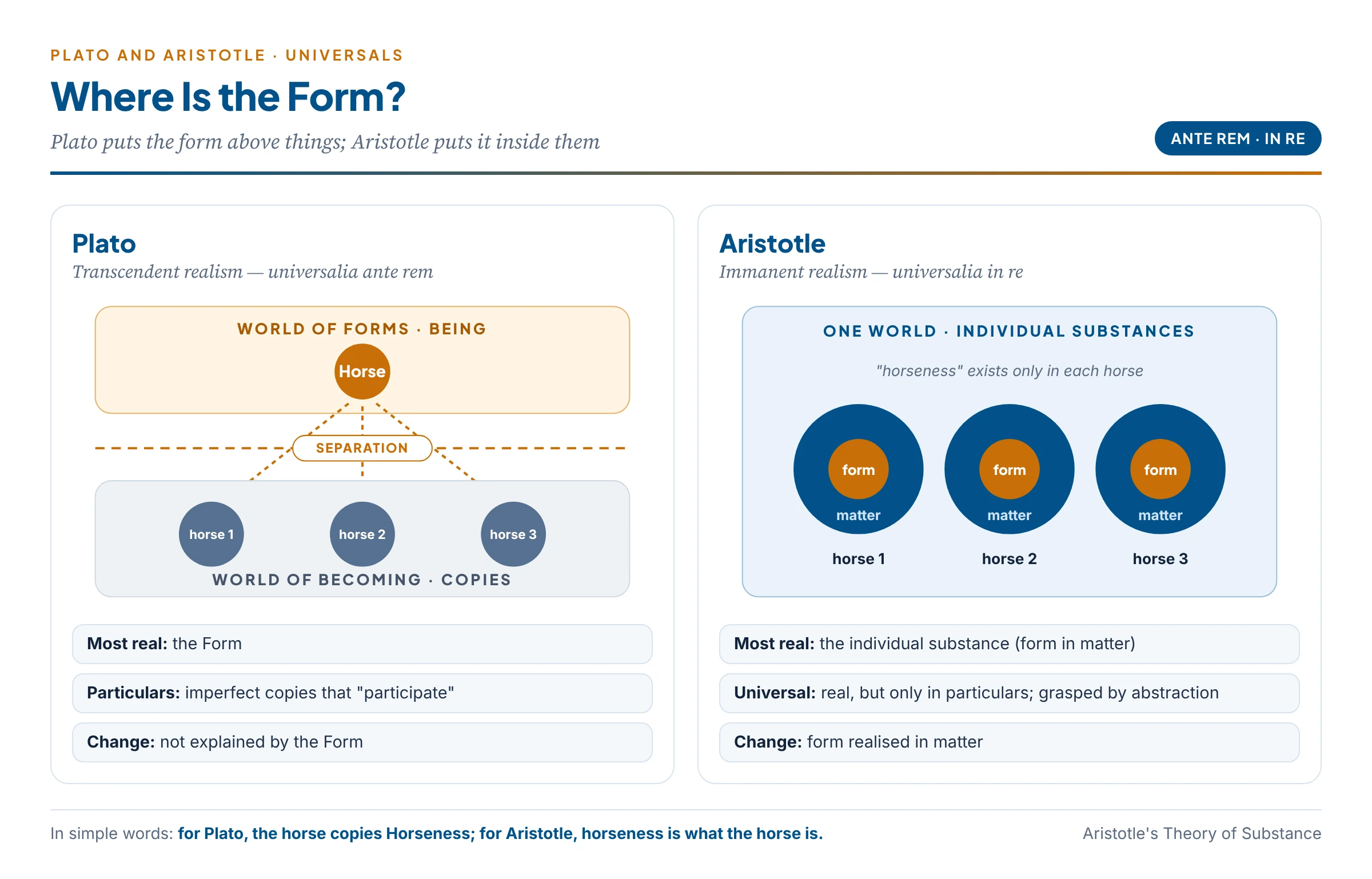
- The constructive point behind every objection: the universal is real, but it is in the particular (universalia in re), not before it (ante rem). Pure form exists only in thought.
Aristotle does not abolish Plato’s Forms; he brings them down into things and makes them the structure of things.
3. Being and the Ten Categories
- Categories (katēgoriai) are the highest kinds of being — the most general answers to “what is it?” about anything.
In simple words
Every true sentence about Socrates answers one of ten questions — what is he, how big, what sort, related how, where, when, in what posture, having what, doing what, undergoing what.
| Category | Greek | Example (about Socrates) |
|---|---|---|
| Substance | Ousia | a man |
| Quantity | Poson | five feet tall |
| Quality | Poion | white, wise |
| Relation | Pros ti | taller than Plato |
| Place | Pou | in the market |
| Time | Pote | yesterday |
| Position | Keisthai | sitting |
| State / Having | Echein | wearing sandals |
| Action | Poiein | cutting |
| Passion | Paschein | being cut |
- Asymmetry: the nine non-substance categories exist only in substances; substance alone exists in its own right. This is the ontological priority of substance.
4. Two Definitions of Substance
- Logical definition — the ultimate subject: substance is that which is always a subject and never a predicate, that to which all predicates apply. In “Gold is heavy,” gold is the substance and heaviness its predicate; in “Ram is brave,” Ram is the substance. Heaviness exists only in heavy things, bravery only in brave people.
- Metaphysical definition — the independent and the enduring: substance is what exists independently and what underlies all change while itself remaining.
- Consequence for Plato: “humanness” is what is common to all men — a predicate, like “heavy.” As heaviness cannot exist apart from heavy things, humanness cannot exist apart from men. So universals are not substances, and Plato’s Ideas fail both definitions: they are used as predicates, and they cannot exist on their own.
- Grammar of the difference: for Plato the Form-word is a noun naming a self-standing thing; for Aristotle it is closer to an adjective — it says what kind or what quality.
- Russell’s illustration: there is such a thing as football, but not without football players; parenthood, but only because there are parents; sweetness, only because there are sweet things. The dependence is one-way: players exist even if they never play, sweet things may turn sour, a red face may turn pale. “What is meant by an adjective is dependent for its being on what is meant by a proper name, but not vice versa.” Russell adds, a little unkindly, that the doctrine is “a common-sense prejudice pedantically expressed.”
5. Substance in the Categories: Primary and Secondary
Aristotle sorts all beings by two relations:
- “Said of” a subject — a general term truly applied to something below it in the same category (“man” is said of Socrates; “animal” is said of man). The general thing gives the definition of what it is said of.
- “In” a subject — something that cannot exist apart from what it is in, though it is not part of its definition (this white is in a body).
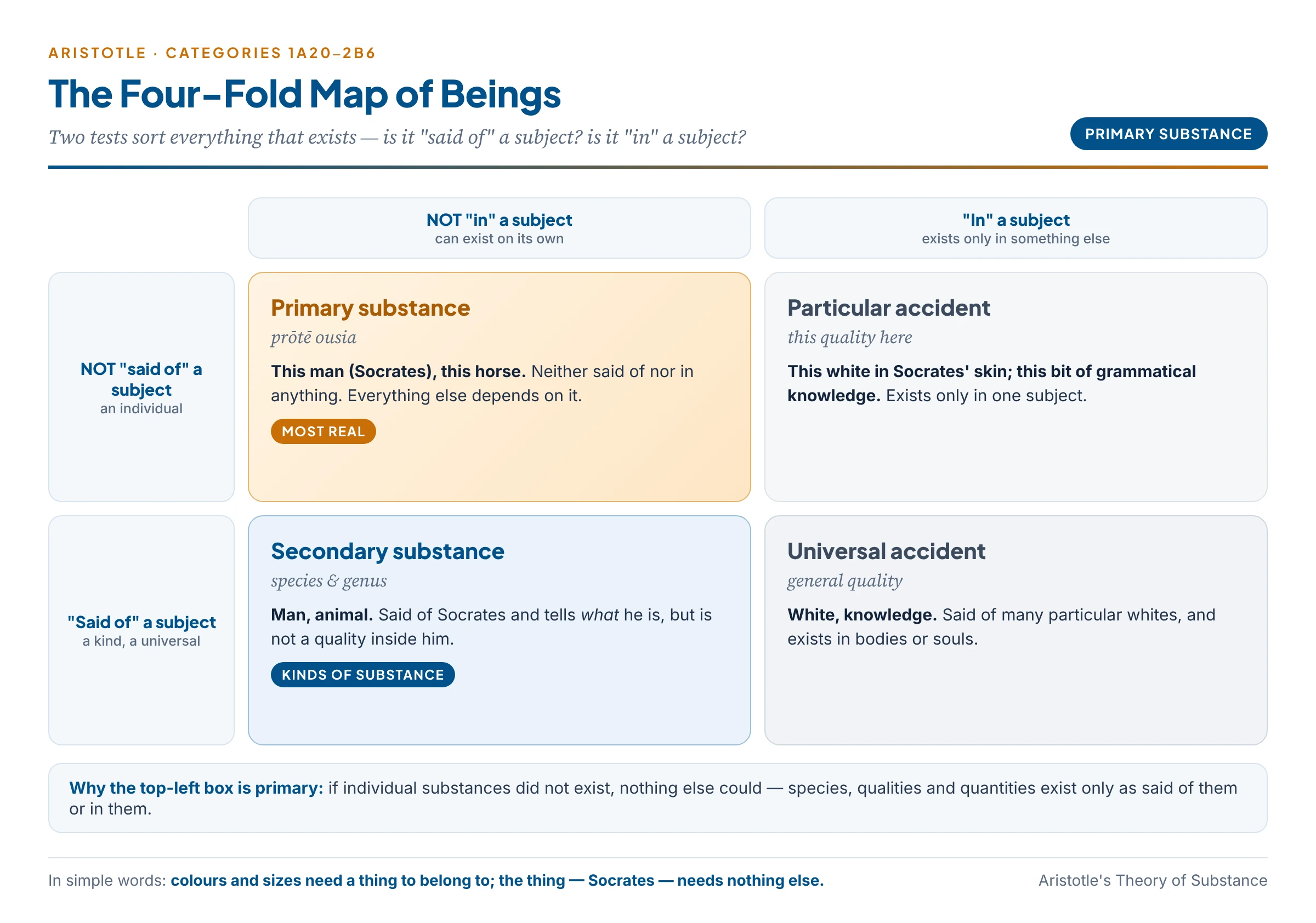
- Primary substance (prōtē ousia): neither said of nor in a subject — the individual man, the individual horse.
- Secondary substance: the species and genera of primary substances (man, animal) — said of individuals, but not in them as accidents.
- Why the individual is primary: if primary substances did not exist, nothing else could exist — species, qualities and quantities exist only as said of or in individuals.
Marks of substance in the Categories:
- Ultimate subject — always a subject of predication, never itself predicated of anything.
- Independent existence — “that which exists in itself and not in another.”
- Persists through contraries — the same Socrates is first pale, then tanned; a colour cannot be both.
- Has no contrary — there is no “opposite” of a man.
- A “this” (tode ti) — a determinate, countable individual.
- Subject of both knowledge and being — the bearer of predicates and of change.
- Contrast with Plato: for Plato the most real thing is the universal; in the Categories the most real thing is the individual, and universals are real only as its kinds.
6. Substance in the Metaphysics: the Four Candidates
In the Categories Aristotle had not yet analysed individuals into matter and form. Once he does, a new question arises: what is the substance of a substance — its matter, its form, or the compound? Book Z tests four candidates.
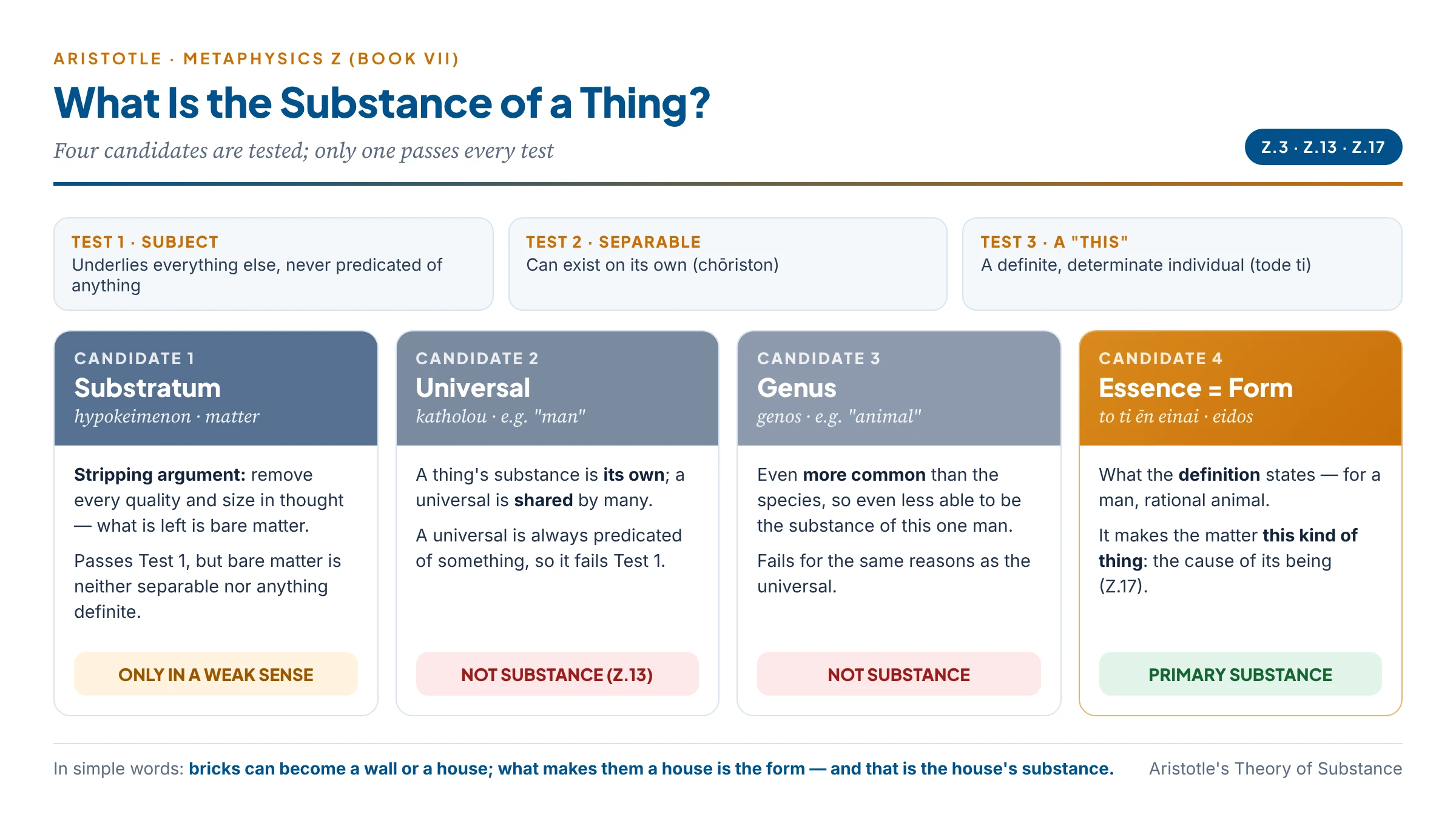
(a) The Subject / Substratum (hypokeimenon)
- Argument for: substance is the ultimate subject of predication (the Categories criterion).
- The stripping argument: take a thing and remove in thought every quality, quantity and power — what remains is a subject with no characteristics at all: prime matter. By the subject criterion alone, matter would be substance.
- Why it fails: substance must also be separable (able to exist on its own) and a “this” (tode ti — a determinate individual). Bare matter is neither; it is never found on its own and is nothing definite.
- Result: the subject criterion is necessary but not sufficient.
(b) The Universal
- Why rejected: the substance of a thing is peculiar to it, while a universal is common to many; and a substance is not predicated of a subject, while a universal always is.
- Corollary: no universal is a substance — the decisive anti-Platonic thesis.
(c) The Genus
- Rejected with the universal: “animal” is even more common than “man,” so it is even less able to be the substance of Socrates.
(d) The Essence (to ti ēn einai, “the what-it-was-to-be”)
- The winner: the essence is what a correct definition states — for a man, rational animal; and the essence of a thing is identical with the thing’s form (eidos).
- Form is primary substance: the form is the substance of the compound because it makes the matter this kind of thing.
- Substance as cause: to ask “why is this (bricks and stones) a house?” is to ask for the form present in the matter. Substance is the principle and cause (archē kai aitia) of a thing’s being what it is.
| Candidate | Criterion it meets | Criterion it fails | Verdict |
|---|---|---|---|
| Substratum / matter | Ultimate subject | Separable; a “this” | Substance only in a weak sense |
| Universal | Knowable, definable | Peculiar to its owner; not predicated | Not substance |
| Genus | Definable | Even more common than species | Not substance |
| Essence = Form | Definable, cause of being, actuality | — | Primary substance (in the Metaphysics) |
In simple words
What makes a pile of bricks a house is not the bricks (they could be a wall) but the arrangement for sheltering — that arrangement is the form, and it is the house’s substance.
Common confusion
What is “primary substance” — the individual or the form? Both answers appear, in different books. In the Categories the primary substance is the concrete individual (this man, this horse). In the Metaphysics, after Aristotle analyses things into matter and form, he says the form is substance in the strictest sense, because it makes the matter this kind of thing. Read the two together: the individual is what exists; its form is what makes it what it is.
7. Neither Form Alone, Nor Matter Alone, Nor the Bare Particular
Aristotle builds his own theory of substance by refuting three rival candidates, step by step:
- Form (Plato’s Idea) is not substance by itself — it is a predicate, it is abstract, and it exists only in things.
- Matter is not substance by itself — it is unorganised, indeterminate and formless, “as good as nothing”; it is an intermediate, dependent stage, not something independent.
- The bare particular is not substance either — there is nothing absolutely particular and isolated. If humanness does not exist apart from men, neither do men exist apart from humanness.
- Conclusion: substance is the concrete individual having both form and matter — “formed matter” or “determinate matter.” What exists is neither matter nor form but formed matter.
- What each contributes: form gives the universal element — it is why one man is similar to other men (all have manness); matter gives uniqueness — it is why each man differs from every other.
8. Does Aristotle Treat Matter as a Substance?
- Yes, in a qualified sense: matter is a subject and persists through change; Aristotle calls sensible matter substance “potentially.”
- No, in the primary sense: matter is indeterminate, not separable, and not a “this”; prime matter in particular has no character of its own and is known only by analogy.
- Proximate vs prime matter: bronze is the proximate matter of a statue and is itself a formed thing (a metal); prime matter is the hypothetical ultimate substrate of the elements — whether Aristotle accepted it is itself debated.
- The compound (synolon) — this matter with this form — is a substance in the ordinary sense; form is substance in the strictest sense; matter is substance only as potentiality.
9. “A Universal Exists Only in the Particular”
- Immanent realism: humanity is real, but only as the humanity of Socrates, Callias and every other man. There is no Man-itself floating free. Beauty exists only in beautiful things.
- How we know universals: knowledge begins in perception; repeated perception gives memory, memory gives experience, and the mind (nous) grasps the universal in the particulars — abstraction, not recollection.
- Universals are prior in knowledge, individuals prior in being: we define and explain through universals, but universals exist only through individuals.
- The “such” vs the “this”: Aristotle insists that form signifies “a such”, not “a this” (tode ti). This is his answer to the Third Man: since the form is not another individual alongside Socrates, no third man is generated.
10. The Ladder of Substances
Three kinds of substance:
- Sensible, perishable — plants, animals, men.
- Sensible, eternal — the heavenly bodies, which move but never perish.
- Non-sensible, eternal — the Unmoved Mover, pure form with no matter, pure actuality (energeia).
- Scale of nature: reality is a plurality of individual substances, each a fusion of form and matter, ordered in a continuous series by the predominance of form over matter — pure matter → objects of the world → human beings → pure form.
- God as substance par excellence: wholly actual, wholly form, “thought thinking itself” (noēsis noēseōs) — the cause of motion as the object of desire, not by pushing. All individual objects are substances, but the supreme substance is God, the Form of forms. Human beings strive to approach this pure form.
11. Plato and Aristotle on Form
| Point | Plato | Aristotle |
|---|---|---|
| Location of form | Separate world (ante rem) | In things (in re) |
| What is most real | The universal Form | The individual substance (compound), and its form |
| Form and matter | Form imitated in the Receptacle | Form and matter inseparable except in thought |
| Form as | Paradigm to copy | Structure, essence, actuality of matter |
| Explains change? | No (Forms are static) | Yes — form is realised in matter through change |
| Knowledge of form | Recollection, dialectic | Perception → experience → abstraction |
| Senses | Deceptive; give only opinion | The starting point of knowledge |
| Cause | Participation; the Demiurge looking to Forms | Form–matter and the four causes |
| Highest reality | Form of the Good | Unmoved Mover (pure form) |
| Method | Visionary — ascent beyond appearances | Descriptive — analysis of the world as found |
12. Visionary (Revisionary) vs Descriptive Metaphysics
The distinction is P. F. Strawson’s (Individuals, 1959), applied back to the Greeks.
- Descriptive metaphysics (Aristotle): describes the actual structure of our thought about the world as it shows itself to human understanding — categories, substance, causes. It explains formed matter and the change and growth of things as observed: seed → sprout → plant → tree.
- Revisionary or visionary metaphysics (Plato): tries to revise our ordinary way of thinking and produce an intellectually and morally better picture of the world, even if it goes beyond observable facts. Plato does this by creating a new world of Ideas and a dichotomy of existence: man vs manness, cow vs cowness.
- Continuity beneath the contrast: both hold that the form is what makes things knowable; both crown their systems with a separate perfect principle (the Good; the Unmoved Mover).
Critical Evaluation
Internal Tensions in Aristotle
- Is form universal or particular? Aristotle says (i) substance is form, (ii) form is what definitions state and so seems universal, and (iii) no universal is substance. These three cannot all hold.
- One answer: each individual has its own form — Socrates’ soul is not Callias’ soul. Then form is particular, and there is no clash.
- Another answer: form is the species-form (“man”) shared by all men; what Aristotle denies is only that a universal predicated of things, or a genus like “animal,” can be substance.
- Ambiguity of “substance”: it is used for the form, for the compound of form and matter, and for the essence — three different things.
- Category shift: the Categories makes the individual primary; the Metaphysics makes form primary — a development, or an inconsistency?
- Substance is not really independent: formed matter depends on both form and matter, and on the Unmoved Mover for its motion.
- Contradiction at both ends of the scale: substance is defined as inseparable form-in-matter, yet the ascending scale gives existence to pure matter at the bottom and pure form at the top.
- Does he escape the Third Man? Only if form is a “such” and not a “this”; but if form is primary substance and substance must be a “this,” the regress threatens to return.
- Return of separation: the Unmoved Mover is a form without matter — a separate, eternal, intelligible reality, close to what Aristotle rejected in Plato. Since Actus Purus is so like the Idea of the Good, Aristotle cannot consistently attack Plato for it.
- Matter used non-uniformly: sometimes an unknowable substratum, sometimes something already formed (clay is matter for the pot). And if one asks what pure matter is, the answer — an unknowable substratum — ends in a kind of scepticism.
Does Aristotle Really Replace Plato?
- Aristotle admits form can be separated from matter in thought; Plato’s Ideas are objects of thought. The two positions come close.
- Plato also made the Good the source of all motion; Aristotle’s Actus Purus plays the same role.
- Verdict: Plato started from the world of Ideas and failed to connect it with the world of opinion; Aristotle started from empirical observation and ended by accepting pure form beyond this world. He set out from the opposite position and ended where Plato began.
- Russell: “Aristotle’s metaphysics, roughly speaking, may be described as Plato diluted by common sense. He is difficult because Plato and common sense do not mix easily.”
- Plato’s defenders’ reply: Aristotle reads Plato’s metaphors (participation, copy) literally; and Plato himself raised the Third Man in the Parmenides.
Critics and Defenders
Criticism — Later critics
- Locke: the substratum is “something, I know not what” — an unknown support for qualities that experience never shows.
- Berkeley: material substance is unnecessary; to be is to be perceived.
- Hume: substance is only a bundle of perceptions united by imagination; the self likewise.
- Russell: the subject–predicate form of Greek grammar misled metaphysics into positing substances.
- Process philosophy (Whitehead): reality is made of events, not enduring things — the “fallacy of misplaced concreteness.”
- Revival: Strawson (Individuals) defends material bodies and persons as basic particulars; Wiggins develops sortal essentialism (identity needs an answer to “same what?”); today’s neo-Aristotelian philosophers restore essence, substance and hylomorphism to the centre of debate.
Defence — Why Aristotle still matters
- The great reconciler: he reconciled the Sophists and Socrates, being and becoming, sense and reason, pleasure and virtue.
- Philosophy brought near to science: he grounded metaphysics in observation and empirical data.
- An evolutionary picture: his pyramidal scheme of nature, from the lowest to the highest, suggested a developmental trend later taken up by scientists and philosophers.
- Still an idealist: by giving priority to form over matter, actuality over potentiality and thought over things, his philosophy remains idealistic at its core.
- Influence: medieval scholasticism (Aquinas) and Islamic philosophy (Avicenna, Averroes); the syllogistic logic; and today’s debates on identity, potentiality, grounding and teleology. He did not just contribute to disciplines — he created the categories in which the West learned to think.
Cross-Tradition Comparison
Aristotle and Indian Theories of Substance
| Point | Aristotle | Nyāya-Vaiśeṣika | Jainism | Buddhism |
|---|---|---|---|---|
| Term | Ousia | Dravya | Dravya | — |
| Definition | Ultimate subject; exists in its own right | Substratum of qualities and actions; inherent cause | That which has qualities and modes (guṇa-paryāyavat) | Substance denied |
| Categories | 10 (katēgoriai) | 7 padārthas: dravya, guṇa, karma, sāmānya, viśeṣa, samavāya, abhāva | 6 dravyas: jīva, pudgala, dharma, adharma, ākāśa, kāla | 5 skandhas, momentary dharmas |
| Universal | In things | Real, eternal, inheres by samavāya | Generality (sāmānya) as an aspect | Only apoha (exclusion) |
| Change | Same substance, changing accidents | Substance persists; qualities change | Permanence + change (utpāda-vyaya-dhrauvya) | Momentariness (kṣaṇikavāda) |
| Individuation | Matter / form | Viśeṣa (ultimate particularity) | Modes | Each moment unique |
Indian Connect
- Closest parallel: Nyāya-Vaiśeṣika — like Aristotle it is a realist, pluralist substance–quality metaphysics. But it makes inherence (samavāya) a separate real category and treats universals as eternal realities, nearer to Plato on that point.
- Sharpest contrast: Buddhism’s no-substance view (anātmavāda, kṣaṇikavāda) — what we call a thing is a series of momentary events; the Buddhist would say Aristotle’s enduring subject is a construction, exactly as Hume did.
- Jaina middle path: reality is permanent in substance and changing in modes — close to Aristotle’s “same Socrates, different qualities,” but framed through many-sidedness (anekāntavāda).
- Atomism East and West: Vaiśeṣika also has eternal atoms (paramāṇu), but unlike Democritus it adds qualities, universals and a guiding intelligence (adṛṣṭa, God) — closer to Aristotle’s demand that matter alone cannot explain the world.
Aristotle and Later Western Views
| Aristotle | Descartes | Spinoza | Locke | Hume | |
|---|---|---|---|---|---|
| Substance | Many individual compounds | Two kinds: mind, matter (God strictly) | One substance: God or Nature | Unknown substratum | None — bundle |
| Known by | Perception + abstraction | Clear and distinct ideas | Reason | Inferred, never perceived | Not known at all |
| Essence | Form in the thing | Thought / extension | Infinite attributes | Real essence unknowable | Rejected |
Synthesis (Siddhānta)
Aristotle’s theory of substance turns metaphysics from the search for a world behind this one into the analysis of this one. Between the Atomists, who left the world without form or purpose, and Plato, who placed its form elsewhere, he locates the essence of things in things: the concrete individual is primary; its form is what makes it the kind of thing it is; its matter makes it this individual; universals are real but only in things; and change is intelligible because something persists while its qualities vary. His critique of Plato is powerful where it targets separation and static Forms, but his own system keeps the Platonic insight that form is the principle of being and knowledge — and even keeps a separate form at its summit.
- Science: classification by genus and species, the search for essences and natural kinds, and biology’s attention to structure and function descend from this theory.
- Logic and language: the subject–predicate analysis and the categories shaped logic for two thousand years.
- Personal identity: questions such as “is a person the same through bodily change?” are still framed in terms of substance and sortal kinds.
- Contemporary metaphysics: the revival of essence and hylomorphism shows that Aristotle’s answer to “what is substance?” remains a live option, not only a historical one.
For Plato, things are real because they copy Forms; for Aristotle, forms are real because they are the being of things.
Previous Year Questions
- 2026What, according to Aristotle, is the fundamental problem of metaphysics? Discuss this in relation with Aristotle’s account of the essence of the world, where he rejects the views of both the Atomists and Plato.
- 2024Differentiate between Plato’s and Aristotle’s conceptions of form.
- 2018Is the relation between the idea and the World as discussed by Plato logically consistent? Discuss Aristotle’s views regarding this and also give arguments in favour of your answer.
- 2016Does Aristotle treat matter as a ‘Substance’? Give reasons for your answer.
- 2013Discuss how by refuting different concepts of Substances Aristotle establishes his own theory of a Substance.
- 2012Discuss Aristotle’s metaphysical theory as a polemic against Plato’s theory of ideas.
- 2003‘A universal exists only in the particular.’ Discuss in this connection Aristotle’s notion of universal and the idea of substance that follows it.
- 2002While Plato’s metaphysics is a visionary one, Aristotle’s metaphysics is a descriptive one! Explain fully giving the essential differences between the views of the two thinkers regarding the nature of reality.
- 1999Aristotle’s arguments for his theory of substance.
- 1999Explain Plato’s theory of ideas and evaluate Aristotle’s argument against it.