

Plato and Aristotle: Ideas; Substance; Form and Matter; Causation; Actuality and Potentiality.
Official Syllabus: Paper I, Section A, Unit 1
Plato’s Theory of Ideas (Eidos, Idea) is the claim that what is truly real is not the changing world we see and touch but a realm of eternal, unchanging, intelligible Forms — Beauty itself, Justice itself, Equality itself, Man itself. It answers two problems at once: how knowledge is possible if everything perceived is in flux, and what makes many things one kind. Epistemology and metaphysics are fused: because knowledge must be stable, its objects must be stable; because the Forms are stable, knowledge of them is possible. As Whitehead put it, the European philosophical tradition is “a series of footnotes to Plato.”
In simple words
No circle you draw is perfectly round, yet you know exactly what a perfect circle is. Plato says that perfect circle — which you know by thinking, not by seeing — is more real than any drawn one. That “perfect original” is a Form.
Context & Problem
Who Plato Was
- Plato (427–347 BCE): born Aristocles in an aristocratic Athenian family; pupil of Socrates, teacher of Aristotle, founder of the Academy. The middle of the Socrates–Plato–Aristotle trinity.
- Poet at heart: he writes in dialogues and explains through myths, metaphors and allegories (cave, sun, line, chariot). This literary style is both his strength and the source of many misreadings.
- Label: an idealist rationalist — reality is Ideas (idealism) and reason, not sense, gives knowledge (rationalism).
The Pre-Socratic Deadlock
- Heraclitus — Flux (Panta rhei): everything changes; “you cannot step into the same river twice.” If so, nothing stays still long enough to be known. (A parallel: the early Buddhists, for whom change alone is real.)
- Parmenides — Being: what is is one, eternal, unchanging; change and plurality are illusion. If so, the world of experience is unexplained. (A parallel: the Vedāntins, for whom permanence alone is real.)
- Pythagoras: reality has a mathematical structure; the soul is immortal and transmigrates. From him Plato took respect for mathematics and his religious-mystical side.
- Protagoras and the Sophists — Relativism (Homo mensura): “Man is the measure of all things”; truth is whatever appears to each perceiver. Taken strictly, this ends in scepticism and nihilism — the death of philosophy and of moral discourse.
- Socrates — Definition: the search for what X is (ti esti) — not examples of courage but courage itself — presupposed a fixed, common essence. But for Socrates these concepts were in the mind; Plato gave them objective existence.
Why Plato Propounded the Theory — Five Reasons
- The sensible world is flux — nothing in it is absolute; “food which nourishes today may kill tomorrow.” No definite knowledge can rest on it.
- The basic question of metaphysics — what is the ultimate reality (substance)?
- To synthesise Parmenides’ eternal-but-static Being with Heraclitus’ “all is flux.”
- To explain the world — why things are as they are, and why many things are one kind.
- To found a theory of knowledge after rejecting both “knowledge is perception” and “knowledge is opinion.”
Plato’s Synthesis
- Heraclitus is right about the sensible world → it is the World of Becoming (Genesis).
- Parmenides is right about reality → the Forms constitute the World of Being (Ousia). Plato favours Parmenides, because he ranks reason above sense.
- Protagoras is right only about perception → perception gives opinion, never knowledge.
- Socrates’ definitions acquire an ontological home: the definiendum is a Form.
The Theory of Forms is Plato’s reconciliation of Heraclitus and Parmenides: flux below, Being above, and the soul as the bridge between them.
Core Doctrine
1. Knowledge Is Not Perception (Theaetetus)
Plato first dismantles the Sophist thesis that knowledge = perception. His central point is “knowledge is not perception but conception.”
- Flux — sensation arises from continuous motion; the object and the perceiver both change every moment. “Nothing is one thing just by itself… being is to be altogether ruled out.” What never stays the same for two moments cannot be known.
- Joint product — perception is produced jointly by the perceived object and the perceiver, so nobody knows what the object is in itself.
- Relativity and contradiction — the same food is sour to a sick man and sweet to a healthy one; it cannot be both in itself.
- No truth/falsity distinction — the dreamer’s and the madman’s perceptions would be equally “true.”
- One-eye absurdity — a man with one eye shut would both “know” (through the open eye) and “not know” (through the closed one) the same thing.
- Memory absurdity — if perception is knowledge, then remembering what I perceived is not knowledge, though I still know it.
- Self-refutation (“turning the tables”) — if every appearance is true, the appearance “Homo mensura is false” is also true.
- Common notions — being, sameness, difference, number are judged by the soul itself, not by any sense organ.
Further arguments against “knowledge is perception”:
- If all perceptions are equally true, education, debate and validity become impossible — the teacher has nothing to teach, and both sides of every dispute are right.
- Animals perceive differently from humans; whose perception counts? Protagoras gives no answer.
- Universals and values (humanity, equality, liberty, fraternity) are never perceived, yet they are not false.
- Classifying and comparing (seeing “this white paper”) are acts of mind, not sensations. Kant later calls all knowledge a “double cognition“: the perception of paper proves an object outside me and a perceptual mechanism within me.
- Perception is field-dependent: a near object looks bigger than the same object far away, and a colour changes against different backgrounds (the later Gestalt point). Hume, in the same spirit, says sense gives ideas that are possible but not necessary.
- Conclusion: knowledge requires objects that are stable, universal and intelligible → the Forms.
2. Knowledge (Epistēmē) vs Opinion (Doxa)
Plato also rejects the second popular view: that knowledge is (true) opinion.
| Feature | Knowledge (Epistēmē) | Opinion / Belief (Doxa) |
|---|---|---|
| Object | Forms — what fully is | Sensibles — what is and is not |
| Faculty | Reason (Nous, Logos) | Senses, imagination |
| Status | Infallible, necessary, always true | Fallible; even right opinion is not knowledge |
| Basis | Reason and explanation | Belief, feeling, guess |
| Stability | “Tied down” by reasons, so it stays | Runs away, like the moving statues of Daedalus in Greek legend |
| Change | Cannot be changed by persuasion | A good orator can change it by arousing emotion (think of election campaigns) |
| Transmissibility | Teachable by instruction and dialectic | Produced by persuasion |
- Right opinion is a blind guess: if someone declares “the Government will resign next Saturday” and it happens, he still did not know it. Knowledge is not instinctive belief but complete rational understanding.
- Knowledge, ignorance and opinion (Republic): every mental power is known by its object. Knowledge is of what is (the Forms), ignorance of what is not (nothing), and opinion lies between them — it is of things that both are and are not, like a sensible thing that is beautiful and ugly, large and small, depending on what it is compared with.
- Compresence of opposites: a finger is large compared with one finger and small compared with another; two equal sticks may look equal to one person and unequal to another. But Equality itself is never unequal, so it cannot be the same as any equal thing we see. This is one of Plato’s strongest reasons for positing Forms.
- Where the argument works best: for relative qualities — large, equal, beautiful, just — which a thing has in one comparison and lacks in another. It is weaker for kinds like man or fire, which is why Plato hesitates over Forms of such things.
In simple words
The road to Larissa (from the Meno): a man told the right road has true opinion; a man who has travelled it and knows why it is right has knowledge. Both reach Larissa, but only the second cannot be talked out of it.
- Even true opinion is not knowledge: a jury rightly persuaded has true belief without understanding why. Knowledge adds the explanation (logos).
- Criteria of genuine knowledge: it must be (i) objective, (ii) universal, (iii) unchanging, (iv) independent of the senses, and (v) grounded in reason. Only the Forms satisfy all five.
3. What Is an Idea? — Plato’s Position on Universals
In simple words
A Form is what makes a thing the kind of thing it is — not this cow or that cow, but “cowness” itself, without which no cow would be a cow.
- Universals debate — three classic positions:
| Position | Status of the universal | Holders |
|---|---|---|
| Realism | Universals exist in their own right | Plato (separate, ante rem); Aristotle (only in things, in re) |
| Conceptualism | Universals are concepts the mind builds after seeing particulars | British empiricists (Locke) |
| Nominalism | Only particulars and names exist; grouping is by resemblance | Ockham, Hobbes |
- Realistic idealism (“idea-realism”): Plato is an idealist because only Ideas are fully real, and a realist because Ideas do not depend on any human mind — they are self-existent. His theory is the theory of the objectivity of concepts: “The Man” is not merely an idea in someone’s head but has a reality of its own. Ideas are “not things but thoughts” only in the sense that they are intelligible, not in the sense of being private mental states.
Common confusion
Is a Platonic “Idea” an idea in our mind? No. In everyday English an idea is a thought inside someone’s head. Plato’s Idea (Greek eidos, “form” or “look”) is an objective reality that exists whether or not anyone thinks of it. Socrates’ concepts lived in the mind; Plato’s Ideas exist outside every mind.
Two parts of the theory (Russell’s reading):
- Logical part — about the meaning of general words. The word “cat” does not mean this or that cat; it means what all cats share, “catness.” This class-essence is not born when a cat is born and does not die when it dies. This part can stand on its own.
- Metaphysical part — the claim that “cat” names an ideal cat, “The Cat”, unique and perfect, of which particular cats are imperfect copies; it is only because of their imperfection that cats are many. In the Republic, the one real Table is “made by God”; of it there is knowledge, of the carpenters’ many tables only opinion.
4. Characteristics of the Forms
- Substances — they exist “in themselves and for themselves” : a cow depends on cowness, cowness depends on nothing. Qualities depend on substances; substances do not depend on qualities.
- Objective & mind-independent — an Idea is not a thought in someone’s head; Plato’s word means “look” or “shape,” the real structure a thing presents to reason.
- Universal — unity in multiplicity — one Form of Beauty, imitated by many beautiful things; the Idea “man” is one, yet it comprehends every member of the class.
- Class-essences — a definition states the Form: man is a rational animal whatever his height, weight or complexion.
- Eternal = timeless — not “lasting through all time” but outside time: no past, no future, only “is” (Timaeus). Time was created with the world; the Ideas pre-exist it. Even if all cows die, cowness remains.
- Non-spatial — if Forms were in space they would be perceptible; they are known by reason alone.
- Immutable, non-composite, pure and simple — no parts that could separate, hence incorruptible.
- One, unique and indivisible — each Form is a single nature.
- Paradigmatic (Paradeigma) — the perfect original or mould; particulars are imperfect copies.
- Perfect / self-predicating — Beauty itself is beautiful, purely and without qualification.
- Cause of things — “it is by Beauty that all beautiful things are beautiful” (Phaedo). They cause by attraction, not by pushing: things strive towards them while the Ideas remain unmoved — as Draupadi at her svayaṃvara drew the princes towards her without herself moving.
- Many (pluralism) — there are as many kinds of Idea as kinds of things: of classes (cat, horse), qualities (whiteness, roundness), relations (equality, similarity), mathematical objects (line, circle), ideals (truth, beauty, goodness) — Plato even wavers over Ideas of “filth” and “hair.”
- Superior to things in reality and in value — things are only copies, shadows, participants or expressions of them.
- Hierarchical — ordered under the Form of the Good.
Common confusion
“Eternal” does not mean “lasting forever”. Something that lasts forever still exists in time — it had a yesterday and will have a tomorrow. Plato’s Ideas are timeless: they are outside time altogether, so words like “was” and “will be” do not apply to them, only “is”. In the same way they are spaceless: not somewhere very far away, but not in space at all.
5. The Two-World Theory (Dichotomy of Existence)
| Sensible World (Becoming) | World of Forms (Being) |
|---|---|
| Appearance — seems real | Reality — is real |
| Immanent: in space and time | Transcendent: beyond space and time |
| Ever-changing, mortal, perishable | Eternal, immutable, immortal |
| Particular, imperfect | Absolute, perfect |
| Many instances (copies) | One essence (archetype) |
| Perceived by the senses | Known by reason |
| Subjective — depends on my perception | Objective — independent of any mind |
| Object of opinion | Object of knowledge |
| A table, a just act, a beautiful person, a drawn circle | Table, Justice, Beauty, Circle |
- Degrees of reality: “just as moonlight is derived from sunlight, the world of sense objects is derived from the world of Ideas.” A sensible thing is real in proportion to how faithfully it copies its Form.
- Proof from meaning: if asked what beauty, sweetness or justice is, we can only point to examples; the concepts themselves are never found as such in space and time. Circularity is never met — only things that approach it.
- Significance against the Sophists: if truth, goodness and justice were matters of opinion, there could be as many “justices” as individuals. Plato anchors them in a transcendent, objective realm, saving philosophy and moral discourse from relativism.
- Historical legacy: this Platonic dualism was absorbed into Christianity (heaven and earth, soul and body) and passed on to later Western thought.
Common confusion
Did Plato call the sensible world an illusion? No. The sensible world is less real, not unreal — a copy or reflection that really exists, but only depends on the Ideas, as moonlight really exists but depends on the sun. It is “between being and non-being.” Calling it pure illusion confuses Plato with the most extreme readings of Parmenides.
6. Why Forms Exist — Arguments
Aristotle (in his lost On Ideas) singled out five of Plato’s arguments as the chief ones; Plato’s dialogues add three more.
| Argument | Core reasoning | Example |
|---|---|---|
| From science (definite knowledge) | Science must be definite and real; nothing sensible is; so its objects are non-sensible | A point has position but no magnitude; a line is the shortest distance between two points — no such thing exists in space |
| One over Many | Many things share one name and nature; if the shared nature were in each particular there would be as many natures as particulars, so it must be one and outside them | Many trees, one treeness |
| From things that are no more | Individuals perish; the Idea remains thinkable | Men die but manness stays; we still speak meaningfully of dinosaurs |
| From relations | Members of a class are unequal approximations; they are called by one name because they follow one perfect standard more or less closely | No two circles or two men are exactly alike |
| From common features (“no copy without an original”) | Every cow has cowness, none is a perfect cow; yet the perfect standard is indispensable for recognising a cow at all | The “perfect rational animal” behind every man |
| From imperfection | We can tell that a drawn circle is imperfect, so we must already know the perfect standard | A drawn circle vs the perfect circle |
| From opposites in things | A sensible thing is beautiful in one way and ugly in another; Beauty itself is never ugly | A finger that is “large” next to one finger and “small” next to another |
| From recollection | We have concepts (perfect equality) that experience never fully gave us | Two “equal” sticks that are never exactly equal |
- Against scepticism: if there were no unchanging objects, nothing could be known — and the sceptic’s own claim to know this would be self-contradictory.
7. Recollection (Anamnēsis)
- Meno’s paradox: you cannot inquire into what you don’t know (you wouldn’t recognise it) nor into what you know (no need).
- Plato’s answer: the soul is immortal and beheld the Forms in a disembodied, pure state — its “pristine glorious existence.” Drawn by desire and sensual pleasure, it descends into a body; birth causes forgetting; learning is remembering.
- Sensible things are only occasions: seeing a cow reminds us of cowness; things act as “provocative agencies” that evoke latent knowledge. That is why a child cannot at first recognise things.
- Slave-boy demonstration (Meno): an untrained boy, guided only by questions, discovers that the square on the diagonal doubles the area.
- Phaedo version: seeing roughly equal sticks reminds us of Equality itself — which we must have known earlier, since sense never shows it.
- Method — dialectic: the teacher does not pour in knowledge but asks the right questions. False opinions are exposed one by one, the learner sees their inadequacy, and moves from the particular to the general until he grasps the Form itself — Socratic midwifery (maieutikē).
- Significance: first statement of innate knowledge — the root of Descartes’ innate ideas and Leibniz’s “veined marble.” Epistemology here is inseparable from metaphysics and from soteriology (the theory of liberation).
- Criticisms: Aristotle — if all ideas are already in the soul, teaching and learning would be unnecessary, yet we plainly acquire ideas by learning; it ignores sense experience. Locke — there are no innate ideas; the mind is a blank slate.
8. Immortality of the Soul, Bondage and Liberation
The Forms are eternal, so the soul that knows them — their “storehouse” — must share their eternity. The theory of Ideas therefore leads directly to a doctrine of the soul.
Proofs of immortality (Phaedo, Phaedrus, Republic):
- From opposites (cyclical argument) — everything comes from its opposite: hot from cold, waking from sleeping, combining from separating. So life comes from death as death from life; the soul must exist after death to be reborn.
- From recollection — learning is recollection, so the soul existed before birth.
- From simplicity / affinity — only what is composite can break into parts. The soul is simple, invisible and akin to the Forms; it cannot be dissolved, so it is eternal.
- From the Form of Life (final argument) — the soul brings life to the body; it cannot admit death, just as fire cannot admit cold.
- From self-motion (Phaedrus) — the soul is the self-mover, the source of all motion; what moves itself never ceases to move.
- From its own evil (Republic) — the soul’s evil (injustice) does not destroy it; nothing else can.
- Bondage: every pleasure and pain “is like a rivet that fastens the soul to the body,” making it accept as true whatever the body reports. The body is a prison; the embodied soul transmigrates through endless births.
- Liberation: through philosophical knowledge and continuous contemplation of the Idea of the Good, the soul regains its pristine glorious existence and escapes the cycle of rebirth — philosophy is “practice for dying.”
- The myth concerning Ideas: since the origin of our knowledge of Ideas cannot be shown by argument alone, Plato tells it as a myth — the soul’s fall, forgetting and remembering (the charioteer myth of the Phaedrus).
- Criticism: myths are not precise concepts; they illustrate but do not prove the relation between eternal Ideas and our perceptions.
Indian Connect — Plato’s soul and the jīvātman
| Point | Plato | Indian systems (Upaniṣads, Sāṃkhya, Nyāya) |
|---|---|---|
| Nature | Rational, simple (Phaedo) yet three-part (Republic) | Pure consciousness (Advaita, Sāṃkhya); a substance with consciousness as a quality (Nyāya) |
| Proof | A priori: opposites, recollection, simplicity | Śruti, inference, and the witness of consciousness |
| Rebirth | Transmigration by desire and forgetting | Rebirth governed by karma |
| Bondage | Attachment to the body and senses | Avidyā, non-discrimination (aviveka) |
| Liberation | Contemplating the Good; return to the Forms | Mokṣa / kaivalya through knowledge |
- Difference: Plato’s liberated soul knows the Forms as an object; Advaita’s liberated self is Brahman — knower and known are not two.
9. The Sun, the Divided Line, the Cave (Republic)
Plato explains the theory through three linked images: the Sun says what the highest Form does, the Line maps levels of reality and knowing, and the Cave tells the story of a soul climbing those levels.
The Sun Analogy — the Form of the Good (to Agathon) is to the intelligible world what the sun is to the visible:
| Visible realm | Intelligible realm |
|---|---|
| Sun | Form of the Good |
| Light | Truth |
| Eye / sight | Soul / reason (nous) |
| Visible objects | Forms |
| Sun gives objects generation and growth | Good gives Forms their being and essence — yet is itself “beyond being in dignity and power” (epekeina tēs ousias) |
- The sun is not vision but the cause of vision; it gives generation and growth but is not itself generation. So the Good is not knowledge but the cause of knowledge and truth.
The Divided Line — a line cut unequally, each part cut again in the same ratio:
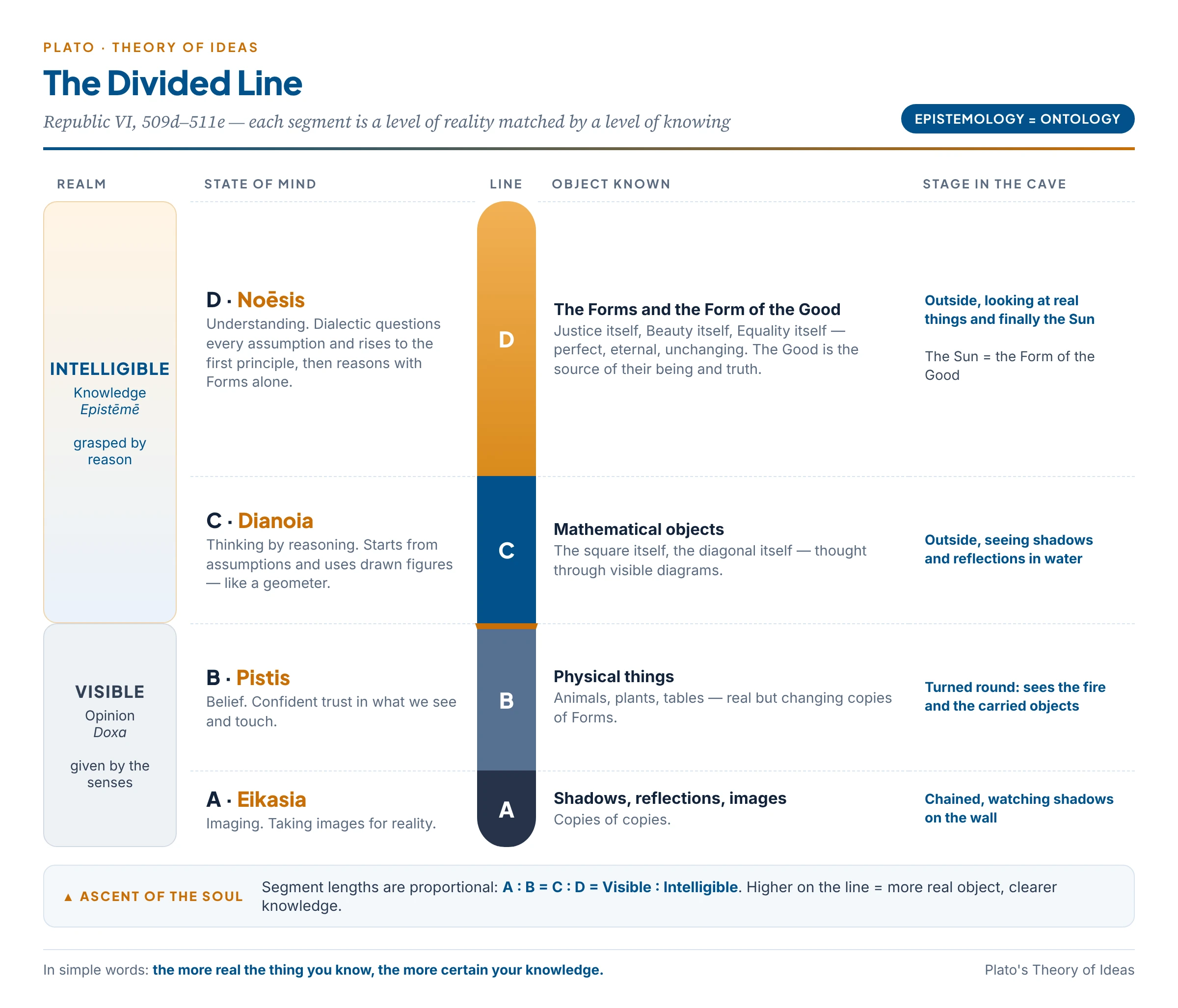
- Meeting point of epistemology and metaphysics: the two worlds of his metaphysics become two kinds of cognition — opinion (lower, visible) and knowledge (higher, intelligible).
- Ontology mirrors epistemology: each mental state is defined by the degree of reality of its object; clarity of cognition ∝ reality of the object.
- Four types of knowledge, lowest to highest:
- Conjecture / illusion (Eikasia) — images, shadows, dreams, hallucinations, a painting of an apple. Plato would include illusions like a snake seen in a rope, silver in nacre, a mirage. Comparable to Śaṅkara’s prātibhāsika level.
- Belief / sensuous knowledge (Pistis) — knowledge of physical things by touching or tasting an apple. It is useful but conditioned by our mental make-up; comparable to Śaṅkara’s vyāvahārika level.
- Hypothetical / mathematical knowledge (Dianoia) — starts from assumed definitions (point, line) and deduces from them; necessary but not actual. It is the mediator between the sensuous and the rational, linking the two worlds.
- Rational insight (Noēsis) — direct grasp of the Forms and the Good by dialectic, with no reliance on sense. This makes Plato the forerunner of Western rationalism.
- Same object, different levels: the Line is not four different sets of things but four ways of grasping one reality — a picture of an apple, the physical apple, its measurable properties, and appleness itself.
- Philosopher vs ordinary person: the ordinary person can recognise a just act; the philosopher asks “what is justice?” — what makes all just acts just. That is the difference between opinion and knowledge.
- Dianoia vs Noēsis: the geometer assumes odd and even and draws diagrams; the dialectician questions every hypothesis and climbs to the Good, then descends using Forms alone.
- The two middle segments (B and C) are mathematically equal — a sign that the Line is proportional, not a ladder of arbitrary steps.
The Allegory of the Cave — the Line dramatised as the education of the soul:
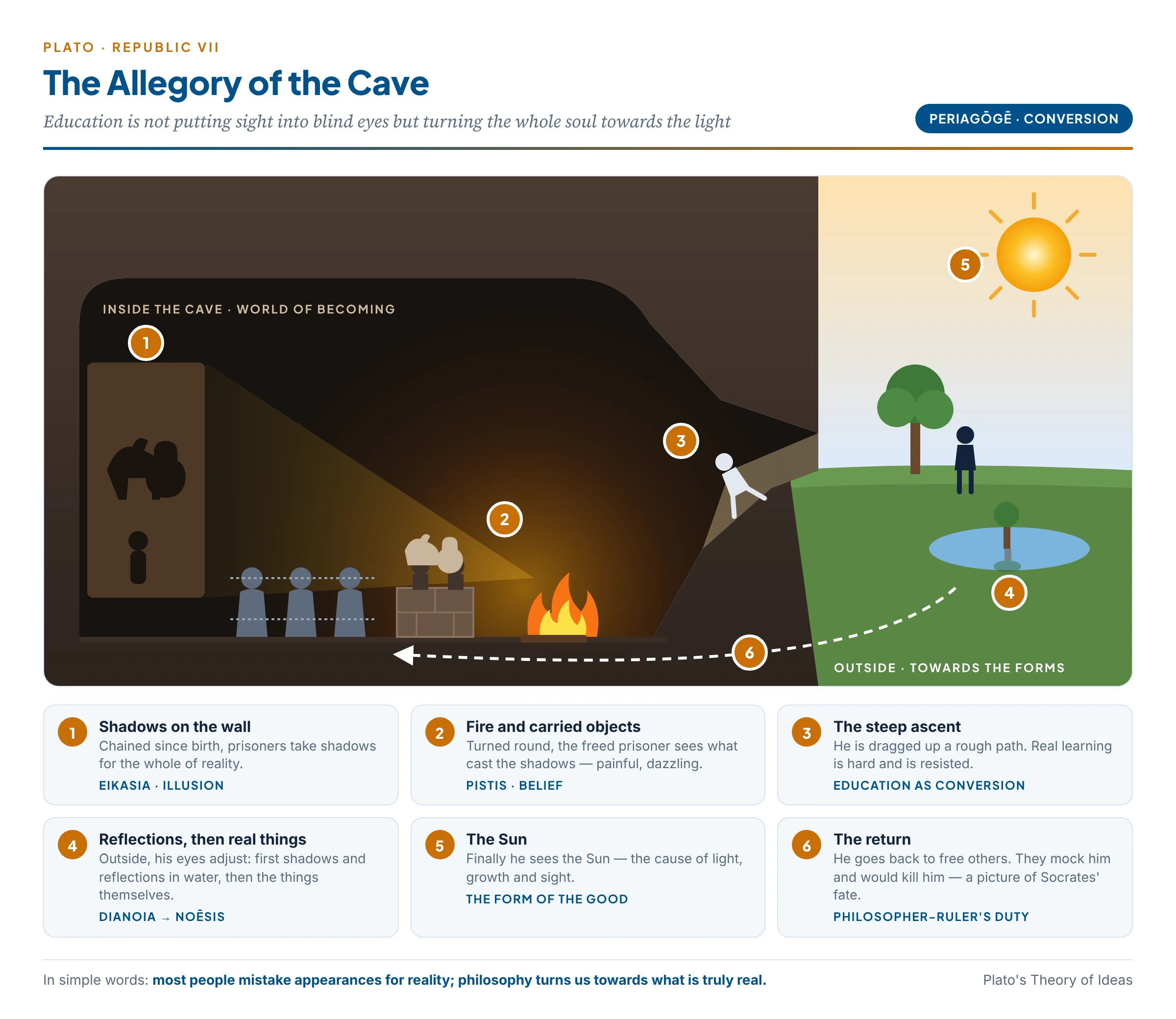
- Four grades of knowledge in the story:
- Men in chains → conjecture: they see only shadows and echoes, are ruled by prejudice, passion and sophistry, and have no wish to escape.
- Men unbound inside the cave → belief: they turn to the fire (a visible stand-in for the sun) and the objects carried before it, and realise shadows are for dreamers.
- Men outside the cave → reasoning: they first look at reflections of the stars and sun in water — the mathematical entities.
- Men fully liberated → understanding: they see real things and finally the sun — the Form of the Good.
- What Plato wants to prove: (i) ordinary people mistake appearance for reality; (ii) education is conversion (periagōgē) of the whole soul, not insertion of sight into blind eyes — philosophy transforms, it does not merely inform; (iii) the transition is painful — the light dazzles; (iv) the knower must return — the epistemological climax founds the political doctrine of the philosopher-king; (v) the death threat recalls Socrates.
- The escaped prisoner’s failure to convince the others can be read as Plato’s own admission that the relation between Forms and particulars is hard to make clear to those who trust only the senses.
Indian Connect
Seeing the sun directly is like Brahmajñāna or Nirvāṇa — a liberating vision, not just information.
- Cave and Line are one continuous ascent from illusion to the Good.
10. Hierarchy of Forms and the Form of the Good
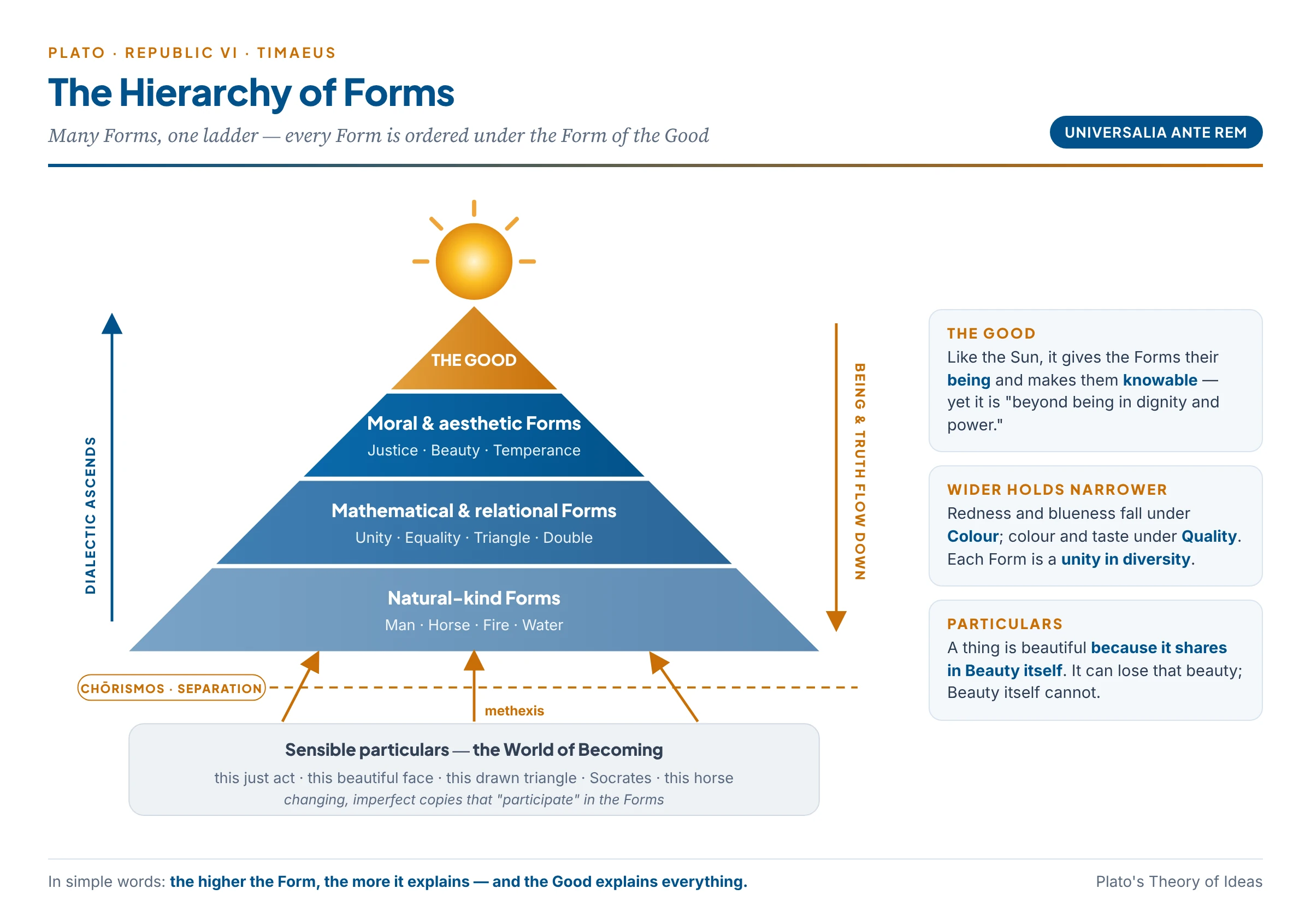
- Basis of the hierarchy — comprehensiveness: narrower Ideas fall under wider ones. Redness and blueness fall under colour; colour and taste under quality. Similarly human-ness → mammal-ness → living being → … → the Good. All Ideas are finally comprehended in the one Idea of the Good, which crowns the “heaven of Ideas.”
- System of Ideas: images → material objects → lower (species) Forms such as Horse or Triangle → higher Forms such as Truth, Beauty, Justice, Unity → the Good. “The ascent is philosophical; the descent is ontological“: knowledge climbs up the ladder (epistemic ascent), while being flows down it.
- The Good as ultimate reality: the substratum of the universe — it holds the place that Substance holds in Spinoza and Brahman in Śaṅkara. It is the highest knowledge, highest value and supreme existence; free, self-existent, perfect; the true, the good and the beautiful.
- Summum bonum: the aim of all desire and activity; all creatures — even the gods — aim at it. A thing is useful or good only to the extent it participates in the Good.
- Indescribable: beyond finite speech and thought, senses and language — best described like Brahman, neti neti (“not this, not this”). The world exists because of the Good but is not the Good, as light is due to the sun but is not the sun.
- Teleological, not logical, rule: the Good controls and guides the whole hierarchy as its end, not as a premise from which the other Ideas are deduced. To understand anything fully is to see why it is best that it be so.
- Its roles: it explains (i) change — as the first, unmoved cause towards which everything strives; (ii) bondage and liberation — liberation is contemplation of the Good; (iii) ethics — the seeker must purify himself from pleasure and contemplate the Good.
- Fact and value fuse: the highest object of knowledge is also the highest object of desire — knowledge is virtue.
- “Beyond being”: Plato says the Good is even above being in dignity and power. Later Neoplatonists (Plotinus) built on this their idea of “the One beyond being.”
- Forms are connected, not isolated: in his later dialogue Sophist, Plato shows the most general Forms — Being, Sameness, Difference, Motion, Rest — combining with each other. The world of Ideas is a connected system, not a heap of separate essences.
Idea of the Good vs God — a conflict in Plato In the Timaeus the Demiurge (divine craftsman) is “good and free from envy” and shapes the world looking to the Forms. Plato’s earlier ontology and ethics put the impersonal Good at the top; his later theology adds a personal God. The two do not fit.
| God (Demiurge) | Idea of the Good |
|---|---|
| Personal, with will and purpose | Impersonal |
| Designs and shapes the world | Controls and guides all Ideas towards itself |
| Efficient cause | Final cause, the end of everything |
- Three possible relations — each fails:
- God causes all Ideas, including the Good → contradicts the ontology, where Ideas are independent, eternal and in no one’s mind.
- The Good is the basis of God → does violence to God as the absolute, highest reality.
- God and the Good are equally real → two absolutes, which is a contradiction.
- Conclusion: there is no full harmony between Plato’s ontology and his theology.
11. Love (Erōs) — the Way Out of the Cave (Symposium)
- Love is longing — a striving to possess what one lacks. It is the force that binds things together and lifts the soul.
- The ladder of love: from love of one beautiful body → all beautiful bodies → beautiful souls → beautiful laws and practices → beautiful knowledge → Beauty itself, eternal and unmixed.
- “To know is to be”: for Plato it is not enough to know the truth; one must become it. The more one knows, the more and the better one is. Epistemology turns into a theory of being and of self-realisation.
12. Forms and Particulars — the Relation
Plato himself saw that it is hard to bridge two worlds of opposite character, so he offers several models, none fully satisfactory.
| Model | Claim | Difficulty |
|---|---|---|
| Copy / Imitation (Mimēsis) | Ideas are original moulds; things are copies | How can a particular be a copy of a universal? A copy and its original should be of the same type. If things are mere copies, the world becomes wholly unreal. If the original is one, why do copies differ? Likeness also implies a shared feature → regress |
| Participation (Methexis) | Things are real to the extent they share in Ideas; a white table shares in whiteness and tableness | Ambiguous. Does each thing get the whole Form or a part (Parmenides “sail” dilemma)? A. D. Woozley: only a universal can participate in a universal; a spatio-temporal individual cannot share in what is beyond space and time. And if the universal is present in the particular, the world becomes more real than Plato allows |
| Expression | Things are imperfect expressions or shadows of Ideas | Calling the world a shadow makes it absolutely unreal, though elsewhere Plato grants it partial reality |
| Presence (Parousia) | The Form is “present” in the thing | Threatens transcendence; makes Forms immanent |
| Craft model (Timaeus) | Demiurge imposes Forms on the Receptacle (Chōra) | Introduces a quasi-material principle |
- Who held what: critics note that the copy and participation theories were originally Socrates’; Plato first accepted and later questioned them.
Indian Connect
Participation resembles Samavāya (inherence) in Nyāya-Vaiśeṣika, the relation that binds a universal to its individuals.
In simple words
One seal pressed into many pieces of wax makes many impressions; each impression is a little blurred by the wax. The seal is the Form, the impressions are particulars, the wax is the Receptacle.
- The Receptacle (Chōra): a “nurse of becoming,” a spatial medium in which images of the Forms appear; it explains why copies are imperfect and why sensibles change — a precursor of Aristotle’s matter.
13. Immanent and Transcendent at Once
- Transcendent: as being — Forms exist independently, outside space and time, unaffected by particulars.
- Immanent: as presence / cause — whatever is beautiful is beautiful by Beauty; the Form is in the thing as its intelligible character.
- Resolution: transcendence is ontological (independence), immanence is explanatory (the particular depends on and expresses the Form) — like the sun that is far yet whose light is everywhere.
- The asymmetry of dependence is the point: particulars need Forms; Forms do not need particulars.
14. “There is a red chair” — Plato’s Analysis
- “There is” → the chair belongs to the World of Becoming: it exists only in a derivative way, between being and non-being.
- “Chair” → it is a chair by participating in the Form of Chair (the carpenter “looks to” the Form while making it); a painter’s chair is a copy of a copy — thrice removed from reality.
- “Red” → its colour is due to Redness/Colour itself; the chair can lose redness, Redness cannot become non-red.
- Knowing vs believing: perceiving the red chair is pistis; understanding what chairness and redness are is noēsis.
- Unity: the sentence joins two Forms (Chair and Red) present in one thing at one place and time — possible because Forms can combine with each other.
15. Does the Theory Entail Essentialism?
- Yes: each Form is the essence (what-it-is) of its kind; definitions state the Form; particulars have essential features (by participation) and accidental ones (by circumstance). Man is a rational animal whatever his height or complexion.
- Strong (Platonic) essentialism: essences are real, separate and prior to individuals — universalia ante rem.
- Qualification: Plato’s essentialism is normative as well — Forms are ideals of perfection, not just classificatory kinds — and the Parmenides hesitates over Forms of “hair, mud, dirt.”
- Contrast: Aristotle’s essentialism is immanent; nominalists (Ockham), Wittgenstein’s family resemblance and Locke’s “nominal essence” reject Platonic essences.
16. Is Knowledge One of the Forms?
- Plato himself raises it: if there is Knowledge itself, it knows the Forms; our knowledge, belonging to our world, knows only things of our world — so we cannot know the Forms, and God (having Knowledge itself) cannot know us. This “greatest difficulty” threatens the whole theory.
- Response: in the later dialogues knowing is treated as a relation between the soul (the knower) and the Forms (the known). So knowledge is better seen as a power of the soul directed at the Forms, not as one more separate Form.
17. Can the Theory Explain Change and the Sensible?
- Not adequately (Aristotelian view): Forms are static; nothing in a static paradigm explains why a particular comes to be or perishes.
- Platonic replies: (i) change is explained by the soul as self-mover; (ii) by the Demiurge as efficient cause; (iii) by the Receptacle as the medium of becoming; (iv) by the Good as the end towards which things strive. The theory explains what things become (their intelligible pattern), the soul and Demiurge explain that they change.
- Sensibility: sensibles are perceptible precisely because they are not pure Forms; their imperfection is their visibility.
- Static vs dynamic: Plato’s mathematical, static view inspires Spinoza; Aristotle’s biological, dynamic view inspires Leibniz.
18. Forms in Ethics and Politics
- Knowledge is virtue: one who truly knows the Good cannot knowingly do evil; vice is ignorance.
- Tripartite soul: reason, spirit and appetite; justice in the individual is each part doing its own work under reason.
- Ideal state: guardians (philosopher-kings), auxiliaries and producers mirror the parts of the soul; only those who have seen the Good are fit to rule. “Until philosophers are kings… cities will never have rest from their evils.”
- These are Paper II themes; here they matter as the practical payoff of the theory — objective Forms make objective justice possible.
19. Three Interpretations of the Theory
| Interpreter | Point of view | What the theory says |
|---|---|---|
| Zeller | Ontological | Ideas are ultimate realities with real existence, not mental constructions — “realistic idealism” |
| Zeller | Logical | Ideas are universals, not particulars — required because the sensible world is impermanent |
| Zeller | Axiological | The Good is the highest value; the aim of philosophy is the soul’s return to its pristine glory |
| W. T. Stace | Epistemological | Ideas are the basis of all knowledge; knowledge is of the universal and eternal, opinion of sensibles |
| W. T. Stace | Mystical | Ideas exist in a “heaven”; the Good draws all to itself, and a glimpse of it liberates — a soteriological end like Indian philosophy |
- Put simply, the theory has three faces: epistemological (rationalism), metaphysical (the nature of reality) and mystical (soul, bondage, rebirth, liberation).
Critical Evaluation
Plato’s Own Self-Critique (Parmenides)
- Scope: are there Forms of hair, mud, dirt? Of man, fire, water? Young Socrates hesitates.
- Whole–part dilemma: if the whole Form is in each participant, it is separated from itself; if a part, Largeness is divided into small parts — absurd.
- Largeness regress (the argument Aristotle later named the “Third Man“): large things + Largeness, viewed together, reveal a second Largeness, and so on infinitely — every Form becomes “unlimited in multitude.”
- Forms as thoughts? If thoughts, everything participating thinks, or thoughts are unthinking — rejected.
- Likeness regress: if particulars resemble Forms, Form and copy share a likeness, needing a further Form.
- Greatest difficulty: unknowability of Forms (above).
- Yet Parmenides insists that without Forms “the power of dialectic is destroyed” — the problems call for refinement, not abandonment.
Aristotle’s Critique
“To say that the Forms are patterns and that other things share in them is to use empty words and poetic metaphors.” — Aristotle
- Two master objections: the Ideas (i) cannot explain the nature and existence of particular things, and (ii) cannot be related to them. Everything else elaborates these two.
- Chōrismos: separating essence from the thing whose essence it is makes the essence inexplicable; beauty can exist only in beautiful things.
- Duplication: positing Forms is like counting a crowd by doubling it — the problem multiplies.
- No causal power: Forms are static, so they explain neither motion nor generation; what is the efficient cause?
- Third Man (Tritos anthrōpos): Socrates and Man-itself share “man,” requiring a third Man.
- Abstraction reversed: it is the man that leads us to the idea of manness, not the other way round; Plato inverts the order.
- Alternative: universals exist in things (universalia in re) as their form. (Full treatment in the next article.)
Modern Views
- Why the Third Man arises: the regress starts only if the Form is treated as one more beautiful thing standing beside beautiful things (“Beauty is beautiful” in the same way that a rose is beautiful). Then Beauty and the rose share a feature, and a further Form is needed.
- The usual reply: a Form is what the quality is, while a thing only has the quality. “Beauty is beautiful” means “Beauty is what beauty is,” not “Beauty is one more beautiful object” — so no third Form is needed.
- An explanation must stop somewhere: even so, critics say, an explanation that keeps calling for a further Form explains nothing.
Critics and Defenders
Criticism — Other critics
- The “A explains B” test: A explains B only if A is necessary for B (deny A and B is denied) and A is rational. Plato’s theory passes the second test, but deny it and nothing in the sensible world changes — so it does not explain the world in the strict sense.
- Ockham’s razor: medieval critics say Plato multiplies independent entities beyond necessity.
- Empiricism: Locke, Hume — concepts derive from impressions; no innate ideas.
- Modern science: seeks laws among observable events and has no use for transcendent archetypes.
- Nominalism: Ockham, Hobbes — only particulars and names exist.
- Wittgenstein: “game” has no single essence, only overlapping family resemblances.
- Myths are not proofs: the recollection-myth and the cave illustrate but do not demonstrate.
Defence — In defence of Plato
- Aristotle also accepted forms — he only moved them inside things; the disagreement is about location, not existence.
- Plato never called the world wholly unreal — it is “real and unreal,” less real than the Ideas but not nothing.
- Much criticism misreads poetic language: by placing Ideas in a “transcendent world” Plato meant to give them a higher degree of reality, not a literal address.
- Aristotle repeats the move he criticises: Plato makes God the efficient cause shaping the world after the Ideas; Aristotle himself crowns his system with pure form (God), immutable and separate.
- Aristotle may have overstated the differences to establish his own theory; there are deeper similarities than differences. As the saying goes, “Aristotle is Plato made consistent.”
- No criticism makes the theory redundant: the problems of universals, objectivity and value it raised are still live.
- Modern support: mathematical Platonism (Frege, Gödel) holds that abstract objects are needed for truth and objectivity in mathematics; Russell (Problems of Philosophy) defends a world of universals.
Cross-Tradition Comparison
Plato and Indian Theories of Universals
| Aspect | Plato | Nyāya-Vaiśeṣika | Mīmāṃsā | Buddhism |
|---|---|---|---|---|
| Name for universal | Eidos | Jāti / Sāmānya | Ākṛti (form) | — |
| Reality | Real, eternal | Real, eternal, one | Real, eternal | Denied |
| Location | Separate (ante rem) | Inheres in individuals by inherence (Samavāya) | In individuals | Only conceptual construction |
| Known by | Reason, recollection | Perception (extraordinary sāmānya-lakṣaṇa pratyakṣa) | Perception | Apoha — exclusion of the other |
| Hierarchy | Under the Good | Para (Being, Sattā) to apara | — | — |
Indian Connect
- Nyāya is closer to Aristotle (universals real but in things); Buddhist apohavāda (Diṅnāga, Dharmakīrti) is a sophisticated nominalism — “cowness” = exclusion of non-cows.
Plato and Śaṅkara
| Point | Plato | Advaita Vedānta |
|---|---|---|
| Two levels | Being / Becoming | Pāramārthika / Vyāvahārika (with Prātibhāsika below) |
| Status of world | Less real copy, not nothing | Neither real nor unreal (Anirvacanīya) |
| Cause of error | Ignorance, attachment to senses | Avidyā, superimposition (Adhyāsa) |
| Illustration | Shadows on cave wall | Rope mistaken for snake |
| Highest | Good beyond being; ground of all | Brahman — Neti neti, beyond predicates |
| Liberation | Dialectical ascent to the Good | Jñāna — knowledge of Brahman-Ātman identity |
| Recollection / recognition | Anamnēsis | Pratyabhijñā-like realisation of what always was |
Indian Connect
- Difference: Plato’s Forms are many and the world is a structured copy; Śaṅkara’s Brahman is one without a second, and plurality itself is appearance (Vivarta).
- Kant parallel: phenomena/noumena echoes Becoming/Being — but for Kant the noumenal is unknowable by theoretical reason, whereas for Plato the highest reality is most knowable.
Plato and Theories of Knowledge
| Plato | Descartes | Locke | Kant | |
|---|---|---|---|---|
| Source | Recollection of Forms | Innate ideas | Experience only | A priori forms + experience |
| Senses | Occasion only | Unreliable | Foundation | Necessary but insufficient |
| Object of knowledge | Forms | Clear & distinct ideas | Ideas of sensation/reflection | Phenomena |
Synthesis (Siddhānta)
The Theory of Forms is the first systematic metaphysics of intelligibility: it holds that the world can be known only because it has a stable rational structure not exhausted by any of its instances. Its weaknesses — the chōrismos, the regress, the static character of Forms, the clash between the Good and God — are real, and Plato saw several of them first. Aristotle’s immanent forms answer the explanatory gap but keep the essential Platonic insight: the universal is what makes a thing knowable.
- Metaphysical legacy: realism about universals, abstract objects, and the debate between Platonism, conceptualism and nominalism continue.
- Epistemic legacy: knowledge as justified/explained true belief begins with the Meno and Theaetetus (later tested by Gettier); recollection becomes the innate ideas of Descartes and Leibniz.
- Religious legacy: Platonic dualism of soul and body, and the Good as the highest reality, shaped Neoplatonism and Christian theology.
- Mathematics and science: physics’ search for invariant laws and symmetry principles is Platonic in spirit — reality behind appearances expressed in mathematical form.
- Ethics & education: education as conversion, not information transfer; objective values against relativism and “post-truth” opinion — the cave is a ready image for echo chambers and manufactured appearances in the digital age.
To know, for Plato, is not to see more things but to see what things are — and that requires turning the whole soul around.
Previous Year Questions
- 2025“Ideas are timeless and spaceless.” Elucidate this statement with reference to Plato.
- 2024Differentiate between Plato’s and Aristotle’s conceptions of form.
- 2023Critically examine Plato’s a-priori proofs for the immortality of the soul.
- 2022How does Plato use the theory of forms to establish the relation between epistemology and metaphysics? Discuss.
- 2021“There is a red chair.” How would Plato explain this statement with the use of his theory of forms? Examine.
- 2019What does Plato want to prove by his ‘Allegory of Cave’?
- 2018Is the relation between the idea and the World as discussed by Plato logically consistent? Discuss Aristotle’s views regarding this and also give arguments in favour of your answer.
- 2017In what sense can ideas be both immanent and transcendent? Discuss in this context Plato’s theory of universal and particulars.
- 2016Does Plato’s ‘Theory of Form’ explain the ‘change’ and ‘sensibility’ of matter? Give reasons for your answer.
- 2015Explain Plato’s theory of forms. Does it entail a kind of essentialism? Discuss.
- 2014Discuss between knowledge and belief according to Plato. How is it based on his metaphysics? Explain.
- 2013Explain Plato’s ontological theory of Forms. Is knowledge one of the Forms? Explain.
- 2011How does Plato relate the world of ideas to the empirical world? Discuss.
- 2010Distinguish between the Indian concept of jīvātmā and Plato’s concept of soul.
- 2009Comment on – Plato’s analogy of the cave and its significance in his theory of knowledge.
- 2007Write short notes on: Plato’s recollection theory of knowledge.
- 2005Write short notes on: Distinction between opinion and knowledge.
- 2004State and discuss Plato’s theory of forms.
- 2002While Plato’s metaphysics is a visionary one, Aristotle’s metaphysics is a descriptive one! Explain fully giving the essential differences between the views of the two thinkers regarding the nature of reality.