

Few questions in the study of international politics are asked as often and answered as carelessly as whether non-alignment still matters. The carelessness has a single cause: the question runs three different things together and then demands one verdict on all of them. Sorting them out does most of the analytical work, and what survives the sorting is a defensible position rather than a slogan.
Three things called “non-alignment”, and why every relevance dispute turns on separating them

- Non-alignment is a doctrine, the Non-Aligned Movement is an organisation, and the movement’s normative ethos is a reputational asset — three distinct objects with three distinct fates. Almost every argument about relevance is a failure to keep them apart.
- The doctrine is a claim about conduct: that a state may take positions issue by issue, on the merits as it judges them, without accepting a patron. It is a rule for decision, and can be practised by a state that never attends a summit.
- The organisation is the institutional apparatus — the triennial summits, the rotating chairmanship, the coordinating bureau, the consensus declarations. It has no charter, no secretariat, no treaty obligations and no enforcement, by original design.
- The ethos is the normative vocabulary the movement made respectable: sovereign equality, non-intervention, peaceful settlement, opposition to coercive unilateral measures, solidarity with the formerly colonised. It is a stock of legitimacy that outlived the conditions that produced it.
- Once separated, the three can be assessed independently, and they do not receive the same verdict.
- A critic who proves that the organisation cannot act has proved nothing about the doctrine.
- A defender who cites 120 members has said nothing about whether those members practise the doctrine.
- A state may abandon the vocabulary of the movement while intensifying its practice of the doctrine — which is close to a description of Indian foreign policy since 2014.
| The object | What it consists of | The test of relevance | Current standing |
|---|---|---|---|
| Doctrine | Decisional autonomy; judgement issue by issue; refusal of exclusivity | Do states still find it useful to remain unclaimed? | Strengthened — more suitors in a multipolar system |
| Organisation | Summits, chairmanship, bureau, consensus declarations | Can it produce outcomes its members could not produce alone? | Weak — no capacity, low salience |
| Ethos | Sovereign equality, non-intervention, anti-coercion, South solidarity | Does it generate attraction and legitimacy? | Live — the working idiom of Global South diplomacy |
The movement is a legacy institution; the doctrine it invented is a live technique of statecraft. Confusing the two produces most of the bad arguments on both sides.
What 1991 removed: a movement that lost its structural rationale
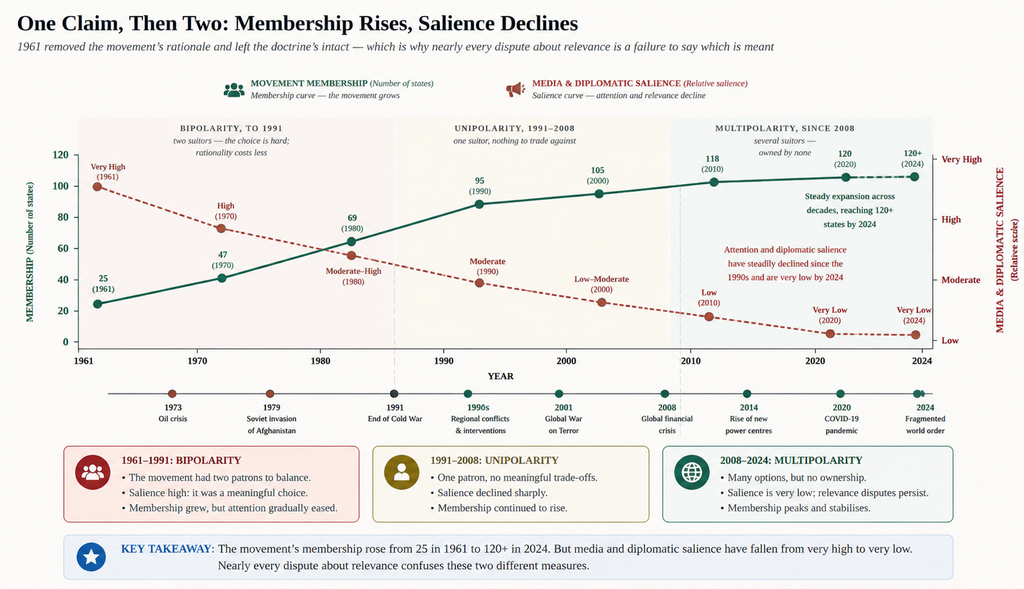
The end of the Cold War did not merely reduce the movement’s importance; it removed the condition that defined it. Non-alignment named a position between two poles, and when one pole vanished the position lost its geometry. Everything written since has tried to answer the question that opened at that moment — non-aligned between what?
The four shocks of 1989–92
- The disappearance of the second pole destroyed the movement’s bargaining logic. Its leverage had never rested on material power; it rested on the ability of weak states to extract concessions from each superpower by threatening to tilt toward the other.
- With one superpower left, there was nothing to tilt toward, and therefore nothing to withhold.
- The manoeuvring space and the intermediary role between the blocs — the two functions the movement had genuinely performed — both closed at once.
- A founding member proposed dissolution. Egypt, one of the states present at Belgrade, argued that the movement’s purpose had lapsed with the bipolar order and that it should be wound up rather than continued out of habit.
- Yugoslavia, the movement’s birthplace and one of its five founders, disintegrated while the movement said nothing. The organisation played no role whatever in managing the crisis, and the summit that had launched the movement in 1961 was held in a capital of a state that no longer existed.
- The failure was compound: a founder, in Europe, in a conflict raising exactly the questions — self-determination, intervention, sovereignty — the movement claimed as its own.
- The members were silent on Iraq’s invasion of Kuwait, although both parties were members. Aggression by one member against another produced no collective position, and the movement played no part in the Gulf crisis that followed.
- A body with no charter and no obligation of mutual restraint cannot discipline its own membership.
Jakarta 1992 and the phrase that has stuck
- The tenth summit at Jakarta in 1992 was the movement’s first attempt to answer the question 1991 had posed, and it set the direction the movement has followed since — away from bloc politics and toward development, South–South cooperation and the reform of international economic institutions.
- It accepted, in effect, that the political rationale had lapsed and an economic one would have to carry the movement — and began the practice of producing enormous consensus documents that are comprehensive, uncontroversial and unenforceable.
- The phrase that captures the whole period is that since 1991 the movement has been in search of an agenda. The search has produced themes; it has not produced a rationale of the kind bipolarity supplied automatically.
- The distinction matters even here. The organisation lost its rationale in 1991; the doctrine did not, never having been a claim about two blocs specifically but about not surrendering judgement to anyone.
The case that non-alignment is redundant
The strongest form of the redundancy case is not that the movement failed but that it succeeded and was superseded — the conditions it existed to address no longer obtain, and the honest response is closure rather than continuation.
The structural argument: the raison d’être has gone
- Hans Köchler, who has written extensively on the movement, puts the position in its sharpest form: non-alignment was relevant only to a bipolar world, and with a single dominant power it has lost its object.
- He adds the more uncomfortable half of the argument: most member states are so heavily dependent on the United States — for markets, finance, security assistance and technology — that they are not non-aligned in any meaningful sense. The label survives the condition it described.
- The blocs the movement defined itself against no longer exist. SEATO and CENTO dissolved decades ago; the Warsaw Pact was wound up in 1991. There is no longer a pair of alliance systems between which a state must decline to choose.
- Foreign military bases, once the movement’s standing grievance, matter less than they did: long-range air power, sea-based deterrence and satellite reconnaissance have reduced the weight of basing rights that once made hosting a base equivalent to alignment.
- Decolonisation, the flagship campaign, is finished. Making the dismantling of empire a standing item of General Assembly business was the movement’s most concrete achievement, and a campaign cannot be a rationale once it has been won.
- The end of the Cold War was therefore the moment at which the movement could have closed with its reputation intact — the argument for a graceful exit rather than an indefinite afterlife.
The competition argument: outperformed by bodies that actually do things
- The movement now competes for the attention of its own members with organisations that deliver concrete goods, and it loses.
- The G-20 sets the agenda on macroeconomic coordination, financial regulation and debt treatment.
- ASEAN and the African Union conduct trade facilitation, dispute management and, in the AU’s case, peace operations; the Organisation of Islamic Cooperation commands a constituency with its own institutions.
- BRICS has built financial machinery — a development bank, a reserve arrangement, payment-system discussions — of a kind the movement never attempted.
- The reason the competitors outperform it is structural, not accidental. They focus on trade, finance and concrete functional cooperation, which produce measurable results and give members a reason to attend.
- The movement has no charter, no obligations, no secretariat and no diplomatic activity of its own. It cannot negotiate, cannot represent its members, cannot bind them and cannot follow up. It convenes; it does not act.
The agenda argument: no progress even where members agree
- The movement has failed to advance even the issues on which its members do not disagree. This is the most damaging version of the critique, because heterogeneity cannot explain it.
- Drug trafficking, international terrorism and non-proliferation are subjects of broad common ground on which nothing operational has been produced.
- Without fresh themes the movement becomes a triennial conference with no purpose beyond its own continuation — a gathering whose principal output is the document announcing that it has gathered.
- The two goals the movement has held most consistently — development of the third world and the eradication of poverty — remain the two on which its progress is least visible.
The Indian critics, who make the case in four different registers
- Jagat S. Mehta argues from success rather than failure: the movement was founded to assert the independent rights of nations, that has been achieved, and the honest course is to declare the mission accomplished and discontinue it.
- C. Raja Mohan makes the harshest version, and makes it about the whole life of the movement, not just its afterlife.
- The movement was irrelevant even before the Cold War ended, because it was extremely idealist to expect so many states with divergent interests to harmonise into a collective position.
- The end of the Cold War was the moment for a graceful exit from a platform with no achievement behind it and no prospects ahead of it — and it was the best possible moment, because the movement could have taken some credit for the Cold War’s peaceful end.
- Instead, the movement is in a coma, kept there because its members were not prepared for a burial and prefer the triennial rituals.
- India’s own approach to it, he adds, has been a tabula rasa — a blank surface capable of accommodating any idea, and so of endorsing economic pragmatism and muscular geopolitics at once.
- S. Jaishankar frames it as a question of temporality rather than of truth or falsehood.
- Non-alignment was an idea born of a particular period, a factor of continuity in Indian foreign policy while that period lasted.
- India should take the independence of action from it and move beyond it, in order to respond efficiently to contemporary conditions.
- Crucially, the rejection of non-alignment is not a rush to alignment. India will not join an alliance system, because “alliance” is as much a Cold War concept as non-alignment is. Both belong to the same vanished architecture.
- Harsh V. Pant argues from changed capability: non-alignment was prudent when India was neither an economic nor a military power. A state of India’s present weight has different instruments and different goals, and there is no point clinging to old shibboleths.
| Critic | The ground of the critique | What it would have India do |
|---|---|---|
| Köchler | The doctrine was indexed to bipolarity; members are in fact dependent | Stop describing as non-aligned what is not |
| Jagat S. Mehta | Mission accomplished — independent rights of nations secured | Declare success and discontinue |
| Raja Mohan | No achievement, no prospects; idealism about harmonising interests | Should have exited in 1991; end the rituals |
| Jaishankar | An idea born of a particular temporality | Retain independence of action; abandon the frame — but not for alliance |
| Pant | Prudent for a weak India, not for a capable one | Pursue new goals; drop the shibboleths |
The case that non-alignment survives
The defence is weakest when it recites membership figures and strongest when it addresses the critics’ premises: that the conditions non-alignment answered were never only about two blocs, and that dismissing a coalition of weak states is itself a position requiring examination.
T.V. Paul: the bias against weak-state coalitions, and soft balancing revived
- T.V. Paul begins by questioning the standard of judgement rather than the record. The movement never received the credit it deserved, and the reason is an intellectual bias against coalitions of weaker states.
- The bias is structural: it mirrors the disdain of upper classes and upper castes for subaltern movements in hierarchical societies. Movements of the weak are judged by whether they achieved what only the strong can achieve, and found wanting.
- Judged by what a coalition of the weak can actually do, the movement functioned as a limited soft-balancing mechanism — constraining great powers not by counter-armament but by naming, shaming and withholding legitimacy.
- His forward-looking claim is that the conditions for soft balancing have returned. Great powers are once more in an arms race, in the militarisation of oceans, and in territorial expansion — precisely the behaviours a normative coalition exists to delegitimise.
- There is space for the resurrection of the old movement as a soft-balancing mechanism against powerful states, and a need to revive the Bandung spirit.
- The argument is prudential as well as normative: if third-world states do not act as a cushioning force, the order will spiral toward open conflict, whose costs fall on the weak.
- The uncomfortable corollary is that the movement’s two largest members cannot lead the revival. India and China are themselves in the race for great-power standing, and a state pursuing that standing cannot credibly lead a coalition constraining it. The onus falls on smaller countries.
Tharoor, Sreenivasan, Narayanan: three defences that concede different amounts
- Shashi Tharoor concedes the most and still defends the movement: the very name signifies the negation of a choice no longer on the world’s geopolitical table.
- But the movement widened its objectives rather than dissolving with the condition: it now serves to resist the hegemony of a single superpower and to assert the independence of its members. The label is dated; the function is not.
- T.P. Sreenivasan makes the cleanest doctrinal defence: non-alignment stood for freedom of judgement and action, and a freedom so defined remains valid whether there is one bloc or two, or none.
- It let India pursue its interest according to its own preferences and navigate bipolarity; India retains a stake in the movement’s integrity, needing partners with whom to exercise judgement away from the United States, Russia and China.
- M.K. Narayanan gives the most carefully hedged verdict, and the most useful. With non-alignment giving way to strategic alignment, bodies like the movement may seem anachronistic — he does not dispute the appearance.
- But it still resonates with many third-world countries and offers an alternative platform for putting forward a different viewpoint.
- Therefore pronouncing the death of the movement is premature — a modest claim: not that it is effective, but that nothing has replaced the function it performs for states wanting a forum they need not be invited into.
Narasimha Rao’s reformulation, which is the pivot of the whole debate
P.V. Narasimha Rao performed the intellectual manoeuvre that made continuation arguable at all. Rather than defending the movement’s Cold War purpose, he redefined its object: the concern of the non-aligned is no longer superpower rivalry but giving voice to and addressing the concerns of developing countries. The subject of the movement changed from the blocs to the South.
“Nonalignment basically consists of the espousal of the right of nations to independence and development, regardless of the bloc phenomenon. Whether there is one bloc or more at a given moment, the urge for a nonaligned country would continue to be to maintain its independence, to take decisions according to its light, not tagging along itself, in advance, to others.” — P.V. Narasimha Rao
- The fuller statement contains the decisive move: “regardless of the bloc phenomenon”. If non-alignment is the espousal of the right to independence and development, it was never logically dependent on there being two blocs, and its object survives their disappearance.
- The operative phrase is “not tagging along in advance”. Non-alignment is defined as a refusal of prior commitment, not a refusal of cooperation — which is why it is compatible with dense partnerships and incompatible only with exclusivity.
- This is the reading on which almost every serious defence since has depended, the vocabulary of strategic autonomy included.
Three further defences, each supplying something the others do not
- A further defence casts the movement as a “timeless organisation”: the complexity of the problems facing developing countries requires a platform that brings them together, and the need for such a platform is not indexed to any particular configuration of power.
- A second line of defence shifts the ground from the past to the future: the dynamics of globalisation have produced a whole set of new problems which the movement must take note of — a claim that the agenda is available if the movement will pick it up, and that failure is one of will rather than obsolescence.
- Aparna Pande explains what the doctrine did for a weak state, which the critics tend to skip.
- India was militarily and economically weak and yet aspired to a leadership role.
- Non-alignment let it maintain independence while remaining a participant in world politics, and hold relationships with both superpowers without being coerced by either.
- Its value rises as a state’s relative power falls, which is why it keeps its appeal among smaller members even as the largest discard the vocabulary.
The numerical argument, and exactly what it is worth
- The movement has 120 member states, 18 observer states and 10 observer organisations, making it the largest grouping of states after the United Nations itself.
- That is roughly two-thirds of UN membership and about 55% of world population — a constituency no other body outside the UN can claim.
- What the numbers establish is that the constituency exists and has not defected: no member has left, states continue to join, the summit cycle has run unbroken since 1961.
- What they do not establish is capacity. Size is what makes consensus produce lowest-common-denominator declarations, turning the movement into a forum where issues are discussed and debated rather than resolved.
- The honest formulation is that numbers are a latent asset, not an active one: standing to speak, without the means to act. Converting one into the other is the whole problem of reform.
A constituency of two-thirds of the world’s states is a bargaining position that nobody has yet worked out how to bargain with.
The unfinished agenda: what 1991 did not settle
The strongest defence of continued relevance is a list of grievances that were live in 1991, remain live now, and are addressed by no other body in which the South holds a majority. If the North–South divide has survived under new names, so has the movement’s agenda.
The divide itself, and the concert that manages it
- The world after 1991 was not simply unipolar, and the disagreement about its shape is part of the analysis.
- Some read it as unipolar, the United States sole superpower; others as multipolar, with the European Union, Japan, Russia and China as independent centres; others as uni-cum-multipolar, unipolar in security and multipolar elsewhere.
- Whatever the terminology, the operative fact for developing countries was that the United States and the G-7 powers could act in concert to manage the rest of the world — what has been called a new Northern concert of powers.
- The practice became harder, the manoeuvring space having closed; the need rose, since developing states had to act together or be overwhelmed by the North.
- Multipolarity has not obviously helped them. It has presented an uncertain environment offering few new opportunities and increased vulnerability, with little sign that they can exploit the differences among the major economic powers.
- Shivshankar Menon describes the present order as militarily unipolar, economically multipolar and politically confused. For a weak state confusion is not neutral: it raises the value of staying uncommitted and the cost of guessing wrong.
Nuclear haves and have-nots
- The world remains divided into nuclear haves and have-nots, and the division hardened rather than dissolved after 1991.
- The nuclear-weapon states retained their arsenals, on a reduced scale, while preventing others from acquiring them — the movement’s oldest objection to the non-proliferation bargain.
- Deterrence, instead of being discarded when the Cold War ended, was retained and refined, and its targets shifted to third-world states, now named as the principal threats to the nuclear powers’ security. Those states are simultaneously pressed to cut their alleged excessive military expenditure by states whose own spending sets the global total.
- The contemporary figures make the asymmetry harder to argue away: global military spending reached $2,887 billion in 2025, 2.5% of world GDP and the highest share since 2009, with the top three spenders alone accounting for 51%.
- Bilateral nuclear restraint has lapsed entirely. New START expired on 5 February 2026 with no successor in force, leaving nothing legally binding on the two largest arsenals; the 11th NPT Review Conference closed in May 2026 without a consensus outcome, the third consecutive failure.
- This is the movement’s oldest grievance in its current form, and it is not addressed by any of the bodies that outperform the movement on trade.
Technology denial and the export-control regimes
- The developed states impose stringent restrictions on the transfer of technology to developing states, and the mechanism is an ever-expanding list of items designated as dual-use.
- The regimes doing the designating sit outside the United Nations, have restricted membership, and carry no sanction of international law.
- The Nuclear Suppliers Group, originating as the London Suppliers Group; the Missile Technology Control Regime; the Australia Group on chemical and biological items; and the Wassenaar Arrangement on conventional arms and dual-use goods.
- Closed membership and decisions taken outside a universal forum undermine multilateralism as a method even where the objectives are defensible.
- The lists are extensive enough to freeze the technological and industrial development of developing countries in vital areas, and it is genuinely difficult to determine whether a particular restriction is motivated by non-proliferation or by the commercial interest of preventing a competitor from developing capacity.
- The contemporary form is export controls on semiconductors, advanced computing and AI hardware — the same states, the same logic, the same ambiguity between security and commerce.
The migration of economic issues out of the United Nations
- Instead of revitalising multilateralism under the UN, the dominant states mounted a campaign to alter its agenda and confine its functioning.
- The hard economic issues were transferred out of the General Assembly into institutions where the North holds greater control — poverty reduction, development planning, trade, money, finance and debt moved to the International Monetary Fund, the World Bank and the trade regime built on the General Agreement on Tariffs and Trade.
- The forum matters because the voting rule does: one state one vote in the General Assembly, votes following quotas in the Bretton Woods institutions. The transfer also permits cross-conditionality, a state seeking relief in one institution finding the terms set by another.
- The demand for reform has a precise object. The 16th General Review of Quotas, agreed in December 2023, delivered a 50% equiproportional increase — which preserves existing shares and so realigns no voting power at all, with the consent period extended to 15 November 2026. Reform of the quota distribution has been deferred again.
Coercive economic measures and the new conditionalities
- In trade, the trend has been toward unilateral and bilateral coercive measures to force reciprocal market access, together with cross-retaliation across unrelated sectors — the substitution of leverage for negotiation.
- Secondary measures extend the coercion to third parties, penalising states for their trade with a sanctioned country rather than for any conduct of their own.
- New issues not directly linked to trade have been attached to it as conditions — labour standards, social conditions and the environment, and now carbon border measures, which apply a cost at the frontier for emissions embodied in imports.
- The objection is to the sequence, not the objectives: standards set by the states that industrialised first are applied to those industrialising now.
- The impression is simultaneously fostered that the third world is responsible for environmental degradation when the historic responsibility lies elsewhere.
- Meanwhile protectionism has risen in the developed economies just as most developing economies have been deregulating — the asymmetry the movement’s economic agenda has always described.
- The unilateral coercive measure is the single item on which the movement’s members are most nearly unanimous, and it appears in every recent declaration for that reason.
Debt, climate finance, health equity and the digital question
- Debt has become the sharpest expression of the divide. Global public debt reached about $102 trillion in 2024; developing countries owe roughly $31 trillion, up from 16% of the global total in 2010 to 31%.
- They paid a record $921 billion in net interest in 2024, and about 3.4 billion people live in countries that spend more on interest than on health or education.
- Developing states borrow at rates two to four times those available to the largest developed economies — a structural penalty independent of policy.
- Climate finance repeats the pattern. The new collective quantified goal agreed at COP29 in Baku set $300 billion a year by 2035 against a stated ambition of $1.3 trillion, and was rejected by major developing countries as inadequate both in scale and in the manner of its adoption.
- Vaccine and health equity became the sharpest grievance of the last decade: pandemic access tracked purchasing power rather than need, and intellectual-property waivers were resisted until scarcity had passed.
- Digital governance is the newest item and the least developed: rules on data flows, platform regulation and artificial intelligence are written in forums where developing states are consulted rather than represented.
- Security Council reform remains the political summit of the list, with the African position expressed through the Ezulwini Consensus and the Sirte Declaration, and the movement’s declarations continue to demand increased African representation in a reformed Council.
What strengthening the movement would actually require
- A vision of five parts has been articulated for revitalisation, and it is a reasonable statement of what an effective movement would have to do.
- Reform and strengthen the United Nations, restoring to it the economic questions that were moved out and democratising the Security Council.
- Encourage South–South cooperation with the G-77 on food, population, trade and investment.
- Strive for an equitable world order — equitable trade flows and technology transfer, and opposition to interventionism and imposed economic conditions.
- Consolidate the movement through necessary reforms of its own working methods.
- Adhere to the movement’s principles and build a common bargaining platform — the point being that a platform which bargains is different in kind from one that declares.
- The internal reforms are the harder half, and the defects are specific.
- Membership criteria are too liberal and are often violated, which admits states whose alignment is not in doubt and dilutes the meaning of the label.
- There is a lack of self-discipline among members, so declarations bind nobody, and the consensus method is weak, producing texts pitched at the least committed member.
- There is no mechanism for monitoring global events, so the movement reacts late and only when a summit falls due.
- A sixth requirement follows from the competition argument: a movement that cannot execute should specialise rather than comprehend, concentrating on the two or three questions where its numerical majority is a genuine bargaining asset — chiefly coercive measures, technology and finance — instead of issuing a position on everything.
A body that issues a position on every subject at once has found the surest way of never using the majority it holds.
The summit record since 1991
The summit series is the movement’s only visible institutional life, and the pattern is instructive: uninterrupted, geographically dispersed, and progressively less consequential in the diplomacy of its largest members.
| Summit | Host | Year | What it is remembered for |
|---|---|---|---|
| 10th | Jakarta | 1992 | The first post-Cold War summit; the turn to development and South–South cooperation |
| 11th | Cartagena | 1995 | The economic agenda consolidated; globalisation’s effects |
| 12th | Durban | 1998 | The first in a post-apartheid South Africa the movement had campaigned for |
| 13th | Kuala Lumpur | 2003 | Convened against the invasion of Iraq; revitalisation proposals |
| 14th | Havana | 2006 | A sharply confrontational chairmanship; reform of the UN as the centrepiece |
| 15th | Sharm el-Sheikh | 2009 | The last summit held in Africa before 2024 |
| 16th | Tehran | 2012 | Chairmanship passed to a state under Security Council sanctions |
| 17th | Margarita Island | 2016 | Attendance thinned sharply; India represented below head-of-government level |
| 18th | Baku | 2019 | Azerbaijan’s chairmanship; the vast consensus documents continued |
| — | Virtual contact-group summit | 4 May 2020 | “United Against COVID-19” — vaccine and medical solidarity |
| 19th | Kampala | 2024 | “Deepening Cooperation for Shared Global Affluence”; dominated by Gaza |
- The nineteenth summit met at Kampala, 15–20 January 2024, leaders’ segment 19–20 January, under the theme “Deepening Cooperation for Shared Global Affluence”.
- 93 of the 120 members took part, about 30 at head-of-state level — participation that is neither collapse nor endorsement.
- It was the first summit held in Africa since 2009, and Uganda holds the chairmanship from 2024 to 2027, taking over from Azerbaijan.
- India was represented by External Affairs Minister S. Jaishankar, not by the Prime Minister.
- The Kampala declaration was dominated by Gaza, and the centrality of the question of Palestine became the document’s organising commitment.
- The chairmanship was used to link the movement to the wider Southern agenda: Uganda hosted the G-77 summit later the same year, treating the two constituencies as one.
- The movement’s working life between summits runs through ministerial meetings, and the 19th mid-term ministerial meeting met at Kampala on 15–16 October 2025 under the same theme.
- Its declaration demanded the complete, immediate and unconditional lifting of all unilateral coercive measures against developing countries and rejected unilateral lists designating states as sponsors of terrorism.
- It restated the centrality of the question of Palestine, welcomed the Sharm el-Sheikh peace summit of October 2025, and supported full Palestinian membership of the United Nations.
- It demanded increased African representation in a reformed Security Council on the Ezulwini Consensus, debt cancellation and relief for African countries, and implementation of the Baku climate finance outcome. India again attended at ministerial level.
- The twentieth summit is expected to pass the chairmanship to Uzbekistan for 2027–2029, a fourth decade of post-Cold War continuation.
- What the record shows is a movement that has never missed a beat and never set an agenda. The regularity is the defenders’ strongest empirical point and the declining seniority of attendance the critics’, and both describe the same series.
India and the movement after 1991
India is a founding member and the movement is unintelligible without it. What changed after 1991 was weight rather than membership: the movement moved from the centre of Indian diplomacy to a platform India maintains, uses occasionally, and does not rely on.
The reappraisal
- The Soviet collapse removed the partner on which India’s Cold War position had quietly rested, while the 1991 reforms reoriented India toward Western capital, markets and technology — together making India’s continued adherence look declaratory, a question the deepening partnership with the United States has kept open since.
- India, like most members, integrated into the liberal economic order and abandoned the New International Economic Order — joining the G-20, declaring itself a nuclear-weapon state, and in practice ceasing to press for global disarmament.
- The critique from within the movement’s own history is that the members were never much use to India anyway. In 1962 several members took explicitly pro-China positions and the Colombo proposals favoured China; in 1965 and 1971 members in West Asia, South Asia and South East Asia supported Pakistan.
- It is not decisive, since solidarity on decolonisation was never a promise of support in bilateral wars, but it explains the durable Indian scepticism about the movement’s value in a crisis.
The absences of 2016 and 2019, and what was read into them
- The Prime Minister did not attend the 17th summit at Margarita Island in 2016 or the 18th at Baku in 2019, the first sustained absence of an Indian head of government from the summit series.
- Analysts read the absences as a political and ideological repudiation — the movement being a Nehruvian inheritance, and the government being unsentimental about Nehruvian inheritances.
- Harsh V. Pant argues that this reading is a serious misreading, and his argument is the most useful available on Indian intent.
- The government’s instinct is a natural inclination toward pragmatism, using every available platform without regard to its provenance.
- Given India’s security predicament, India cannot afford to be non-aligned in the traditional sense. That is a statement about capability and threat, not about ideology.
- Using the platform instrumentally when it serves an immediate need is not an embrace of a redundant philosophy. The conclusion is unromantic: non-alignment has not returned as a paradigm, and the movement’s utility to India is tactical.
2020, and the shape of India’s present relationship
- The Prime Minister’s one appearance was the virtual NAM Contact Group summit of 4 May 2020, “United Against COVID-19”, convened by the Azerbaijani chairmanship.
- He called the movement “the world’s moral voice” and said it must remain inclusive to retain that role — a formulation that claims the ethos while committing nothing to the organisation.
“NAM has often been the world’s moral voice and in order to retain this role, NAM must remain inclusive.” — Narendra Modi, virtual NAM summit, 4 May 2020
- The timing explains the participation. The pandemic made the constituency salient in a way summits do not: access to medicines and vaccines tracked purchasing power, and India was at once a supplier to that constituency and a member of it.
- Ministerial-level representation at Kampala in 2024 and at the mid-term ministerial in 2025 is now the settled pattern — sustained presence, junior seniority.
- The most accurate description of India’s position is that it retains the movement’s normative capital while conducting its consequential relationships elsewhere — bilaterally with the United States, Russia, France, Japan and the Gulf states, and plurilaterally through the Quad, BRICS and the G-20.
Non-Alignment 2.0: the attempt to restate the doctrine for a rising India
- The report titled Non-Alignment 2.0 was released in 2012 by a group of scholars and practitioners including Pratap Bhanu Mehta, Nandan Nilekani, Srinath Raghavan and Shyam Saran, setting out principles to guide India’s foreign and strategic policy for the coming decade.
- Its purposes were stated as three.
- To lay out the opportunities India enjoys in the international sphere.
- To identify the challenges and threats it is likely to confront.
- To define the approach India should adopt in enhancing its strategic autonomy in circumstances likely to remain volatile.
- Its coverage was deliberately comprehensive, and the breadth is the point — the argument was that foreign policy could no longer be conducted as a separate domain.
- The Asian theatre — the neighbourhood, China, and the balance in continental and maritime Asia; and the international order, its institutions and India’s stake in their reform.
- Hard power — military capability, procurement and the machinery of strategic decision; and internal security, the domestic foundation of external strength.
- Non-conventional security — energy and the nuclear question; and the knowledge and information foundations of power.
- The state and democracy — institutional capacity and the legitimacy on which external policy rests.
- Its central claim inverted the usual order of foreign-policy writing. Strategic autonomy is not primarily a diplomatic posture; it rests on domestic economic growth, social inclusion and democracy.
- India must secure the maximum space possible for its own growth; competitors will obstruct, but “the foundations of India’s success will depend on its developmental model.”
- The corollary is uncomfortable and correct: a state that cannot grow cannot stay autonomous, because dependence follows weakness regardless of doctrine.
Non-alignment 1.0 against 2.0
| Non-alignment 1.0 | Non-Alignment 2.0 | |
|---|---|---|
| System addressed | Rigid bipolarity, two alliance systems | Emerging multipolarity, an Asian theatre, a rising China |
| India’s position | Weak state seeking room to manoeuvre | Rising state seeking to expand choices |
| Core value | Independence of judgement between blocs | Strategic autonomy in a system with many suitors |
| Chief instrument | Coalition diplomacy and moral voice at the UN | Domestic capability — growth, technology, institutions |
| Attitude to partnerships | Avoid entanglement; keep distance from both | Engage all, commit exclusively to none |
| Economic content | NIEO, commodity prices, technology transfer | Integration on terms that preserve space for growth |
- The document’s honest assessment is that it had limited influence on policy, particularly after 2014. Its diagnosis was widely accepted; its label was not.
- Part of the reason is nomenclature rather than substance. Non-alignment is a Nehruvian legacy, so a government defining itself against that legacy preferred strategic autonomy as the term for very nearly the same idea.
- Part is that it was an exercise without an institutional owner inside government, and such documents rarely survive a change of administration.
- Its substantive influence is nonetheless visible in the vocabulary of strategic autonomy, in the treatment of technology as an instrument of power, and in the insistence that external ambition is limited by domestic capacity.
From strategic autonomy to multi-alignment
The vocabulary changed twice in thirty years, and each change carried an argument: non-alignment gave way to strategic autonomy, and strategic autonomy in practice became multi-alignment. Whether these are three names for one idea is the live question.
Why the vocabulary shifted
- Non-alignment described a state’s relation to blocs; strategic autonomy describes its control over its own decisions. The second is the more general concept, and it survives the disappearance of the first’s object.
- The term also solved a domestic problem. Because non-alignment carries a specific political lineage in India, a government uncomfortable with that lineage needed different words for a policy it largely continued.
- Multi-alignment then named the method rather than the value. Strategic autonomy says what is to be preserved; multi-alignment says how — by holding several partnerships simultaneously and granting exclusivity to none, so that no single partner can price India’s compliance.
Gokhale’s formulation, and the criticism of it
- Vijay Gokhale states it precisely: India is ideologically non-aligned but can seek issue-based alignment — and the combination does the work.
- Issue-based alignment preserves flexibility and decisional autonomy, a commitment on one issue not transferring to another.
- Hedging is a delicate exercise — in the non-alignment of earlier periods as in the multiple engagements of the future — but there is no getting away from it in a multipolar world. It is what the system requires of a state strong enough to matter and not strong enough to dominate.
- S. Jaishankar describes the same policy as an “issue-based alliance” — partnerships with like-minded states on specific subjects, expanding the space to pursue interests without being caught flat-footed by dogma.
- The criticism is that multi-alignment reads as opportunism. A state that aligns with everyone on something and with no one on everything can be described as unprincipled, and the description is not easy to refute from the outside.
- India’s own answer is that what it seeks is strategic convergence, not transactional advantage: partnerships formed where interests genuinely coincide, which is a different thing from partnerships formed wherever advantage lies.
- The distinction is real but unverifiable in the short run, which is why the charge recurs.
- A second criticism is that multi-alignment has a ceiling: it works while several powers want a state and none can compel it, and fails when one is prepared to impose a cost for non-exclusivity — which is what secondary tariffs and sanctions are designed to do.
The strongest single argument for the doctrine’s survival
- In a multipolar system the value of remaining unclaimed rises, and this reverses the critics’ central premise.
- Under bipolarity there were two suitors, the choice was near-binary, and the price of neutrality was hostility from both.
- Under unipolarity there was one suitor and nothing to trade against, and the practice became genuinely difficult — the period in which the redundancy case was strongest.
- Under multipolarity there are several suitors, each of which gains from a state’s non-exclusivity being available and loses if a rival secures it. The uncommitted state is therefore courted by all of them and owned by none.
- Non-alignment’s essential claim — positions taken issue by issue without a patron — is worth more when more powers compete for alignment, each bidding for a commitment that can be declined.
- This is why the doctrine has spread even as the movement has faded. States that would never join the movement now practise its central technique, and the practice is described by the vocabulary of hedging, strategic autonomy and multi-alignment across Southeast Asia, the Gulf, Africa and Latin America.
The doctrine has outgrown the movement. Its central technique is now practised by states that would never attend its summits.
The normative ethos as soft power
The most precise version of the relevance question is not whether the movement can act but whether the values it made respectable still generate advantage — a question about soft power, answerable with evidence.
The ethos, stated
- Sovereign equality — formal equality as a real constraint on the strong, not a courtesy.
- Non-intervention — the internal arrangements of a state are not a licence for external action, whatever the justification.
- Peaceful settlement of disputes — dialogue is the default, force the exception requiring justification.
- Opposition to coercive unilateral measures — sanctions and economic coercion applied outside the United Nations lack legitimacy however effective they are.
- Solidarity with the formerly colonised — the historical position of the South is a live consideration in designing present rules, from emissions budgets to voting quotas.
- Its code is Panchsheel and its institutional moments Bandung and Belgrade; the vocabulary outlived the circumstances that produced it because it was stated as principle rather than policy.
How an ethos becomes power
- Soft power, in Nye’s sense, is getting others to want what you want through attraction and legitimacy rather than inducement or threat — by making a state’s preferences appear reasonable, so that agreement costs the other party nothing in self-respect.
- India’s attraction rests on three attributes no other major power combines, and each of them is underwritten by the ethos.
- A democracy that is not Western, so the political model is available as an argument without the history that makes the Western version unattractive to many states.
- A rising power that has taken no patron, so its positions are credible as its own and not a proxy’s.
- An advocate for the Global South that does not seek to lead a bloc, so it can speak for a constituency without requiring it to follow.
- The mechanism is agenda access rather than persuasion: states that decline to choose between Washington and Beijing will attend a forum convened by a state that has also declined.
Where it delivers
- The position on Ukraine is the clearest case, and is intelligible only in this idiom: India refused both condemnation and endorsement, urged dialogue, and bought Russian energy on the argument that a developing economy cannot absorb a price shock for a conflict to which it is not a party.
- India abstained on the successive General Assembly resolutions on the invasion, and again on 25 February 2026 on a resolution calling for an unconditional ceasefire — one of 51 abstentions, alongside Brazil, China and South Africa.
- It preserved India’s access to both parties: a state that had condemned would not be received in Moscow, one that had endorsed would not be trusted in Europe.
- Vaccine supply during the pandemic and disaster relief in the neighbourhood are the practical expressions — capability delivered without conditions, which is what the ethos claims.
- The Voice of the Global South summits convened by India from 2023 turned the ethos into agenda-setting — three editions, the third in August 2024 proposing a Global Development Compact, collecting Southern priorities before the meetings at which they are decided.
- The African Union’s admission to the G-20 during India’s presidency is the most concrete conversion of ethos into outcome — a change in the composition of the body that sets the economic agenda, achieved by a state acting as advocate rather than patron.
Where it strains
- Deepening defence and technology ties with the United States, Japan and Australia sit awkwardly with the language of non-alignment: logistics access and intelligence-sharing produce an operational integration the doctrine’s older formulations would not recognise.
- Regional asymmetry is experienced by India’s smaller neighbours very differently from how solidarity sounds in Delhi: the largest economy, largest military and upstream riparian cannot be, to its own region, what it is to Africa or Latin America.
- The movement’s own institutional incapacity limits how far the ethos can be operationalised: no secretariat converts a declaration into a programme.
| Dimension | Ethos as asset | Ethos under strain |
|---|---|---|
| Ukraine | Access to both parties retained; abstention read as principle | Read in Europe as evasion of a plain aggression |
| Global South advocacy | AU into the G-20; Voice of the Global South summits | India’s own G-20, BRICS and Quad seats set it apart from the constituency |
| Security partnerships | Alignment without alliance; no mutual defence obligation | Interoperability approaching integration in practice |
| Neighbourhood | Vaccines, disaster relief, first responder | Asymmetry experienced as dominance |
| The movement | Standing, legitimacy, a forum of 120 | No secretariat, no enforcement, consensus paralysis |
The contemporary test cases
Doctrines are tested by cases. Five show what non-alignment can and cannot do in the present system; a sixth asks whether it has simply changed its name.
Ukraine: the doctrine working, and its costs
- The abstentions are the doctrine in operation, not an evasion of it: a refusal of prior commitment, a judgement on India’s own reading of its interests, held consistently through four years of repeated votes.
- The war has produced no ceasefire and no binding settlement, Russia holds roughly a fifth of Ukrainian territory, and diplomacy through 2025 and 2026 has failed — which is why access to both parties retains value.
- The costs of the position have been real and were imposed economically rather than diplomatically, which is the significant fact for the doctrine’s future.
Gaza and the Kampala declaration
- Gaza dominated the Kampala summit and its declaration, and the mid-term ministerial of October 2025 restated the centrality of the question of Palestine, demanded an end to the blockade, and supported full Palestinian membership of the United Nations.
- This is the movement doing the one thing it can still do well: assembling a large, formally unanimous Southern position where the Security Council is deadlocked.
- It is also its limitation. The declaration changed nothing on the ground, and the states that could change something were not in the room.
Tariff wars and coercive economic measures
- The tariff conflict of 2025–26 was the most direct test of multi-alignment in decades, because it attached a price to non-exclusivity.
- The United States imposed a 25% reciprocal tariff on Indian goods and then a further 25% secondary tariff explicitly tied to India’s purchases of Russian crude, taking the total to 50% from 27 August 2025.
- The tariff was reduced to 18% on 2 February 2026 in an arrangement under which India moved away from Russian crude toward American energy supply.
- The episode is analytically important whichever way it is read.
- Read as vindication of the critics: a state’s autonomy is bounded by its dependence, and when a major partner is prepared to impose costs, the uncommitted position is priced and then bought.
- Read as vindication of the doctrine: India adjusted one input under commercial pressure without joining an alliance, changing its UN vote or accepting a general alignment — the distinction between adjusting and being claimed.
- It also illustrates why unilateral and secondary coercive measures are the movement’s most unanimous grievance: they punish third parties for lawful conduct, operate outside the United Nations, and are the instrument by which alignment is now extracted.
BRICS: successor or competitor
- BRICS has eleven full members — Brazil, Russia, India, China, South Africa, Egypt, Ethiopia, Iran, the United Arab Emirates, Indonesia, and Saudi Arabia, which the official listing includes although Riyadh has never formally confirmed accession.
- A partner-country category was created at Kazan in October 2024, and India holds the 2026 chairship, hosting the summit in New Delhi on 12–13 September 2026.
- The case that BRICS is the movement’s successor is that it carries the same constituency and agenda — financial-institution reform, alternatives to dollar settlement, resistance to unilateral measures — with actual machinery in the New Development Bank and the Contingent Reserve Arrangement.
- The case that it is a competitor rather than a successor rests on three differences.
- It is exclusive where the movement is open: membership is by invitation, which makes it a club rather than a constituency.
- It contains a great power with its own project: a grouping that includes China cannot claim to constrain great powers, only to be led by one.
- It is not non-aligned. Two members are parties to the confrontation the ethos asks states to stand outside of, which is why an expanded BRICS is read in Washington as a bloc rather than a coalition of the uncommitted.
- The economic claim needs the same care. BRICS at roughly 41% of world output is a purchasing-power-parity figure; at market exchange rates the comparison with the G-7 reverses.
- The most defensible reading is that BRICS is the movement’s agenda without the movement’s ethos — Southern demands pursued by a club that has abandoned the claim to stand outside great-power competition.
The Global South agenda and the Voice of the Global South summits
- The convening initiative has passed from the movement to individual states: India’s three Voice of the Global South summits, from January 2023 to August 2024, perform the aggregation function the movement’s own machinery cannot.
- The agenda they aggregate is the movement’s agenda in current vocabulary: debt relief, climate finance, technology access, food and energy security, and reform of the Security Council and the financial institutions.
- The shift is from a coalition that speaks for the South to states that speak on behalf of it — more effective, because a state can act, and less legitimate, because nobody elected it to the role.
Has strategic autonomy simply replaced non-alignment?
- The continuity is genuine: both hold that a state should keep the capacity to decide its own positions, both refuse exclusive commitment, and both treat choice as itself a national interest.
- The differences are equally genuine, and they are three.
- The referent has changed: non-alignment referred to blocs, strategic autonomy to decisions, so the second survives where the first was tied to a vanished structure.
- The method has inverted: non-alignment sought autonomy by distance from the powerful, multi-alignment by many simultaneous partnerships, so that no partner is indispensable.
- The foundation has moved inward: where non-alignment rested on coalition and moral standing, strategic autonomy rests on domestic capability — growth, technology, defence-industrial capacity.
- The most accurate formulation is that strategic autonomy is non-alignment’s doctrine adapted, and multi-alignment its method updated — the same value, a different instrument, a vocabulary requiring nobody to defend a Cold War inheritance.
Conclusion
The evidence supports a divided verdict, and the division is the finding rather than a hedge. The doctrine is more relevant than the institution. Its essential claim, that a state may take positions issue by issue without accepting a patron, is worth more in a system of several competing powers than in one of two, because more suitors mean more to be gained by remaining unclaimed. The organisational form is a legacy institution India maintains and does not rely on.
- The critics are right about the organisation, and the concession should be unqualified: no charter, no secretariat, no obligations, no diplomatic activity; consensus texts pitched at the least committed member; no advance even where members agree.
- They are wrong to infer the redundancy of the doctrine, since that needs the premise that non-alignment was a claim about two blocs — while its fuller statements defined it as the right to independence and development regardless of the bloc phenomenon.
- The defenders are right that the agenda is unfinished, and the list is not rhetorical: a hardened nuclear division with no bilateral restraint in force; export-control regimes outside international law; economic questions moved to institutions where votes follow quotas; secondary coercive measures; $31 trillion of developing-country debt carrying $921 billion in annual interest; climate finance at a fifth of the stated ambition.
- They are wrong when they treat 120 members as an answer: numbers are standing, not capacity, and converting one into the other needs reforms of membership, consensus, monitoring and scope that the movement has never attempted.
- The ethos has travelled furthest from its origin and is worth the most: sovereign equality, non-intervention, peaceful settlement, opposition to coercion and solidarity with the formerly colonised are the working idiom of Global South diplomacy, and what makes a democracy that is not Western and has taken no patron credible to states that decline to choose.
- The strongest counter-case is not that the doctrine is obsolete but that it has a ceiling, which the tariff episode located: autonomy survives while several powers want a state and none will pay to compel it. That is a limit, not a refutation, and it is the limit within which every middle power now operates.
- The judgement to avoid is the confident obituary: nothing has replaced a standing forum most of the world’s states can enter without invitation, and a coalition once dissolved is not easily reassembled.
Previous Year Questions
- Discuss the relevance of the normative ethos of the Non-Aligned Movement in magnifying India’s soft power in pursuit of her national interest. (2023)
- Discuss the ways to strengthen the Non-Aligned Movement (NAM) to enable it to address the challenges faced by the developing countries. (2020)
- Do you endorse the view that the end of Bipolarity and the rise of multiple regional organisations has made Non-Aligned Movement (NAM) more or less irrelevant? (2017)
- Highlight the major features of Non alignment 2.0 document. (200 words) (2013)
- Comment: Relevance of Non-Alignment in Post-Cold war era. (2005)
- Do you agree with the stand that the Non-Aligned Movement needs to be reinvented? (2000)
- “In a uni-polar world, non-alignment has lost its relevance.” Do you agree with this view? Give arguments in support of your answer. (1999)
- Comment: NAM in the post-Cold War era. (1993)
