

Between 1945 and 1965 the number of sovereign states in the world roughly doubled, and almost every one of the new arrivals was asked, within months of its independence, to choose a side in a quarrel it had not started. Non-alignment was the answer a substantial part of that generation gave. It was not a refusal to have opinions and not a retreat from world politics, but a claim that a state could participate fully in international affairs while declining to lease its foreign policy to either bloc.
Non-alignment defined by contrast: what it is not

The concept is most often misunderstood by being collapsed into an adjacent idea it explicitly rejects. Non-alignment is a positive, active policy of participation in world affairs without commitment to a military bloc. Every one of the four terms it is confused with denies one half of that formula.
- Neutrality is a legal status, not a foreign policy. It is assumed by a state in relation to a specific war, and it carries a defined body of obligations under international law — impartiality between belligerents and abstention from assisting either.
- Its classic instances are Switzerland, whose permanent neutrality was recognised at the Congress of Vienna, and Belgium before 1914; it is a status conferred and recognised, not a stance adopted.
- A non-aligned state took positions on wars all the time — Suez, Algeria, Vietnam, Palestine — which a neutral in the legal sense could not do.
- Neutralism is permanent abstention from power politics as such — a standing disposition to stay out of great-power quarrels in general rather than one war in particular.
- The distinction matters because non-aligned states were relentlessly present in exactly the arenas neutralism avoids: mediation, disarmament negotiation, and General Assembly voting blocs.
- Nehru rejected the label directly, describing India’s policy as “not neutralist” but one of active endeavour.
- Isolationism is withdrawal from international engagement altogether, the doctrine associated with the United States between the wars and with the injunction against entangling alliances.
- Non-alignment inverted it: the non-aligned states were conspicuous joiners — of the United Nations, of UNCTAD, of every conference that would have them.
- The point was never to have fewer relationships but to have no exclusive ones.
- Equidistance is a policy of mechanical symmetry, treating the two blocs identically on every question so as to give neither an advantage.
- This is the version non-alignment’s critics found convenient, because it makes the policy look like evasion dressed as principle.
- It is also the version its practitioners denied most emphatically: the whole claim was that each issue would be judged on its merits, and merits do not distribute themselves symmetrically.
| Position | What it is | Relation to war | Relation to engagement | Relation to judgement |
|---|---|---|---|---|
| Neutrality | A legal status in a particular war | Defined by a specific conflict | Compatible with wide engagement outside that war | Impartiality is obligatory |
| Neutralism | A permanent disposition to stay out of power politics | Standing, not war-specific | Reduced by choice | Judgement withheld as a rule |
| Isolationism | Withdrawal from international commitments | Avoided by staying out of the system | Minimal | Judgement irrelevant, since there is no involvement |
| Equidistance | Mechanical symmetry between blocs | Symmetrical posture in every conflict | High | Judgement subordinated to balance |
| Non-alignment | An active policy of participation without bloc commitment | Positions taken freely on particular wars | Maximal | Issue-by-issue judgement on merits |
| Alliance | A binding commitment to a bloc | Obligations triggered by a partner’s war | High but channelled | Judgement pre-committed |
Principled distance
The most useful single phrase for what non-alignment actually is, is principled distance. It is borrowed from the analysis of Indian secularism, and the parallel is exact enough to be worth stating: the Indian state is neither identified with a religion nor mechanically equidistant from all of them, but keeps a distance it may vary on principle, intervening in one tradition and abstaining in another as its own commitments require.
- Non-alignment stands in the same relation to the two blocs. It is not a fixed spot on a line between Washington and Moscow but a position from which either can be approached or criticised as the issue warrants.
- This explains the pattern that looks like inconsistency to critics — condemning the Anglo-French action at Suez while treating the Soviet suppression of Hungary far more gently in the same season of 1956.
- Defenders answer that issue-by-issue judgement is precisely what the doctrine licenses; critics answer that a principle applied selectively is a preference in disguise. Both readings survive the evidence.
- Nehru’s own insistence was that the policy was not indifference. He returned to the point repeatedly, and the formulation he used before the United States Congress is the clearest:
“Where freedom is menaced or justice threatened or where aggression takes place, we cannot be and shall not be neutral.” — Nehru
- He was equally clear that the policy was grounded in interest rather than sentiment, telling Parliament that no government could sacrifice the national interest for the sake of an ideology, and that non-alignment was simply the course most conducive to India’s.
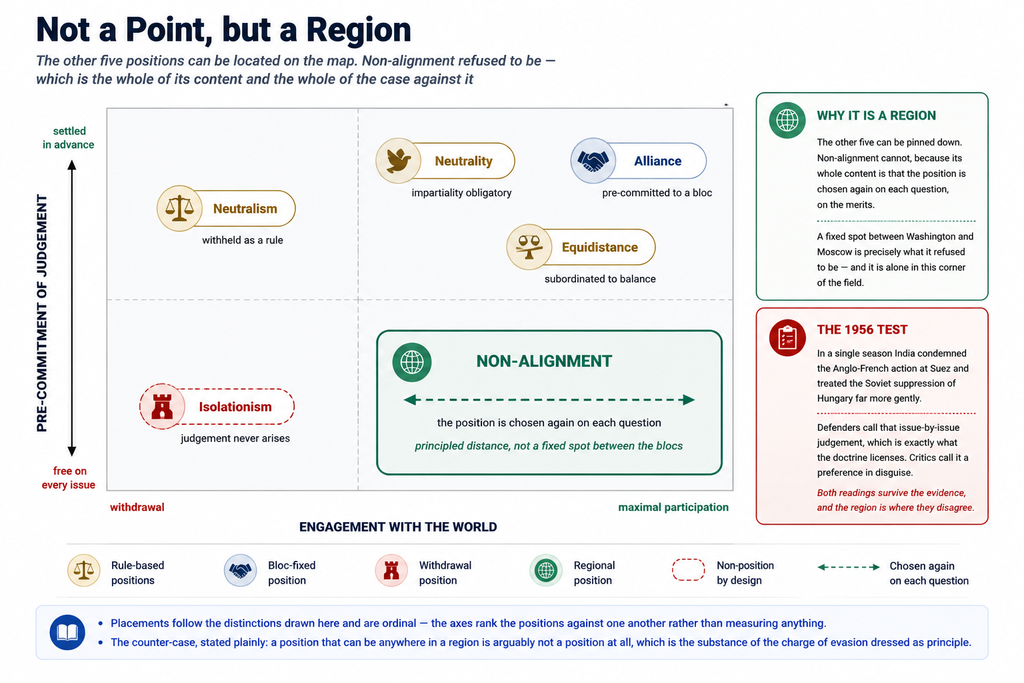
Non-alignment was never a place on the map between the blocs; it was a refusal to let the map decide what a state would think.
The structural conditions that produced the movement
Non-alignment was not a philosophy that went looking for adherents. It was the response of a particular kind of state to a particular configuration of world politics, and four structural facts made that response almost predictable.
- Decolonisation created dozens of states with formal sovereignty and almost no capacity. Between the independence of India and Pakistan in 1947 and the “Year of Africa” in 1960, when seventeen African states became independent in a single year, the international system acquired a large new class of members.
- These states possessed juridical sovereignty — recognition, a seat, a flag — without the empirical attributes of statehood: administrative reach, industrial capacity, trained armies, or economies not organised around exporting a single commodity.
- Their sovereignty was therefore valuable and fragile at once, which made any arrangement that appeared to mortgage it intolerable.
- The Cold War arrived before the new states had consolidated. The Truman Doctrine of 1947 and the founding of NATO in 1949 fell inside the first two years of Indian independence; the Korean War began in 1950.
- Newly independent governments were being asked to take positions on European and East Asian confrontations while still constructing their own administrations.
- The bloc system, in other words, hardened around them rather than being built with them.
- Both blocs demanded that every new state choose. Alliance-building in the 1950s was explicitly global — SEATO in 1954, the Baghdad Pact and the Warsaw Pact in 1955, and the Baghdad Pact’s successor CENTO in 1959 — and the pressure to accede was economic and diplomatic as much as military.
- Membership was framed as the price of aid, arms and security guarantees. Pakistan’s accession to both SEATO and the Baghdad Pact is the case closest to India, and it converted a bilateral South Asian rivalry into a Cold War front.
- Choosing meant exchanging one dependence for another. This was the decisive recognition, and it is the intellectual core of the whole doctrine.
- A state that had just ended external control over its decisions saw an alliance as the reimposition of that control in a consensual form — bases, basing rights, procurement dependence, alignment of votes.
- The formula the period produced was that alignment would mean surrendering the very independence just won, which is why non-alignment was experienced by its adherents as the continuation of the freedom struggle rather than as a departure from it.
Why states adopted it
The reasons were overlapping rather than alternative, and different states weighted them differently. Six can be separated cleanly.
- Decisional freedom. The first and most frequently stated: the capacity to decide each question by one’s own lights rather than by a bloc’s discipline.
- This was not an abstraction. Alliance membership in the 1950s carried voting expectations at the United Nations, restrictions on recognising governments, and constraints on trade with the other bloc.
- India’s early recognition of the People’s Republic of China, and its refusal to endorse the extension of the Korean War beyond the 38th parallel, are the concrete exercises of that freedom.
- Development priority. Newly independent states needed their resources for planning and industrialisation, not for alliance obligations and standing military commitments.
- Non-alignment had a specific economic payoff: it permitted aid and technology from both blocs. India received American food aid and Soviet heavy industry — the Bhilai steel plant built with Soviet assistance and the Rourkela and Durgapur plants built with West German and British assistance are the emblem of the strategy.
- An aligned state, by contrast, drew from one donor pool and paid for it in strategic obligations.
- Avoiding entanglement. The Cold War was fought over European and East Asian stakes — the German question, Berlin, the Chinese revolution, Korea — in which the new states had no direct interest.
- Alliance risked importing that quarrel into regions that did not have it, converting local disputes into superpower confrontations. South Asia and the Middle East are where this actually happened.
- Solidarity and collective voice. Individually, none of the new states possessed leverage; collectively they possessed numbers.
- The arithmetic was the point. As decolonisation proceeded, the newly independent states became a majority of the General Assembly, where each member has one vote and the great-power veto does not operate.
- This gave the Assembly a Southern agenda — decolonisation, apartheid, economic restructuring — and gave the movement an institutional address for its demands.
- Normative conviction. Non-alignment was continuous with the anti-colonial movements’ own history, not a policy invented after independence.
- The freedom struggles had been built on anti-colonialism, anti-racism and self-determination; opposition to bloc politics, understood as a new form of great-power domination, followed from the same premises.
- This is why the movement’s language of sovereign equality and non-intervention sounds less like statecraft than like a continuation of the nationalist argument — because that is what it was.
- The domestic explanation.Paul Power supplied the argument that is most often left out: non-alignment solved a problem inside India as much as outside it.
- Indian opinion was internally divided on foreign policy — the political right favoured the West, the left favoured the East, and either alignment would have handed one faction a permanent grievance.
- Non-alignment gave Nehru a free hand, because it belonged to neither camp and could be defended to both. The same logic operated in Egypt, Indonesia and Yugoslavia, each of which had comparable internal fractures.
| Motive | What it secured | Where it shows |
|---|---|---|
| Decisional freedom | Positions taken issue by issue | Recognition of the People’s Republic of China; refusal to extend the Korean War |
| Development priority | Aid and technology from both blocs | Bhilai (Soviet) alongside Rourkela and Durgapur (West German, British) |
| Avoiding entanglement | Insulation from a European and East Asian quarrel | Resistance to importing the Cold War into South Asia |
| Solidarity and voice | Numerical weight where numbers count | The General Assembly majority and its agenda |
| Normative conviction | Continuity with the freedom struggle | The vocabulary of sovereign equality and non-intervention |
| Domestic consensus (Power) | A policy no domestic faction owned | Nehru’s free hand against a pro-Western right and a pro-Soviet left |
The intellectual lineage: from Brussels to Colombo
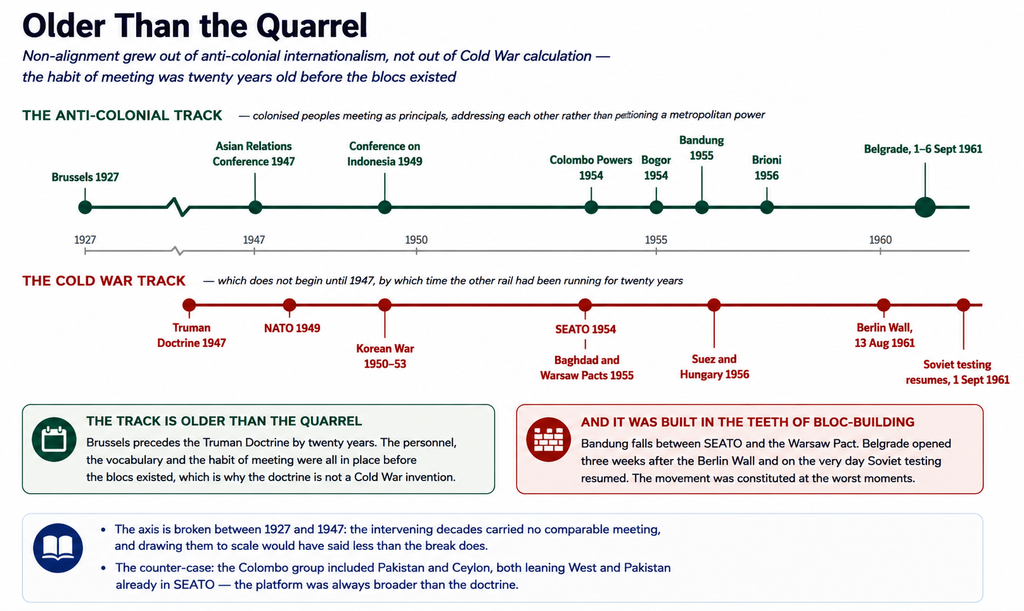
The movement founded at Belgrade in 1961 had a prehistory of more than thirty years. It matters because it establishes that non-alignment grew out of anti-colonial internationalism rather than out of Cold War calculation — the personnel, the vocabulary and the habit of meeting were all in place before the blocs existed.
- The Brussels Congress of Oppressed Nationalities, 1927, is the earliest ancestor worth naming. Delegates from colonised territories across Asia, Africa and Latin America met in Brussels and founded the League Against Imperialism.
- Nehru attended as the Indian National Congress representative and was elected to its executive; the experience is where his conviction that Indian freedom belonged to a wider anti-colonial struggle acquired an institutional form.
- The Congress established a template the later conferences reproduced: colonised peoples meeting as principals, addressing each other rather than petitioning a metropolitan power.
- It also foreshadowed the movement’s central difficulty. The League was drawn increasingly into Comintern control, and the nationalists who wanted anti-colonialism without communist direction drifted away — an early demonstration that the anti-imperial cause could be captured by a bloc.
- The Asian Relations Conference, New Delhi, March–April 1947, was convened by the Indian Council of World Affairs with Nehru as host, months before Indian independence was formal.
- Delegates came from twenty-eight countries, with Sarojini Naidu presiding once Nehru’s entry into the interim government made his chairmanship inappropriate.
- Its declared purposes were cultural and intellectual exchange rather than a political programme, and it created the short-lived Asian Relations Organization. Its real significance was that it asserted an Asian voice as such, at a moment when Asian international relations were still conducted through European capitals.
- The Conference on Indonesia, New Delhi, January 1949, was the first occasion on which this grouping acted politically.
- Nehru convened it in response to the second Dutch “police action” against the Indonesian Republic, and delegations from across Asia — with Australia and New Zealand participating — adopted a resolution demanding the restoration of the Republican government and a transfer of sovereignty.
- The conference then took its resolution to the United Nations Security Council, and the Council’s subsequent pressure on the Netherlands was a genuine, traceable outcome. It demonstrated that a coalition of newly independent states could move a great-power institution, which is the operational premise of everything that followed.
- The Colombo Powers — India, Pakistan, Ceylon, Burma and Indonesia — met at Colombo in April 1954 and became the movement’s immediate organising nucleus.
- The five prime ministers took up Indochina, the hydrogen bomb, colonialism and the recognition of China, and it was here that the proposal for a wider Asian-African conference was made.
- They reconvened at Bogor in December 1954, where the decision to hold that conference at Bandung the following April was taken, the invitation list settled and the agenda fixed.
- The Colombo Powers illustrate the coalition’s real composition. Pakistan and Ceylon were aligned or leaning West — Pakistan had joined SEATO that same year — yet were inside the founding group. From the beginning, the platform was broader than the doctrine.
| Precursor | Date and place | What it contributed |
|---|---|---|
| Congress of Oppressed Nationalities | 1927, Brussels | Colonised peoples meeting as principals; the League Against Imperialism; Nehru’s formative exposure |
| Asian Relations Conference | March–April 1947, New Delhi | An Asian voice as such, independent of European mediation |
| Conference on Indonesia | January 1949, New Delhi | Proof that the grouping could act politically and move the Security Council |
| Colombo Powers | April 1954, Colombo | The organising nucleus and the proposal for an Asian-African conference |
| Bogor meeting | December 1954, Bogor | The agenda and invitation list for Bandung |
Panchsheel: the normative code and its record
Panchsheel — the Five Principles of Peaceful Coexistence — supplied the movement with a moral vocabulary before it had an institution. They were set out in the preamble to the 1954 agreement between India and China on trade and intercourse between the Tibet region of China and India, signed in Peking in April of that year.
| Principle | Formulation | What it addresses |
|---|---|---|
| 1 | Mutual respect for each other’s territorial integrity and sovereignty | The legal equality of states regardless of size |
| 2 | Mutual non-aggression | The renunciation of force between the parties |
| 3 | Mutual non-interference in each other’s internal affairs | Ideology and domestic order as beyond challenge |
| 4 | Equality and mutual benefit | Reciprocity in economic and political dealings |
| 5 | Peaceful coexistence | Cooperation across different political and social systems |
- The principles were designed to solve a specific problem: how states with incompatible ideologies could deal with one another at all, at a moment when both blocs held that ideological difference was itself a ground for hostility.
- Their answer was to make conduct rather than character the test of a relationship. A state’s internal system became nobody else’s business.
- The formulation was jointly authored, with Zhou Enlai as its Chinese sponsor, and the two governments promoted it in a joint statement in June 1954.
- Their diffusion was rapid and complete. They were affirmed at Bandung in 1955 and absorbed almost verbatim into the Ten Principles of Bandung, which in turn became the movement’s declared objectives.
- Principles two, three, four and five of Bandung — sovereignty and territorial integrity, racial and national equality, non-interference, and the right of self-defence — are Panchsheel restated and extended.
- Through Bandung they entered the movement’s founding documents, and through the movement they entered the working vocabulary of the General Assembly, where sovereign equality and non-intervention became the standard idiom of Southern diplomacy.
- The standard criticism has to be made, and made without hedging. The agreement in which the Five Principles appear accepted Chinese sovereignty over Tibet while leaving the boundary unsettled.
- India gave up the extraterritorial rights it had inherited from the British in Tibet — trade agencies, military escorts, post and telegraph installations — and received in exchange a statement of principle.
- The 1962 war followed eight years later. The slogan Hindi–Chini bhai bhai is remembered chiefly as an epitaph.
- The honest conclusion separates two things. Panchsheel’s normative value is not cancelled by the failure of the bargain that carried it, since the principles were adopted far beyond that bilateral relationship and outlived it.
- But its record as a guarantee — as something that would restrain a stronger party — is poor, and any account presenting it as a working security mechanism is wrong.
A code of conduct that binds only those who were not going to break it is a description of good faith, not a substitute for power.
Bandung, 18–24 April 1955
The Asian-African Conference at Bandung in West Java is the movement’s most immediate antecedent — and it was not the movement’s founding. The distinction is the single most common error in accounts of the subject, and it is worth stating before anything else: Bandung was Afro-Asian; the Non-Aligned Movement, founded six years later at Belgrade, was neither.
- Twenty-nine heads of state and government attended, from newly independent Asia and Africa, representing something close to 1.5 billion people — over half the world’s population at the time.
- They were the first post-colonial generation of leaders: Nehru, Sukarno as host, Nasser, Zhou Enlai, U Nu of Burma, Mohammed Ali of Pakistan, John Kotelawala of Ceylon, Carlos Romulo of the Philippines.
- The declared objectives were to identify and assess world issues and pursue joint policies in international relations, to promote economic and cultural cooperation, and to consider colonialism and racialism.
- The unstated objective was the more important one. These states had newly attained independence and their overwhelming preoccupation was development and living standards; they did not want to be dragged into the Cold War as auxiliaries of either bloc.
The tensions inside the conference
Bandung is often remembered as a moment of unanimity. It was in fact an argument that produced a text, and the argument is more instructive than the text.
- The pro-Western delegations pressed a definition of colonialism that would include the Soviet Union. Mohammed Ali of Pakistan, John Kotelawala of Ceylon and Carlos Romulo of the Philippines argued that Soviet domination of Eastern Europe and Central Asia was colonialism by another name.
- Kotelawala raised it in open session, which Nehru had not expected and did not welcome.
- The compromise was a formula condemning “colonialism in all of its manifestations” — sufficiently capacious to censure both empires without naming either. It is a model of what consensus among heterogeneous states actually produces.
- The defence of military pacts was pressed by the states that had joined them. Pakistan, Turkey, Iran, Iraq, Thailand and the Philippines were in SEATO or the Baghdad Pact and would not accept language condemning alliances as such.
- The resulting principle — abstention from the use of collective defence arrangements to serve the particular interests of any of the great powers — condemns not alliances but their instrumentalisation. Nehru’s stronger position was defeated, and the text records the defeat.
- Nehru’s reception was mixed. His argument against military blocs was heard as lecturing by delegations that had made the opposite choice, and his standing was noticeably lower leaving Bandung than arriving.
- Zhou Enlai’s performance was the conference’s diplomatic success. Arriving after an assassination attempt destroyed the aircraft that was to have carried him, the Chinese premier presented a strikingly moderate case, played down revolutionary communism and endorsed self-determination.
- He offered direct talks to the United States over Taiwan and negotiated on the status of overseas Chinese communities.
- The effect was to make the People’s Republic acceptable to a wide range of anti-communist governments, and it was China rather than India that left Bandung with enhanced standing.
The Ten Principles of Bandung
The principles governing relations among large and small nations — Dasasila Bandung — were proclaimed unanimously at the close of the conference. Their fulfilment became the essential criterion for membership of the movement, and they were described as the “quintessence of the Movement”.
- Respect of fundamental human rights and of the objectives and principles of the Charter of the United Nations.
- Respect of the sovereignty and territorial integrity of all nations.
- Recognition of the equality among all races and of the equality among all nations, both large and small.
- Non-intervention or non-interference into the internal affairs of another country.
- Respect of the right of every nation to defend itself, either individually or collectively, in conformity with the Charter of the United Nations.
- (a) Non-use of collective defence pacts to benefit the specific interests of any of the great powers; (b) non-use of pressures by any country against other countries.
- Refraining from carrying out or threatening to carry out aggression, or from using force against the territorial integrity or political independence of any country.
- Peaceful solution of all international conflicts in conformity with the Charter of the United Nations.
- Promotion of mutual interests and of cooperation.
- Respect of justice and of international obligations.
- Principle six is the one to notice. It does not prohibit collective defence at all; it prohibits only defence pacts turned to a great power’s own purposes — which is exactly where the argument in the hall came to rest.
- Read as a whole, the Ten Principles are the Charter of the United Nations restated from the standpoint of the weak. Every clause that a small state would want — sovereign equality, non-intervention, peaceful settlement, racial equality, the prohibition on force — is retained and emphasised; the clauses that presuppose great-power management are absent.
- What Bandung did not produce was an organisation. There was no secretariat, no membership roll, no standing machinery and no second conference; attempts to convene “Bandung II” at Algiers in the 1960s collapsed amid coups in Algeria, Ghana and Indonesia.
- Its bequest was a set of principles and a proof of concept, which is precisely why the movement had to be founded separately.
Brioni, July 1956: the Afro-Asian conference becomes a global project
The meeting of Nehru, Tito and Nasser on the Yugoslav island of Brijuni on 19 July 1956 is the hinge between Bandung and Belgrade. It converted an Asian-African gathering into a project with European and, eventually, Latin American reach.
- Tito’s presence was the decisive addition. Yugoslavia was a European, socialist and non-aligned state, expelled from the Cominform in 1948 and refusing to rejoin the Soviet camp thereafter.
- Its participation demonstrated that non-alignment was not a racial or continental category but a policy any state could adopt, which was the condition of the movement ever becoming global.
- It also brought a state with a genuine grievance against bloc discipline, having survived the Stalin–Tito split with its independence intact.
- The Declaration of Brioni committed the three to peace through collective security rather than division into blocs, to the settlement of disputes by negotiation, and to support for disarmament and for peoples still under colonial rule.
- The timing gave the meeting immediate consequence. Within a week of Brioni, Nasser nationalised the Suez Canal Company; within three months, the Anglo-French-Israeli attack on Egypt made non-alignment a live proposition rather than a doctrine, and the three leaders’ coordinated response established the movement’s political credibility.
- Brioni also established the movement’s leadership triangle — an Asian, an African and a European founder — which is what made the Belgrade conference something other than a second Bandung.
Belgrade, 1–6 September 1961: the founding summit
The Non-Aligned Movement was founded at the First Summit Conference of Belgrade, six years after Bandung and on a far wider geographical basis. The immediate context was as dangerous as any moment of the Cold War outside the Cuban crisis, and it shaped both the conference’s agenda and its limits.
- The Berlin crisis was at its height. The Berlin Wall had gone up on 13 August 1961, three weeks before the delegates convened, after a summer in which Khrushchev had renewed his ultimatum on the status of the city and both sides had raised military spending.
- The Soviet Union resumed nuclear testing on the conference’s opening day, ending a three-year moratorium; the atmospheric series that followed included the largest device ever detonated.
- The conference’s response is one of the two moments that define its character. The Belgrade Declaration condemned nuclear testing in general terms and did not name the Soviet Union, which cost the movement moral authority at the moment it was claiming it.
- Critics have used this ever since as the founding illustration of asymmetric criticism; defenders point out that the conference sent envoys to both capitals rather than to one.
- Twenty-five countries participated as full members, drawn from Asia, Africa, Europe and Latin America — Cuba being the Latin American member — with Bolivia, Brazil and Ecuador attending as observers and nineteen national liberation movements present as guests.
- The presence of Yugoslavia and Cyprus as European members and of Cuba as an American one is what makes Belgrade the founding rather than Bandung: the movement was intercontinental from its first day, and Afro-Asian solidarity was one of its sources rather than its definition.
- The summit sent delegations to both superpowers after it closed, pressing for negotiation on Berlin and a resumption of disarmament talks.
- Nehru and Nkrumah carried the appeal to Moscow; Sukarno and Modibo Keïta of Mali took it to Washington.
- The mediation attempt was the movement’s first exercise of the only power it possessed.
Five founding fathers
Nehru of India, Tito of Yugoslavia, Nasser of Egypt, Sukarno of Indonesia and Nkrumah of Ghana are the movement’s founders and its emblematic leaders. Each brought something the others did not.
- Nehru supplied the doctrine — the formulation of non-alignment as a positive policy, and the argument that connected it to peaceful coexistence and disarmament.
- Tito supplied the European anchor and, in practice, the organisational drive; Belgrade was his conference, and Yugoslavia’s expulsion from the Cominform gave the movement its proof that non-alignment was not a euphemism for pro-Sovietism.
- Nasser supplied Arab and African weight and the Suez precedent — the demonstration that a Southern state could face down two European powers and prevail politically.
- Sukarno supplied the Bandung inheritance and the language of the “new emerging forces” against the “old established forces”.
- Nkrumah supplied the Pan-African constituency at the moment African decolonisation was accelerating fastest.
Movement, not organisation
The founders deliberately declared the grouping a “movement” and not an organisation. This was a considered choice with lasting consequences, and it is not a piece of trivia.
- The stated reason was to avoid the bureaucratic implications of an organisation — a charter, a secretariat, a budget, a headquarters, and the machinery of obligation that comes with them.
- The word “movement” was also chosen to convey dynamism and an ever-evolving agenda, responsive to a changing international order rather than fixed by a founding text.
- The deeper logic was consistency: an organisation that bound its members would have reproduced the very thing non-alignment existed to refuse. A body demanding conformity from states whose defining commitment was independent judgement would have been self-contradictory.
- The cost is equally structural and shows up in every later assessment: no charter, no enforcement, no obligation of mutual defence, and no capacity to discipline a member. What the movement gained in fidelity to its principle it lost in capability.
The Belgrade criteria
Membership was defined by five criteria settled at the preparatory meeting of ambassadors in Cairo in June 1961 and applied to invitations for the summit. They are the most precise definition of non-alignment ever produced, because they had to be operational.
| Criterion | What it required |
|---|---|
| 1 | An independent policy based on peaceful coexistence among states of differing political and social systems and on non-alignment — or a demonstrable tendency toward such a policy |
| 2 | Consistent support for national independence movements |
| 3 | No membership of a multilateral military alliance concluded in the context of great-power conflict |
| 4 | No bilateral military alliance with a great power, and no regional defence pact deliberately oriented to great-power confrontation |
| 5 | No foreign military bases conceded on its territory in that context |
- Criteria three, four and five are negative and testable; criteria one and two are positive and judgemental, and criterion one’s “or a tendency toward” clause is the loophole through which the movement’s later heterogeneity arrived.
- The criteria show what non-alignment did and did not prohibit. They forbid alliance and bases. They do not forbid aid, trade, arms purchases, friendship treaties or close relations with a superpower.
- This is why states that were manifestly closer to one bloc than the other could remain members in good standing, and why the movement’s critics found the label hollow.
- It is also why the movement’s defenders can say that no member ever formally breached them: the bar was set where a new state could actually clear it.
- The tension between an inclusive and an exclusive movement was present at the founding. The Cairo preparatory meeting divided between those who wanted the widest possible participation and those who wanted a movement of the genuinely non-aligned, and the argument was never settled — only deferred.
The founders wrote criteria strict enough to mean something and loose enough to be joined. Every later argument about the movement is an argument about that trade.
The aims and objectives as declared
The movement’s declared purposes were set out at Belgrade and restated at successive summits. Listed together they show a programme that is considerably wider than “staying out of the Cold War” — political, economic and institutional at once.
- Self-determination, national independence, sovereignty and territorial integrity of states. The foundational commitment, from which most of the rest follows.
- Opposition to apartheid. Named separately and from the beginning, not folded into a general anti-racism; South Africa was the movement’s most sustained single campaign.
- Non-adherence to multilateral military pacts, and the independence of non-aligned countries from great-power or bloc influences and rivalries.
- The struggle against imperialism in all its forms and manifestations, and against colonialism, neo-colonialism, racism, foreign occupation and domination.
- The inclusion of neo-colonialism is significant: it extends the target from formal empire to economic and institutional control surviving independence, and it is the bridge to the movement’s economic phase.
- Disarmament — general and complete, with a particular emphasis on nuclear disarmament and on a comprehensive ban on testing.
- Non-interference in the internal affairs of states, and peaceful coexistence among all nations.
- Rejection of the use or threat of use of force in international relations.
- Strengthening of the United Nations. The movement’s consistent institutional loyalty; it treated the Charter as its own text and the General Assembly as its natural forum.
- Democratisation of international relations — the demand that decisions affecting all states be taken by all states, which becomes the demand for Security Council reform.
- Socio-economic development and the restructuring of the international economic system.
- International cooperation on an equal footing.
The most compressed statement of the movement’s purpose came later, in the Havana Declaration of 1979, which defined its object as ensuring
“the national independence, sovereignty, territorial integrity and security of non-aligned countries” in their “struggle against imperialism, colonialism, neo-colonialism, racism, and all forms of foreign aggression, occupation, domination, interference or hegemony as well as against great power and bloc politics.” — Havana Declaration
- The formula is worth reading closely for what sits at its end. “Great power and bloc politics” is named as an adversary in itself, distinct from any particular empire — which is the movement’s claim to be structural rather than merely anti-Western.
- The three campaigns the movement actually organised around are decolonisation, universal nuclear disarmament and the dismantling of apartheid. Whether it achieved them is a separate question, treated elsewhere in this series.
From political to economic non-alignment
The movement’s centre of gravity shifted decisively between the mid-1960s and the mid-1970s, from the politics of blocs to the economics of the international system. The reason was arithmetic: as decolonisation completed, political independence had largely been won, and what remained conspicuously unwon was economic autonomy. Formal sovereignty had not changed the terms on which Southern economies met the world market.
- UNCTAD, 1964, is the institutional beginning. The United Nations Conference on Trade and Development met in Geneva and became a permanent organ of the General Assembly, giving developing states a forum on trade that they did not control at the GATT.
- Its first Secretary-General, the Argentine economist Raúl Prebisch, supplied the analytical case: that the terms of trade between primary commodities and manufactured goods deteriorate over time, so that a country exporting raw materials must export ever more to buy the same imports.
- This is the technical claim underneath the entire economic programme, and it converted a grievance into an argument.
- The Group of 77 was formed at the close of that conference, when seventy-seven developing countries issued a Joint Declaration committing themselves to act together on economic questions.
- The relationship between the two bodies is the key structural fact of this phase: NAM was the political caucus and the G-77 the economic one, with overlapping membership and a division of labour. The G-77 retains its name though its membership long since passed 130.
- The Algiers summit of 1973 launched the demand formally. The fourth NAM summit adopted an Economic Declaration and Action Programme that called for a fundamental restructuring of international economic relations and put the phrase New International Economic Order into circulation.
- The New International Economic Order was adopted by the General Assembly on 1 May 1974, at a special session convened at Algeria’s initiative.
- The instruments were the Declaration on the Establishment of a New International Economic Order and its accompanying Programme of Action; the Charter of Economic Rights and Duties of States followed that December.
| NIEO demand | What it targeted |
|---|---|
| Commodity price stabilisation | The volatility and decline of primary-product earnings; an Integrated Programme for Commodities and a Common Fund |
| Preferential market access | Tariff and quota barriers in industrial-country markets; non-reciprocal preferences for developing-country exports |
| Technology transfer | The concentration of industrial technology, and its price when licensed |
| Permanent sovereignty over natural resources | The right to nationalise, and to determine compensation, without it being an international wrong |
| Regulation of multinational corporations | Transfer pricing, extraction contracts, and the capacity of firms larger than their hosts |
| Debt relief and increased aid | Servicing burdens and the shortfall against the 0.7% of GNP aid target |
| Reform of decision-making | Voting weights in the IMF and the World Bank, and an enhanced role for the General Assembly in economic governance |
- The 1973 oil shock is the reason the demand was made when it was, and the reason it did not hold. The quadrupling of crude prices after the October war demonstrated that a Southern producers’ cartel could impose costs on the industrial world — the first such demonstration in the history of the system.
- It supplied the model: if oil producers could do it, why not producers of copper, bauxite, coffee, cocoa?
- It also split the movement’s membership down the middle. The oil-importing developing countries — the great majority — were devastated by the same price rise, facing balance-of-payments crises and, in the following decade, the debt crisis that grew out of recycled petrodollars.
- The South’s first display of leverage was also its first display of internal contradiction, and the coalition that made the NIEO demand was fractured by the event that inspired it.
- The programme’s fate belongs to the assessment of the movement’s achievements, treated elsewhere in this series.
- The economic theory underneath it — dependency, unequal exchange, the structure of the world economy — is developed in this archive’s notes on globalisation and the international economic system.
- What belongs here is that the demand was made, what it contained, and where it came from.
Informational non-alignment: the news agencies pool
- The Non-Aligned News Agencies Pool was founded in late 1974 and began operating in January 1975, led by Yugoslavia’s Tanjug agency, with most early operations run from Belgrade. It drew twenty-six news organisations within its first year.
- Its premise was that economic and political independence were incomplete without informational independence. Four Western agencies dominated international news flows, and the image of the developing world reaching global audiences — and reaching the developing world itself — was produced almost entirely in London, Paris and New York.
- Member agencies exchanged copy directly, so that a report from Delhi could reach Lagos without passing through a Western wire.
- The initiative fed into the wider campaign for a New World Information and Communication Order pressed through UNESCO in the same decade, and it shares that campaign’s trajectory: it declined after 1980 when the United States and the United Kingdom withdrew support, and was revived in 2005 as the internet-based NAM News Network.
- The pool is the clearest evidence that non-alignment was understood by its practitioners as a demand for autonomy across every domain — strategic, economic and informational — rather than as a position on military blocs alone.
The economic turn was not a change of subject. It was the discovery that political independence without economic autonomy is a form of sovereignty that cannot make decisions.
Organisation, and the deliberate absence of one
The movement’s structure is best described as the minimum machinery required to hold a conference. That is not an accident or a failure of design; it follows directly from the choice at Belgrade to be a movement rather than an organisation.
- The Summit Conference of Heads of State or Government is the supreme body, held every three years, and it is where the movement’s positions are settled and its final documents adopted.
- The chairmanship rotates with the host. The country hosting a summit assumes the chair and holds it until the next summit — in practice a three-year term — and the chair is the movement’s spokesman, its representative to other bodies and the coordinator of its work.
- Rotation is by region: Africa, Asia, Latin America and the Caribbean, and Europe.
- The Coordinating Bureau, based in New York, is the movement’s working instrument. It meets at ambassadorial level, directs the working groups, committees, contact groups and task forces, and is the focal point for coordinating positions in the General Assembly and the Security Council.
- Ministerial machinery fills the gap between summits. A ministerial conference is held at roughly the mid-point of each chairmanship; foreign ministers also meet annually on the margins of the General Assembly, and specialised ministerial meetings cover information, economic questions and other sectors.
- Decisions are taken by consensus, which the movement’s own methodology defines as substantial agreement that does not require or imply unanimity. In practice this means extensive prior consultation, texts drafted to accommodate objection, and outcomes pitched at what every member can accept.
- There is no permanent secretariat, no charter and no enforcement mechanism. There is no budget of consequence, no headquarters, no dispute-settlement procedure and no sanction for a member that acts against the movement’s declared principles.
- The chair’s national foreign ministry does the secretariat’s work for three years and then hands over, which means institutional memory is discontinuous by design.
- This is the movement’s defining structural fact, and every serious criticism of it — that it cannot act, cannot restrain its own members, cannot follow through — traces back to this single choice.
| Summit | Year | Host |
|---|---|---|
| 1st | 1961 | Belgrade, Yugoslavia |
| 2nd | 1964 | Cairo, Egypt |
| 3rd | 1970 | Lusaka, Zambia |
| 4th | 1973 | Algiers, Algeria |
| 5th | 1976 | Colombo, Sri Lanka |
| 6th | 1979 | Havana, Cuba |
| 7th | 1983 | New Delhi, India |
| 8th | 1986 | Harare, Zimbabwe |
| 9th | 1989 | Belgrade, Yugoslavia |
| 10th | 1992 | Jakarta, Indonesia |
| 11th | 1995 | Cartagena, Colombia |
| 12th | 1998 | Durban, South Africa |
| 13th | 2003 | Kuala Lumpur, Malaysia |
| 14th | 2006 | Havana, Cuba |
| 15th | 2009 | Sharm el-Sheikh, Egypt |
| 16th | 2012 | Tehran, Iran |
| 17th | 2016 | Margarita Island, Venezuela |
| 18th | 2019 | Baku, Azerbaijan |
| 19th | 2024 | Kampala, Uganda |
- The movement today has 120 member states, with 18 observer states and 10 observer international organisations, making it the largest grouping of states after the United Nations itself. Its members are close to two-thirds of the UN’s membership and contain a majority of the world’s population.
- The nineteenth summit met at Speke Resort Munyonyo, Kampala, 15–20 January 2024, with the leaders’ segment on 19–20 January, under the theme “Deepening Cooperation for Shared Global Affluence”.
- Ninety-three of the 120 members took part, about thirty at head-of-state or head-of-government level. It was the first NAM summit held in Africa since 2009, and Uganda hosted the G-77 summit later the same year — the two caucuses meeting in the same capital within months.
- Uganda holds the chairmanship from 2024 to 2027, having taken over from Azerbaijan, and hosted the mid-term ministerial meeting of the Coordinating Bureau at Kampala in October 2025.
- The Kampala declaration was dominated by Gaza, which is a useful indication of what the movement’s agenda now consists of in practice.
- India was represented by its External Affairs Minister, S. Jaishankar, rather than by the Prime Minister — as at Margarita Island in 2016 and Baku in 2019. What that level of representation signifies about India’s current relation to the movement is taken up elsewhere in this series.
What was non-alignment actually doing?
A movement of states with almost no material capability, meeting every three years to issue declarations nobody was obliged to obey, invites an obvious question: what, in the vocabulary of international relations theory, was it for? Three answers compete.
Soft balancing
T.V. Paul reads the movement as an instance of soft balancing — the attempt by weaker states to constrain a stronger one without the military capability that hard balancing requires.
- The logic starts from the constraint. These states had little material ability to restrain superpower conflict, the arms race, or intervention in their own regions; a conventional balancing coalition was arithmetically impossible.
- What they had instead was normative power — the capacity to define and diffuse a set of values that a great power would find costly to be seen violating: peace, disarmament, development, autonomy of choice, and a restructured world order.
- The instrument was “naming and shaming”: General Assembly resolutions, summit declarations, coordinated diplomatic pressure, and the withholding of legitimacy from particular actions.
- The mechanism works by raising a great power’s reputational and diplomatic costs rather than its military risks. It is slow, indirect, and only effective where a great power cares about legitimacy — which, in a competitive bipolar system where both sides were courting the same states, both did.
- Paul adds an argument about the scholarship itself: the intellectual bias against NAM is exactly what one should expect.
- A coalition of weak states attracts the same dismissal from mainstream international relations that subaltern movements attract from upper classes and upper castes in hierarchical societies.
- The movement is judged by criteria — capability, enforcement, decisive outcomes — never available to it.
The realist dismissal
The opposing case is straightforward and has the better of some of the evidence.
- Balancing requires capabilities. A coalition that cannot impose costs cannot alter another state’s calculation, and declarations that carry no threat are not a form of power but a substitute for it.
- The movement never restrained either superpower on any question either superpower cared about. Berlin, Cuba, Vietnam, Czechoslovakia, Afghanistan: in each case the movement spoke and the outcome was determined elsewhere.
- Its members’ own behaviour undercut the claim. States inside the movement hosted foreign bases, bought Soviet or American weapons systems, and went to war with each other. A coalition that cannot bind its own members is not balancing anything.
- The permissive condition was bipolarity itself, not the movement’s agency. Non-aligned states had leverage because two superpowers competed for their allegiance; where that competition was absent, so was the leverage.
The judgement in between
- Kissinger’s assessment is the most useful corrective, because it comes from someone with no sentimental attachment to the movement. He concluded that non-alignment, however irritating to Washington, was the best course of action available to India given its position — which concedes the strategic rationality of the policy while conceding nothing about its morality.
- The reactions of the two superpowers at the time confirm that they took it seriously enough to attack it. John Foster Dulles, as Secretary of State, treated neutrality between the blocs as a moral failure:
“The principle of neutrality … has increasingly become an obsolete conception, and, except under very exceptional circumstances, it is an immoral and shortsighted conception.” — Dulles
- American policymakers were, in this period, structurally allergic to non-alignment: they declined to recognise the integrity of India’s claim to it and read India as a Soviet auxiliary.
- Stalin’s position was the same in inverted form — those not with the socialist camp were against it — and Moscow was as hostile to non-alignment in the early 1950s as Washington.
- Soviet courtship of the non-aligned world began only after Stalin’s death, with Khrushchev and Bulganin’s tour of India, Burma and Afghanistan in 1955.
- That both superpowers initially condemned it is the strongest single piece of evidence that non-alignment was doing something. A policy that is genuinely empty does not attract that much hostility from both sides at once.
India in the movement
India is the movement’s founder, its principal intellectual author and, for its first two decades, its indispensable state. The movement is not intelligible without India; India’s early foreign policy is not intelligible without the movement.
- Nehru formulated the doctrine and supplied its vocabulary. The term entered international usage through Indian and Yugoslav diplomacy at the United Nations around the Korean War, and Nehru’s Colombo speech of 1954 gave it wide currency.
- His statement of the underlying disposition, made before independence, is the doctrine in one sentence:
“We propose … to keep away from the power politics of groups, aligned against one another.” — Nehru
- He grounded it in nationalism rather than idealism. India could not have devoted itself to modernisation, nor protected its frontiers, had it joined a bloc; non-alignment was nationalistic in its objectives even where it was internationalist in its idiom.
- The internationalism was nonetheless real. Nehru held that India must be prepared to discard narrow nationalism in favour of world cooperation, that narrow nationalism led to imperialism and fascism, and that states should maintain a balance between the national and the international.
- V.K. Krishna Menon was the doctrine’s most effective and most abrasive advocate.
- As India’s representative at the United Nations he gave non-alignment its formal diplomatic expression, and chaired the Neutral Nations Repatriation Commission that broke the deadlock over prisoners in the Korean armistice.
- He made himself the personification of the policy, so his fall after 1962 damaged its standing along with his own.
- Nehru resisted admitting states that were not genuinely non-aligned. At the Cairo preparatory meeting and at Belgrade he was on the exclusive side of the movement’s founding argument, wanting membership confined to states that actually met the criteria and the agenda focused on reducing the risk of war rather than on colonial grievance alone.
- He lost both arguments in the medium term. The movement expanded and its centre of gravity moved toward the anti-imperial and, later, the economic agenda.
- The expansion is what later critics have in mind when they say the movement’s principles were diluted, and it is worth recording that its principal founder predicted exactly that.
- Non-alignment has been called India’s grand strategy and a form of Indian exceptionalism — the claim that India would conduct itself in world politics by a different logic from the one great powers used.
- The claim carries an ambiguity that was never resolved. Martand Jha observes that non-alignment remained an ambiguous term because the Indian elite never set out the substance of the policy with precision, so that it could be read as anything from a moral stance to a hedging strategy.
- The scholarly readings of why India chose it converge on autonomy rather than idealism.
- Aparna Pande argues that Nehru aspired to a leadership role for a country that was militarily and economically weak; non-alignment let India maintain its independence while remaining a participant in world politics, and hold relationships with both superpowers without being coerced by either.
- K. Natwar Singh describes non-alignment as a doctrine and never a dogma — flexible enough to let India stay independent rather than become a camp follower, and a refusal to put all its eggs in one basket.
- Paul Power’s domestic-consensus argument, set out above, explains the policy’s durability at home rather than its logic abroad, and the two explanations are complementary.
- The early scepticism came from both superpowers, which is the most telling detail in the Indian story.
- Washington suspected India of being a Soviet auxiliary; Moscow, under Stalin, of being a bourgeois nationalist state serving Western interests.
- Being distrusted by both was the policy working as designed — though not a comfortable place from which to seek aid.
Why the founding principles still describe the Global South
The movement’s origins are not merely historical, because the behaviour they were designed to produce is visible in a large number of states today that have no particular attachment to the movement itself.
- The founding claim was about autonomy, not about blocs, and autonomy is the scarcer commodity in a system with more centres of power rather than fewer. A state courted by three great powers has more to gain from remaining unclaimed than a state courted by two.
- The vocabulary has changed and the demands have not. Debt, commodity dependence, technology transfer, terms of trade, voice in the institutions of economic governance and the right to develop are the NIEO agenda restated as the Global South agenda — on climate finance, vaccine equity, debt distress and institutional reform.
- Narasimha Rao’s restatement is the most durable: non-alignment consists in espousing the right of nations to independence and development regardless of the bloc phenomenon.
- Whether there is one bloc or several, the impulse of a non-aligned country is to keep its independence and decide by its own light rather than tagging itself in advance to others.
- The refusal of most states to take sides in the confrontations of the 2020s — on Ukraine, on the Sino-American rivalry, on sanctions regimes — is behaviour the founders would have recognised immediately, whatever name it now travels under.
Whether the movement itself achieved what it set out to achieve, and whether it survived the disappearance of the bipolar order that gave it leverage, are separate questions taken up elsewhere in this series.
Conclusion
- Non-alignment was a doctrine before it was a movement, and the movement’s founding documents are the doctrine written down. The concept is defined by what it refuses: not neutrality’s legal impartiality, not neutralism’s abstention, not isolationism’s withdrawal, and not equidistance’s symmetry, but participation without pre-commitment — principled distance.
- Its origins are structural, not accidental. A large class of new states with sovereignty and no capacity met a bipolar system that demanded adherence, and concluded that adherence would return in a new form the dependence they had just ended.
- Its lineage runs from Brussels in 1927 through the Asian Relations Conference and the Colombo Powers to Bandung, Brioni and Belgrade, which establishes that it grew out of anti-colonial internationalism rather than out of Cold War arithmetic.
- The two texts carrying its normative content are Panchsheel and the Ten Principles of Bandung, and the honest account gives both their weight and their record — including the fact that the 1954 agreement carrying the Five Principles did not prevent the war of 1962.
- Its declared aims were wider than bloc politics from the start, and the shift to economic non-alignment through UNCTAD, the G-77 and the NIEO was an extension of the founding logic rather than a change of subject.
- The choice to be a movement and not an organisation is the source of both its integrity and its incapacity, and no assessment of it that ignores either half is worth much.
Previous Year Questions
- Discuss the significance of Non-Aligned Movement as a unique contribution of the Non-Western world to World Politics. (2018)
- Bring out your perspective on Plausible aims of the Non – Aligned Movement in the post-Cold War period. (2010)
- “The change in the position of the people of Asia and Africa and their relations with Europe was the surest sign of the advent of a new era.” Discuss. (1997)
- Comment: Agenda before NAM. (1995)
