If you’ve written a few History Optional mocks and come back with marks in the low teens on 20-mark questions, you’re not alone — and it’s very rarely because you don’t know the history. Most aspirants who plateau in the 10–13 range know the content cold. They can talk for ten minutes about the Harappan civilization or the causes of the 1857 revolt without notes. And then they sit for the exam, write for seven minutes, and get a 12.
The gap between a 12 and an 18 on the same question, for the same aspirant, with the same knowledge, comes down to three things: structure, historian citations, and value addition. Here’s exactly what each one costs you, and what it looks like when you fix it.
The Three Marks-Killers

1. No structure. An answer that starts wherever the thought started and ends whenever the time ran out reads as a stream of facts, not an argument. Examiners are marking dozens of answers to the same question in a limited time — a clear introduction that frames the question, a body that’s organised into distinct dimensions, and a conclusion that closes the argument is not decoration. It’s what allows the examiner to find the marks you’ve earned instead of having to dig for them.
2. No historian citations, or the wrong ones. History Optional is not a general studies essay. UPSC is testing whether you understand historiography — that historians disagree, and that “what happened” is often less interesting than “how historians have argued about what happened.” An answer that states facts as flat, uncontested truth signals that you’ve read a summary, not the subject. One correctly used citation, even a single line, changes how the entire answer reads.
3. No value addition. Two answers can cover the same facts, in the same order, and one still outscores the other because it adds something the question didn’t hand you for free — a contemporary parallel, a specific piece of archaeological or epigraphic evidence, a comparative note against a related civilization or period. This is what separates “answered the question” from “answered the question well.”
None of these require more knowledge. They require knowing what to do with the knowledge you already have. Here’s what that looks like on an actual question.
A Worked Example: “Discuss the factors responsible for the decline of the Harappan Civilization.” (20 marks)
The 10–13 mark version (this is a realistic answer, not a strawman — it’s close to what most aspirants actually write under time pressure):
The Harappan Civilization declined due to several reasons. Some historians believe that the Aryans invaded and destroyed the cities. Others say that floods and changes in the course of rivers like the Saraswati caused the decline. Trade with Mesopotamia also declined, which affected the economy. Natural disasters and climate change may have played a role too. The cities were abandoned gradually and people moved to smaller settlements. This shows that the Harappan Civilization declined due to a combination of factors.
This isn’t wrong. Every sentence in it is broadly true. But look at what it’s missing: there’s no introduction framing why this question matters or what the historiographical debate actually is, no historian is named even once despite two competing theories being paraphrased, there’s no specific evidence (no site names, no dates, no data), and the conclusion just restates the opening line. An examiner reading this sees content recall with no analytical work done on top of it. That’s a 10–13 mark answer, even though nothing in it is factually incorrect.
The 16–18 mark version, same knowledge, restructured and sourced:
Introduction: The decline of the Harappan Civilization (c. 1900 BCE) has been explained through competing frameworks — invasion, environmental collapse, and internal socio-economic transformation — each resting on different kinds of evidence.
Body: The earliest explanation, associated with Mortimer Wheeler, linked the decline to an Aryan invasion, citing skeletal remains found at Mohenjodaro as evidence of a massacre — his phrase “Indra stands accused” became emblematic of this view. This theory has since been substantially discredited: George Dales, in his paper “The Mythical Massacre at Mohenjo-daro” (1964), showed that the skeletons were scattered across different occupation levels, not a single destruction layer, undermining the invasion narrative.
A stronger case has been made for environmental and hydrological change. Tectonic shifts and the drying up of the Ghaggar-Hakra (identified with the Saraswati) disrupted agriculture and river-based trade routes that Harappan urbanism depended on. This aligns with archaeological evidence of declining settlement density along the river’s former course.
Jim Shaffer, working from the archaeological record rather than the invasion narrative, has argued for a “Localization Era” — a gradual transformation rather than a collapse, in which urban centres deurbanized, craft specialization declined, and populations dispersed into smaller, regionally distinct settlements. This view is now broadly favoured, as it explains cultural continuities (script elements, motifs, technologies) into the succeeding period, which a sudden violent end would not.
The decline in Mesopotamian trade — evidenced by the disappearance of Harappan seals from Mesopotamian sites after roughly 1900 BCE — would have removed a key source of urban surplus, compounding agrarian stress.
Conclusion: The current historiographical consensus favours a multi-causal, gradual decline — environmental stress triggering deurbanization and trade collapse — over Wheeler’s invasion thesis, which survives more as a historiographical episode than an accepted explanation.
Same facts as the first answer. The difference is that every claim is now attached to a name, a piece of evidence, or both, the structure makes the argument’s shape visible at a glance, and the conclusion actually takes a position instead of restating the question. That’s the 24–40 mark swing across a paper that the difference between these two versions represents — and it’s available to you with the knowledge you already have, not knowledge you don’t.
Why This Matters More Than “Reading More”
The instinct when marks plateau is to read more — another book, another set of notes, another topic. For most aspirants stuck at 10–13, that’s solving the wrong problem. You don’t need another source of facts. You need to know, for each topic you’ve already studied, which historians to cite, what the actual debate is, and how to build the structure around it — the same rebuild we just did above, done for the roughly 200+ distinct questions across History Optional’s syllabus.
That’s the exact gap the History Optional PYQ Master Pack closes: every PYQ from 1985–2025, answered in this before/after style — correct structure, the right historian citations for that specific topic, and the value additions that move an answer from average to exceptional.
You already know the history. This is the part that turns it into marks.
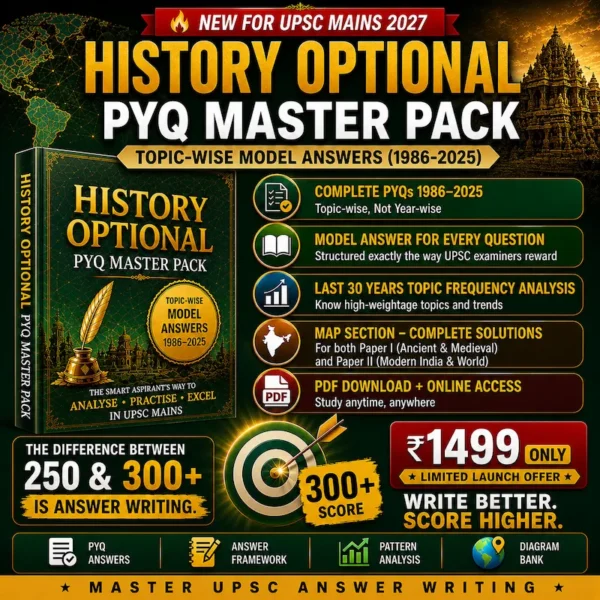
History Optional PYQ Master Pack: Topic-wise Model Answers (1985–2025) by LotusArise IAS
Most History Optional aspirants study PYQs the hard way — reading the question, guessing the answer, checking a random source, moving on. No structure. No historian citations. No idea what UPSC actually rewards. History Optional PYQ Master Pack — 100% complete and ready to download today — changes this completely.
📚 1985–2025 PYQs (Topic-wise) — Ancient India, Medieval India, Modern India, Post-Independence, World History — every question, fully solved
✍️ Model answers for every important question — exact structure, historian citations, diagram suggestions
🗺️ Map section solutions included — the full 50-mark section most aspirants ignore, at no extra cost
📲 PDF Download + Online Access — both included — study offline on any device, forever, not just while a subscription lasts
💰 Priced at ₹1,499 — for everything. Similar History Optional PYQ solutions elsewhere are sold for ₹2,500–₹3,500, often charging separately for online access, hard copies, and the Map section. Here, one price gets you PYQs + Map + PDF + online access, combined.
✅ Fully complete, nothing pending — every section is live the moment you enroll
You will be charged ₹1,499 today. Access is provided instantly. One-time payment. No subscription.