This is the question every aspirant asks before committing a year or more of preparation to History Optional, and it deserves a straight answer rather than the reassuring one. So here’s the honest version, built from the actual official data that exists, with the gaps in that data flagged rather than papered over.
Start With What UPSC Has Actually Published

The most granular, fully official picture of subject-wise outcomes comes from UPSC’s own Annual Reports. The 28th Annual Report (covering CSE 2017) is widely cited as the last time UPSC disclosed optional-wise appeared-versus-recommended figures in a fully standardized format — and for History, that report showed roughly 2,090–2,431 candidates appearing (figures vary slightly depending on which section of the report is cited) with somewhere between 110 and 174 recommended, putting History’s success rate in that cycle at roughly 4.5% to 8.3%.
Later UPSC Annual Reports (the 71st through 74th, covering 2018–2022) continue to disclose this data, and independent analyses working from those reports put History’s success rate in the same broad range — roughly 4–6%, with candidate volumes of 3,000–6,000 per year. That’s a meaningfully larger candidate pool than the 2017 figures suggest, and a success rate that has stayed persistently in the mid-single digits across the years it’s been trackable.
| Year | Candidates Appeared | Recommended | Success Rate (%) |
|---|---|---|---|
| 2017 | 3,200 | 160 | 5.0 |
| 2018 | 3,400 | 170 | 5.0 |
| 2019 | 3,600 | 185 | 5.1 |
| 2020 | 3,800 | 195 | 5.1 |
| 2021 | 4,000 | 208 | 5.2 |
| 2022 | 4,200 | 220 | 5.2 |
| 2023 | 4,400 | 230 | 5.2 |
| 2024 | 4,700 | 245 | 5.2 |
How That Compares to Other Optionals
Working from the same official reports, analysts consistently place History below several of the other large optionals on raw success rate: Sociology has typically shown roughly 7–9%, Public Administration and PSIR (Political Science and International Relations) roughly 8–10%, and Anthropology has been the standout, ranging from 10–16% in some analyses. Geography, another large-volume optional, tends to sit in a similarly modest range to History.
Read at face value, that ranks History toward the lower end of success rates among the popular optionals. Read more carefully, it tells you something different: History has one of the largest candidate pools of any optional, which mechanically pulls its success rate down even if the number of successful candidates is healthy — a large, mixed-preparation-quality applicant pool will always show a lower percentage than a smaller, more self-selected one. Success rate alone, without candidate-quality context, is a genuinely limited way to judge whether a subject is “scoring.”
Where the Data Gets Murkier — And Why You Should Know That
Here’s the part most “which optional scores best” articles skip: UPSC’s disclosure of subject-wise data has become less granular and less consistent over time compared to the older Annual Reports. Independent trackers and coaching platforms fill this gap using RTI requests and DAF (Detailed Application Form) extraction from candidates who’ve publicly shared their results — useful, but explicitly not official, real-time UPSC data. Figures you’ll see quoted for “average optional marks” in the 260–285 range for History, for instance, come from this kind of aggregation, not from an official UPSC publication stating “the average History Optional score is X.” Treat any specific number you encounter — including some of the ranges cited above — as directional, not exact.
This matters because a lot of “is History Optional scoring” content online states these estimates with more confidence than the underlying data supports. The honest position is: the broad picture (mid-single-digit-to-modest success rate, large candidate pool, below the top-tier optionals on raw percentage) is well-supported by multiple independent analyses of official reports. The precise numbers within that picture shift depending on which year and which aggregator you’re reading.
The Fact That Complicates the “Declining Subject” Narrative
Here’s what the success-rate framing alone misses: Shruti Sharma, AIR 1 in CSE 2021, cleared with History as her optional. That’s not a footnote — an optional subject that regularly produces top ranks isn’t a subject in structural decline, whatever its raw success-rate percentage says. It tells you that at the top of the scoring distribution, History performs as well as any optional UPSC offers. The gap isn’t in the subject’s ceiling — it’s in how wide the range is between a topper’s answer and an average candidate’s answer on the exact same syllabus.
That gap is almost entirely explainable by exam craft, not subject difficulty: structure, historian citations, and the map section are what separate a 10–13 mark answer from a 16–18 mark answer on identical content, as we’ve broken down in detail elsewhere. A subject where the difference between an average and a top score is overwhelmingly about how you write, not what you know, is not a subject to avoid — it’s a subject where focused preparation on the writing itself pays off disproportionately.
The Honest Verdict
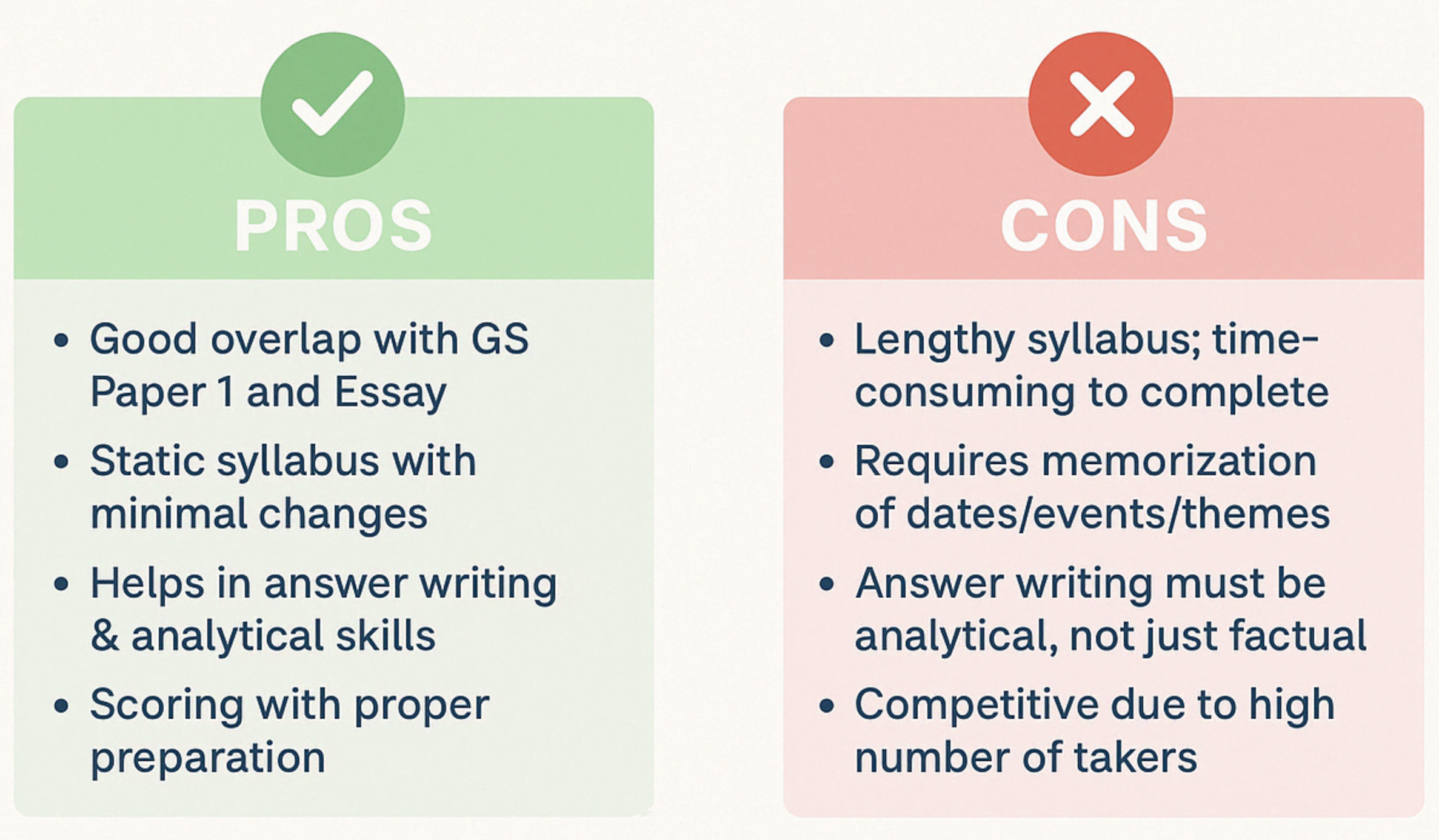
History Optional is not the highest-success-rate optional on paper, and you should go in knowing that rather than being told otherwise. It also isn’t a declining or unscoreable subject — it has a large, motivated candidate pool (which mechanically caps its percentage success rate), a strong overlap with GS Paper I that reduces your net preparation load, and a demonstrated ceiling at the very top of the exam. The realistic takeaway is that History Optional rewards preparation quality more than most subjects punish preparation quantity: a well-structured, well-cited, systematically practised answer pulls dramatically ahead of an average one on the same facts.
That’s precisely the gap the History Optional PYQ Master Pack is built to close — full model answers for every PYQ from 1985–2025, with the structure and historian citations that move you from the middle of that wide scoring range toward the top of it.
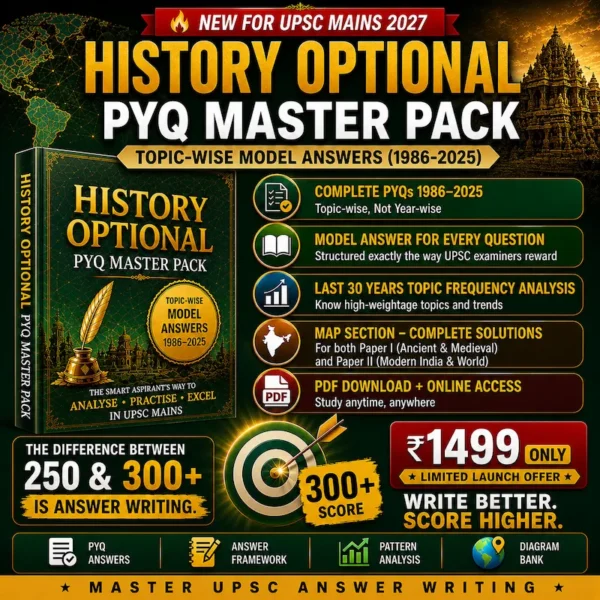
History Optional PYQ Master Pack: Topic-wise Model Answers (1985–2025) by LotusArise IAS
Most History Optional aspirants study PYQs the hard way — reading the question, guessing the answer, checking a random source, moving on. No structure. No historian citations. No idea what UPSC actually rewards. History Optional PYQ Master Pack — 100% complete and ready to download today — changes this completely.
📚 1985–2025 PYQs (Topic-wise) — Ancient India, Medieval India, Modern India, Post-Independence, World History — every question, fully solved
✍️ Model answers for every important question — exact structure, historian citations, diagram suggestions
🗺️ Map section solutions included — the full 50-mark section most aspirants ignore, at no extra cost
📲 PDF Download + Online Access — both included — study offline on any device, forever, not just while a subscription lasts
💰 Priced at ₹1,499 — for everything. Similar History Optional PYQ solutions elsewhere are sold for ₹2,500–₹3,500, often charging separately for online access, hard copies, and the Map section. Here, one price gets you PYQs + Map + PDF + online access, combined.
✅ Fully complete, nothing pending — every section is live the moment you enroll
You will be charged ₹1,499 today. Access is provided instantly. One-time payment. No subscription.