Ask ten History Optional aspirants how they use previous year papers, and most will describe the same routine: pick up the 2024 paper, attempt it under timed conditions, check it against a model answer or coaching PDF, move to 2023, repeat. It feels rigorous — you’re doing real papers, under real conditions, going backward year by year. And it is genuinely useful for exam-temperament practice.
But if the goal is understanding what UPSC actually rewards on a given topic, year-wise practice is close to the least efficient way to use forty years of previous papers. Here’s why, and what to do instead.
The Problem With Studying PYQs Year by Year

A year-wise paper mixes topics that have nothing to do with each other. The 2024 Paper I might ask about Harappan trade, Delhi Sultanate land revenue, and the Bhakti movement in the same sitting. You solve all three, move to 2023, and the next paper asks about Mauryan administration, Vijayanagara polity, and Sufi orders. Nothing connects one year’s Harappan question to the previous decade’s Harappan questions, because you never see them side by side — they’re separated by nine other topics and an entire calendar year of your study schedule.
The result is that you learn to answer that specific question, that specific year reasonably well, but you never build a picture of how UPSC treats a topic across a decade or more — which angles it returns to, which it has abandoned, and where the framing has shifted. You’re solving forty individual puzzles instead of learning the puzzle-maker’s habits.
What Topic-Wise Practice Actually Shows You
When you instead pull every question UPSC has asked on a single topic — say, the decline of the Harappan Civilization — across every year it’s appeared, a pattern emerges that no single year’s paper could show you.
You start to see that the same underlying debate gets tested from different angles across cycles: sometimes the question asks you to “discuss the factors” behind the decline (a broad, multi-causal framing), sometimes it narrows to “critically examine the environmental factors” (forcing you to prioritise one causal thread and defend it), and sometimes it’s folded into a comparative question alongside another Bronze Age civilization. Studied year-wise, these look like three unrelated questions you happen to have notes for. Studied topic-wise, they reveal that UPSC keeps returning to the same historiographical debate — invasion versus environmental collapse versus gradual internal transformation — and simply keeps changing which angle of it you’re asked to argue.
That’s not a trivia observation. It tells you three concrete things a year-wise solver never learns:
Which debates are “live” for a topic, so you know which historians and evidence to have ready regardless of exactly how the question is phrased on exam day.
How question framing has shifted over time — UPSC’s questions across many topics have moved from purely descriptive (“Discuss the salient features of…”) toward more analytical, opinion-demanding framings (“Critically examine…”, “To what extent…”) in more recent cycles. If your practice is scattered year by year, you won’t notice this drift; if you line up a topic’s questions chronologically, it’s unmistakable.
Where the gaps are — topics that were asked heavily a decade ago and haven’t reappeared recently, which is exactly the kind of signal that should raise your guard, not lower it. A topic UPSC hasn’t touched in ten years isn’t necessarily “safe to skip” — it’s often overdue.
A Concrete Way to Start Doing This Yourself
If you want to build this habit with material you already have, take one topic you’ve already studied — the Bhakti and Sufi movements is a good one, since it recurs often — and go through every previous paper you can find, pulling out only the questions on that topic, regardless of year. Line them up chronologically. Read them as a set, not as isolated questions. Ask yourself: what’s the common thread being tested across all of them? What’s the one angle that keeps reappearing? What historian or piece of evidence would let you answer any framing of this topic, not just the exact wording from one specific year?
Do that for a single topic and the difference in how you understand it is immediate. Do it across all 20-odd major topics in Ancient, Medieval, Modern, and World History, and you’ve effectively rebuilt your preparation around what UPSC actually tests rather than what a random assortment of individual papers happened to ask.
Why Most Aspirants Don’t Do This — And What It Costs Them
The honest answer is that it’s slow. Reorganising forty years of scattered PYQs by topic, by hand, across two papers and roughly twenty distinct topic areas, is a multi-week project on its own — before you’ve written a single practice answer. Most aspirants correctly judge that this isn’t a good use of the limited weeks before Mains, and default back to year-wise solving because it’s what’s readily available in every previous-papers PDF.
That’s a reasonable trade-off if the alternative is doing the reorganisation yourself from scratch. It’s not a reasonable trade-off if the reorganisation already exists.
The History Optional PYQ Master Pack is built on exactly this principle: every question from 1985–2025 is grouped by topic, not by year, with a 12-year frequency analysis showing which topics UPSC returns to most, which have gone quiet and may be due, and how framing has shifted toward analytical questions since 2019. It’s the topic-wise view this article describes, already built, alongside fully solved model answers for every question in it.
You don’t need to solve more PYQs. You need to see the ones you’ve already got, arranged so the pattern is visible.
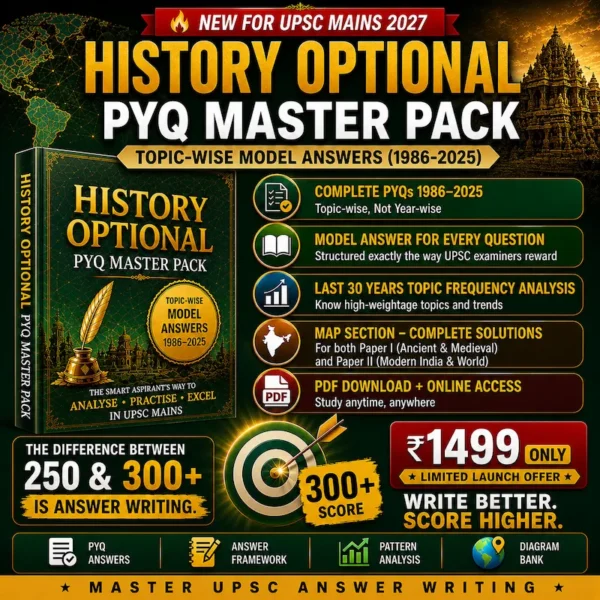
History Optional PYQ Master Pack: Topic-wise Model Answers (1985–2025) by LotusArise IAS
Most History Optional aspirants study PYQs the hard way — reading the question, guessing the answer, checking a random source, moving on. No structure. No historian citations. No idea what UPSC actually rewards. History Optional PYQ Master Pack — 100% complete and ready to download today — changes this completely.
📚 1985–2025 PYQs (Topic-wise) — Ancient India, Medieval India, Modern India, Post-Independence, World History — every question, fully solved
✍️ Model answers for every important question — exact structure, historian citations, diagram suggestions
🗺️ Map section solutions included — the full 50-mark section most aspirants ignore, at no extra cost
📲 PDF Download + Online Access — both included — study offline on any device, forever, not just while a subscription lasts
💰 Priced at ₹1,499 — for everything. Similar History Optional PYQ solutions elsewhere are sold for ₹2,500–₹3,500, often charging separately for online access, hard copies, and the Map section. Here, one price gets you PYQs + Map + PDF + online access, combined.
✅ Fully complete, nothing pending — every section is live the moment you enroll
You will be charged ₹1,499 today. Access is provided instantly. One-time payment. No subscription.