- Human settlements did not evolve randomly. They passed through critical turning points: the shift from nomadism to sedentary life, the rise of an agricultural surplus, and the emergence of the first cities as centres of power, trade, worship and administration.
- Archaeologists, historians and geographers explain these turning points through several theories, each stressing one prime mover: surplus, irrigation, trade, defence or religion. Later work added social power and systems views, such as Constantinos Doxiadis’s Ekistics.
- Most scholars now accept that settlement evolution is multi-causal: the theories are complementary pieces of one explanation. The sequence of events and the earliest cities are traced under the origin and growth of settlements.
Turning Points in Settlement Evolution

- Sedentism: from mobile camps to year-round villages, first in resource-rich places, then with farming.
- The Neolithic Revolution (from about 10,000 BCE): domestication gave a storable food supply, tying people to fields and granaries.
- The Urban Revolution (from about 3500 BCE): surplus, specialisation and the state produced cities.
- Later revolutions: the commercial revival of medieval towns, the Industrial Revolution and today’s metropolitan and global urbanisation.
- Theories differ mainly on the second and third steps: why some villages became cities, and which force came first.
Theories of Urban Origin
Agricultural Surplus Theory and Childe’s Urban Revolution
- Proponent: V. Gordon Childe (Man Makes Himself, 1936; “The Urban Revolution”, 1950).
- Core idea: cities arose when farming produced a surplus large enough to feed people who did not farm.
- The surplus freed a section of society from food production for crafts, trade, administration and ritual.
- Surplus enabled barter and exchange, and its collection and storage needed records and rulers.
- A large, stable population supported occupational specialisation, social stratification and institutions.
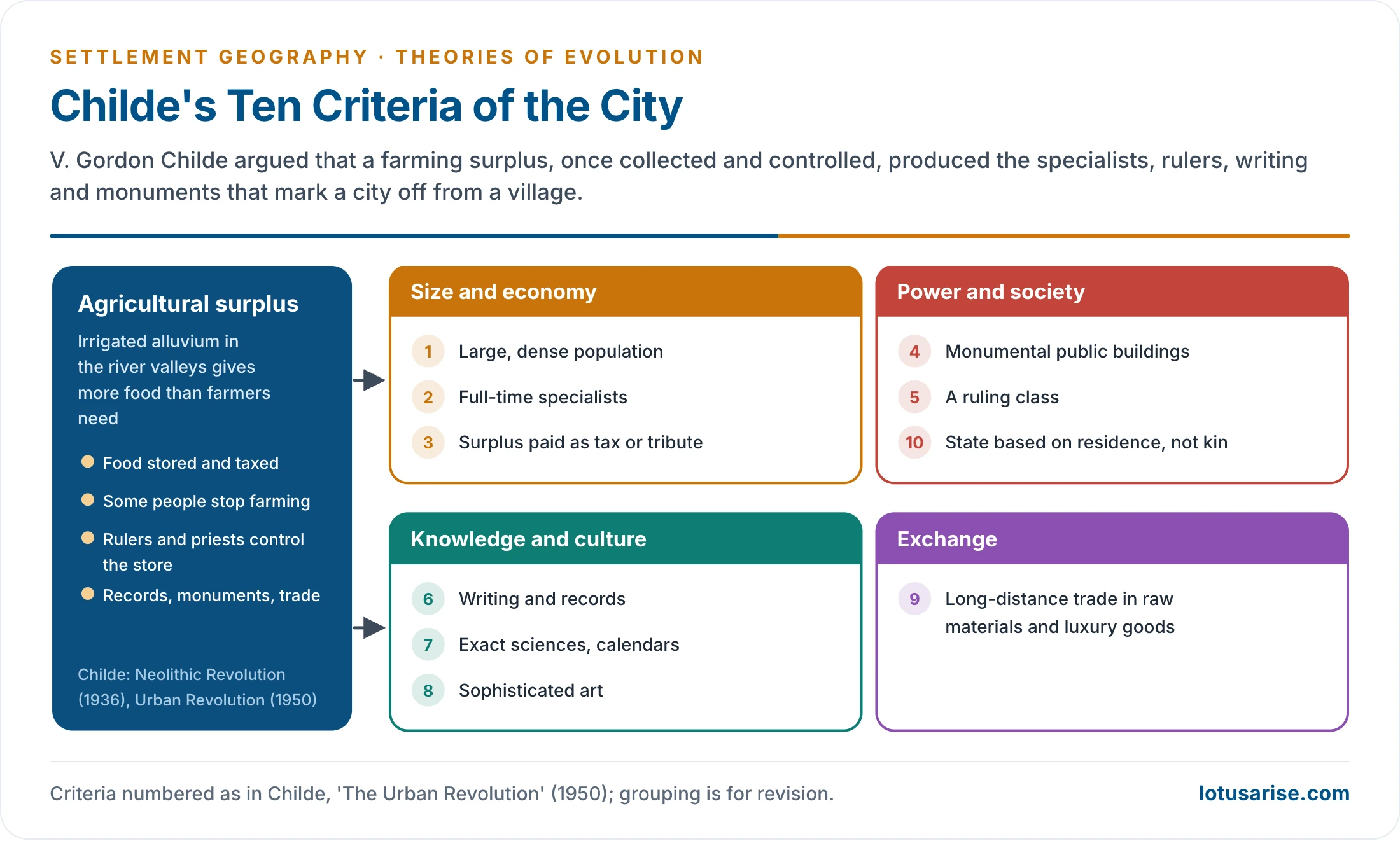
- Childe set out ten criteria that mark a city off from a village:
| Group | Criteria |
|---|---|
| Size and economy | 1. Large, dense population; 2. Full-time specialists (craftsmen, traders, priests, officials); 3. Surplus paid as tax or tribute to a god or king |
| Power and society | 4. Monumental public buildings; 5. A ruling class that controls the surplus; 10. A state organised by residence, not kinship |
| Knowledge and culture | 6. Writing and records; 7. Exact sciences (arithmetic, geometry, astronomy, calendars); 8. Sophisticated art |
| Exchange | 9. Long-distance trade in raw materials and luxuries |
- Evidence:
- Sir Leonard Woolley’s excavations at Ur (1922–34) revealed granaries, temples, royal tombs and specialised crafts, all resting on irrigated barley farming.
- The Indus, Nile and Mesopotamian valleys combined fertile alluvium, water and long growing seasons.
- In India, the Indo-Gangetic plain later supported dense, continuous settlement and the cities of the second urbanisation (from about 600 BCE).
- Criticism:
- Surplus is a necessary but not sufficient condition. Many farming societies produced surpluses but never built cities.
- A surplus is socially created: rulers or priests must first demand it. The cause may be power, not productivity.
- The model is unilinear: it assumes all societies pass through the same steps.
Hydraulic Theory
- Proponent: Karl August Wittfogel, Oriental Despotism (1957).
- Sir Leonard Woolley is sometimes listed under this heading because he stressed river-valley surplus. The irrigation-state argument itself is Wittfogel’s.
- Core idea: in arid and semi-arid river valleys, farming depended on large-scale irrigation and flood control.
- Building and running canals, dykes and reservoirs needed mass labour, planning and discipline.
- This produced a managerial bureaucracy and a despotic state (“hydraulic society”).
- Cities grew as the seats of this bureaucracy: centres of administration, storage and command.
- Examples cited: Egypt, Mesopotamia, China, and the river plains of South Asia.
- Criticism:
- Robert McCormick Adams (The Evolution of Urban Society, 1966) showed that in Mesopotamia large canal systems came after cities and states. Early irrigation was small and locally managed.
- Harappan cities show wells, drains and reservoirs (Dholavira), but no evidence of a centrally managed canal network.
- Many irrigation systems were run from below: the subak of Bali and the tank systems of south India were managed by villages and temples.
- It is environmentally deterministic and was coloured by Cold War politics: it treated “Oriental” states as inherently despotic.
- Its lasting point is that water management and state power reinforce each other once cities exist.
Economic Theories: Trade and Markets
- Settlements are products of exchange: they arise where goods, people and information meet.
- Mercantile (long-distance trade) view:
- Henri Pirenne (Medieval Cities, 1925) argued that the revival of long-distance trade after about 1000 CE re-created European towns. Merchants settled outside castles and monasteries, and these merchant quarters became towns.
- Towns grow along trade routes, ports, river crossings and caravan halts.
- Market-centre view:
- Max Weber (The City, 1921) defined the city first as a market settlement, where the inhabitants live mainly from trade and crafts rather than farming.
- Settlements are local nodes of exchange serving a hinterland through periodic and permanent markets.
- This logic was formalised in Walter Christaller’s central place theory (1933).
- “Cities first”:
- Jane Jacobs (The Economy of Cities, 1969) reversed the usual order. She imagined a trading settlement (“New Obsidian”) dealing in obsidian, where seeds and animals brought for trade were first domesticated. In her view agriculture began in and around cities, not before them.
- Few archaeologists accept the sequence, but the idea that trade and towns can lead has influenced later research.
- Indian examples:
- Pataliputra and Ujjain flourished at the meeting of trade and administrative routes.
- Indo-Roman ports such as Arikamedu and Muziris grew on maritime trade.
- Towns of the Silk Route network (Taxila) prospered on overland trade.
- The weekly haat and the market town (mandi, ganj) continue this logic in rural India.
- Strength: explains the spacing, hierarchy and network of settlements. Limitation: may overlook cultural and political causes.
Military and Defence Theories
- The need for security drew people together behind walls in a hostile world.
- Evidence:
- Jericho had a stone wall and tower by about 8000 BCE.
- At Çatalhöyük (Anatolia), houses were packed together with no street-level doors; people entered through the roofs, making the settlement itself a defensive block.
- The Egyptian hieroglyph for “town” is a cross within a circle: crossing streets inside an enclosing wall.
- Robert Carneiro’s circumscription theory (1970):
- Where farmland is hemmed in by desert, mountain or sea (the coastal valleys of Peru, the Nile valley), a growing population cannot move away.
- Warfare over land leads to conquest, subordination of the defeated and the rise of states and fortified towns.
- Max Weber also saw the early city as a fortress as well as a market.
- Indian examples:
- The Arthashastra lays down rules for fortified capitals (durga).
- Hill forts and fort towns: Gwalior, Chittorgarh, Jaisalmer, Golconda, Daulatabad.
- Walled cities with gates: Shahjahanabad (Old Delhi) and Jaipur (founded 1727).
- Strength: explains the compact, nucleated form of many early settlements. Limitation: not every settlement began for defence; many walls were added later.
Religious and Ceremonial Theories
- Settlements formed around sacred places: shrines, temples and ritual centres drew people periodically, and some stayed.
- Thinkers:
- Fustel de Coulanges (The Ancient City, 1864): the Greek and Roman city began as a religious association of families sharing cults.
- Paul Wheatley (The Pivot of the Four Quarters, 1971): the earliest Chinese cities grew from ceremonial centres; he argued the same for other hearths.
- Lewis Mumford (The City in History, 1961): the city was first a magnet (a shrine or meeting place people returned to) before it became a container of permanent residents.
- Evidence:
- Göbekli Tepe (Turkey, about 9500 BCE): monumental stone enclosures built by hunter-gatherers, suggesting that ritual gatherings came before farming villages.
- Caral (Peru) and Mesoamerican centres are dominated by temple platforms and plazas.
- Sumerian cities were organised around the temple of the city god.
- Indian examples: tirtha cities such as Varanasi, Ayodhya, Prayagraj, Puri, Madurai, Tirupati and Ajmer, where religion still shapes urban form, fairs and economy.
- Strength: shows the role of non-economic forces: belief, authority and identity. Limitation: underplays material and environmental conditions.
Social Cohesion: Ibn Khaldun
- Ibn Khaldun, in the Muqaddimah (1377), contrasted two ways of life:
- Umran badawi: nomadic or rural life, with simple needs and strong asabiyya (group solidarity).
- Umran hadari: settled urban life, with crafts, luxury, institutions and learning.
- Groups with strong asabiyya, often reinforced by religion, conquer and found dynasties and cities. Urban comfort then weakens solidarity, and the dynasty declines in three to four generations, to be replaced by a new group from the margins.
- He thus offered an early cyclical theory of settlement and state, linking the rise of cities to social cohesion and authority.
Social Power and Multi-Causal Theories
- Gideon Sjoberg (The Preindustrial City, 1960) named three prerequisites for cities:
- A favourable ecological base that permits a surplus.
- An advanced technology, in farming and in other fields such as metalwork and transport.
- A complex social organisation, above all a power structure that can extract and redistribute the surplus.
- Robert McC. Adams (1966) compared Mesopotamia and Mesoamerica and concluded that urbanism arose through the interplay of farming, social stratification, trade and the state, not one cause.
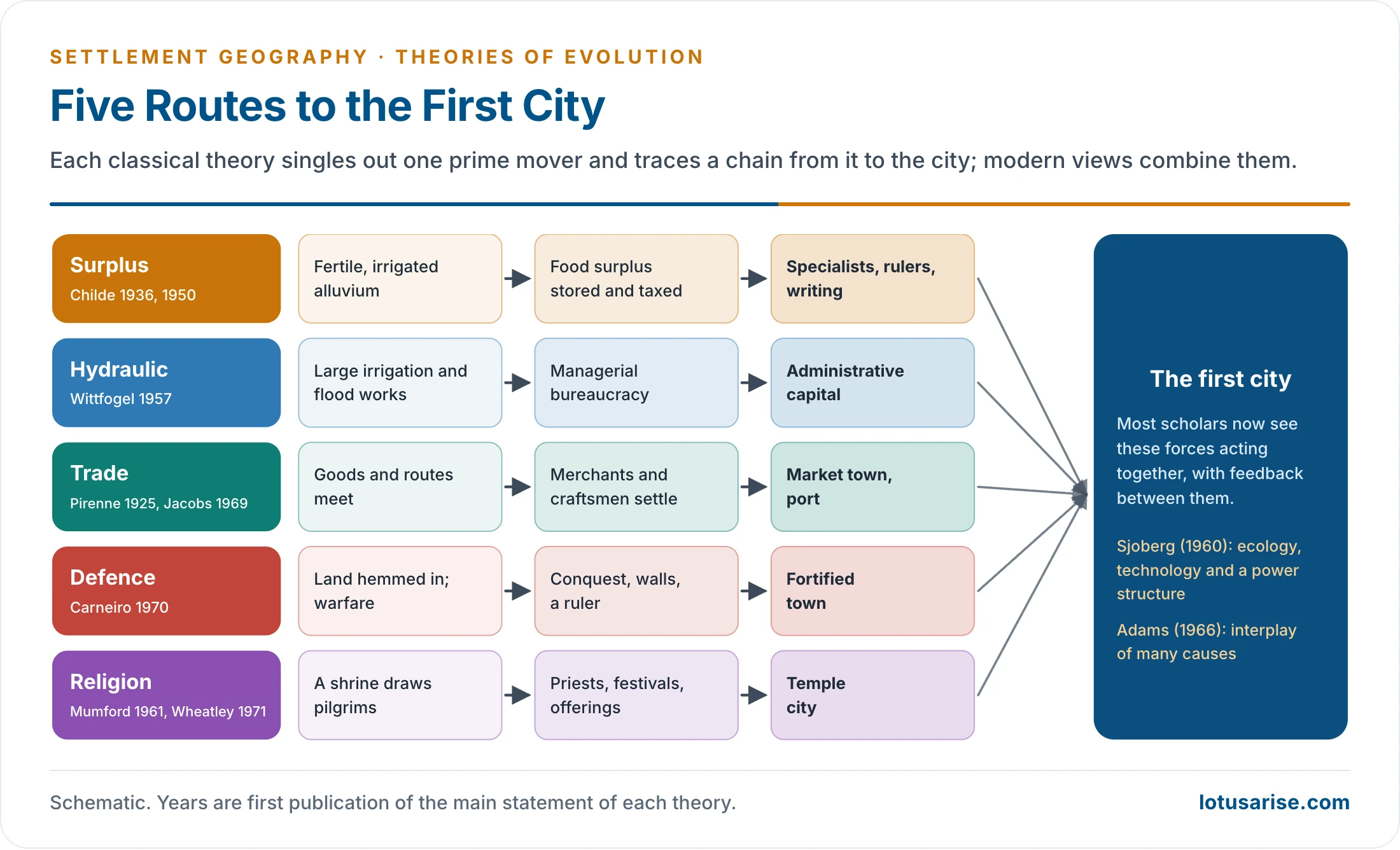
- Modern archaeology favours such feedback models: a small surplus supports a few specialists; specialists and rulers raise production and trade; trade and warfare strengthen rulers; the city grows.
| Theory | Key thinker | Prime mover | Main evidence | Main criticism |
|---|---|---|---|---|
| Surplus (urban revolution) | Childe (1936, 1950) | Agricultural surplus | Ur, Indus, Nile | Surplus needed but not sufficient |
| Hydraulic | Wittfogel (1957) | Large-scale irrigation | Egypt, China | Big canals came after cities |
| Trade and market | Pirenne (1925), Weber (1921), Jacobs (1969) | Exchange | Medieval towns, ports | Overlooks culture and politics |
| Defence | Carneiro (1970) | Warfare, security | Jericho, Çatalhöyük | Walls often added later |
| Religious | Fustel de Coulanges (1864), Wheatley (1971) | Ritual centres | Göbekli Tepe, Caral | Underplays material base |
| Social power | Sjoberg (1960), Adams (1966) | Power structure, many causes | Comparative studies | Harder to test |
Doxiadis and Ekistics
- Constantinos A. Doxiadis (1913–1975), a Greek architect-planner, founded Ekistics, the science of human settlements (Ekistics, 1968).
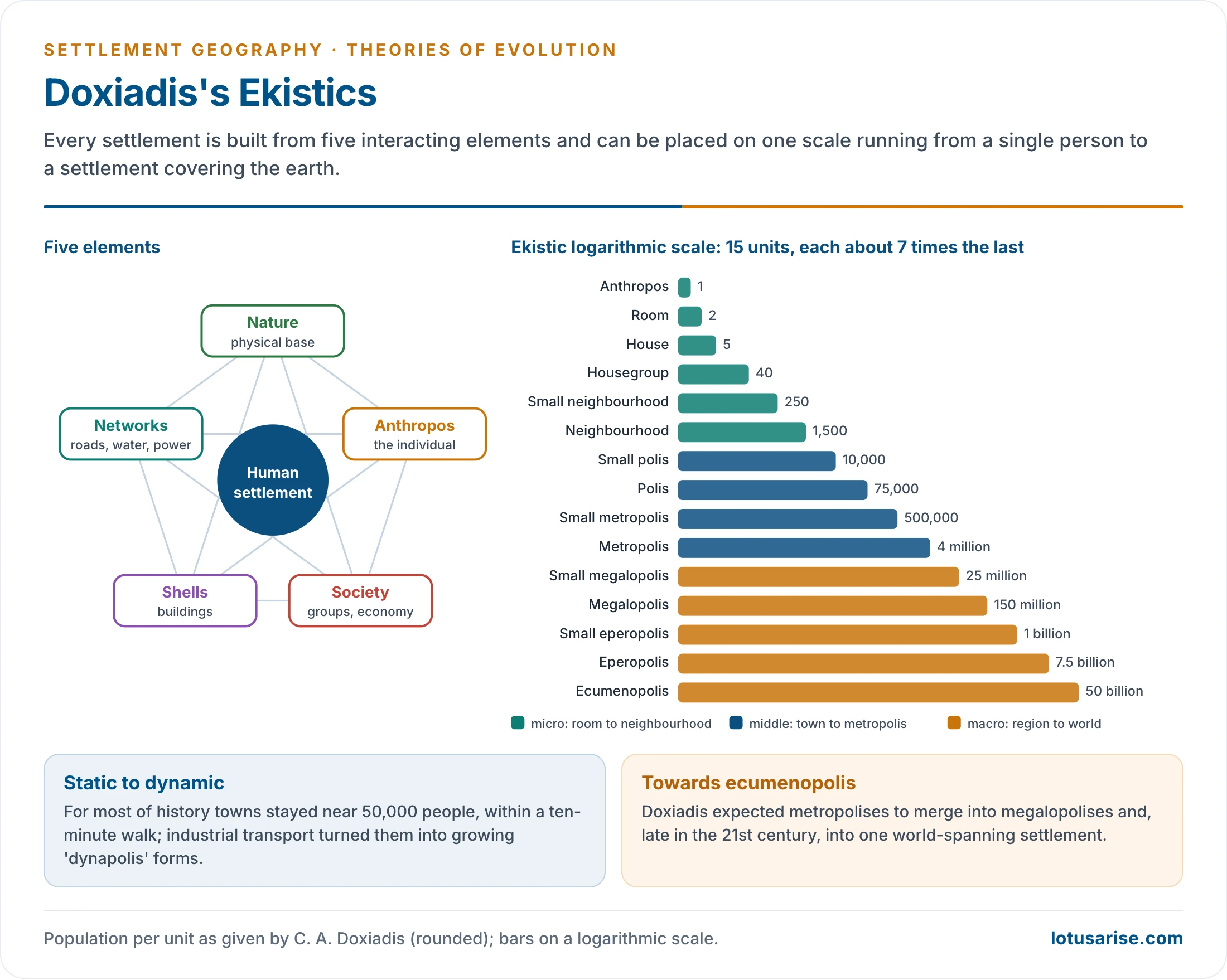
- Five elements make every settlement:
- Nature (the physical base), Anthropos (the individual), Society, Shells (buildings and structures) and Networks (roads, water, power, communication).
- Change in one element changes the others. A new road (network) brings trade (society), new buildings (shells) and pressure on land and water (nature).
- The ekistic logarithmic scale classifies settlements into 15 units, each about seven times the population of the one before:
- Anthropos (1), room (2), house (5), housegroup (40), small neighbourhood (250), neighbourhood (1,500).
- Small polis (10,000), polis (75,000), small metropolis (500,000), metropolis (4 million).
- Small megalopolis (25 million), megalopolis (150 million), small eperopolis (1 billion), eperopolis (7.5 billion), ecumenopolis (50 billion).
- The factor of seven follows Christaller’s hexagonal pattern.
- Evolution of settlements in Ekistics:
- For most of history, towns stayed near an optimum of about 50,000 people, with everyone within about a ten-minute walk of the centre.
- Industrial technology broke this limit. Static cities became dynamic cities (dynapolis), growing outward along transport axes.
- Doxiadis predicted that metropolises would merge into megalopolises and finally into a single world-spanning ecumenopolis in the late 21st century.
- Contribution: a holistic, interdisciplinary framework linking geography, architecture, planning, sociology and economics. Doxiadis applied it in master plans for Islamabad (1960) and in housing programmes across Asia and Africa.
- Criticism: the scale is mechanical, the ecumenopolis forecast is speculative, and the framework treats settlements as technical systems more than social and political ones.
Synthesis
- The theories are not mutually exclusive. Each explains a part of the process:
- Environment supplies the base conditions (fertile, watered land).
- Surplus and technology make non-farming specialists possible.
- Economic exchange drives functional growth, hierarchy and networks.
- Defence and political power shape location, walls and compact form.
- Religion and culture give identity, authority and continuity.
- The balance differed by region:
- Mesopotamia: temples, surplus and trade together.
- The Andes: ceremonial centres first.
- Medieval Europe: trade revival.
- India: Harappan planning and drainage; Ganga valley states and trade; temple towns in the south; fort and court cities under the Rajputs, Sultanate and Mughals; colonial ports.
- Modern settlement geography views settlements as parts of a larger spatial system, shaped today by technology, state policy and global economic integration. Settlements are best understood as dynamic socio-spatial systems, continuously reshaped by historical processes and contemporary change.
Previous Year Questions
- No direct PYQ has been asked on this sub-topic yet.