Unification of Europe: Post War Foundations: NATO and European Community; Consolidation and Expansion of European Community; European Union.
Unification of Europe covers European integration and NATO after 1945 and the end of the Cold War. UPSC has set 13 questions on it between 2003 and 2026, appearing in five of the last ten papers — two in 2026. It is a young unit in the paper, and one clearly growing.
Every question the Commission has asked on this topic is listed below, newest first, with a written model answer linked against each one.
| Questions asked (2003–2026) | 13 |
| Appeared in | 5 of the last 10 papers |
| Paper | Paper II, Section B (World History) |
| Usual mark value | 10, 15 or 20 marks |
| Model answers available | 11 of 13 |
PYQs: Unification of Europe [1985-2026]

| Year | Question | Answer |
|---|---|---|
| 2026 | The European Union sought to create 'Europe without frontiers'. Elaborate. | |
| 2026 | Discuss the core principles and significance of the North Atlantic Treaty Organisation. | |
| 2025 | To what extent did the concept of free trade of the European Economic Community contribute to the formation of the European Union? Examine. | View answer |
| 2024 | Trace the different stages of European economic integration. | View answer |
| 2019 | Do you agree with the view that the formation of NATO marked a revolution in American attitude to the world problems? | View answer |
| 2017 | Critically examine in 150 words: “The collapse of Berlin Wallon 9 November, 1989 brought new meaning to the imdea of cooperation in Europe." | View answer |
| 2015 | "The European Union, a diplomatic marvel, continues to grapple with intermittent fissures arising out of economic contentious issues that pose a challenge to an effective integration of the Union.” Critically examine. | View answer |
| 2014 | “Europe was eclipsed through European folly due to the two world wars.” Elucidate. | View answer |
| 2013 | “The European Union is the new sick man of Europe." Critically evaluate. | View answer |
| 2011 | “The collapse of Berlin Wall in 1989 brought new ideas of co – operation in Europe." Critically evaluate. | View answer |
| 2011 | Examine the challenges confronted by the proponents of European unity after the collapse of Soviet Empire in Eastern Europe. | View answer |
| 2007 | "NATO in many ways symbolized the key role that the United States had come to play in Europe.” Comment. | View answer |
| 2003 | ‘The Brussels Treaty of 17 March, 1948 paved the way for the formation of NATO.' | View answer |
What UPSC keeps asking about the Unification of Europe
Thirteen questions fall into three threads. Note that two questions here — NATO in 2026 and Europe’s eclipse in 2014 — are shared with the post-war world unit, so the two should be prepared together.
1. European economic integration and the EU (2011, 2013, 2015, 2024, 2025, 2026)
- The most active thread — three questions in the last three papers.
- The stages of integration (2024), free trade in the EEC (2025), a Europe without frontiers (2026).
- The EU as a “new sick man of Europe” (2013) and a diplomatic marvel still grappling with its problems (2015) invite a balanced account — the euro crisis and Brexit against the single market and enlargement.
2. NATO and Western security (2003, 2007, 2019, 2026)
- The Brussels Treaty as the path to NATO (2003), NATO as the symbol of American leadership (2007), its formation as a revolution in American policy (2019), and its principles (2026).
- The 2019 framing is the one to prepare: the break with the American tradition of avoiding peacetime alliances.
3. The end of the Cold War and Europe’s eclipse (2011, 2014, 2017)
- The fall of the Berlin Wall (2011, 2017) and Europe eclipsed by its own folly in two world wars (2014).
- Short in number but easy to combine with the integration thread in a single essay.
The model answers to this unit, in one place
Knowing the questions is half the work. The other half is seeing what a full-mark answer to each one looks like — not a hint or a bullet outline, but a complete answer at the mark and the word limit, with the historians named inside the argument.
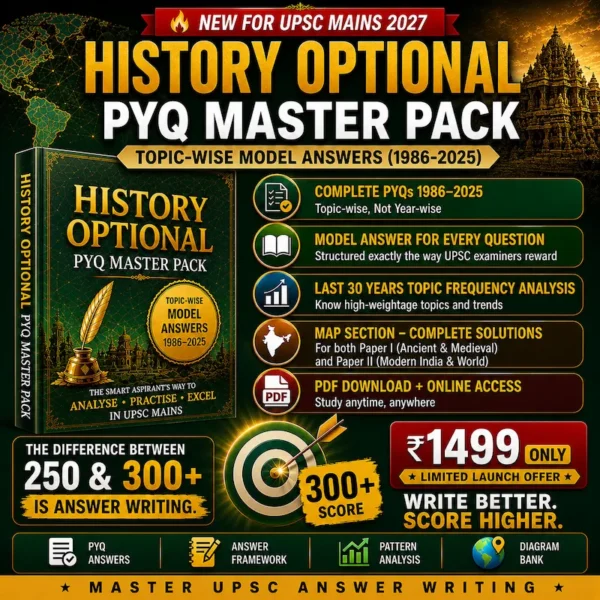
The History Optional PYQ Master Pack carries the same for every question the Commission has set since 1985, across the whole syllabus.
- PYQs 1985–2025, arranged topic-wise — revise a theme and see every way it has been asked
- Model answers with historiography — the debate cited where it belongs, not bolted on
- Map sections solved — the full 50-mark section, every year
- PDF plus online access — any device, permanently, no subscription
₹1,499 (regular ₹2,500). One-time payment, instant access.
How to use this topic list
Reading a question list feels like preparation and is not. Three sittings turn it into marks.
Sitting 1 — sort before you read (30 minutes)
- Copy the questions above into the threads identified in the previous section.
- Note which thread has gone longest without being asked — that is your priority, not the one you find most interesting.
Sitting 2 — write three answers cold (45 minutes)
- Pick the most recent question from three different threads.
- Seven minutes for a 10-marker, fifteen for a 20-marker. Stop when the time is up, even mid-sentence.
- Mark every place you wanted a historian’s name and could not produce one.
Sitting 3 — compare, then rewrite (45 minutes)
- Put your script beside the model answer for the same question.
- Compare structure first: opening claim, evidence, counter-view, judgement.
- Rewrite your weakest answer using that structure and no new content. Most candidates gain four to six marks from structure alone.
Two ways to prepare this optional
Two routes, depending on what is actually missing.
| PYQ Master Pack | Mains Master Kit 2027 | |
| Best when | Your notes are done; answer-writing is the gap | You are still building the subject |
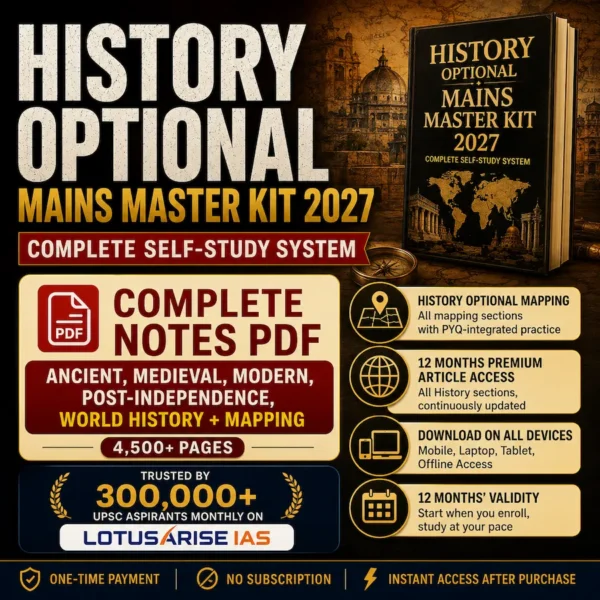
| What you get | Model answers to every question since 1985, topic-wise, map sections included | 4,500+ pages of notes, full mapping coverage, 12 months of article access |
| Price | ₹1,499 (reg. ₹2,500) | ₹1,770 (reg. ₹5,000) |
Frequently asked questions
Related topics
This unit connects to:
- The World after World War II
- World Wars
- Nation-State System
- Revolution and Counter-Revolution
- All topics — History Optional PYQs, topic-wise
Prefer to work year by year?
The complete papers, with both papers in full, unit-wise analysis and the official PDFs:
- History Optional Question Paper 2026
- History Optional Question Paper 2025
- History Optional Question Paper 2024
- History Optional Question Paper 2023
- History Optional Question Paper 2022
- History Optional Question Paper 2021
- History Optional Question Paper 2020
- UPSC History Optional Map Solutions (2013–2025)