

During the early medieval era, the Senas of Bengal governed through the 11th and 12th centuries as a Hindu dynasty, ruling over a sizable area of the northeast Indian subcontinent at its height. This article traces the origins, political history, administration, literature, religion, and material culture of the Sena dynasty of Bengal — an important regional successor state to the Palas for UPSC History Optional aspirants.
Origin

- Samantasena, the founder of the Sena dynasty, was a Brahmakshatriya immigrant, as recorded in the Deopara Prashasti.
- “Brahma-Kshatriya” implies that the Senas of Bengal were Brahmins by caste who chose to become Kshatriyas by taking up arms.
- According to historian P.N. Chopra, the Baidyas were also likely among the kings of the Sena line.
- The Senas of Bengal initially joined the Palas’ service in Radha as samantas (feudatories), most likely under Samantasena.
- By the end of Vijayasena’s rule, Sena territory had grown to include Vanga and a portion of Varendra.
- The Sena dynasty’s emperors were said to have descended from Karnataka, a province in southern India — the emperors themselves are traced to a Karnataka origin.
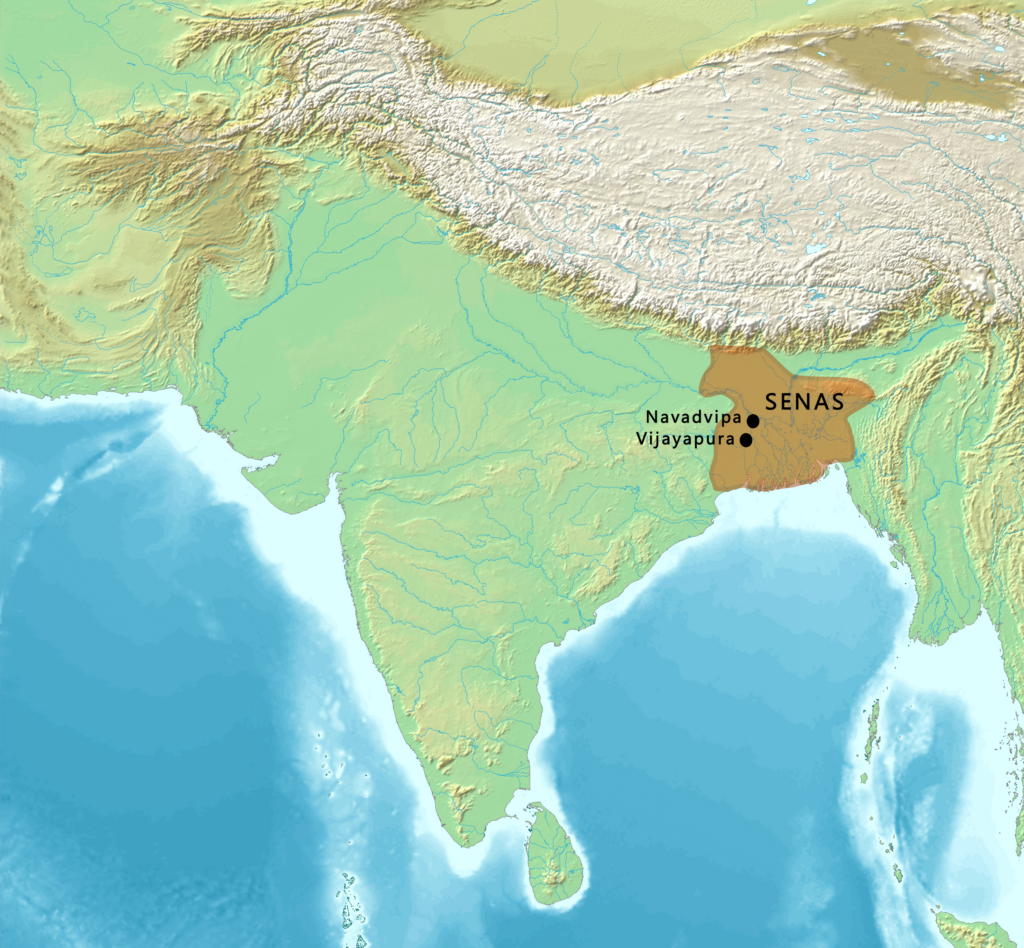
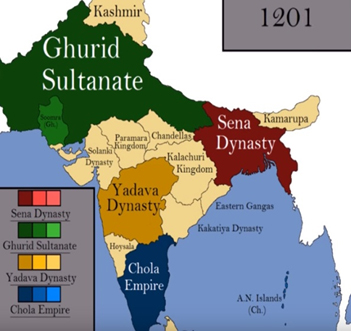
Brief History
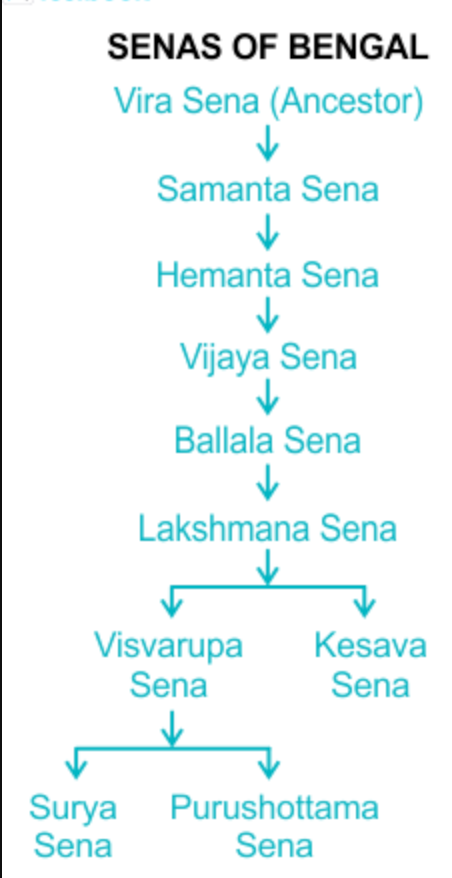
- Samanta Sena was the founder of the dynasty. Hemanta Sena usurped the throne, proclaimed himself king in 1095 CE, and succeeded him.
- His successor, Vijaya Sena, had an unusually long reign of more than 60 years, contributing greatly to establishing the dynasty.
- Ballala Sena expelled the Palas from Gaur, took control of the Bengal Delta, and established Nadia as the new capital.
- After succeeding Ballala Sena in 1179 CE, Lakshmana Sena governed Bengal for almost 20 years, expanding the Sena empire to include Odisha, Bihar, and likely Varanasi.
- Ramadevi, a princess of the Western Chalukya kingdom, was married to Ballala Sena — evidence that the Sena rulers maintained close social ties with South India.
Sena Rulers
- Following the Palas, the Sena family ruled Bengal; Hemantasena, son of Samantasena, established an independent principality.
- Samantasena, the dynasty’s founder, was referred to as a “Brahmakshatriya,” but his successors referred to themselves simply as Kshatriyas.
Vijayasena
- Vijayasena, son of Hemantasena, made the family famous during his lengthy reign of more than sixty years.
- Starting as a small ruler, he conquered nearly all of Bengal, laying the groundwork for his family’s future supremacy.
- The renowned poet Sriharsha wrote the Vijayaprashasti in his honour.
- Vijayasena adopted the imperial titles Parameshvara, Paramabhattaraka, and Maharajadhiraja, among others, and maintained two capitals — one at Vikramapura in present-day Bangladesh, and the other at Vijayapuri in West Bengal.
Ballalasena
- Ballalasena, son of Vijayasena, succeeded his father; the dominions inherited from his father were kept intact during his generally quiet reign.
- Ballalasena excelled in scholarship, producing four surviving works, of which the Danasagara and the Adbhutasagara are notable — the former a thorough study of portents and omens, and the latter a treatise on astronomy.
Lakshmanasena
- In 1179 CE, Lakshmanasena took over as head of the family at the advanced age of sixty.
- His reign faced a mounting sea of troubles: internal uprisings had already begun to weaken Sena power, but Bakhtiyar Khalji’s invasion dealt it a fatal blow.
- The Tabakat-i-Nasiri contains a thorough account of Bakhtiyar Khalji’s invasion of Bengal.
Sena Administration
- In general, the Pala system of government was maintained under the Senas of Bengal — administrative divisions such as Bhuktis, Vishayas, and Mandalas continued to exist.
- The terms Patakas and Chaturakas also appear frequently in inscriptions and literature of the Sena era.
- The Sena kings adopted titles such as King Aswapati, King Narapati, and King Rajaprayadhapati, among others, suggesting that the Senas of Bengal gave greater weight to minor administrative divisions.
- Bhuktipati, Mandalpati, and Vishayapati were common royal officers, while Mahamantri became the new title for the Palas’ Prime Minister.
- Evidence shows that Sena monarchs granted land concessions to their queen, or Rajmahishi.
- The Purohitas and Mahapurohitas were also granted land through official charters, reflecting the great respect and importance these priestly officials had attained.
- Under the Senas of Bengal, the Sandhivigrahika of the Palas adopted the new title Mahasandhivigrahika.
- The Senas also appointed the Mahamudradhikrita and Mahasarvadhikrita; the highest judge was known as the Mahadharmadhyaksha.
- Military officers likewise adopted new titles under the Senas, including Mahapilupati, Mahaganastha, and Mahabyutpati.
- There is a reference to 29 classes of officers under the Senas of Bengal in Ishwar Ghosh’s copper plate — never before had independent Bengal seen so many different classes or grades of officers.
- It must be noted, however, that the basic framework of Pala governance remained essentially the same under the Senas.
- During the Sena era, the class of officers known as Pradeshtris, mentioned by Kautilya, was also appointed — demonstrating how the Sena administration was influenced by earlier Hindu administrative traditions.
- The Sena era was, on the whole, one of peace and prosperity in Bengal’s history, with improvements in society, politics, and religion alike.
Sena Literature
- Lakshmanasena’s rule is notable for encouraging considerable literary activity; he held a strong Vaishnava faith.
- At his court resided Jayadeva, the well-known Bengali Vaishnava poet and author of the Gita Govinda.
- Other notable poets who visited his court included Govardhana and Dhoyi, the author of the Pavanaduta.
Religion
- The birth of orthodox Hinduism is typically linked to the rule of the Senas of Bengal.
- This period is thought to mark the beginning of the persecution of Buddhists in Bengal, leading to a mass exodus of Buddhists to neighbouring lands.
- After the fall of the Senas, Buddhism in India fell further out of favour, and Bakhtiyar Khalji plundered numerous Buddhist universities.
Inscriptions
- In 1838 CE, a copper plate was discovered at Adilpur; the inscription is dated to the third Jyaistha of 1136 Samvat, or 1079 CE, and is written in Sanskrit and Gauda characters.
- According to the copperplate of Keshava Sena, the goddesses of fortune were taken from the enemies by king Ballala Sena.
- According to another copperplate record, a Brahman received three villages in the third regnal year of Keshava Sena; the grant carried landlord powers, including the authority to punish a tribe known as the Chandrabhandas, or Sundarbans, who resided in the jungle.
- The land granted lay in the village of Leliya, in the Shatata-Padmavati-Vishaya, part of the Kumaratalaka mandala.
- The king also granted Nitipathaka Ishvaradeva Sarman a grant for the interior of the Subha-varsha.
- This inscription mentions the construction of pillars of victory and sacrifice posts built by Ballala Sena’s son, Lakshmana Sena, and also describes Bengali dance and music.
Senas of Bengal Sculpture
- Many sculptures depicting Hindu gods and goddesses are part of the creative movement begun by the Sena monarchs (c. 1097–1223 CE).
- The stylistic index for Sena sculptures is provided by two dated images: a Sadashiva from Rajibpur, Dinajpur, engraved during the reign of Gopala III, and a Chandi from Dalbazar, Dhaka, inscribed during the third year of Lakshmanasena.
- A profusion of ornamental motifs appears to have overtaken stone sculpture of this period, though the modelling of the body, while ornate, remained skilfully maintained.
- A few Sena-era freestanding images nonetheless show bold and superior modelling — notably the enormous stone head of Vishnu from Padumshahar Tank, and the stone torso of Garuda from Malda.
- Among the finest illustrations of Sena sculpture is the stone representation of Ardhanarishvara, its carving shaped like a circle, with Shiva’s characteristics on the right and Uma’s on the left.
- The stone statue of Apitakucha from Vikrampur is another composite sculpture from this era.
Coinage of the Senas of Bengal
- The Senas of Bengal were a powerful ruling dynasty in Bengal’s history; Sena texts frequently refer to several types of currency, including the Purana, Dharan, and Dramma.
- These terms referred to a karshapana weighing scale, or a silver coin weighing 32 ratis.
- The coin was called “Karpadaka,” and the “Purana” was undoubtedly a type of silver coin.
- A medium of exchange comparable in quality to a Purana, or silver coin, but calculated by a fractional denominator, was called a “kapardaka-purana.”
- Instead of a single silver coin, the traditional Bengali arithmetic table equated to 1,260 cowries — the source records the Purana and the Kapardaka as standing in a ratio of 1:1280.
- Excavations at Paharpur and Kalgang have provided solid proof of the widespread use of cowries in early medieval Bengal.
- In Bengal during the early medieval period, cowries were widely used, and valuable coinage was comparatively scarce; academics have long tried to explain the reasons behind these apparent constraints on coinage.
Conclusion
After the reign of its last capable king, Lakshmana Sena, the Sena dynasty showed clear signs of decline. His heirs gave little indication of any intent to sustain or expand the dynasty, sharing in their predecessors’ waning interest in the flourishing arts, culture, and religion of the age, and instead pursuing comfort and personal enjoyment. This vulnerability was exploited by Bakhtiyar Khalji of the Ghurid Empire, who successfully invaded and later seized control of the Sena dynasty’s capital — bringing an end to Sena rule in Bengal, and marking this dynasty’s transition, alongside its administrative continuity from the Palas and its rich contributions to literature, religion, and art, as an important chapter of early medieval Indian history for UPSC History Optional preparation.




