Islam and Its Arrival in India: Introduction

The arrival of Islam in India was not a sudden event but the culmination of a long chain of political, economic, and religious developments that began far outside the subcontinent — in the war-exhausted lands of Persia and the Byzantine Empire during the early 7th century. The collapse of old imperial orders in the Middle East created the conditions for the rise of a new religion, Islam, under Prophet Muhammad, which within a century expanded through successive Caliphates across Western Asia and North Africa. This expansion eventually reached India’s north-western frontier — first through the Arab conquest of Sind in 712 CE, and later, more consequentially, through the Turko-Islamic Ghaznavid raids of the 11th century. Understanding this sequence — from the Sassanid-Byzantine wars to Mahmud of Ghazni’s invasions — is essential to appreciating how Islam first arrived in India and set the stage for the establishment of Muslim rule in the subcontinent.
The Middle East on the Eve of Islam (Early 7th Century)
- During the early 7th century, there were two major powers outside India and China:
- The Sassanid Empire — a Zoroastrian nationalistic dynasty that ruled Persia (modern-day Iran).
- The Eastern Roman Empire/Byzantine Empire — an orthodox Christian empire (the Catholic Western Roman Empire had already fallen around 480 CE).
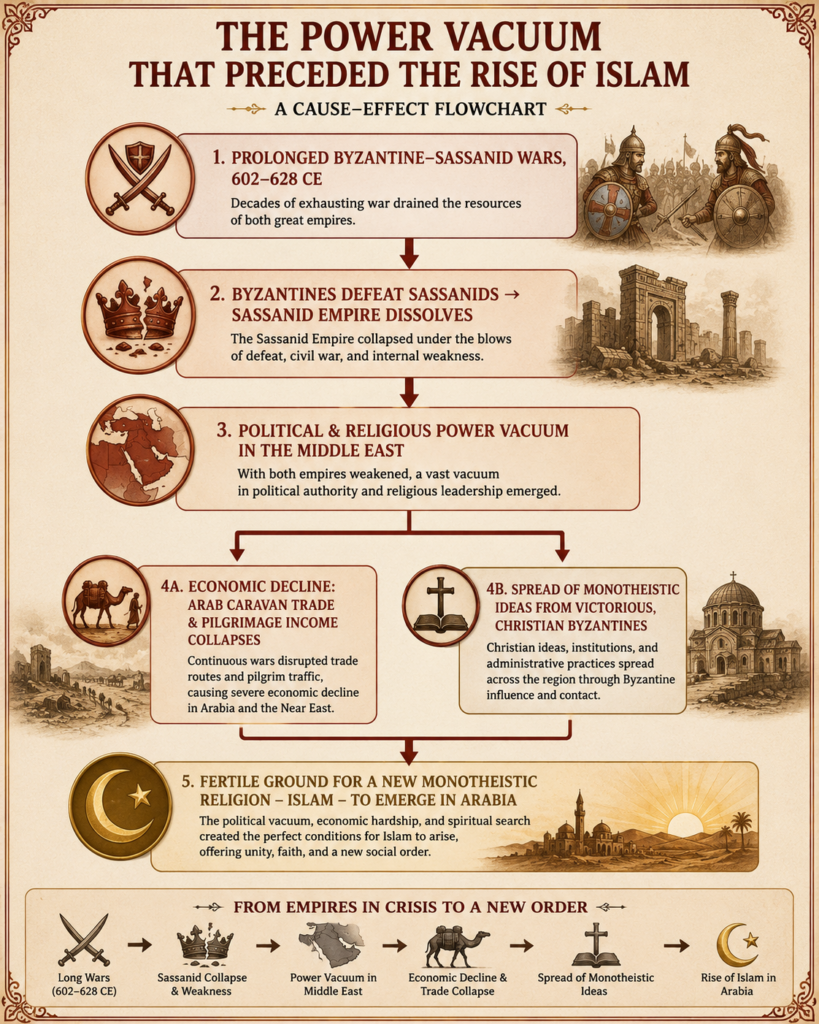
- Between 602 and 628 CE, these two empires were constantly at war with each other, leaving the region around modern-day Iran, Jordan, and Syria perpetually war-torn.
- These regions, including the Arab peninsula, were home to numerous polytheist tribes.
- The Arab tribes were caravan traders who sold luxury goods to Constantinople and Persia; the caravan trade routes made Mecca and Medina rich cities.
- The long war between these two powers eventually ended with the Byzantines defeating the Persian Sassanid Empire.
- However, the dissolution of the Sassanid Empire and the eventual decline of the Byzantines created a political and religious power vacuum in the Middle East region.
- The prolonged wars between Rome and Persia caused economic decline in the region — the customer base for Arab luxury products shrank during wartime, and the absence of pilgrimage to polytheist sites during the war dried up the coffers of Mecca and Medina.
- Since the monotheist Romans had emerged victorious, their monotheistic ideas and the tales of Jesus and Moses spread rapidly across the Middle East.
The Rise of Islam and the Caliphates
- It was during this period of upheaval that Muhammad (who later became Prophet Muhammad) was born to the powerful Quraysh tribe of Mecca.
- It is said that he experienced visions of God and the angel Jibril, which led him to preach a new religion following only one god, Allah.
- The new religion, Islam, gradually brought the different tribes of Arabia under one roof and united them.
- Prophet Muhammad is believed to have lived between 570 and 632 CE. According to the Hijri calendar, the migration (Hijra) of the Prophet and his followers from Mecca to Medina took place in 622 CE.
- After the death of the Prophet, the religious and political heads of Islam (the Ummah) were called Caliphs.
The Important Islamic Caliphates
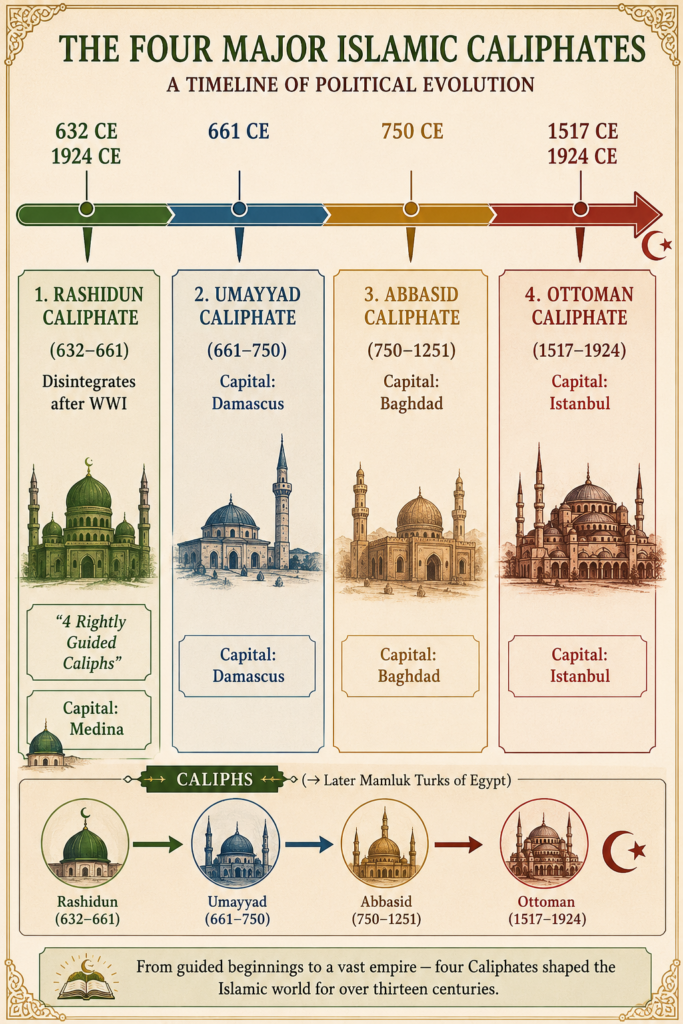
- Rashidun Caliphate (632–661) — believed to be the era of the four rightly guided Caliphs.
- Umayyad Caliphate (661–750) — ruled from Damascus.
- Abbasid Caliphate (750–1251) — ruled from Baghdad; the Caliphate was briefly transferred to the Mamluk Turks of Egypt after this period.
- Ottoman Caliphate (1517–1924) — ruled from Istanbul, and disintegrated after World War I.
- The conquests to spread Islam reached the doors of the Indian subcontinent during the rule of the Umayyad Caliphate.
The Islamic Conquest of Sind (712 CE)
- The Umayyad Caliphate sent his 18-year-old nephew, Muhammad Bin Qasim, to attack the areas beyond Baluchistan.
- He attacked and defeated the Chacha ruler of Sindh, Dahir, and established Arab rule over Sindh, from where later conquests erupted.
The Age of Conflict (1000–1200 CE)
- By the end of the 9th century, the Abbasid Caliphate began declining, and the farther regions of the kingdom started becoming independent.
- This age is known as the end of the Arab culture of learning and science. The Arabs were gradually replaced by Turks from Central Asia (Turkestan), who came to rule over many Islamised states.
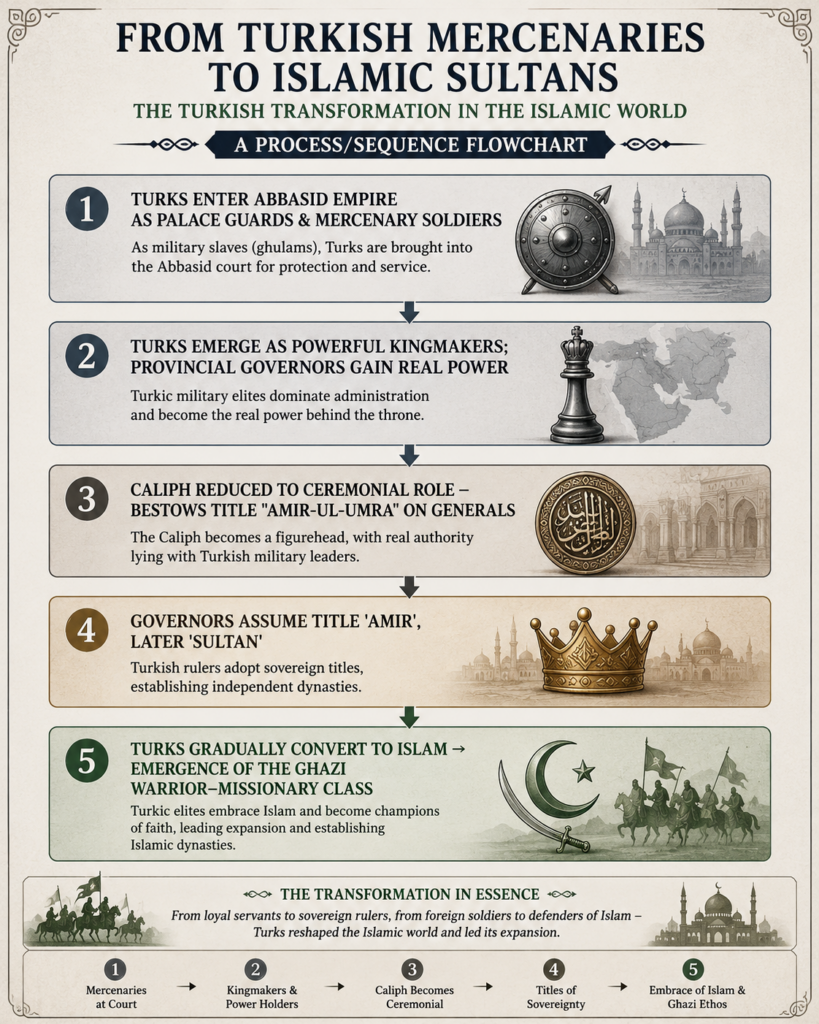
- The Turks had entered the Abbasid Empire during this century as palace guards and mercenary soldiers, but they soon became powerful kingmakers.
- The provincial governors became increasingly powerful, and the Caliph performed little more than the formality of bestowing the title Amir-ul-Umra (“Commander of Commanders”) on the generals.
- These new rulers initially assumed the title of ‘Amir’, but later took the title ‘Sultan’.
- The Turkish tribesmen brought with them their habit of looting and plunder, a practice prevalent in Central Asia — much as, in the ancient era, India had faced invasions from the Kushans, Sakas, and Huns from Central Asia. They initially believed in pagan gods.
- Their mode of warfare relied on rapid raids and retreat, made possible by the excellent quality of their horses and their habit of covering large distances on horseback.
- Numerous kingdoms rose and fell in rapid succession, as the invading Turks were quick to switch loyalties.
- Over the years, amid innumerable wars, the Turks were gradually converted to Islam, and a new class of soldiers emerged among them called the Ghazi — fierce soldiers who also served as religious missionaries.
The Turko-Islamic Ghaznavid Kingdom
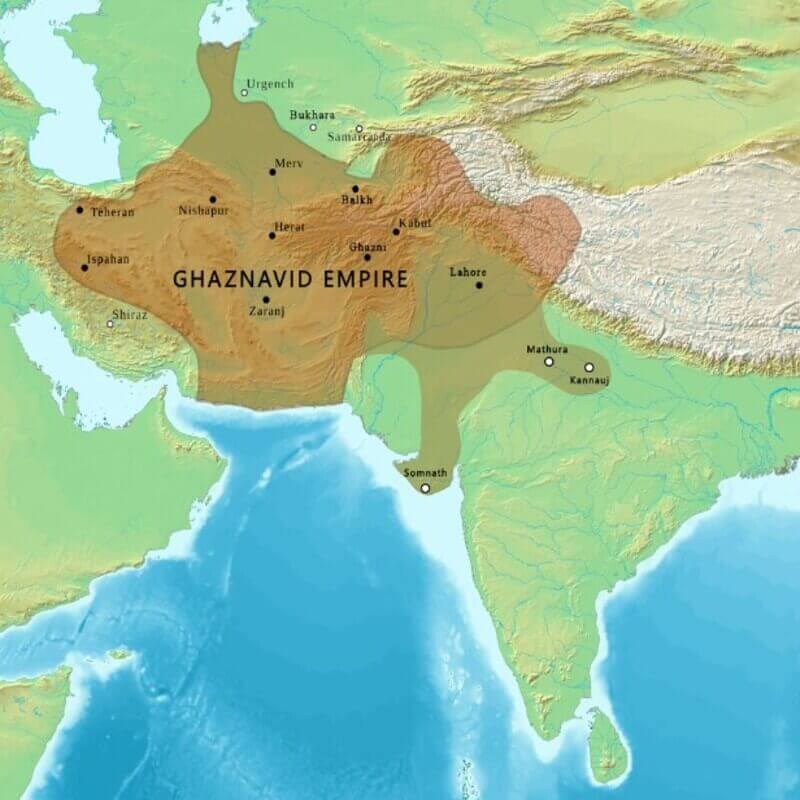
- The Turkish slave Alaptigin, a Samanid governor, established an independent kingdom at Ghazni, Afghanistan (962 CE).
- The Samanid kingdom soon collapsed, and the Ghaznavids took up the task of the “defence of Islam.”
- His successor, Sabuktigin (977–998 CE), became completely independent in 988 CE. He was later succeeded by his son, who became known as Mahmud of Ghazni, and who defended the Afghanistan region from Turkish tribal invaders of Central Asia.
- The Persians, even though they had adopted Islam, never accepted Arabic culture.
- The history and conquests of Persian kingdoms and the Ghaznavids were glorified by the Persian poet Firdausi, who was Mahmud’s court poet.
- He wrote the Shah Namah, in which he portrayed Mahmud as a rightful Persian ruler, even though Mahmud was himself a Turk.
The Arrival of Islam in India
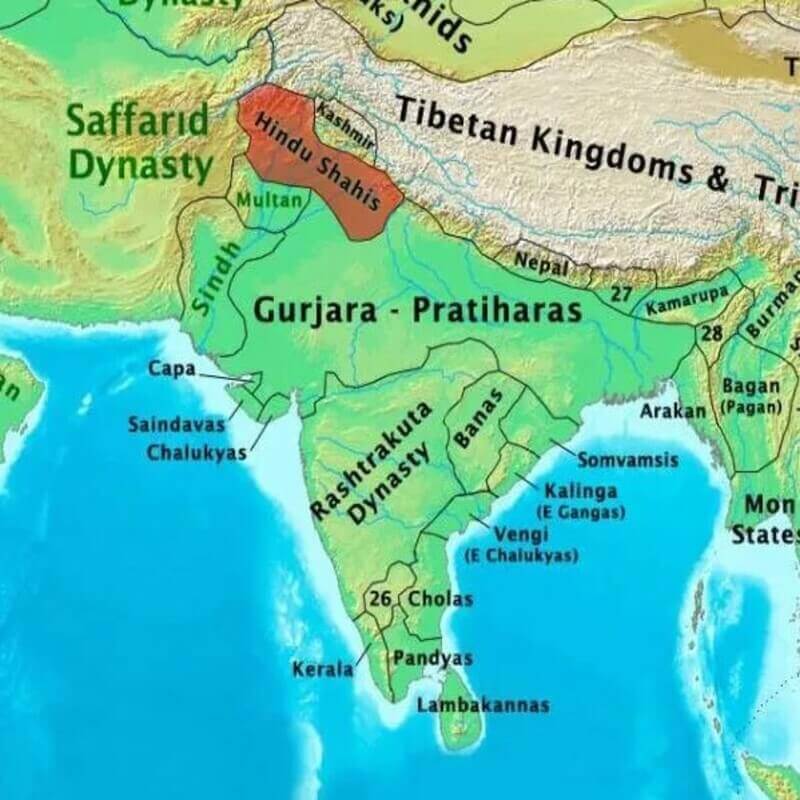
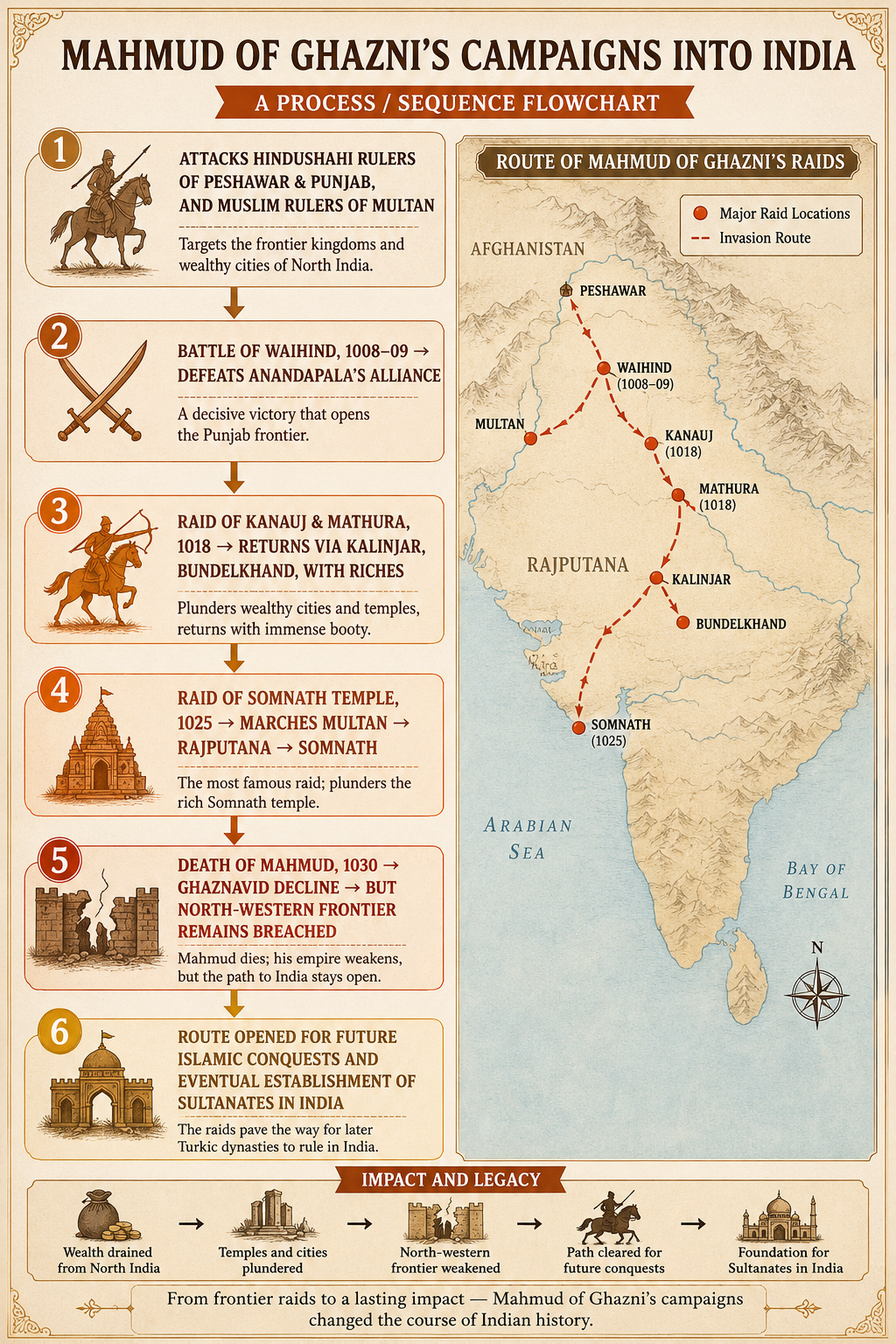
- Mahmud of Ghazni attacked India 17 times over the course of his reign. He initially attacked the Hindushahi rulers of Peshawar and Punjab, and even the Muslim rulers of Multan (a kingdom earlier established by Muhammad Bin Qasim).
- Battle of Waihind (1008–09): This battle was fought near Peshawar between Mahmud and the Hindushahi ruler Anandapala, who was in alliance with the ruler of Multan and the Khokar tribe of Punjab.
- The battle was won by Mahmud, who captured both their territories.
- Mahmud’s most dreadful attacks on India were:
- The raid of Kanauj and Mathura in 1018, after which he returned via Kalinjar, Bundelkhand, carrying huge riches.
- The raid of the Somnath Temple in 1025.
- Mahmud, however, did not annex these states, but marched from Multan to Somnath through Rajputana without encountering any resistance.
- Mahmud died in 1030 and was succeeded by his son Masud. However, Masud could not maintain the kingdom and was defeated by the Seljuk Turks.
- The Ghaznavids lost most of their territories, retaining rule only over Punjab and Ghazni — though they continued their raids into India.
- A Persian scholar, Al-Biruni, accompanied the Ghaznavids to India and wrote the book Kitab-ul-Hind (also known as Tahqiq-i-Hind), describing the society, culture, and kingdoms of medieval India.
- In his account, he highlighted selected portions of the Gita, the Upanishads, Patanjali, the Puranas, and the four Vedas, along with scientific texts by Nagarjuna and Aryabhata, as well as stories from Indian mythology.
- He also compared Indian thought to Greek philosophy — Socrates, Pythagoras, Plato, Aristotle, and Galen — and, at times, to Sufi teaching.
- The Ghaznavid conquests opened the route for the spread of Islam in India, as the north-western frontier was breached.
- The in-fighting between Rajput kingdoms gave the Ghaznavids a clear pathway to attack and raid western India repeatedly.
- After the death of Mahmud of Ghazni, many more Islamic conquests followed, eventually leading to the establishment of Sultanates in India.
Conclusion
The arrival of Islam in India was thus the end product of a long chain of causation — beginning with the exhaustion of the Sassanid and Byzantine empires, continuing through the rise of the Caliphates and the Umayyad conquest of Sind in 712 CE, and culminating in the era of Turkish ascendancy within the Islamic world that produced the Ghaznavid kingdom. It was Mahmud of Ghazni’s repeated invasions, particularly the breaching of India’s north-western frontier and the exploitation of Rajput political disunity, that truly opened India’s doors to sustained Islamic conquest. While Mahmud himself did not seek to annex Indian territory, his campaigns — and the accompanying scholarly record left by Al-Biruni — laid the political and cultural groundwork for the establishment of Islamic Sultanates in India in the centuries that followed, making this period a crucial starting point for the study of medieval Indian history.