Firuz Tughluq

Firuz Shah Tughluq (1351–1388), cousin and successor of Muhammad bin Tughlaq, holds the unique distinction of having been chosen as Sultan by the nobles themselves — a reign that stands in sharp contrast to his predecessor’s, defined not by military conquest but by an ambitious programme of welfare administration, agrarian reform, and civil engineering. Firuz revived the tradition of a benevolent state first envisioned by Jalaluddin Khalji, building canals, hospitals, and rest houses across his realm, even as his later years saw him descend into religious orthodoxy and intolerance that alienated significant sections of his Hindu subjects. Yet his reign also sowed the seeds of the Delhi Sultanate’s eventual decline — through a policy of appeasing and empowering the nobility, making both iqtas and military service hereditary, and undermining the very administrative disciplines that had sustained centralised Sultanate power. This article examines Firuz’s approach to kingship, his military expeditions, his religious policy, his administrative and agrarian reforms, his remarkable achievements in civil engineering, and finally, the broader structural causes — spanning the entire history of the Sultanate — that led to its ultimate disintegration into a patchwork of regional successor states.
The 14th Century: Firuz Shah Tughluq
- After the death of Muhammad bin Tughlaq in 1351, Firoz Tughluq — a cousin of Muhammad Tughlaq — had the unique distinction of being chosen as Sultan by the nobles.
His Nature of Kingship
- Firuz Tughlaq tried to revive the tradition of a state based on benevolence and the welfare of the people, an ideal first sought to be established by Jalaluddin Khalji.
- He set up an irrigation department, a marriage bureau, an employment bureau, promoted public works, and encouraged education — establishing madrasas and hospitals, etc.
- He created a new department called the Diwan-i-Khairat, dedicated to taking care of orphans and widows.
- He patronised scholars such as Barani and Afif.
- Firuz pursued a policy of conciliation, attempting to win over the sections — nobles, administrators, soldiers, clergymen, peasants, etc. — who had been alienated by Muhammad bin Tughlaq for one reason or another.
- He linked state and religion, proclaiming to rule on the basis of Islam. He appeased the Ulemas, abolishing many taxes considered un-Islamic, while imposing Jaziya on Brahmans.
- As he was guided by the Ulemas, he was intolerant towards Shia Muslims and Sufis.
- In this respect, he was a precursor of Sikandar Lodi and Aurangzeb.
- He followed an appeasement approach towards nobles and muqtis, and made the iqta system hereditary.
- He maintained his link with the Caliph by using the Caliph’s name on coins and in the khutba.
Military Expeditions
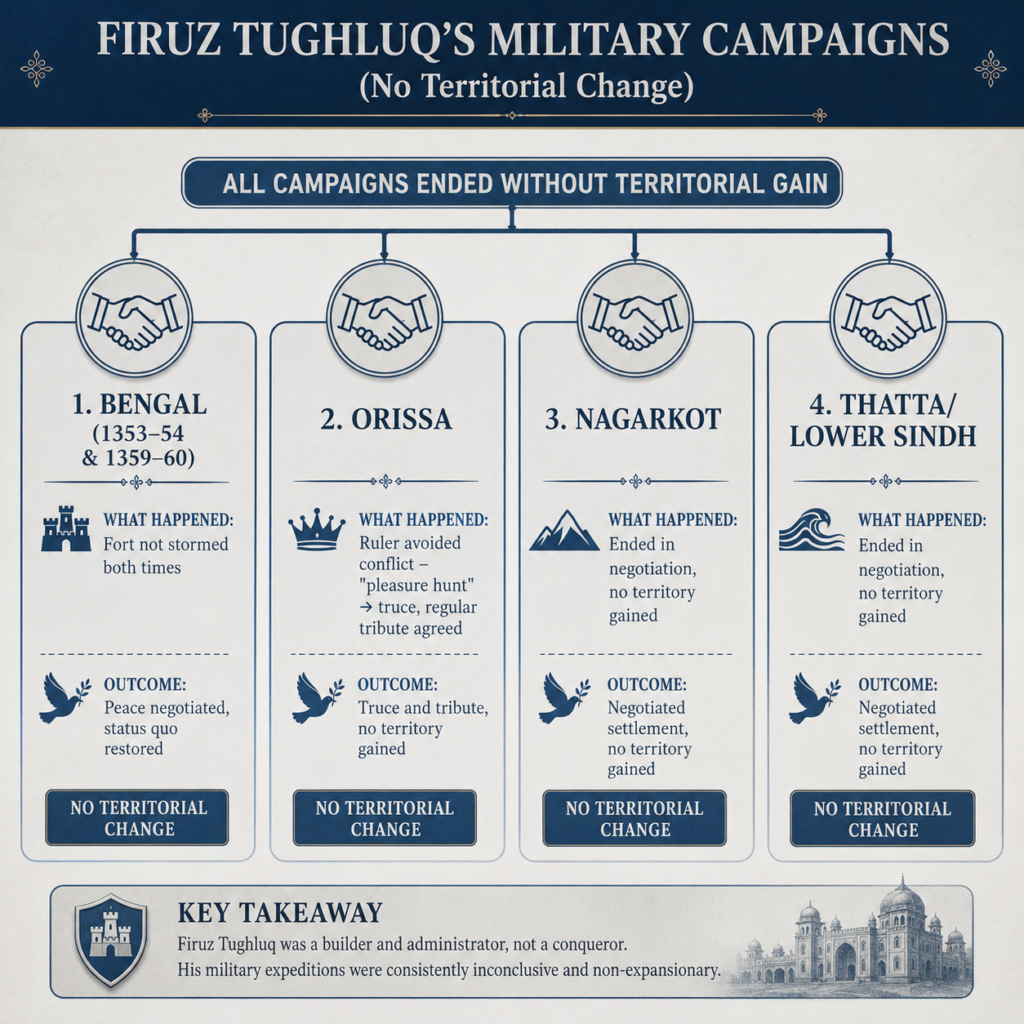
- Firuz led two campaigns to Bengal, raided Orissa and Nagarkot, and led a campaign into lower Sindh. None of these campaigns added to the territories of the Delhi Sultanate — but at the same time, the Sultanate’s territories did not diminish further either.
- The two Bengal campaigns (1353–54 and 1359–60) aimed at recovering Bengal, which had declared independence from Delhi.
- On both occasions, Firuz was unable to storm the fort, and instead opened negotiations for peace. After an exchange of costly presents, a status quo and a policy of mutual peace were agreed upon.
- Afif’s account — that Firuz refused to attack the fort because it would lead to further bloodshed and the dishonouring of Muslim women — was, perhaps, the official explanation put out.
- On both occasions, Firuz was unable to storm the fort, and instead opened negotiations for peace. After an exchange of costly presents, a status quo and a policy of mutual peace were agreed upon.
- The purpose of the Orissa expedition was to reassert Delhi’s overlordship over the region, which had been subjugated following the earlier expedition of Prince Muhammad bin Tughlaq, during the reign of Ghiyasuddin Tughlaq.
- The Orissa ruler had also withheld tribute when Bengal asserted its independence.
- Firuz’s march became almost a “pleasure hunt,” as the Orissa ruler avoided conflict. Ultimately, a truce was patched up, with the Orissa ruler agreeing to pay regular tribute.
- His Nagarkot campaign likewise led to negotiation and did not add any territory; a similar outcome occurred in the Thatta campaign.
- After a number of militarily insignificant expeditions, Firuz gave up warfare, choosing instead to make the state more an instrument of development and welfare.
Firuz as an Orthodox Ruler
- Firuz records his orthodox measures in the Futuhat-e-Firozshahi (his 32-page autobiography).
- However, he does not mention having forbidden wine-bibbling. Interestingly, Afif lists the wine department as one of the state’s karkhanas (departments).
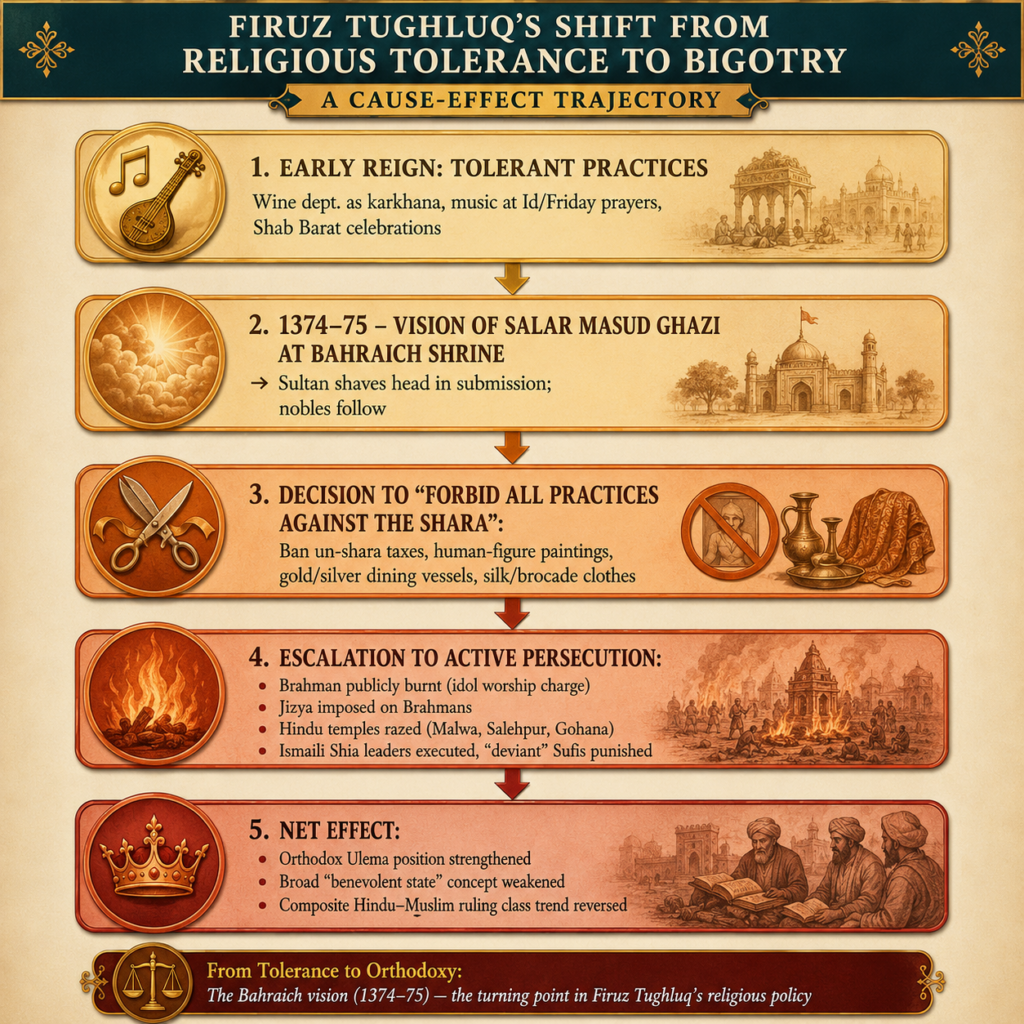
- Firuz was also fond of music and songs, to which he listened during the festivals of the two Ids and after Friday prayers — a practice he continued till the end of his reign.
- He also celebrated Shab Barat with great pomp.
- These were practices that were later banned as anti-Islamic by Aurangzeb.
- However, as Firuz grew older, he became narrower, even bigoted, in his religious approach.
- Although reputed to be a disciple of the liberal Sufi saint Fariduddin Ganj Shakar of Ajodhan, the warrior-saint Salar Masud Ghazi appeared to him in a dream when the Sultan visited his tomb at Bahraich in 1374–75. Much moved, the Sultan had his head shaved as a mark of submission to him — and many nobles followed suit.
- Thereafter, the Sultan decided to forbid all practices against the shara:
- He banned all taxes not sanctioned by the shara, and warned revenue officials not to realise any such taxes.
- He ordered all paintings with human figures erased from his palace, and forbade the use of gold and silver vessels for dinner.
- He also banned clothes of pure silk or brocade, or those on which human figures had been painted.
- One of the worst instances of bigotry on the part of Firuz at this time was that he publicly burnt a Brahman, on the charge that the man had openly conducted idol worship at his house — attended by both Hindus and Muslims — and had converted a Muslim woman.
- He also insisted on collecting jizya from Brahmans, who had been exempted from this tax till then.
- He refused to relent even though Brahmans from the four cities of Delhi went on hunger strike. Finally, the Hindus of the city agreed to pay the Brahmans’ share of the jizya themselves.
- In the Fatuhat, Firuz says that while Hindus who paid jizya were protected people, whose property and freedom of worship were safeguarded, they had begun to build new temples — which was against the shara.
- He had such temples razed. He includes, in this account, a temple in the village of Malwa near Delhi, destroyed on the ground that Hindus had built a hauz (tank) there, at which a festival was held — attended by Hindu men, women, and even Muslims.
- Similarly, he destroyed new temples built in the villages of Salehpur and the qasba of Gohana.
- In his eagerness to serve the shara, Firuz inflicted the death penalty on the leaders of the Ismaili group of Shias.
- He also inflicted similar punishment on a number of Muslims who, in a sufistic manner, had gone against orthodox beliefs.
- In his orthodoxy, he even banned Muslim women from going to the tombs of saints outside Delhi, on the grounds that it would expose them to licentious people.
- There is, however, no evidence that, despite these individual acts of intolerance, Firuz went against the broader concept of religious freedom granted to the dhimmis (Hindu subjects). Nor can the age of Firuz be considered one of generally growing intolerance.
- In fact, this was the age when the largest number of Sanskrit works on music, medicine, etc., were translated into Persian.
- Hindu chiefs were treated with respect by Firuz, and three of them were even allowed to sit on the floor in his court — considered a rare honour.
- Nevertheless, Firuz’s occasional acts of intolerance, and the importance he gave to theologians and men of religion to the exclusion of others, tended to strengthen the position of the orthodox Ulemas, and to that extent, weaken the concept of a benevolent policy based on people’s welfare and broad religious freedom.
- Firuz also reversed the trend towards a composite ruling class of Muslims and Hindus — a trend started by Muhammad bin Tughlaq. This trend was resumed cautiously by the Lodis, but resumed in a real sense only with the coming of Akbar.
Administrative Reforms
Firuz undertook a series of administrative reforms which brought him popularity in the immediate context, but weakened the central government in the long run.
- Firuz was keen to conciliate all sections, including the nobility — he wanted a nobility that was stable and cohesive.
- Firuz Tughlaq tried to cherish the nobility that had remained loyal to Muhammad bin Tughlaq.
- He appointed Khan-i-Jahan Maqbul, who had been trained by Muhammad bin Tughlaq, as wazir, leaving much of the administration’s work to him.
- Other senior nobles, such as Tatar Khan, were also honoured.
- Unlike Muhammad bin Tughlaq, Firuz had no special fondness for foreigners.
- He made this clear at the outset, when many foreigners from Herat, Sistan, Aden, Egypt, etc., had been camping at Thatta, awaiting word from Muhammad bin Tughlaq offering them employment.
- They were given travelling money by Firuz, and asked to go back.
- At the same time, Firuz did not try to induct into the nobility men from the lower classes — either Muslims or Hindus — whom Barani had denounced as “mean and ignoble.”
- Firuz awarded extremely high salaries to the nobles.
- These salaries were given in terms of grants of iqtas. At the beginning of his reign, Firuz had a new valuation (Jama) of the income from lands made.
- This jama was not revised during the rest of his reign. The nobles, therefore, became the beneficiaries of any extension and improvement of cultivation that took place in their holdings during the period.
- Finally, Firuz tried to give his nobility a hereditary character.
- In his Fatuhat, Firuz states: “When a person holding an office died, I transferred his office and his dignities to his son, and the status, perquisites and dignities of the office were not reduced in any way.”
- A notable example of this law of heredity was Khan-i-Jahan Maqbul, whose son Jauna Khan succeeded him in office as wazir after his death in 1368–69.
- However, this was done only when Jauna Khan asserted that Firuz had given a written undertaking — apparently at the time of Khan-i-Jahan’s accession — that the post of wizarat would remain in his family as long as he reigned.
- Another such case was that of Zafar Khan, governor of Gujarat, who died in 1370–71 and was succeeded in his post and title by his son, Darya Khan — though Darya Khan was ousted from the post soon after.
- The rule of heredity was not applied by Firuz to any other senior posts.
- Perhaps what Firuz implied was that the iqta of any incumbent would not be transferred, but granted to his sons after his death.
- Such an arrangement had recurred whenever there was weakness in the central government, since it strengthened the position of the nobles vis-à-vis the Sultan.
- Next to the nobility, the army was the next most important element in the administration.
- Like the nobility, Firuz wanted an army drawn from elements with a tradition of soldiering, and with a long-term stake in the stability of the state.
- He therefore ordered that soldiers of the central army should be paid not in cash, but by grants of villages (wajh) in the neighbourhood of Delhi and the doab. Eighty per cent of the central army were paid by means of such village grants.
- To emphasise the hereditary and family character of soldiering, Firuz ordered that if an army man died, his village would go permanently to his son; if he had no son, to his son-in-law; if he had no son-in-law, to his slave; and if he had no slave, then permanently to his women.
- Later, Firuz issued an order that if a soldier became old, he could be deputised by his son, if he had no son by his son-in-law, if he had no son-in-law, by his slave.
- It is hardly possible to defend these measures. Even then, an attempt to create a corps of hereditary soldiering families might have succeeded had Firuz not undermined the system of dagh (branding of horses), designed to ensure that sub-standard horses were not produced for service.
- Normally, horses had to be produced for branding within a year. But many soldiers could not do so, and, at the instance of the deputy muster-master, Firuz granted them an extension of 51 days, and then another two months.
- Even this was waived on the ground that soldiers had to travel to their villages, at the officers’ instance, to collect their salaries.
- Adopting a wholly wrong view of generosity, Firuz once even gave a golden tanka to a distraught soldier so that he could bribe the clerk to pass his sub-standard mount before the year ended!
- In the later part of his reign, Firuz seems to have realised that his mistaken view of generosity had undermined the efficiency of the central army. He therefore ordered the great iqtadars and officers to capture slaves whenever they were at war, and to pick out and send the best of them for the service of the court.
- This was extended to chiefs who, according to practice, sent annual presents to the ruler. In this way, 180,000 slaves were collected.
- While some spent their time in reading and religious studies, 12,000 became artisans of various types, dispersed into many parganas; a large central corps of slaves was brought together as an armed guard, in addition to the central army.
- A separate muster-master, treasury, and diwan were set up for this corps of slaves, which consisted mostly of converted Hindus.
- The efficiency of the slave corps was never tested in battle by Firuz — but to the extent that it acted as a counter to the power of the nobility and the standing army, it created a duality in the administration, running counter to Firuz’s own attempt to provide stability by depending on a cohesive nobility and an army drawn from military-minded families.
- It was, therefore, no surprise that conflict between the two erupted even before Firuz closed his eyes.
- In the field of general administration, Firuz was fortunate in having an able and energetic officer in Khan-i-Jahan Maqbul, whom the Sultan used to call “brother,” and to whom he extended full support. Firuz went so far as to say that Khan-i-Jahan was the real Sultan. For his part, Khan-i-Jahan never exceeded his powers, kept the Sultan fully informed, and was scrupulously honest.
- Another powerful noble at Firuz’s court was Bashir Sultani, the Ariz-i-Malik (Muster-Master). He had been a slave of Firuz, and accumulated a great deal of money through dishonest means; Khan-i-Jahan shielded him for his corrupt practices. When Bashir died, he left 13 crores; Firuz confiscated nine crores, on the ground that Bashir had been his slave, distributing the rest among Bashir’s sons.
- The tasks of administration continued with reasonable efficiency after the death of Khan-i-Jahan, under his son, Jauna Shah (Khan-i-Jahan II).
- But Khan-i-Jahan II was ambitious, and tried to build a party of his own supporters, while the powers of Firuz gradually declined with advancing age — becoming another cause of conflict after Firuz’s death.
Agrarian Measures
- Wrote off Sondhar: Firuz Shah Tughluq wrote off the Sondhar — advances given to peasants by Muhammad bin Tughluq.
- New Valuation (Jama):
- He appointed Khwaja Hisamuddin Junaid to settle the revenues afresh. The Khwaja toured the country for six years with a team of officials, and made a new valuation (jama).
- The amount of Jama was fixed at six crores and seventy-five lakh tankas, on the basis of rough estimation, and was not altered for the rest of Firuz Tughluq’s reign.
- The basis of assessment was not measurement but sharing — meaning the benefit of any growth (or decline) would be shared by the peasant and the State.
- Since the bulk of the land revenue had been granted to nobles as iqta, they were the principal beneficiaries of any development.
- Improving Cropping Pattern: An effort was made to improve the cropping pattern so that superior crops, such as wheat and sugarcane, began to be cultivated in place of inferior crops.
- Gardens: Firuz was fond of planting orchards, and is supposed to have planted 1,200 gardens around Delhi.
- Most of these orchards grew black and white grapes, and also dry fruits; the Sultan’s income from these was 180,000 tankas.
- Abolition of Taxes/Abwabs (Miscellaneous Cesses):
- In the latter years of his reign, Firuz tried to bring the agricultural taxation system in line with the shara — abolishing all taxes not sanctioned by the shara.
- Twenty-one such taxes were abolished, as listed by contemporaries. These included the ghari (house tax), which we hear of during the time of Alauddin. Many others were cesses on produce payable at the market.
- It is difficult to say how far the abolition of these taxes benefited the peasants, or how effective the abolition actually was, since many of them had to be abolished again by Akbar, and once more by Aurangzeb.
- In the latter years of his reign, Firuz tried to bring the agricultural taxation system in line with the shara — abolishing all taxes not sanctioned by the shara.
- Irrigation:
- Canals:
- Firuz founded the city of Hissar-Firuza (modern Hissar), and decided to dig two canals to bring water from the Sutlej and the Jamuna. These canals joined together near Karnal, providing plentiful water for the city of Hissar.
- The peasants could now cultivate two crops — the spring (kharif) and winter (rabi).
- In Firuz’s time, the entire tract of land along the canal was irrigated, leading to the expansion of cultivation in old villages, and the emergence of new villages.
- Other canals were also dug by Firuz, most in the present Haryana area. One canal also carried water to the city of Ferozpur, south of Delhi, founded by Firuz.
- Afif says that the entire areas from the river Sutlej to Koil (modern Aligarh) became fully cultivated.
- Firuz founded the city of Hissar-Firuza (modern Hissar), and decided to dig two canals to bring water from the Sutlej and the Jamuna. These canals joined together near Karnal, providing plentiful water for the city of Hissar.
- Besides canals, Firuz’s irrigation scheme included the construction of a large number of wells, dams, and reservoirs, which greatly fostered agriculture.
- During the rainy season, he appointed special officers to examine the banks of watercourses and report the extent of inundations.
- The scheme of irrigation enabled the Sultan to overcome famine, which had been the greatest menace during the reign of Muhammad bin Tughluq.
- It also aided the production of Rabi crops, in addition to the Kharif, in areas such as around Hisar, where cultivation had previously been impossible owing to scarcity of water.
- It also brought vast areas of barren land under cultivation.
- The increased production led to a fall in the prices of commodities. Compared to the reign of Muhammad bin Tughluq, Firuz’s reign showed a considerable fall in prices.
- This was perhaps the result of prosperity, and the resulting affluence of the nobility, reflected in the writings of Barani and Afif.
- Other sections, such as peasants, artisans, and traders, also benefited. However, in places distant from Delhi, such as Sindh, grain prices remained unstable, and the wages of artisans were extremely high.
- Firuz himself also benefited from this agrarian prosperity.
- He brought together a set of learned men and mullahs, who decreed that, for his pains in digging canals and bringing water, the Sultan was entitled to an extra charge of 10 per cent, called haqq-i-sharb.
- This was levied from old villages where cultivation had grown, forming part of the personal income (khalisa) of the Sultan.
- The normal land revenue of new villages was also part of the Sultan’s personal income — which he distributed in charity to religious divines and learned people.
- Canals:
Achievement in Civil Engineering and Public Work Activities
Founding New Cities
- Firuz founded a large number of cities, well-planned and beautified with high palatial buildings, mosques, mausoleums, madrasas, rest houses, hospitals, tanks, dams, gardens, etc.
- A number of towns built around Delhi by him included:
- Hissar-Feroza.
- Ferozpur.
- Fatehabad.
- A new capital, Ferozabad, along the Jamuna — only the fort, now called Kotla Feroz Shah, has survived from this town.
- A renovated Jaunpur (in East UP).
- These towns were needed due to the agricultural development of the area, which required new towns (qasbas) as their grain markets.
- The new towns also became centres of trade and handicrafts, with some of the 12,000 slaves trained as artisans posted there.
Canals for Irrigation
- Firuz built a total of six canals:
- Two canals bringing water to Hissar from the Sutlej and Yamuna, enabling cultivation of both the spring (kharif) and winter (rabi) crops.
- One canal cut from the Ghaggar, and another cut from the Yamuna.
- One canal carried water to the city of Ferozpur, leading to the expansion of cultivation in old villages and the emergence of new ones.
- Afif says the entire area from the river Sutlej to Koil (modern Aligarh) became fully cultivated.
- Firuz also constructed a large number of wells, dams, and reservoirs, which fostered agriculture.
Rest Houses (Inns)
- Rest houses were built for travellers, who could stay for three days.
- The Sultan is said to have established 120 rest houses, most situated in Delhi and Firuzabad.
Mosques
- Mosques were erected in different localities.
Madrasas
- Madrasas added to the cultural importance of the cities.
- The Madrasa-i-Firuz Shahi was built in the midst of a garden near Hauz-i-Khas at Firuzabad.
- Another madrasa was built at Siri, with an attractive and beautiful panorama stretched around it.
Other Public Works
- Tanks, reservoirs, wells, and bunds were built and repaired for water supply to the cities.
- Hospitals (Dar-ul-Safa): A large number of hospitals were opened, where medicines were distributed free.
- Gardens: Firuz is supposed to have planted 1,200 gardens around Delhi, most growing grapes and dry fruits; the Sultan’s income from these was 180,000 tankas.
- Pillars: Firuz Tughlaq had two Ashokan pillars transported from Meerut and Topra (Haryana), installing one at the Kotla at Firozabad, and another at a hunting lodge on the Ridge.
Repair and Restoration Work
- Firuz’s work for the restoration of ruined buildings was remarkable — he set up a public works department that repaired many old buildings and mausoleums.
- The Madrasa of Shamshuddin was rebuilt and furnished with sandalwood doors.
- Sandalwood doors were also supplied to the tomb of Alauddin.
- The city of Jahanpanah, whose foundation had been laid by Muhammad Tughluq, was also repaired.
- The upper storey of the Qutub Minar, which had been destroyed by lightning, was repaired.
- He restored the mosque and the tombs of Iltutmish and Alauddin near the Qutub Minar.
- He repaired the Shamsi Tank (south of the Qutb Minar), and the Hauz-i-Alai (present-day Hauz Khas), whose water channel had become choked.
Responsibility of Firuz Tughluq for the Decline of the Sultanate
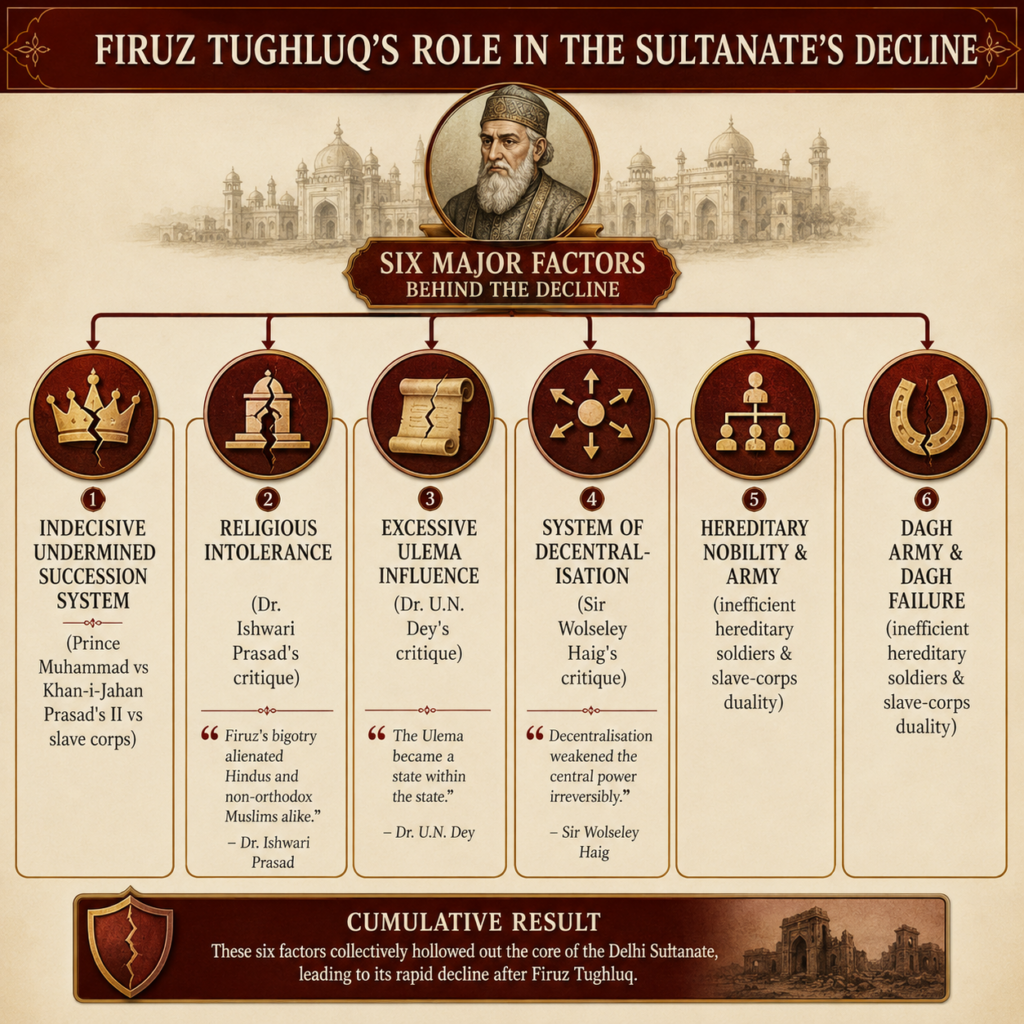
Though no individual Sultan can be held solely responsible for the downfall of the Delhi Sultanate, a significant share of the responsibility lies with Firoz Tughluq:
- Firuz was not able to decide decisively about his succession. Soon after his death in 1388, a struggle for the Crown began between his sons and grandsons.
- First, there was a struggle for power between Prince Muhammad (the eldest surviving son of Firuz) and the wazir Khan-i-Jahan II, followed by a power struggle with the slaves.
- The corps of slaves tried to play kingmaker but failed, and were defeated and dispersed — these events contributed to the decline of his Sultanate.
- Religious intolerance of Firoz Tughluq had alienated the Hindu majority, weakening his kingdom.
- Dr. Ishwari Prasad has commented: “The reforms of Firoz failed to gain confidence of Hindus whose feelings were embittered by his religious intolerance. Altogether they produced a reaction which proved fatal to the interest of the dynasty which was by no means an unworthy representative.”
- Ulema influence on administration also weakened the Sultanate.
- Dr. U.N. Dey has observed: “His supplication to the ‘Ulemas’ only encouraged a group of unscrupulous selfish people to behave arrogantly and pose themselves as the custodians of Muslim conscience. All these combined to create a situation in which disintegration became inevitable.”
- The system of decentralisation pursued by Firoz also caused disintegration — he gave extensive powers to his nobles and officials, which ultimately went against the larger interests of the state.
- According to Sir Wolseley Haig: “His system of decentralisation accelerated the downfall of his dynasty.”
- Firuz tried to give his nobility a hereditary character. Such attempts had recurred whenever there was any weakness in the central government, since they strengthened the position of the nobles vis-à-vis the Sultan — ultimately proving detrimental to the Sultanate.
- Next to the nobility, the army was the next most important element in the administration, and Firuz tried to make it hereditary as well.
- To emphasise the hereditary and family character of soldiering, Firuz issued an order that if a soldier became old, he could be deputised by his son, then his son-in-law, then his slave.
- The resulting hereditary soldiers proved inefficient, badly affecting the quality of the army.
- Firuz had undermined the system of dagh (branding of horses), leading to sub-standard horses being produced for service.
- Normally, horses had to be produced for branding within a year — but many soldiers were unable to do so, and Firuz used to grant them extensions.
- Adopting a wholly wrong view of generosity, Firuz once even gave a golden tanka to a distraught soldier, so that he could bribe the clerk into passing his sub-standard mount.
- In the later part of his reign, Firuz realised that his mistaken generosity had undermined the efficiency of the central army.
- He ordered the great iqtadars and officers to capture slaves whenever they were at war, and to send the best of them into the service of the court.
- In this way, 180,000 slaves were collected. While some spent their time in reading and religious studies, 12,000 became artisans, dispersed into many parganas, and a large central corps of slaves was brought together as an armed guard, in addition to the central army.
- The corps of slaves acted as a counter to the power of the nobility and the standing army, creating a duality in the administration, running counter to Firuz’s own attempt to provide stability through a cohesive nobility and a military-minded hereditary army.
- It was, therefore, no surprise that conflict between the two erupted even before Firuz closed his eyes — the corps of slaves proved selfish and disloyal.
- Firoz’s failure as a conqueror reveals his incompetence as a military leader, weakening the Sultanate.
- Neither by temperament nor training was Firuz Tughlaq cut out to be a great warrior or military leader.
- He did, however, lead two campaigns to Bengal, raided Orissa and Nagarkot, and led a campaign into lower Sindh — but none of these added to the territories of the Delhi Sultanate.
- Firuz awarded extremely high salaries to the nobles, given in terms of grants of iqtas, based on a jama that was never revised after being fixed early in his reign.
- The nobles, therefore, remained the beneficiaries of any extension and improvement of cultivation that took place in their holdings — affecting the economic condition of the Sultanate.
- Dr. R.C. Majumdar has correctly remarked: “On the whole, in-spite of peace, prosperity and contentment that prevailed during the long reign of Firoz Shah, no one can possibly doubt that his policy and administrative measures contributed to a large extent to the downfall of the Delhi Sultanate, and accelerated the process of decline that had already set in during his predecessor’s reign.”
Decline of the Sultanate: Broader Structural Causes
- One political reason for the decline of the Sultanate was the absence of any universally accepted law of succession.
- The continued struggle between the nobility and the Sultans was also an important reason.
- As long as a Sultan was strong, and able to gain the support of some groups of nobles, he could continue with some superficial semblance of dynastic stability.
- Dissensions and conflicts amongst the ruling groups might remain apparently dormant under such circumstances — but at the slightest opportunity, their internal struggles would come to the fore, often in a violent fashion.
- Initially, the iqta system served the central authority well — its elements of transfer and non-permanence ensured the Sultan’s power.
- On the other hand, the gradual disappearance of these principles, especially during Feroz Tughluq’s rule, paved the way for the steady dissipation of the state’s authority.
- The upshot was the emergence of autonomous, and then independent, political centres in different regions.
- The Mongols might have hammered the Sultanate off and on, but, on the whole, their forays did not affect the Sultanate’s political and economic fortune.
- The Mongol danger first appeared in the early years of Iltutmish’s reign; their invasions continued up to the period of Muhammad Tughluq, with intervals.
- Balban, Alauddin Khalji, and Muhammad Tughluq were all very much conscious of the Mongol assaults, and resisted them successfully.
- True, much money and time had to be spent, and thousands of soldiers were sacrificed, but it does not appear that these invasions enfeebled the Sultanate in any substantial manner.
- Occasional shocks were awesome but without any visible damage to the economy or the state apparatus.
Nature of Kingship
- No clear and well-defined law of succession developed in the Sultanate.
- The hereditary principle was accepted, but not adhered to invariably.
- There was no rule of primogeniture (that only the eldest son would succeed). In one case, even a daughter was nominated — for example, Raziya Sultan.
- At any rate, a slave, unless manumitted (freed), could not claim sovereignty. In fact, as it operated in the Sultanate, “the longer the sword, the greater the claim.”
- Thus, in the absence of any succession rule from the very beginning, intrigues surfaced to usurp power:
- After Aibak’s death, it was not his son Aram Shah, but his slave and son-in-law Iltutmish, who captured the throne.
- Iltutmish’s death (1236 A.D.) was followed by a long period of struggle and strife, until finally Balban, Iltutmish’s slave of “the Forty” fame, assumed power in 1266 A.D.
- Balban attempted to give a new shape to the concept of kingship, to salvage the prestige of the office of the Sultan — but the struggle for power that started soon after Balban’s death confirms again that the “sword” remained the main deciding factor.
- Kaiqubad was installed on the throne, against the claims of Balban’s nominee, Kaikhusrau. Later, even Kaiqubad was slain by the Khalji Maliks (1290 A.D.), who laid the foundation of Khalji rule.
- In 1296 A.D., Alauddin Khalji killed his uncle, Jalaluddin Khalji, and occupied the throne. Alauddin Khalji’s own death signalled a civil war and scramble for power.
- Muhammad Tughluq’s reign was weakened by the rebellions of amirs.
- Rivalries that followed after Feroz Tughluq ultimately led to the rise of the Sayyids (1414–51 A.D.).
- With the accession of the Lodis (1451–1526 A.D.), a new element — the Afghans — was added.
- The Afghans had a peculiar concept of sovereignty: they were prepared to accept the position of a Sultan over them, but sought to partition the empire among their clans (Farmulis, Sarwanis, Niyazis, etc.).
- After the death of Sultan Sikandar Lodi (1517 A.D.), the empire was divided between Ibrahim and Jalal (younger brother); even royal privileges and prerogatives were equally shared by clan members.
- For example, the keeping of elephants was a royal privilege — yet Azam Humayun Sarwani is reported to have possessed seven hundred elephants.
- The Afghans entertained the concept of maintaining a tribal militia, which in the long run greatly hampered the military efficiency of the Central Government.
- Sikandar Lodi did try to keep ambitious Afghan nobles in check, but the concept of Afghan polity remained more tilted towards decentralisation, creating fissures in the end.
Conflict Between the Nobility and the Sultans
- The political history of the Sultanate period testifies that consolidation and decline of the Sultanate were largely the result of the constructive and destructive activities of the nobles (umara).
- The nobles always tried to maximise their demands in terms of economic and political gains.
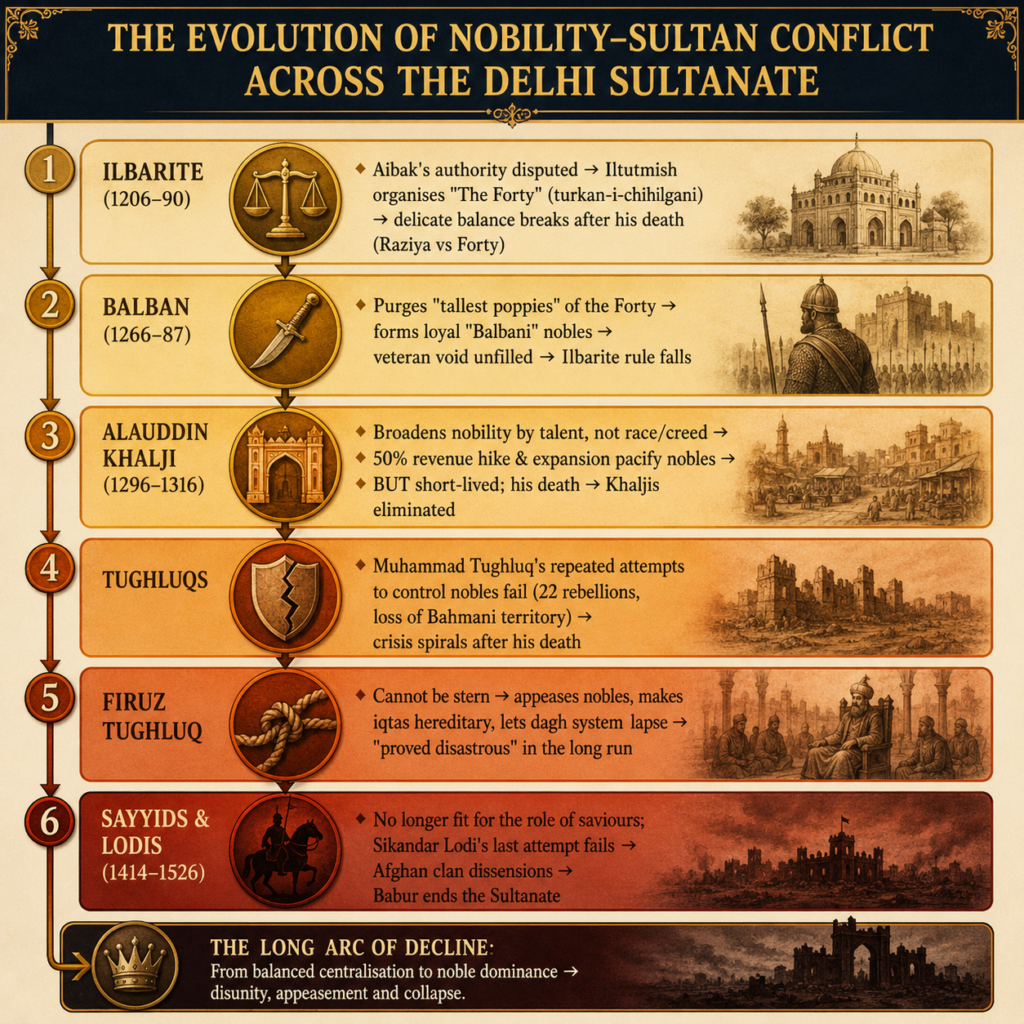
- Under the Ilbarite rule (1206–90 A.D.), conflicts usually revolved around three issues: succession, the organisation of the nobility, and the division of economic and political power between the nobility and the Sultans.
- When Qutbuddin Aibak became Sultan, his authority was not accepted by influential nobles such as Qubacha (governor of Multan and Uchh), Yilduz (governor of Ghazni), and Ali Mardan (governor of Bengal).
- This problem was inherited by Iltutmish, who finally overcame it through both diplomacy and force.
- Iltutmish later organised the nobles into a corporate body, known as the turkan-i-chihilgani (“The Forty”), personally loyal to him.
The Sultan-Forty Relationship
- Naturally, other groups of nobles envied the status and privileges of members of the “Forty” — though this did not mean the “Forty” were free from internal bickering.
- At most, they united on one principle: to plug the entry of non-Turkish persons into the charmed circle, as far as possible.
- On the other hand, the “Forty” tried to retain their political influence over the Sultan — who would not wish to alienate this group, but also would not surrender his royal privilege of appointing persons from other groups as officers.
- Thus, a delicate balance was achieved by Iltutmish, which broke down after his death.
- For example, Iltutmish had declared his daughter, Raziya, his successor during his lifetime — but some nobles disapproved of her succession after his death, because she tried to organise non-Turkish groups (Abyssinians and Indians) as a counterweight to the “Forty.”
- This was one reason a number of nobles from this group supported her brother, Ruknuddin, whom they considered incompetent and weak, thereby giving themselves an opportunity to maintain their own position.
- This spectacle continued during the reign of Nasiruddin Mahmud (1246–66 A.D.), as exemplified by the rise and fall of Imaduddin Raihan — a transgender individual, appointed by Nasiruddin as wakil-i-dar (deputy to the king in judicial matters), and an Indian convert.
- This episode coincided with the banishment, and subsequent recall, of Balban — who was the naib (deputy) of Sultan Nasiruddin Mahmud, and also belonged to the “Forty.”
- During Balban’s reign (1266–87 A.D.), the influence of the turkan-i-chihilgani was minimised.
- Since he himself had been a member of the “Forty” before his accession, he was fully aware of the nobles’ rebellious tendencies.
- He therefore eased out the “tallest poppies” among them, through assassin’s dagger or poisoning, even including his own cousin. He formed, instead, a group of loyal and trusted nobles, called the “Balbani.”
- The removal of many members of the “Forty” deprived the state of the services of veterans, and the void could not be fulfilled by the new and less experienced “Balbani” nobles.
- This situation inevitably led to the fall of the Ilbarite rule, paving the way for the Khaljis.
- The reign of Alauddin Khalji (1296–1316 A.D.) saw a broadening in the composition of nobles.
- He did not admit monopolisation of the state by any single group of nobles — state offices were open to talent and loyalty, to the exclusion of race and creed. He also controlled the nobility through various measures.
- The enhancement of land revenue up to 50 per cent of surplus produce must have pacified the nobles, since an increase in the revenue of their respective iqta would have raised their income too.
- Territorial expansion also provided enough resources for recruiting persons with talent — the case of Malik Kafur, an Abyssinian slave, is well known.
- But this situation was short-lived — the death of Alauddin Khalji brought out once again the dissensions and conspiracies of the nobles, leading to the elimination of the Khaljis as rulers.
- As for the Tughluqs, Muhammad Tughluq made repeated attempts to organise the nobles, “with turns and twists.”
- But all his efforts failed to put them under check. Even the Khurasanis, whom he used to call “Aizzah” (“the dear ones”), betrayed him.
- The problems created by the nobles can be gauged from the fact that twenty-two rebellions took place during his reign, resulting in the loss of at least one territory — later known as the Bahmani kingdom.
- The crisis set in motion after Muhammad Tughluq’s death seems to have gone out of hand.
- Under these circumstances, Feroz Tughluq could not be expected to be stern with the nobles.
- They were given many concessions, and succeeded in making their iqtas hereditary.
- The appeasement policy of the Sultan pleased the nobles, but in the long run, it proved disastrous.
- The army became inefficient, because the practice of branding (dagh) of horses, introduced by Alauddin Khalji, was almost given up.
- It was not possible thereafter for his descendants or later rulers to roll back the tide of decline of the Delhi Sultanate.
- Under the Sayyids (1414–51 A.D.) and the Lodis (1451–1526 A.D.), the situation did not appear comfortable — the former were not at all fit for the role of saviours.
- Sikandar Lodi made the last attempt to prevent the looming catastrophe.
- But dissensions among the Afghans, and their unlimited individual ambitions, hastened the final demise — actually, its murder, with Babur as the executioner.
Crisis in Revenue Administration
- Iltutmish had introduced a sound system of revenue assignments (iqta), through which the vast bureaucracy was maintained.
- In Feroz Tughluq’s reign, revenue assignments tended to become hereditary and permanent.
- This applied even to the royal soldiers (yaran-i-hashm): “If a person died,” says Afif, “his office would go permanently to his son; if he had no son, then to his son-in-law; if he had no son-in-law, then to his slave; if he had no slave then to his women.”
- Sikandar Lodi (1489–1517 A.D.) stopped attempting to reclaim the balance (fawazil — the excess amount paid to the exchequer by the iqtadar).
- The tendency of principal assignees to sub-assign their territories also increased greatly during his reign.
- All this had deep implications:
- A loss of vast revenue resources.
- The Sultan allowed assignees to develop strong local roots, which led to wide-scale corruption and turbulence.
The Rise of Regional States
- Clashes between the nobles and the Delhi Sultans marred the Sultanate from the very beginning of its foundation. But, so long as the centre was powerful enough to retaliate, the rebellions were successfully crushed.
- Signs of physical disintegration were witnessed for the first time during Muhammad Tughluq’s reign, in 1347 A.D., with the establishment of the Bahmani kingdom.
- But the Sultanate remained largely intact for nearly fifty more years, until the Timurid invasion (1398 A.D.) exposed its underlying weakness.
- This provided ample opportunity for nobles to establish their own areas of influence, independent of the Sultan. Governors such as Khwaja Jahan (Jaunpur, 1394), Dilawar Khan (Malwa, 1401), Zafar Khan (Gujarat, 1407), and some regions in Rajasthan also declared their independence during the 15th century.
- Bengal was already a semi-independent kingdom since the days of Bughra Khan.
- The Sultanate practically shrank to a radius of 200 miles around Delhi, with deep implications:
- The loss of the fertile provinces of Bengal, Malwa, Jaunpur, and Gujarat greatly curtailed the state’s vast revenue resources.
- This, in turn, disabled the centre from waging long wars or organising campaigns against refractory elements.
- The situation became so critical under the Sayyids and the Lodis that even for regular revenue exactions, the Sultans had to send yearly campaigns. For example, forces were sent repeatedly to suppress the Katehr and Mewati chiefs, with frequent intervals from 1414 to 1432 A.D.
- Similarly, the chiefs of Bayana and Gwalior also showed their reluctance to pay revenue, resulting in repeated campaigns from 1416 to 1506 A.D.
- All this shows that the control of the Sultans during the 15th century remained nominal, and only minimum efforts would have sufficed to overthrow the Sultanate entirely.
Conclusion
Firuz Shah Tughluq’s reign presents a striking paradox in the history of the Delhi Sultanate: a ruler remembered for genuine humanitarian achievement — his canals, hospitals, rest houses, and revival of Jalaluddin Khalji’s welfare ideal — who nonetheless, through his policy of appeasement, hereditary iqtas, hereditary military service, and abandonment of the dagh system, laid much of the institutional groundwork for the Sultanate’s eventual disintegration. His growing religious orthodoxy, while not evidence of a uniformly intolerant reign, nevertheless alienated significant sections of his Hindu subjects and reversed the composite ruling-class experiment begun by Muhammad bin Tughluq. Firuz’s failures, however, were only the proximate cause of a much longer structural crisis — one rooted in the Sultanate’s absence of a clear succession law, the perennial conflict between an ambitious nobility and a centralising Sultan that stretched back to Iltutmish’s “Forty,” and the gradual erosion of the transferable iqta system that had once anchored central authority. By the time the Timurid invasion of 1398 exposed the Sultanate’s underlying fragility, the stage had already been set for the rise of independent regional kingdoms — Jaunpur, Malwa, Gujarat, Bengal, and the Bahmani Deccan — leaving the once-vast Delhi Sultanate reduced, by the 15th century, to little more than a 200-mile radius around its capital, a nominal power awaiting its final conqueror in Babur.