Early Medieval India, 750–1200: Major Political Developments

Understanding Early Medieval India, 750–1200: Major Political Developments requires first engaging with a deeper historiographical question — how historians periodise Indian history, and why the “early medieval” phase is treated as a distinct, transitional category rather than simply the start of the “medieval” or “Muslim” period.
Periodisation of Indian History
- An important problem confronting historians is the characterisation of historical phases into periods such as ancient, medieval, and modern.
- These periods had earlier been correlated with the Hindu, Muslim, and British periods respectively.
- N.R. Ray laid stress on associating chronology with the special features or aspects of historical change, rather than with ruler religion or dynasty.
- Analysing this historiography is essential for understanding the periodisation of Indian History into ancient, medieval, and modern.
- According to the conventional interpretation, the ancient period began with the Aryan invasion, and the medieval period with the Muslim invasion.
- More recently, historians have preferred the term ‘early historical’ over “ancient” for the period starting from the middle of the first millennium B.C.
- Historians like R.S. Sharma have outlined the following features to define the ‘early historical’ phase:
- Territorial states headed by Rajanyas or Kshatriyas developed into an extremely centralised officialdom, where authority did not emanate from landholding, since officials were remunerated in cash.
- The economy was marked by the development of a cash nexus, urbanisation, overseas trade, and urban crafts — while communal landholdings remained prevalent among village communities, which formed the core of village social and economic life.
- Consolidation of the Varna system, in which:
- Kshatriyas and Brahmanas controlled the produce.
- Vaishyas — as traders and peasants engaged in trade and agriculture — paid the taxes.
- Shudras rendered slave labour, though this slavery was not similar to serfdom, and the multiplicity of castes seen in later periods did not yet exist.
- These features are found in their mature form in the 3rd–4th centuries A.D.
- Historians like R.S. Sharma have outlined the following features to define the ‘early historical’ phase:
The ‘Early Medieval’ Transition
- The term ‘early medieval’ suggests the evolution from the early historical to the medieval period, capturing both continuity and change within a broad historical context.
- This viewpoint demolishes the ideas of orientalism, which had emphasised the ‘timelessness’ and ‘changelessness’ of Indian polity, society, and economy.
- The transformation from the ‘early historical’ to the medieval is explained, in the context of Indian feudalism, by the most widely accepted school of ancient Indian historiography — represented by D.D. Kosambi, R.S. Sharma, and B.N.S. Yadava.
- The basic premise of this feudal polity thesis is:
- The disintegration of the unitary administrative system of the Mauryan state — based on a money or cash economy — led to the creation of various loci of authority.
- The religious and secular land grants of the period embodied administrative rights as well, leading to the fragmentation of authority and sovereignty.
- Most conventional writings on the early medieval political system consider these states as monarchies, with kings wielding power through officialdom; however, the feudal attributes led to fragmentation, decentralisation of authority, and a weakening of central control within the Hindu political system.
- A.S. Altekar captured this prevalent view among historians, describing the ideal as a “federal-feudal empire” — one giving each constituent state full liberty to strive for imperial status, but without permission to forge a unitary empire after conquest — thus producing a “state of continuous instability in ancient India.”
- This transformation was regarded as a crisis, since a centralised state was replaced by a fragmented polity.
- The basic premise of this feudal polity thesis is:
N.R. Ray’s Three Phases of the Medieval Period
- N.R. Ray divides the medieval period into three phases:
- 7th century – 12th century A.D.
- 12th century – 16th century A.D.
- 16th century – 18th century A.D.
- He identifies the following characteristics of medievalism:
- Kingdoms became regional, and are regarded as analogous to the nation-states of Europe.
- The economy was transformed from one based on monetary transactions to one predominantly agrarian.
- In language, literature, and script, regional features became consolidated.
- Religion was marked by the mushrooming of numerous sects and sub-sects.
- Art became categorised into specific regional schools — Eastern, Orissan, Central Indian, West Indian, and Central Deccanese.
Trend of Polity in the Early Medieval Period
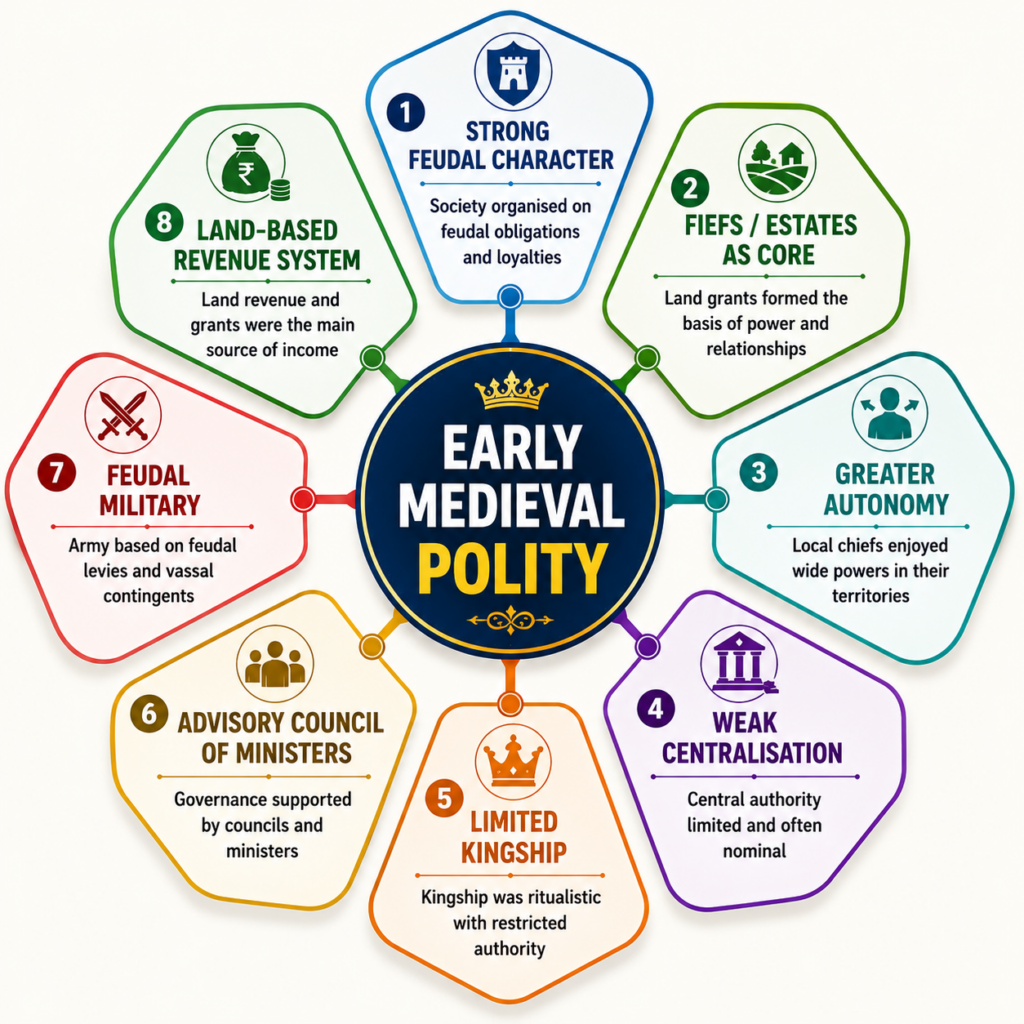
- A strong feudal character:
- A period of feudal consolidation, where the overlord–subordinate relationship was an essential feature.
- A chain of personal allegiance bound retainers to chiefs, tenants to lords, and barons to kings.
- This was reflected in a hierarchical political structure represented by various ranks.
- Fiefs or estates as the central feature of polity:
- A special pattern of land distribution prevailed, where landholding was itself a status symbol.
- Fiefs and estates consolidated the political status of individuals holding them.
- These land holdings emerged as centres of local control and foci of power, forming the basis on which local ruling elites existed.
- A greater degree of autonomy in the political system:
- At the lower level, varying degrees of autonomy in administration, fiscal matters, and justice gave birth to local politics, which then integrated into larger state politics — a hallmark of the Rajput political system.
- Under the feudal system, the feudal lord fulfilled military and fiscal obligations — in fact, feudal authority rested on the fulfilment of these obligations, with lords providing military assistance and paying tributes in cash and kind to the king in return for this autonomy.
- Centralisation tended to be very weak:
- The overlord–subordinate relationship formed the core of the political system, and the relative strength of the feudatory vis-à-vis the suzerain was a key factor determining the system’s stability.
- The application of force and the ability to overawe or overpower samantas was important in maintaining this relationship, since the tendency towards autonomy was always powerful.
- This constantly disrupted political stability and weakened centralised control.
- The kingship concept:
- The concept of an all-powerful king remained important, though only in a limited sense — a number of authorities vested in the king, but this did not imply centralised control.
- Existence of a council of ministers, whose role was primarily advisory.
- Military being feudal in character:
- The king’s standing army was greatly supplemented by the armies of the feudal lords.
- Military aid or assistance was one of the two main obligations of the feudatories.
- Existence of bureaucracy:
- Available references suggest the bureaucracy was well organised and elaborate, but this is not entirely historically accurate.
- Official designations continued as before — such as Akshapatalika, Mahapratihara, and Mahasandhivigrahika — yet the bureaucracy did not play a significant role, since the polity was fundamentally feudal, marked by a devolution of powers to feudal lords, who enjoyed considerable authority.
- The revenue system:
- Mainly based on land tax, with certain levies on trade and commerce also collected.
- The revenue system came under great pressure due to the feudal economy — a centralised revenue system lost relevance, and revenue instead rested on feudal tribute.
Major Political Developments in Northern India and the Peninsula
- After the disappearance of centralised polities in northern India, the period between 800–1200 A.D. saw the emergence of regional kingdoms.
- Centralised states gave way to decentralised political systems based on local interests — a change driven by the emergence of the politico-economic structure termed feudalism.
- Since the Gupta period, the political structure in northern India had been increasingly feudal, with the relationship of the king to his subordinates resembling that of a vassal and lord.
- Feudatories were granted land along with certain rights over it, and were later given the right of sub-infeudation — making further grants of the land — thereby building a hierarchy of officials.
- The feudatory had certain military obligations towards the king, being required to supply armed men whenever needed.
- Theoretically, the feudatory was merely a claimant of the land revenue, and the land was meant to be re-assigned after his death; in reality, however, the feudatory held the land in perpetuity, and this tenure tended to become hereditary over time.
- Gradually, feudatories assumed criminal and judicial functions, administering their territories with minimal allegiance to the central authority, and began adopting high-sounding titles such as Mahasamanta and Mahamandaleshwara.
- The outcome of the growth of feudalism was the carving out of independent principalities by various vassals across the country — it was under these conditions that decentralised regional power flourished in the eighth–ninth century A.D. in northern India.
The Tripartite Struggle
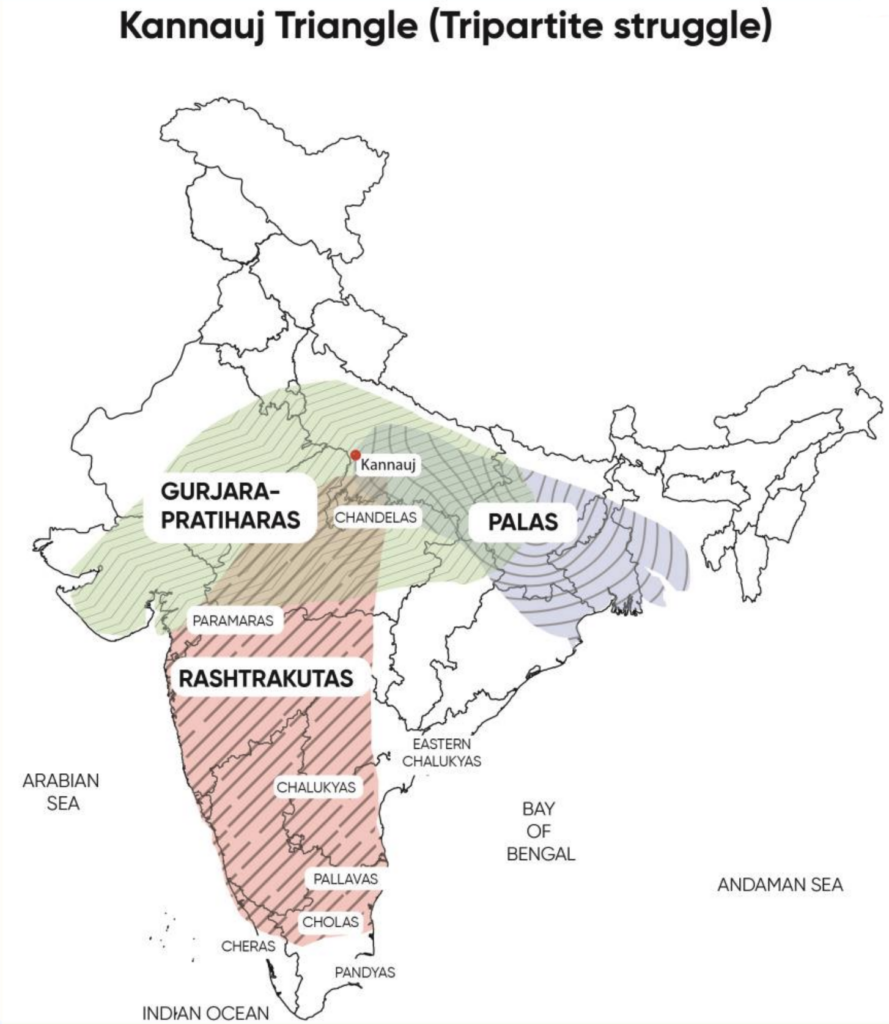
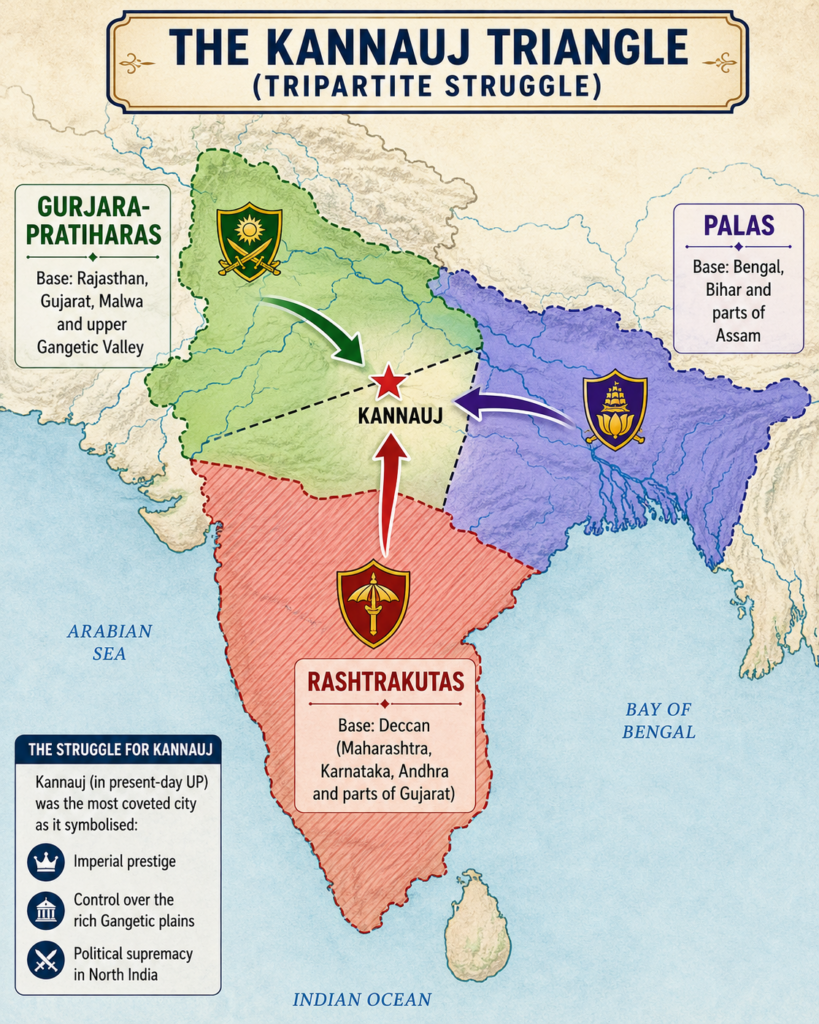
- This period is also known for the tripartite struggle between the Rashtrakutas, the Palas, and the Pratiharas, who had established themselves in different regions of the subcontinent.
- Ever since Harshavardhana made Kanauj the capital of his empire, it remained the imperial centre of North Indian polities for several centuries, even as its political fortunes changed frequently.
- This implied a shift in political power from east to west — Pataliputra, an important centre under both the Mauryas and Guptas, was now replaced by Kanauj as the centre of North Indian political dominance.
- Large states arose in north India and the Deccan between AD 750 and 1000:
- The Pala empire, which dominated eastern India till the middle of the ninth century.
- The Pratihara empire, which dominated western India and the upper Gangetic valley till the middle of the tenth century.
- The Rashtrakuta empire, which dominated the Deccan and also controlled territories in north and south India at various times.
- Each of these empires, although they fought among themselves, provided stable conditions of life over large areas — they extended agriculture, built ponds and canals, and gave patronage to arts and letters, including temples.
- Of the three, the Rashtrakuta empire lasted the longest — it was not only the most powerful empire of the time, but also acted as a bridge between north and south India in both economic and cultural matters.
The Palas (Bengal Region)
- The first significant ruler of Bengal was Sasanka, who ruled roughly between 606–637 A.D., and is considered the first historically known ruler of the area constituting Bengal.
- Sasanka’s death was followed by a period of political decline in Bengal — the region was attacked by Yasovarman of Kanauj and Lalitaditya of Kashmir, and later, perhaps, by the king of Kamrupa, resulting in the weakening of central authority and the rise of independent chiefs.
- It appears that the prevailing anarchy led the chiefs to elect someone named Gopala as ruler of the whole kingdom.
- The Pala dynasty was founded by Gopala in A.D. 750, at a time when Bengal was without a king, amid anarchy.
- He consolidated his rule over Bengal, bringing much-needed stability and prosperity to the region, and died around 780 A.D., succeeded by his son Dharmapala.
- Dharmapala is regarded as one of the greatest kings to have ruled Bengal, raising the kingdom’s glory to great heights.
- In the famous tripartite struggle between the Palas, Pratiharas, and Rashtrakutas for control over Northern India, Dharmapala played a crucial role, managing for a while to attain a supreme position in North India.
- He spent much of his life in military campaigns — after suffering defeat at the hands of the Pratiharas and Rashtrakutas, he still went on to establish an empire covering a considerable part of Northern India.
- Details of his reign are known mostly from copper plate inscriptions found at Khalimpur.
- Apart from his military campaigns, Dharmapala is also known for his patronage of Buddhism — he founded many Buddhist monasteries, but it was the famous Vikramshila University, founded by him, that earned him lasting fame.
- Dharmapala was succeeded by his son Devapala, who ruled for about 40 years and also emerged as a powerful king — the last among the line of powerful Pala rulers.
- Both Dharmapala and Devapala won fame and glory through their victories in the Tripartite Struggle — the contest among the Pratiharas, Palas, and Rashtrakutas for control over the imperial capital of Kanauj and, through it, Northern India.
The Pratiharas
- The Pratiharas were an Indian dynasty that ruled a large kingdom in northern India from the 6th to the 11th centuries.
- The ascendancy of Pratihara power began with Nagabhatta I, who ascended the throne in the middle of the 8th century.
- He extended control eastward and southward from Mandor, conquering Malwa as far as Gwalior and the port of Bharuch in Gujarat, and established his capital at Ujjaini in Malwa.
- His greatest achievement was his victory against the Arabs — the Arabs had earlier seized a portion of Malwa, threatening the foundations of the Pratihara kingdom; Nagabhatta inflicted a decisive defeat on them, confining the Arabs to the region of Sind, preventing further penetration into India.
- He subsequently united the Gurjara principalities of Nandipuri and Jodhpur under his banner, installing a strong Pratihara kingdom comprising Malwa, Gujarat, and parts of Rajputana.
- In Pratihara political history, Nagabhatta I was succeeded by Vatsaraja, during whose reign the famous tripartite struggle began.
The Rashtrakutas
- While the Palas and Pratiharas ruled over north India, the Deccan was governed by the Rashtrakutas.
- The kingdom was founded by Dantidurga, who set up his capital at Manyakhet (Malkhed), near modern Sholapur; the Rashtrakutas soon dominated the entire area of northern Maharashtra and also contested the Pratiharas for overlordship of Gujarat and Malwa.
- Although their raids did not extend the Rashtrakuta empire to the Ganga valley, they brought rich plunder and added to Rashtrakuta fame.
- The Rashtrakutas also fought constantly against the eastern Chalukyas of Vengi (modern Andhra Pradesh) and, in the south, against the Pallavas of Kanchi and the Pandyas of Madurai.
- The greatest Rashtrakuta rulers were probably Govinda III (793–814) and Amoghavarsha (814–878).
- After a successful expedition against Nagabhatta (of Kanauj) and the annexation of Malwa, Govinda III turned south — an inscription records that he “terrified the Kerala, Pandya, and Chola kings” and “caused the Pallavas to wither,” while the Gangas of Karnataka, having grown disloyal, were bound in fetters and met with death.
- Amoghavarsha ruled for 64 years, though by temperament he preferred the pursuit of religion and literature over war.
- He was himself an author, credited with writing the first Kannada book on poetics.
- He was also a great builder, said to have constructed the capital city of Manyakhet to rival the city of Indra.
- Numerous rebellions broke out across the far-flung Rashtrakuta empire under his reign — these were barely contained, and resumed soon after his death.
- His grandson, Indra III (915–927), re-established the empire — after defeating Mahipala and sacking Kanauj in 915, Indra III became the most powerful ruler of his time.
Causes of the Tripartite Struggle
- Kannauj was the erstwhile capital of Harshavardhana’s empire in North India. The following factors provoked the tripartite struggle:
- Kannauj was a symbol of prestige and power during the early medieval period.
- Control of Kannauj implied control of the Central Gangetic valley, rich in resources, and thus strategically and commercially significant.
- The city was ideally suited for trade and commerce, being connected to the Silk Route.
- A general desire to loot through war also drove the conflict.
How the Tripartite Struggle Began
- The Pratihara ruler Vatsaraja was highly ambitious about Kannauj; similarly, Dharmapala, the Pala ruler, also sought control over it — bringing the two rulers into direct conflict.
- Vatsaraja defeated Dharmapala in a battle at the Gangetic Doab.
- Around the same time, Vatsaraja was defeated by the Rashtrakuta king Dhruva, who also went on to defeat Dharmapala.
- This pronounced enmity ultimately led to the full-scale Tripartite Struggle between the Palas, Rashtrakutas, and Pratiharas.
Consequences of the Tripartite Struggle
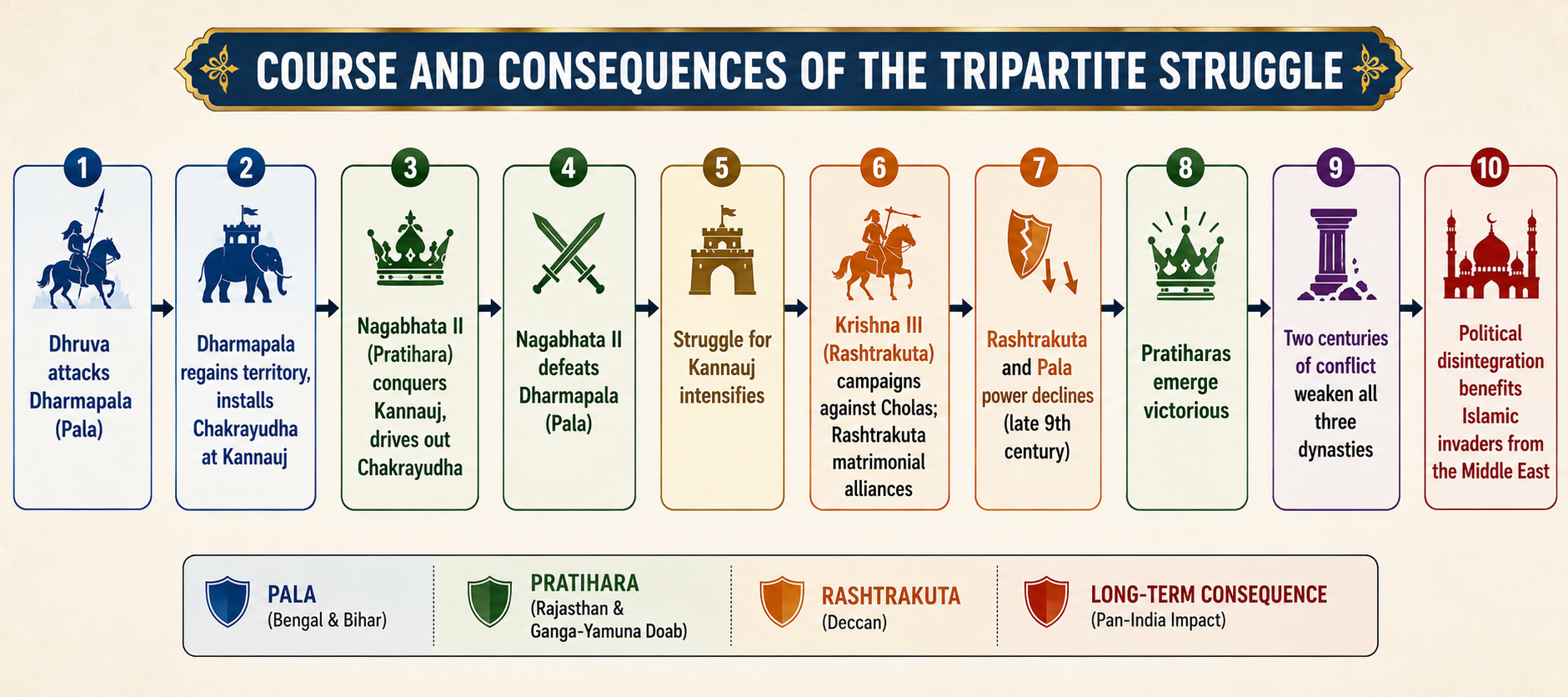
- After Dhruva’s attack, Dharmapala managed to regain control of his territory and installed Chakrayudha on the throne of Kannauj.
- However, Nagabhata II, successor of the Pratihara ruler Vatsaraja, soon conquered Kannauj and drove away Chakrayudha, later also defeating Dharmapala.
- The struggle for Kannauj grew more intense once Nagabhata II established control over it.
- During the reign of the Rashtrakuta ruler Krishna III, there was a successful campaign against the Cholas, and the Rashtrakutas also formed matrimonial relationships with other feudal kings.
- However, by the end of the 9th century, the power of the Rashtrakutas began to decline, along with the Palas.
- By the end of the tripartite struggle, the Pratiharas emerged victorious, establishing themselves as the rulers of central India.
- The tripartite struggle lasted for two centuries, weakening all three dynasties in the long run.
- This resulted in the political disintegration of the country, ultimately benefiting the Islamic invaders from the Middle East.
Conclusion
The major political developments in Early Medieval India (750–1200) reflect a decisive shift from centralised imperial rule to a decentralised, feudal political order built on land grants, hierarchical allegiance, and regional consolidation. The prolonged Tripartite Struggle among the Palas, Pratiharas, and Rashtrakutas for control of Kanauj exemplifies how this feudal structure — despite producing regional stability and cultural patronage — ultimately left North India politically fragmented and militarily exhausted, paving the way for future invasions. For UPSC History Optional aspirants, this period is central to understanding the transition from ancient to medieval Indian polity and the roots of Rajput and regional state formation.