Indian Feudalism in Early Medieval Period

Indian Feudalism in the Early Medieval Period

  • The early medieval period in Indian history was marked by significant transition — visible changes and developments across society, economy, polity, and agriculture.
  • The most distinctive development of this era was the expansion of the land grants system, a phenomenon that Marxist historians have used as the basis for propounding the theory of “Indian Feudalism.”
  • Feudalism, in this context, refers to the practice of establishing superior rights over land — rights that became the basis for appropriating a share of the produce and acquiring further rights over land and its inhabitants.
    • These superior rights conferred upon beneficiaries the status of an overlord, while the peasantry was correspondingly reduced to a subordinate status — giving rise to a distinctive overlord–subordinate agrarian relationship.
  • This article examines Indian Feudalism in the early medieval period through four lenses: its defining features, its economic, political, and social implications, and finally the historical trajectory of its rise and decline — a theme of central importance for UPSC History Optional aspirants.

Features of Indian Feudalism

  • The system was fundamentally based on land and land rights, with feudal lords enjoying superior rights that formed the basis for the appropriation of revenue.
  • These superior rights included proprietary and hereditary rights over land, along with wide-ranging administrative, judicial, military, and fiscal powers exercised by feudal lords.
  • The period also saw the rise of Jayaskandhavaras — victory army camps that functioned as politico-military centres — along with feudal titles such as Thakur, Raja, Rao, and Raut, conferred upon lords.
  • A defining practice of this system was sub-infeudation, which produced a hierarchical structure of landed intermediaries.
    • Vassals, state officers, and other secular assignees held military obligations and feudal titles; when these donees further sub-infeudated their land to get it cultivated, it led to the growth of multiple strata of intermediaries between the king and the actual cultivator.
    • In essence, Indian feudalism came to be characterised by a grossly unequal distribution of land and its produce.
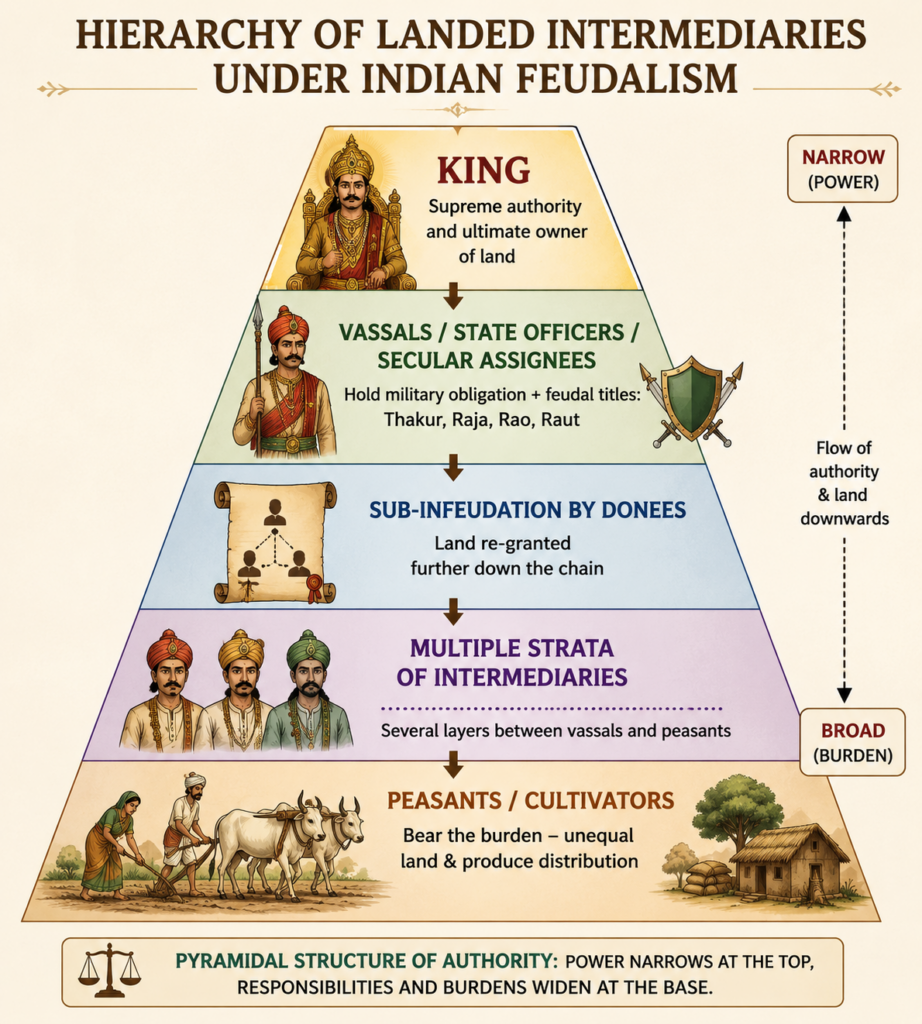
Feudal intermediaries in Indian hierarchy

Vishti (Forced Labour) under Feudalism

  • Vishti, or forced labour, was a widely prevalent practice under Indian feudalism, believed to have been exercised by Brahmana and other land-grantees.
    • Forced labour was originally a prerogative of the king or the state, but it was progressively transferred to grantees, petty officials, village authorities, and others.
    • The Chola inscriptions alone contain more than a hundred references to forced labour, indicating how widespread the practice had become.
  • Even peasants and artisans fell within the jurisdiction of vishti, leading to the emergence of a form of serfdom, in which agricultural labourers were reduced to the position of semi-serfs.

Curtailment of Peasants’ Land Rights

  • As rulers and intermediaries increasingly claimed greater rights over land, the peasantry’s own rights over land correspondingly declined.
    • Many peasants were reduced to the position of tenants, facing a growing threat of eviction, while a section of them survived merely as ardhikas (sharecroppers).

Economic Implications of Indian Feudalism

  • The system produced a new pattern of land distribution, giving rise to a new landlord class and a distinct hierarchy within the land structure, along with a new kind of agrarian relationship.
  • The economy became increasingly land-based, with agriculture emerging as its dominant feature and a marked growth of village or rural economy.
  • This was accompanied by the growth of a “closed” kind of economyR.S. Sharma notably argued that self-sufficiency in a country’s economy is an essential precondition for feudalism to take root.
  • A direct corollary of this closed, agrarian, self-sufficient economy was the decline of urban centres and urban economic activity.

Political Implications of Indian Feudalism

  • The political structure itself came to be based on land and the land structure, giving rise to a hierarchy of feudal lords.
  • This produced a pyramidal structure of authority, with the king at the apex and the peasantry forming its base.
  • As land-based feudal relationships deepened, the bureaucracy progressively lost relevance, and the character of the military changed — the earlier standing army was gradually replaced by a feudal army raised through land-vassal obligations.
  • Overall, these developments set in motion a clear trend of political decentralisation, with the entire political structure coming to rest on the land–vassal relationship.

Social Implications of Indian Feudalism

  • Land and the land structure emerged as a new basis of social hierarchy and status, cutting across the traditional caste system — anyone who received a land grant, along with its associated rights and powers, rose correspondingly in the political hierarchy.
  • This period also witnessed the rise of a more “closed” kind of society, in which social relations became increasingly restricted.
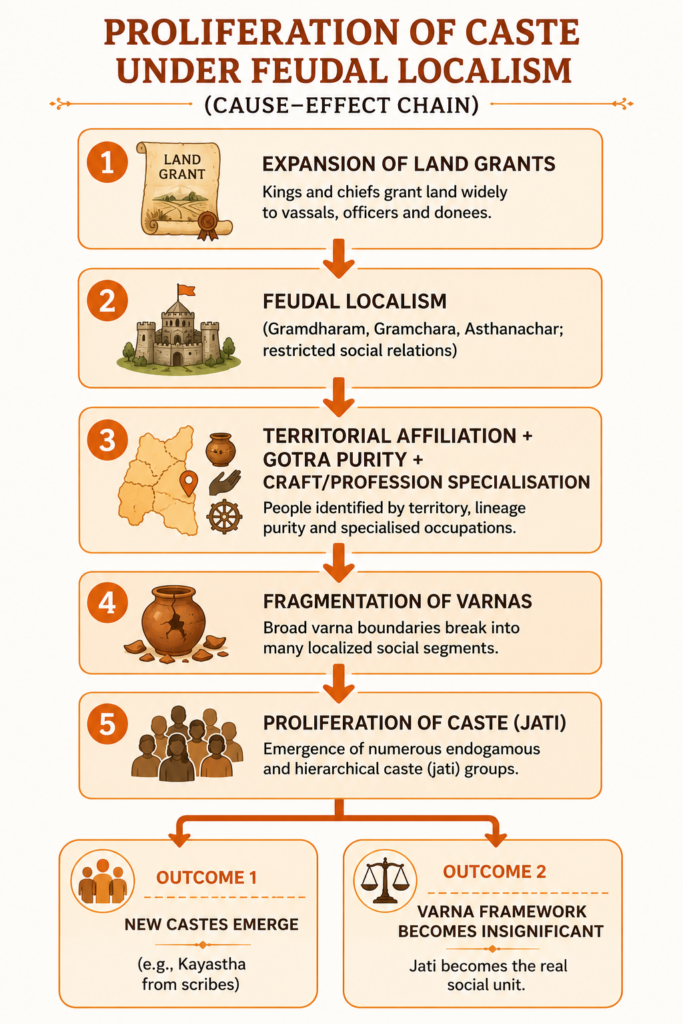
    • Contemporary texts use terms like Gramdharam, Gramchara, and Asthanachar, all indicative of what historians term “feudal localism.”
    • Law books of the period even suggest that those who undertook sea voyages fell from their caste, and that a man should not marry his daughter to someone living at a great distance — both reflecting the increasingly localised and insular character of society.

Changes in Caste Structure

  • The decline of trade and craft led directly to the decline of the Vaisyas as a distinct, prosperous class.
    • Several references suggest that the distinction between Vaisyas and Shudras got blurred during this period — a trend also corroborated by Al-Beruni, who observed that both were punished with amputation of the tongue for reciting the Vedas.
    • At the same time, many Shudras took to agriculture, resulting in a rise in their social status.
  • The expansion of the land grant system also gave rise to a new caste — the Kayastha.
    • As land grants multiplied, growing numbers of people took up the profession of scribes; this profession, over time, crystallised into the distinct caste of Kayasthas.

Proliferation of Caste

  • Feudal localism was a key factor behind what is termed the “proliferation of caste” in early medieval India — the emergence of a large number of caste groups, which rendered the broader varna framework increasingly insignificant as the organising principle of social structure, with caste (jati) becoming the operative social reality instead.
  • The Brahmavaivarta Purana‘s dictum of deshabheda (differences based on region/territory) captures this well, suggesting that regional differences themselves produced differences in caste.
    • As a result, no varna remained homogeneous; each fragmented further on account of territorial affiliation, purity of gotras, and the pursuit of specific crafts, professions, and vocations.
  • Land grant expansion also drove the “peasantisation of tribes” — tribal groups, whose earlier occupations did not involve cultivation, increasingly took to agriculture.
  • The period also saw a further growth of slavery under feudal conditions, even as feudalism simultaneously contributed to the emergence of new regional languages and art forms.
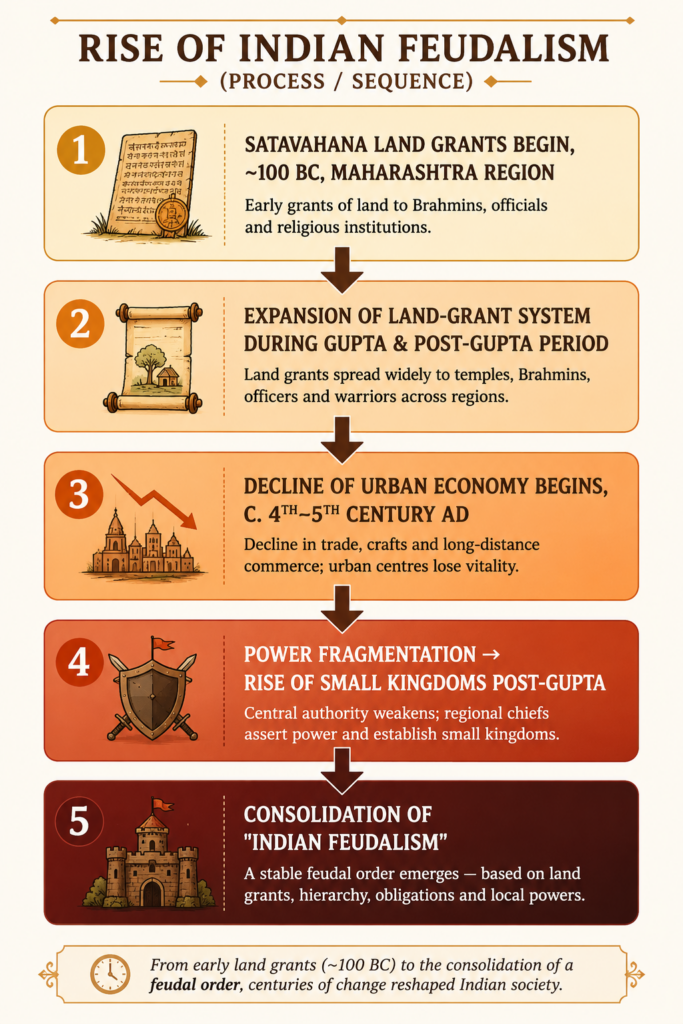
Rise of Feudalism in India

  • The background for the rise of feudalism was laid by developments already underway in ancient India, with the trend gathering pace through the Gupta and post-Gupta periods.
  • The land-grant system itself is traceable to the Satavahanas, who initiated the practice around 100 BC in the Maharashtra region; the system then expanded significantly during the Gupta and post-Gupta periods.
  • This was accompanied by a declining trend in the urban economy, beginning around the 4th–5th century AD, and by growing power fragmentation and disintegration, marked by the rise of small kingdoms in the post-Gupta period.
Decline of Feudalism in India

  • The decline of Indian feudalism was the result of multiple causes; since the system rested on the idea of land tenure granted in return for governmental service, any development that disturbed this underlying adjustment inevitably weakened feudalism itself.

Political Centralisation under the Delhi Sultanate

  • The foundation of the Delhi Sultanate in 1206 brought about political centralisation, dealing a major blow to the feudal system.
    • The Sultanate’s Iqta system functioned as a key tool of this centralisation, since the grant of an iqta did not confer a hereditary right to the land — unlike earlier feudal land grants.
    • Muhammad Habib argued that the economic changes following the establishment of the Delhi Sultanate created an administrative organisation considerably superior to what had existed earlier — changes he considered significant enough to be termed an “Urban Revolution” and a “Rural Revolution.”
    • D.D. Kosambi, by contrast, acknowledged that “hidebound customs in the adoption and transmission of new techniques” were broken down by the “Islamic raiders,” but regarded these changes as no more than an intensification of elements already present within Indian feudalism, rather than a wholesale transformation.

Revival of Trade and the Cash Economy

  • The growth of a cash economy created conditions unfavourable to the sustenance of feudal tendencies, and a clear revival of trade became visible from around the 10th century itself.
    • During roughly 900–1300 CE, the mercantile community regained prominence, with a large number of merchants carrying both luxury and essential goods across regions — a trend confirmed by contemporary literature and inscriptions, which refer to merchants known by their specific trades.
    • Moneylending emerged as a major mercantile activity: in western India, a distinct group of merchants called Nikshepa-vanika specialised in banking and moneylending, a practice also documented in the Gujarati text Lekhapaddhati.
    • Several regional merchant groups, mostly from Western India, also emerged during this period — for instance, the Oswals (from Osia), Palivalas (from Patli), Shrimalis (from Shrimala), and Modhas (from Modhera) — most of whom are today collectively known as Marwaris (“merchants from Marwar”).
    • In South India, regional markets called nagaram served as centres of exchange; the expansion of agriculture and trade from the tenth century onward led to the rise of major merchant guilds such as the Ayyavole and the Manigraman.
  • The arrival of the Turks brought fairly well-defined systems of tax collection, distribution, and coinage, though these could not replace existing systems immediately — instead, they were initially superimposed on older structures, with modifications introduced gradually by successive Sultans up to the close of the 15th century.
  • Taken together, these developments meant that feudalism, as a large-scale phenomenon, gradually collapsed under the combined pressure of political centralisation and economic revival.
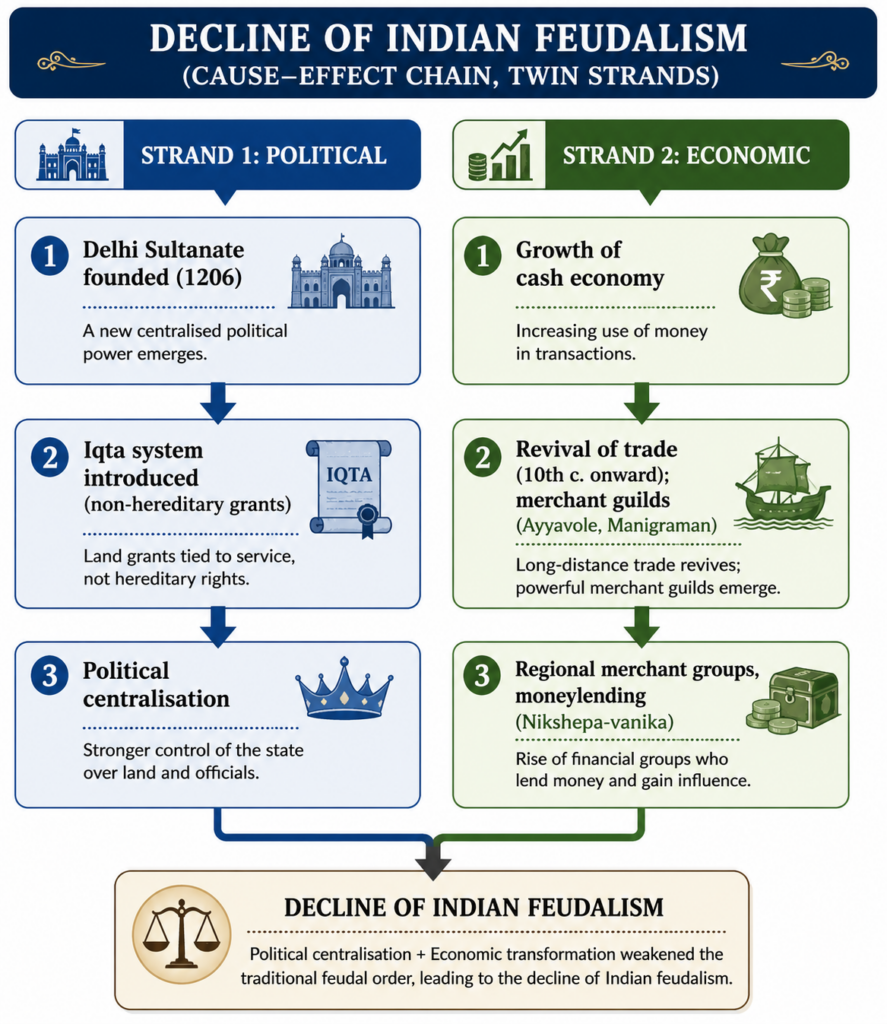
Decline of Indian feudalism flowchart

Conclusion

  • The theory of Indian Feudalism, as articulated by historians like R.S. Sharma, offers a powerful lens for understanding the deep transformations in land relations, economy, polity, and society during the early medieval period.
  • From the rise of landed intermediaries and vishti, through its far-reaching economic, political, and social implications — including the proliferation of caste — to its eventual decline under the combined weight of Delhi Sultanate centralisation and the revival of trade, the feudalism debate remains central to any serious study of early medieval Indian history.


Royal land charter was a formal document issued by a monarch, granting a right or power on land to an individual or abody corporate. Land charters of medieval India were generally on metal plates and they give us several informationwhich can be used as a source of history: 

  • Land charters give us details of the Royal donor generally in eulogical tone by giving information about royal donor’s 
    • ancestry of royal donor 
    • title 
    • religious affliations 
    • capital conquests
    • his other achievements. 
  • Land charters give following details of the beneficiary/donee/receivers 
    • ancestry 
    • place 
    • gotra 
    • his other achievements. 
  • Land charters give the following description of land to be given as grant: 
    • location of the land 
    • measurement of the land 
    • type of the land- settled/unsettled/cultivates/uncultivated/ forest etc. 
    • type of inhabitants on that land. 
  • Land charters give information about the rights and powers of the donee like: 
    • appropriation of revenues 
    • control over inhabitants 
    • administrative, judicial, military, fiscal, proprietary powers etc. 
  • Land charters give information about: 
    • The taxes and subjects to exemption with respect to donee (many a times, land was completely tax free).
    • The list of officers who were informed of the land grants and this was given. normally, in hierarchical order with official designations. 
    • The occasion for grants like 
      • victory in war 
      • performance of sacrifice 
      • visit to tirthas etc. 
  • In certain land charters, the purpose of grant is also mentioned: 
    • to earn spiritual merit for himself and ancestors 
    • to make perform religious duties (land given to temple priest etc.) 
    • to impart education. 
  • In some charters the name of the executor (generally high officer) and name of the writer (a literate artisan who excised on metal plates).

Hence land charters give us variety of information and can be used as a source of history. 

The early medieval period in Indian history marks the growth of cultivation and organisation of land relations throughland grants. These grants began around the beginning of Christian era and covered practically the entire subcontinentby the end of the twelfth century. Practice picked up momentum in the post-Gupta period. What began as a meretrickle, became a mighty current.

Major Types of Lang grants

  • Brahmadeya: 
    • A brahmadeya represents a grant of land either in individual plots or whole villages given away to Brahmanas making them landowner or land controller. 
    • It was meant either to bring virgin land under cultivation or to integrate existing agricultural (or peasant) settlements into the new economic order dominated by a Brahmana proprietor. 
    • These Brahmana donee played a major role in integrating various socio-economic groups into the new order, through service tenure and caste groupings under Verna system. for example, the growing peasantisation of shudras was sought to be rationalised in the existing brahmanical social order.
    • Brahmadeya facilitated agrarian expansion because they were 
      • Exempted from various taxes or dues either entirely or at least in the initial stages of settlements (e.g. for 12 years); 
      • endowed with ever growing privileges (pariharas). The ruling families derived economic advantage in the form of the extension of the resource base, moreover, by creating brahmadeyas they also gained ideological support for their political power. 
    • Lands were given as brahmadeya either to a single Brahmana or to several Brahmana families.
    • Brahmadeyas were invariably located near major irrigation works such as tanks or lakes. Often new irrigation sources were constructed when Brahmadeyas were created, especially in areas dependent on rains and in arid and semi-arid regions. When located in areas of intensive agriculture in the river valleys, they served to integrate other settlements of a subsistence level production. 
    • Sometimes, two or more settlements were clubbed together to form a brahmadeya or an agrahara.
    • Boundaries of the donated land or village were very often carefully demarcated. 
    • The Brahmanas became managers of agricultural and artisanal production:
      • The various types of land, wet, dry and garden land within the village were specified. Sometimes even specific crops and trees are mentioned. 
      • The land donations implied more than the transfer of land rights. For example, in many cases, along with the revenues and economic resources of the village, human resources such as peasants (cultivators), artisans and others were also transferred to donees. 
      • There is also growing evidence of the encroachment of the rights of villagers over community lands such as lakes and ponds. 
      • Brahmanas organised themselves into assemblies. 
  • Devadanas: 
    • There is evidence of large scale gifts to the religious establishments, both brahmanical and non brahmanical. 
    • These centres worked as nuclei of agricultural settlements and helped in integrating various peasant and tribal settlements through a process of acculturation
    • They also integrated various socio-economic groups through service tenures or remuneration through temple lands. Temple lands were leased out to tenants, who paid a higher share of the produce to the temple. Such lands were also managed either by the sabha of the brahmadeya or mahajanas of the agrahara settlements. 
    • In non-Brahmana settlements also, temples became the central institution. 
      • Here temple lands came to be administered by the temple executive committees composed of land owning non-Brahmanas, e.g.: the Velalas of Tamil nadu, the Okkalu, Kampulu etc. of Karnataka and Andhra regions. 
    • The caste organization centered round the temple, in which different groups were assigned a caste and ritual status. 
    • It is in this process that people following ‘impure” and “low occupations” were assigned the status of untouchables, kept out of the temple and given quarters at the fringes of the settlement. 
    • Several strata of intermediaries emerged between the King and the actual producer. 
      • The Brahmana, the temple and higher strata of non-Brahmanas as landlords, employers and holders of superior rights in land became the central feature of early medieval agrarian organisation. 
      • The new landed elite also consisted of local peasant clan chiefs or heads of kinship groups and heads of families, who had kani rights i.e. rights of possession and supervision.
  • Secular Grants: 
    • From the seventh century onwards, officers of the state were also being remunerated through land grants. Demonetized economy was one of the reason for this. As there was difficulty in paying their salary in cash. 
    • It created another class of landlords who were not Brahmanas. 
    • Evidence of such grants are available from as early as c. A.D. 200 (the time of Manu) but the practice picks up momentum in the post-Gupta period. 
    • Literary works dealing with central India, Rajasthan, Gujarat, Bihar and Bengal between the tenth and twelfth centuries make frequent references to various kinds of grants to ministers, kinsmen and those who rendered military services. 
    • The rajas, rajaputras, ranakas, mahasamantas etc. mentioned in Pala land charters were mostly vassals connected with land. 
    • The incidence of grants to state officials varies from one region to another. For example: 
      • while we hear of about half a dozen Paramar official ranks, only a few of them are known to have received land grants. But very large territories were granted to vassals and high officers under the Chalukyas of Gujarat. 
      • The available evidences suggest that Orissa had more service grants than Assam, Bengal and Bihar taken together. 
    • Intermediaries were created: The right of various officials to enjoy specific and exclusive levies (irrespective of the tenure of these levies) created intermediaries with interests in the lands of the tenants. 

Ideological Background

Land grants had begun to follow a set legal formula systematized through law books (Dharmashastras) in post Guptaperiod. 

  • Brahmanical logic of acquiring Punya
    • Main Ideas behind the gift of land emphasise the importance of dana or gift. 
    • The idea of dana or gift to Brahmanas was developed by Brahmanical texts as the surest means of acquiring merit (punya) and destroying sin (pataka). It appears to be a conscious and systematic attempt to provide means of subsistence to the Brahmnnas. 
    • The whole concept of dana (gift making) was undergoing perceptible change. The dharmashastras underline prayashchitta (repentance) for sins committed in this world. Kings were rarely free from sins  and transgressions (guilty of Loot, arson, killing during wars). The lawmakers, who were invariably brahmanas, instilled a feeling of fear by a graded system of sins and punishments and by evolving such notions as that of mahapataka
    • The sense of guilt in kings coupled with principle of its prayashchitta was exploited by brahmanas. Grants of cultivable land to them and registration of gifts of land on copper plates are recommended by all the Smriti and Puranas of the post-Gupta centuries. 
    • Different item of gift: 
      • Food, grain, paddy etc. 
      • Movable assets like gold, money etc. and 
      • The immovable assets i.e cultivable land, garden and residential plot. 
      • The plough, cows, oxen and ploughshare 
    • The gift of land was considered to be the best of all type of gift made to the learned Brahmana. 
      • Vyasa is quoted very often in epigraphic records, is known to have laid down that giver of land lives in heaven for 16000 years. 
      • Many puranas stipulate that the donor of land would have the good fortune of being in the charming company of apsaras. 
  • Imprecations against the destruction of such gifts and the resumption of land donated to a Brahmana ensured their perpetuity
  • While the early land grants were made to Vedic priests (Shrotriya fire priests), from the fifth to thirteenth centuries, grants were also made to temple priests. 
  • The quest for legitimacy was a major consideration for political authorities. Thus, there was mutuality of interests of the donor as well as the donee. 
  • Monetary anaemia refers to paucity of coins and coins of poor quality with less purchasing power.
  • Though first suggested by D.D. Kosambi, it was R.S. Sharma’s ‘Indian Feudalism’ in 1965 that brought to focus the paucity of coinage in the post-Gupta times, its link with trade and commerce and consequent emergence of feudal social formation. Sharma proposed the theory of urban decay which resulted in decline of trade, collapse of artisan activity and paucity of metallic money. 
  • During A.D. 750 to 1000, India was ruled by dynasties like Gurjara Pratiharas in Western India, the Palas in Eastern India and the Rashtrakutas in the Deccan. 
    • But their available coins are very few and in no way comparable either in quantity or quality with the coins of earlier centuries. 
    • Pratiharas issued some silver coins but they are of doubtful standard. 
    • Such coins of doubtful standards were unsuitable for long distance trade because of questionable intrinsic value which did not match the face value. (since in ancient times, money was not fiat money, so intrinsic value was important). 
  • Cowry shells were the main medium of exchange which was a poor substitute for metallic money. Such shells suited for local trade but not for long distance trade. (one silver coin was equivalent to 1280 cowries).
  • Kashmir shows emergence of copper coinage from about eighth century A.D. but extremely poor quality of this coinage has been explained in terms of the decline in trade based economy and rise of agricultural pursuits in the valley. 
  • A case study of Orissa substantiates complete absence of coins between c. A.D. 600 and use of barter in trade.
  • In Pandya kingdom of south India, horses imported from abroad were paid not in cash but in Indian goods like silk, spices or ivory. 
  • The declining trade due to monetary anaemia has negative implication for commodity production for exchange related purposes. Such scenario led to the urban decay. 
  • Theory of monetary anaemia can be collaborated with several other factors like declining trade and ruralisation: 
    • Copper plate charters, since 600 AD, contain various scarce information regarding non-agricultural sector. It implies ruralisation of economy and decline of urban economy. 
    • The decline of the Indo-Roman trade after 4th century AD had adverse impact on India’s commercial economy. 
    • Puranic references are also indicative of declining status of merchants. 
    • There are literary evidences which suggest that urban centres got formed into villages. 
    • The archaeological evidences of urban centres are suggestive of poor construction, use of used bricks (like in Vaishali), haphazard layouts etc. These are indicative of urban decay. 
    • Urban centres during this period were not craft-trade exchange centre rather they were replaced by Jayakandhvaras and Tirthas. 
      • Copper plated of Palas, Senas, Pratiharas have fewer references of Nagar and pura and they have more references of Jayaskandhavaras (victory army camps which acted as politico-military centres).
      • Certain Tirthas assumed urban proportions (i.e. some tirthas emerged as urban centres). 
    • Land based economy and money economy were mutually incompatible and hence there are evidences which suggest this fact. For e.g. Shahi rulers of Punjab issued standard coins but this territory had not yielded any Copper plate charter and huge number of Copper plate charters discovered from the regions under Palas but no coins discovered. 
    • The evidence for transaction of goods of daily use is quite meagre in the sources belonging to this period. 

Counter views 

  • Many other views question not only the idea of paucity of coins but also the decline of trade.
  • While it is conceded that there was no coined money and the Palas and Senas themselves did not strike coins, it is also argued that there was no dearth of media of exchange. There was not only a long series of Harikela silver coinage but also cowries and most importantly churni (money in the form of gold/silver dust) also functioned as media of exchange. 
  • John S Deyell: 
    • He has argued that money was not scarce in early medieval India, nor were the states of the time suffering from a financial crisis. 
    • There was a reduction of coin types and decline in the aesthetic quality of coins but not in the volume of coin in circulation. 
  • Early medieval texts such as Prabandhachintamani, Lilavati, Dravyapariksha, Lekhapaddhati, etc. mention bhagaka, rupaka, vimshatika, dinar, karshapana, dramma, nishka, tanka, gadhiya-mudra, gadyanaka and many other coins. 
  • There are also inscriptional references of coins. For exampleSiyodani inscription refers to varieties of drammas in the mid-tenth century. 

Conclusion 

  • There may be some regional exceptions but the all-India perspective fits in the general hypothesis of monetary anaemia. 
  • Despite the plethora of references of coins, the evidence of overall volume of money in circulation is almost negligible. Nor can one overlook poor purchasing power of early medieval coins, irrespective of the metal used.
  • The revival of trade received considerable help from the re-emergence of metal money during later period ofearly medieval India. Though revival of even “partial monetization” was contributing to economic growth, yet noless significant was the parallel development of credit instrument, Hundika (or bill of exchange), by which debitsand credits could be transferred without handling of cash money. Through this device credit could be extendedby one merchant to another and, thus, the obstacle to commerce due to shortage of coined money could beovercome. 

Arguments in the favor of Indian Feudalism 

  • The early medieval period was considered synonymous with Indian feudalism. Indian feudalism emerged as a separate school in 1970s. Its early proponents were Marxist historians like D D Kosambi and R S Sharma.
  • D D Kosambi envisaged (in 1950s) the feudal formation in India in two stages: 
    • Feudalism from above: “Feudalism from above” was the first stage in which the direct relationship between overlord and his tributary/autonomous vassals without the prevalence of an intermediary land-owning class.
    • feudalism from below: “Feudalism from below” was more complex, witnessing the rise of rural land owners as powerful intermediaries between the ruler and the peasantry which led to administrative decentralization and the conversion of the communal property into a feudal property. 
  • R.S. Sharma accepted feudalism as a one way process. i.e. Feudalism from above. (but later, he also accepted the concept of feudalism from below.) 
    • Other historians like D. N. Jha and B.N.S Yadav also supported the feudalism from above. 
  • Later, towards the beginning of the decade of 2000. Historians like R.S Sharma & D.N. Jha presented the ideological and cultural aspects of feudalism. The focused on Bhakti, religion, regional cultures etc in playing a role in the development of feudalism. 
  • The presented the idea that the temples through emphasizing Bhakti, devotion, strengthened the idea of loyalty and subjection to deity/God. Such idea had implication for feudal trend. 
  • The donees enjoyed the revenue right as well as administrative and judicial rights. The grantees therefore derived many material advantages at the cost of both, ruler and the actual peasantry. 
  • Expansion of agriculture was the only positive feature of the early medieval times. Otherwise, there was broadening of different castes, hierarchization, social inequality, and peasant exploitation.
  • R S Sharma on Indian Feudalism: 
    • Sharma proposed that decline of foreign trade is the cause of feudalism. This led to a great uproar in the Marxist circles. 
      • According to Marxism changes in a society comes from within not from outside. Changes in social, economic, and political structure originates from internal contradictions. 
    • Later in early 1970s, Sharma proposed the theory of urban decay. Urban decay resulted in decline of trade, collapse of artisan activity, disappearance of metallic money, and an overall decline which reduced the power of the state. 
    • Later to counter his critics R S Sharma invented the kali age crisis theory to explain the cause land grants. 
      • He said that the Brahmanical system was threatened with the prosperity of Vaishyas and Shudras. They started challenging the Brahmana-Kshatriya superiority. The Brahmanical order and Varna system were questioned. This led to the kali age crisis which is also prophesied in the Puranas and other texts.
      • To overcome the crisis rulers started granting lands to Brahmanas so that they can bring order in the society. Land grants resulted in dissemination of Brahmanical ideology and expansion of agriculture. 

Arguments against the Indian Feudalism 

  • In 1966, D C Sircar criticized the feudalism model. But there was a difference in the style of criticism before 1979 and after 1979. 
  • Before 1979 scholars were criticizing the feudalism school by using its own terminology (such as “decline of trade”, “urban decay”, “loss of metallic money”, and “collapse of cities”). 
    • The critics were fighting on a battlefield chosen and prepared by the Indian feudalism advocates. 
  • The intellectual arguments changed after 1979 when new ideas came. 
  • In 1979, Harbans Mukhia wrote a paper titled, “Was There Feudalism in India?” He discussed that there was no manorial system in India like Europe. 
    • The climatic conditions were better in India than Europe. Indian soil was more fertile. Indian peasants owned their lands. In Europe, land and agricultural tools were given by the lord to the peasants. Peasants had to work on lord’s land before tilling their own land.
  • Another big blow to feudalism theory came from Hermann Kulke and B Chattopadhyaya in 1980s and 1990s. 
    • Chattopadhyaya questioned the very basis and thinking of feudalism school. He argues that in the period before 4th-5th century we see expansion of trade, development of new towns and cities, increase in metallic coins, expansion of artisan activity. It is not possible that suddenly after 4th -5th century the situation became totally opposite (as reconstructed by Sharma). 
    • Chattopadhyaya says that history is a process and everything is connected. Land grants were given by the state to consolidate its power. Most of the lands were granted in virgin territories to bring agricultural activity in those areas. 
  • Argument against “Urban decay” and “Collapse of artisan activity” 
    • B D Chattopadhyay has argued that the early medieval period saw the decline of urban centres but there were others that continued to flourished, as well as some new ones that emerged. 
    • Inferences about the continued vibrancy of city life can also be made on the basis of the numerous literary works and the sculpture and architecture which must have been patronized by urban elites. 
  • Argument against “Decline of trade” 
    • KN Chaudhury had shown that by the eleventh century, the Indian Ocean trade was divided into smaller segments- the stretch from the Red Sea and Persian Gulf to Gujarat and Malabar, from Indian coast to Indonesian archipelago and from South-East Asia to East Asia. 
    • Hence the nature of trade changed instead of decline of trade. 
  • Argument against “Disappearance of metallic money” 
    • John S Deyell has argued that money was not scarce in medieval India, nor were the states of the time suffering from a financial crisis. There was a reduction of coin types and decline in the aesthetic quality of coins but not in the volume of coin in circulation. 
  • Argument against “Reduced power of the state” 
    • Far from being symptom of the disintegration of polities and Royal disempowerment, land grants to Brahmanas were one of the several integrative and legitimizing policies adopted by Kings. The increase in the wealth and power of a section of Brahmanas and institutions such as temples did not take place at the expense of Royal power. 
  • Argument against “the theory of kali age crisis” 
    • In 1980s, Burton Stein proposed the segmentary state theory which was another blow to the Indian feudalism model. Stein talked about the Brahmana-peasant alliance in the Tamil Nadu region where the maximum number of land grant inscriptions was found. 
    • Yellava Subbarayalu says that at any time in history not more than 20% of the total land was given to Brahmanas as grants. Then how can we build a theory of kali age crisis over whole of India based on 20% of the total land.
    • There is remarkable data collected from the Kaveri delta of pre-10th century where hierarchy had come in the Brahmanical settlements but there was communal ownership in non-Brahmanical settlements. This shows that developments were not same everywhere and all areas do not change simultaneously. 

Conclusion 

Recent historical studies and writings have raised several questions on the applicability of the term ‘Indian Feudalism’to early medieval society. All in all, we should not restrict ourselves to rigid models but be open to new ideas, interpretations, theories, and connections while reconstructing the history. 


History Optional Courses

guest
0 Comments
Oldest
Newest Most Voted