

- Agriculture is itself an energy conversion: photosynthesis turns solar energy into food for people and feed for animals.
- Primitive farming was little more than scattering seed on the land and accepting a scanty yield. Modern farming needs energy at every stage:
- Direct use: farm machinery, water management, irrigation, cultivation and harvesting.
- After harvest: food processing, storage and transport to market.
- Indirect or sequestered use: the energy locked in mineral fertilizers and chemical pesticides, insecticides and herbicides.
- Power in this sense covers human and animal labour, diesel and electricity. Its use is measured as farm power availability in kilowatts per hectare.
Farm Output and Its Limits
- India’s foodgrain output has risen steadily, reaching 376.56 million tonnes in 2025-26 (third advance estimates). It is among the top producers of wheat, rice, pulses, sugarcane and cotton.
- It is the highest producer of milk and second in fruits and vegetables.
- In 2013, India gave 25% of world pulses, 22% of rice and 13% of wheat, and about 25% of cotton, besides ranking second among cotton exporters for several years.
- Yields remain lower for most crops than in other leading producers such as China, Brazil and the United States.
- Key issues holding productivity down:
- Shrinking land holdings.
- Continued dependence on the monsoon.
- Inadequate access to irrigation.
- Imbalanced use of soil nutrients, which harms fertility.
- Uneven access to modern technology.
- Thin access to formal credit.
- Limited government procurement of foodgrains.
- Failure to give remunerative prices.
- Expert bodies have recommended:
- Land-leasing laws.
- A shift to micro-irrigation for water efficiency.
- Better access to quality seed through the private sector.
- A national online market for farm produce.
Farm Power and Mechanisation
- Farm power availability rose from 0.48 kW per hectare in 1975-76 to about 2.5 kW per hectare by 2023.
- The Standing Committee on Agriculture (July 2023) wants 4 kW per hectare by 2030. Regional gaps are wide, from 6 kW in Punjab to 0.7 kW in Mizoram.
- Other countries stand far higher: Korea over 7 kW, Japan over 14 kW and the USA over 6 kW per hectare in the classical comparison.
- Level of mechanisation: 47% of farm activities were mechanised as of August 2022.
- Gains from mechanisation have been estimated as:
| Gain | Estimate |
|---|---|
| Farm productivity | 10–15% higher |
| Cropping intensity | 5–20% higher |
| Saving of fertilizers and chemicals | 15–20% |
| Saving of time and labour | 20–30% |
- Electrification came first. At Independence only about 1,300 villages had electricity and about 6,400 pump sets were energised. Haryana was the first State to electrify all its villages, in 1970. More than 95% of villages were electrified by the early 2010s.
- Pump sets: electric pumps and tube wells numbered about 2 lakh in 1960 and over 45 lakh by 2009-10, a later count putting them near 84 lakh. Diesel sets rose from 2.3 lakh to about 35 lakh over the same period.
- Why it matters: machines speed up harvest and land preparation, which allows a second crop on the same field, and they make better use of irrigation, fertilizers and pesticides.
- Still uneven: the wooden plough and bullock cart persist across large parts of India.
- Tractors: sales rose from 2.48 lakh in 2004-05 to 9.71 lakh in 2021-22, before easing to 8.75 lakh in 2023-24.
- The largest markets in 2023-24 were Madhya Pradesh (1.11 lakh), Rajasthan (1.08 lakh), Gujarat (0.92 lakh) and Maharashtra (0.74 lakh).
- Power tillers: about 51,000 were sold in 2023-24. Tillers, harvesters and threshers are the other main machines.
- Scale problem: small, fragmented holdings and low purchasing power make individual ownership uneconomic.
- The answer is custom-hiring centres and high-tech machinery banks.
- The Sub-Mission on Agricultural Mechanisation began in 2014-15. About 37,097 custom-hiring centres, including 17,727 machinery banks, had been set up by 2023.
Electricity in Agriculture
- Rapid growth of ground water irrigation has pushed up farm electricity use, especially since the 1980s.
| Year | Agriculture (GWh or million units) | Share of total consumption |
|---|---|---|
| 1969 | 3,465 | |
| 1985-86 | 23,422 | 19.04% |
| 1998-99 | 97,195 | 31.38% |
| 2010-11 | 1,26,377 | 20.48% |
| 2015-16 | 1,73,185 | 20.06% |
| 2016 (other series) | 1,87,493 | |
| 2022-23 | 2,43,852 | 19.29% |
- The share has fallen from its peak even as the absolute amount has grown, because homes, industry and commerce have grown faster. The chart below puts the peak near 27%.
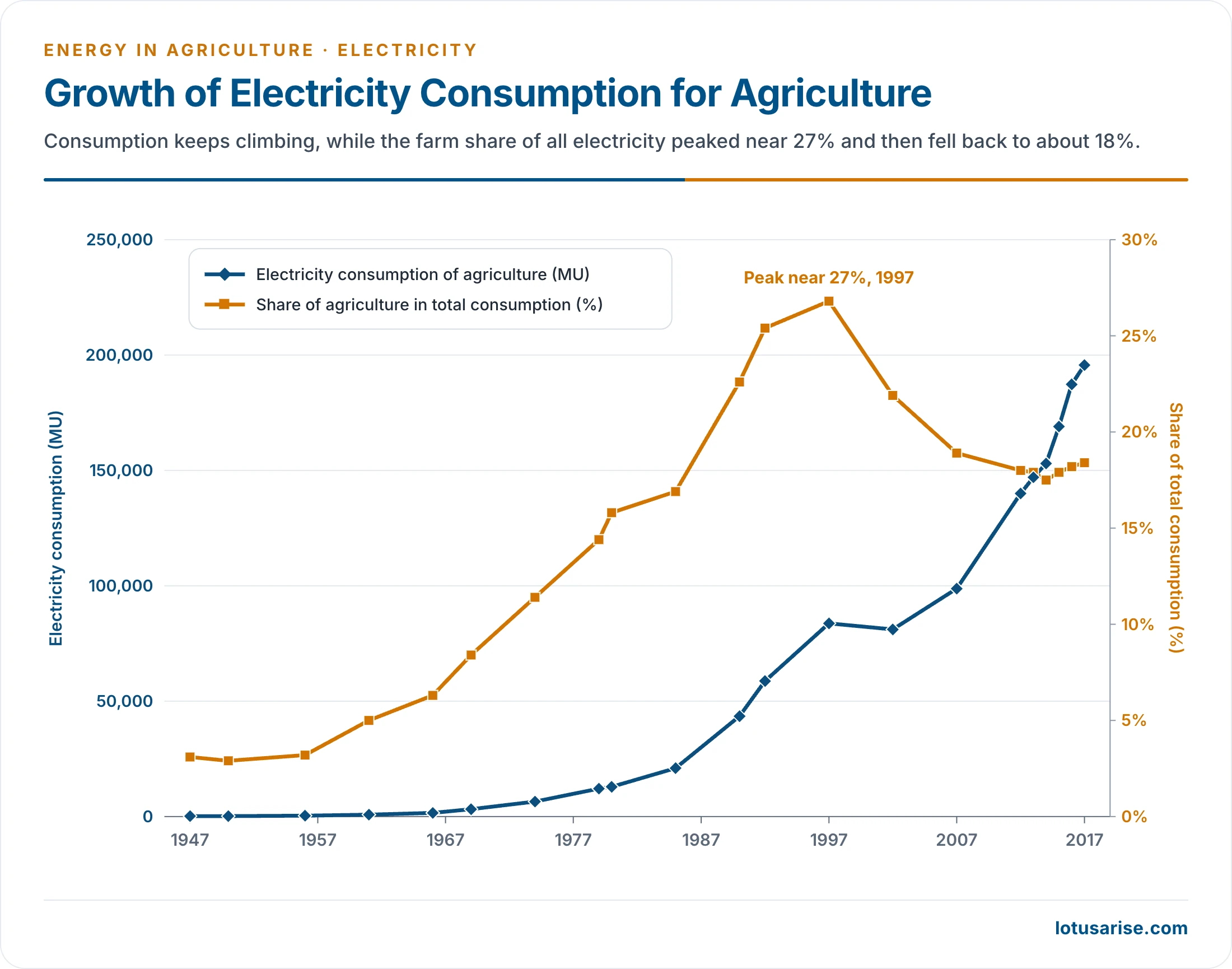
- State pattern (2009-10): Andhra Pradesh led in absolute use, with over 18.8 thousand GWh, followed by Maharashtra, Gujarat, Karnataka, Rajasthan, Tamil Nadu and Punjab.
- Share of State electricity was highest in Haryana (40.29%), then Rajasthan, Karnataka, Punjab and Andhra Pradesh.
- The North-East and hill States use very little.
- Subsidy strain: farm electricity has been subsidised, directly or through cross-subsidy, and this makes demands on power-sector and State finances.
- Unmetered supply: many connections are unmetered, which makes consumption hard to estimate, hides technical and commercial losses including theft behind farm use, and weakens accountability.
- Cheap or free unmetered farm use is therefore blamed for long-standing power-sector problems: distribution company finances, poor supply to farmers and the burden of cross-subsidy on other consumers.
- Distribution companies (DISCOMs) have long carried heavy losses, and the Centre had run three bailout packages in 15 years, including UDAY (2015).
- Distribution is called the weakest link of the power sector, largely because of subsidised supply to some categories, chiefly farming. Other consumers pay through higher tariffs (cross-subsidy), or State governments pay direct subsidy.
- Since the 1970s, many States have given farmers low-tariff electricity, in some cases free and much of it unmetered.
- This supply played a key role in ground water irrigation and farm output during and after the Green Revolution.
- Recent studies stress the costs to DISCOMs, State governments and cross-subsidising consumers. Free or subsidised power is seen as the main cause of unsustainable ground water extraction and of poor rural supply.
Problems with Electricity in Agriculture
- Pumping dominates: nearly all farm electricity goes to pumps, and over 85% of the energy for pumped irrigation is electric.
- Short hours: rural and farm supply hours are well below urban hours.
- Many States roster supply, alternating between daytime on some days and night on others.
- Farming gets no more than 10 hours a day in most States.
- Poor quality: farmers get fewer than the scheduled hours, with erratic supply, interruptions and voltage swings.
- Motor burnouts add avoidable repair costs.
- Transformer failures are common, and repairs are slow.
- Unreliable supply pushes farmers to buy larger electric pumps and diesel sets.
- Safety: night irrigation is risky, above all for women and older farmers.
- Dangers include snakes and electric shock.
- Accidents occur during pump operation, on contact with low-hanging conductors and during repairs to failed transformers.
- The National Crime Records Bureau counted nearly 10,000 deaths from electrical accidents in 2015, mostly rural. The number had been rising by 5–6% a year over two decades.
- Over-pumping: the marginal cost of pumping is very low or zero under subsidy, which encourages unregulated extraction and falling water tables.
- The national stage of ground water extraction was 60.63% in 2025, and far higher in Punjab, Rajasthan and Haryana.
- Cropping pattern: crop choice largely sets irrigation demand. Crops unsuited to a region’s agro-climate need water far above rainfall, from canals or ground water.
- Sugarcane in water-stressed Maharashtra and rice in Punjab are the standard examples.
- Demand ahead: shortage and long cuts have provoked farmer protests in Punjab, Haryana and Uttar Pradesh, where tube wells are the main source of water. Cheap and regular supply raises the efficiency of every farm operation, yet heavily subsidised supply has already strained several State electricity boards.
Steps for Improvement of Energy in Agriculture
- Pradhan Mantri Kisan Urja Suraksha evam Utthaan Mahabhiyan (PM-KUSUM), launched in 2019, seeks better irrigation access and farm income through solar power.
- By 31 January 2026, about 10.06 lakh standalone solar pumps had been installed, against 13.30 lakh sanctioned.
- Capacity under the scheme stood at about 10,949 MW, benefiting over 23 lakh farmers.
- Pradhan Mantri Krishi Sinchayee Yojana:
- Convergence of irrigation investment at field level.
- Recharge of aquifers and sustainable water conservation.
- Extension on water harvesting, water management and crop alignment, for farmers and field staff.
- National Mission for Sustainable Agriculture (NMSA): raises productivity, especially in rainfed areas, through integrated farming, water-use efficiency, soil health and resource conservation.
- Revamped Distribution Sector Scheme (2021): an outlay of Rs 3,03,758 crore for 2021-22 to 2025-26, tied to loss reduction and reform.
- Shift in irrigation sources and incentives for shifts in cropping patterns, so that power and water use ease together.
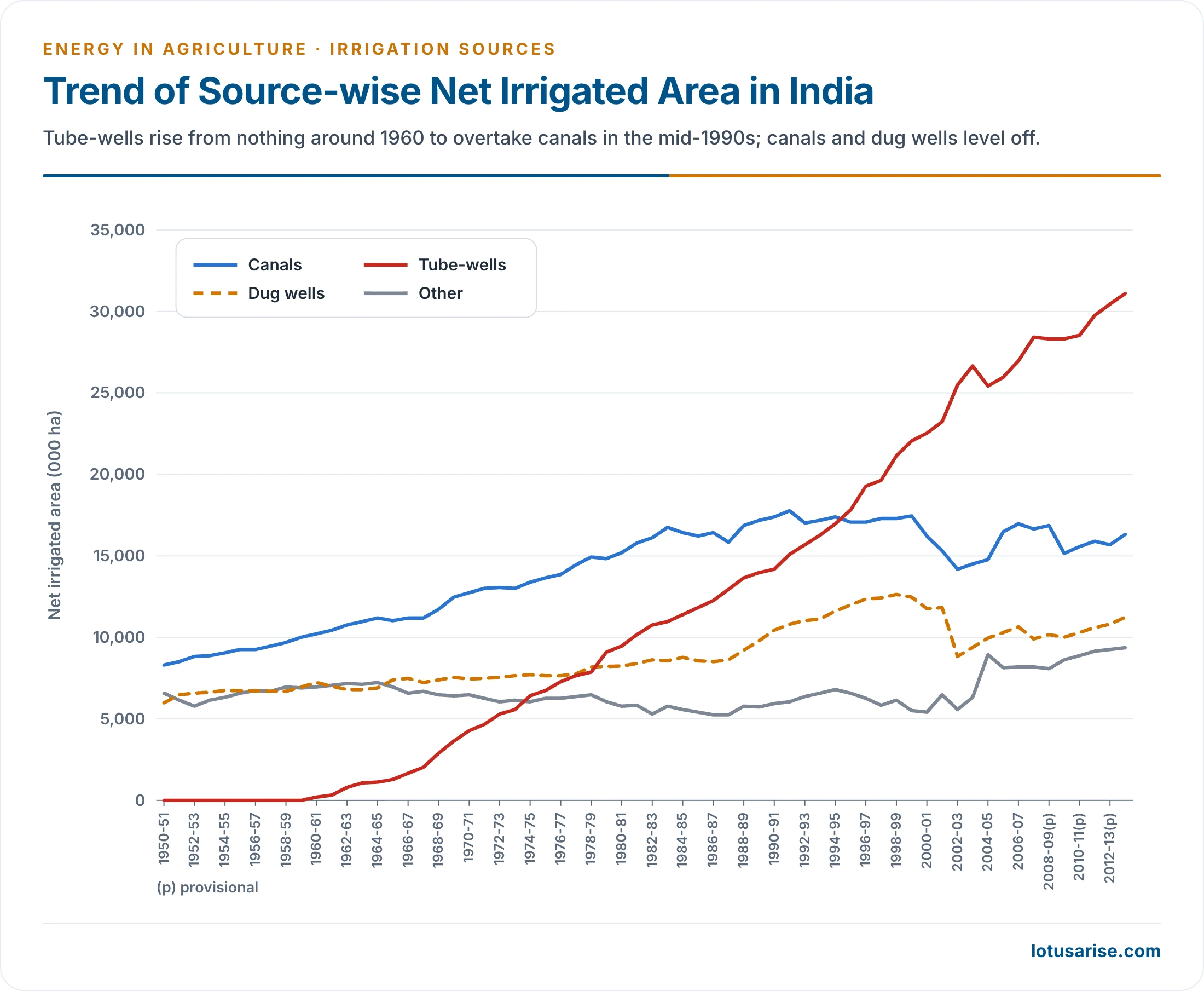
- This chart’s last labelled year is 2012-13. In 2023-24, tube wells irrigated 39.41 million hectares, canals 17.42, other wells 12.47 and other sources, including tanks, 13.12.
Previous Year Questions
- No direct PYQ has been asked on this sub-topic yet.





Valueble content
Really thank you 🙏🏻🙏🏻