

- A conglomerate is a multi-industry company: one group oversees several business entities in entirely different industries.
- Industrial houses (business groups) are public or private structures that bring together companies in different segments. They mark the industrial scene of many developing economies and are a major contributor to India’s GDP.
- In India about 90% of businesses are family-owned, and they have shaped its development.
- India is a mixed economy, in which public and private players both take part, so industrial complexes and houses are of two types by ownership: public, and private, such as the Tata and Birla houses.
Rise of Industrial Houses
Background
- Some houses led the industrialisation of a country that stayed mainly agrarian until the mid-20th century. Many date from before Independence, and others arose afterwards.
- Policy towards big business has swung sharply since 1947:
- In 1947, India was an open economy.
- By the mid-1950s, big business had become a bad word, regulatory limits came on large firms, and public sector firms stood at the centre.
- In 1991, the P. V. Narasimha Rao government brought reforms, and big business and foreign capital came to be courted.
- One feature has stayed the same: the dominance of family-owned enterprises. Fifteen of the top 20 groups were family-owned in the 2016 ranking.
Early Inquiries into Concentration
- Monopolies Inquiry Commission (1965), under K. C. Das Gupta, found 75 houses controlling 1,536 companies.
- Industrial Licensing Policy Inquiry Committee (1969), under Subimal Dutt, accepted the idea of the industrial house and listed 20 larger houses.
- R. K. Hazari studied the corporate private sector and showed how big firms used licensing to their advantage.
- The MRTP Act (1969), in force from June 1970, set an asset limit of ₹20 crore, raised to ₹100 crore in 1985. After 1991 the aim moved from approving expansion to curbing unfair and restrictive practices.
The Churn
- Beneath the apparent status quo lies a big churn. Most family groups of the early 1950s have fallen by the wayside, and many of today’s top groups were then very small or arose after Independence.
- Only three groups in the top 20 of 1951 were still there in 2016: Tata, Birla (AV) and Mahindra. Among the Birlas, only one branch kept its place.
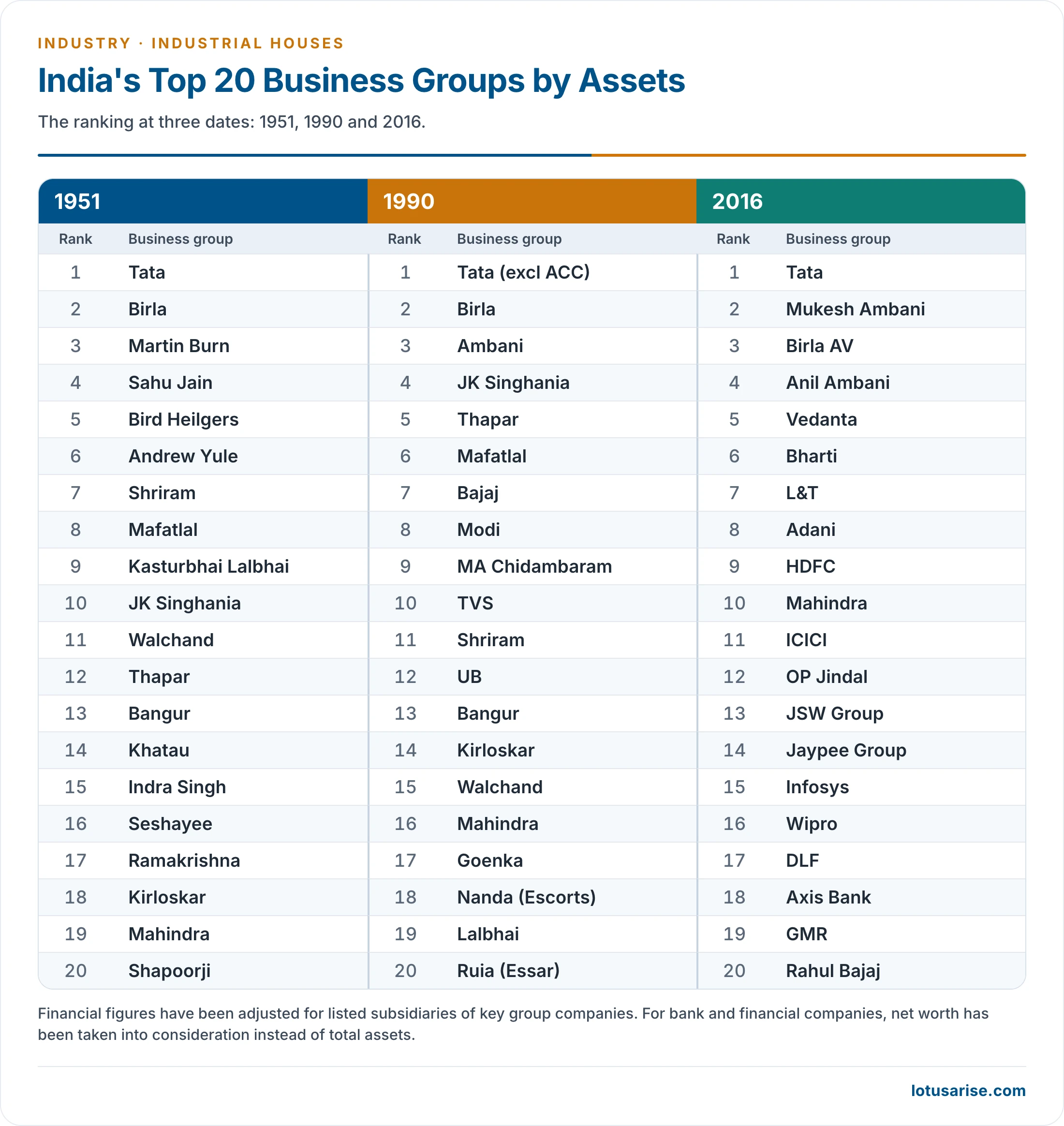
- Across the three dates:
- Gone by 1990: Martin Burn, Sahu Jain, Bird Heilgers, Andrew Yule, Khatau, Indra Singh, Seshasayee, Ramakrishna, Shapoorji.
- Risen by 1990: Ambani, Bajaj, Modi, MA Chidambaram, TVS, UB, Goenka, Nanda (Escorts), Ruia (Essar).
- Risen by 2016: Vedanta, Bharti, L&T, Adani, HDFC, ICICI, OP Jindal, JSW, Jaypee, Infosys, Wipro, DLF, Axis Bank, GMR. The Ambani house by then ranked as two groups, under Mukesh and Anil.
- Adaptability is the usual explanation. Groups that adjusted to the 1956 licensing regime or the post-1991 market kept growing, and others dropped from view.
- The 1969 MRTP Act limited big business and hit prominent family groups. It made room for newcomers such as the Om Prakash Jindal group, which used the curbs on incumbents such as Tata Steel (then TISCO), and for many of today’s cement barons.
- The 1970s saw the rapid rise of the Dhirubhai Ambani group, in sectors where old money was hardly present: synthetic textiles and their whole chain from petrochemicals to crude oil refining.
- Sixteen of the top 20 groups of 2016 were products of post-Independence growth, holding two-thirds of combined assets and nearly 70% of combined revenue of the top 20.
- The 1991 reforms speeded this up. Nine of the 2016 top 20, among them Bharti, Adani, GMR, HDFC and Jaypee, owed their rise to the abolition of industrial licensing, free movement of capital, and entry into banking, infrastructure and telecom.
- The software boom took Infosys and Wipro to 15th and 16th place in 2016.
- Family value today: at 30 June 2026 the leading family businesses were Ambani, Birla, Jindal, Bajaj and Mahindra, with the Ambani family at about ₹25.8 lakh crore. Adani led first-generation families in the 2025 list.
Major Private Houses
Steel, Automobile and Engineering Houses
- Tata: among the oldest houses, active for over a century, with iron and steel and heavy automobiles as its traditional fields.
- Jamsetji Tata planned its base, India’s first large integrated steel works, which his son Dorabji Tata set up in 1907 at Sakchi, now Jamshedpur in Jharkhand.
- It diversified into power, cement, hotels, finance, insurance, telecommunication, consumer goods and software, where Tata Consultancy Services is the country’s largest software services company.
- Air India came to the group in January 2022.
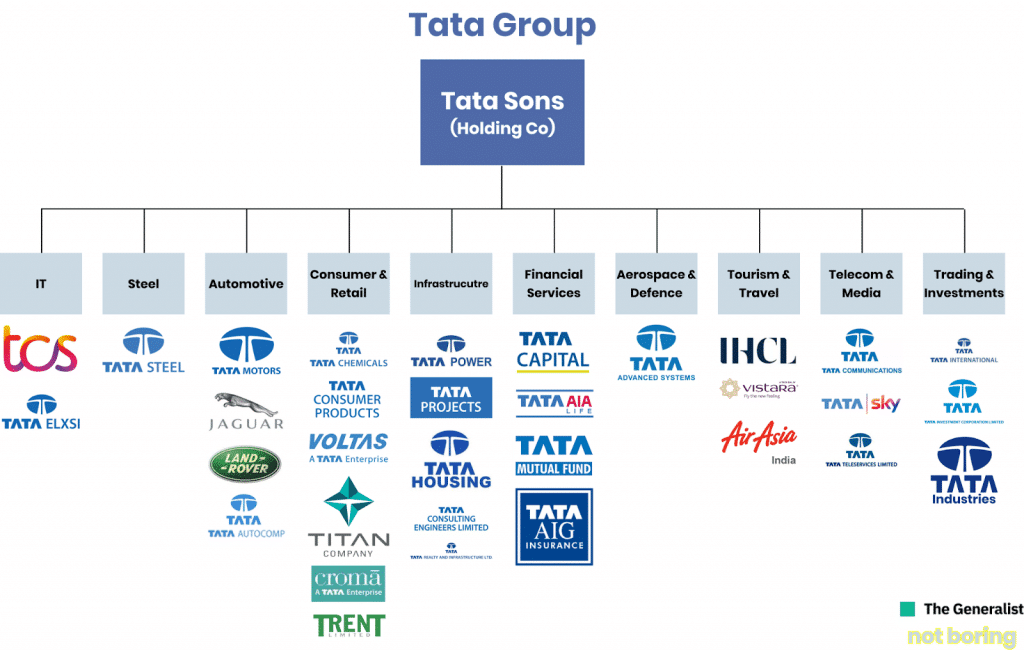
- The chart is dated: Vistara merged into Air India in November 2024, AirAsia India was absorbed into Air India Express in October 2024, and Tata Motors split in two in October 2025.
- Birla: as old as the Tatas, though since divided into branches. Seth Shiv Narayan Birla began with cotton trade at Pilani, Rajasthan, in 1857.
- Traditional fields are textiles, paper, viscose, cement, aluminium and automobiles, later joined by machine tools, telecommunications and consumer goods.

- Bajaj: known for the Bajaj scooter, it moved into motorcycles and electrical and home appliances. Petrol scooter output ended around 2009, and the electric Chetak came in January 2020.

- Escorts: known for the Rajdoot motorcycle and for tractors, its main line. The Escorts Heart Institute was sold to Fortis in September 2005, and with Kubota holding a majority the company is now Escorts Kubota Limited.
- Firodias: four-wheelers, two-wheelers and generator sets.
- Kirloskars: founded in 1888 and famed for machine tools and compressors. Older accounts credit the house with India’s first diesel pump set and first tractor.
- Toyota Kirloskar Motor (1997, Bidadi near Bengaluru) makes cars with Toyota, which holds 89%.
- Mahindra: founded in 1945 and headquartered in Mumbai, with operations in over 100 countries. It leads India in utility vehicles and tractors, and also spans components, IT, finance, real estate, hospitality and defence.

- SsangYong in this collage has left the group: a consortium led by KG Group took over in 2022, and it now runs as KG Mobility.
- TVS: founded in 1911 by T. V. Sundaram Iyengar at Madurai, its headquarters. It is India’s leading supplier of automotive components, with over 50 companies in two-wheelers, components, dealerships and finance.

Textile, Paper and Consumer Houses
- Goenka: power, textiles, pharmaceuticals, machine tools and entertainment. The family’s RPG empire divided in 2010-11 between RPG Enterprises (CEAT, KEC) under Harsh Goenka and the RP-Sanjiv Goenka Group (CESC, Saregama).
- Godrej: locks, almirahs, furniture, refrigerators and detergents made to high standards. The family split the group on 30 April 2024 into the Godrej Industries Group and the Godrej Enterprises Group.
- Thapars: paper, sugar and allied industries, and a contribution to education.
- Jagatjit: textiles, sugar and distilleries.
- Wadia: Bombay Dyeing & Manufacturing Company Limited, flagship of the Wadia Group, is among India’s largest textile producers, best known for bed sheets and towels.
- Lalbhai: Arvind Limited, formerly Arvind Mills, is among the largest producers of denim, which it supplies to major brands worldwide.
- Modi: founded by Gujarmal Modi. The town of Modinagar in Uttar Pradesh grew up around it, and its fields include textiles, sugar, medicines, tyres and hospitality.
- Sriram: cloth, fertilizers, power, home appliances, generator sets and medicines.
- Singhania: cloth, medicines, machine tools and tyres.
- UB Group: alcoholic drinks as its traditional field, later airlines, infrastructure and real estate.
Petroleum, Telecom and Software Houses
- Ambanis (Reliance): a rags-to-riches story of a new entrepreneurial class. Dhirubhai Ambani built it, and it was later divided between Mukesh and Anil Ambani.
- From synthetic yarn and petrochemicals it spread into power, petroleum, telecommunication, pharmaceuticals, software, banking and insurance.
- The Jamnagar complex in Gujarat is the world’s largest single-site refinery, at about 68 million tonnes a year.

- In this wheel, the inner ring shows Reliance’s own brands, and the outer ring shows firms that compete with them in each market.
- Infosys: a well-reputed house in IT services and software, which also contributes to education and social work.
- Wipro: a doyen of the sunrise industries, in software development and export and business process outsourcing.
- It began in 1945 at Amalner, Maharashtra, as Western India Vegetable Products, a cooking oil maker, and its consumer lines keep this older side alive.

- Bharti: Bharti Enterprises was founded by Sunil Bharti Mittal in 1976, with headquarters in New Delhi. Telecom gives the largest revenue, and in April 2026 Airtel served over 650 million customers in 15 countries across India and Africa.

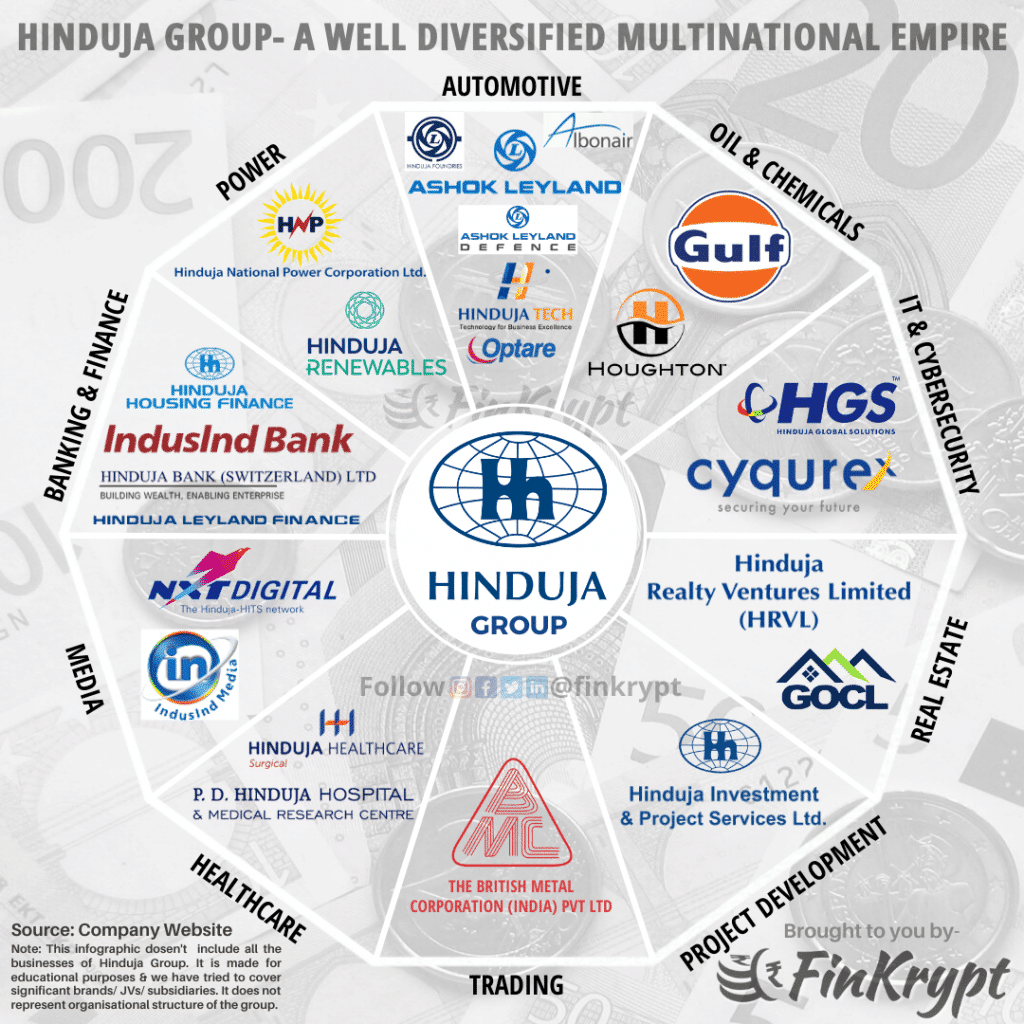
- Hinduja: founded in 1914 by Parmanand Deepchand Hinduja, who moved from Shikarpur in Sindh to Bombay, with a first overseas office in Iran in 1919. Run from London, it spans oil and gas, media and telecom, financial services and IT-enabled services, with motor vehicles, banking and healthcare.
Drugs, Medicine and Seed Houses
| House | Field | Note |
|---|---|---|
| Biocon | Biotechnology | Founded by Kiran Mazumdar-Shaw in 1978 |
| Ranbaxy | Drugs and pharmaceuticals | Merged into Sun Pharma in March 2015, after Daiichi Sankyo held the majority |
| Sarabhais | Drugs and pharmaceuticals | Renowned worldwide |
| Hamdard | Unani medicine | Delhi, 1906; Rooh Afza from 1907 |
| Dabur | Ayurvedic medicine, later juices and toiletries | Kolkata, 1884, S. K. Burman |
| Baidyanath | Ayurvedic medicine | Well known in this field |
| Arya Vaidya Sala | Ayurveda and naturopathy | Kottakkal, Kerala, 1902, P. S. Varier; a charitable trust |
| Pioneer | Hybrid seed, pesticides, herbicides | Now under Corteva; in India since 1972 |
| Pantnagar | Better seed | G. B. Pant University (1960); Tarai Development Corporation (1969) |
- Hamdard has done pioneering work in the Unani tradition, and split into Delhi and Karachi branches after Partition. Dabur, Baidyanath and Arya Vaidya Sala, which runs a hospital for Ayurvedic treatment, preserve and spread Ayurveda.
- Pioneer has led in high-yielding hybrid seeds. The brand was founded in the USA in 1926, so its Indian arm is a multinational unit.
- Pantnagar seeds became a symbol of the Green Revolution. They come from the G. B. Pant University of Agriculture and Technology and its seed body, now Uttarakhand Seeds and Tarai Development Corporation.
Services and Construction Houses
- Manipal: founded in 1953, it provides education and healthcare in India and abroad. Manipal Hospitals had 49 hospitals and 13,037 beds on 31 March 2026, and listed on the exchanges in August 2026.
- Oberois: hospitality, with high-class hotels across India and abroad.
- Jaypee: a major real estate and construction company, known for building roads and bridges on time. Jaiprakash Associates went into insolvency, and Adani Enterprises’ resolution plan was approved on 17 March 2026.
- Ansals: among the largest and oldest real estate developers. Ansal Properties was admitted to insolvency in February 2025, and a January 2026 appeal order limited the process to specific projects.
- ACC: the Associated Cement Companies, formed on 1 August 1936 by a merger of cement companies. Adani bought Holcim’s stakes in Ambuja and ACC in September 2022.
Public Sector Undertakings
- A public sector undertaking (PSU) is an enterprise whose paid-up capital is at least 51% government-held, by the Centre, a State, or both.
- Before 1947 there were few: the railways, posts and telegraphs, port trusts, ordnance and aircraft factories, and State salt and quinine factories.
- The Industrial Policy Resolution of 1956 made public firms strategic, as private capital then lacked the finance and willingness for large, long-gestation projects.
| Year | Central enterprises operating | Investment (₹ crore) |
|---|---|---|
| 1951 | 5 | 29 |
| 1961 | 47 | 950 |
| 1980 | 179 | 18,150 |
| 1990 | 233 | 99,330 |
| 2001 | 234 | 2,74,198 |
| 2011 | 220 | 6,66,848 |
| 2024-25 | 291 | 31,65,000 |
- Objectives: rapid growth through infrastructure, financial resources for development, redistribution of income, jobs, balanced regional development, support to small and ancillary units, and both exports and import substitution.
- Industrial base: the Durgapur, Rourkela, Bhilai and Bokaro steel plants, Hindustan Machine Tools, and locomotive works at Chittaranjan and Varanasi. Many went to backward areas by design, as with the three steel plants of the 1950s.
- Employment: the public sector gave 191 lakh jobs in 2001 against 87 lakh in the private sector. Its share of organised jobs fell from 71.2% in 1991 to 62.4% in 2010.
- Shortcomings:
- Mounting losses and over-capitalisation.
- Political interference in siting, and delays in completing projects.
- Administered prices set for public interest, with profit second.
- Excess manpower, flight of skilled staff, under-used capacity and inefficient management.
- Latest: of 272 operating enterprises in 2023-24, 212 made profits.



Excellent notes… Thank you sir