

- India was placed 5th in the world for installed hydroelectric capacity, a rank dating from about 2020. The geography and the policy behind the plants belong to the account of hydroelectric power in India.
| Date | Large hydro (MW) | Share of national capacity | Small hydro (MW) | Share |
|---|---|---|---|---|
| 31 March 2020 | 46,000 | 12.3% | 4,683 | 1.3% |
| 30 September 2026 | 52,064.66 | About 9.3% | 5,181.76 | About 0.9% |
- The share falls because solar and coal capacity have grown faster, while hydro itself has kept rising.
Plants: History and Size
Early Power and Plant Facts
- Power development in India dates from the end of the 19th century.
- 1897: electricity reached Darjeeling, from the Sidrapong station, India’s first.
- 1902: the Sivasamudram (Shivanasamudra) station in Karnataka began work, the first on a large scale.
- Koyna has long been named India’s largest completed plant, at 1,960 MW.
- The Tehri complex now totals 2,400 MW, once the 1,000 MW pumped storage plant was fully commissioned on 12 April 2026.
- Tehri is India’s highest hydroelectric project, and its dam, at 260.5 m, is the country’s tallest.
- NTPC took control of the owner, THDC India, by buying the Government’s 74.496% stake. The Cabinet approved the sale in 2019, and it closed in March 2020.
- Srisailam (1,670 MW) has been placed second or third among working plants, depending on the year and the count.
- Nathpa Jhakri (1,500 MW) is an underground plant, among the biggest of its kind.
- Sardar Sarovar is often called the world’s second-largest concrete dam by volume.
- Subansiri Lower, on the Arunachal Pradesh–Assam border, is planned at 2,000 MW. Its fifth 250 MW unit entered commercial operation on 23 October 2026, making 1,250 MW, and the rest are scheduled by December 2026.
- How capacity grew: 508 MW at independence in 1947, about 600 MW in 1950-51, about 40,500 MW in 2013-14, and over 52,000 MW in 2026.
- The Five Year Plans drove much of this through multipurpose river schemes, and the National Hydroelectric Power Corporation (NHPC) dates from 1975.
- Western Ghats plants came early, to meet the growing demand of Mumbai. The 1930s then added stations in Himachal Pradesh, Uttar Pradesh, Tamil Nadu and Karnataka.
Size Classes and Small Hydro
- Hydro projects are divided by size into large and small. National limits for “small” range from 10 MW to 50 MW.
- In India, plants of 25 MW or below count as small hydro:
| Class | Capacity |
|---|---|
| Micro | 100 kW or below |
| Mini | 101 kW to 2 MW |
| Small | 2 MW to 25 MW |
- Who looks after small hydro:
- Before 1989, the Ministry of Power did, working mainly through State Electricity Boards.
- In 1989, plants of up to 3 MW moved to what is now the Ministry of New and Renewable Energy (MNRE), adding 63 MW of existing capacity to its charge.
- In November 1999, the limit rose to 25 MW.
- Promotion by MNRE:
- The UNDP-GEF technical project “Optimizing Development of Small Hydro Resources in Hilly Regions of India”.
- The India-Renewable Resources Development Project, on an IDA credit line, with a target of 100 MW of canal-based small hydro through private firms.
- In 2026, a Small Hydro Power Development Scheme of ₹2,584.60 crore for 2026-27 to 2030-31, aimed at about 1,500 MW.
- Potential: 21,135.37 MW from 7,135 sites, as assessed by the Alternate Hydro Energy Centre (AHEC) of IIT Roorkee in its Small Hydro Database of July 2016.
- Arunachal Pradesh, Himachal Pradesh, Jammu and Kashmir and Uttarakhand hold about half.
- Maharashtra, Chhattisgarh, Karnataka and Keralam (Kerala) follow.
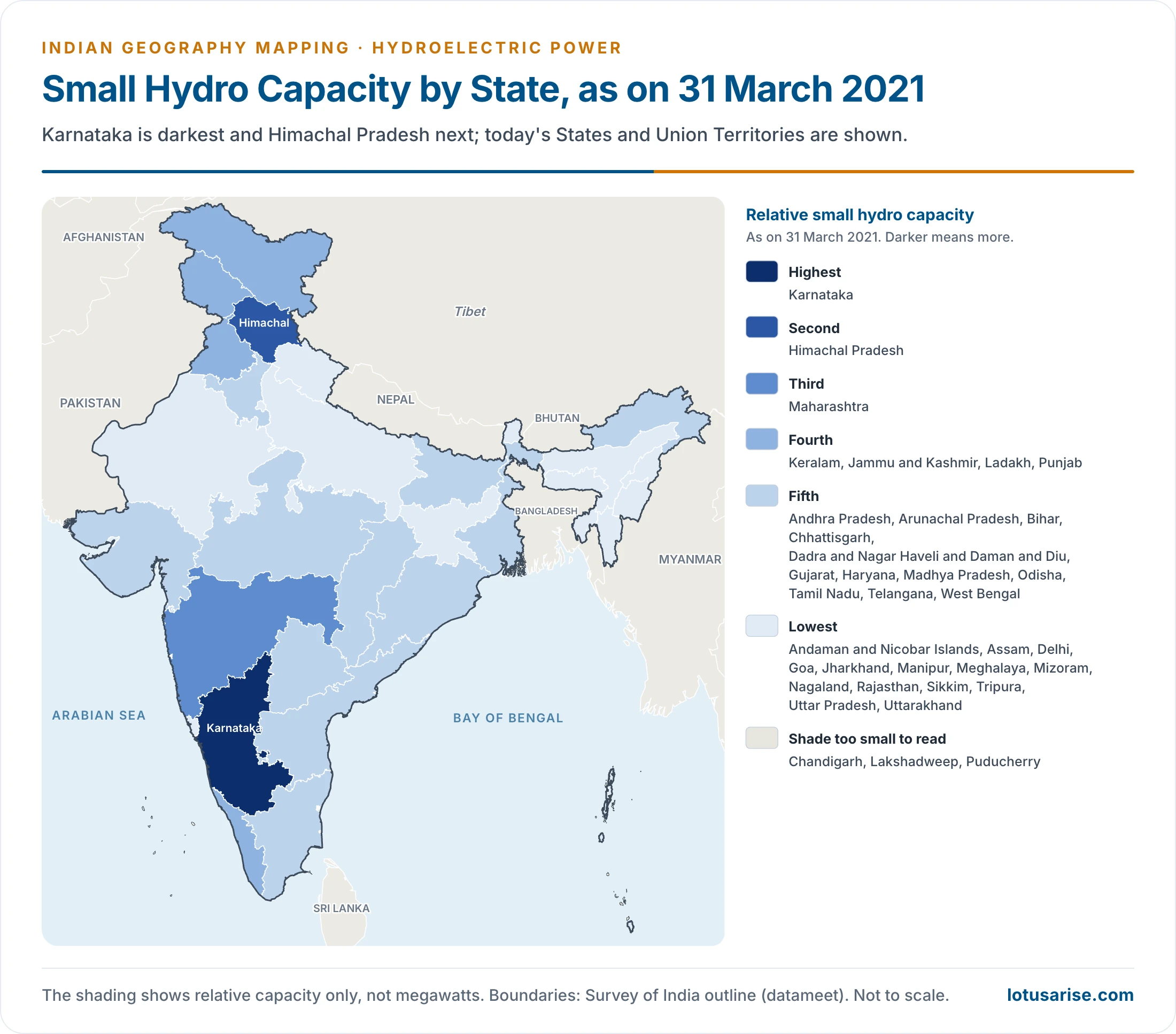
- The map shades small hydro capacity by State as on 31 March 2021, with Karnataka darkest and Himachal Pradesh next.
List of Hydroelectric Power Plants in India
- Why the plants cluster where they do: the Himalayan rivers are snow-fed and steep, and they hold about three-fourths of the potential.
- Peninsular rivers depend on rain alone, so they need storage, but the Western Ghats and Nilgiris offer high drops far from the coalfields.
Himalaya and the North-West
| State or UT | River | Plant | MW |
|---|---|---|---|
| Himachal Pradesh | Baira | Baira-Siul | 180 |
| Himachal Pradesh | Satluj (Sutlej) | Bhakra Nangal | 1,379 at Bhakra |
| Himachal Pradesh | Beas | Dehar | 990 |
| Himachal Pradesh | Satluj | Nathpa Jhakri | 1,500 |
| Himachal Pradesh | Baspa | Baspa-II | 300 |
| Himachal Pradesh | Beas | Pandoh Dam | Feeds Dehar |
| Himachal Pradesh | Ravi | Chamera-I, Chamera-II | 1,071 with Chamera-III |
| Himachal Pradesh | Beas | Pong | 396 |
| Jammu and Kashmir | Chenab | Salal | 690 |
| Jammu and Kashmir | Jhelum | Uri | 480 |
| Jammu and Kashmir | Chenab | Dulhasti | 390 |
| Uttarakhand | Bhagirathi | Tehri | 1,000, plus 1,000 pumped storage |
Central and Eastern India
| State or UT | River | Plant | MW |
|---|---|---|---|
| Uttar Pradesh, with the reservoir reaching Madhya Pradesh | Rihand | Rihand | 300 |
| Uttar Pradesh | Rihand (Renuka) | Obra | See below |
| Madhya Pradesh | Son (Sone) | Bansagar | 425 |
| Madhya Pradesh | Narmada | Indira Sagar | 1,000 |
| Madhya Pradesh | Sindh | Madikheda Dam | 60 |
| Madhya Pradesh | Narmada | Bargi Dam | 105 |
| Jharkhand | Subarnarekha | Subarnarekha | – |
| Jharkhand, on the West Bengal border | Barakar | Maithon | 63.2 |
| Odisha | Sileru | Balimela | 510 |
| Odisha | Mahanadi | Hirakud | 347.5 |
| Odisha | Indravati | Indravati Dam | 600 |
| Odisha and Andhra Pradesh | Machkund | Machkund | 120 |
Western India and the Peninsula
| State or UT | River | Plant | MW |
|---|---|---|---|
| Gujarat | Narmada | Sardar Sarovar | 1,450 |
| Gujarat | Tapi | Ukai Dam | 300 |
| Maharashtra | Koyna | Koyna | 1,960 |
| Maharashtra | Bhima | Ujjani Dam (Bhima Dam) | 12 |
| Maharashtra | Godavari | Jayakwadi Dam | 12 |
| Maharashtra | Mula | Mulshi Dam | 300 |
| Andhra Pradesh–Telangana | Krishna | Nagarjunasagar | About 816 |
| Andhra Pradesh–Telangana | Krishna | Srisailam | 1,670 |
| Karnataka | Kalinadi | Kalinadi | 1,240 |
| Karnataka | Sharavathi | Sharavathi | 1,608 |
| Karnataka | Kaveri (Cauvery) | Shivanasamudra | – |
| Keralam | Periyar | Idukki | 780 |
North-East and Sikkim
| State or UT | River | Plant | MW |
|---|---|---|---|
| Manipur | Leimtak | Loktak | 105 |
| Sikkim | Rangit | Rangit | 60 |
| Sikkim | Teesta | Teesta | 510 at Teesta-V |
| Arunachal Pradesh, on the Assam border | Subansiri | Lower Subansiri | 2,000 planned; 1,250 working |
| Meghalaya | Umiam | Umiam-Umtru | 185 |
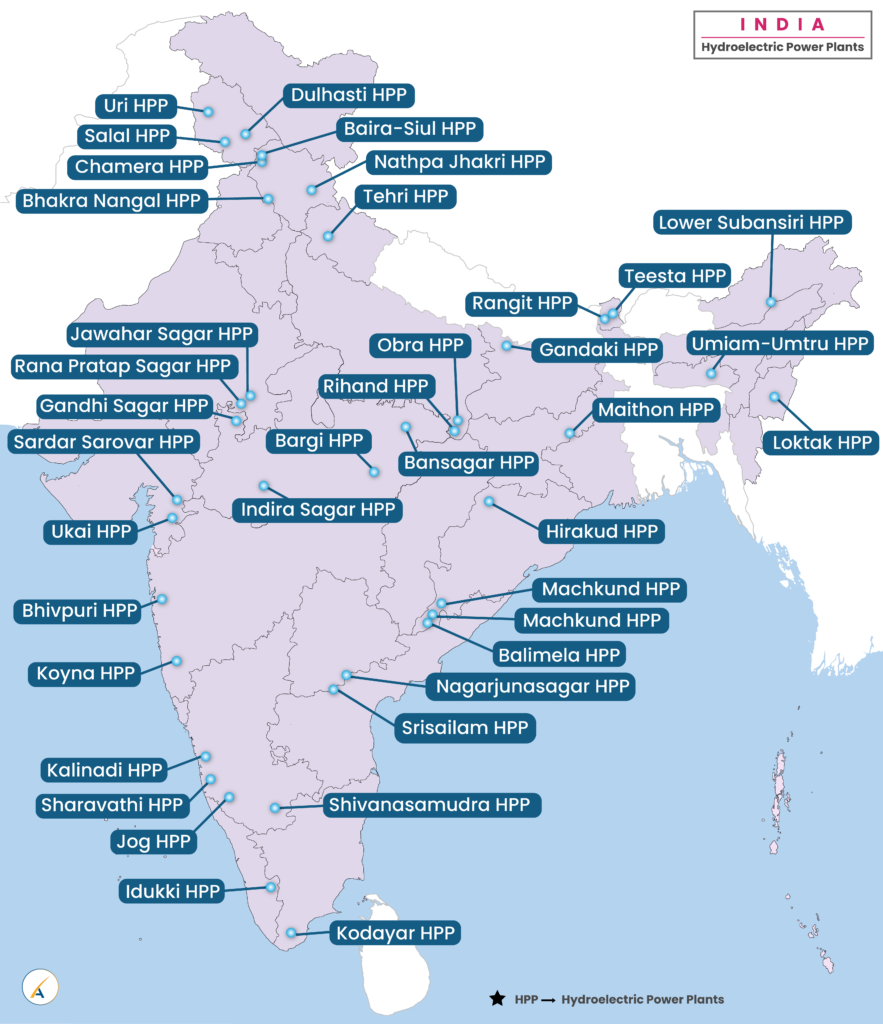
- Machkund appears twice on this map, and it is a single station on the Odisha–Andhra Pradesh border.
More Stations by State
- Andhra Pradesh and Telangana: Nizam Sagar, Lower Sileru and Upper Sileru. The two together had 3,272 MW in older accounts, then the highest of any State.
- Karnataka: Mahatma Gandhi station at Jog Falls, Shimsha on a Kaveri tributary and Krishnaraja Sagar. An older figure of 2,944 MW made up over half of the State’s capacity.
- Keralam: short, swift streams off the Western Ghats feed Sabarigiri, Sholayar, Kuttiady and Pallivasal. An older figure gives 1,807 MW.
- Tamil Nadu: Pykara, Mettur, Papanasam, Kodayar and Kundah, in the hill districts and joined by a grid.
- Maharashtra: the Tata hydroelectric grid near Lonavala has Khopoli, Bhivpuri and Bhira, which send power to Mumbai.
- Punjab and Himachal Pradesh: Ganguwal and Kotla on the Bhakra system; Joginder Nagar in the Mandi project.
- Uttar Pradesh and Uttarakhand: the Upper Ganga Canal has 12 falls between Haridwar and Meerut, with stations such as Bahadurabad and Mohammadpur. Matatila on the Betwa adds to these.
- Jammu and Kashmir: Chenani, Sind and Lower Jhelum.
- Odisha: Rengali, beside Hirakud and Balimela.
- West Bengal and Jharkhand: Panchet and Tilaiya, under the Damodar Valley Corporation.
- North-east: Dikhu and Doyang in Nagaland, Kopili in Assam, and Ranganadi in Arunachal Pradesh.
- Dependence: hill States such as Sikkim, Meghalaya, Himachal Pradesh, Nagaland and Uttarakhand have long leaned on hydro for most of their supply.
- Their terrain and drainage suit it, while coal lies far away and must be hauled in over difficult routes.
Selected Plants
Baira Siul Power Station
- A major step in tapping the hydro potential of Himachal Pradesh.
- It works on a run-of-the-river basis, using the combined flow of three Ravi tributaries: Baira, Siul and Bhaledh.
- Installed capacity: 180 MW (3 × 60 MW).
- Annual design energy: 779.28 million units in a 90% dependable year, with 95% availability.
- Project headquarters: Surangani.
Machkund Hydro Electric Power Plant
- At Machkund Dam in Koraput district, Odisha.
- First unit commissioned in 1959, with a total of 120 MW. The plant is operational.
- Jalaput Dam: a hydroelectric dam on the Machkund, a tributary of the Godavari.
Balimela Hydro Electric Power Plant
- On the Sileru, a tributary of the Godavari, at Balimela town in Malkangiri district of Odisha.
- The dam lies 35 km east of Malkangiri.
- It is a joint project of Odisha and Andhra Pradesh, and inflow to the reservoir is shared 50:50.
Rangit Hydroelectric Power Plant
- In Sikkim: 60 MW (3 × 20 MW), using the Rangit.
- A run-of-the-river project.
- Beneficiaries: Sikkim, West Bengal, Odisha, Bihar, Jharkhand and the Damodar Valley Corporation.
Obra Hydroelectric Power Plant
- At Obra village in Sonbhadra district, Uttar Pradesh, using water of the Rihand (Renuka).
- Obra Dam stands upstream of the point where the Rihand meets the Son.
- Owned by the Uttar Pradesh Government and run by Uttar Pradesh Jal Vidyut Nigam Limited. Uttar Pradesh and nearby States benefit.
Previous Year Questions
2018Map item: Mulshi Lake





Obra dam mapping is wrong. It’s in sonebhadra, uttar pradesh.
Yes
Kirru hydroelectric power is not available which is in chenab river