

- Nuclear energy is an important part of India’s energy mix, developed alongside other sources.
- It is a clean, environment-friendly base-load source available at all hours.
- Its large potential can support long-term energy security on a sustainable basis.
- Rank among sources:
- Older accounts placed it fifth, after coal, gas, wind and hydro.
- On installed capacity on 30 September 2026, it stood behind coal, solar, wind, hydro, gas and bio-power, at about 1.6% of the national total.
- Number of reactors:
- In 2021: 22 reactors with 6,780 MWe, working above an 80% plant load factor. Eighteen were Pressurised Heavy Water Reactors (PHWRs) and four were Light Water Reactors (LWRs).
- In 2026: 24 reactors and 8,780 MWe at 7 sites, of which 20 are PHWRs and 4 are LWRs.
- The programme began around independence under Homi Jehangir Bhabha, with a Tata-based atomic research effort in the 1940s and the Trombay establishment in 1954. Its plan is the three-stage programme.
- Apsara, Asia’s first nuclear reactor, is a research reactor at Trombay, Mumbai.
- Fuel: India’s uranium reserve is small, so the industry depends on imported uranium. Russia has been a major supplier since the 1990s.
- Policy: the SHANTI Act of December 2025 replaced the Atomic Energy Act, 1962 and the Civil Liability for Nuclear Damage Act, 2010. It allows licensed private firms and joint ventures to build and run plants. The aim is 100 GW by 2047.
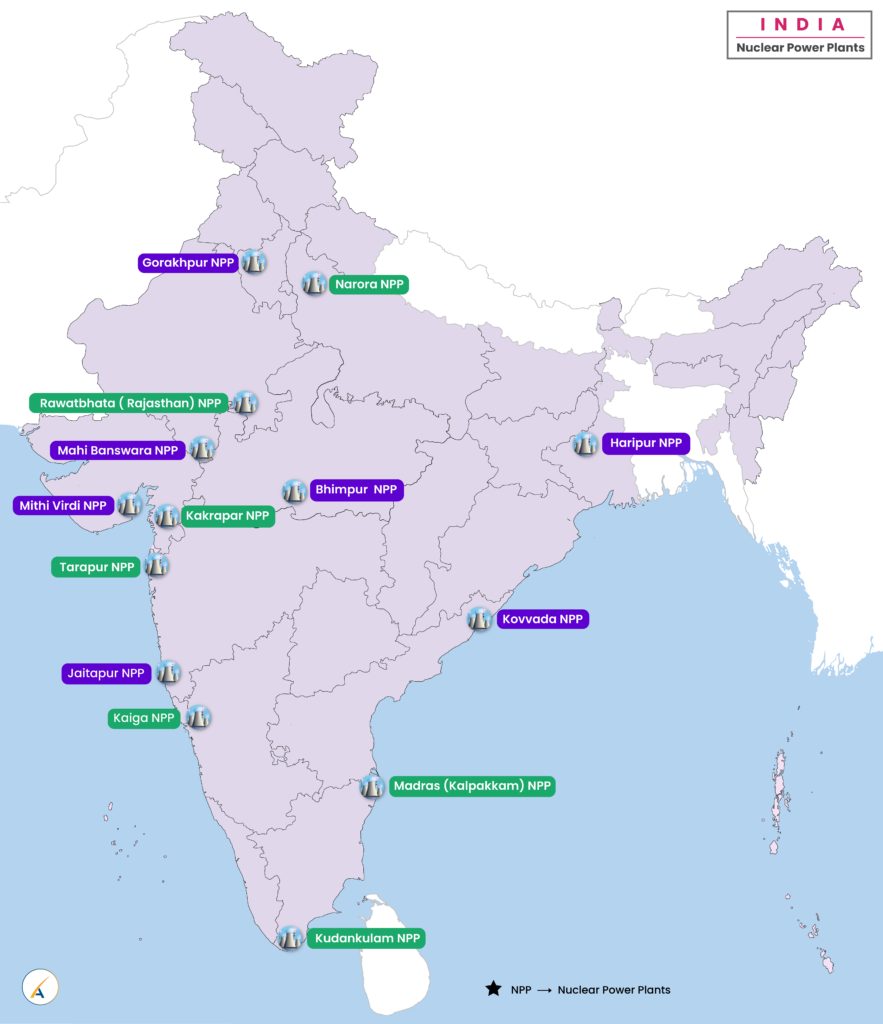
- On this map Haripur belongs on the Purba Medinipur coast of West Bengal, and Bhimpur in Shivpuri district in the north of Madhya Pradesh.
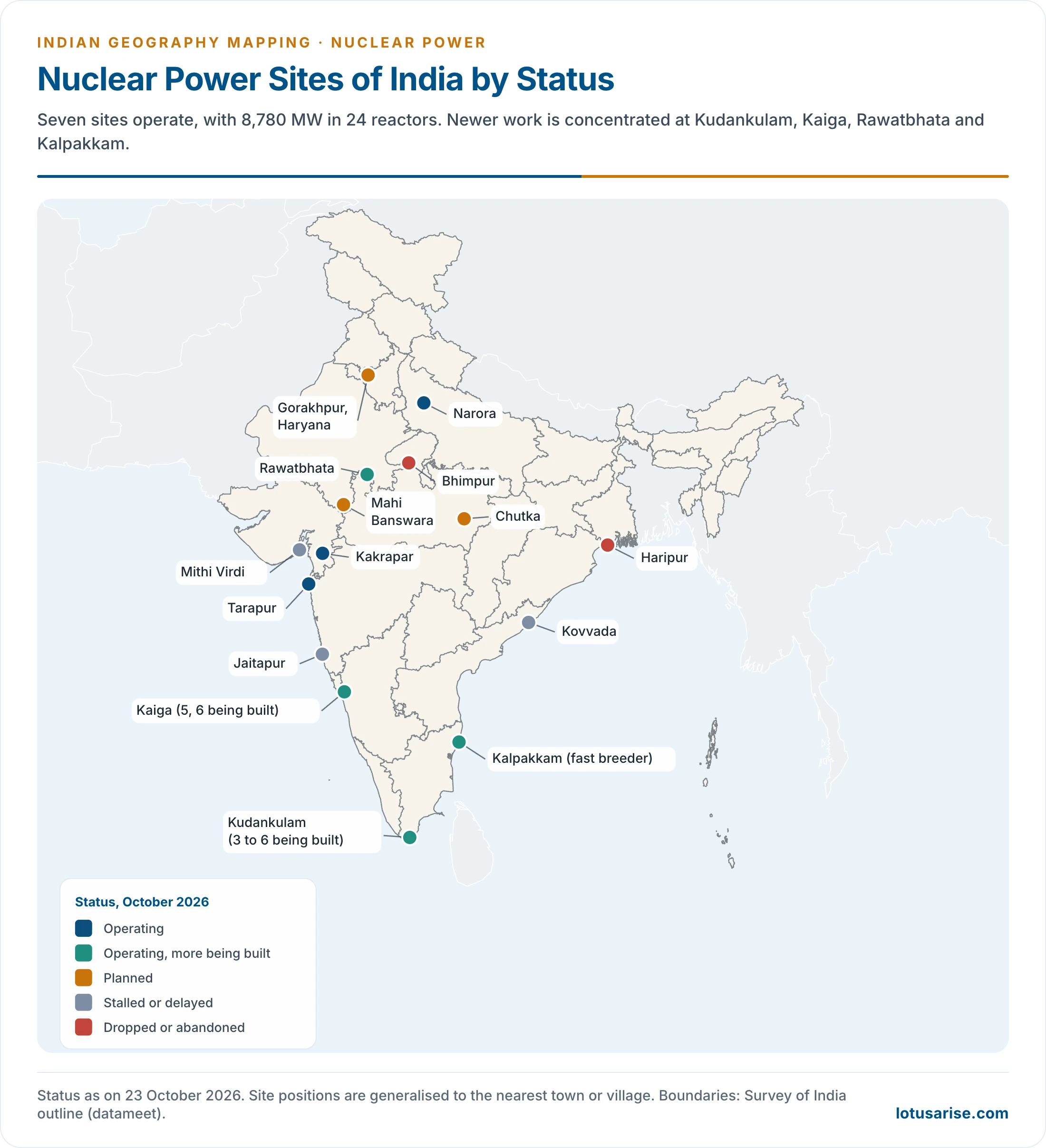
The List of Plants
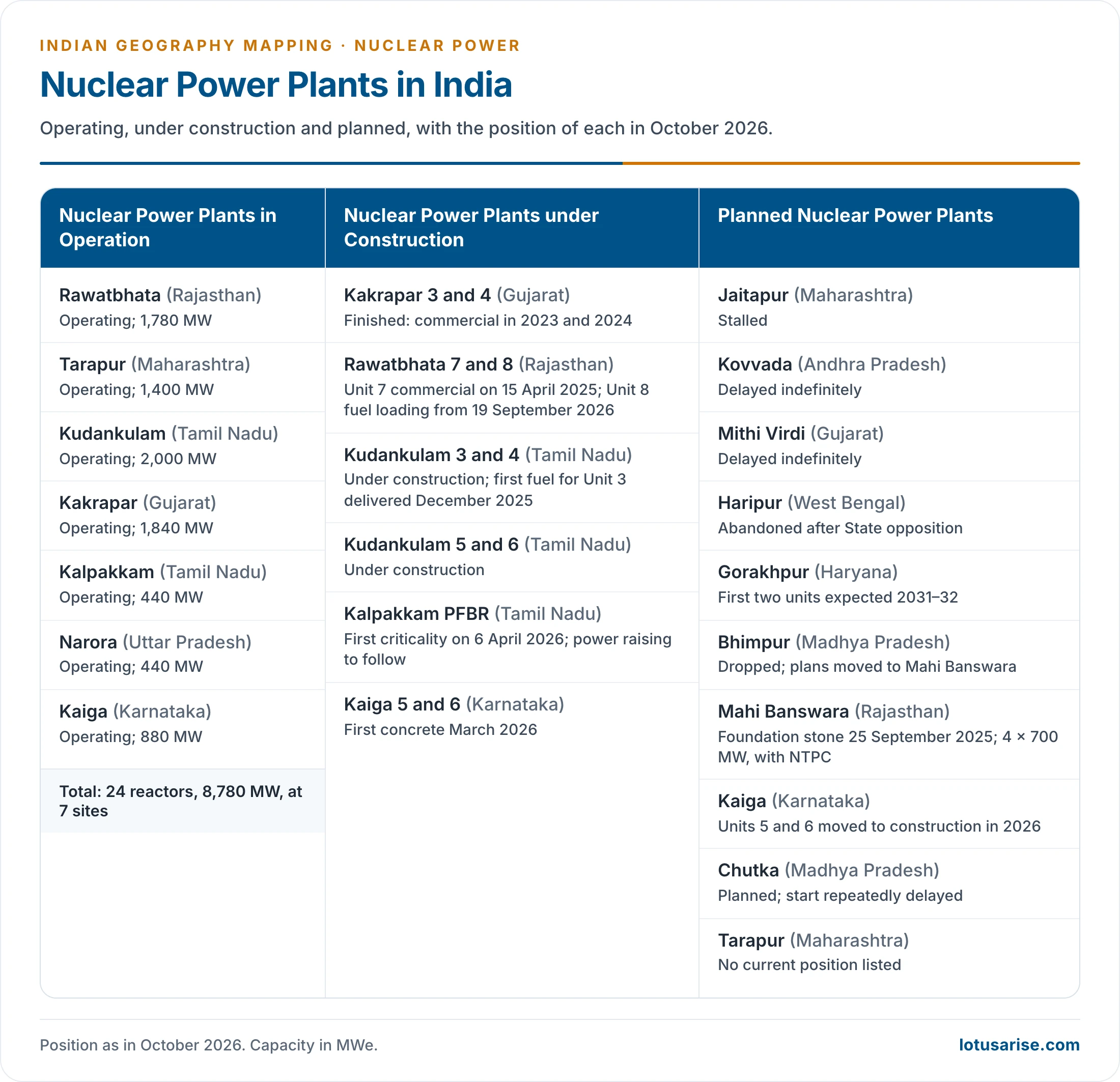
Operational
- Capacity below is in MWe. The Nuclear Power Corporation of India Limited (NPCIL) runs all seven sites.
| Station, with older date | State | Reactors and commercial operation | Older MW | MW in 2026 |
|---|---|---|---|---|
| Kudankulam, 2013 | Tamil Nadu | 2 × 1,000 PWR, 2014 and 2017 | 2,000 | 2,000 |
| Kakrapar, 1993 | Gujarat | 2 × 220 PHWR, 1993 and 1995; 2 × 700 PHWR, 2023 and 2024 | 440 | 1,840 |
| Rajasthan (Rawatbhata), 1973 | Rajasthan | 200, 4 × 220 and 700 PHWR, 1981 to 2025 | 1,180 | 1,780 |
| Tarapur, 1969 | Maharashtra | 2 × 160 BWR, 1969; 2 × 540 PHWR, 2005 and 2006 | 1,400 | 1,400 |
| Kaiga, 2000 | Karnataka | 4 × 220 PHWR, 2000 to 2011 | 880 | 880 |
| Madras (Kalpakkam), 1984 | Tamil Nadu | 2 × 220 PHWR, 1984 and 1986 | 440 | 440 |
| Narora, 1991 | Uttar Pradesh | 2 × 220 PHWR, 1991 and 1992 | 440 | 440 |
| Total | 24 reactors | 8,780 |
- Rajasthan 1 (100 MW), shut since 2004, is left out of the 2026 total.
Under Construction
- A Rajya Sabha answer of January 2026 gave 17 reactors of 13,100 MW under implementation: seven under construction and ten in pre-project work.
| Station | State | Operator | MW | Position |
|---|---|---|---|---|
| Madras (Kalpakkam) fast breeder | Tamil Nadu | BHAVINI | 500 | First criticality on 6 April 2026; power raising to follow |
| Rajasthan Units 7 and 8 | Rajasthan | NPCIL | 1,400 | Unit 7 commercial on 15 April 2025; Unit 8 fuel loading from 19 September 2026 |
| Kudankulam Units 3 and 4 | Tamil Nadu | NPCIL | 2,000 | Under construction; first fuel for Unit 3 delivered December 2025 |
| Kudankulam Units 5 and 6 | Tamil Nadu | NPCIL | 2,000 | Under construction |
| Kaiga Units 5 and 6 | Karnataka | NPCIL | 1,400 | First concrete March 2026 |
| Kakrapar Units 3 and 4 | Gujarat | NPCIL | 1,400 | Finished: commercial in 2023 and 2024 |
Planned (Future Projects)
| Station | State | Older MW | Position in October 2026 |
|---|---|---|---|
| Tarapur | Maharashtra | 300 | – |
| Madras | Tamil Nadu | 1,200 | – |
| Chutka | Madhya Pradesh (Mandla) | 1,400 | Planned; start repeatedly delayed |
| Gorakhpur | Haryana (Fatehabad) | 2,800 | First two units expected 2031–32 |
| Bhimpur | Madhya Pradesh | 2,800 | Dropped; plans moved to Mahi Banswara |
| Mahi Banswara | Rajasthan (near Napla, Banswara) | 2,800 | Foundation stone 25 September 2025; 4 × 700 MW, with NTPC |
| Haripur | West Bengal | 4,000 | Abandoned after State opposition |
| Mithi Virdi (Viradi) | Gujarat (Bhavnagar) | 6,000 | Delayed indefinitely |
| Kovvada | Andhra Pradesh (Srikakulam) | 6,600 | Delayed indefinitely |
| Jaitapur | Maharashtra (Ratnagiri) | 9,900 | Stalled |
Important Sites
Operating Sites
- Kalpakkam:
- On the Coromandel Coast, about 80 km south of Chennai.
- Known for the Madras Atomic Power Station (MAPS) and the Indira Gandhi Centre for Atomic Research (IGCAR).
- India’s first fully indigenously built nuclear power station, with two CANDU-type PHWRs, MAPS-1 and MAPS-2.
- The Prototype Fast Breeder Reactor marks the country’s entry into the second stage of its programme.
- Kaiga:
- In Uttara Kannada district, Karnataka.
- Four units are working, all small CANDU-type plants of 220 MW. Units 5 and 6 of 700 MW are being built.
- Kakrapar:
- Near Surat, on the bank of the Tapi in Gujarat.
- Began with two 220 MW PHWRs, and has since added two 700 MW units of Indian design.
- A heavy water plant lies in the area.
- In January 2003, the CANDU Owners Group rated KAPS-1 the world’s best PHWR of its class.
- Rawatbhata:
- On the bank of the Chambal, about 65 km from Kota and 3 km from the Rana Pratap Sagar.
- The Rajasthan Atomic Power Station (RAPS) was India’s first pressurised heavy water reactor of the CANDU type.
- Six reactors gave 1,190 MW in older accounts. Unit 7 of 700 MW has since been added.
- Tarapur:
- In Maharashtra, north of Mumbai.
- The first nuclear power station of India, and the home of Asia’s first boiling water reactors.
- It was long the country’s largest, at 1,400 MW. Kudankulam now leads at 2,000 MW.
- Narora:
- In Bulandshahr district of Uttar Pradesh, on the Ganga.
- Its twin reactors are an Indian version of the Canadian CANDU type, with natural uranium fuel and heavy water as both moderator and main coolant.
- Kudankulam:
- In Tirunelveli district of Tamil Nadu, built with Russian assistance.
- Two VVER-1000 reactors of 1,000 MW are working. They are water-cooled and water-moderated.
- With Units 3 to 6, it will reach 6,000 MW, and it is the largest complex in India today.
Proposed Sites
- Chhaya Mithi Virdi:
- A proposed site in Gujarat near Alang Port, to be set up with help from the USA.
- Kovvada:
- In Ranasthalam mandal, Srikakulam district, Andhra Pradesh, with assistance from the USA.
- An early proposal gave 2,000 MW. The Ministry of Environment and Forest withheld clearance at one stage.
- Haripur:
- A coastal village in Purba Medinipur district of West Bengal, planned with Russian assistance.
- Proposed capacity: 10,000 MW at the largest stage. People protested against the reactors.
- Jaitapur:
- In Ratnagiri district of Maharashtra.
- Six European Pressurised Reactors of 1,650 MW each, making 9,900 MW, designed by Areva of France. EDF has since taken over the talks.
- Controversial on seismic grounds, and older accounts placed it in Zone V.
Safety Record
- Fear of accidents drives much of the local opposition, and the Fukushima disaster of March 2011 sharpened it at Jaitapur and Kudankulam.
- Incidents reported at Indian plants include:
- Narora, 31 March 1993: a fire at the steam turbine blades, with a year-long shutdown.
- Kaiga, 13 May 1994: collapse of an inner containment dome during building.
- Kalpakkam, 26 December 2004: sea water entered the intake tunnel in the tsunami, and the plant shut down.
Previous Year Questions
2019Map item: Narora2016Map item: Kudankulam





thnq u so much sir
Good day