

- This is the atlas list of India’s important cities and towns, set out by zone and State. Each entry gives the place and what makes it worth marking: industry, history, a river, a railway or a national institute.
- A city usually has a clear function: many towns below grew around one industry, one railway junction or one military station.
- “Million-plus” means a city with one million people or more on the 2011 Census. India had 53 such cities then, against 12 in 1981.
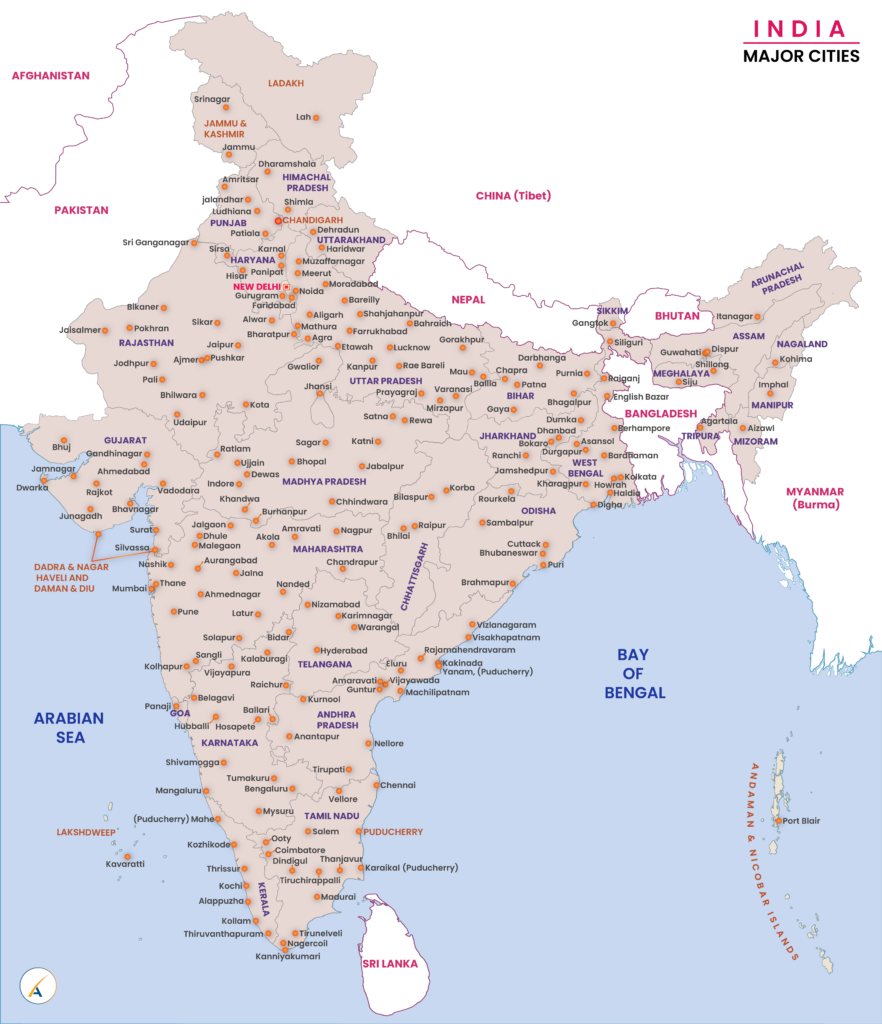
- On this map, “Lah” is Leh, Ahmednagar is Ahilyanagar and Aurangabad is Chhatrapati Sambhajinagar. Port Blair is now Sri Vijaya Puram.
Towns by Function
| Function | Towns in this list |
|---|---|
| Fertiliser | Ranipet, Sindri, Aonla, Kalol, Jagdishpur, Nangal, Gorakhpur, Bathinda, Bareilly |
| Cement | Dalmiapuram, Katni, Churk, Dalmianagar, Japla, Shahabad, Chaibasa, Jamul, Siju, Satna |
| Sugar | Ahilyanagar, Sakarwadi, Rawalgaon, Chandaonagar, Mandya, Sakkarnagar, Modinagar, Anakapalli |
| Jute | Titagarh, Budge Budge, Rishra, Serampore, Kakinara, Naihati, Cuttack |
| Textiles and hosiery | Ludhiana, Dhariwal, Coimbatore, Solapur, Kolhapur, Malegaon, Surendranagar |
| Crafts | Firozabad (glass), Moradabad (brass), Bhadohi and Mirzapur (carpets), Khurja (ceramics), Sivakashi (fireworks), Meerut and Jalandhar (sports goods) |
| Oil refineries | Jamnagar, Koyali, Bina, Mathura, Bathinda, Tinsukia |
| Railway zone headquarters | Gorakhpur, Jabalpur, Hubballi, Secunderabad, Bilaspur |
| Capitals in this list | Ranchi, Dehradun, Gandhinagar, Raipur, Bhubaneswar, Panaji, Dispur, Itanagar, Kohima, Aizawl, Agartala, Gangtok, Sri Vijaya Puram, Kavaratti, Srinagar and Jammu |
North and the Himalaya
Jammu and Kashmir
- Srinagar: the largest city and summer capital of the Union Territory, on the bank of the Jhelum.
- Long described as the largest city in India without a Hindu majority.
- Famous for lakes, houseboats, handicrafts, gardens and dry fruits.
- Jammu: the largest city of the Jammu region and the winter capital, known as the City of Temples.
- Vaishno Devi lies in its vicinity.
- Anantnag: near the meeting of the Lidder (Liddar) River and the Jhelum, and the second-largest city of the Kashmir Valley.
- Industries: silk, carpets and gabbas. Its sulphur springs are known for medical value.
- The route to Amarnath passes through it.
- Baramulla (Baramula): a city of the Kashmir Valley on the bank of the Jhelum, near the Line of Control (LoC).
- The third-largest city of the valley after Srinagar and Anantnag.
- Industries: woollens, silk, gabba and namda.
- Udhampur: just north of Jammu city, and headquarters of the Indian Army’s Northern Command.
- It also has the Forward Base Support Unit (FBSU) of the Indian Air Force.
- Pampore (Pulwama district): on the eastern side of the Jhelum, on the Jammu–Srinagar National Highway.
- Known for saffron, almonds, walnuts and apricots. It has a solar energy centre.
- Amarnath Caves: on the Greater Himalaya in Anantnag district.
- The cave has limestone topography, and a natural Shivling forms in it.
- Reached by the Pahalgam and Baltal (Sonamarg) routes. Thousands of pilgrims visit for darshan of the Shivling.
- Rajouri (Rajauri): a border city near the LoC, strategically located, with a silk industry.
- Described as part of the land of the Kambojas in Mahabharata times.
- Poonch: an important border city along the LoC, also linked with the Kambojas of the Mahabharata.
- The Pir Panjal separates the Poonch Valley from the Kashmir Valley, and the Mughal Road connects the two.
- Akhnoor (Jammu district): an important border city at the foothills of the Himalaya, on the bank of the Chenab.
- Its caves are believed to be a hiding place of the Pandavas, and a local story connects the river with the cleaning of Jahangir’s eye.
- Kupwara: an important border city along the LoC.
- Tourist places: Lolab Valley and Sogam, known for meadows, mountains, gushing waters and fresh air.
- Uri (Baramulla district): an important border city along the LoC, on the bank of the Jhelum.
- It suffered in the earthquake of 2005.
Ladakh
- Leh: the largest city of the Ladakh region, on the bank of the Indus.
- It represents the typical culture of Ladakh and its Buddhists, with many monasteries, and it draws large numbers of tourists.
- Kargil: near the LoC, and the only Muslim-majority district of the Ladakh region. Known for the Kargil War of 1999.
- Dras: a border town in Kargil district, often called the gateway to Ladakh.
- Long called the coldest inhabited place in India.
- It has the Dras War Memorial.
Punjab and Haryana
- Amritsar: a million-plus city of Punjab near the Pakistan border, founded in 1577 by Ram Das, the fourth Guru of the Sikhs.
- Golden Temple, and the Jallianwala Bagh massacre of 1919.
- Ludhiana: an important industrial city of central Punjab, and a million-plus city.
- Cotton, woollen and silk textiles and hosiery. Long the largest centre of hosiery manufacture in India.
- Jalandhar: long ranked the third-largest city of Punjab after Amritsar and Ludhiana, midway between the two, on old NH-1, now NH-44.
- It has a big cantonment and a military air base.
- Known for sports goods, and musical and surgical equipment.
- Bathinda (Bhatinda): an important industrial city of south-western Punjab, in the Malwa region, named after the Bhati Rajput kings.
- Attractions: two thermal power plants, of which the Guru Nanak Dev plant closed around the start of 2018, a fertiliser plant, a large oil refinery and the Qila Mubarak fort.
- Nangal: a small city on the bank of the Satluj, downstream of the Bhakra Dam.
- The Nangal Dam and a hydroelectric plant lie here, and it has a nitrogenous fertiliser plant.
- Rupnagar (Ropar): in eastern Punjab on the bank of the Satluj, and an ancient city of the Harappan civilisation.
- Nangal city and dam lie near it.
- Dhariwal (Gurdaspur district): an industrial city near Amritsar, and the largest centre of woollen textiles in the State.
- A main station on the Amritsar–Pathankot rail line. Gurudwara Burj Sahib is just 1 km from the station.
- Pinjore (Panchkula district, Haryana): a unit of Hindustan Machine Tools (HMT), with tractor production. The town owes its growth to it.
- It is a breeding centre of vultures, and the Yadavindra Gardens are a great attraction.
Himachal Pradesh
- Solan: an important city of southern Himachal Pradesh between Kalka and Shimla, on the Kalka–Shimla Railway.
- It has diversified industries and is known as the mushroom city of India.
- Known for the Mohan Meakin Brewery, described as India’s oldest.
- Kasauli (Solan district): a small cantonment town, set up as a hill station by the British in 1842.
- Home of the Kasauli Brewery, long called the highest brewery and distillery in the world.
- It has the Central Research Institute, a medical research centre founded in 1906.
- Kangra: on the Dhauladhar Range, north of the Pong Reservoir, with many temples visited by large numbers of devotees.
Uttarakhand
- Dehradun: capital of Uttarakhand, in the south-western part of the State, and an academic and learning centre.
- Institutions: Forest Research Institute, ONGC, Indian Institute of Petroleum, Wadia Institute of Himalayan Geology, Indian Military Academy and the Doon School.
- Uttarkashi: in north-western Uttarakhand on the bank of the Bhagirathi, on the Great Himalaya.
- Routes to Gangotri and Yamunotri pass through it. It suffered a major earthquake in 1991.
- Ranikhet: a hill station and cantonment town west of Almora, home of the Kumaon Regiment and Naga Regiment.
- The British set up the Kumaon Regiment’s headquarters here in 1869.
Northern Plains and Central India
Uttar Pradesh
- Kanpur: on the bank of the Ganga, a million-plus city, long the largest city of Uttar Pradesh, known as the Manchester of North India.
- Industries: cotton and woollen textiles, leather and sugar.
- Meerut: a million-plus city of western Uttar Pradesh, to the north-east of Delhi, on the Delhi–Saharanpur rail line.
- History: the start of the 1857 uprising and the Meerut Conspiracy Case.
- Known for sports goods.
- Aonla: near Bareilly in the Rohilkhand Division, known for chemical fertilisers from gas.
- A gas pipeline runs to it from Ankleshwar.
- Jagdishpur: in Amethi district, formerly Sultanpur.
- Industries: gas-based fertilisers, Bharat Heavy Electricals Limited (BHEL) and paper.
- The Hazira–Bijaipur–Jagdishpur (HBJ) pipeline provides its gas, and a plan links it with Haldia by gas pipeline.
- Churk (Sonbhadra district): a cement factory was set up here in 1956, owing to its limestone hills.
- Firozabad: an industrial city known for glass factories and bangle making.
- Its founding is credited to Firoz Shah, named in older accounts as Firoz Shah Tughlaq.
- In ancient periods, invaders brought many glass articles into India.
- Mirzapur: an industrial city in south-eastern Uttar Pradesh, just south of Varanasi, on the right bank of the Ganga.
- Known for carpets, blankets, brassware and pottery. It lies on the Delhi–Kolkata rail line.
- Moradabad: in the Rohilkhand Division, west of Rampur, founded in 1625 by Rustam Khan, a Mughal general.
- Known for inlaid brass work and electroplated nickel-silver cutlery, and so called Peetalnagri (Brass City).
- Bhadohi (Sant Ravidas Nagar district): a small industrial town west of Varanasi, headquarters of a newer district.
- Known for carpet-making, with sari-making and agro-based industries.
- Khurja: an industrial town of western Uttar Pradesh, south of Bulandshahr, known as the Ceramic City for its pottery.
- Its coal-based chimneys cause much air pollution.
- Modinagar (Ghaziabad district): an industrial city of western Uttar Pradesh close to Delhi, best known as the home of Modi Mills.
- Industries: sugar, textiles and petrochemicals.
- Gorakhpur: on the bank of the Rapti, an important city of north-eastern Uttar Pradesh.
- Headquarters of the North Eastern Railway Zone.
- Industries: fertilisers, sugar and printing. Its fertiliser plant, shut for nearly 30 years, restarted in December 2021.
- Mathura: an important historical, religious and industrial city of western Uttar Pradesh, on the bank of the Yamuna.
- Revered as the birthplace of Lord Krishna, with Vrindavan just north of it.
- It has an oil refinery.
- Aligarh: an important industrial, historical and educational city in the Ganga–Yamuna Doab.
- Known for Aligarh Muslim University, and traditionally for lock-making and printing.
- Saharanpur: an important industrial and religious city of north-western Uttar Pradesh, founded in 1340 and named after the Sufi saint Shah Haroon Chishti.
- Industries: paper and sugar.
- Institutes: paper technology, sericulture research, fruit research and an aviation training centre.
- Bareilly (Baraily): between Delhi and Lucknow in Rohilkhand, founded in 1537 by the Mughal governor Makrand Rai, and later the capital of the Rohillas.
- It took part in the 1857 uprising.
- Industries: sugar and gas-based fertiliser.
- Rae Bareli: an important industrial and historical city in the Ganga–Gomati Doab, on the bank of the Sai River, with many architectural features.
- The nearby town of Lalganj has a railway coach factory.
- Naini: a satellite town of Prayagraj (Allahabad), on the bank of the Yamuna.
- Naini Jail, where Jawaharlal Nehru was jailed.
- It has many educational institutions and some important companies.
Rajasthan
- Alwar: in north-eastern Rajasthan between Delhi and Jaipur, within the National Capital Region.
- Known for Sariska National Park and Tiger Reserve. The Kho-Dariba copper mines lie nearby.
- Udaipur: the most important city of southern Rajasthan, on old NH-8, now NH-48, and on the Delhi–Mumbai rail line.
- The old capital of a princely state, known for palaces, lakes and luxury hotels.
- Industries: zinc smelting, fertilisers, cement and marble.
- Pokhran: in the Thar Desert on NH-11, between Phalodi and Jaisalmer, and between Jodhpur and Jaisalmer.
- India’s nuclear testing site of 1974 and 1998. The name is taken to mean the place of five mirages.
- Sri Ganganagar (Ganganagar): the northernmost city of Rajasthan, near the borders of Pakistan and Punjab, on NH-11.
- Known as the Granary of Rajasthan, with cotton textiles and sugar.
- It has benefited from the Indira Gandhi Canal.
- Bikaner: an important industrial and historical city of the northern Thar, on old NH-15, where old NH-11 ended.
- Named after its founder, Rao Bika, a Rajput chief.
- It has an agricultural university, and it is a wool-collecting and camel-breeding centre.
- Jodhpur: long ranked the second-largest city of Rajasthan, a famous historical city in the Thar and a million-plus city on the 2011 Census.
- The Central Arid Zone Research Institute (CAZRI) is here.
- Seat of a princely state of the same name and capital of Marwar, with tourism in forts, palaces and temples.
- Known as the Sun City and the Blue City.
- Jaisalmer: an important historical city of western Rajasthan on old NH-15, nicknamed the Golden City.
- Desert National Park lies in the vicinity, and tourism is the main industry.
- Pushkar: 14 km north-west of Ajmer, on the shore of Pushkar Lake.
- Called one of the five sacred dhams of Hindus, and often the Tirth Raj.
- Home of many temples, and known for the Pushkar Fair.
- Munabao (Barmer district): a village on the Pakistan border, through which the Thar Express ran to Khokhrapar in Pakistan.
- The link reopened in February 2006, and the train has been suspended since August 2019.
Madhya Pradesh
- Indore: long the largest city of the State, on the Malwa Plateau, known as Mini Bombay and a million-plus city.
- The old capital of the Holkar Maratha family.
- Industries: cotton textiles, soya and pharmaceuticals.
- It lies on the Khan and Saraswati streams of the Shipra (Sipra) basin.
- Dewas: an important industrial city between Indore and Ujjain, known for the Bank Note Press.
- Cotton textiles and soya processing.
- The seat of two princely states in British times.
- Narmadapuram (Hoshangabad): an important industrial town on the southern bank of the Narmada, south of Bhopal, renamed in February 2022.
- Known for the Security Paper Mill, with paper, pulp and textiles.
- Famous for Sethani Ghat on the river.
- Jabalpur: an important industrial city of eastern Madhya Pradesh on the bank of the Narmada, and a million-plus city.
- Seat of the High Court of Madhya Pradesh, and headquarters of the West Central Railway.
- Mainly known for defence-related industries.
- Katni (Kanti): an industrial city of eastern Madhya Pradesh on the Katni River, famous for its lime and bauxite.
- A cement factory and an ordnance factory.
- One of the largest railway junctions in India, with a very large rail yard and diesel locomotive shed.
- Satna: an important industrial city of eastern Madhya Pradesh, on the Uttar Pradesh border, known for cement.
- Prism Cement here was once called Asia’s biggest cement factory.
- Mandsaur: in western Madhya Pradesh near the Rajasthan border, south-west of the Gandhi Sagar.
- Long the centre of the largest opium production in India.
- Tourist places: Pashupatinath Temple, Gandhi Sagar Sanctuary and Mandsaur Fort.
- Itarsi: south of Narmadapuram, and one of the star railway junctions of India, described as near the geographical centre of the country.
- Tawa Dam and Bori Wildlife Sanctuary lie in the vicinity.
- Economy: ordnance factory, soya oil mills and plywood.
- Bina: an important industrial town near Sagar, on the right side of the Betwa, and an important railway junction of central India.
- Its oil refinery, long in development, was commissioned in 2011, at 7.8 million tonnes a year.
- Ratlam: an important industrial town and railway junction on the Delhi–Mumbai line, with a railway workshop.
- It lies a few kilometres south of the Tropic of Cancer.
- Gwalior: the most important northern city of the State, and a million-plus city, the old capital of the Scindias (Sindhiyas).
- It has Gwalior Fort, the Tomb of Tansen and the Saas-Bahu Temple.
Chhattisgarh
- Raipur: capital and largest city of Chhattisgarh, on the bank of the Kharun, a tributary of the Mahanadi.
- Founded in the 14th century by Rai Brahma Deo of the Ratanpur dynasty.
- On old NH-6, now NH-53, and on the Mumbai–Kolkata main rail line.
- Bilaspur: the second most important city of the State, on the Mumbai–Kolkata railway line.
- Headquarters of the South East Central Railway Zone, and seat of the High Court of Chhattisgarh.
- Jamul (Durg district): an industrial town near Bhilai, with the State’s most important cement plant, set up in 1965 and run by ACC.
Bihar and Jharkhand
- Dalmianagar (Rohtas district, Bihar): one of the oldest and biggest industrial towns of India, on the bank of the Son in south-western Bihar.
- Founded by Ramkrishna Dalmia, founder of the Dalmia group.
- Madhubani (Bihar): in northern Bihar near the Nepal border, west of the Kosi.
- Known for Madhubani Paintings, and the cultural heart of Mithilanchal, the birthplace of many literary figures.
- Sindri (Dhanbad district, Jharkhand): known for a large chemical fertiliser plant set up by the Fertilizer Corporation of India (FCI) in 1951.
- It also has a cement plant.
- It was the first fertiliser plant in India to produce ammonium sulphate, urea and ammonium nitrate sulphate.
- A new urea plant of Hindustan Urvarak and Rasayan was dedicated in March 2024.
- Japla (Palamu district): an industrial town near the Bihar border, known for cement, with the factory at Deori.
- Chaibasa (West Singhbhum district): near the Odisha (Orissa) border, known for cement.
- India’s first entirely indigenous cement plant was set up here in 1947, operated by ACC.
- Ranchi: capital and industrial city of Jharkhand, on the bank of the Subarnarekha, and a million-plus city on the 2011 Census.
- HMT and other heavy engineering industries, and it has often been called the Manchester of the East.
- Known for its hospital for mental illness at Kanke.
- The City of Waterfalls: Dassam, Hundru, Jonha, Hirni and Panchghagh lie near it.
- Dhanbad: an industrial city between the Barakar and the Damodar, and a million-plus city.
- Industries: iron and steel, fertilisers, cement and heavy engineering goods.
- A coal-mining centre and zinc smelter, with the Jharia coal mines very close.
- Site of the Indian School of Mines, now an Indian Institute of Technology, and of the Central Fuel Research Institute.
West Bengal
- Titagarh: an important industrial city on the bank of the Hooghly (Hoogly), known for jute and paper, with 9 jute mills.
- Budge Budge: an industrial city on the bank of the Hooghly, south-west of Kolkata, towards Haldia, with 8 jute mills, paper and pulp.
- Rishra (Risra): an industrial town in the Hooghly Valley, near Titagarh.
- The modern jute industry began here in 1855. It also has a petrochemical industry.
- Serampore: an industrial town on the bank of the Hooghly, near Titagarh, known for jute.
- Kakinara: an industrial town on the bank of the Hooghly, near Titagarh, known for jute textiles and paper.
- Naihati: an industrial town on the bank of the Hooghly, known for jute textiles and paper.
- Murshidabad: an important industrial and historical city, near the border with Bangladesh.
- Once the capital of Bengal under its Nawab, with the Nawab’s palace.
- Industries: cotton, woollen and silk textiles.
- Diamond Harbour (South 24 Parganas district): on the bank of the Hooghly, once a stronghold of Portuguese pirates.
- A minor port that the State has considered upgrading and expanding, and a popular tourist destination.
- Asansol: the State’s second million-plus city, along the Damodar, an important industrial, educational and Bengali cultural centre.
- Raniganj, Kulti, Burnpur, Durgapur, Chittaranjan and Jaykaynagar (Jayaknagar) all lie in its vicinity.
- Kharagpur: near Medinipur, known for its Indian Institute of Technology (IIT).
- It long had the longest railway platform in India. Gorakhpur’s, at 1,366 m (2013), and then Hubballi’s, at 1,507 m (2023), passed it.
- The Chennai–Kolkata and Kolkata–Mumbai main rail lines pass through it.
- Belur: on the right bank of the Hooghly (Hugli), about 20 km north of Howrah (Haora), and an important suburb of Kolkata.
- Well known for the Belur Math, headquarters of the Ramakrishna Math and Mission.
- Jaykaynagar (Jayak Nagar): an industrial town of West Bengal in the Asansol belt.
- Aluminium Corporation of India Ltd was formed here in 1937, which sped the growth of the aluminium industry in India.
West and Western India
Gujarat
- Kalol: two places carry the name. The gas-based fertiliser plant and oilfields belong to Kalol in Gandhinagar district, while Kalol in Panchmahal district, with Halol, forms part of a special economic zone (SEZ).
- Vadodara (Baroda): between the Mahi and the Narmada, and a million-plus city.
- The old capital of the Maratha Gaekwad family.
- The Jawaharnagar refinery at Koyali gives feedstock for pharmaceuticals.
- Koyali: near Vadodara, the Gujarat Refinery of Indian Oil Corporation.
- Long called the largest public sector refinery in India and Indian Oil’s most efficient. Its capacity is 13.7 million tonnes a year, against 15.0 each at Indian Oil’s Panipat and Paradip.
- Surat: a million-plus, industrial and historical city on the bank of the Tapi.
- It has an old tradition of trade through its port, and it is known for diamond-cutting and jewellery.
- Rajkot: the main city of Saurashtra, in the centre of the Kathiawar Peninsula, on the banks of the Aji and Niari, and a million-plus city.
- Industries: sugar, textiles and pharmaceuticals.
- It was the capital of the former Saurashtra State.
- Anjar: an important town of the Kachchh region, near Kandla, and capital of Kachchh three times in the past.
- The earthquake of 2001 shattered the old fortified town.
- Bhuj: the most important city of the Kachchh region, established by Rao Hamirji in 1510, and capital of an old princely state.
- Earthquakes: that of 1819 formed the Allah Bund. That of 2001 left about 20,000 dead, against 30,000 in earlier reports.
- Anand: an important industrial city between Vadodara and Ahmedabad, on old NH-8, now NH-48.
- The birthplace of the White Revolution, known for the Anand Milk Union Ltd (AMUL).
- Jamnagar: an important industrial city near the Gulf of Kachchh.
- Industries: oil refining, petrochemicals and textiles.
- The Jamnagar complex of Reliance Industries is the largest refinery in India, at 68.2 million tonnes a year.
- Lothal (Ahmedabad district, near Dholka): an ancient Indus Valley city near the Gulf of Khambhat.
- It was a port and trading centre, and it is a famous tourist destination.
- Surendranagar: an industrial city between Ahmedabad and Rajkot, west of the Nal Sarovar Bird Sanctuary, called the Gateway to Saurashtra.
- Industries: cotton textiles and groundnut processing.
- Junagadh (Junagarh): an important industrial and historical city of southern Saurashtra, at the foot of the Girnar Hills.
- Gir National Park lies in the vicinity. It was a princely state, and it is a favourite of tourists.
- Gandhinagar: capital of Gujarat, on the bank of the Sabarmati, north of Ahmedabad.
- Home to multinational companies, a thermal power plant and the Akshardham Temple.
- Planned by H. K. Mewada and Prakash Apte.
Dadra and Nagar Haveli and Daman and Diu
- Silvassa: long the capital of Dadra and Nagar Haveli. The merged Union Territory has its capital at Daman (2020).
- It has many factories and industries, it is home of the Warli culture, and it is a place of natural beauty.
- Diu: on the eastern edge of Diu Island, and the site of the Battle of Diu in 1509.
- Known for fortresses and a Portuguese cathedral, and a tourist destination.
Maharashtra
- Pune: a million-plus city on the eastern side of the Sahyadris.
- Shivaji’s home, and the Maratha capital by 1750.
- Industries: cotton textiles and automobiles.
- A hub of research and education, with the Indian Institute of Tropical Meteorology.
- Nashik (Nasik): a million-plus city of north-western Maharashtra, a site of the Maha Kumbh Mela.
- It has the Indian Army’s School of Artillery and a printing and security press.
- Nagpur: the most important city of the Vidarbha region, and a million-plus city.
- It lies on the Nag River, in the Wainganga system, where old NH-6 and NH-7 cross, now NH-53 and NH-44.
- It hosts the winter session of the Maharashtra Legislature.
- Site of the National Environmental Engineering Research Institute (NEERI), and known for Nagpur oranges and bananas.
- Ahilyanagar (Ahmadnagar, Ahmednagar): an industrial city on the bank of the Sina, which flows to the Bhima and the Krishna, renamed in 2024.
- Industries: sugar, cotton and textiles.
- Long called the largest sugar-producing centre of Maharashtra.
- Sakarwadi (Ahilyanagar district): an industrial town north of Ahilyanagar with a sugar plant.
- Mr. Apte of Pune set up the first private sugar factory of Maharashtra here in the 1930s.
- Rawalgaon: an industrial town near Nashik, known for sugar.
- Chandaonagar: an industrial city to the north of Ahilyanagar, known for sugar.
- Solapur: an industrial and historical city of southern Maharashtra, once a seat of the Chalukya and Yadava dynasties, known for bedsheets.
- Kolhapur: an industrial city of southern Maharashtra, on the bank of the Panchganga.
- It was a centre of Buddhism, and it was a princely state.
- Industries: cotton textiles, leather goods and chemicals.
- Location of the Temple of Mahalakshmi.
- Satara: an industrial and historical city of southern Maharashtra.
- Industries: cotton textiles, sugar and scooters.
- Mahabaleshwar and Panchgani lie near it, and Shivaji Sagar and Koyna Dam a few kilometres west.
- Lavasa: near Pune, promoted as the first hill station of independent India, on a dammed river that forms a scenic lake.
- Built chiefly for tourism, hospitality and leisure, with only pollution-free industries allowed.
- Malegaon (Nashik district): at the confluence of the Girna and Mausam, and a major textile-producing centre.
- It came into the news for the serial bomb blasts of 8 September 2006.
- Latur: an important city on the Balaghat Range, on the bank of the Manjira.
- It suffered the earthquake of 1993.
- Industries: sugar and cotton textiles.
Goa
- Panaji: capital of Goa, on the bank of the Mandovi on Tiswadi Island.
- The National Institute of Oceanography lies here.
- The name is taken to mean the land that never floods.
South India
Karnataka
- Vijayapura (Bijapur): in north-western Karnataka, a historical and industrial city, renamed in 2014.
- Gol Gumbaz, the mausoleum of Mohammad Adil Shah, is described as the world’s second-largest dome unsupported by pillars.
- Industries: sugar, textiles and cement.
- Shahabad (Kalaburagi district): known for Shahabad stones, with cement companies, among them Alstom Projects India Ltd and Jaypee Cements.
- Mandya: an industrial city of southern Karnataka, between Mysuru and Bengaluru.
- Industries: sugar, silk, matches and fertilisers. The Mysore Sugar Factory is in the city.
- Hoysala temples and Somanathapura are great attractions of the area.
- Tumakuru (Tumkur): an industrial town north-west of Bengaluru, with silk, cotton and woollen textiles, renamed in 2014.
- Belagavi (Belgaum): an important industrial and historical city of north-western Karnataka, near Maharashtra, renamed in 2014.
- Industries: cotton and woollen textiles.
- Kodagu (Coorg): a commercial and historical district of southern Karnataka, known for coffee and cardamom trade, and long India’s largest coffee-producing region.
- Tourists come to this former princely state, and pilgrims come to bathe at Talakaveri, the source of the Kaveri.
- Ballari (Bellary): a historical and industrial city, near Andhra Pradesh and Telangana.
- The region has good reserves of iron ore, and the city has a 16th-century fort.
- Industries: sugar and textiles.
- Hassan: an important city with the Master Control Facility (MCF) of the Indian Space Research Organisation.
- Belur, Halebidu and Shravanabelagola lie in the vicinity.
- Hubballi (Hubli): an important industrial city between Dharwad and Gadag.
- Headquarters of the South Western Railway, and the site of the world’s longest railway platform (1,507 m, 2023).
- Industries: cotton and woollen textiles.
- With its twin, Dharwad, it forms the State’s second-largest urban agglomeration.
- Raichur: an important industrial and historical city, between the Krishna and the Tungabhadra.
- Famous for the wars of the Vijayanagar Empire in the Raichur Doab.
- Mysuru (Mysore): the most important city of southern Karnataka, and long the State’s second-largest.
- It was the capital of the princely state of Mysore.
- Industries: silk and sandalwood crafts.
- Attractions: the royal palaces, the Giant Nandi, Krishnaraja Sagar Dam and Brindavan Gardens. Famous for the Dussehra Festival.
- Kalaburagi (Gulbarga): formerly part of Hyderabad state, founded by the Bahmani Sultans in the 14th century as their capital, renamed in 2014.
- The Sharana Basaveshwara Temple draws both Hindu and Muslim devotees.
Tamil Nadu
- Ranipet (Ranipet district, once Vellore): the modest beginning of the chemical fertiliser industry in India was made here in 1906, with a superphosphate factory.
- It has suffered serious groundwater pollution.
- Dalmiapuram (Tiruchirappalli district): 40 km from Tiruchirappalli (Trichy), and hometown of Dalmia Cements, in a region rich in limestone.
- Sivakashi (Virudhunagar district): the capital of India’s fireworks industry, also known for printing and match making.
- It has been notorious for employing children.
- Coimbatore: an important industrial city in the Palghat region, on the bank of the Noyyal, known as the Manchester of South India.
- A million-plus city, with the Salim Ali Centre for Ornithology and Natural History.
- Avadi (Thiruvallur district): about 23 km north-west of Chennai. The name is an acronym for Armoured Vehicles and Ammunition Depot of India.
- It has units of the Indian Air Force, Army, Central Reserve Police Force and Navy, and T-72 tanks are produced here.
- Thanjavur: an important city in the Kaveri Delta, dating back to the Sangam Age, which rose under the Later Cholas.
- Brihadeeswara Temple, part of the Great Living Chola Temples World Heritage Site.
- Known for craft industries.
- Yercaud: a hill station near Salem, on the Shevaroy Hills.
- Tourism and coffee, with abundant sandalwood, teak and silver oak.
- A Summer Festival is held every May, and it is listed as a cantonment town.
- Tiruchirappalli (Trichy): an important city at the start of the Kaveri Delta.
- A Chola fortified town of the second century, known to the Greek geographer Ptolemy.
Andhra Pradesh and Telangana
- Anakapalli (Andhra Pradesh): an industrial city near Visakhapatnam, on the Sarada River, known for sugar.
- The largest source of jaggery in southern India, and the second largest in India.
- Rajamahendravaram (Rajahmundry): the main city of the East Godavari district.
- The Central Tobacco Research Institute, since renamed the National Institute for Research on Commercial Agriculture, is here, and it is a collection centre for rice and salt.
- Guntur: an important industrial city at the head of the Krishna Delta, just south of Vijayawada, on NH-16 and the Chennai–Kolkata main rail line.
- Known for sugar, cement and leather goods.
- It has the largest chilli market (mandi) in Asia.
- Vijayawada: on the banks of the Krishna, among the Eastern Ghats hills known as Indrakeeladri.
- A million-plus city, and the second-largest of Andhra Pradesh after Visakhapatnam, often called its Business Capital.
- Industries: automobile body building and garments.
- Secunderabad (Telangana): the twin city of Hyderabad, just north of it, set up by the British as a cantonment.
- Headquarters of the South Central Railway Zone.
- Sakkarnagar (Telangana): an industrial city of the Telangana Plateau, near Nizamabad, named for its sugar industry.
- The Nizam Sugar Factory was once one of the largest sugar factories in Asia.
- Nizamabad (Telangana): an important industrial and historical city, formerly in northern Andhra Pradesh, with Nizam Sagar in the vicinity.
- Industries: sugar, paper and cotton textiles.
East, North-East and the Islands
Odisha
- Cuttack: an important industrial city at the apex of the Mahanadi Delta, the former capital and the commercial capital of Odisha.
- Industries: jute textiles, sugar and handicrafts.
- It has the Central Rice Research Institute (CRRI), set up in 1946 and known as the National Rice Research Institute from 2015, and the famous Katak Chandi Temple.
- Bhubaneswar: the capital and a religious city of Odisha, on the Mahanadi Delta, famous for its temple architecture.
- It dates back to the third century BC, when the area was the capital of the Kalinga kingdom.
- It has the University of Agriculture and Technology, Utkal University and a Tribal Research Institute.
Sikkim and the North-East
- Gangtok: capital and largest city of Sikkim, listed on the Shiwalik (Siwalik) Hills.
- A centre of Buddhist culture and of Sikkim’s tourism, with the Enchey Monastery, built in 1840.
- Dispur: capital of Assam, 5 km south of Guwahati, with the University of Guwahati in the city.
- Industries: paper, tea and coal marketing.
- Silchar: an important city of southern Assam in the Surma (Barak) Valley, headquarters of Cachar district.
- The region is agriculturally productive, with tea plantations.
- About 90% of the people are given as Sylhetis. It trades and processes tea, rice and other farm products.
- Jorhat: an important city of the Upper Assam Valley, south of Majuli Island, and the last capital of the Ahom Kingdom.
- Known as the Cultural Capital of Assam, and the area has been a principal place of pilgrimage of Vaishnavites.
- Tinsukia: an important city of the Upper Assam Valley, north-west of Digboi.
- The region is rich in oil and coal, and there is an oil refinery in the area.
- Itanagar: capital of Arunachal Pradesh, with a 14th-century fort, a Buddhist temple and a university, formerly Arunachal University.
- Kohima: capital and historical city of Nagaland, inhabited mainly by the Angami tribes.
- NH-2 connects it with Dimapur and Imphal.
- It has the burial place of British soldiers who died in the Second World War.
- Dimapur: the main commercial hub of Nagaland, a gateway to Nagaland and Manipur, and an important military centre.
- Long the only city of Nagaland connected by both rail and air.
- Aizawl: capital and primate city of Mizoram, in the Mizo Hills, known for Lushai culture.
- Dampa Wildlife Sanctuary lies in the vicinity.
- Agartala: capital of Tripura, near the Bangladesh border, on the Haroa River, a tributary of the Meghna.
- Industries: rice processing and tea.
- The Jagannath Temple has the shape of a four-storeyed shikhara.
- Siju (Meghalaya): famous for the Siju Caves, and it also has a cement plant.
- Mawsynram (Meghalaya): in the Khasi Hills, about 15 km west of Cherrapunji, against 22 km in older accounts.
- It receives the highest average rainfall in the world, about 1,187 cm a year, because of its funnel-shaped topography.
- Inhabited by the Khasi tribes. The region has been ecologically degraded by shifting cultivation.
- Cherrapunji (Sohra, Meghalaya): in the southern part of the Khasi Hills.
- It receives one of the highest rainfalls in the world.
- Inhabited by the Khasi tribes, and shifting cultivation has degraded its ecology.
Andaman and Nicobar Islands and Lakshadweep
- Sri Vijaya Puram (Port Blair): capital and largest city of the Andaman and Nicobar Islands, renamed on 13 September 2024, in the south-east of South Andaman Island.
- A base of the Indian Navy and the Indian Coast Guard, with the famous Cellular Jail.
- Kavaratti: capital of Lakshadweep, on Kavaratti Island, and a favourite tourist place.
- India’s first low-temperature thermal desalination (LTTD) plant opened here in May 2005.
- It is associated with India’s ocean thermal energy conversion (OTEC) work.
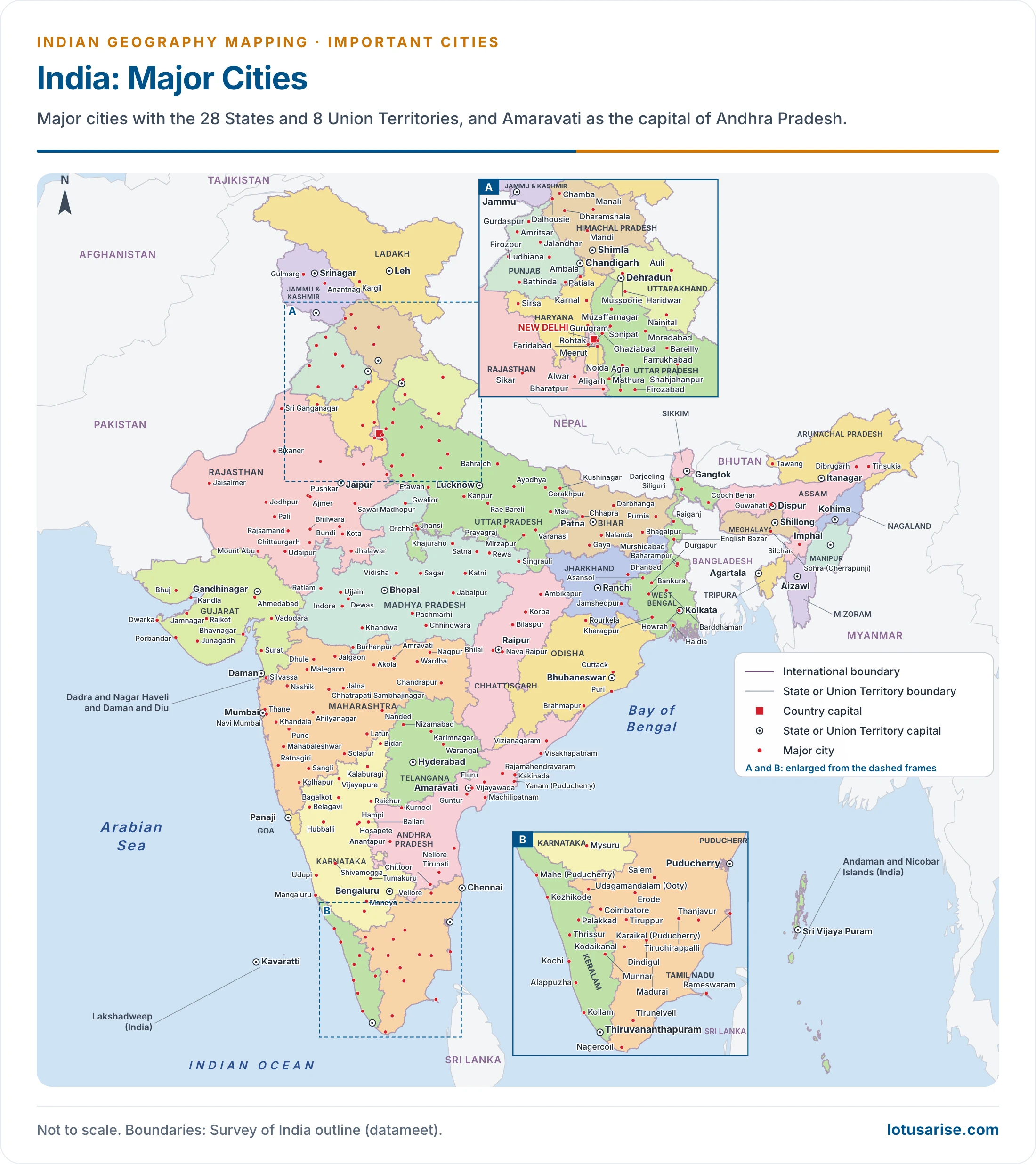
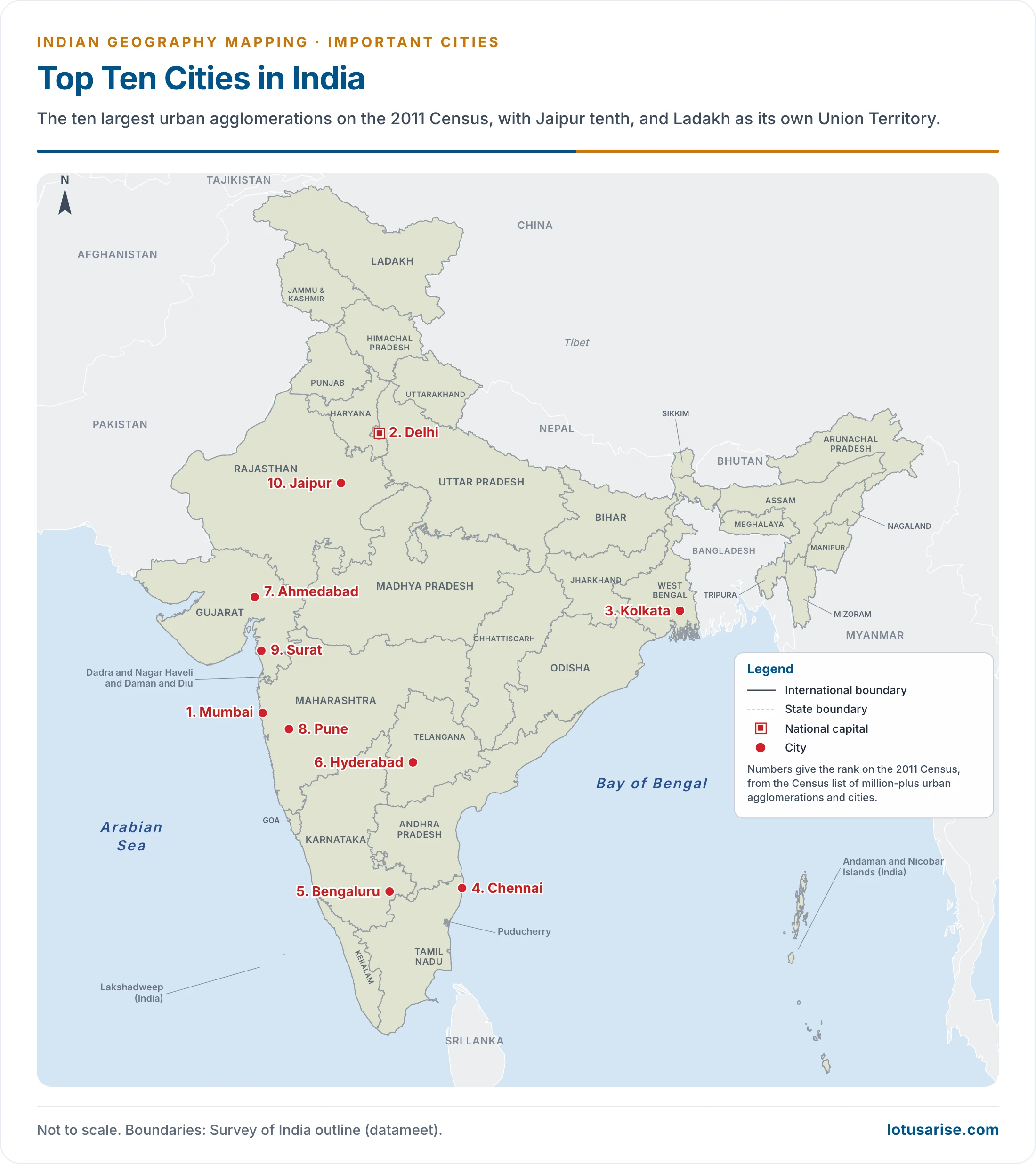
- Ladakh has been a separate Union Territory since 31 October 2019.
Previous Year Questions
2026Map item: Dras2020Map item: Coorg2019Map item: Lothal2016Map item: Headquarters of North-Eastern Railways2013Map item: Amarnath2013Map item: Sindri2013Map item: Churk


sir thank u so much, ur notes r very helpful pls upload the remaining part as early as possible