

- Ports are the point where India’s foreign trade, its coastal economy and its inland transport meet. Nearly all of the country’s trade by volume passes through them.
- The Sagarmala Programme, launched in March 2015, is the national plan for port-led development: it treats a port as the base for connectivity, industry and coastal livelihoods, not only as a place to load ships.
Growing Importance of Ports
Ports in National and Foreign Trade
- The coast: India’s coastline, long given as 7,516.6 km and split as 6,100 km of mainland coast plus the Andaman, Nicobar and Lakshadweep islands, was re-assessed in 2025 at 11,098.81 km.
- It touches 13 States and Union Territories. The western coastal plains lie along the Arabian Sea and the eastern coastal plains along the Bay of Bengal.
- 20% of India’s population lives in coastal areas.
- Coastal economy: the maritime States contribute about 60% of India’s GDP. Big and small ports along the coast carry out their trade.
- Number of ports: the long-used count is 13 major and 200 minor ports, of which 60 non-major ports were operational, on a coast of over 7,500 km.
- The current count is 12 operational major ports, two more under construction, and over 200 non-major ports.
- Share of trade: 95% of India’s foreign trade by volume and 70% by value moves by sea, a figure also given as 90% by volume and 70% by value.
- Traffic: major ports were said to handle about 58% of cargo. By 2024-25 the share stood at 53.5% of 1,597.27 million tonnes, as non-major ports grew faster.
- Cargo at major ports: the older split was bulk 44% (iron ore, coal and fertiliser), liquid 33% (petrol, oil and lubricants) and container 23%.
- In 2025-26, petroleum products made up 29.77%, containers 23.29% and coal 21.03%.
- Why water matters: water transport has served the Indian economy since time immemorial. It is an easy, cheap and energy-efficient way to export and import heavy goods, and ports are the essential link in it.
- Internal trade: besides foreign trade, ports serve internal trade. Many rivers link with major ports, and they carry goods between port and hinterland. Coastal cargo was 23.33% of major-port traffic in 2025-26.
Why Some Ports Grew First
- Of India’s sea-borne trade, more than 85% was once shared by Bombay, Calcutta, Cochin, Madras and Visakhapatnam, for both geographical and historical reasons.
- Mumbai, Chennai and Kolkata were centres of administration for a long time.
- As their populations grew, commercial and industrial activity grew too.
- Railway lines were built to them in the later half of the 19th century, and they turned from political centres into great ports.
- The pattern has since shifted north-west and to deep-water bulk ports. In 2025-26, the top five major ports were Deendayal, Paradip, Jawaharlal Nehru, Visakhapatnam and Mumbai, with 63.94% of major-port cargo, while Gujarat’s non-major ports carried about 65% of non-major traffic.
Seaports and Regional Development
- Port to hinterland: a port grows with its hinterland, and the hinterland in turn grows with its port.
- Mumbai’s rise drew on the cotton and industry of western India.
- Kolkata serves the whole east and north-east, along with Nepal and Bhutan.
- Port-based industry: imported or exported bulk cargo pulls heavy industry to the coast.
- Haldia has a refinery, fertiliser and petrochemical plants.
- Port-led sites such as Mundra and Visakhapatnam draw steel, power and refining.
- Kandla gave India its first export processing zone (1965).
- Regional balance: new ports can lift backward coasts. Paradip opened Odisha’s minerals to the sea, and New Mangalore served the iron ore of Karnataka.
- Limits: the benefit stays near the coast unless rail and road reach inland, and a small hinterland limits ports such as Mormugao. Coastal regions can gain income while fishing communities bear the losses.
- A corridor view: the Western Dedicated Freight Corridor, completed to JNPT in March 2026, and coastal corridors extend a port’s reach far inland.
The Sagarmala Project
Rationale for Sagarmala Project
- The Sagarmala project promotes port-led direct and indirect development and provides infrastructure to move goods to and from ports quickly, efficiently and cost-effectively.
- No cohesive institutional arrangement: many agencies are involved in coastal infrastructure, which causes policy failure and ambiguity in carrying out projects.
- Weak infrastructure at ports and beyond: limited mechanisation, lack of scale and deep draft, and poor facilities at many ports hold back port-led development.
- Lack of requisite infrastructure: moving goods from major and non-major ports to the hinterland suffers from a shortage of modal and multimodal transport.
- Limited hinterland linkages: these gaps raise the cost of transport and cargo movement and limit the linkages coastal regions need.
- Limited centres of manufacturing and economic activity in the hinterland also called for an integrated project.
Objectives of Sagarmala Project
- Port-led development: the development of Coastal Economic Zones, with projects for port-based industrialisation, coastal tourism, logistics parks, warehousing, fisheries and so on.
- Port infrastructure enhancement: turning existing ports into world-class ports through deep drafts, mechanisation of existing berths, and new capacity and greenfield ports.
- Efficient evacuation: expanding the rail, road and inland waterway networks linked to ports, and identifying congested routes.
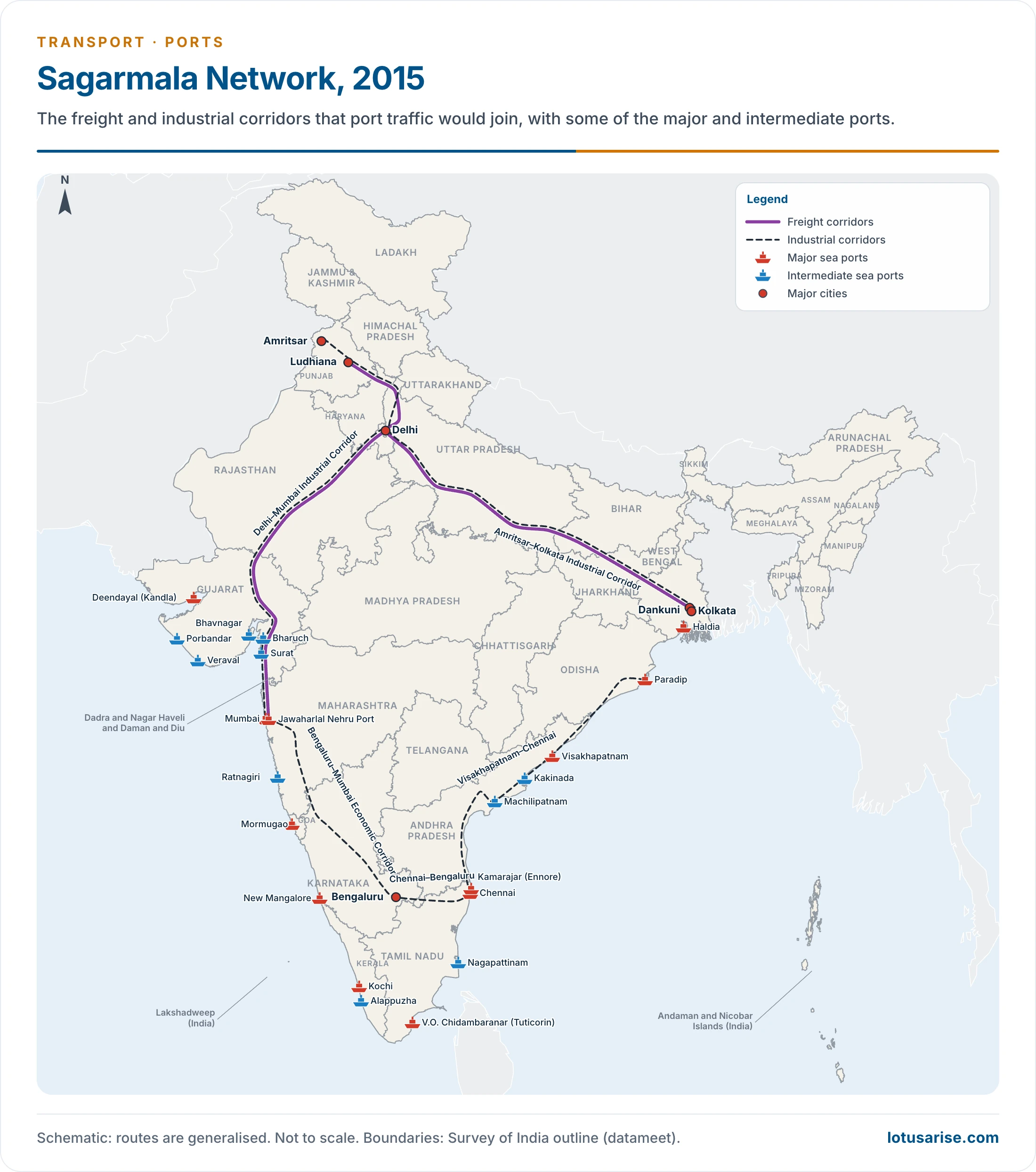
- This map dates from 2015 and shows the freight and industrial corridors that port traffic would join, with some of the ports.
Sagarmala Vision
- Sagarmala aims to open access to new development regions through intermodal solutions, promote the best modal split, and improve links with main economic centres through wider rail, inland water, coastal and road services.
- Changing the way India moves logistically:
- Raise the competitiveness of core industry and manufacturing by saving up to 5% of the input cost of power and steel through modern port infrastructure.
- Use national resources better by raising trade on inland waterways and coastal shipping by 50 million tonnes a year (MTPA).
- Use an IT-enabled national multimodal logistics plan to streamline the project.
- Build coastal roads through the maritime States, linking them with at least two-lane highways.
- Creating world-class port institutions:
- Sagarmala Development Company Limited (SDCL) was incorporated on 31 August 2016 under the Companies Act, 2013. Its objectives were to:
- Develop and formulate projects arising from the National Perspective Plan (NPP).
- Assist project special purpose vehicles (SPVs) set up by Central line ministries, State Governments, State Maritime Boards, ports and others, for projects in line with Sagarmala.
- Provide a funding window for residual projects that no other source could fund.
- Prepare the Detailed Master Plans for the Coastal Economic Zones (CEZs) identified in the National Perspective Plan.
- Raise funds from multilateral and bilateral agencies as long-term debt or equity, as projects required.
- In June 2025 the company became Sagarmala Finance Corporation Limited, India’s first non-banking financial company (NBFC) for the maritime sector.
- Sagarmala Coordination and Steering Committee (SCSC):
- At the national level, this committee sits under the Cabinet Secretary. Members are the Secretaries of Shipping, Road Transport and Highways, Tourism, Defence, Home Affairs, and Environment, Forest and Climate Change; the Departments of Revenue, Expenditure, and Industrial Policy and Promotion; the Chairman of the Railway Board; and the CEO of NITI Aayog.
- It coordinates ministries, State Governments and agencies, and reviews progress on the National Perspective Plan, the Detailed Master Plans and individual projects.
- Other bodies: the National Sagarmala Apex Committee, formed in May 2015, gives overall policy guidance. The Maritime States Development Council brings the Centre and States together, and State Sagarmala Committees identify and monitor projects.
- A world-class public-private partnership (PPP) programme in ports, waterways and connectivity projects is meant to attract the best domestic and international investors.
- Maritime services clusters will boost port infrastructure, for example through shipbuilding facilities.
- Sagarmala Development Company Limited (SDCL) was incorporated on 31 August 2016 under the Companies Act, 2013. Its objectives were to:
- Boosting development through ports and shipping:
- For 2–3 port-based smart cities and marine clusters or CEZs, over 10,000 acres of land would be pooled, creating 50,000 direct jobs.
- Launch of 100 early-bird projects, including PPP projects, with ₹1,00,000 crore of investment.
- Addition of 1,200–1,500 MTPA of port capacity, by strengthening existing ports and launching 3–4 new mega ports.
- Establishing a world-class transshipment port.
- Empowering coastal communities:
- Skill development in coastal communities, for example in fisheries, with an early aim of 20 million jobs in the maritime States. The programme now puts its employment potential at about 1 crore jobs, 40 lakh of them direct and 60 lakh indirect.
- Community development from tourism on islands, at lighthouses and on cruises would raise the GDP share of the maritime States and sectors.
- The original four pillars have since become five. The fifth is coastal shipping and inland waterways transport, and the first now reads port modernisation and new port development.
Potential Benefits of Sagarmala Project
- Under this framework the Government hoped to raise cargo traffic three-fold in the next 5 years, benefiting about 14% of the country’s population in at least 13 States and Union Territories.
- It will integrate the coastal economy with the ports through Coastal Economic Regions and projects with synergies to coastal industrial corridors.
- It will lead to port-based smart cities and other urban infrastructure, raising standards of living.
- Skill development and livelihood projects will serve coastal communities.
- Modernising and expanding existing ports and creating greenfield ports will reduce bottlenecks to future growth.
- Port evacuation (road, rail, inland waterways) and logistics infrastructure will cut the overall logistics cost and increase cargo movement to and from the hinterland.
- The maritime sector will bring new economic activity to the region, for example shipbuilding and repair clusters.
- Easing policy and institutional bottlenecks in project approvals, funding and implementing partners will help implementation and monitoring.
- Some other benefits:
- Ease of doing business.
- Shorter farm-to-factory time for products and raw materials.
- Employment generation.
- India may become a major destination of port-led trade among the major economies of east and west.
Six Mega Ports Planned Under Sagarmala Project
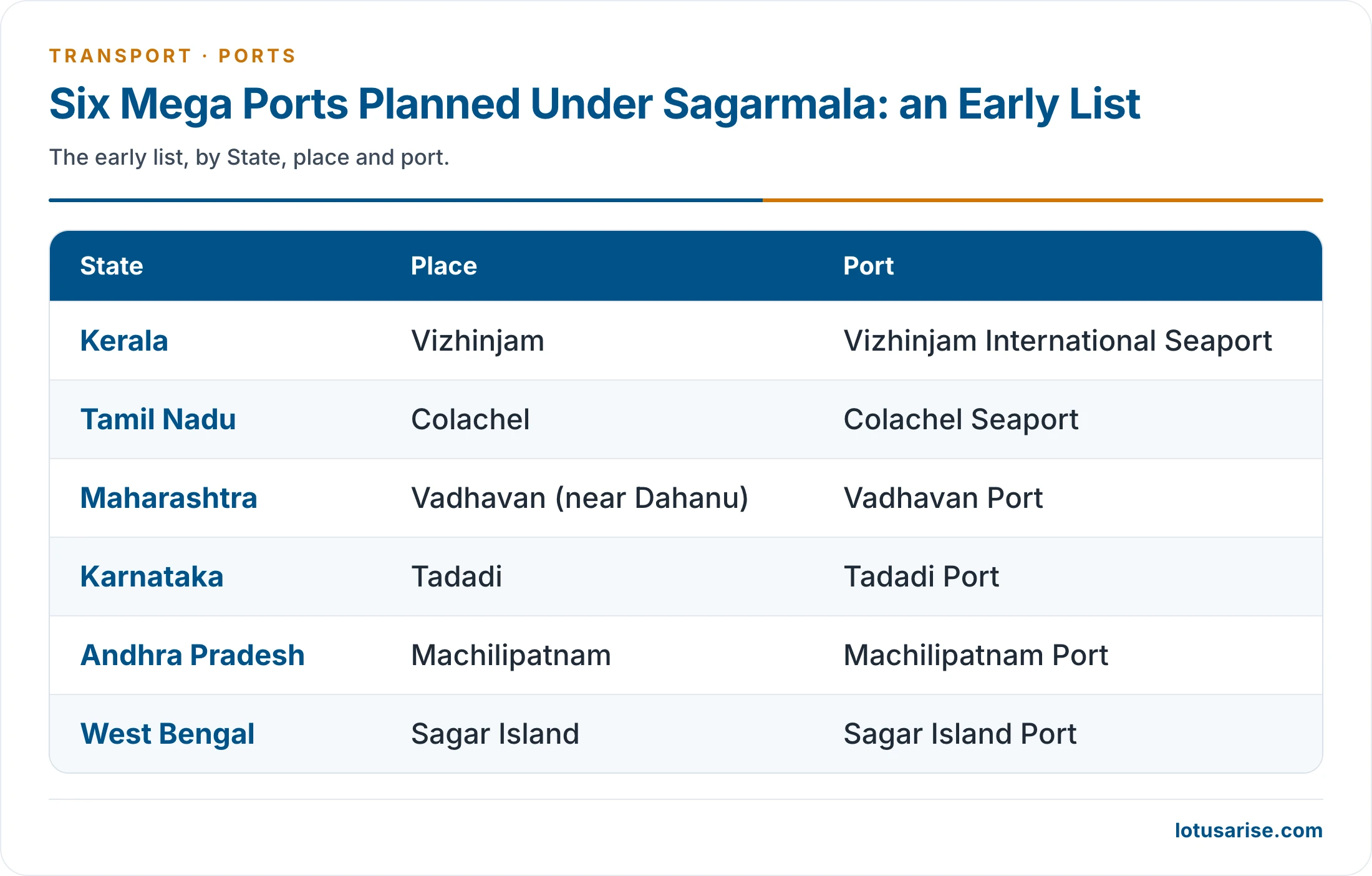
- This table carries an early list. The National Perspective Plan named Vadhavan, Enayam, Sagar Island, Paradip Outer Harbour, Sirkazhi and Belekeri. Vizhinjam went ahead as a State project, and Enayam stands near Colachel.
- What became of them: Vadhavan is under construction, and Vizhinjam was dedicated on 2 May 2025. The viability of Sagar Island came up for re-examination after West Bengal announced a port at Tajpur.
Coastal Economic Zones
- A Coastal Economic Zone (CEZ) is a designated coastal area with special economic rules, such as tax incentives and lower tariffs, to attract foreign direct investment.
- It resembles a Special Economic Zone (SEZ), but it focuses on coastal projects: port-proximate industrial clusters, port-led development and lower cost and time for moving goods.
- CEZs form part of a plan for 14 such clusters to spur manufacturing and jobs. The plan foresaw ₹15,000 crore of investment in the first phase and more than 1.5 lakh jobs.
- Coastal Economic Zones planned under Sagarmala:
| S.No. | CEZ | State | Linkage Ports |
|---|---|---|---|
| 1 | Kachchh | Gujarat | Deen Dayal, Mundra |
| 2 | Saurashtra | Gujarat | Pipavav, Sikka |
| 3 | Suryapur | Gujarat | Dahej, Hazira |
| 4 | North Konkan | Maharashtra | JNPT, Mumbai |
| 5 | South Konkan | Maharashtra, Goa | Dighi, Jaigarh, Mormugao |
| 6 | Dakshin Kanara | Karnataka | New Mangalore |
| 7 | Malabar | Keralam (Kerala) | Cochin |
| 8 | Mannar | Tamil Nadu | VOCPT (Tuticorin) |
| 9 | Poompuhar | Tamil Nadu | Cuddalore |
| 10 | VCIC South | Tamil Nadu | Chennai, Kamarajar, Kattupalli |
| 11 | VCIC Central | Andhra Pradesh | Krishnapatnam |
| 12 | VCIC North | Andhra Pradesh | Vizag, Kakinada |
| 13 | Kalinga | Odisha | Paradip, Dhamra |
| 14 | Gaud | West Bengal | Kolkata, Haldia |
- VCIC is the Visakhapatnam–Chennai Industrial Corridor. Its three zones tie the ports of the middle east coast to the industry inland.
Sagarmala in Practice
- Progress at 24 March 2026:
| Status | Projects | Value |
|---|---|---|
| Taken up | 845 | ₹6.06 lakh crore |
| Completed | 315 | ₹1.57 lakh crore |
| Under implementation | 210 | — |
| At planning stage | 320 | — |
- Results reported:
- Vessel turnaround fell from 96 hours (2014) to 49.5 hours (2025).
- Major ports handled about 915 million tonnes in 2025-26, and inland waterway cargo rose from 18.1 million tonnes (2013-14) to 145.5 (2024-25) and 218 (2025-26).
- Eleven fishing harbours were completed, and 7 coastal berths added 9.84 MTPA.
- Ghogha–Hazira Ro-Pax cut about 10 hours by road to 4 by sea, and Mumbai–Mandwa replaced a 109 km road journey with 18.5 km by sea.
- Sagarmala 2.0: proposed with ₹85,482 crore of budget support and ₹3.6 lakh crore of total investment, tied to the Maritime India Vision 2030 and Maritime Amrit Kaal Vision 2047.
- Critical view:
- Pace: after eleven years, completed projects are about a quarter of the programme by value, and 320 are still at the planning stage.
- Coastal communities: the National Fishworkers’ Forum and other groups have opposed the programme on grounds of displacement, coastal erosion and thin consultation, and fishers opposed the port at Vizhinjam.
- Environment: deep-water ports and dredging raise concerns in fragile coastal tracts, and changes in coastal regulation rules have drawn objections.
- Dependence on one route: the programme improves links to sea trade but does not by itself reduce exposure to maritime choke-points.
Previous Year Questions
2025With reference to the transport and communication network of India, critically discuss the ‘Sagarmala project’.2024Examine the relationship between seaports and regional development in India.2017Describe the salient features of the Sagar Mala Project and highlight its role in port-led development of coastal regions in India.2003Discuss the growing importance of ports in foreign trade of India.





excellent job lotusrise team. Heart full thanks.
Can you please share whole notes in Evernote or Onenote, it will be easy to read and highlight.
Sorry, I have not complete notes on Evernote/Onenote. I am using both handwritten with digital notes on Onenote. So, You can also make your own notes on Onenote.
I must say, your website is much better than Drishti, Insight, Byju etc. You give complete information! Please keep on giving complete information like this only!
Hello
please tell me
india’s trade relations with japan
thank u so much…