

Yoga: Citta; Cittavṛtti; Kleśas; Samādhi; Kaivalya.
Official Syllabus: Paper I, Section B, Unit 17
Why does the mind keep producing waves that bind us? Patañjali’s answer is the doctrine of the five kleśas — the “afflictions” or “torments” that lie deeper than individual thoughts. They are ignorance (avidyā), egoism (asmitā), attachment (rāga), aversion (dveṣa) and clinging to life (abhiniveśa). Ignorance is the field in which the other four grow. Together they colour our thoughts, push us into action, lay down the karmic deposit (karmāśaya) that ripens as birth, life-span and experience, and so keep the wheel of rebirth turning. The doctrine is Yoga’s diagnosis of bondage — and, as in medicine, a correct diagnosis already points to the cure. This article explains each kleśa, their four states, how they produce karma and suffering, the fourfold scheme of pain–cause–cure–means, and the methods by which the kleśas are first thinned and finally burnt like roasted seeds.
In simple words
Think of weeds in a garden. You can cut the leaves (our angry or greedy thoughts), but they grow back, because the roots are still in the soil. The kleśas are the roots; the vṛttis are the leaves; and avidyā is the soil itself. Yoga’s method is to weaken the roots, pull them out, and finally roast the seeds so that nothing can sprout again.
Context & Problem
- From vṛtti to kleśa. Article 3 showed that the mind’s modifications (vṛttis) bind when they are afflicted (kliṣṭa). The kleśas are the source of that affliction: an afflicted vṛtti is simply one “caused by the kleśas”.
- Why the self suffers. Puruṣa is eternally pure, transcendent consciousness. But when citta changes into vṛttis and the self is reflected in it, “Puruṣa considers itself to be the subject of birth and growth, decay and death”. The self appears to be concerned in these functions “because it is reflected in citta, held up before it as a mirror before a person. As a result of this wrong identification, the self goes through kleśas.”
- The meaning of the word. The root kliś means “to be afflicted” (as an intransitive verb) and “to torment, to cause pain” (as a transitive verb). Hence kleśa means “mental affliction, distress, suffering or torment” — and also the cause of torment.
- Who suffers? The jīva — “citta with the reflection of Puruṣa in it” — is “subject to all sufferings”. The five kleśas are therefore called the “five kinds of sufferings” of the phenomenal ego.
- The question. What exactly are these afflictions, how do they bind, and how can they be removed so that the self is free?
Core Doctrine
1. The Five Kleśas
“Ignorance, egoism, attachment, aversion and clinging to life are the five afflictions.”
1. Avidyā — ignorance, the root.
- Definition. “Avidyā is taking the non-eternal as eternal, the impure as pure, the painful as pleasant, and the non-self as the self.”
- The four forms explained with examples.
- Non-eternal as eternal — living as though youth, wealth and the body will last for ever.
- Impure as pure — admiring the body as beautiful and clean, though it is made of flesh, blood and waste.
- Painful as pleasant — chasing pleasures that end in loss, anxiety and fresh craving.
- Non-self as self — taking the body, mind and their “accessories” (family, house, furniture, food) to be “me” and “mine”.
- Why it is the root. Avidyā is “the field (kṣetra) of the others”. It is “the misperception of reality”, a “fundamental error in cognition” that “clouds discriminative knowledge (viveka) and perpetuates bondage”. When it is dispelled, the other kleśas — which may exist “in latent unconscious form” — disappear.
- Not mere absence of knowledge. Avidyā is not a blank; it is a positive wrong knowledge — like seeing a snake where there is a rope.
2. Asmitā — egoism, the false “I am”.
- Definition. “Asmitā is the apparent identity of the power of seeing (Puruṣa) with the instrument of seeing (buddhi).”
- In plain words. It is “the I-am-ness that equates the seer with the instrument of seeing”, the “principle of individuation” that says “I” (aham) and “mine” (mama).
- Example. A man looking through binoculars forgets the binoculars and says “I see the bird”. Asmitā is a far deeper forgetting: the self forgets that the mind is only an instrument and says “I think, I feel, I am clever”.
In simple words
An actor who has played a king for twenty years starts giving orders at home and feels insulted when his family does not bow. He has forgotten that the crown was a costume. Asmitā is this forgetting: the self wears the costume of the mind and ego and takes it to be its own face.
- How it works. It is “the specific aspect of ignorance which identifies the non-self — specifically the buddhi — with the true self”. It “generates separateness and strengthens desires and aversions”.
3. Rāga — attachment.
- Definition. “Attachment is that which follows pleasure” — the residue left by a pleasant experience.
- How it arises. “Whenever the senses encounter something delightful, the memory of pleasure creates attachment, leading to craving.” “The key ingredient in this process is memory.”
- Effects. It keeps the mind “restless and outward-oriented”, binding it to “the cycle of desire and frustration” — the thirst for worldly pleasures, power and money.
- Example. One taste of a rich sweet and the mind keeps returning to it; the memory itself becomes a craving.
4. Dveṣa — aversion.
- Definition. “Aversion is that which follows pain” — repulsion towards unpleasant experiences and their causes.
- How it arises. “Just as attachment springs from remembered pleasure, aversion arises from remembered pain.”
- Effects. It “breeds resistance, anger, frustration and resentment”; with rāga it produces “attraction–repulsion cycles that trap the mind in duality”.
- Example. A child once bitten by a dog fears and hates all dogs; an employee once humiliated by a manager resents every instruction from him.
5. Abhiniveśa — clinging to life, the fear of death.
- Definition. “Clinging to life, flowing by its own momentum, established even in the wise.”
- Nature. It is “the most subtle kleśa” — “the instinctual drive for self-preservation”, a “deep fear of death and attachment to continuity of existence”.
- Even the learned have it. Patañjali notes that “even the learned and wise experience this kleśa”, showing its powerful subconscious roots.
- Why everyone has it. Vyāsa explains that even a newborn creature, which has never experienced death in this life, fears it; such fear can only come from the memory of the pain of death in past lives — which the commentators also take as evidence of rebirth.
- Example. Even a tiny insect, when touched, pretends to be dead or flees — the will to live is instinctive in every creature.
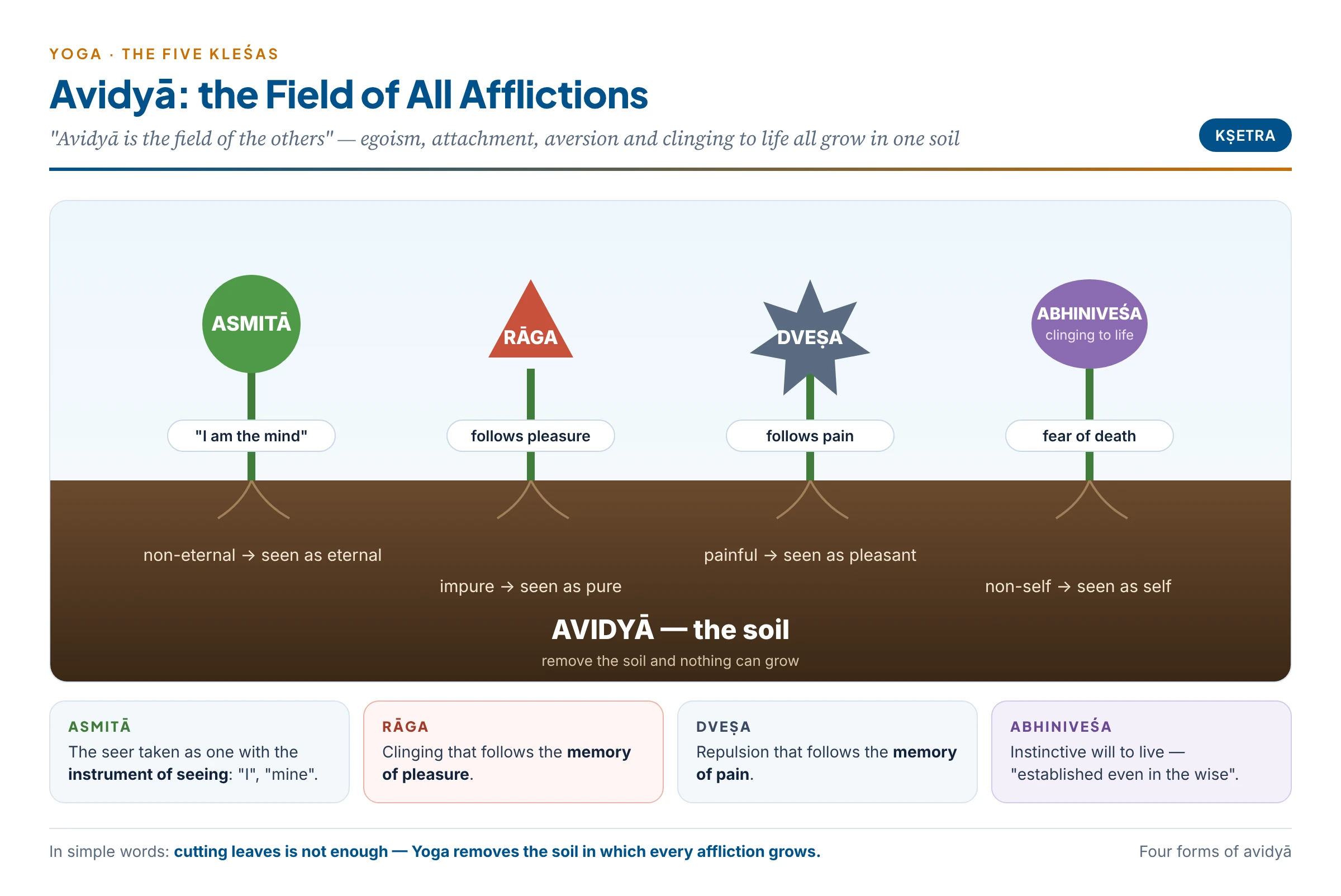
| Kleśa | What it is | Root in experience | Everyday example |
|---|---|---|---|
| Avidyā | Seeing the non-eternal, impure, painful, non-self as eternal, pure, pleasant, self | The basic misperception | Living as if youth and wealth last for ever |
| Asmitā | Seer identified with the instrument of seeing | Identification with buddhi | “I am clever”, “I am this body” |
| Rāga | Clinging that follows pleasure | Memory of pleasure | Returning again and again to a craving |
| Dveṣa | Repulsion that follows pain | Memory of pain | Hating all dogs after one bite |
| Abhiniveśa | Instinctive clinging to life, fear of death | Impressions of past deaths | Even the wise fear death |
Common confusion
Does avidyā mean thinking that the self is not eternal? No — it is the reverse. Some lecture notes say that avidyā is “cognising the self as eternal, though the self is not eternal”. In Yoga the self (Puruṣa) is eternal; avidyā is taking the non-eternal (body, mind, possessions) as eternal and the non-self as the self. Similarly, dveṣa is aversion, not “desire”.
2. The Four States of the Kleśas
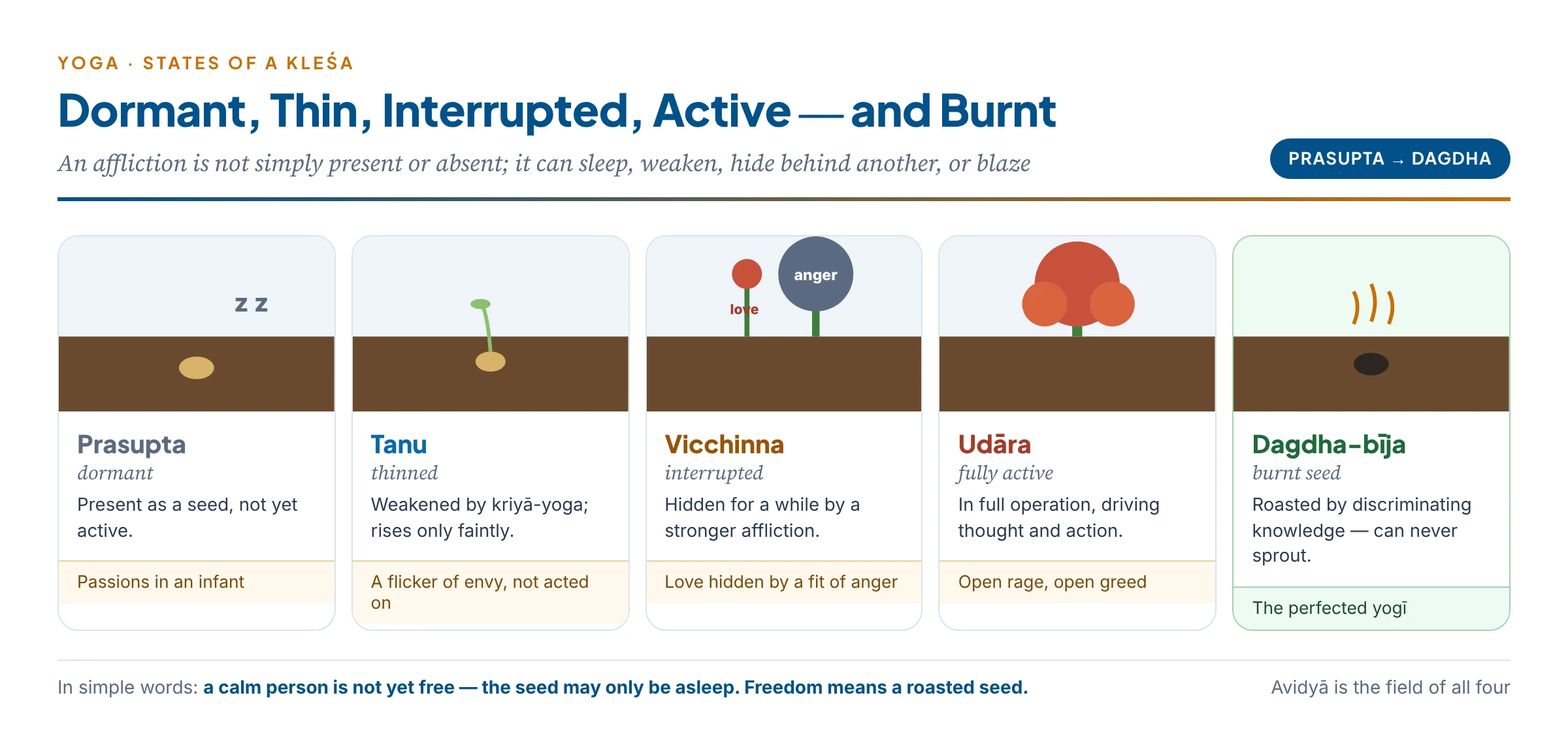
Avidyā is the field of the other kleśas, which may be in one of four states — dormant, thin, interrupted or fully active.
- Prasupta — dormant. The kleśa is present as a seed but not active. Example: the sexual passions in an infant; anger in a calm person who has not yet been provoked.
- Tanu — attenuated, thinned. Weakened by yogic practice (kriyā-yoga, meditation); it rises only faintly. Example: a practitioner who still feels a flicker of jealousy but does not act on it.
- Vicchinna — interrupted, intercepted. Temporarily overpowered by another, stronger kleśa. Example: a man’s love for his wife is hidden while he is furious with her; his attachment is “interrupted” by aversion, not destroyed.
- Udāra — fully active. The kleśa is in full operation. Example: open rage, open greed.
- A fifth condition — burnt (dagdha-bīja). In the perfected yogī, the seeds of the kleśas are burnt by discriminating knowledge. Like roasted seeds, they may look like seeds but can never sprout again.
In simple words
Fire in a house can be in four states: ash-covered embers (dormant), a small flame turned low (thin), a fire put out in one room while another room burns (interrupted), or a blaze (active). Yoga wants not only to turn the flame low but to burn the fuel completely, so that no spark is left.
3. From Kleśa to Karma to Rebirth
- The karmic deposit. “The karmic deposit (karmāśaya) has the kleśas as its root; it is to be experienced in this seen birth or in unseen (future) births.”
- Three fruits. “While the root exists, its fruit is birth (jāti), span of life (āyus) and experience (bhoga).” So the kleśas decide what kind of being we are born as, how long we live and what pleasures and pains we meet.
- Pleasure and pain. These fruits bring joy or sorrow according as they spring from merit (puṇya) or demerit (apuṇya).
- The vicious circle. Kleśas lead to action; action leaves karmic deposits and impressions; these ripen into new birth and new experience; experience feeds new kleśas. “Kleśas → vṛttis → karma → saṃskāras → rebirth.”
- Bondage defined. “Due to the modifications of citta, the self is reflected there and feels pleasure or pain out of the objects in the world. It means the bondage of the self.” Bondage is thus the self’s identification with citta, maintained by the kleśas.
- The yogī’s action is different. “The karma of the yogī is neither white nor black; for others it is threefold” — white (good), black (bad) and mixed. Because the yogī acts without kleśas, his actions leave no binding deposit.
4. “Everything Is Pain to the Discerning”
- The striking claim. “For the discerning person, everything is pain,” Patañjali says, for four reasons:
- Pain of change (pariṇāma-duḥkha) — every pleasure changes and ends; its ending is pain.
- Pain of anxiety (tāpa-duḥkha) — while enjoying, we fear losing; the means of pleasure create worry.
- Pain of impressions (saṃskāra-duḥkha) — pleasures leave impressions that create fresh cravings, and so new pain.
- Conflict of the guṇas — sattva, rajas and tamas are always at war in the mind, so no state is stable.
- Why this matters. It explains why even pleasant experiences are rooted in the kleśas and why Yoga seeks freedom from all vṛttis, not only painful ones.
In simple words
A new phone delights you for a week (pleasure). Then you worry it will be scratched or stolen (anxiety). A newer model arrives and yours feels old (change). And the memory of that first delight makes you crave the next phone (impression). Yoga says the wise see the whole cycle at once — that is why “everything is pain to the discerning”.
5. The Fourfold Scheme: Pain, Its Cause, Its Removal, the Means
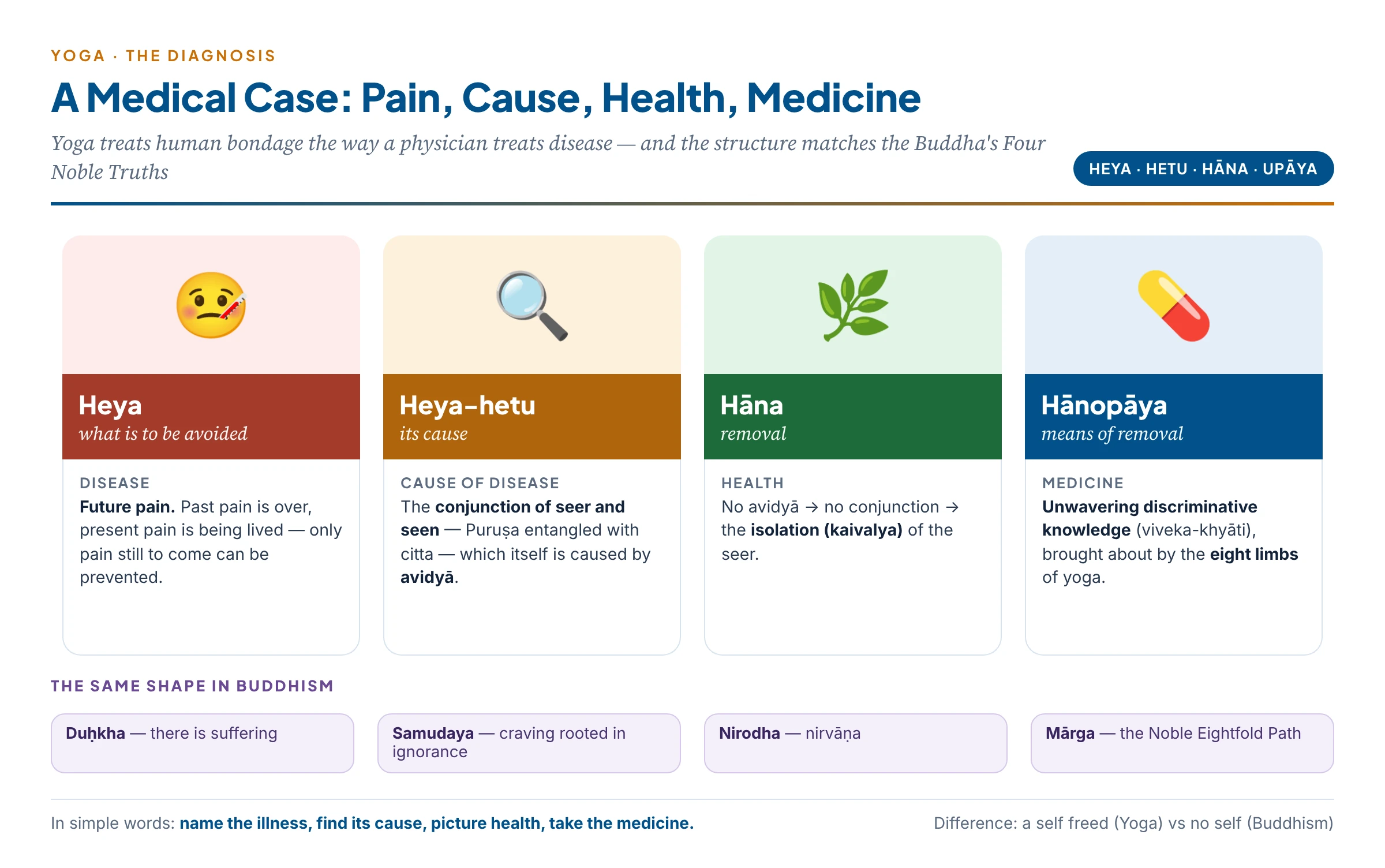
Yoga borrows the structure of medicine — disease, cause of disease, health, and medicine — and applies it to the human condition (Vyāsa).
- Heya — what is to be avoided: “Future pain is to be avoided.” Past pain is gone; present pain is being experienced; only future pain can be prevented.
- Heya-hetu — its cause: “The cause of what is to be avoided is the conjunction (saṃyoga) of the seer and the seen” — Puruṣa and Prakṛti (citta). And “the cause of this conjunction is avidyā.”
- Hāna — removal: “From the absence of avidyā comes the absence of conjunction; this is removal — the isolation (kaivalya) of the seer.”
- Hānopāya — the means of removal: “Unwavering discriminative knowledge (viveka-khyāti) is the means of removal.”
| Medicine | Yoga | Buddhism’s Four Noble Truths |
|---|---|---|
| Disease | Heya: future suffering | Duḥkha: there is suffering |
| Cause of disease | Heya-hetu: conjunction of seer and seen, due to avidyā | Samudaya: craving rooted in ignorance |
| Health | Hāna: kaivalya | Nirodha: nirvāṇa |
| Medicine | Hānopāya: viveka-khyāti through the eight limbs | Mārga: the Noble Eightfold Path |
Indian Connect — Yoga and the Four Noble Truths
- The fourfold scheme is strikingly close to the Buddha’s Four Noble Truths, and both use the medical model of diagnosis and cure. Both also have an eightfold path.
- The difference lies in the cause and the cure: for Yoga the cause is the confusion of an eternal self with the mind, and the cure is the self standing alone; for Buddhism the cause is craving based on the illusion of a self, and the cure is seeing that there is no self.
- Both agree that ignorance (avidyā) is the first link of bondage — Yoga places it as the field of the kleśas, Buddhism as the first of the twelve links of dependent origination.
6. How the Kleśas Are Eliminated
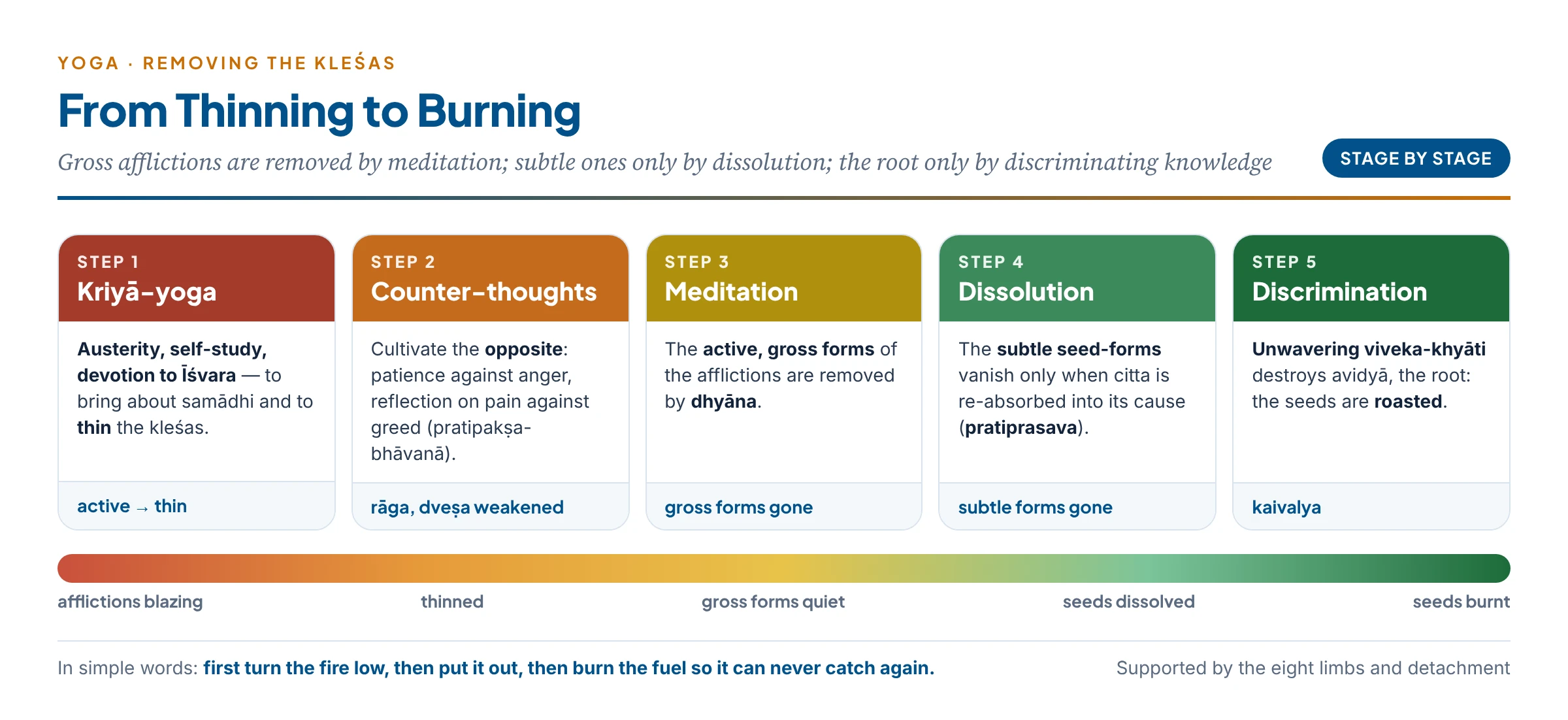
The removal happens in stages, matching the states of the kleśas.
- Stage 1 — thinning by kriyā-yoga. “Austerity (tapas), self-study (svādhyāya) and devotion to Īśvara (Īśvara-praṇidhāna) are kriyā-yoga.” Its purpose is twofold: “to bring about samādhi and to attenuate the kleśas.” Practice turns active kleśas into thin ones.
- Stage 2 — counter-thoughts. “When the mind is disturbed by wrong thoughts, one should cultivate the opposite” (pratipakṣa-bhāvanā). Against anger, cultivate patience; against greed, reflect on the pain greed brings. This weakens rāga and dveṣa directly.
- Stage 3 — meditation removes the gross forms. “Their modifications (active forms) are to be removed by meditation (dhyāna).” Gross afflictions — open anger, open greed — subside when the mind is held steadily on one object.
- Stage 4 — dissolution removes the subtle forms. “The subtle kleśas are to be removed by re-absorption (pratiprasava)” — when citta itself dissolves back into its cause at the end of the practice, the seed-forms disappear with it.
- Stage 5 — burning by discriminating knowledge. Unwavering viveka-khyāti — “I am Puruṣa, not citta” — destroys avidyā, the root. The kleśas then become “burnt seeds” that cannot sprout.
- Supporting means. The eight limbs (Article 5) — especially the yamas, which are the direct opposites of rāga and dveṣa — practice and detachment (vairāgya), and devotion to God, who is himself “untouched by the kleśas” (Article 7).
- The final stage. In the highest absorption, the “cloud of virtue” (dharma-megha samādhi), there follows “cessation of kleśas and karma“.
7. How the Removal of the Kleśas Leads to Kaivalya
- Bondage depends on avidyā. The conjunction of seer and seen — the cause of all pain — exists only because of avidyā.
- The other kleśas depend on avidyā. Egoism, attachment, aversion and clinging grow in its field.
- Karma depends on the kleśas. The karmic deposit “has the kleśas as its root”; “while the root exists”, it ripens as birth, life-span and experience.
- Remove avidyā, and everything collapses. Discriminating knowledge destroys avidyā → the conjunction ends → the kleśas are burnt → no new karma is deposited and the old cannot ripen → no rebirth.
- What remains is the seer alone, in its own nature — kaivalya (Article 8).
Critical Evaluation
1. Strengths of the Doctrine
- Deep psychology. It goes beneath surface thoughts to motivational roots — ignorance, ego, desire, aversion, fear of death — that modern psychology also recognises.
- A unified theory of suffering. Everything is traced to one root, avidyā, which explains why the many forms of pain are really one problem.
- Precision about degrees. The four states recognise that afflictions can be latent, weak, hidden or active — and that a calm person may still carry dormant seeds.
- Tied to practice. Every element of the diagnosis has a matching remedy: kriyā-yoga, counter-thoughts, meditation, dissolution, discrimination.
- Abhiniveśa as insight. The universal fear of death, “even in the wise”, is a profound observation about human nature.
2. Criticisms
- Pessimism. “Everything is pain to the discerning” seems to deny the real value of joy, love and beauty. Critics call the outlook world-negating.
- Circularity. Avidyā causes the conjunction of seer and seen; but avidyā is itself a state of citta, which exists only because of that conjunction. Which comes first?
- Who is ignorant? Puruṣa is pure consciousness and cannot be ignorant; citta is unconscious and cannot “know” or “not know”. The subject of avidyā is hard to locate — the same problem that troubles Sāṃkhya.
- Rebirth assumed. The explanation of abhiniveśa through memories of past deaths presupposes rebirth rather than proving it; fear of death can also be explained by biological instinct.
- Elimination of emotion? Removing attachment and aversion entirely may seem to remove love and moral indignation too. Is a person without rāga and dveṣa still human?
- Buddhist objection. If there is a permanent self, why is identifying with it the cure? Buddhists argue that the belief in a permanent self is itself the deepest form of ignorance.
3. Yoga’s Replies
- Realistic, not pessimistic. Yoga does not deny pleasure; it points out that pleasure is unstable and mixed with pain. Its goal is a freedom beyond the swing of pleasure and pain.
- Beginningless. Like the seed and the tree, avidyā and conjunction are beginningless; there is no first moment. What matters is that the cycle can end.
- Love without attachment. Removing rāga does not remove friendliness and compassion — Patañjali explicitly prescribes them (Article 3). What goes is selfish clinging, not care.
- Fear of death as data. Whether through past lives or instinct, the fact remains that the will to live distorts the mind; Yoga’s practical point survives either explanation.
Critics and Defenders
Criticism — Critics
- Pessimism: “everything is pain” undervalues joy and love.
- Circularity: avidyā causes conjunction, yet presupposes it.
- No subject of ignorance: Puruṣa cannot err; citta cannot know.
- Rebirth assumed: fear of death need not prove past lives.
- Buddhists: belief in a permanent self is the deepest ignorance.
Defence — Defenders and strengths
- One root for many sorrows: a unified theory of suffering.
- Depth: latent, thin, interrupted and active states of affliction.
- Beginningless but endable: like seed and tree, the cycle has no start but can stop.
- Love remains: friendliness and compassion are prescribed, only clinging goes.
- Cure built in: each stage of affliction has its own remedy.
Cross-Tradition Comparison
The Roots of Bondage across Indian Schools
| School | Root afflictions | Cure |
|---|---|---|
| Yoga | Five kleśas rooted in avidyā | Kriyā-yoga, eight limbs, discrimination |
| Buddhism | Three poisons: greed, hatred, delusion; craving rooted in ignorance | Noble Eightfold Path; insight into no-self |
| Nyāya | Doṣas: attachment, aversion, delusion (rāga, dveṣa, moha) | True knowledge of the categories |
| Jainism | Passions (kaṣāya): anger, pride, deceit, greed | Three jewels; stopping and shedding karma |
| Advaita | Avidyā — ignorance of identity with Brahman | Knowledge of Brahman |
Western Parallels
- The Stoics. The passions — desire, fear, pleasure, distress — come from false judgements about what is good and bad; wisdom removes them. This matches Yoga’s tracing of rāga and dveṣa to avidyā.
- Spinoza. “Human bondage” is our subjection to the passions; freedom comes through adequate ideas — understanding replaces passive emotion.
- Schopenhauer. The blind will-to-live drives all creatures and produces endless suffering — very close to abhiniveśa and rāga. Schopenhauer himself admired Indian thought.
- Freud. The life instinct and the drive for self-preservation, and the idea that much of our motivation is unconscious, echo the dormant (prasupta) kleśas and abhiniveśa.
Indian Connect — Key takeaways
- Almost every Indian school agrees that ignorance and desire bind; Yoga’s special contribution is a fivefold, layered analysis with states and stage-wise remedies.
- Yoga’s avidyā (non-self taken as self) is close to Advaita’s, while Buddhism turns it around (self taken where there is none).
- The Nyāya doṣas and Yoga’s rāga–dveṣa are nearly identical; the schools differ mainly about the self that is freed.
Synthesis (Siddhānta)
- The kleśas are the deep afflictions beneath the mind’s waves: ignorance, egoism, attachment, aversion and clinging to life. They are the “five sufferings” of the jīva, which arises when Puruṣa is reflected in citta.
- Avidyā — taking the non-eternal, impure, painful and non-self as eternal, pure, pleasant and self — is the field of all the rest. Asmitā confuses the seer with the instrument of seeing; rāga and dveṣa follow remembered pleasure and pain; abhiniveśa is the instinctive fear of death, present even in the wise.
- Kleśas exist in four states — dormant, thin, interrupted, active — and in the yogī are finally burnt seeds.
- Rooted in the kleśas, the karmic deposit ripens as birth, life-span and experience; this is bondage and rebirth. To the discerning, everything is pain.
- Yoga’s fourfold scheme — future pain, its cause (the conjunction of seer and seen through avidyā), its removal (kaivalya) and its means (discriminative knowledge) — mirrors medicine and the Four Noble Truths.
- Removal proceeds by kriyā-yoga, counter-thoughts, meditation, dissolution and discrimination; when avidyā goes, the conjunction ends and kaivalya follows.
- A balanced view. The doctrine is a profound psychology of motivation; its weak points are the old puzzle of the subject of ignorance and a tone that can seem world-weary.
- Contemporary relevance.
- Consumer culture runs on rāga — manufactured craving — and Yoga’s analysis of pleasure as change, anxiety and fresh craving is a sharp critique of it.
- Polarisation — love for one’s group and hatred of the other — is rāga and dveṣa at the social level, rooted in a narrow asmitā.
- Mental health. Fear, resentment and compulsive craving are recognised by modern therapy as central to anxiety and addiction; Yoga’s counter-thought method resembles cognitive techniques of replacing harmful thoughts.
“Avidyā is the field of the others, whether they be dormant, thin, interrupted or active.” — Patañjali, Yoga Sūtra
Previous Year Questions
- 2021Explain, with reference to Yoga philosophy, the nature of kleśas. How does the removal of these lead to kaivalya?
- 2016What are Kleśas? How can these be eliminated? Explain.
- 2015What is bondage according to Yoga philosophy? Explain the method of attaining Kaivalya in Patañjali’s Yoga Sūtra.