

Yoga: Citta; Cittavṛtti; Kleśas; Samādhi; Kaivalya.
Official Syllabus: Paper I, Section B, Unit 17
The second sūtra of Patañjali is the most quoted line in all of Yoga: yogaś citta-vṛtti-nirodhaḥ — “yoga is the cessation of the modifications of the mind”. A vṛtti (literally a “turning” or “wave”) is any form that the mind-stuff (citta) takes: a perception, an error, an idea, a memory, even dreamless sleep. Patañjali claims that every mental state falls into just five kinds, and that each can be either afflicted (kliṣṭa) — feeding bondage — or unafflicted (akliṣṭa) — helping freedom. Because the self mistakes these waves for itself, they are the immediate cause of bondage; because they leave seeds (saṃskāras) that sprout as new waves, they keep the wheel of rebirth turning. This article explains the five vṛttis, their effects, why Yoga asks for their cessation, how cessation is achieved by practice (abhyāsa) and detachment (vairāgya), the obstacles on the way and the means of calming the mind — and ends with a critical account of the whole theory.
In simple words
A lake is covered with waves — some made by wind, some by stones thrown in, some by fish below. You cannot see the bottom. Stop the wind, stop throwing stones, let the fish settle, and the water becomes so clear that the bed of the lake is visible. The waves are vṛttis; the clear water is the stilled mind; the bottom seen at last is the self.
Context & Problem
- The mind is never still. “The mind is never still; it constantly engages with perceptions, memories and imaginations. These movements veil the pure consciousness of Puruṣa and cause bondage.”
- How a vṛtti arises. When citta is related to an object through the senses and mind, “it assumes the form of that object. This form is called vṛtti.” Lit by the consciousness of Puruṣa, the vṛtti becomes knowledge.
- The meaning of the word. Citta is the mind-stuff; vṛtti is its “wave”, “fluctuation” or “modification” — the thoughts “that clutter the mind”. In the Yoga Sūtra, vṛtti refers to “any sensual impression, thought, idea or cognition, psychic activity or conscious mental state whatsoever”.
- The problem. Because Puruṣa is reflected in each vṛtti, it seems to take the form of the vṛtti — “at other times, the seer takes the form of the modifications”. So the question is: what are these modifications, why must they cease, and how?
Core Doctrine
1. The Five Kinds of Vṛtti
Patañjali says the modifications are fivefold and are either afflicted or unafflicted. They are: pramāṇa (valid cognition), viparyaya (error), vikalpa (verbal construction), nidrā (sleep) and smṛti (memory). “All cognitive mental states and processes may be included in these five; we need not admit any other kinds.”
1. Pramāṇa — valid cognition. Correct cognition gained through three means, accepted “in almost the same way as in the Sāṃkhya”:
- Perception (pratyakṣa) — when citta, through the sense-organs, comes into contact with an external object and assumes its form, or comes into contact with an internal mental state. Perception can be through the five senses and also through the mind, the “sixth” sense. It grasps chiefly the particular features of a thing. Example: seeing a rope as a rope.
- Inference (anumāna) — when citta “cognizes the generic nature of things”, relying on an invariable relation. Example: having seen in the kitchen, the lamp and the candle that wherever there is smoke there is fire, one infers fire on a distant smoky hill. The relation must hold uniformly; one case of smoke without fire would spoil it.
- Verbal testimony (āgama, śabda) — knowledge from a reliable person or scripture. Example: a traveller wanting to cross a river asks the fisherman, not the passer-by on a bicycle or the tourist, about its depth — because the fisherman is the reliable authority.
2. Viparyaya — error. “False knowledge of an object, not established in its real form” — knowing a thing as what it is not.
- Examples: a rope in dim light seen as a snake; mother-of-pearl seen as silver.
- It includes doubt — uncertain cognition (“is it a post or a man?”).
- It can be corrected: a later valid cognition cancels it (“this is only a rope”).
3. Vikalpa — verbal construction. “A cognition that follows mere words, with no real object corresponding to it.”
- Examples: the “horn of a hare“, the “sky-flower“, the “son of a barren woman“, a unicorn, a “sea of milk“.
- Subtler examples: the phrase “Rāhu’s head” makes us imagine a distinction between Rāhu and his head, though Rāhu (in the myth) is only a head; “the consciousness of the Puruṣa” makes us imagine two things — a Puruṣa and its consciousness — though Puruṣa is consciousness.
- How it differs from error. Error is corrected when the truth is seen; vikalpa is not cancelled by knowledge — we go on using the words, and they go on being understood, even though nothing real corresponds to them. Some translators therefore call it “metaphor” or “conceptualisation”.
4. Nidrā — sleep. “The modification that rests on the cognition of absence” (abhāva-pratyaya-ālambanā vṛtti).
- It is due to the preponderance of tamas, which stops waking and dream experience; it means deep, dreamless sleep (suṣupti).
- Why sleep is a vṛtti, not mere blankness. On waking we say, “I slept well; I knew nothing.” Such a memory presupposes an experience; we can remember only what was experienced. So “there must be in sleep some cognitive mental state” — an awareness of the absence of objects.
- “Some philosophers think that in sound sleep there is no mental function at all. But this is wrong.”
In simple words
You come out of a dark room and say, “There was nothing on the table.” You could say this only because you saw the empty table. In the same way, “I knew nothing in deep sleep” is a report of an experience — the experience of absence. That experience is the vṛtti called nidrā.
5. Smṛti — memory. “The not-losing of an object once experienced.”
- It is “the reproduction of past experiences without alteration or innovation“, made possible by the impressions (saṃskāras) left by those experiences.
- Examples: remembering the taste of mangoes eaten in childhood; recognising a tree seen years ago.
- If the original impression was weak, the memory fails — though citta “strives”, it cannot retrieve the information.
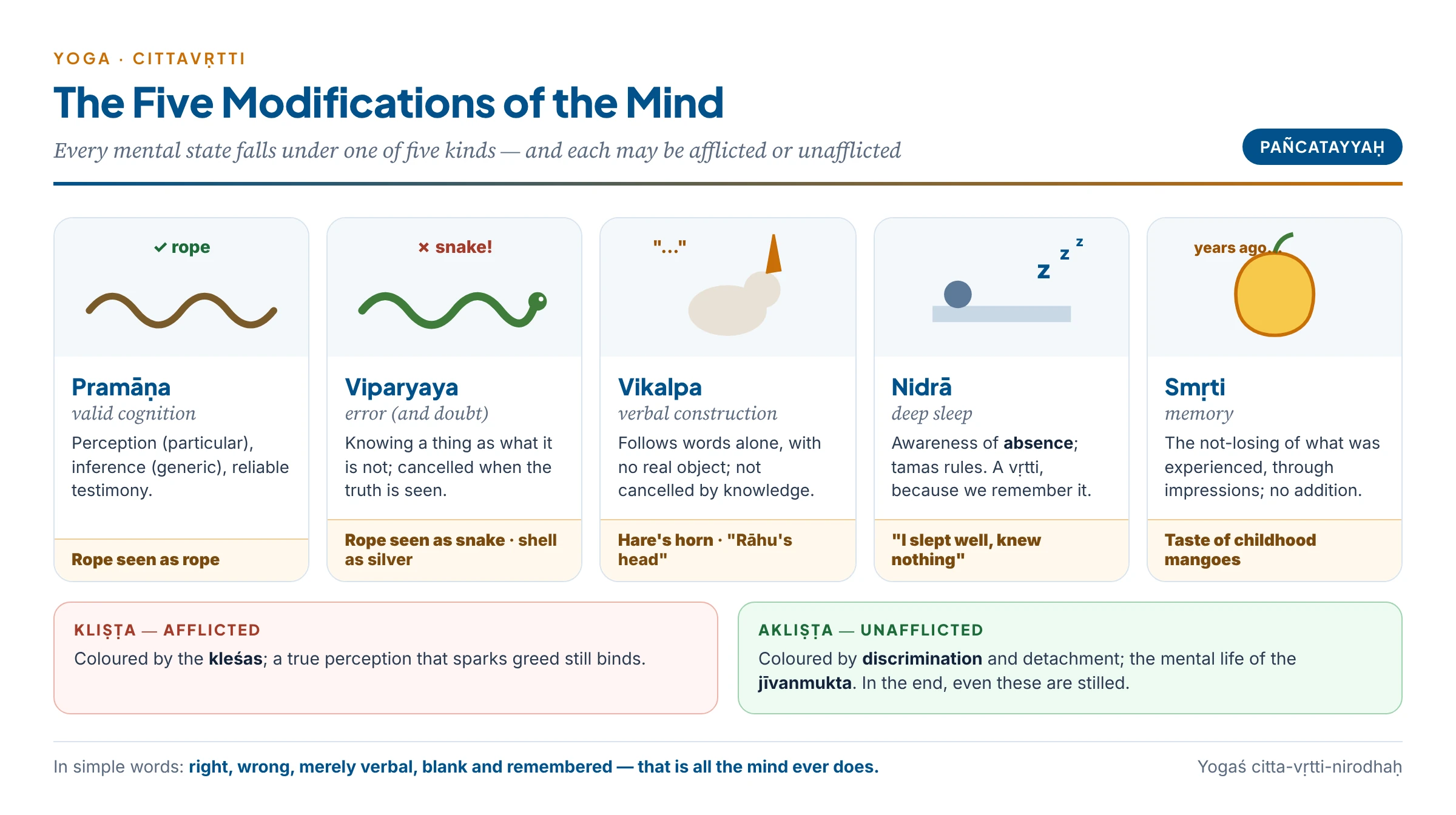
| Vṛtti | Meaning | Mark | Example |
|---|---|---|---|
| Pramāṇa | Valid cognition | Matches the object; three means | Rope seen as rope |
| Viparyaya | Error (and doubt) | Does not match; corrected later | Rope seen as snake |
| Vikalpa | Verbal construction | Words without a real object; not cancelled | Hare’s horn; “Rāhu’s head” |
| Nidrā | Deep sleep | Awareness of absence; tamas | “I slept well, knew nothing” |
| Smṛti | Memory | Past experience retained, unaltered | Taste of childhood mangoes |
Common confusion
Is viparyaya “doubt” and vikalpa “imagination” in the ordinary sense? Not quite. Viparyaya is, first of all, positive error — taking a thing for what it is not (rope as snake); doubt is included in it only as an uncertain cognition. Vikalpa is not daydreaming in general but a cognition produced by words alone, with no real thing behind them (“son of a barren woman”, “Rāhu’s head”). Unlike error, it is not cancelled when we know the truth.
2. Kliṣṭa and Akliṣṭa: Afflicted and Unafflicted Vṛttis
- Two kinds of each. Every one of the five vṛttis may be:
- Kliṣṭa (afflicted) — “detrimental to the goal of Yoga”. These arise when the mind is under the five kleśas (ignorance, egoism, attachment, aversion, clinging to life). Literally, kliṣṭa means “caused by the kleśas”.
- Akliṣṭa (unafflicted) — “conducive to it”. These arise from the opposites of the kleśas: discriminating knowledge and freedom from desire.
- Examples.
- A valid perception of a beautiful house that sparks greed is afflicted; a valid perception of the impermanence of things that strengthens detachment is unafflicted.
- Memory of an insult that breeds anger is afflicted; memory of the teacher’s instruction is unafflicted.
- The liberated life. “Put simply, akliṣṭa vṛttis are the mental activities of a jīvanmukta” — one liberated while still alive.
- Even good vṛttis must finally go. Unafflicted vṛttis are like a thorn used to remove another thorn: once the work is done, both are thrown away. In the highest absorption all five — even valid knowledge — are stilled.
In simple words
Two people read the same newspaper report of a rival’s failure. One feels a secret thrill — an afflicted vṛtti fed by envy. The other thinks, “this could happen to anyone; let me not be proud” — an unafflicted vṛtti fed by understanding. Same perception, opposite direction: one adds to bondage, the other loosens it.
3. Effects of Cittavṛtti: How Vṛttis Bind
- The self appropriates the states. “When citta is modified into any kind of vṛtti, the self is reflected in it and is apt to appropriate it as a state of itself.”
- The result in experience. The self “considers itself to be subject to birth and growth, decay and death. It is led to believe that it sleeps and wakes up, imagines and remembers, makes mistakes and corrects errors.” Through this it “feels pleasure or pain out of the objects of the world, and loves or hates them accordingly. This means bondage.”
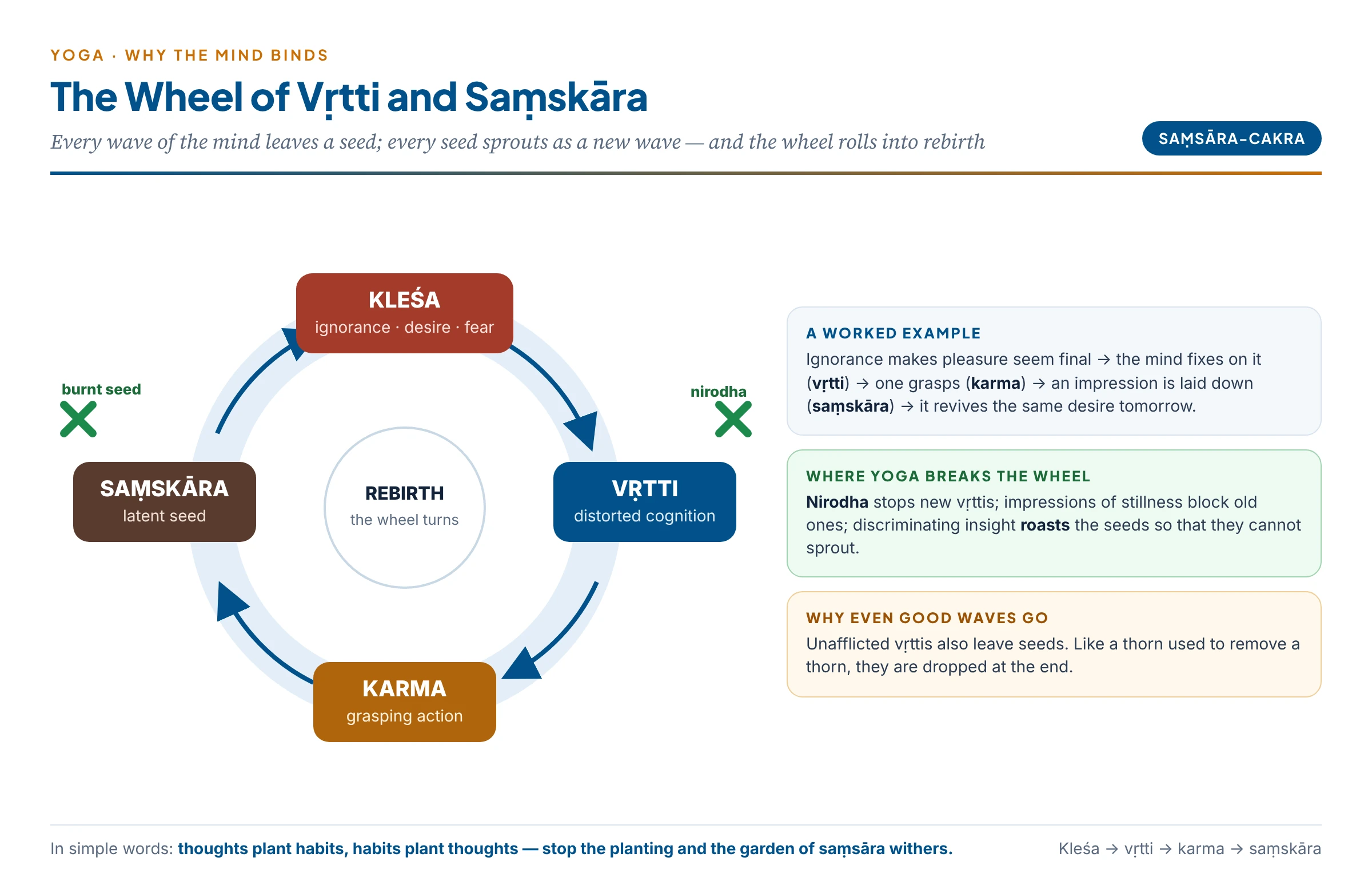
- The cycle of saṃsāra. The vṛttis do not end when they pass; they leave seeds:
- Kleśa (ignorance, desire, aversion) colours the mind;
- it produces vṛttis (distorted cognitions — error, vikalpa);
- these lead to karma (actions);
- actions leave saṃskāras (latent impressions) in citta;
- saṃskāras sprout as new vṛttis — and the wheel turns into rebirth.
- Example of the cycle. Ignorance makes pleasure seem ultimate → attachment drives grasping action → the action leaves an impression → the impression revives desire → bondage deepens.
- So the cause of disturbance is attachment. “We attach to different objects differently; we cognise objects wrongly; we fall into inactivity, doubt and carelessness” — and the mind never reaches tranquillity, because “citta imagines itself as the agent and the enjoyer, due to Puruṣa’s reflection on it.”
4. What Does “Yogaś Citta-vṛtti-nirodhaḥ” Mean?
- The definition. “Yoga is the restraint (nirodha) of the modifications (vṛttis) of the mind (citta).”
- Nirodha is not violence. “Nirodha means restraint, control, or complete stilling. It does not imply violent suppression but a state of mastery in which the fluctuations of citta are pacified.”
- The image of the lake. “Just as a lake becomes transparent when its waves settle, so too consciousness becomes clear when vṛttis are stilled. In this state, the mind reflects only the Self, rather than being coloured by external objects or internal impressions.”
- Definition and goal together. Citta-vṛtti-nirodha is “both the definition and the goal of Yoga”. It links psychology with metaphysics: by disciplining the mind, one transcends Prakṛti and realises the self.
- Not blankness. “This state is not mere blankness but the revelation of the Puruṣa — unconditioned, eternal consciousness.” Freedom comes “not through rituals or dogmas, but through mastery of the mind“.
- Two senses of nirodha.
- Partial nirodha — in one-pointed concentration all modifications except the one on the chosen object are stopped (samprajñāta).
- Total nirodha — even that one is stopped; only impressions remain (asamprajñāta).
5. Why Must the Modifications Cease? Five Reasons
- They veil the self. While the mind is full of waves, Puruṣa is seen only through them and “takes their form”. Only when they cease does “the seer abide in its own nature”.
- They are the channel of bondage. Pleasure, pain, love and hate reach the self only through vṛttis; no vṛtti, no misidentification, no suffering.
- They produce saṃskāras and rebirth. Every vṛtti leaves a seed; seeds sprout as new vṛttis and actions. To end rebirth, the production of seeds must stop.
- Even pleasant states are painful to the wise. For the discerning person “everything is pain“: pleasures change and end, bring the anxiety of losing them, leave impressions that create new cravings, and the guṇas are always in conflict. So even sāttvika vṛttis cannot be the final home.
- Discrimination needs a still mind. Liberating insight (viveka-khyāti) — “I am not citta” — cannot arise in a mind that is flooded with its own contents, just as the bottom of a lake cannot be seen through waves.
In simple words
A man watching a horror film forgets the cinema and his heart races. The film is not “bad” for being a film; the problem is that he has lost himself in it. Switch off the projector and the hall lights come on; he remembers who he is. Yoga does not hate thoughts; it asks us to stop the projector long enough to remember the watcher.
6. The Means of Cessation: Abhyāsa and Vairāgya
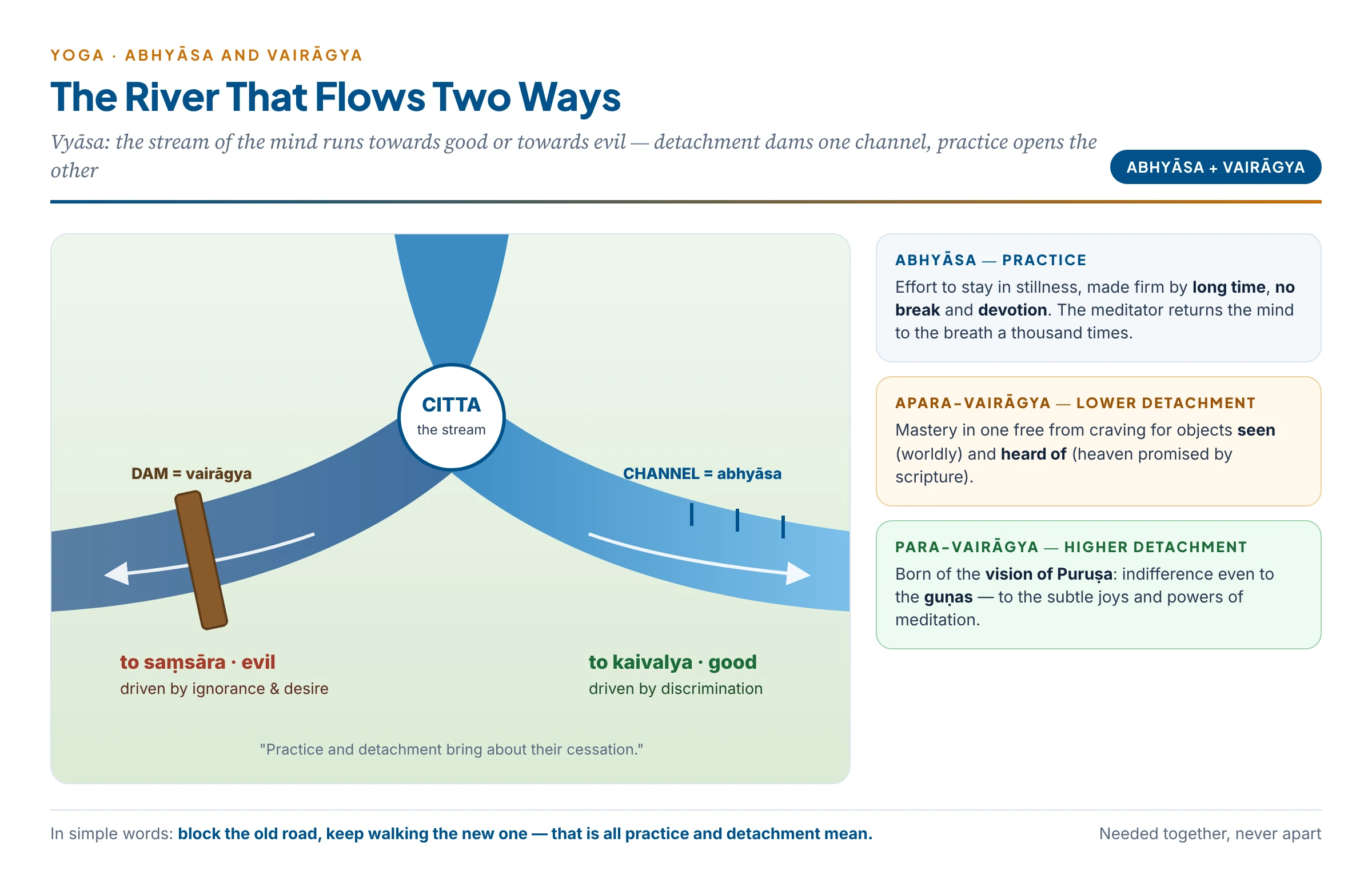
“The cessation of the modifications is brought about by practice and detachment” (abhyāsa-vairāgyābhyāṃ tan-nirodhaḥ).
- Why both are needed — the river of the mind. Vyāsa compares citta to a river that flows both ways: towards evil (pāpa) when driven by ignorance and desire, and towards good (kalyāṇa) when driven by discrimination. Detachment dams the flow towards objects; practice opens the channel towards discrimination.
- Abhyāsa — practice.
- It is “the effort to remain firmly anchored in the state of mental stillness”.
- It becomes firmly grounded only when “cultivated for a long time, without interruption, and with devotion (respect)”.
- Example: the meditator who brings the wandering mind back to the breath a thousand times; the student who practises daily, not occasionally.
- Vairāgya — detachment.
- Basic detachment (apara-vairāgya, “the non-highest”): the consciousness of mastery in one who is free from craving for objects seen (worldly pleasures) and objects heard of (pleasures promised in scripture, such as heaven).
- Higher detachment (para-vairāgya): arising from the vision of Puruṣa, it is indifference even to the guṇas themselves — not only to objects but to the subtle joys and powers of meditation.
- How they work together. Practice builds steadiness; detachment removes the pull of objects. Without detachment, practice is constantly disturbed; without practice, detachment remains a pious wish.
7. Obstacles to Practice and Their Remedies
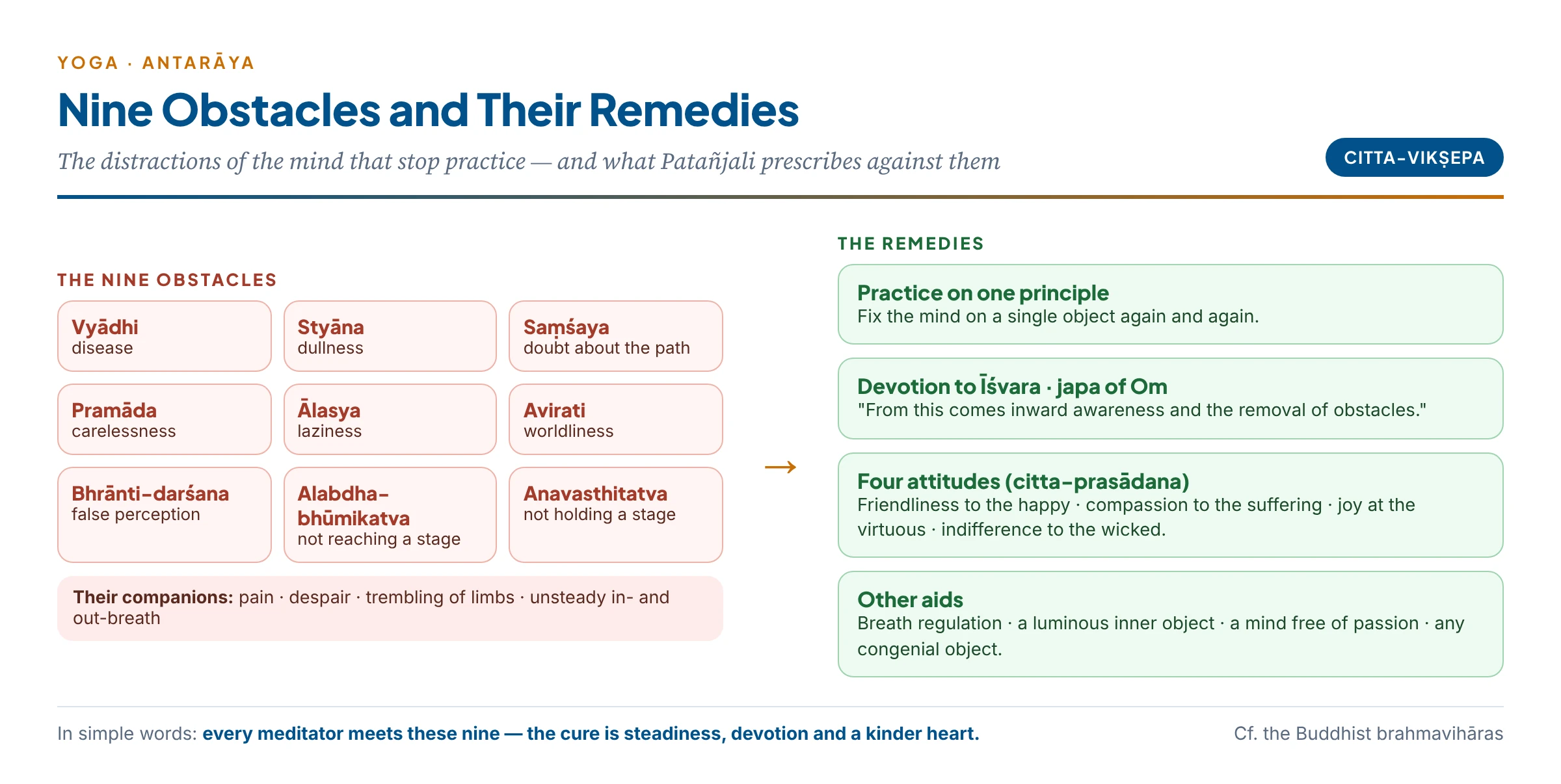
- Nine obstacles (antarāya), which “distract the mind” (citta-vikṣepa):
- Disease (vyādhi)
- Dullness — mental inertia (styāna)
- Doubt about the path (saṃśaya)
- Carelessness (pramāda)
- Laziness (ālasya)
- Worldliness — failure to detach from sense-pleasures (avirati)
- False perception — mistaken views (bhrānti-darśana)
- Failure to reach a stage of concentration (alabdha-bhūmikatva)
- Instability — failure to hold a stage once reached (anavasthitatva)
- Their five companions: pain, despair, trembling of the limbs, and disturbed inhalation and exhalation.
- Remedies.
- Practice on one principle (eka-tattva-abhyāsa) — fixing the mind on one object.
- Devotion to Īśvara — repetition of Om “removes the obstacles” (Article 7).
- Four attitudes that clear the mind (citta-prasādana): friendliness (maitrī) towards the happy, compassion (karuṇā) towards the suffering, joy (muditā) towards the virtuous, and indifference (upekṣā) towards the wicked.
- Other aids: regulated breathing, focusing on a luminous inner object, meditating on a mind free of passion, reflecting on the knowledge of dreams and sleep, or meditating on any object one finds congenial.
Indian Connect — The four attitudes in Buddhism and Yoga
- Patañjali’s friendliness, compassion, joy and equanimity are the same four “divine abodes” (brahmavihāras) taught by the Buddha.
- They show that Yoga’s psychology grew in dialogue with Buddhism: both treat emotions towards others as a direct cause of mental disturbance or calm.
- Yoga also calls internal purification (part of śauca, Article 5) the cultivation of “friendliness, kindness and cheerfulness for the virtues and indifference to the vices of others”.
Critical Evaluation
1. Strengths of the Theory of Cittavṛtti
- Exhaustive and simple. Five kinds cover all cognitive states — valid, invalid, verbal, absent and remembered.
- Sleep as a mental state. Treating deep sleep as a vṛtti, on the basis of the memory “I slept well”, is an acute piece of analysis that Advaita too accepts.
- Vikalpa — a theory of linguistic illusion. Yoga noticed long ago that language can create objects that do not exist (“Rāhu’s head”, “the consciousness of Puruṣa”) — a point close to modern critiques of language “bewitching” thought.
- Ethics inside psychology. The afflicted/unafflicted distinction shows that the same cognition can bind or free depending on its emotional colour.
- Practical. Every element of the theory is tied to a method: practice, detachment, the four attitudes, remedies for obstacles.
2. Criticisms
- Only cognition? The list is entirely cognitive. Where are emotions, feelings and will? Yoga’s answer is that these belong to the kleśas (attachment, aversion) which colour the vṛttis — but critics feel the classification is lopsided.
- Is sleep really a cognition? Nyāya argues that in deep sleep the mind is not in contact with anything, so there is no cognition; the waking memory “I slept well” can be inferred from feeling refreshed.
- The reflection problem. An unconscious citta takes forms, and an inactive Puruṣa “sees” them — the old Sāṃkhya puzzle reappears at the level of every single vṛtti.
- Suppression or transformation? Modern psychology warns that stopping mental activity may become repression; Buddhism holds that meditation should transform the mind through insight into impermanence, not simply halt it.
- Can cessation liberate? Nyāya argues that liberation needs true cognition of the self; mere cessation of cognition is not knowledge. And if all vṛttis cease, what distinguishes the result from unconsciousness?
- Nirodha of valid knowledge? Why should even true knowledge be stilled? Does Yoga undervalue reason?
3. Yoga’s Replies
- Not repression but replacement. Yoga does not push vṛttis down by force; it replaces distracting impressions with impressions of stillness (nirodha-saṃskāra) through patient practice, and it removes their cause (the kleśas) by detachment and discrimination.
- Cessation reveals. The aim is not an empty mind but the self-revelation of Puruṣa, which is pure consciousness; unconsciousness is a tamas state (nidrā), the very opposite of nirodha.
- Knowledge used, then transcended. Valid knowledge is the ladder: right understanding of self and non-self is cultivated first, then even this mental state is let go, because the self is not a thought about the self.
Critics and Defenders
Criticism — Critics
- Narrow classification: feelings and will are not listed as vṛttis.
- Nyāya: deep sleep is no cognition; liberation needs knowledge, not cessation.
- Buddhism: halting thought is not insight; there is no self to be revealed.
- Modern psychology: nirodha risks becoming suppression.
- Sāṃkhya puzzle: how does an inactive Puruṣa “see” an unconscious citta’s forms?
Defence — Defenders and strengths
- Exhaustive: five vṛttis cover all cognitive states.
- Sharp analysis: sleep shown to be a vṛtti through memory; vikalpa exposes illusions of language.
- Ethical psychology: the afflicted/unafflicted distinction.
- Method, not force: practice and detachment replace and uproot, they do not repress.
- Goal is positive: cessation reveals pure consciousness, unlike sleep.
Cross-Tradition Comparison
Yoga’s Vṛttis and Other Theories of Knowledge
| Point | Yoga | Nyāya | Advaita | Western parallel |
|---|---|---|---|---|
| Pramāṇas | Three: perception, inference, testimony | Four (adds comparison) | Six | Empiricism: perception chief |
| Error | Viparyaya: knowing a thing as what it is not | Anyathākhyāti: misplacing a real object | Anirvacanīya: neither real nor unreal | Descartes: error from will outrunning intellect |
| Sleep | A vṛtti (awareness of absence) | No cognition | Witness remains; ignorance present | Locke: the mind does not always think |
| Words without objects | Vikalpa | — | — | Russell’s “the present King of France”; Wittgenstein on language misleading us |
| Final aim | Stilling all cognition | True cognition of the self | Knowledge of identity with Brahman | Truth for its own sake |
Indian Connect — Key takeaways
- Yoga shares the three pramāṇas with Sāṃkhya; its originality lies in treating error, verbal construction, sleep and memory as modifications to be stilled, not only as problems of logic.
- Unlike Nyāya and Advaita, where knowledge liberates, Yoga finally asks even knowledge to fall silent.
- Its four attitudes and the stress on attention show the closeness of Yoga and Buddhist meditation.
Synthesis (Siddhānta)
- Vṛttis are the forms citta takes — five in all: valid cognition, error, verbal construction, sleep and memory. Each may be afflicted (feeding bondage) or unafflicted (aiding freedom).
- Their effect: the self, reflected in them, appropriates them — it seems to sleep and wake, err and remember, love and hate. Through saṃskāras they turn the wheel of kleśa → vṛtti → karma → saṃskāra → rebirth.
- Yoga is their cessation — not violent suppression or blankness but the mastery in which the waves settle and the seer abides in itself.
- Why cease? They veil the self, carry pain, sow rebirth, are painful even when pleasant to the discerning, and block discriminating insight.
- How? By practice (long, unbroken, devoted) and detachment (lower and higher), aided by remedies for the nine obstacles and the four attitudes of friendliness, compassion, joy and equanimity.
- A balanced view. The theory is a precise map of cognition joined to a method of mental training; its limits are its cognitive bias and the inherited puzzle of how an inactive self can be bound.
- Contemporary relevance.
- Overthinking and anxiety. Modern therapy’s focus on rumination — thoughts that feed on themselves — echoes the vṛtti–saṃskāra cycle.
- Media and misinformation. Vikalpa — words creating “objects” that do not exist — is a sharp tool for thinking about slogans, labels and fake narratives.
- Habit formation. Practice that is “long, unbroken and devoted” is exactly how stable habits are built today.
“Practice becomes firmly grounded when cultivated for a long time, without interruption, and with devotion.” — Patañjali, Yoga Sūtra
Previous Year Questions
- 2023Explain Chitta and its modifications in the philosophy of Yoga. Why does Yoga philosophy prescribe cessation of modifications of Chitta? Give reasons in support of your answer.
- 2017What is meant by ‘yogaś citta-vṛtti-nirodhaḥ’? Explain Cittavṛtti and its effects according to Yoga philosophy.
- 2013Give a critical account of the concept of cittavṛtti in Yoga philosophy.