

Anthropology Optional › Paper II › Unit 09: Tribal Administration and Development
9.1 History of administration of tribal areas, tribal policies, plans, programmes of tribal development and their implementation. The concept of PTGs (Primitive Tribal Groups), their distribution, special programmes for their development. Role of N.G.O.s in tribal development.
Official Syllabus: Paper II, Unit 9.1
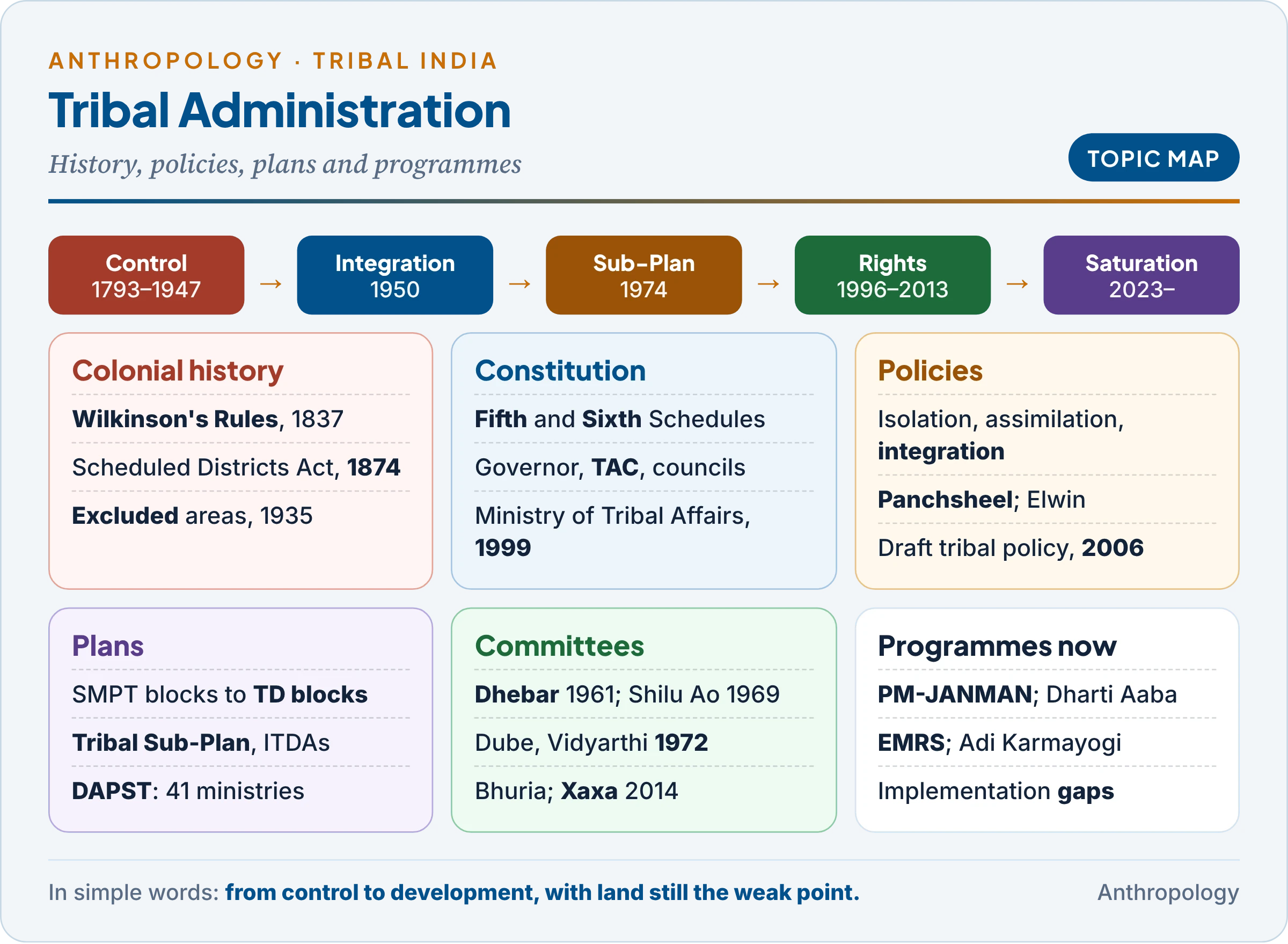
This article covers the history of tribal administration, tribal policies, and plans and programmes with their implementation. Particularly Vulnerable Tribal Groups and the role of NGOs are in 9.1b. The Fifth and Sixth Schedules are explained in 7.1, Nehru’s Panchsheel and the working of ITDPs in 7.2, and the colonial timeline of tribal change in 7.3b; they are summarised here where the story needs them.
1. History of Administration of Tribal Areas
In simple words
The British first ruled tribal areas like any other district, which let landlords and moneylenders take tribal land and caused revolts. They then kept these areas apart under special laws and officers. After 1947 the Constitution kept the idea of special areas but changed the goal from control to protection and development.
Example first: Wilkinson’s Rule in Kolhan. After the Kol rising of 1831–32 in Chotanagpur, Captain Thomas Wilkinson, the Agent of the new South-West Frontier Agency, chose not to rule the Ho country of Kolhan through police and courts. From 1837 he governed through the Ho’s own headmen: the village munda and the manki (head of a group of villages, a pir), with simple rules for land, revenue and disputes. These Wilkinson’s Rules kept outsiders and lawyers away and recognised customary authority. The case shows the colonial pattern in miniature: revolt first, then special administration, using tribal institutions as the lowest rung of the state.
1.1 Phases of colonial administration
The colonial record falls into three phases. The table sets them out with their main instruments.
| Phase | Instruments | What they did |
|---|---|---|
| Ordinary rule and revolt (1765–1830s) | Permanent Settlement (1793); ordinary courts; forest and excise rules | Zamindars became owners; tribal cultivators became tenants and debtors; revolts followed (Kol 1831–32, Santhal hul 1855) |
| Non-regulation tracts and special laws (1833–1918) | Regulation XIII of 1833 (South-West Frontier Agency); Wilkinson’s Rules (1837); Santhal Parganas district (1855); Inner Line (Bengal Eastern Frontier Regulation, 1873); Scheduled Districts Act (1874); Chota Nagpur Tenancy Act (1908) | Ordinary laws did not apply automatically; officers ruled with wide discretion; some land protection after revolts |
| Backward tracts to excluded areas (1919–1947) | Government of India Act, 1919 (“backward tracts”: wholly excluded and modified exclusion); Government of India Act, 1935 (sections 91–92) and the Order of 1936 | Tribal areas kept outside the reformed legislatures and placed under the Governor |
- Non-regulation meant that the general regulations (laws) of a province did not run automatically; the Government of India Act of 1870 let the Governor-General make simple regulations for such tracts, and the Scheduled Districts Act of 1874 let the government decide which laws applied in listed “scheduled districts”.
- Criminalisation: the Criminal Tribes Act (1871, consolidated 1924) branded whole wandering and forest communities as “criminal by birth”, registered them and confined many to settlements that supplied cheap labour. It was repealed in 1952, but States’ Habitual Offenders Acts, police records and prison rules kept the label alive; the Supreme Court struck down such prison rules in 2024. The commissions on these “denotified” tribes are in 7.1.
- Why special rule came: each major revolt (Kol, Santhal, Birsa Munda’s ulgulan of 1899–1900) exposed land loss and outsider exploitation; special administration and tenancy laws were the state’s answer (movements in 7.4).
1.2 Excluded and Partially Excluded Areas (1935)
The Government of India Act, 1935 created two categories, listed in the Government of India (Excluded and Partially Excluded Areas) Order, 1936.
| Point | Excluded Areas | Partially Excluded Areas |
|---|---|---|
| Examples | Naga Hills, Lushai Hills and the frontier tracts of Assam; Chittagong Hill Tracts; Laccadives | Chotanagpur and Santhal Parganas (Bihar); Agency tracts of Madras and Orissa; parts of Assam |
| Who governed | The Governor in his discretion, outside ministerial control | The Governor, but with ministers’ advice, which he could override by his individual judgement |
| Laws | No Act applied unless the Governor so directed; he could make regulations for peace and good government | Same power to exclude or modify laws |
| Legislature | Expenditure non-votable; no discussion without the Governor’s consent | Expenditure voted; limited debate |
- Two readings: officials such as J.H. Hutton (Census Commissioner, 1931) and W.V. Grigson (The Aboriginal Problem in the Central Provinces and Berar, 1944) defended exclusion as protection; nationalists called it divide and rule that kept tribes apart from the freedom movement. G.S. Ghurye (The Aborigines “So-called” and Their Future, 1943) argued that tribes were “backward Hindus” who should be integrated.
- Verrier Elwin’s early idea of a protected “national park” for the most isolated groups (The Baiga, 1939) became the symbol of isolationism in this debate, though he later moved to protected integration (§2.2).
1.3 From the Constituent Assembly to the Schedules
- Two sub-committees of the Constituent Assembly studied tribal areas: the North-East Frontier (Assam) Tribal and Excluded Areas sub-committee under Gopinath Bordoloi, and the Excluded and Partially Excluded Areas (other than Assam) sub-committee under A.V. Thakkar (“Thakkar Bapa”).
- Their reports produced the Fifth Schedule (Scheduled Areas in central and western India: Governor’s power to make regulations on land transfer and moneylending, Tribes Advisory Councils, annual report to the President) and the Sixth Schedule (elected autonomous district councils in Assam, Meghalaya, Tripura and Mizoram). B.R. Ambedkar observed that “Scheduled Areas” were the old excluded and partially excluded areas under a new name. Both Schedules are compared in 7.1.
- What changed: the goal shifted from control to protection plus development, and tribes gained reserved seats and voice. What stayed: the area-based special regime, the Governor’s special powers and the forest bureaucracy.
Common confusion
Are “Scheduled Areas”, “Tribal Areas” and “Tribal Sub-Plan areas” the same? No. Scheduled Areas are declared by the President under the Fifth Schedule (ten States, such as Jharkhand, Odisha and Madhya Pradesh). Tribal Areas are the Sixth Schedule areas of four North-Eastern States, run by autonomous district councils. Tribal Sub-Plan areas are a planning category (ITDPs, MADA pockets, clusters) used to channel funds; they overlap with Scheduled Areas but also cover tribal pockets outside them.
1.4 The administrative machinery after 1950
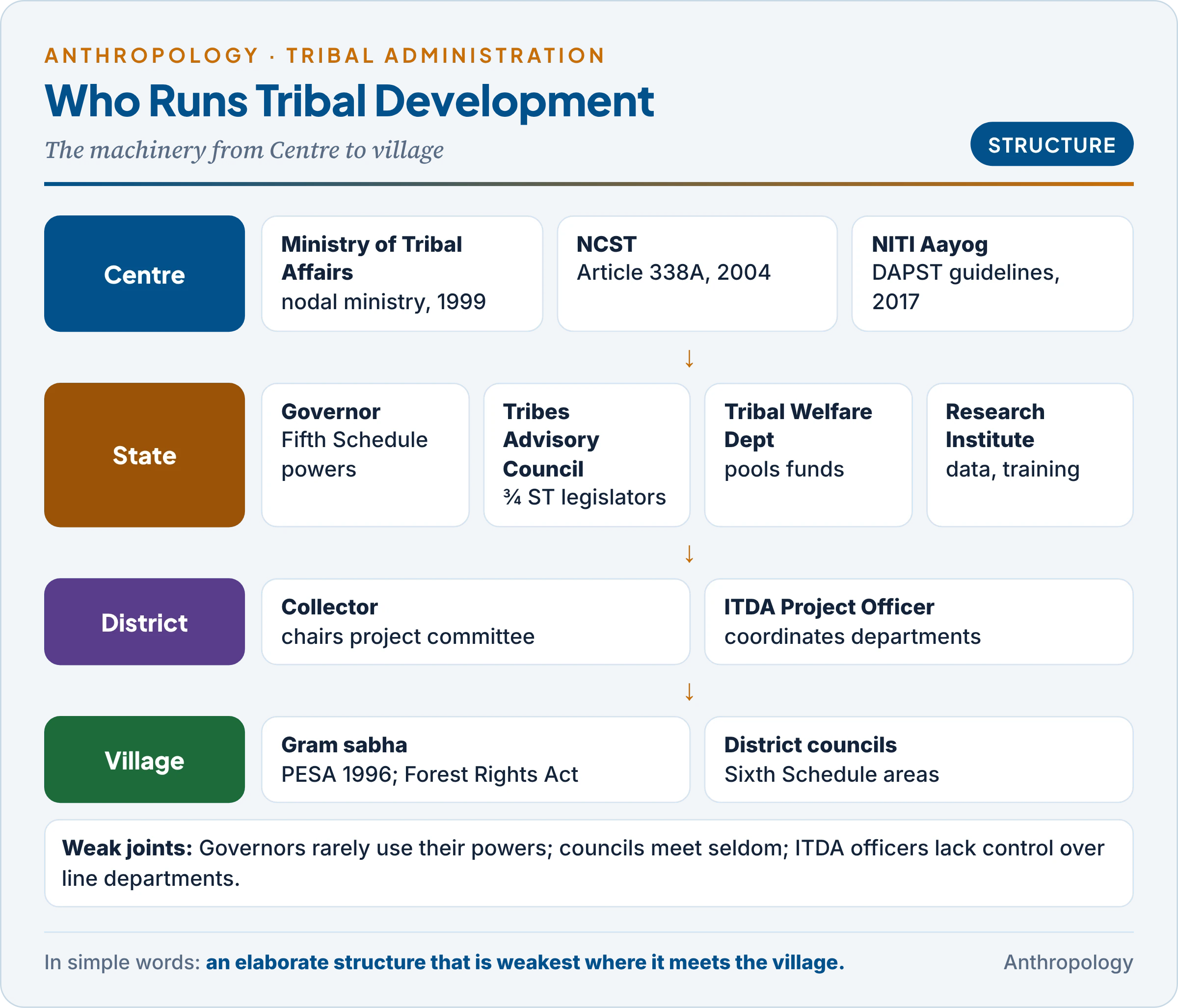
- Centre: tribal welfare sat with the Home Ministry and then with social welfare departments until the Ministry of Tribal Affairs was carved out in October 1999 as the nodal ministry. A Commissioner for SCs and STs (Article 338) reported from 1950; a non-statutory Commission for SCs and STs came in 1978, a constitutional National Commission after the 65th Amendment (1990), and a separate National Commission for Scheduled Tribes (Article 338A, 89th Amendment, 2003) from 2004. The President also appoints a Scheduled Areas and Scheduled Tribes Commission under Article 339 (Dhebar, 1960–61; Bhuria, 2002–04).
- State: the Governor (Fifth Schedule powers and annual report), the Tribes Advisory Council (up to 20 members, three-fourths of them ST legislators), a Tribal Welfare Department, and a Tribal Research Institute for data, training and evaluation.
- District and project: the Collector, and the Project Officer of an Integrated Tribal Development Agency (ITDA), meant to coordinate all departments in a tribal project area.
- Village: the gram sabha with special powers under PESA (1996) and the Forest Rights Act (2006); in the North-East, the autonomous district councils and customary councils.
The weak link: reviews from the Dhebar Commission onward found that Governors rarely used their Fifth Schedule powers, Tribes Advisory Councils met irregularly and only on matters referred to them, and ITDA officers had little control over line departments. The machinery was elaborate on paper and weak at the joints.
2. Tribal Policies
In simple words
A policy is the government’s basic answer to the question: what should happen to tribal communities? Should they be kept apart, absorbed into the majority, or helped to develop while keeping their identity? India chose the last answer, called integration, but its practice has often drifted towards absorption and loss of land.
2.1 Isolation, assimilation and integration
The three classic positions are compared below; the scholars’ debate is in 4b and the social effects in 7.2.
| Approach | Core idea | Champions | Weakness |
|---|---|---|---|
| Isolation | Keep tribes apart to protect them from exploitation | Colonial excluded areas; early Elwin | Freezes poverty; serves the state’s convenience |
| Assimilation | Absorb tribes into the Hindu or national mainstream | G.S. Ghurye; reformist and missionary agencies | Destroys culture; treats difference as backwardness |
| Integration | Join national life on equal terms, keeping identity | Nehru; later Elwin; the Constitution | Easy to state, hard to practise; slides into assimilation |
India’s official choice was integration: development without loss of identity. The table shows why: isolation had kept tribes poor and exploited under British rule, and assimilation would have destroyed what the Constitution set out to protect.
2.2 Nehru’s Panchsheel and Elwin’s contribution
Nehru’s Tribal Panchsheel, in his foreword to Elwin’s A Philosophy for NEFA (second edition, 1959), set five principles: develop “along the lines of their own genius”; respect land and forest rights; train their own people for administration; do not over-administer or overwhelm them with schemes; judge results by the quality of human character, not money spent. Their record is assessed in 7.2.
Verrier Elwin, the British-born anthropologist who became an Indian citizen in 1954, shaped post-independence policy more than any other anthropologist:
- Adviser for Tribal Affairs, NEFA (present Arunachal Pradesh) from 1954: he argued for administration through tribal councils, recruitment of local people, protection of land, use of local languages and respect for tribal arts and religion.
- A Philosophy for NEFA (1957; second edition 1959) gave the NEFA approach: neither a “museum” nor rapid assimilation, but gradual, self-directed change. Nehru’s Panchsheel was its preface.
- The 1959 committee on the 43 Special Multipurpose Tribal Blocks, which he chaired, criticised schemes copied unchanged from plains blocks and pressed for simpler, tribe-specific programmes; its report (1960) led to the Tribal Development Blocks.
- Assessment: critics called him an isolationist and later scholars noted his paternalism; but his principles of consent, land protection and tribal agency run through PESA and the Forest Rights Act.
2.3 The constitutional framework in brief
The Constitution turned policy into law. The table lists the main provisions and Acts that a policy answer cites.
| Provision or Act | What it does |
|---|---|
| Article 46 | Directs the State to promote STs’ educational and economic interests and protect them from exploitation |
| Articles 15(4), 16(4), 335 | Allow special provisions and reservation in education and jobs |
| Articles 330, 332 | Reserved seats in the Lok Sabha and State Assemblies |
| Article 244(1), (2); Fifth and Sixth Schedules | Special administration of Scheduled Areas and Tribal Areas |
| Article 275(1) | Central grants for tribal welfare and for raising administration in Scheduled Areas |
| Article 338A | National Commission for Scheduled Tribes |
| Article 339 | Union control over Scheduled Areas administration; periodic commission |
| Article 342, 366(25) | Notification of Scheduled Tribes by the President; changes only by Parliament |
| Bonded Labour System (Abolition) Act, 1976 | Frees bonded labourers, many of them tribal |
| SC and ST (Prevention of Atrocities) Act, 1989 | Punishes atrocities, including land dispossession |
| PESA, 1996 | Gram sabha powers in Fifth Schedule areas |
| Forest Rights Act, 2006 | Individual and community forest rights |
| LARR Act, 2013 | Consent, social impact assessment and resettlement in land acquisition |
- Changing the ST list: only Parliament can amend a Presidential order (Article 342(2)). Since 1999 a claim must be backed by the State government, the Registrar General of India and the National Commission before the Cabinet and Parliament act. A large revision came with the Scheduled Castes and Scheduled Tribes Orders (Amendment) Act, 2002; recent additions such as the Hattee (2023) show the political pressures (6.1, 7.3b).
The list falls into the three types of safeguard usually named: protective (land, atrocities, bonded labour), political (seats, councils, PESA) and developmental (grants, the sub-plan). The gap between them is the theme of §4.
2.4 Five approaches to tribal welfare
Older reviews describe five agencies or approaches through which tribal welfare has been pursued, each with a typical strength and weakness.
| Approach | Agent | Strength | Weakness |
|---|---|---|---|
| Political | Constitution, legislatures, tribal leaders | Reserved seats, new tribal states and councils | Politicisation; tribal elites capture benefits |
| Administrative | Ministries, Governors, ITDAs | Large machinery and funds | Paternalism; poor coordination |
| Religious | Missions, Ramakrishna Mission, Arya Samaj | Schools, hospitals, literacy | Conversion splits communities (see 8.1) |
| Voluntary | NGOs such as the Bharatiya Adimjati Sevak Sangh (1948) | Commitment, local presence | “Omnibus” reforms that ignore tribal values (see 9.1b) |
| Anthropological | Anthropologists, Tribal Research Institutes | Knowledge of culture and resistance points | Little executive power; labelled “isolationist” |
The anthropological approach asks planners to study tribal values first, identify integrating forces and points of least resistance, train administrators in tribal culture, and watch the effects of schemes so that what destroys solidarity can be stopped. Cultural factors decide whether a programme is accepted: a scheme that clashes with land tenure, kinship or religious calendars fails however well funded.
2.5 The draft National Tribal Policy (2006)
The Ministry of Tribal Affairs prepared a draft National Tribal Policy in 2006, the first attempt at a single written policy. It was never finalised; the government later said it had been overtaken by new laws, and a High Level Committee (Xaxa, §3.4) was asked instead to prepare a position paper.
- Content: mother-tongue teaching at the primary level and residential schools; validation of tribal medicine; displacement only as a last resort, with land for land; converting forest villages into revenue villages; pattas and access to land records; intellectual property protection for traditional knowledge; strengthening Tribes Advisory Councils and autonomous councils; posting sensitive officers for fixed tenures; and stopping the stigma of the word “primitive“.
- Critique: it was a list of aims without legal force or funds; its section on “assimilation” through ending isolation sat uneasily with its promise to preserve identity; and it stayed silent on mining and consent, the main source of conflict. Its value lies in recording the problems in one place.
2.6 Shifting terrains: colonial to post-colonial policy
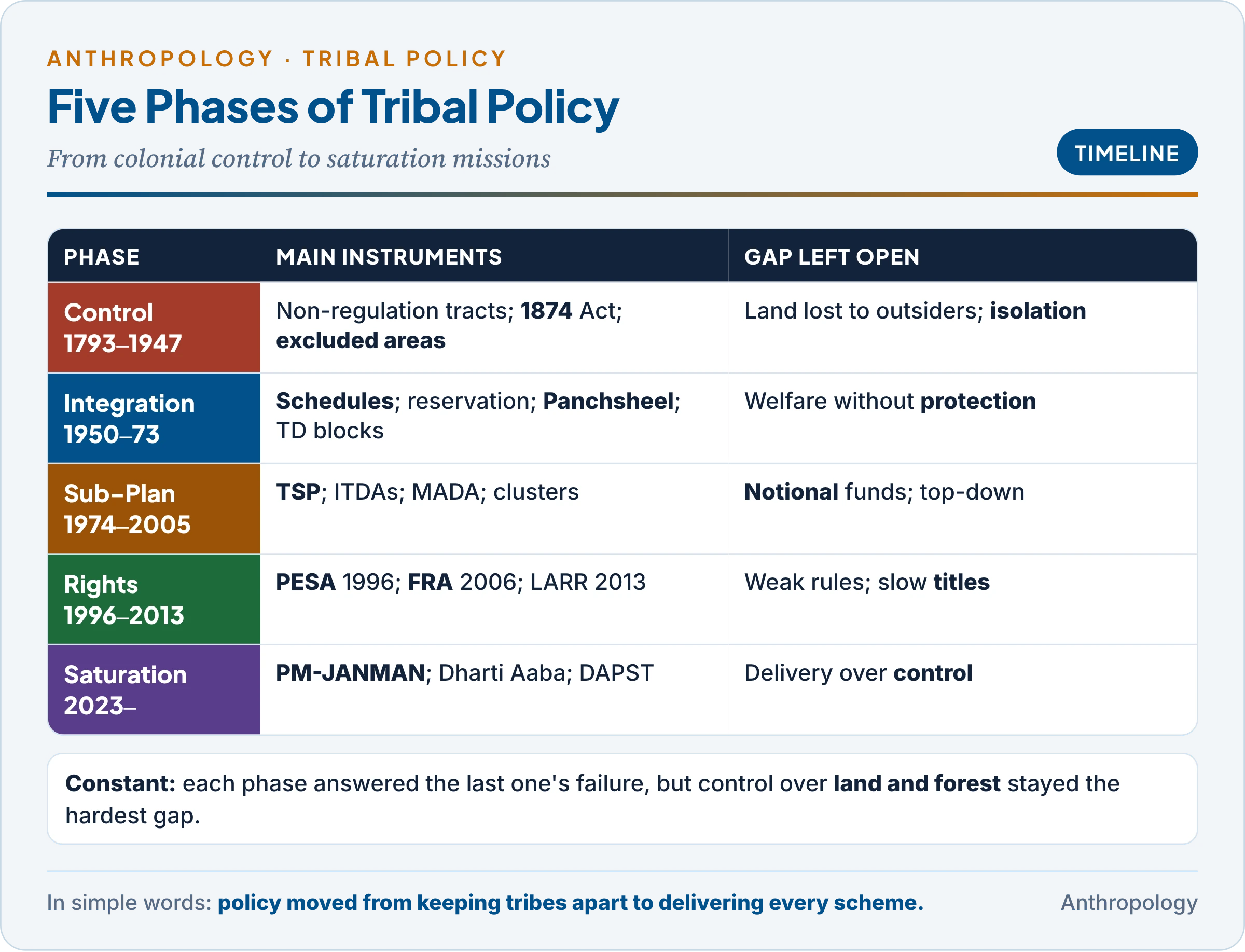
Policy has moved through five phases. The colonial state controlled and isolated; the Constitution chose integration with welfare; the Fifth Plan added area development through the sub-plan; the 1990s and 2000s turned to rights (PESA, the Forest Rights Act, land acquisition reform); and since 2023 the state has run saturation missions that try to deliver every scheme to every tribal household. Each phase corrected a gap in the last, yet the deepest gap, control over land and forest, has narrowed only slowly.
3. Plans and Programmes of Tribal Development
In simple words
Since 1951 India has planned tribal development through Five Year Plans and special schemes. Early plans treated tribal areas like other villages and failed. From 1974 the Tribal Sub-Plan required every government to set aside money for tribal areas in proportion to their population. Today this money is called the Development Action Plan for Scheduled Tribes, and large missions try to bring every service to tribal villages.
Example first: the 3 per cent that was not spent. In the 1960s the Andhra Pradesh government ordered every department to earmark 3% of its plan budget for Scheduled Tribes. The Shilu Ao study team (1969) found the order “largely ignored”: departments treated the small special tribal budget as the only money for tribes and spent their own funds elsewhere. This lesson, that tribal shares vanish unless they are separate and non-divertible, is why the Tribal Sub-Plan of 1974–75 made earmarking compulsory and placed the money under separate budget heads.
3.1 Plan by plan
The table follows the main steps from the First Plan to the present. Each step answers a failure of the one before.
| Period | Programme | Lesson learnt |
|---|---|---|
| First Plan (1951–56) | Community Development (2 October 1952) for all villages | General blocks did not reach tribal areas |
| 1954 onwards | 43 Special Multipurpose Tribal Blocks, about 25,000 people over some 200 sq miles each | Schemes copied from the plains (Elwin Committee, 1959–60) |
| Third Plan (1961–66) | Tribal Development Blocks, about 500 by the end of the Plan, covering some 40% of STs | Too small; developmental but not protective |
| Fourth Plan (1969–74) | Six pilot Tribal Development Agencies in Andhra Pradesh, Bihar, Madhya Pradesh and Orissa | Mostly farm and road work; showed the need for a larger unit |
| Fifth Plan (1974–79) | Tribal Sub-Plan; ITDPs; micro-projects for primitive groups (1975–76) | Area plus protection; funds still notional |
| Sixth and Seventh Plans (1980–90) | MADA pockets; clusters; TRIFED (1987) | Extended coverage to dispersed tribes |
| 1990s–2000s | PESA (1996); Ministry of Tribal Affairs (1999); NSTFDC (2001); Forest Rights Act (2006) | Turn to rights and self-rule |
| 2015–17 | NITI Aayog replaces the Planning Commission (2015); plan and non-plan merged; sub-plan renamed DAPST (2017) | Earmarking kept without Five Year Plans |
| 2023–26 | PM-JANMAN (2023), Dharti Aaba mission (2024), Adi Karmayogi (2025), VB-G RAM G Act (from July 2026) | Saturation and convergence |
3.2 The Tribal Sub-Plan
- Origins: a Planning Commission Task Force on Development of Tribal Areas under L.P. Vidyarthi (1972) found that tribal development had been treated as “welfare” rather than “development” and starved of funds; an Expert Committee under S.C. Dube (1972) drafted the new strategy; the administrator B.D. Sharma, a former Collector of Bastar, conceptualised the sub-plan inside government.
- Idea: a sub-plan within every State and Central plan, with funds at least in proportion to the ST population, shown under separate budget heads so they cannot be diverted.
- Objectives: narrow the gap between tribal and other areas; raise incomes (agriculture, horticulture, animal husbandry, forest produce); and eliminate exploitation: land alienation, moneylending, bonded labour, unfair forest and excise practices.
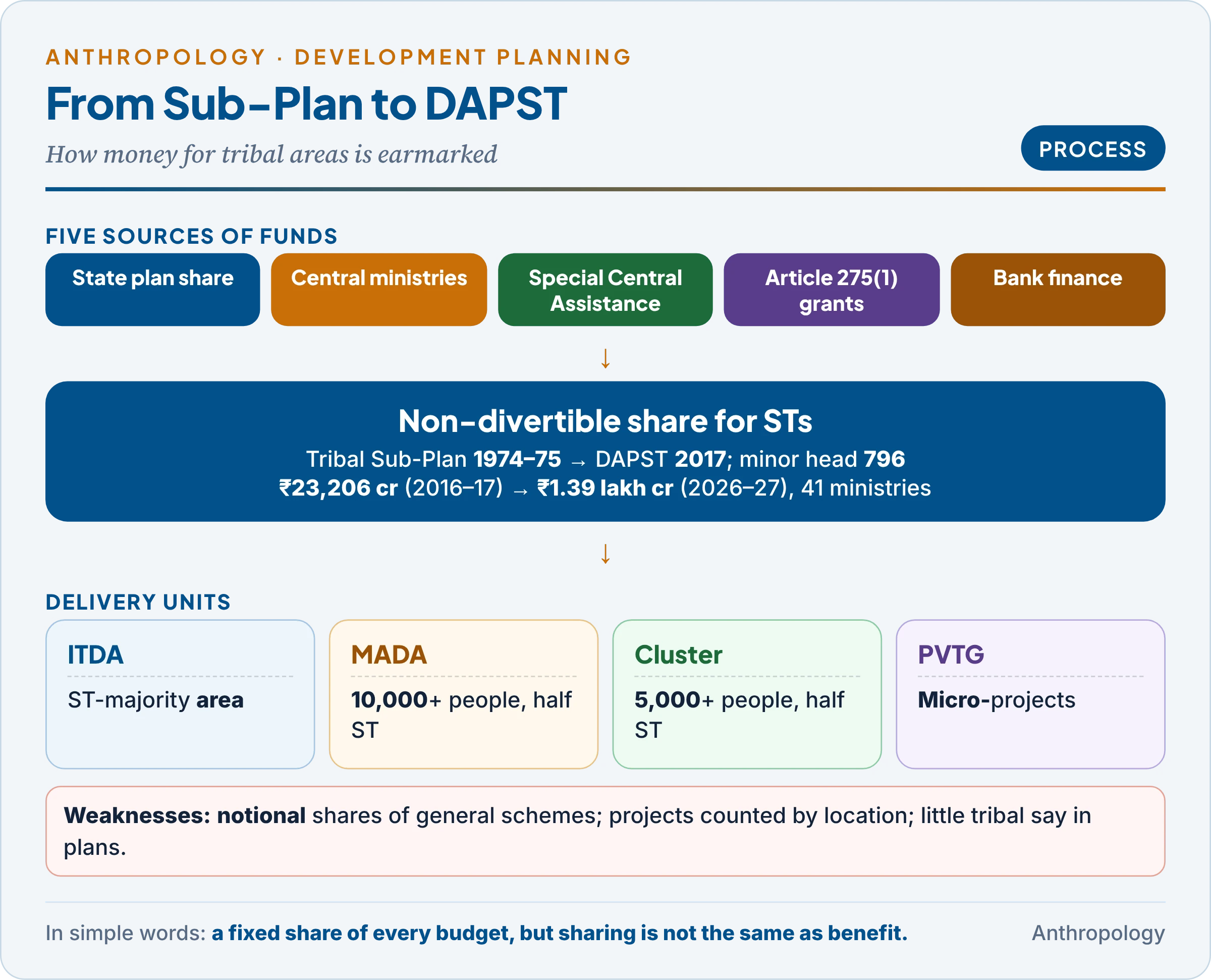
- Delivery units: ITDPs/ITDAs for contiguous areas where STs are a majority (about 190); MADA pockets (population 10,000 or more, at least 50% STs); clusters (5,000 or more, 50% STs); micro-projects for primitive groups (9.1b); and help for dispersed tribes.
- Funding: the State plan share; Central ministries’ sectoral outlays; Special Central Assistance (gap-filling, now the Pradhan Mantri Adi Adarsh Gram Yojana, 2021–26, aimed at 36,428 villages with at least half their people tribal); Article 275(1) grants; and institutional finance.
- Administration: a Project Officer coordinates; the Collector chairs a project-level committee with local MPs and MLAs; States were asked to pool funds under the Tribal Welfare Department. ITDPs worked beside rural schemes such as the Integrated Rural Development Programme (1978–80), but the two were rarely joined at the level of the family.
Critical appraisal. Reviews since the 1980s agree on four defects. First, funds were often notional: big dams, power plants and industries located in tribal areas were counted as sub-plan spending although non-tribals gained most (such investments made up about half or more of sub-plan outlays in some reviews). Second, the ITDP officer had little control over line departments, so the “single line administration” the planners wanted never came. Third, the sub-plan became a bundle of sectoral schemes rather than an area plan made with people. Fourth, protection (land, debt, bonded labour) lagged far behind construction. The sub-plan did, however, make tribal shares visible and auditable for the first time.
3.3 DAPST today
- Renaming: when plan and non-plan spending were merged in 2017–18, the sub-plan continued as the Development Action Plan for Scheduled Tribes (DAPST), also called the Scheduled Tribe Component. NITI Aayog‘s 2017 guidelines require obligated ministries to earmark a share of scheme funds (not less than half the ST population proportion, or as decided by a task force) and to book it under minor head 796, so that it cannot be diverted.
- Scale: besides the Ministry of Tribal Affairs, 41 ministries and departments earmark funds. Allocation rose from ₹23,206 crore (2016–17) to ₹1,39,190 crore (BE 2026–27) across about 210 schemes; the Ministry reports utilisation above 92% of revised estimates over five years and tracks it online through PFMS.
- State laws: undivided Andhra Pradesh gave the sub-plans statutory force in 2013; its successor law was extended in 2023 for ten years. The Centre has said it is not considering a central law.
- Critique: much of DAPST is a notional share of general schemes (roads, housing, health) rather than programmes designed with tribes; budget analyses by civil-society groups find the share of ST-specific schemes small. Allocation is easier to measure than benefit.
Common confusion
Does DAPST money go only to tribal people? Not necessarily. DAPST is a share of each ministry’s scheme budget marked for STs or tribal areas. Some of it reaches individual tribal households (scholarships, houses), but much is spent on area infrastructure such as roads or water schemes whose users include non-tribals. That is why reviews distinguish allocation (money marked) from outcomes (tribal households actually benefiting).
3.4 Committees and commissions
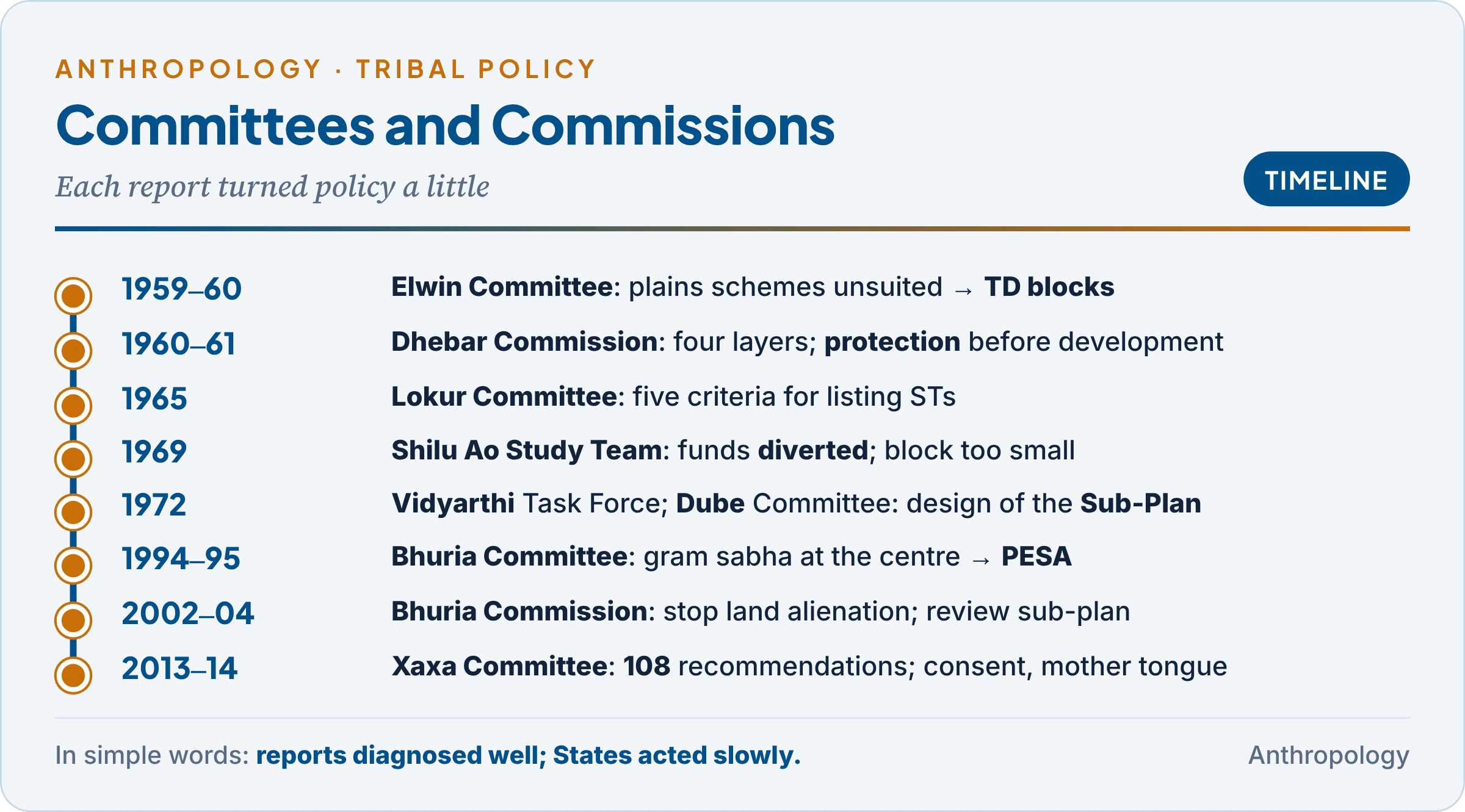
Every major turn in tribal policy followed a committee report. The chronology gives each one’s central finding.
| Year | Body | Key finding or result |
|---|---|---|
| 1959–60 | Elwin Committee on Special Multipurpose Tribal Blocks | Plains schemes unsuited; simpler tribe-specific blocks → Tribal Development Blocks |
| 1960–61 | Scheduled Areas and Scheduled Tribes Commission (U.N. Dhebar, Article 339) | Slow development; weak protection; four layers among STs, the lowest needing most care; use tribal councils |
| 1965 | Lokur Committee | Criteria for listing STs: primitive traits, distinct culture, geographical isolation, shyness of contact, backwardness |
| 1969 | Shilu Ao Study Team (Planning Commission) | Dhebar ignored; block too small; earmarked funds diverted; panchayats alien to tribes |
| 1972 | Vidyarthi Task Force; S.C. Dube Expert Committee | “Welfare” to “development”; design of the Tribal Sub-Plan |
| 1994–95 | Bhuria Committee (on extending panchayats to Scheduled Areas) | Gram sabha at the centre of tribal self-rule → PESA 1996 |
| 2002–04 | Second Scheduled Areas and Scheduled Tribes Commission (Dileep Singh Bhuria) | Land and forest assaults; strengthen anti-alienation laws; review the sub-plan |
| 2013–14 | High Level Committee (Virginius Xaxa) | 108 recommendations on livelihood, education, health, land, displacement and governance |
- Dhebar set the agenda for decades: integrated development, protection before development, tribal councils alongside panchayats, and special care for the most backward layer (the origin of the PTG category).
- Xaxa (submitted 29 May 2014) found tribes worst off on almost every indicator and called for strict enforcement of PESA and the Forest Rights Act, gram sabha consent (not mere consultation) for land acquisition, mother-tongue schooling, a tribal health plan and better use of sub-plan funds. Most of its recommendations remained “under consideration”.
3.5 Programmes now
The present system works through umbrella schemes and saturation missions:
- Education: Eklavya Model Residential Schools (one in every block with more than 50% STs and at least 20,000 tribal people; 723 sanctioned and 499 functional with about 1.57 lakh students in March 2026), ashram schools, hostels and pre- and post-matric scholarships.
- Livelihood and forest produce: TRIFED, minimum support prices for minor forest produce and Van Dhan centres (6.2); the VB-G RAM G Act, 2025, in force from 1 July 2026, replaced MGNREGA and guarantees 125 days of work to rural households.
- Health: the National Sickle Cell Anaemia Elimination Mission (2023) and mobile medical units (6.2).
- Scheduled Castes: the parallel instruments are the Special Component Plan (1979, later the Scheduled Castes Sub-Plan and now DAPSC), post-matric scholarships (from 1944) and the Atrocities Act; their record mirrors the tribal one (7.1).
- Missions: PM-JANMAN for the 75 PVTGs (9.1b); the Dharti Aaba Janjatiya Gram Utkarsh Abhiyan for tribal-majority villages; the Adi Karmayogi Abhiyan for responsive local governance.
The table gives the latest verified status of the main schemes.
| Scheme | Launched | Target | Latest status |
|---|---|---|---|
| DAPST | 1974–75 (as TSP) | 41 ministries earmark funds | ₹1.39 lakh crore BE 2026–27 |
| EMRS | 1997–98; revamped 2018–19 | 728 schools | 723 sanctioned, 499 functional (March 2026) |
| PM-JANMAN | 15 Nov 2023 | ₹24,104 crore; 11 interventions, 9 ministries | 4.83 lakh houses sanctioned, 3.06 lakh built; 831 mobile medical units (30 June 2026) |
| Dharti Aaba (DAJGUA) | Sept–Oct 2024 | ₹79,156 crore; 63,843 villages in 549 districts; 25 interventions, 17 ministries | 13.03 lakh houses sanctioned, 8.22 lakh built; tap water saturated in 29,497 villages (July 2026) |
| Adi Karmayogi | 17 Sept 2025 | About 1 lakh villages | About 15 lakh volunteers; 62,187 gram sabha village plans (Aug 2026) |
| PMAAGY | 2021–22 | 36,428 villages; ₹20.38 lakh gap-filling each | Plans for about 16,000 villages approved (July 2024) |
| VB-G RAM G | 1 July 2026 | 125 days of work per rural household | All States notified schemes (July 2026) |
Why DAJGUA is linked to the Sustainable Development Goals: its interventions (houses, tap water, electricity, health units, schools and hostels, mobile connectivity, livelihoods) map onto SDG 1 (poverty), 2 (hunger), 3 (health), 4 (education), 6 (water), 7 (energy) and 9 (infrastructure); by targeting tribal-majority villages it serves the SDGs’ promise to leave no one behind.
4. Implementation: Achievements, Failures and the Way Forward
In simple words
Seventy years of plans have brought roads, schools, scholarships and reserved jobs to many tribal areas, and tribal literacy has risen sharply. But tribes have also lost land to projects, protective laws have been weakly used, and schemes have been made for tribes rather than with them. The lesson of every review is that money works only when tribal communities control planning.
4.1 What has been achieved
- Education and representation: ST literacy rose from about 8.5% (1961) to 59% (2011); reserved seats and jobs created a tribal middle class and political leadership; PESA opened elected posts in Scheduled Areas.
- Infrastructure: roads, schools, hostels, health centres and electricity reached remote areas, especially after the saturation missions.
- Rights: the Forest Rights Act recognised individual and community rights over forests for the first time; gram sabhas used them at Niyamgiri (2013) and Mendha-Lekha (Gadchiroli).
- Visibility: earmarked budgets and online monitoring make tribal spending traceable.
4.2 Why implementation fell short
| Problem | How it shows | Example or source |
|---|---|---|
| Protection lagged development | Land alienation and displacement continued | Large dams and mines in Scheduled Areas (6.3a) |
| Unused constitutional powers | Governors seldom made Fifth Schedule regulations; Tribes Advisory Councils met rarely | Dhebar, Shilu Ao, Bhuria reports |
| Notional and diverted funds | Location-based projects counted as tribal spending | Sub-plan reviews; DAPST critiques |
| Weak project units | ITDA officers without power over departments | Sub-plan reviews |
| Top-down planning | Plans made by officials with little tribal consultation | Xaxa Committee |
| Uneven reach | Benefits concentrated among advanced tribes and areas | Dhebar’s “layers”; reservation studies |
| Delays in rules | PESA rules framed late in several States | 7.2 |
The table shows that most failures are institutional, not financial: funds rose many times, but the mechanisms that protect land and give tribes control remained weak.
Effect of reservation on unemployment. Job reservation (7.5% in central services) gave secure employment to a section of educated STs and created role models, but it cannot absorb the mass of tribal workers: quotas apply only to shrinking public-sector jobs, posts often remain unfilled for want of qualified candidates, and benefits concentrate among the better-off tribes. Most tribal workers remain cultivators, agricultural labourers and seasonal migrants (6.2).
4.3 Participation, sustainability and the way forward
- Planning from below: the Participatory Rural Appraisal method, associated with the British development scholar Robert Chambers (1990s), uses villagers’ own maps, seasonal calendars and wealth rankings so that plans begin with local knowledge. The Adi Karmayogi village vision plans and gram sabha micro-plans under PESA apply the same idea.
- Sustainable development: tribal development lasts only if it protects the resource base: community forest rights, watershed and minor-forest-produce value chains, and limits on extraction and displacement.
- Single-line administration and smaller units: one accountable officer for each tribal area, smaller districts, separate programmes for STs rather than joint SC–ST schemes, and officers posted for adequate tenures after training in tribal culture.
- Use the Schedules: Governors’ regulations on land and moneylending, regular Tribes Advisory Council meetings, and the Xaxa recommendations on consent and mother-tongue education.
- Anthropology’s role: studying tribal values, identifying resistance points and evaluating effects, as Elwin and the Tribal Research Institutes did (the full discussion is in 9.2).
Key Terms
| Term | Meaning in simple words |
|---|---|
| Non-regulation tract | A colonial area where ordinary laws did not apply automatically |
| Scheduled Districts Act | 1874 law letting the government choose which laws applied in listed districts |
| Excluded Area | Tribal area under the Governor’s discretion (1935) |
| Partially Excluded Area | Tribal area where ministers advised but the Governor could override (1935) |
| Scheduled Area | Fifth Schedule area declared by the President |
| Tribes Advisory Council | Body of mostly ST legislators advising on tribal welfare |
| Panchsheel | Nehru’s five principles of tribal policy (1959) |
| SMPT Block | Special Multipurpose Tribal Block, the first special tribal unit (1954) |
| Tribal Sub-Plan | Compulsory, non-divertible share of plan funds for tribal areas |
| ITDA / ITDP | Project office coordinating development in a tribal-majority area |
| MADA pocket | Small tribal pocket of at least 10,000 people, half of them STs |
| Cluster | Smaller pocket of at least 5,000 people, half of them STs |
| Special Central Assistance | Central gap-filling grant added to the sub-plan |
| DAPST | Development Action Plan for STs, the sub-plan’s name since 2017 |
| Saturation mission | Programme aiming to cover every eligible household in a target area |
| Single-line administration | One officer responsible for all development in a tribal area |
| Participatory Rural Appraisal | Planning that starts from villagers’ own maps and knowledge |
Contemporary Developments
- DAPST 2026–27: ₹1,39,190 crore earmarked across 41 ministries; the Centre told Parliament in April 2026 that it does not plan a central law on sub-plan funds.
- Dharti Aaba mission: by July 2026, 13.03 lakh houses sanctioned and 8.22 lakh completed in tribal-majority villages; reviews flagged delays in roads, hostels and mobile towers.
- PM-JANMAN: 4.83 lakh PVTG houses sanctioned and 3.06 lakh completed by 30 June 2026; a habitation survey counted about 48.5 lakh PVTG people.
- VB-G RAM G Act: in force from 1 July 2026, replacing MGNREGA with a 125-day guarantee.
- EMRS: 499 schools functional of 723 sanctioned (March 2026), enrolling about 1.57 lakh students.
Diagrams to Master
- Topic map: colonial history, Constitution, policies, plans, committees, programmes and implementation.
- Administrative machinery: Centre (Ministry of Tribal Affairs 1999, NCST 2004, NITI Aayog), State (Governor, Tribes Advisory Council, Tribal Welfare Department, Tribal Research Institute), district (Collector, ITDA), village (gram sabha or district council).
- Policy phases: isolation, integration, sub-plan, rights, saturation; one instrument and one gap each.
- Sub-plan to DAPST: five funding sources, delivery units, minor head 796, 2016–17 and 2026–27 figures, weaknesses.
- Committees chronology: Elwin, Dhebar, Lokur, Shilu Ao, Vidyarthi and Dube, Bhuria (twice), Xaxa.
Revision Grid
| Scholar or body | Work (year) | Key idea |
|---|---|---|
| J.H. Hutton | Census of India report (1931) | Protection of “primitive tribes” |
| W.V. Grigson | The Aboriginal Problem in the Central Provinces and Berar (1944) | Protective administration |
| G.S. Ghurye | The Aborigines “So-called” and Their Future (1943) | Tribes as backward Hindus; assimilation |
| Verrier Elwin | A Philosophy for NEFA (1957; 1959) | Protected, self-directed integration |
| Jawaharlal Nehru | Foreword to A Philosophy for NEFA (1959) | Tribal Panchsheel |
| U.N. Dhebar | Commission report (1961) | Four layers; protection before development |
| Shilu Ao | Study Team report (1969) | Diverted funds; block too small |
| L.P. Vidyarthi | Task Force (1972) | From welfare to development |
| S.C. Dube | Expert Committee (1972) | Design of the Tribal Sub-Plan |
| B.D. Sharma | Reports as Commissioner for SCs and STs (1986–91) | Sub-plan; tribal self-rule; PESA |
| Christoph von Fürer-Haimendorf | Tribes of India: The Struggle for Survival (1982) | Failure of protective laws |
| Virginius Xaxa | High Level Committee report (2014) | 108 recommendations; consent and rights |
| Robert Chambers | Participatory Rural Appraisal (1990s) | Planning from villagers’ own knowledge |
Previous Year Questions
9.1 History of administration of tribal areas, tribal policies, plans, programmes of tribal development and their implementation
- 2026‘Dharti Aaba Janjatiya Gram Utkarsh Abhiyan aims to meet some of the Sustainable Development Goals’. Discuss.
- 2026Write an account on the contribution of Verrier Elwin in developing policies for the tribal populations in post-independent India.
- 2026Write an account on Development Action Plan for Scheduled Tribes (DAPST).
- 2023Elucidate the shifting terrains of India’s tribal policies in colonial and post-colonial periods.
- 2022Discuss the views of G. S. Ghurye and Verrier Elwin on the approach towards tribal populations. What are the policies of the Government of India towards Indian tribal populations?
- 2020Discuss the effect of job reservation in alleviating unemployment among the tribal people of India.
- 2017Discuss the emergence, salient features and limitations of Tribal sub-plan.
- 2014Critically evaluate the National Tribal Policy.
- 2012Using suitable examples, bring out the historical processes of the social exclusion of denotified tribes.
- 2012Write a note in 150 words on Participatory Rural Appraisal.
- 2005Write a note on Tribal sub-plan,.
- 2004Write a note on Sustainable Development of Tribes.
- 2003Write a note on Implications of recent Presidential orders relating to Scheduled Tribes and Scheduled Castes.
- 2002What do you understand by the integrated tribal and rural development programmes? How would you evaluate the success or failure of these programmes ?
- 2001Mention various developmental programmes implemented for the socio-economic well-being of Scheduled Castes. Do these programmes fulfil their aspiration ? Discuss.
- 2000Write a note on Tribal education in the context of development.
- 1999Write a note on Tribal Sub-Plan.
- 1997Write a note on Plans and Programmes of Tribal development.
- 1995Critically evaluate various approaches to set the tribals within the mainstream of Indian civilization. In your opmion which approach is relevant in the modern context ?
- 1985What are the various policies that have been suggested for bringing the tribals into the mainstream of national life ? In the interest of the tribals, which of these policies do you consider suitable ?
- 1984Write a note in 200 words : History of tribal administration in India.
- 1982How are cultural factors important in planning and executing development programmes among simple communities ?
Related questions from other units
- 2025Unit 4: Write notes on: Verrier Elwin’s philosophy with respect to Arunachal Pradesh.
- 2022Unit 7.2: Discuss the objectives of Integrated Tribal Development Projects (ITDPs). How far have these objectives been achieved?
- 2019Unit 7.2: Critically assess the existing plans and programmes meant for tribal welfare.
- 2017Unit 7.2: Give a critical appraisal of any one tribal development programme during XIIth Five-Year plan. Give your suggestions for any improvement in the programme.
- 2015Unit 7.2: Write a note in 150 words on Relevance of tribal Panchsheel today.
- 2014Unit 7.3: Describe the history of tribal administration in the colonial period.
- 2013Unit 7.1: Fifth Schedule and Sixth Schedule of the Constitution are built on the foundations laid by the colonial Government. Discuss. (250 words).
- 2005Unit 7.3: Elucidate the nature of changes in administration of tribal areas from colonial period to Post-Independence era in India.
- 2000Unit 7.3: Outline the historical background of tribal administration during the colonial period. Evaluate post-Independence administrative policies with special reference to states under either the Fifth Schedule or Sixth Schedule of the Constitution of India.
- 1986Unit 7.1: Analyse the programmes for tribal welfare undertaken Governments in terms of relevant constitutional and statutory provisions.
More from Tribal Administration and Development: all notes of this unit · every PYQ of this unit · Anthropology Optional hub