

Anthropology Optional › Paper II › Unit 09: Tribal Administration and Development
9.1 History of administration of tribal areas, tribal policies, plans, programmes of tribal development and their implementation. The concept of PTGs (Primitive Tribal Groups), their distribution, special programmes for their development. Role of N.G.O.s in tribal development.
Official Syllabus: Paper II, Unit 9.1
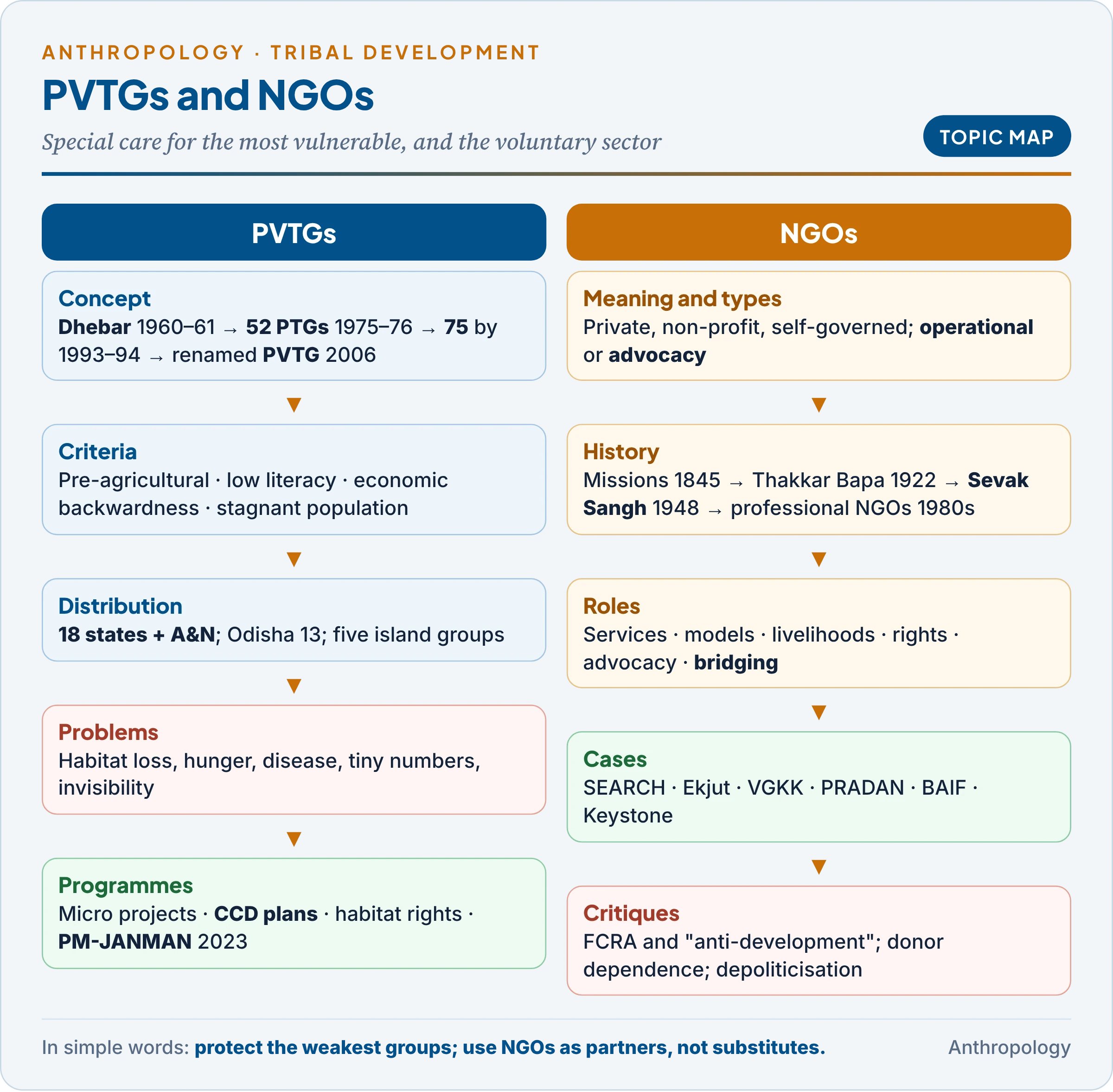
This article covers the second half of the syllabus line: the concept and distribution of PTGs (now PVTGs), their special programmes, and the role of NGOs. The history of tribal administration, the Tribal Sub-Plan, ITDPs, DAPST and the Dharti Aaba mission are in 9.1a; welfare outcomes in 7.2; the Forest Rights Act in 6.3b; the biological variability of the Andamanese in 6.1; Christian missions in 8.1; and anthropology’s role in development in 9.2.
1. The Concept of Particularly Vulnerable Tribal Groups
In simple words
India has more than 700 Scheduled Tribes, but they are not equally placed. A few very small communities still live mainly by hunting, gathering or simple farming, have very low literacy and a population that is not growing. The government picked out 75 such groups for special care and calls them Particularly Vulnerable Tribal Groups.
Example first: the Birhor of Chotanagpur. The Birhor (Jharkhand, Odisha, Chhattisgarh, West Bengal) were described by the pioneer Indian ethnographer Sarat Chandra Roy in The Birhors (1925) as small wandering bands (tanda) who trapped monkeys and made rope from forest creepers, which they bartered in peasant villages. Their poverty came not from a “primitive mind” but from shrinking forests, and colonies built for them failed when houses were placed far from the forest. The Birhor show the three features that define a PVTG: a forest-based, pre-agricultural economy, very small numbers, and extreme vulnerability to outside change.
1.1 From Dhebar to PVTG
The category grew out of a single observation: tribal development funds were being captured by the more advanced tribes.
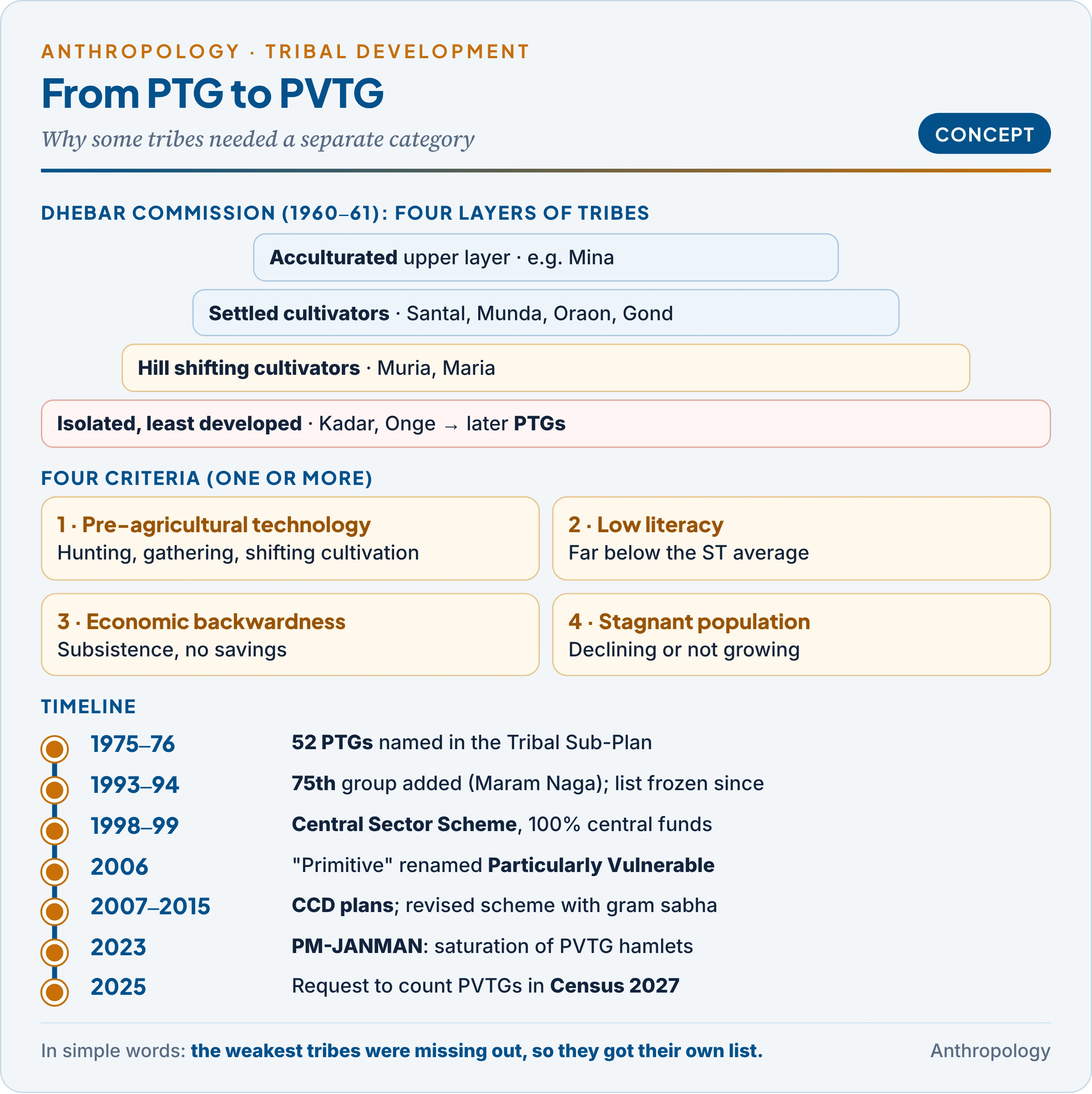
- Dhebar Commission (1960–61): the Scheduled Areas and Scheduled Tribes Commission under the Congress leader U.N. Dhebar found four layers among tribes; at the bottom lay small, isolated, extremely underdeveloped groups who had gained almost nothing from development.
- Fifth Five-Year Plan (1975–76): 52 communities were identified as Primitive Tribal Groups (PTGs) within the new Tribal Sub-Plan, which placed them as a separate “special category” beside ITDPs and MADA pockets (9.1a).
- Additions up to 1993–94: more groups were added in the Sixth, Seventh and Eighth Plans; the 75th, the Maram Naga of Manipur, was added in 1993–94. No group has been added since, and none has ever been removed.
- Renaming (2006): the Government of India replaced “Primitive” with “Particularly Vulnerable“.
- Present position: 75 PVTGs in 18 States and one Union Territory (Andaman and Nicobar Islands), as the Ministry of Tribal Affairs told Parliament in 2026.
1.2 The four criteria
The Ministry of Tribal Affairs uses four criteria. A group needed to show one or more of them, not all four.
| Criterion | What it means | Why it signals vulnerability |
|---|---|---|
| Pre-agricultural level of technology | Hunting, gathering, fishing or shifting cultivation with simple tools | Livelihood depends entirely on access to forest or sea |
| Low level of literacy | Far below even the ST average | Cannot claim rights, read notices or use schemes |
| Economic backwardness | A subsistence economy with little saving or market income | No cushion against drought, disease or eviction |
| Declining or stagnant population | Births barely replace deaths | Disease or a single disaster can threaten survival |
The criteria are relative: they compare a group with other STs, not with an ideal of “civilisation”. Applied loosely by state governments in the 1970s, they produced a list far more varied than the label suggests (§1.3).
Common confusion
Are the PVTG criteria the same as the criteria for declaring a Scheduled Tribe? No. A community is listed as a Scheduled Tribe under Article 342 using the Lokur Committee (1965) indicators: primitive traits, distinctive culture, geographical isolation, shyness of contact and backwardness. PVTG is an administrative sub-category within STs, chosen by the four development criteria above. PVTG status has no separate constitutional basis; it decides who gets special schemes.
1.3 Why “primitive” was the wrong word
The renaming of 2006 was more than politeness. Anthropologists had long objected to the label for four reasons.
- Evolutionist baggage: “primitive” placed living peoples at the bottom of the nineteenth-century ladder of progress of evolutionists such as Lewis Henry Morgan; a hunting economy is an adaptation to a habitat, not a survival from the past.
- Vulnerability is produced, not innate: the Birhor, Baiga and Great Andamanese became vulnerable through loss of forest, bans on shifting cultivation, disease and colonial contact; “primitive” blamed the victims.
- The list is not even “pre-agricultural”: it includes pastoral Todas and artisan Kotas of the Nilgiris, settled cultivators such as the Saharia of Rajasthan and Madhya Pradesh and the Maram Naga, and the Siddi of Gujarat, of African descent. What unites them is marginality, not technology.
- Stigma: the draft National Tribal Policy (2006) itself said their stigmatisation as “primitive” should end.
“Particularly vulnerable” shifts attention from the people to their situation: it asks what makes a group vulnerable and who is responsible for reducing that vulnerability.
1.4 Problems with the category itself
- Administrative, not ethnographic: in Odisha and elsewhere, benefits were tied to the area of a micro project, so members of the same community outside it were not treated as PVTG.
- Invisible in the Census: PVTGs have never been enumerated separately. Only about 40 of the 75 appear as separate entries in the ST lists; the rest are counted inside a larger tribe (for instance, Abujh Maria and Hill Korwa were added to Chhattisgarh’s ST list only in 2013).
- Frozen list: no group has graduated out, and no new group has been added since 1993–94, although some groups have changed greatly and others outside the list are equally vulnerable. A former Director of the Anthropological Survey of India, Kamal K. Misra, has argued that the criteria should be revisited before any new count.
- Same name, different places: the 75 are entries in state lists; the Birhor appear in four states and the Kolam, Koraga, Lodha and Saharia in two each, so there are fewer than 75 distinct communities.
2. Distribution of PVTGs
In simple words
PVTGs live in 18 states and the Andaman and Nicobar Islands, mostly in hill and forest belts far from roads and markets. Odisha has the most groups, but the largest PVTG populations are in Madhya Pradesh and Maharashtra. Several island groups number only a few dozen or a few hundred people.
2.1 State-wise list
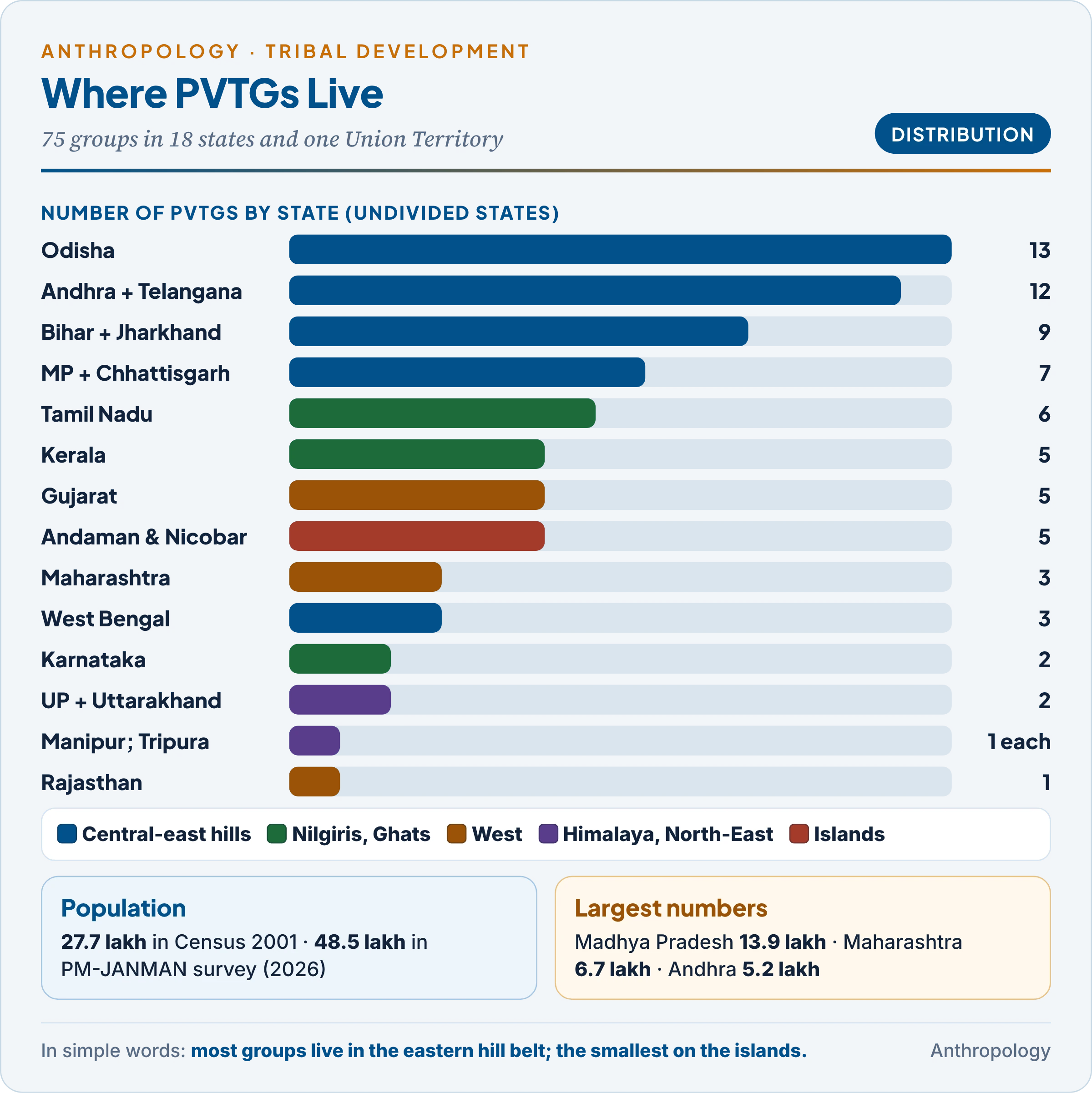
The Ministry’s list is grouped under the older, undivided states. The table gives the number of groups and the main names.
| State (with later divisions) | No. | PVTGs |
|---|---|---|
| Odisha | 13 | Bondo, Chuktia Bhunjia, Birhor, Didayi, Dongria Kondh, Juang, Kharia, Kutia Kondh, Lanjia Saora, Lodha, Mankidia, Paudi Bhuyan, Saora |
| Andhra Pradesh and Telangana | 12 | Chenchu, Bodo Gadaba, Gutob Gadaba, Dongria Kondh, Kutia Kondh, Kolam, Konda Reddi, Kondasavara, Bondo Porja, Khond Porja, Parengi Porja, Thoti |
| Bihar and Jharkhand | 9 | Asur, Birhor, Birjia, Hill Kharia, Korwa, Mal Paharia, Parhaiya, Sauria Paharia, Savar |
| Madhya Pradesh and Chhattisgarh | 7 | Abujh Maria, Baiga, Bharia, Birhor, Hill Korwa, Kamar, Saharia |
| Tamil Nadu | 6 | Irular, Kattunayakan, Kota, Kurumba, Paniyan, Toda |
| Gujarat | 5 | Kolgha, Kathodi, Kotwalia, Padhar, Siddi |
| Kerala | 5 | Cholanaikkan, Kadar, Kattunayakan, Koraga, Kurumba |
| Andaman and Nicobar Islands | 5 | Great Andamanese, Jarawa, Onge, Sentinelese, Shompen |
| Maharashtra | 3 | Katkari (Kathodi), Kolam, Maria Gond |
| West Bengal | 3 | Birhor, Lodha, Toto |
| Karnataka | 2 | Jenu Kuruba, Koraga |
| Uttar Pradesh and Uttarakhand | 2 | Buksa, Raji |
| Manipur, Rajasthan, Tripura | 1 each | Maram Naga; Saharia; Reang |
The eastern and central hill belt holds more than half the groups, because there forests, shifting cultivation and dense tribal settlement coincide. The Nilgiri groups form a second cluster and the islands a third, with the smallest and most isolated groups.
2.2 Population
- Census 2001: about 27.7 lakh people belonged to the 75 groups; 19 groups had fewer than 1,000 members and 8 had more than one lakh (National Advisory Council review).
- PM-JANMAN habitation survey (2026): state teams using the PM Gati Shakti mobile app counted about 48.5 lakh PVTG people in 30,597 habitations of 20,096 villages. The largest numbers were in Madhya Pradesh (about 13.9 lakh), Maharashtra (6.7 lakh) and Andhra Pradesh (5.2 lakh).
- Why the figures differ: the survey counted everyone in PVTG habitations, the Census only groups listed by name. Neither is a true PVTG count, so the Ministry asked the Registrar General (August 2025) to enumerate PVTGs separately in Census 2027.
2.3 Classic ethnographies of PVTGs
Classic monographs on PVTGs, and what each proves:
| Group (region) | Ethnographer, work (year) | What it shows |
|---|---|---|
| Birhor (Chotanagpur) | S.C. Roy, The Birhors (1925) | Nomadic hunting-rope economy tied to forest and peasant exchange |
| Baiga (Maikal hills, MP) | Verrier Elwin, The Baiga (1939) | Shifting cultivation (bewar) banned by forest law; Elwin’s case for protection |
| Chenchu (Nallamalai, Andhra) | C. von Fürer-Haimendorf, The Chenchus (1943) | Food-gatherers squeezed by forest rules and settlers |
| Bondo (Koraput, Odisha) | Verrier Elwin, Bondo Highlander (1950) | Hill people with strong autonomy, dormitories and distinct dress |
| Lodha (Medinipur, West Bengal) | P.K. Bhowmick, The Lodhas of West Bengal (1963) | A “criminal tribe” stigma and action anthropology (9.2) |
| Toda (Nilgiris) | W.H.R. Rivers, The Todas (1906) | Buffalo pastoralism and polyandry; a PVTG that was never “pre-agricultural” |
| Andamanese | A.R. Radcliffe-Brown, The Andaman Islanders (1922) | Ritual and social cohesion in a foraging society |
| Onge (Little Andaman) | Vishvajit Pandya, Above the Forest (1993) | Cosmology of winds and spirits in a hunter-gatherer society |
3. PVTGs of the Andaman and Nicobar Islands
In simple words
Five of the 75 PVTGs live on the islands. They are among the oldest populations of South and Southeast Asia, and some had almost no contact with outsiders until recently. Contact brought disease and dependence, so the government now follows a careful policy of protection with very limited interference.
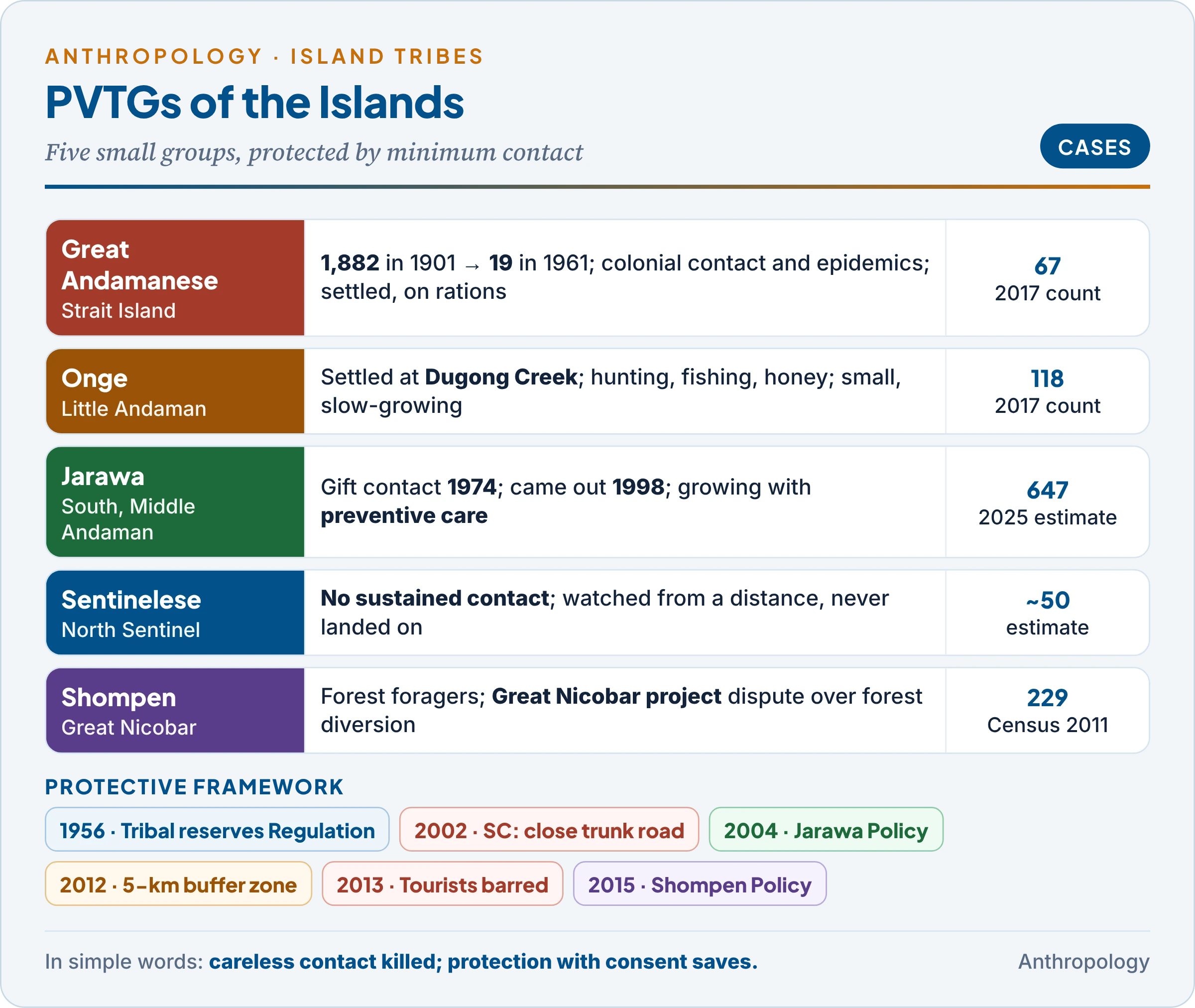
Example first: the Great Andamanese. The Census of 1901 counted about 1,882 Great Andamanese; by 1961 only 19 were left. The penal settlement at Port Blair (1858), the “Andaman Homes” set up to pacify them, and epidemics of measles, syphilis and influenza destroyed a people once spread across ten or more tribes. The survivors were resettled on Strait Island (44 in 2011, 67 in 2017). Their fate is the main argument behind today’s “minimum contact” policy.
| Group | Habitat | Contact and way of life | Numbers |
|---|---|---|---|
| Great Andamanese | Strait Island | Settled, dependent on rations; languages nearly lost | 44 (2011); 67 (2017) |
| Onge | Dugong Creek and South Bay, Little Andaman | Settled by the administration; hunting, fishing, honey | 101 (2011); 118 (2017) |
| Jarawa | Western South and Middle Andaman (about 1,040 sq km reserve) | Gift contact from 1974; came out on their own in 1998; foraging bands | 480 (2017); 647 (2025 official estimate) |
| Sentinelese | North Sentinel Island | No sustained contact; resist all landings | Estimated, not counted (about 50 in 2017) |
| Shompen | Interior forests of Great Nicobar | Little contact; hunting, gathering, pandanus and tubers | 229 (2011) |
The Nicobarese of the Nicobar Islands are a large Scheduled Tribe (about 27,000 in 2011) but not a PVTG.
Why numbers fell and are now rising: island groups had no immunity to mainland diseases (the Jarawa suffered measles in 1999); settlers, logging and roads shrank hunting grounds; rations brought dependence, alcohol and tobacco to the Onge and Great Andamanese. The Jarawa have recovered because the administration gives preventive medical care while leaving daily life alone.
The protective framework:
- Andaman and Nicobar (Protection of Aboriginal Tribes) Regulation, 1956: declares tribal reserves that outsiders cannot enter without permission.
- Jarawa Policy (21 December 2004): protect the Jarawa from harmful contact, no forced assimilation, minimum intervention, health care on their terms, and no individual visits to their areas.
- Supreme Court: ordered closure of the Andaman Trunk Road through the Jarawa reserve (7 May 2002, never fully implemented); upheld a 5-km buffer zone free of tourism (July 2012); and in January 2013, after videos of Jarawa women being made to dance for food, barred tourists from using the road (“human safari”).
- Shompen Policy (2015): gives priority to the welfare and integrity of the Shompen when large development is proposed on Great Nicobar.
- Sentinelese: the administration watches from a distance without landing; the killing of an American missionary who landed illegally in November 2018 showed the risks of contact for both sides.
Current issues:
- Great Nicobar project: a trans-shipment port, airport, township and power plant on Great Nicobar require diversion of a large area of forest used by the Shompen and claimed by the Nicobarese. The tribal council says the 2022 certificate that forest rights had been settled is false and that no proper gram sabha consent was taken (letter of June 2026; Calcutta High Court case, October 2026). In October 2026 the Supreme Court refused to stay the High Court proceedings and described the preservation of culture as a fundamental right.
- Voting: 19 Jarawas were enrolled as voters in January 2025; the Shompen first voted in 2014.
Common confusion
Is the “minimum contact” policy the same as Elwin’s “isolation”? Not quite. Isolation in the 1930s debate meant keeping whole regions closed to outsiders while tribes lived as before. The island policy is protection with consent: the state provides health care and food security, keeps exploiters out, and lets contact grow at the community’s own pace. The guiding principle is self-determination, not freezing a culture.
4. Problems of PVTGs and the Challenges of Planning for Them
In simple words
PVTGs face the same problems as other tribes, such as loss of land and forest, poverty and poor health, but in a sharper form because they are small, scattered and depend directly on nature. Designing programmes for them is hard because each group is different, reliable data are missing, and schemes made for villages often do not fit forest hamlets.
Example first: the Mankidia of Similipal. The Mankidia of Mayurbhanj, Odisha, live by making rope from the bark of the siali creeper and by catching monkeys, much like the Birhor. When Similipal became a tiger reserve, they were barred from collecting bark in the core area; only in September 2024 did they receive habitat rights. The main threat to PVTGs is often not “backwardness” but conservation and development policies that ignore their dependence on the forest.
4.1 Problems
| Problem | How it works | Example |
|---|---|---|
| Loss of habitat and resources | Sanctuaries, tiger reserves, mining and dams take the forest on which food and income depend | Mankidia (Similipal), Dongria Kondh (Niyamgiri bauxite), Baiga (ban on bewar) |
| Food insecurity and malnutrition | Wild foods decline; diets shift to polished rice from the ration shop | Anaemia and stunting widespread among PVTG children |
| Disease and genetic disorders | Malaria, tuberculosis and new infections; inherited sickle-cell disorder and G6PD deficiency in many central Indian groups | Onge and Jarawa epidemics after contact |
| Demographic fragility | Small numbers mean one epidemic or disaster can halve a group | Great Andamanese, Onge, Sentinelese |
| Very low literacy | No schools in hamlets; teaching in an unfamiliar language | Literacy far below the ST average (59% in 2011) in most PVTGs |
| Cultural erosion and exposure | Tourism, videos and outside missions treat groups as exotic | “Human safari” of the Jarawa; Bonda market visits |
4.2 Challenges in designing special programmes
The difficulties lie both in the diversity of the groups and in the design of the state machinery.
- Heterogeneity: the Toda pastoralist, the Chenchu forager and the Saharia labourer need different strategies; a uniform package fails most of them.
- Data gaps: without a reliable count of people and habitations, budgets are guesses.
- Scheme design for villages, not hamlets: housing, roads and water norms assume a revenue village; PVTG hamlets of a few houses on hill tops fall outside the norms (PM-JANMAN had to relax PMAY-G exclusion rules for this reason).
- Culturally unfit models: concrete houses far from the forest, schools only in the regional language, and rations that replace wild foods can increase dependence and ill-health.
- Consent and pace: sudden contact or rapid change can harm small groups; programmes must move at the community’s pace and through its traditional institutions.
- Rights before schemes: without habitat rights and protection from eviction, welfare schemes only soften a continuing loss of land.
- Weak delivery: remote postings, untrained staff and poor coordination among many ministries.
5. Special Programmes for PVTGs
In simple words
Since 1975 the government has run special programmes for PVTGs: first local micro projects, then a dedicated central scheme with five-year development plans for each group, and since 2023 a large mission, PM-JANMAN, to give every PVTG hamlet a house, road, water, electricity, health care and schools. The Forest Rights Act also gives them a special right over their whole customary habitat.
5.1 Micro projects and the Development of PVTGs scheme
- Micro projects (from 1975–76): small agencies, each covering the area of one PVTG, set up under the Tribal Sub-Plan with Special Central Assistance; Odisha’s micro projects for the Bondo, Juang, Lanjia Saora and others are the best-known examples.
- Central Sector Scheme (1998–99): 100% central funding for survival needs no other scheme covered, implemented by states and NGOs.
- Conservation-cum-Development (CCD) plans: introduced under the scheme from the Eleventh Plan (2007–12); each state prepares a five-year plan for each PVTG, combining development with conservation of culture.
- Revised scheme (from 1 April 2015): activities in livelihood, education, health, housing, land, water, energy and culture; plans to be drawn up with the gram sabha and a separate mahila sabha; 100% sickle-cell screening and health cards; funds only for gaps not met by other schemes.
5.2 Habitat rights under the Forest Rights Act
- Section 3(1)(e) of the Forest Rights Act, 2006 recognises “rights including community tenures of habitat and habitation” for primitive tribal groups and pre-agricultural communities; section 2(h) defines habitat to include their customary territory in reserved and protected forests.
- 2012 amended rules: the District Level Committee must ensure that all PVTGs receive habitat rights, in consultation with their traditional institutions.
- Why it matters: a habitat right covers not only land and produce but sacred sites, seasonal routes and cultural landscapes.
- Progress: Baiga villages of Dindori, Madhya Pradesh, were the first (December 2016); Bharia (Patalkot, Madhya Pradesh); Kamar (August 2023) and Baiga (October 2023) in Chhattisgarh; Paudi Bhuyan (March 2024), Juang, Chuktia Bhunjia, Saora and Mankidia in Odisha (2024); and the Maria Gond in Maharashtra. Yet only 11 of the 75 PVTGs had habitat rights in August 2026.
5.3 PM-JANMAN (2023)
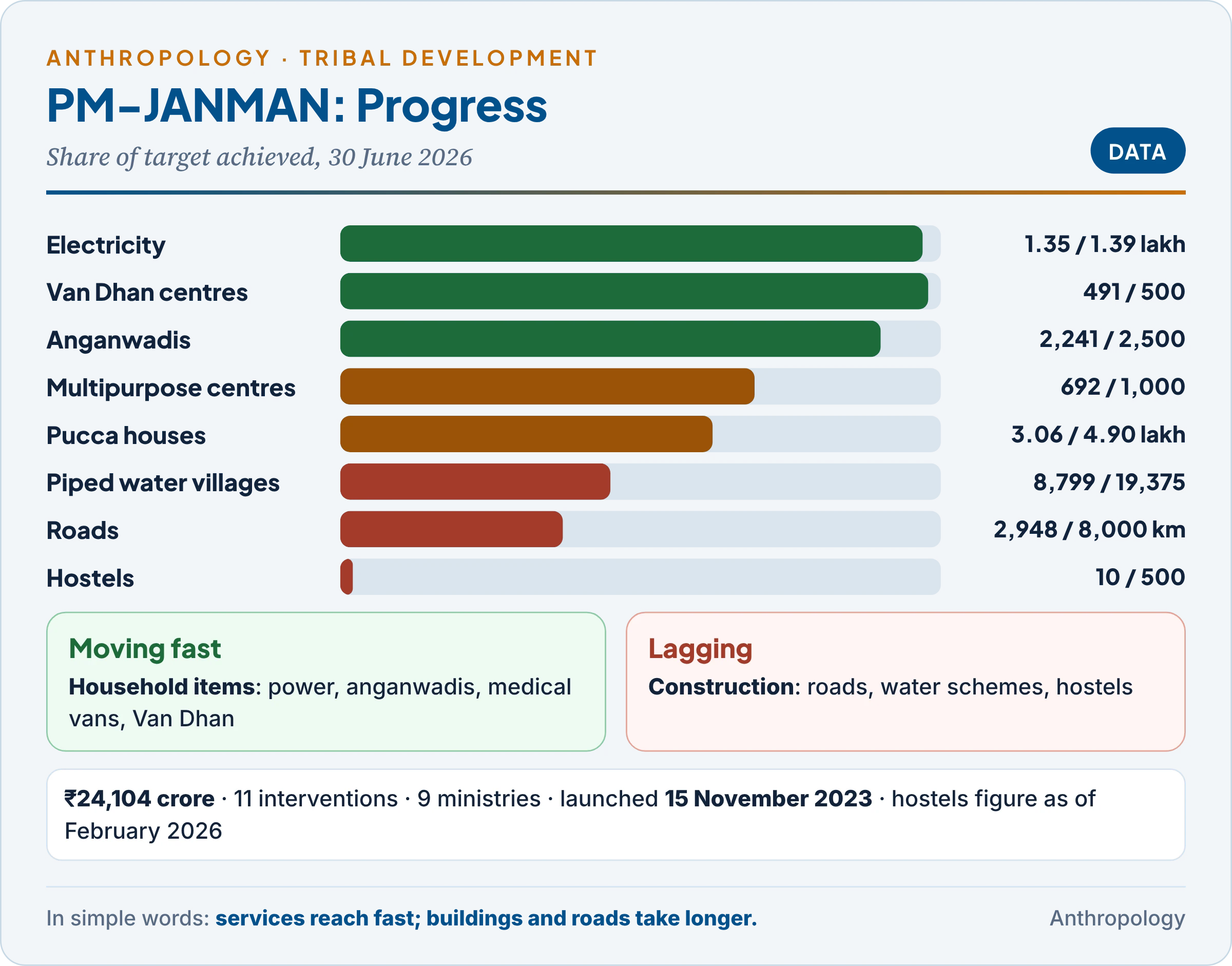
Pradhan Mantri Janjati Adivasi Nyaya Maha Abhiyan was launched on 15 November 2023 (Janjatiya Gaurav Divas) at Khunti, Jharkhand, with ₹24,104 crore for 2023–24 to 2025–26. It aims at saturation: every eligible PVTG household should receive basic services through 11 interventions run by 9 ministries.
| Intervention | Target | Status (30 June 2026) |
|---|---|---|
| Pucca houses (PMAY-G) | 4.90 lakh | 4.83 lakh sanctioned; 3.06 lakh completed |
| Connecting roads (PMGSY) | 8,000 km | 7,992 km sanctioned; 2,948 km completed |
| Piped water (Jal Jeevan Mission) | 19,375 villages | 18,756 sanctioned; 8,799 saturated |
| Mobile medical units | Cover all habitations | 831 running |
| Anganwadi centres | 2,500 | 2,241 operational |
| Hostels | 500 | 500 sanctioned; 10 completed (February 2026) |
| Household electricity | 1.39 lakh households | 1.35 lakh electrified |
| Mobile towers | All uncovered habitations | 3,198 of 4,347 planned habitations covered |
| Multipurpose centres | 1,000 | 692 completed |
| Van Dhan Vikas Kendras | 500 | 491 of 540 trading |
The figures show that quick, household-level items (electricity, anganwadis, medical vans) have moved fast, while construction-heavy items (roads, hostels, piped water) lag. Its habitation survey also produced the first fresh PVTG population estimate in decades.
Other measures include the National Sickle Cell Anaemia Elimination Mission (2023), Van Dhan centres and minimum support prices for forest produce (6.2), and the wider Dharti Aaba village mission (2024, 9.1a).
5.4 Assessment
| Strengths | Weaknesses |
|---|---|
| A separate category draws attention and funds to the weakest groups | The list is frozen and administratively drawn; some needy groups are left out |
| CCD plans link development with culture | Plans often prepared by officials, not by the communities |
| Habitat rights offer secure territory | Only 11 of 75 groups have them; conservation agencies resist |
| PM-JANMAN brings speed, convergence and data | Infrastructure-led; risk of dependence and loss of forest livelihoods; hostels and roads lag |
| Island policies have reversed population decline among the Jarawa | Large projects such as Great Nicobar threaten the same groups |
Policy has moved from welfare for “primitive” people to rights and saturation for vulnerable people. The anthropological test is whether the group decides the pace and direction of change: where it does, as in the Jarawa health policy, outcomes improve; where outsiders decide, even well-funded schemes deepen dependence.
6. Role of NGOs in Tribal Development
In simple words
NGOs are private, non-profit groups that work for the public good. In tribal areas they run schools and clinics, help people earn a living, teach them their rights and speak for them before the government. They can reach places and people the state cannot, but they also face criticism over funding, accountability and hidden agendas.
Example first: newborn care in Gadchiroli. In 1986 two doctors, Abhay and Rani Bang, founded SEARCH (Society for Education, Action and Research in Community Health) in Gadchiroli, a tribal district of Maharashtra. They trained village women to visit newborns at home, keep them warm, support breastfeeding and treat sepsis with simple antibiotics. In a field trial (1995–98, published in The Lancet, 1999) neonatal mortality fell by about 62% compared with control villages, at a cost of about US$5 per baby. The model shaped India’s home-based newborn care by ASHA workers. The case shows what NGOs do best: innovate close to the community, test the idea, and let the state scale it up.
6.1 Meaning and types
- Definition: the British social reformer William Beveridge, in Voluntary Action (1948), called a voluntary organisation “an organisation which, whether its workers are paid or unpaid, is initiated and governed by its own members without external control“.
- Indian policy: the Planning Commission’s National Policy on the Voluntary Sector (2007) treats voluntary organisations as private, not-for-profit and self-governing, including community-based organisations, development NGOs, charities and networks.
- Legal forms: society (Societies Registration Act, 1860), trust, or not-for-profit company (section 8, Companies Act, 2013).
The table gives the main typologies.
| Basis | Types | Tribal example |
|---|---|---|
| Function (World Bank) | Operational (run projects) and advocacy (campaign for a cause) | PRADAN (operational); legal rights groups on FRA (advocacy) |
| Orientation | Charitable, service, participatory, empowering | Mission hospitals (service); women’s groups (empowering) |
| Level | Community-based, district or state, national, international | Soliga sanghas (community); Oxfam India (international affiliate) |
| Origin | Religious, Gandhian, professional, government-made (GONGO) | Missions; Adimjati Sevak Sangh; PRADAN |
The American development thinker David Korten (Getting to the 21st Century, 1990) traced four generations of NGO strategy: relief and welfare, local self-reliant development, sustainable systems development (changing policies) and people’s movements. Many tribal-area NGOs have moved from the first to the third.
6.2 History of voluntary action in tribal India
- Missionaries (from the 1840s): the Gossner Lutheran mission reached Ranchi in 1845; Catholic Jesuits such as Constant Lievens (from 1885) defended Munda and Oraon tenants in land cases, and John Baptist Hoffmann founded a cooperative credit society (1909) against moneylenders. Missions pioneered schools, hospitals and scripts (8.1).
- Gandhian workers: A.V. Thakkar (“Thakkar Bapa“) of the Servants of India Society founded the Bhil Seva Mandal at Dohad (1922), the model for ashram schools. The Congress session at Ramgarh near Ranchi (1940) drew national leaders to Chotanagpur’s tribes.
- After Independence: the Bharatiya Adimjati Sevak Sangh (24 October 1948), founded on Thakkar Bapa’s initiative with Rajendra Prasad as its first president, helped shape early tribal policy; the Central Social Welfare Board (1953) gave grants to voluntary bodies; the Vanvasi Kalyan Ashram was founded at Jashpur (1952).
- Professional NGOs (1980s): PRADAN (1983), SEARCH (1986) and others; the Sixth Plan (1980–85) first named areas for NGO participation.
- Rights phase (1990s–2000s): NGOs and movements campaigned for PESA (1996) and the Forest Rights Act (2006).
- Regulation phase (2010s–2020s): tighter FCRA rules and NITI Aayog’s NGO-Darpan registration portal.
6.3 Roles of NGOs
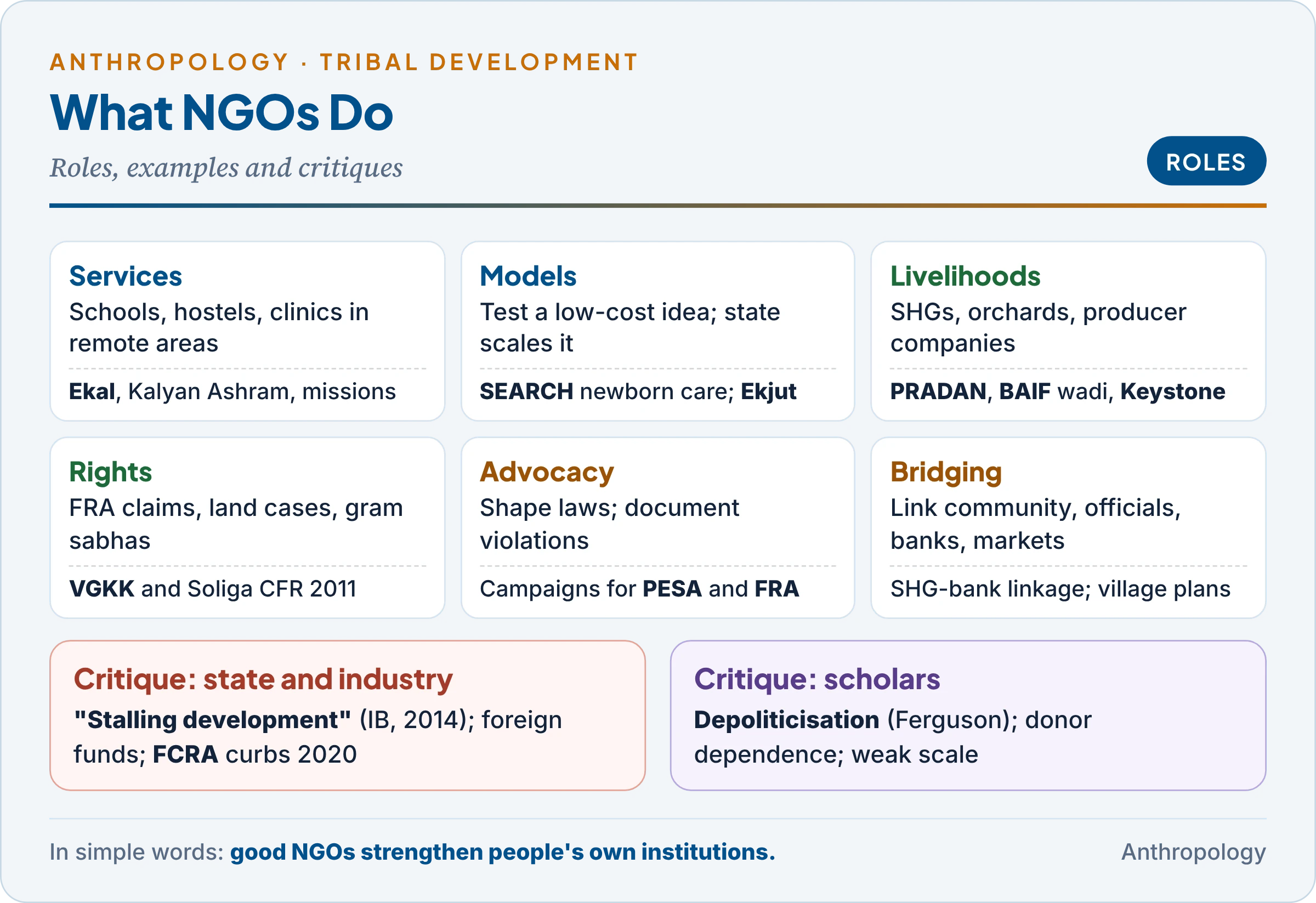
NGO roles, grouped by what they do for the community and the state:
| Role | How it works | Example |
|---|---|---|
| Service delivery | Schools, hostels, clinics where the state does not reach | Residential schools and mobile dispensaries funded by the Ministry’s grant scheme |
| Innovation and models | Test a low-cost idea; the state scales it | SEARCH newborn care; BAIF wadi orchards |
| Livelihoods | Self-help groups, producer companies, fair markets | PRADAN; Aadhimalai honey company |
| Rights and legal aid | Help file FRA claims, fight land cases, train gram sabhas | Support to Soliga and Mendha-Lekha claims |
| Advocacy and research | Document violations, shape laws and policies | Campaigns for PESA and FRA |
| Bridging stakeholders | Translate between community, officials, banks, markets and donors | Linking SHGs to banks; helping gram sabhas plan |
| Culture and knowledge | Record languages, medicine and crafts; community registers | Documentation of traditional healing knowledge |
NGOs facilitate other stakeholders through this bridging role: speaking the language of both village and bureaucracy, they turn a scheme into a local plan, a loan into a group enterprise, and a community demand into a policy proposal. The Ministry of Tribal Affairs’ grants-in-aid to voluntary organisations for schools, hostels and clinics in “service-deficient” tribal areas rests on this logic.
6.4 Case studies
Well-documented NGOs across sectors (listed, not ranked):
| NGO (year, place) | Work | Significance |
|---|---|---|
| SEARCH (1986, Gadchiroli) | Home-based newborn care; tribal-friendly hospital | Trial cut neonatal deaths by about 62%; adopted in national policy |
| Ekjut (Jharkhand and Odisha) | Monthly participatory learning and action meetings of women’s groups | Lancet trial (2005–08): neonatal mortality 32% lower, 45% lower in years 2–3 |
| Vivekananda Girijana Kalyana Kendra (1981, BR Hills, Karnataka) | Health, schooling and organisation among the Soliga | Soliga gram sabhas won community forest rights inside a tiger reserve (October 2011), a first |
| Lok Biradari Prakalp (1973, Hemalkasa) | Hospital and school for the Madia Gond | Care in a remote PVTG area |
| PRADAN (1983) | Women’s self-help groups, tasar silk, water harvesting in Jharkhand, Odisha and central India | Livelihoods through women’s collectives |
| BAIF (Vansda, Gujarat, from 1982) | Wadi: 1–2 acre orchards of mango, cashew or amla with forest trees | Cut distress migration; scaled through NABARD’s Tribal Development Fund |
| Keystone Foundation (1993, Kotagiri, Nilgiris) | Fair prices for honey hunters; Aadhimalai producer company (2013) | Kurumba and Irula PVTG members own the enterprise |
| Ekal Vidyalaya (1986, Gumla, Jharkhand) | One-teacher, two-hour village schools | About 89,000 schools (2025); linked to Sangh Parivar organisations |
| Vanvasi Kalyan Ashram (1952, Jashpur) | Hostels, schools, health and cultural programmes | Seeks to bring tribes closer to the mainstream and strengthen their faith; part of the Sangh Parivar |
| SEWA (1972, Ahmedabad) | Union and cooperatives of informal women workers | A model of women’s organising |
6.5 NGOs and the empowerment of tribal women
- Collectives: PRADAN and the National Rural Livelihoods Mission build self-help groups and federations that give women savings, credit and a collective voice.
- Health: Ekjut‘s women’s groups identified local causes of newborn deaths and devised their own remedies; SEARCH’s early studies documented the hidden reproductive illness of rural women.
- Livelihoods and markets: producer companies (Aadhimalai) and SEWA cooperatives give women control of income.
- Rights and leadership: training for gram sabha and mahila sabha participation under PESA and FRA, and support against witch-hunting and trafficking.
- Limits: better-off women can dominate groups, and empowerment rarely changes land inheritance, which customary law still denies to most tribal women.
6.6 NGOs in health and education
- Health: community health workers, newborn care, malaria and sickle-cell work, with traditional healers as partners; trusted because local and continuous.
- Education: residential and one-teacher schools, bridge courses, mother-tongue primers and adult literacy, as in the Total Literacy Campaigns of the 1990s.
- Limits: small scale, uneven quality and dependence on a founder; government schools and health centres remain the backbone.
6.7 NGOs and missionaries in Central India
Christian and Hindu organisations in Central India are best seen together, because they have often worked in competition.
- Christian missions: schools and hospitals produced the first educated tribal leaders in Chotanagpur and defended land rights, but also divided villages.
- Hindu organisations: Vanvasi Kalyan Ashram and Ekal Vidyalaya spread schools and hostels partly to counter conversion, preferring vanvasi (“forest dweller”) to adivasi (“original inhabitant”).
- State concern: the Niyogi Committee (Madhya Pradesh, 1956) and freedom of religion Acts (Odisha 1967, Madhya Pradesh 1968).
- Consequences: literacy, health and new elites, but also Sarna–Christian–Hindu tensions and the delisting debate (8.1).
6.8 Critiques of NGOs
NGOs face two very different kinds of criticism, which should be kept apart.
Criticism from the state and industry:
- An Intelligence Bureau report (June 2014) said foreign-funded NGOs were “stalling development projects”, including mining and power projects in Odisha and central India, at a cost it assessed at 2–3% of GDP a year. It singled out Greenpeace‘s support for the Mahan Sangharsh Samiti against a coal block in Singrauli, Madhya Pradesh; Greenpeace India’s FCRA registration was cancelled in 2015.
- The Foreign Contribution (Regulation) Act has since been tightened: more than 20,600 registrations were cancelled between 2011 and early 2021, mostly for not filing returns, and the 2020 amendment banned passing foreign grants to other NGOs, cut the administrative-cost limit from 50% to 20%, and required a designated account at the State Bank of India, New Delhi.
- The other side: defenders reply that opposition to projects often comes from tribal communities themselves, as when the Dongria Kondh gram sabhas rejected bauxite mining at Niyamgiri in 2013, and that the right to dissent and advocacy is part of democracy.
Criticism from scholars and activists:
- Depoliticisation: the anthropologist James Ferguson (The Anti-Politics Machine, 1990), studying a development project in Lesotho, showed how development agencies recast political problems as technical ones; NGOs that only deliver services can do the same.
- “NGO-isation” of resistance: the writer Arundhati Roy (2004) argued that funded NGOs turn movements into projects and rights into charity.
- Donor dependence: NGOs answer to funders more than to the people; agendas shift with grant cycles.
- Scale and sustainability: projects collapse when the NGO leaves; successes are hard to replicate.
- Governance and agendas: opaque funds, “briefcase NGOs” that exist only to draw grants, and welfare used for conversion or reconversion.
Anthropologists see NGOs as brokers between state, market and community; the test is whether an NGO strengthens the community’s own institutions (gram sabha, clan council, women’s group) or replaces them.
6.9 Making the partnership work
- Community ownership: plans made in the gram sabha; NGOs as facilitators.
- Transparency: NGO-Darpan registration, public accounts, social audits.
- Division of labour: the state gives universal services; NGOs innovate, reach the hardest-to-reach and monitor.
- Exit strategy: producer companies and federations that outlive the NGO; regulation without suppression of advocacy.
Key Terms
| Term | Meaning in simple words |
|---|---|
| PTG | Primitive Tribal Group, the old name (1975 to 2006) |
| PVTG | Particularly Vulnerable Tribal Group, the present name |
| Pre-agricultural technology | Living by hunting, gathering, fishing or shifting cultivation |
| Micro project | A small agency set up for one PVTG’s area |
| CCD plan | Conservation-cum-Development plan: a five-year plan for one PVTG |
| Habitat rights | FRA right of a PVTG over its whole customary territory |
| Saturation | Giving every eligible household a full set of services |
| PM-JANMAN | The 2023 mission for basic services in all PVTG habitations |
| Tribal reserve | Island area closed to outsiders under the 1956 Regulation |
| NGO | Private, non-profit body working for public good |
| Advocacy NGO | One that campaigns to change laws or policies |
| GONGO | An “NGO” set up or controlled by a government |
| FCRA | Law that controls foreign funds received by NGOs |
| Wadi | Small family orchard, BAIF’s model for tribal farmers |
| Depoliticisation | Treating political problems as merely technical |
Contemporary Developments
- PM-JANMAN (30 June 2026): 3.06 lakh of 4.90 lakh houses completed; 2,948 km of roads; 2,241 anganwadis running; habitation survey counts about 48.5 lakh PVTG people.
- Census 2027: the Ministry of Tribal Affairs has asked for separate enumeration of PVTGs (August 2025).
- Habitat rights: only 11 of 75 PVTGs covered (August 2026); Odisha leads with six groups approved since 2024.
- Great Nicobar: the tribal council challenges the 2022 forest-rights certificate (June–October 2026); the Supreme Court called preservation of culture a fundamental right (October 2026).
- Jarawa: population estimated at 647 (2025), up from about 260 at first friendly contact; 19 enrolled as voters (January 2025).
Diagrams to Master
- Topic map: Dhebar → criteria → renaming → distribution → problems → programmes; NGOs: roles, cases, critiques.
- Concept and timeline: four Dhebar layers; four criteria; 1975–76 (52) → 1993–94 (75) → 2006 → 2015 → 2023 → 2025.
- Regional distribution: central-eastern belt, western belt, Nilgiris, Himalaya and north-east, islands; state counts.
- Island PVTGs: five groups with habitat, contact status and numbers; the protective framework.
- PM-JANMAN progress: targets against achievements, with the gap between quick and construction-heavy items.
- NGO roles: six roles, examples, and the two kinds of critique.
Revision Grid
| Scholar or body | Work (year) | Key idea |
|---|---|---|
| Dhebar Commission | Report (1961) | Four layers; the least developed need special care |
| S.C. Roy | The Birhors (1925) | Forest-based nomadic economy |
| Verrier Elwin | The Baiga (1939); Bondo Highlander (1950) | Protection of vulnerable hill peoples |
| C. von Fürer-Haimendorf | The Chenchus (1943) | Foragers squeezed by forest law |
| P.K. Bhowmick | The Lodhas of West Bengal (1963) | Stigma and action anthropology |
| A.R. Radcliffe-Brown | The Andaman Islanders (1922) | Ritual and cohesion among foragers |
| Vishvajit Pandya | Above the Forest (1993) | Onge cosmology |
| William Beveridge | Voluntary Action (1948) | Voluntary body is self-governed |
| David Korten | Getting to the 21st Century (1990) | Four generations of NGO strategy |
| James Ferguson | The Anti-Politics Machine (1990) | Development depoliticises |
| Abhay and Rani Bang | Lancet (1999) | Home-based newborn care cut neonatal deaths |
| Tripathy et al. (Ekjut) | Lancet (2010) | Women’s groups cut neonatal deaths |
Previous Year Questions
The concept of PTGs, their distribution, special programmes for their development; role of NGOs in tribal development
- 2026Write notes on: Particularly Vulnerable Tribal Group (PVTG) of the islands.
- 2025What are the identifying criteria for PVTGs in India? Examine their current status, nomenclature and distribution.
- 2025Discuss the role of NGOs in the socioeconomic and political development of weaker sections and the manner in which they facilitate other stakeholders.
- 2024Critically discuss the recent welfare measures initiated by the Government for the Particularly Vulnerable Tribal Groups (PVTGs). Comment why PVTGs were erroneously called Primitive Tribal Groups (PTGs).
- 2023Elucidate the problems faced by Particularly Vulnerable Tribal Groups and the major challenges in the formulation of special programmes for their development.
- 2021Discuss the interventions made by the Non-Governmental Organizations for empowering tribal women.
- 2019Identify some special programmes for particularly vulnerable Tribal Groups (erstwhile PTGs).
- 2019Critically discuss the role of NGOs in tribal development.
- 2017Write a note in 150 words on Particularly Vulnerable Tribal Groups (earlier known as PTG).
- 2016Critically examine the role of NGOs and missionaries in transformation of scheduled tribes in Central India.
- 2015Recently non-government organizations have been critiqued for interfering with developmental process in tribal heartland ! Critically comment.
- 2014Write a note in 150 words on The concept of PTG.
- 2014Critically examine the role of NGOs in promoting health and education in tribal areas.
- 2009Write a note on NGOs and tribal development.
- 2008What are the special problems of the Primitive Tribal Groups (PTGs) ? How far have the developmental programmes of the Government been able to address these?
- 2007Write a note on Role of NGO’s in Development.
- 2002Write a note on the role of N.G.O.s for tribal development.
- 1996Write a note on Role of NGOs in literacy programme.
Related questions from other units
- 2026Unit 9.1: ‘Dharti Aaba Janjatiya Gram Utkarsh Abhiyan aims to meet some of the Sustainable Development Goals’. Discuss.
- 2021Unit 6.2: Examine the factors responsible for malnutrition in tribal India and suggest interventions required to overcome the problem.
- 2018Unit 6.1: Write a note in 150 words on Distinctive cultural features of tribes of Andaman islands.
- 2014Unit 9.1: Critically evaluate the National Tribal Policy.
- 2010Unit 6.2: Write a note in 150 words on Education and health among tribal women.
- 2000Unit 6.3: Give an account of Joint Forest Management programmes. What is the role of NGOs in such programmes ?
- 1999Unit 6.3: Discuss the problem of tribal displacement in India. To what extent, are development policies responsible for such displacement ? Also explain the role of NGOs in providing the remedial measures to the affected people.
More from Tribal Administration and Development: all notes of this unit · every PYQ of this unit · Anthropology Optional hub