

Theories of forgetting: decay, interference and retrieval failure.
Official Syllabus: Paper I · Unit 7 Memory
“With the lapse of time the series are forgotten, but not all at once and not at a uniform rate.”
— Hermann Ebbinghaus (1885), in Über das Gedächtnis, reporting the first forgetting curve
Forgetting is the loss of access to material that was once learnt — a definition that deliberately leaves open whether the material itself is gone, because that is the question the competing theories answer differently. The systematic study of it begins with Ebbinghaus (1885), who measured it on himself with nonsense syllables and produced both the first quantitative curve of retention and the method that still detects memory where recall fails.
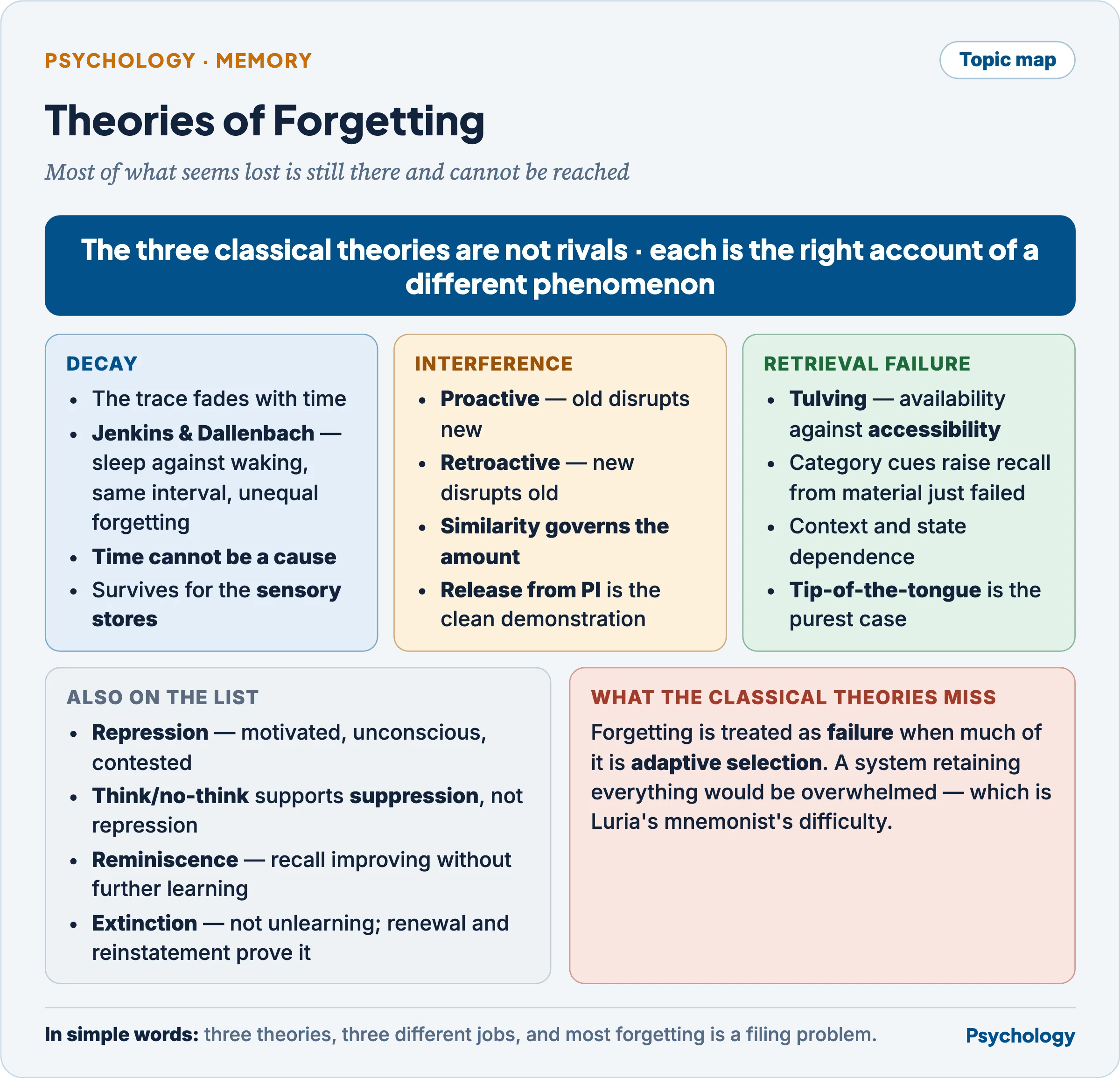
Forgetting was then studied for a century as the decay of a record, and almost every modern finding points the other way: most of what seems lost is still stored and cannot be reached. The three classical theories survive as accounts of different phenomena rather than as rivals, and distinguishing which applies in a given case is the whole of the practical question.
The forgetting curve
Hermann Ebbinghaus, working on himself with lists of nonsense syllables chosen to be free of meaning, measured retention by the savings method — the proportion of time or trials saved when relearning a list compared with learning it fresh.
- Forgetting is rapid at first, then slows sharply: a large fraction is lost within the first hour, and the curve flattens thereafter, so material surviving a day is likely to survive much longer.
- The savings method matters as much as the curve. It detects retention where recall and even recognition show nothing, which is the first demonstration that “forgotten” does not mean “gone”.
- The limitations are equally instructive: one participant, who was also the experimenter, and deliberately meaningless material, which strips out exactly the organisation that governs real retention. Meaningful material is forgotten far more slowly.
Decay theory
The claim. The memory trace fades with the passage of time through disuse, as a path becomes overgrown when not walked.
- In favour. It is intuitive, it fits the forgetting curve’s shape, and it is well supported for sensory memory, where decay over a few hundred milliseconds or seconds is the established mechanism. Biological trace decay is also plausible for unconsolidated material.
- Against.
- Time itself cannot be a cause. What matters is what happens during the interval, and time is merely the dimension along which it happens.
- Jenkins and Dallenbach’s comparison is the classic test: participants learned material and then either slept or stayed awake for the same interval. Retention after sleep was substantially better. Equal time, unequal forgetting — so time is not the operative variable.
- Reminiscence and spontaneous recovery — material inaccessible at one moment and accessible later, with no further study — are impossible if the trace has decayed.
- Savings persist long after recall has failed.
- Where it survives. Decay is accepted for the sensory stores and is a live candidate for short-term memory, where separating decay from interference is notoriously difficult because any delay is also an opportunity for interference.
Interference theory
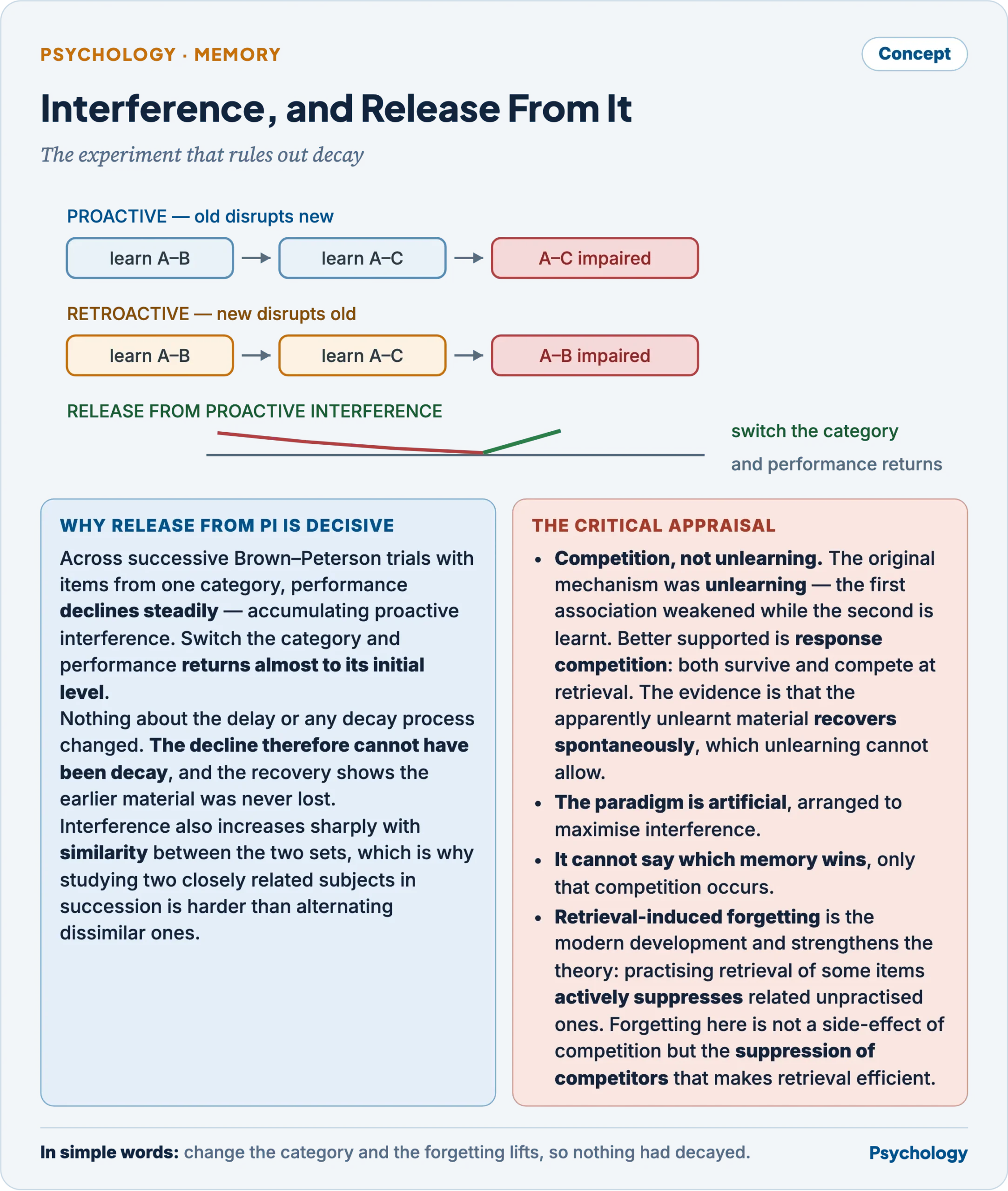
The claim. Forgetting occurs because other material competes with the target at retrieval. The dominant account of long-term forgetting for much of the twentieth century.
- Proactive interference — old material disrupts the retention of new. Having learnt a previous telephone number, the new one is harder to recall. In the classic design, learn A–B, then A–C, and A–C is impaired relative to a group with no prior list.
- Retroactive interference — new material disrupts the retention of old. Having learnt the new number, the old one is harder to recall. Learn A–B, then A–C, and A–B is impaired.
Two findings give the theory its force.
- Similarity governs the amount. Interference increases sharply with the similarity between the two sets of material, which is why learning two closely related subjects in succession is harder than alternating dissimilar ones.
- Release from proactive interference. Across successive Brown–Peterson trials with items from one category, performance declines steadily — accumulating proactive interference. Switch the category, and performance returns almost to its initial level. Since nothing about the delay or the decay process changed, the decline cannot have been decay, and the recovery shows the earlier material was never lost.
The critical appraisal.
- Its strength is that it is specific, testable and supported by a large body of controlled work, and that it explains why forgetting depends on what else was learnt rather than merely on elapsed time.
- Competition, not unlearning. The original mechanism was unlearning — the first association is weakened during the learning of the second. The better-supported account is response competition: both associations survive and compete at retrieval, with the stronger winning. The evidence is that the apparently unlearnt material recovers spontaneously over time, which unlearning cannot allow.
- The paradigm is artificial. Paired-associate lists sharing stimulus terms are arranged to maximise interference, and the extent to which ordinary life presents such configurations is assumed rather than shown.
- It cannot say which memory wins, only that competition occurs.
- It is not the whole story, because material with no plausible competitor is also forgotten.
- Retrieval inhibition is the modern development, and it strengthens the theory rather than replacing it. Retrieval-induced forgetting shows that practising retrieval of some items suppresses related unpractised items — recalling some members of a category makes the others harder to recall later, worse than if nothing had been practised. Forgetting here is not a side-effect of competition but the active suppression of competitors, an executive process that makes retrieval efficient. The cost is paid by the inhibited material.
Retrieval failure
The claim. The trace is intact and the cue needed to reach it is absent. Forgetting is a failure of access, not of storage.
- Cue-dependent forgetting. Tulving distinguished availability — whether the material is in store — from accessibility — whether it can be retrieved now. Much of what appears forgotten is available but inaccessible.
- The demonstration. Free recall of a categorised list yields a certain number of items; supplying the category names as cues raises recall substantially, from material the participant had just failed to produce. Nothing was learnt in between.
- Context and state dependence. Recall is better when the environment, physiological state or mood at retrieval matches that at encoding — Godden and Baddeley’s divers learning and recalling on land or underwater being the standard case.
- The tip-of-the-tongue state is the purest instance: the person has the item, can report its first letter, its length and words it sounds like, and cannot retrieve it. Storage is demonstrably intact.
- Why it is now the favoured account for most everyday forgetting: it explains recovery with better cues, context effects, spontaneous recovery and reminiscence, all of which the other two theories struggle with.
Motivated forgetting and repression
Freud’s claim is that anxiety-arousing material is actively excluded from consciousness by repression, which is motivated and unconscious, and that the material remains in store and continues to exert effects.
- The clinical evidence is case material — symptoms attributed to repressed content, and recovery of memories in therapy — which is suggestive and cannot establish the mechanism, since the same observations are produced by ordinary forgetting, by reluctance to disclose, and by suggestion within the therapeutic relationship.
- The experimental evidence is thin, and the design problem is severe: one cannot ethically induce trauma, so laboratory analogues use mildly unpleasant material, which may be forgotten for reasons that have nothing to do with repression.
- The best modern analogue is the think/no-think paradigm, in which participants practise not retrieving certain learnt items. Those items are subsequently recalled worse than unpractised ones, which demonstrates that deliberate retrieval suppression can impair later access. This supports suppression — a conscious, effortful process — more directly than it supports repression in Freud’s unconscious sense.
- The alternative explanations are substantial: retrieval failure, because the context of a traumatic event is deliberately avoided and so never rehearsed; ordinary infantile amnesia for early events; and in some cases never having encoded the material, since extreme stress impairs encoding.
- The honest position. Motivated forgetting of some kind is real and demonstrable; that it operates by the specific unconscious mechanism Freud described is not established, and the clinical stakes of overclaiming are high.
Reminiscence
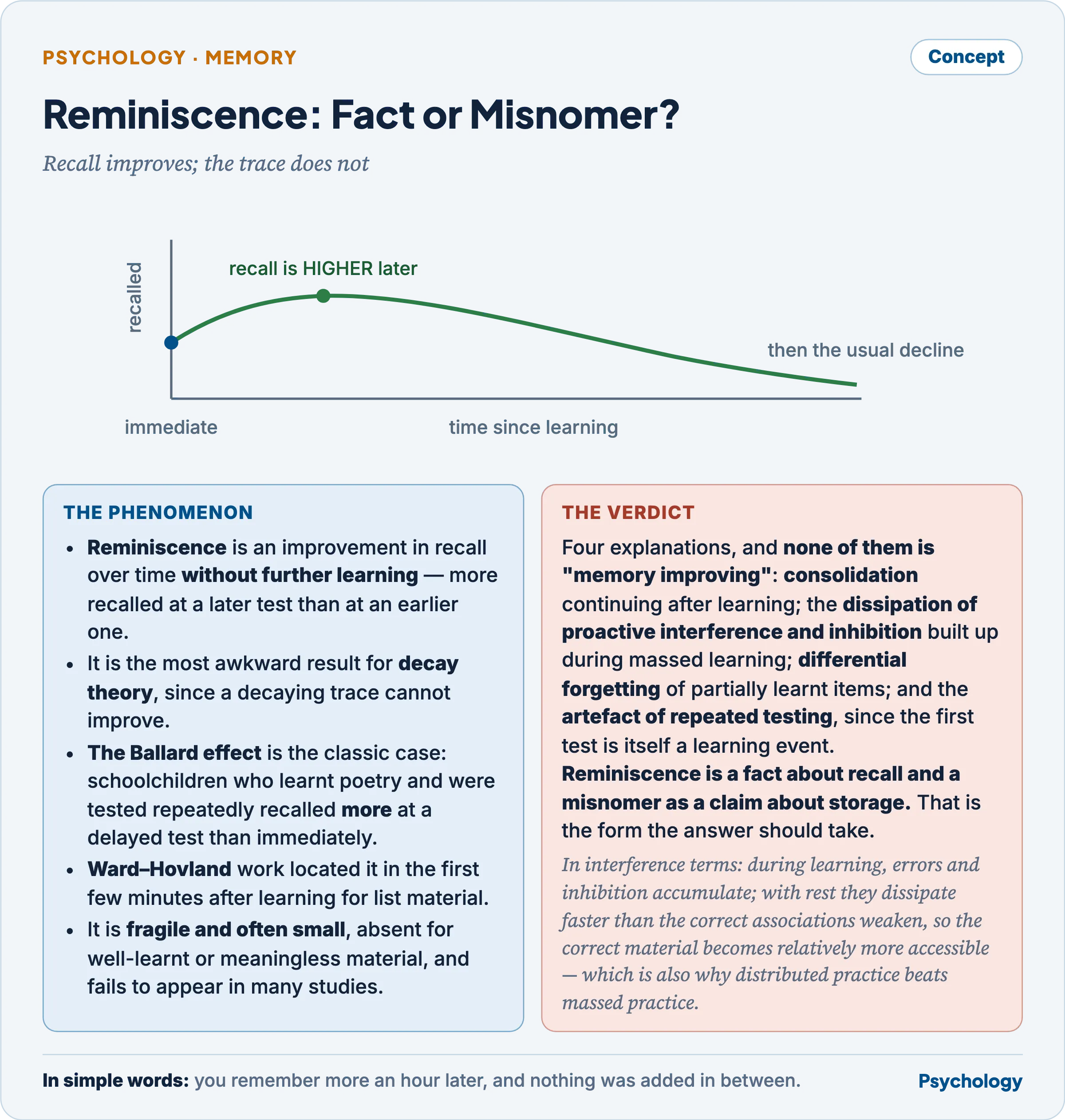
Reminiscence is an an improvement in recall over time without further learning — the recall of more material at a later test than at an earlier one. It is the single most awkward phenomenon for decay theory, since a decaying trace cannot improve.
- The Ballard effect is the classic demonstration: schoolchildren who learnt poetry and were tested repeatedly recalled more at a delayed test than immediately after learning.
- Ward–Hovland work located the effect in the first few minutes after learning for list material.
- Is it fact or misnomer? Both positions have support, and the question is best answered by separating the phenomenon from its explanation.
- The phenomenon is real under specifiable conditions: incompletely learnt, meaningful material, after short intervals, with repeated testing.
- It is fragile and often small, fails to appear in many studies, and is absent for well-learnt or meaningless material.
- Several explanations are not “memory improving”. Consolidation continuing after learning; the dissipation of proactive interference and inhibition built up during massed learning — which is the interference account, and the one the phenomenon is usually framed by; differential forgetting of partially learnt items; and the artefact of repeated testing, since the first test is itself a learning event. On these readings recall improves while the trace does not, so the “improvement in memory” is a misnomer even though the improvement in recall is genuine.
- The verdict: reminiscence is a a fact about recall and a misnomer about storage. That is the form the answer should take.
- In terms of interference, the account is straightforward: during learning, errors, competing responses and inhibition accumulate; with rest they dissipate faster than the correct associations weaken; so the correct material becomes relatively more accessible. This is also why distributed practice outperforms massed practice, and the two findings are explained by one mechanism.
Extinction and long-term memory
Extinction is the decline of a conditioned response when the reinforcer or unconditioned stimulus is withdrawn. Its role in long-term memory is instructive precisely because it looks like forgetting and is not.
- Extinction is not unlearning. The original association survives, which three findings establish: spontaneous recovery, the return of the response after a rest interval; renewal, its return when the animal is tested outside the extinction context; and reinstatement, its return after a single unsignalled presentation of the unconditioned stimulus.
- It is new learning that competes with the old — an inhibitory association, “not here, not now”, learnt alongside the original rather than in place of it.
- The consequence for long-term memory is a general one: suppression of a response is not deletion of the memory, and an inhibited memory remains liable to return given the right context or cue. The parallel with retrieval-induced forgetting and with motivated forgetting is exact.
- The clinical consequence is the relapse problem in exposure therapy. Fear reduced in the clinic returns in the original setting, which is renewal, and treatment is therefore conducted across multiple contexts so that the inhibitory learning is not tied to one.
The theories compared
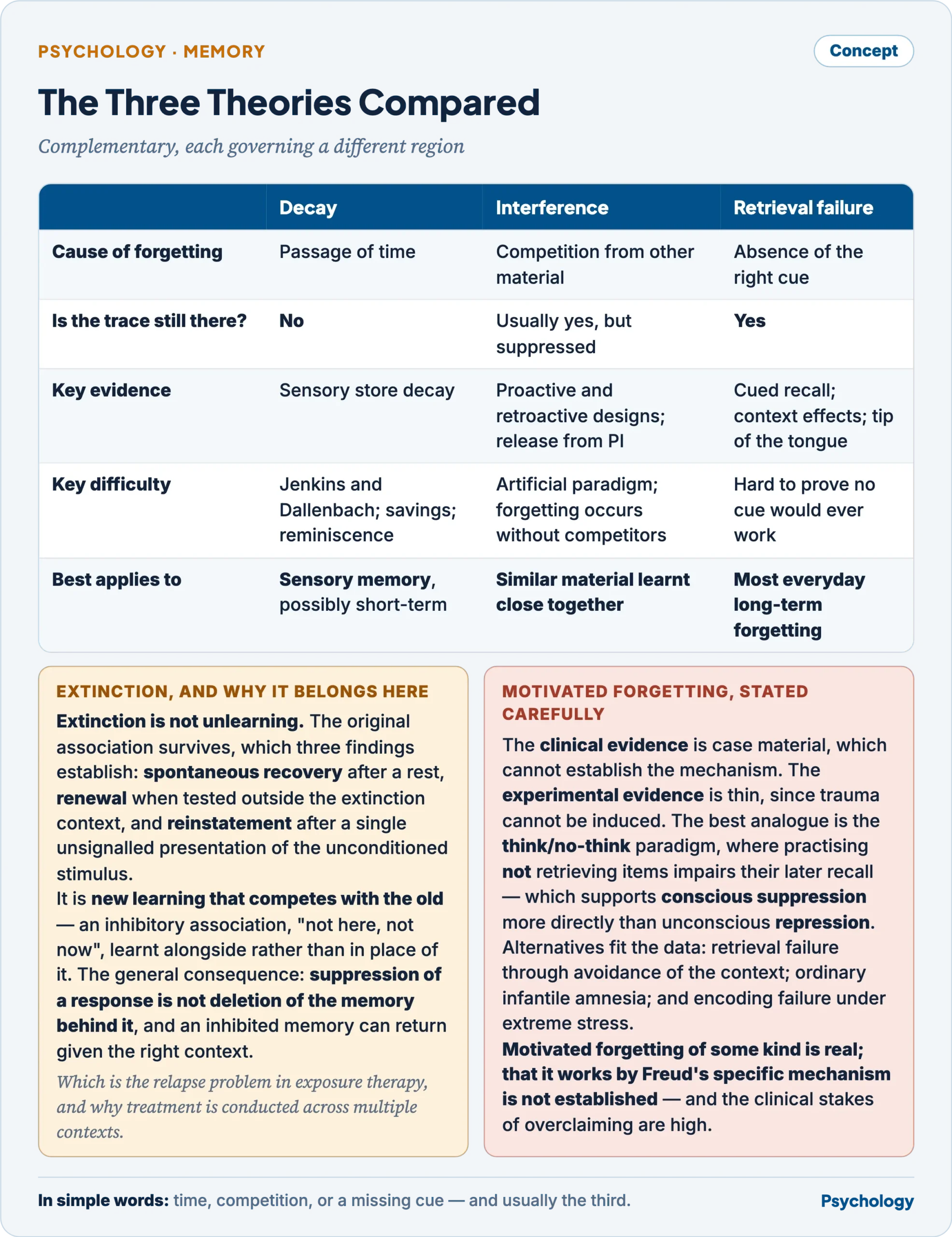
| Decay | Interference | Retrieval failure | |
|---|---|---|---|
| Cause of forgetting | Passage of time | Competition from other material | Absence of the right cue |
| Is the trace still there? | No | Usually yes, but suppressed | Yes |
| Key evidence | Sensory store decay | Proactive and retroactive designs; release from PI | Cued recall; context effects; tip of the tongue |
| Key difficulty | Jenkins and Dallenbach; savings; reminiscence | Artificial paradigm; cannot explain forgetting without competitors | Hard to prove a cue could never work |
| Best applies to | Sensory memory, possibly short-term | Similar material learnt close together | Most everyday long-term forgetting |
They are complementary. Decay governs the sensory stores, interference governs similar material learnt in proximity, and retrieval failure governs most of the rest.
Criticisms and limitations
- The three theories are hard to separate experimentally, because any interval contains both elapsed time and intervening material, and any failure of recall is consistent with both suppression and absence.
- Retrieval failure is near-unfalsifiable. One can always argue that a better cue would have worked, and no experiment can demonstrate that no cue would.
- Nonsense syllables and word lists underpin most of the literature, and forgetting of meaningful, emotionally significant, autobiographical material may follow different rules.
- Forgetting is treated as failure when it is substantially adaptive: a system that retained everything would be overwhelmed by obsolete and irrelevant detail, which is precisely Luria’s mnemonist’s difficulty. The modern view treats forgetting as selection, which the classical theories do not represent.
- Repression remains contested, and the dispute is not merely academic given its use in legal and therapeutic settings.
Previous Year Questions
- 2016Give a critical appraisal of interference theory of forgetting and show how the process of retrieval inhibition influences forgetting.
- 2015Bring out the disruption in retrieval processes due to anxiety, context and repression.
- 2007Discuss the role of repression and interference in forgetting.
- 1999What is Reminiscence? Discuss this phenomenon in terms of interference processes.
- 1997What role does extinction play in long-term-memory?
- 1995Is reminiscence a fact or a misnomer? Answer with relevant findings in support.
The questions on amnesia listed under this syllabus clause — on retrieval failure in amnesia, on repression in dissociative amnesia, and on the anterograde–retrograde distinction — are answered in the note on amnesia, where the clinical syndromes are set out together.