

Amnesia: Anterograde and retrograde.
Official Syllabus: Paper I · Unit 7 Memory
“He could not remember from moment to moment what he had just done, and yet he learnt, day after day, a skill he denied ever having practised.”
— the pattern Brenda Milner documented in H.M. from 1957 onward, which split memory into two
Amnesia is a loss of memory disproportionate to any general intellectual impairment, arising from damage to the brain or, in a distinct group of cases, from psychological causes without demonstrable damage. The modern understanding of it dates from Scoville and Milner (1957), whose report on a single surgical patient showed that memory could be destroyed while intelligence, language and perception were left intact. It is the most informative disorder in cognitive psychology, because the memory system does not fail as a whole: it fails in specific patterns, and each pattern marks a boundary between components that are otherwise invisible.
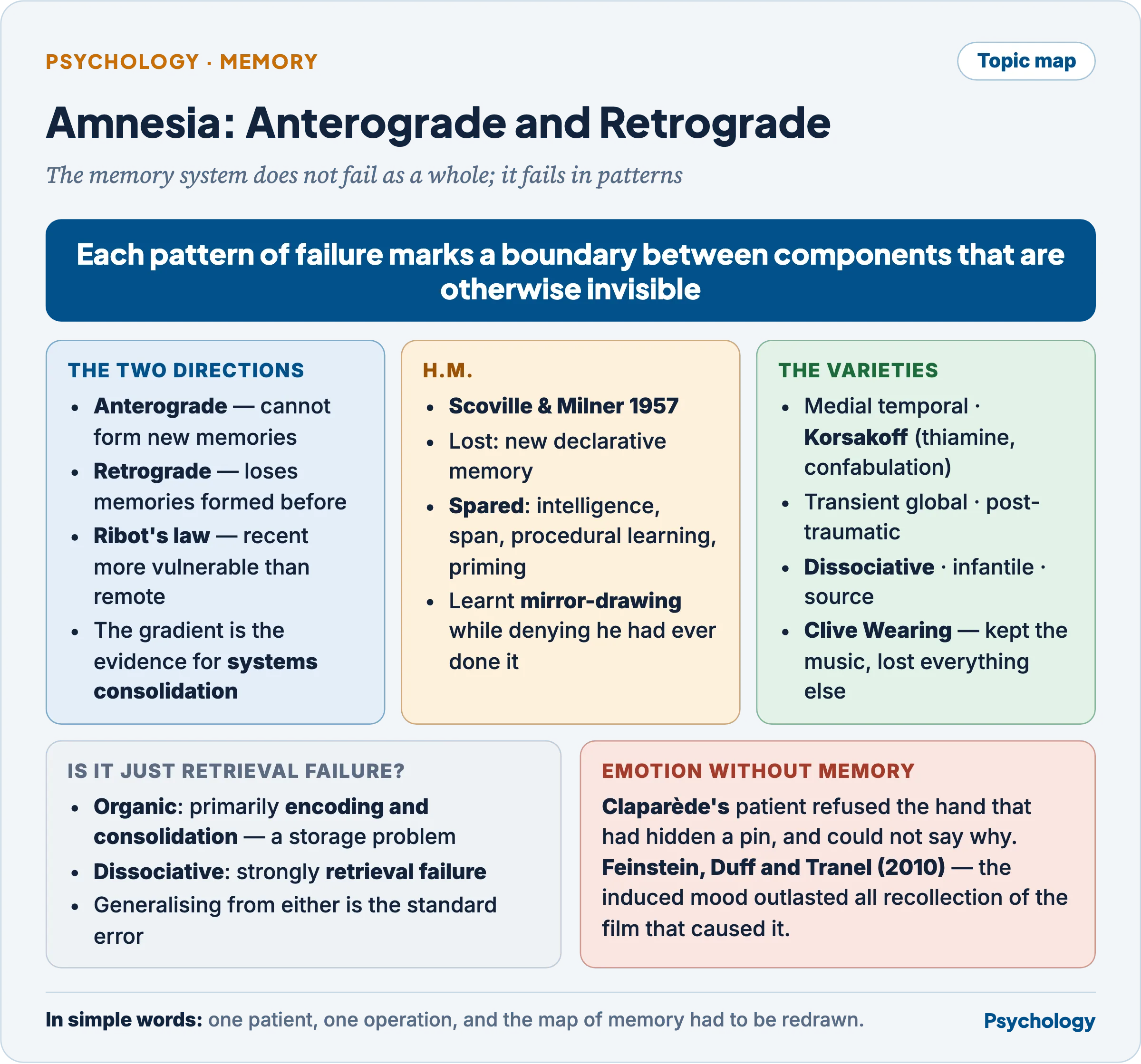
The two directions
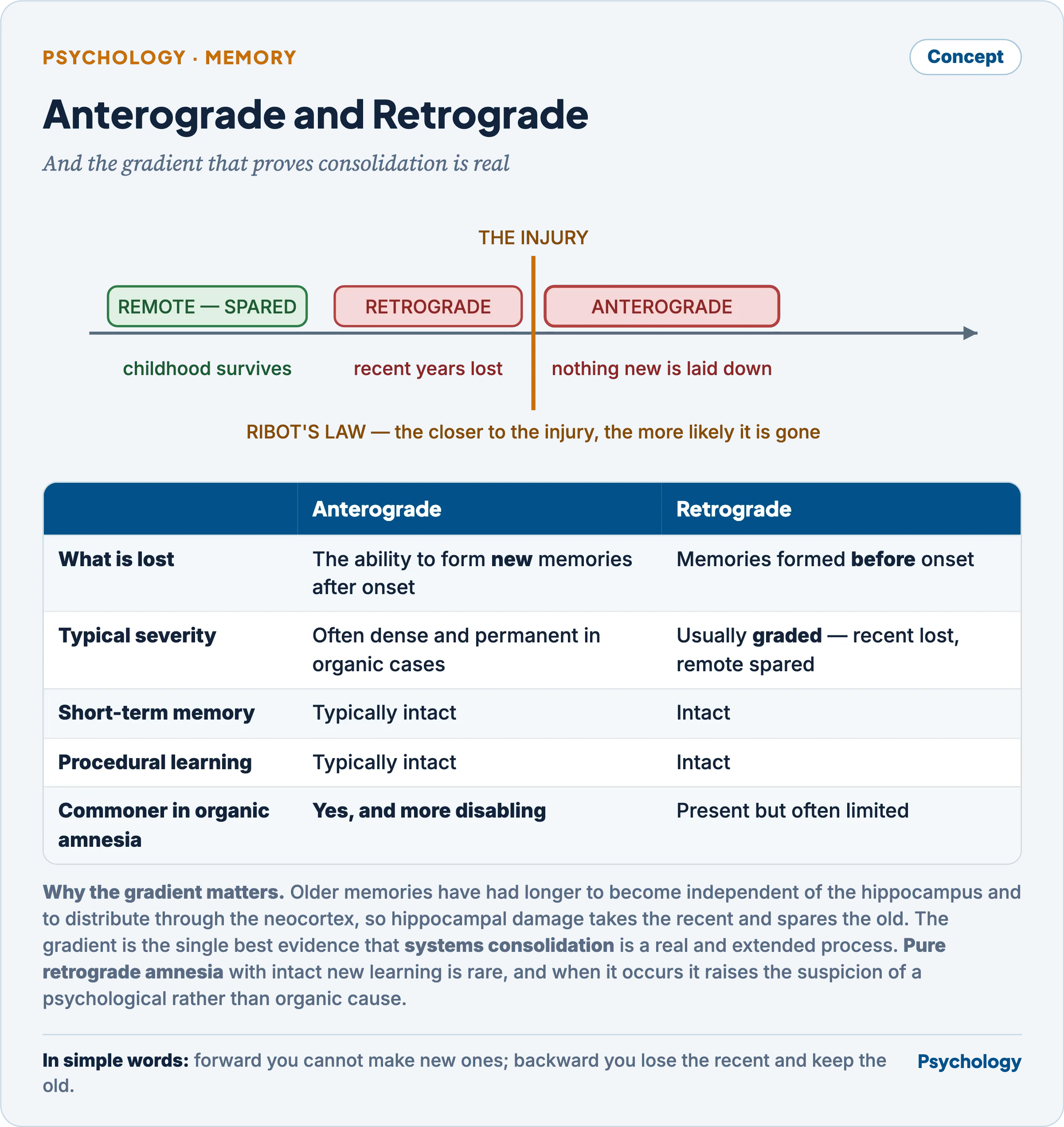
| Anterograde amnesia | Retrograde amnesia | |
|---|---|---|
| What is lost | The ability to form new memories after the onset | Memories formed before the onset |
| Direction in time | Forward from the event | Backward from the event |
| Typical severity | Often dense and permanent in organic cases | Usually graded, with recent memories lost and remote ones spared |
| Short-term memory | Typically intact | Intact |
| Procedural learning | Typically intact | Intact |
| Usual cause | Medial temporal or diencephalic damage | The same damage, plus psychological causes |
| Commoner in organic amnesia | Yes, and more disabling | Present but often limited |
Ribot’s law describes the gradient: in retrograde amnesia, recent memories are more vulnerable than remote. The explanation is systems consolidation — older memories have had longer to become independent of the hippocampus and distributed through the neocortex, so damage to the hippocampus takes the recent and spares the old. The gradient is the single best piece of evidence that consolidation is a real and extended process.
The two commonly occur together, and the usual pattern after injury is a dense anterograde loss with a retrograde loss covering months or years before it. Pure retrograde amnesia, with intact new learning, is rare and when it occurs raises the suspicion of a psychological rather than organic cause.
Why we forget, and where amnesia fits
Ordinary forgetting and amnesic forgetting are not the same thing, and the comparison places both.
- Decay — the trace fades with time. Accepted for the sensory stores, doubtful elsewhere, since equal intervals filled differently produce unequal forgetting.
- Interference — other material competes at retrieval, proactively from earlier learning and retroactively from later. The dominant account of ordinary long-term forgetting, and strongest where the competing material is similar.
- Retrieval failure — the trace is available but not accessible for want of the right cue, which is what cued recall, context effects and the tip-of-the-tongue state demonstrate.
- Motivated forgetting — anxiety-arousing material excluded from consciousness, the mechanism claimed for dissociative amnesia.
Where amnesia differs. Ordinary forgetting is overwhelmingly a problem of access to material that was successfully laid down. Organic amnesia is primarily a failure to lay material down at all — a deficit of encoding and consolidation rather than of retrieval — which is why it is not simply severe forgetting but a different kind of failure. The full treatment of the three theories is in the note on theories of forgetting.
H.M., and what his case established
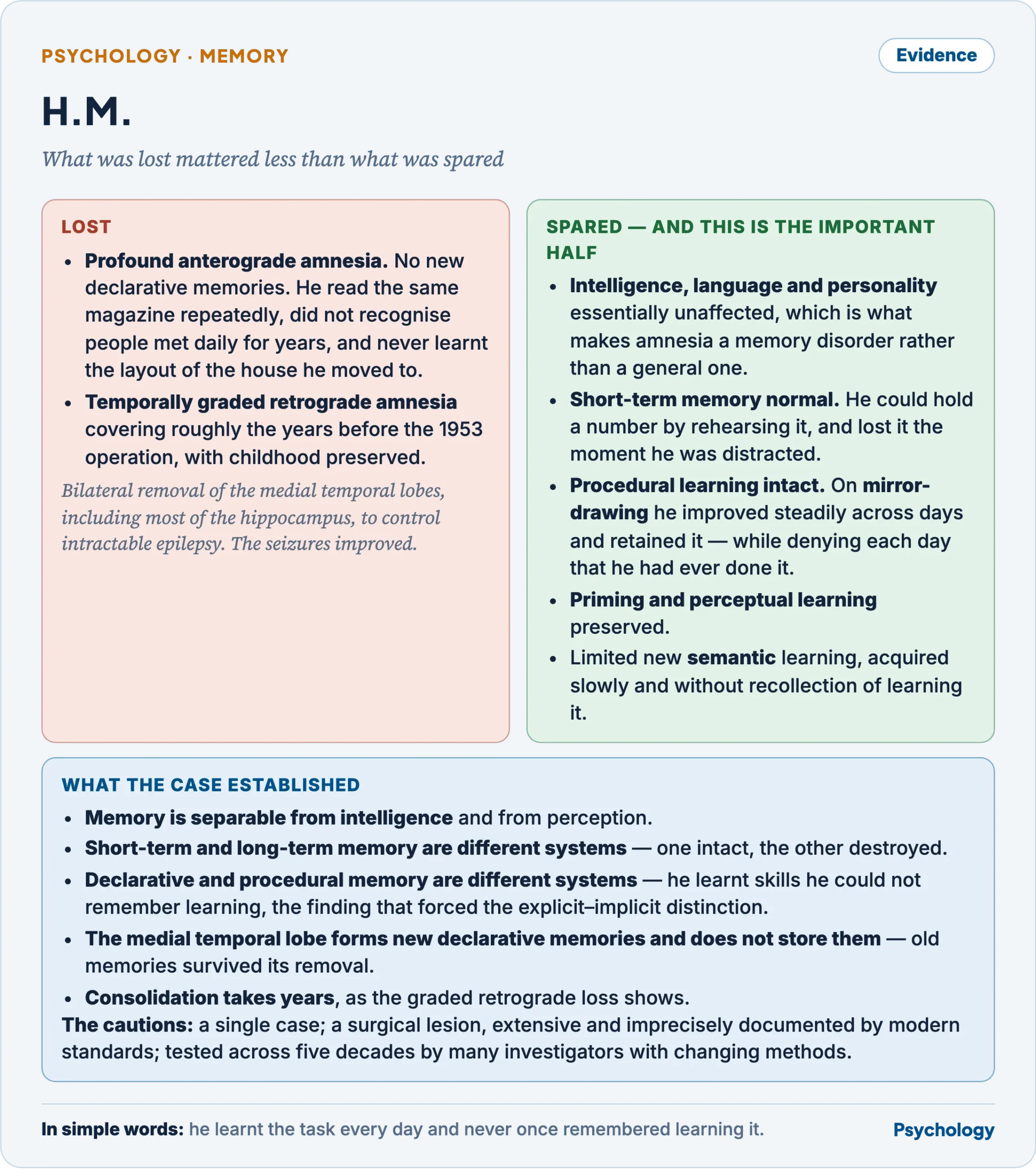
In 1953, a patient with intractable epilepsy underwent bilateral removal of the medial temporal lobes, including most of the hippocampus, the amygdala and surrounding cortex. The seizures improved. The memory consequences were catastrophic and were documented by Scoville and Milner (1957) and by Brenda Milner over the following decades. Known throughout his life as H.M., he was identified after his death in 2008 as Henry Molaison.
What was lost.
- Profound anterograde amnesia. He could not form new declarative memories. He read the same magazine repeatedly, did not recognise people he had met daily for years, and could not learn the layout of the house he moved to.
- Temporally graded retrograde amnesia covering roughly the years before the operation, with childhood memories preserved.
What was spared, and this is the important half.
- Intelligence, language and personality were essentially unaffected, which is what makes amnesia a memory disorder rather than a general one.
- Short-term memory was normal. He could hold a number by rehearsing it and lost it the moment he was distracted.
- Procedural learning was intact. On the mirror-drawing task he improved steadily across days and retained the improvement — while denying each day that he had ever done it.
- Priming and perceptual learning were preserved, as later testing established.
- Some evidence of limited new semantic learning, acquired slowly and without any recollection of the occasions of learning.
What the case established, which is why it is the most cited case in the discipline.
- Memory is separable from intelligence.
- Short-term and long-term memory differ, since one was intact and the other destroyed.
- Declarative and procedural memory differ, since he learnt skills he could not remember learning — the finding that forced the explicit–implicit distinction.
- The medial temporal lobe forms declarative memories; it does not store them, since old memories survived its removal.
- Consolidation takes years, as the graded retrograde loss shows.
The cautions. It is a single case; the lesion was surgical, extensive and imprecisely documented by modern standards; he was tested across five decades by many investigators using changing methods, and his awareness of being a research subject may itself have affected performance.
The main varieties
- Medial temporal lobe amnesia, the H.M. pattern, following surgery, anoxia, herpes encephalitis or stroke. Anterograde loss predominates.
- Diencephalic amnesia, most often Korsakoff’s syndrome, caused by thiamine deficiency, typically secondary to chronic alcohol use, damaging the mammillary bodies and medial thalamus. It differs from the H.M. pattern in important ways: extensive retrograde loss, marked confabulation — the production of false accounts offered sincerely and without intent to deceive — and poor insight, with frontal involvement contributing to all three.
- Transient global amnesia, a sudden, self-limiting episode of dense anterograde amnesia with repetitive questioning, lasting hours and resolving, usually with a permanent gap for the episode itself.
- Post-traumatic amnesia after head injury, in which the duration of the confused, non-recording period is one of the better predictors of long-term outcome.
- Dissociative (psychogenic) amnesia, discussed below.
- Infantile amnesia, the normal absence of adult recall for the first years.
- Source amnesia, in which content is retained and its origin is not — present in mild form in healthy people and exaggerated in amnesia and ageing.
- Clive Wearing, a musician whose herpes encephalitis produced one of the densest recorded amnesias, both anterograde and retrograde, illustrates the same dissociation as H.M. in an extreme form: he retained the ability to read, play and conduct music fluently while having no recollection of ever having done so.
Dissociative amnesia, and the role of repression
Dissociative amnesia is an inability to recall important autobiographical information, usually of a traumatic or stressful nature, that is too extensive to be ordinary forgetting and is not explained by brain damage or substance use.
- Its forms: localised (a circumscribed period, commonly the one surrounding the trauma), selective (parts of a period), generalised (the whole of one’s life, including identity — rare), continuous (everything from a point onward), and systematised (one category of material, such as everything concerning a particular person).
- Dissociative fugue adds purposeful travel and confusion about identity.
Repression as the proposed mechanism. On the Freudian account, the material is actively excluded from consciousness because it is anxiety-arousing; it remains in store and continues to exert effects; and the exclusion is unconscious and motivated rather than accidental. Dissociative amnesia is the clinical phenomenon the concept was built to explain.
What supports it. The onset is typically tied to an identifiable traumatic event; the forgetting is content-specific rather than general, which decay or interference would not predict; recovery is often sudden and complete, which implies the material was stored throughout; and the amnesia frequently resolves when circumstances change or the material becomes tolerable.
What tells against it, and the criticism is serious.
- The mechanism is not demonstrated. No experimental procedure establishes unconscious motivated exclusion, and the laboratory analogue that comes closest — the think/no-think paradigm, in which deliberately avoiding retrieval impairs later recall — demonstrates conscious suppression, which is not the same claim.
- Alternatives fit the data. Retrieval failure, since the context of the event is deliberately avoided and therefore never rehearsed or re-cued; state-dependent retrieval, since the encoding state was extreme and is not reinstated; encoding failure, since very high stress impairs encoding; and, in a minority of cases, simulation, which has an obvious motive where legal consequences follow.
- Culture and expectation shape it. The presentation varies with what a culture recognises as a legitimate response to trauma, and the diagnosis’s frequency has varied with its prominence in professional and popular discourse.
- The recovered-memory controversy bears directly on it. The same mechanism said to hide memories is invoked to explain their recovery, and the false-memory literature shows that confident, detailed and emotional memories can be produced by suggestive questioning. No feature distinguishes a genuine recovered memory from an implanted one.
The defensible position. Dissociative amnesia is a real clinical presentation; motivated forgetting of some kind occurs; and whether the mechanism is Freudian repression, retrieval failure under avoidance, or a mixture, is not settled. The careful formulation attributes the phenomenon confidently and the mechanism tentatively.
How it differs from organic amnesia, which is the clinically decisive comparison.
| Organic | Dissociative | |
|---|---|---|
| Direction | Anterograde predominates | Retrograde predominates |
| New learning | Impaired | Usually intact |
| Personal identity | Retained | May be lost |
| Gradient | Ribot gradient — remote spared | Often no gradient; may lose remote and keep recent |
| Onset | Tied to injury or illness | Tied to psychological stress |
| Procedural memory | Intact | Intact |
| Recovery | Limited and gradual | Often sudden and complete |
Is amnesia merely retrieval failure?
The question is well posed, because both answers have real evidence.
The case that it is retrieval failure.
- Priming is intact. Amnesic patients complete word stems with studied words at near-normal rates while failing to recognise the same words. The material is demonstrably stored and cannot be reached by explicit retrieval.
- Cueing helps disproportionately. Performance improves with strong cues, recognition typically exceeds recall, and savings appear in relearning.
- Procedural learning is normal, so acquisition as such is not broken.
- In dissociative cases recovery is often complete, which is decisive for that group: material fully recovered was never lost.
The case that it is more than retrieval failure.
- The retrograde gradient points to consolidation. Memories formed shortly before the lesion are lost and older ones spared. A pure retrieval deficit should not respect the age of the memory.
- Recognition is impaired too, and often severely. A retrieval-failure account predicts that supplying the item itself should largely solve the problem, and in dense amnesia it does not.
- The deficit is relational. The hippocampus appears necessary for binding elements into an integrated episode, so what fails is the formation of a bound representation rather than access to a complete one.
- Forgetting is often accelerated, which indicates a storage problem rather than a retrieval one.
- The spared learning is of another kind. Priming and procedural learning are non-declarative; their preservation shows that another system is working, not that the damaged system’s output is merely inaccessible.
The verdict. For organic amnesia the primary deficit is in encoding and consolidating new declarative memories — a storage problem — with a genuine retrieval component for material acquired before onset. For dissociative amnesia the evidence points strongly to retrieval failure. Treating all amnesia as retrieval failure generalises from the dissociative case and from the spared implicit performance, and both are special.
Can amnesic patients recall emotional events?
The answer separates two things that ordinarily travel together: the memory of what happened and the emotional response to it.
- Declarative recall is impaired like any other. In dense anterograde amnesia a frightening or joyful episode is no better recalled than a neutral one, because the system that records events is the one that is damaged.
- The emotional response is still acquired. Claparède’s patient, pricked by a pin concealed in his hand during a greeting, afterwards refused to shake hands while having no recollection of why. The behaviour had been learnt; the episode had not.
- The anatomy explains the split. Emotional conditioning depends on the amygdala, declarative memory on the hippocampus. Where damage spares the amygdala, the patient acquires conditioned emotional responses without any recollection; patients with selective amygdala damage show the converse, retaining the declarative memory of an emotional event while losing its emotional enhancement.
- The feeling outlasts the memory. Feinstein, Duff and Tranel (2010) showed amnesic patients film clips that induced sadness or happiness. The patients were soon unable to recall the films at all, and nevertheless continued to report the induced mood, in some cases for longer than controls — and the strength of the feeling was unrelated to how much of the film they could recall.
- In normal memory, emotional arousal enhances consolidation through amygdala modulation of hippocampal processing; amnesia removes the target of that modulation while leaving the modulator intact.
The practical implication is substantial for care: a patient with dense amnesia may be distressed by an interaction they cannot remember, and may remain distressed without being able to say why. The absence of recollection is not an absence of consequence.
Assessing memory disorders
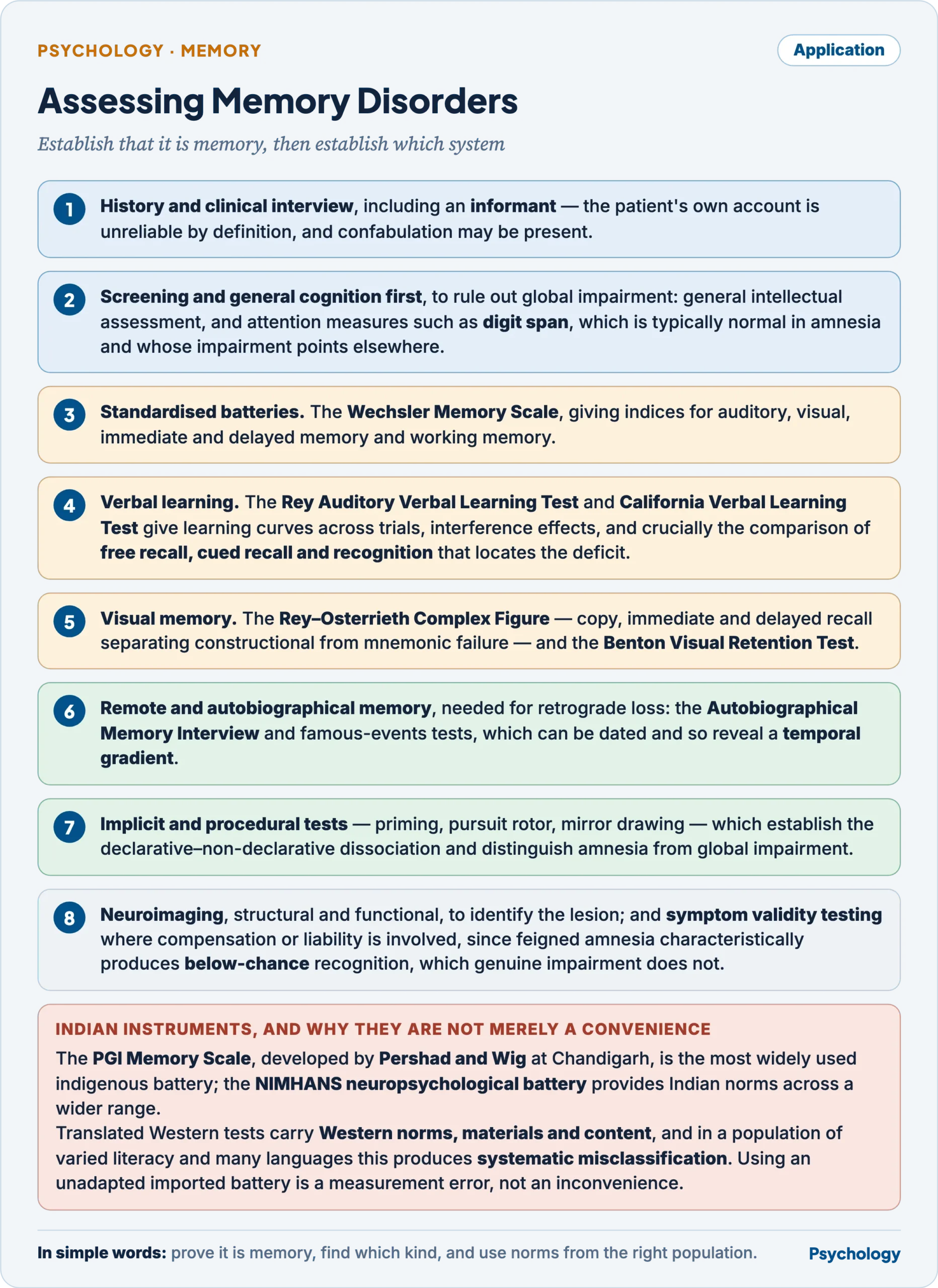
Assessment must establish that the deficit is in memory rather than in attention, language or motivation, and must characterise which memory systems are affected.
- History and clinical interview, including an informant, since the patient’s own account is unreliable by definition and confabulation may be present.
- Screening and general cognition first, to rule out global impairment: general intellectual assessment, and attention measures such as digit span, which is typically normal in amnesia and whose impairment points elsewhere.
- Standardised memory batteries. The Wechsler Memory Scale is the most widely used, giving indices for auditory, visual, immediate and delayed memory and working memory.
- Verbal learning and memory: the Rey Auditory Verbal Learning Test and the California Verbal Learning Test, which give learning curves across trials, interference effects, and crucially the comparison of free recall, cued recall and recognition that locates the deficit.
- Visual memory: the Rey–Osterrieth Complex Figure, with copy, immediate and delayed recall separating constructional from mnemonic failure, and the Benton Visual Retention Test.
- Remote and autobiographical memory, needed for retrograde loss: the Autobiographical Memory Interview and famous-events or famous-faces tests, which can be dated and so reveal a temporal gradient.
- Implicit and procedural tests — priming, pursuit rotor, mirror drawing — which establish the declarative–non-declarative dissociation and are what distinguishes amnesia from global impairment.
- Neuroimaging, structural and functional, to identify the lesion and support localisation.
- Symptom validity testing, important where compensation or criminal liability is involved, since feigned amnesia characteristically produces below-chance recognition performance, which genuine impairment does not.
- Indian instruments. The PGI Memory Scale, developed by Pershad and Wig at Chandigarh, is the most widely used indigenous battery and is important for a reason beyond convenience: translated Western tests carry Western norms, materials and content, and in a population with varied literacy and many languages this produces systematic misclassification. The NIMHANS neuropsychological battery provides Indian norms across a wider range of functions. Using an unadapted imported battery is a measurement error, not merely an inconvenience.
What amnesia reveals about representational knowledge
Amnesia is studied not only as a disorder but as a method, and the logic is the same throughout: what dissociates must be separately represented.
- Declarative against non-declarative. H.M.’s intact mirror-drawing and impaired recollection show that skill knowledge and fact knowledge are held in different form and in different places.
- Episodic against semantic. Amnesic patients lose events while retaining general knowledge; semantic dementia patients show the reverse. The double dissociation establishes two kinds of declarative representation.
- Priming reveals perceptual representation. Intact priming with impaired recognition, and the sensitivity of priming to surface form — modality, typeface, voice — while recognition is not, indicates a perceptual representation system distinct from the declarative one.
- Binding as the hippocampal function. Amnesic patients are disproportionately impaired at remembering associations — which face went with which name, which object in which place — compared with the items themselves, which suggests the hippocampus represents relations rather than content.
- Where storage lives changes. The Ribot gradient shows that a representation changes its neural home over time — a fact about representation that no behavioural method could have established.
- Short-term against long-term. Normal span with absent long-term learning, and the reverse pattern in parietal patients, separates two forms of maintenance.
Each conclusion is a claim about how knowledge is represented, reached by observing which parts of it survive selective damage. That is the sense in which representational knowledge can be investigated neurocognitively, and it is the reason a single patient could change a discipline.
Criticisms and limitations
- Single-case evidence carries unusual weight here, and with it the usual risks: lesions are rarely confined to one structure, premorbid ability is unknown, and generalisation from one brain is hazardous.
- Lesions are not experiments. They are accidents of disease and surgery, and the damaged regions are those that disease happens to attack.
- Dissociations are weaker than they look. A single dissociation can reflect task difficulty, and even a double dissociation can be produced by a single system with a non-linear mapping to two tasks.
- “Amnesia” names several syndromes, not one, and results from Korsakoff patients, surgical cases and encephalitis are pooled more often than the differences justify.
- Dissociative amnesia remains contested in a way with real consequences for legal and clinical practice.
- Rehabilitation lags understanding. Errorless learning, spaced retrieval and external memory aids help, and none restores the damaged system — a gap worth stating plainly in any account that dwells on how much the cases have taught us.
Previous Year Questions
- 2008Representational knowledge can be investigated neurocognitively through the studies of amnesia. Elaborate this statement.
- 2017Why do we forget? Differentiate between anterograde and retrograde amnesia.
- 2020Repression is a motivated forgetting process that protects us by inhibiting anxiety-arousing memories. Explain its role in dissociative amnesia.
- 2019Is amnesia merely a phenomenon of retrieval failure? Discuss in the light of empirical evidences.
- 2025Can amnesia patients recall emotional events? Explain your answer citing research evidence.
- 2022Discuss the techniques to assess patients with memory disorders.
- 2016What do you understand by amnesia? Illustrate the types of amnesia with reference to the case of “H.M.’s brain operation”.
- 2010Explain anterograde amnesia with special reference to the classical case of HM.