

Development and Social Progress.
Official Syllabus: Paper II, Section A, Unit 8
Sustainable development asks whether development can last. The growth of the last two centuries has lifted billions out of poverty, but it has also warmed the climate, emptied forests and rivers, and loaded the bill onto people who are not yet born and onto communities, often tribal, who live closest to the land. The Brundtland Commission (1987) answered with the most quoted definition in development thinking: development that meets the needs of the present without compromising the ability of future generations to meet their own needs. Behind this simple sentence lie hard philosophical questions. What do we owe to future people who cannot speak for themselves? Is nature valuable only as a resource for humans, or in itself? And can the development of a nation be reconciled with the values of tribal communities whose way of life depends on forests, hills and rivers? This article covers the meaning and pillars of sustainable development, its global and Indian milestones, intergenerational justice (Rawls, Parfit, Jonas), environmental ethics (shallow and deep ecology), the critical estimate of sustainable development, and development and tribal values.
In simple words
A farmer who eats next year’s seed grain has a full stomach this winter and an empty field next spring. Unsustainable development is a society eating its seed grain: forests, groundwater, clean air and a stable climate are the seeds of every future harvest. Sustainable development means eating the crop and saving the seed.
Context & Problem
- The warning signs: Rachel Carson’s Silent Spring (1962) showed how pesticides poisoned birds and food chains. The Club of Rome’s report The Limits to Growth (1972) argued that endless growth on a finite planet would end in collapse.
- Prevalent models of development (capitalist and socialist alike) caused serious environmental damage and over-exploitation of resources: deforestation, polluted rivers, falling groundwater, loss of species, and now climate change.
- The North–South tension: at the first UN environment conference at Stockholm (1972), Indira Gandhi asked, “Are not poverty and need the greatest polluters?” Poor countries feared that environmental rules would block their right to develop, while rich countries had already polluted their way to prosperity.
- The synthesis: the World Commission on Environment and Development, chaired by Norway’s Prime Minister Gro Harlem Brundtland, published Our Common Future (1987). It tried to join development for the poor with protection of the environment in one idea.
Core Doctrine
The Brundtland Definition
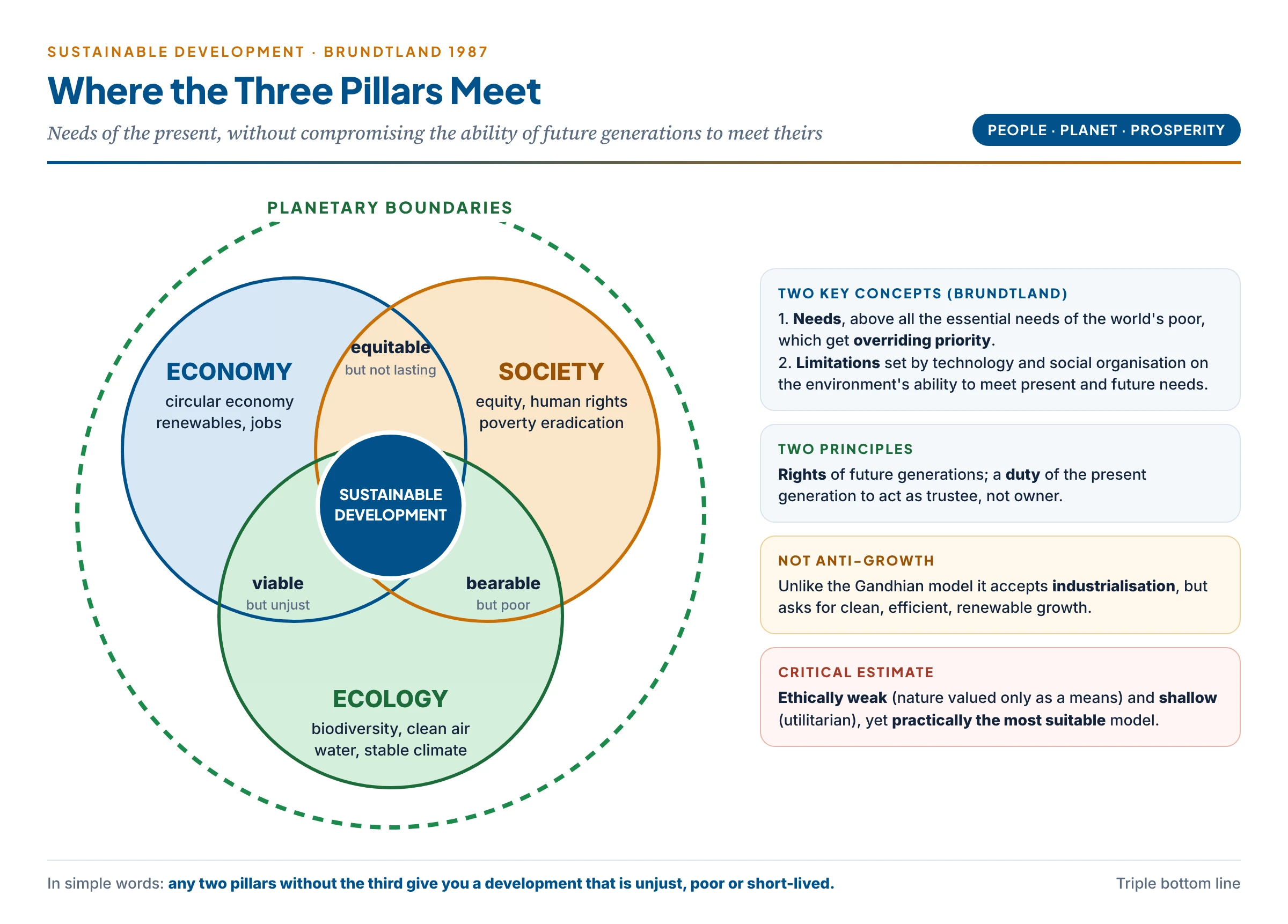
“Sustainable development is development that meets the needs of the present without compromising the ability of future generations to meet their own needs.” — Our Common Future (1987)
The Commission said the definition contains two key concepts:
- The concept of “needs”, in particular the essential needs of the world’s poor, to which overriding priority should be given.
- The idea of limitations imposed by the state of technology and social organisation on the environment’s ability to meet present and future needs.
What this means:
- Sustainable development is not anti-growth: the poor need growth. It asks for a different quality of growth: less wasteful, less polluting, more equitable.
- It reflects two principles:
- Recognition of the rights of future generations: they have a claim to a liveable planet.
- A sense of duty towards future generations: the present generation must act as a trustee, not an owner.
- Unlike the Gandhian model, it does not condemn industrialisation; it asks for sustainable industrial development: clean technology, efficiency and renewable energy.
The Three Pillars
Sustainable development balances three dimensions (often called the “triple bottom line”: people, planet, profit):
- Economic sustainability: growth and livelihoods that can continue: circular economy (products reused, repaired and recycled instead of thrown away), renewable resources, efficient use of materials.
- Social sustainability: equity, human rights, poverty eradication, health and education; a society that excludes many is not stable.
- Ecological sustainability: biodiversity, clean air and water, healthy soils, and staying within planetary boundaries, the safe limits of Earth’s systems such as climate, nitrogen cycles and freshwater.
- Where only two pillars meet, the result is incomplete:
- Economy + society without ecology = “equitable” but not lasting.
- Economy + ecology without society = “viable” but unjust.
- Society + ecology without economy = “bearable” but poor.
- Only where all three meet is development sustainable.
Strong and Weak Sustainability
- Weak sustainability: what we must pass on is total capital (machines, money, knowledge plus nature). If we cut a forest but build a school worth more, the future is no worse off. Natural capital can be substituted by human-made capital.
- Strong sustainability: some natural capital is irreplaceable: a stable climate, the ozone layer, biodiversity, fertile soil. No amount of money can substitute for them, so they must be preserved as such.
- Why it matters: most economic policy assumes weak sustainability; ecologists and deep ecologists insist on strong sustainability.
In simple words
If you inherit your grandfather’s house and sell its garden to buy a car, weak sustainability says you have kept the family “wealth”. Strong sustainability says: your grandchildren can repair or replace a car, but once the old banyan tree and the well are gone, nothing will bring them back.
Tools and Milestones
Ideas and tools:
- Circular economy (design out waste); green economy (low-carbon, resource-efficient, socially inclusive growth); renewable energy; the 6R principle (commonly listed as reduce, reuse, recycle, recover, redesign and remanufacture); environmental impact assessment; carbon pricing.
Global milestones:
- Stockholm Conference (1972): first UN conference on the human environment; created the UN Environment Programme.
- Brundtland Report (1987): the definition.
- Rio Earth Summit (1992): Agenda 21, the climate convention (UNFCCC) and the biodiversity convention; principles such as the precautionary principle, polluter pays and common but differentiated responsibilities (all must act, but rich countries, which polluted most, must do more).
- Millennium Development Goals (2000–2015): eight goals, mainly on poverty, health and education.
- Sustainable Development Goals (2015): 17 goals and 169 targets for 2030, from ending poverty and hunger (Goals 1–2) to gender equality (5), clean energy (7), climate action (13) and life on land (15), under the pledge “leave no one behind”.
- Paris Agreement (2015): holding warming well below 2°C and pursuing efforts towards 1.5°C, through national pledges.
Indian Connect — Indian Connect
- Ancient roots: the Pṛthivī Sūkta of the Atharva Veda declares “mātā bhūmiḥ putro’haṃ pṛthivyāḥ”: “the Earth is my mother, I am her son“, and prays: “What of thee I dig out, let that quickly grow over; let me not hit thy vitals or thy heart.” Sacred groves (devrai, orans, kavu) protected forests through religion.
- Constitution: Article 48A (the State shall protect and improve the environment and safeguard forests and wildlife) and Article 51A(g) (every citizen’s duty to protect nature and have compassion for living creatures), added by the 42nd Amendment (1976).
- Courts: Vellore Citizens’ Welfare Forum (1996) made sustainable development, the precautionary principle and polluter pays part of Indian law; State of Himachal Pradesh v. Ganesh Wood Products (1995) invoked intergenerational equity; M. K. Ranjitsinh v. Union of India (2024) recognised a right against the adverse effects of climate change under Articles 14 and 21.
- Policy: the International Solar Alliance (2015); Mission LiFE (Lifestyle for Environment, launched at the Glasgow climate summit, 2021), which asks for “mindful and deliberate utilisation” instead of “mindless and destructive consumption”; India’s pledge of net-zero emissions by 2070.
The Problem of Intergenerational Justice
Why justice to the future is hard:
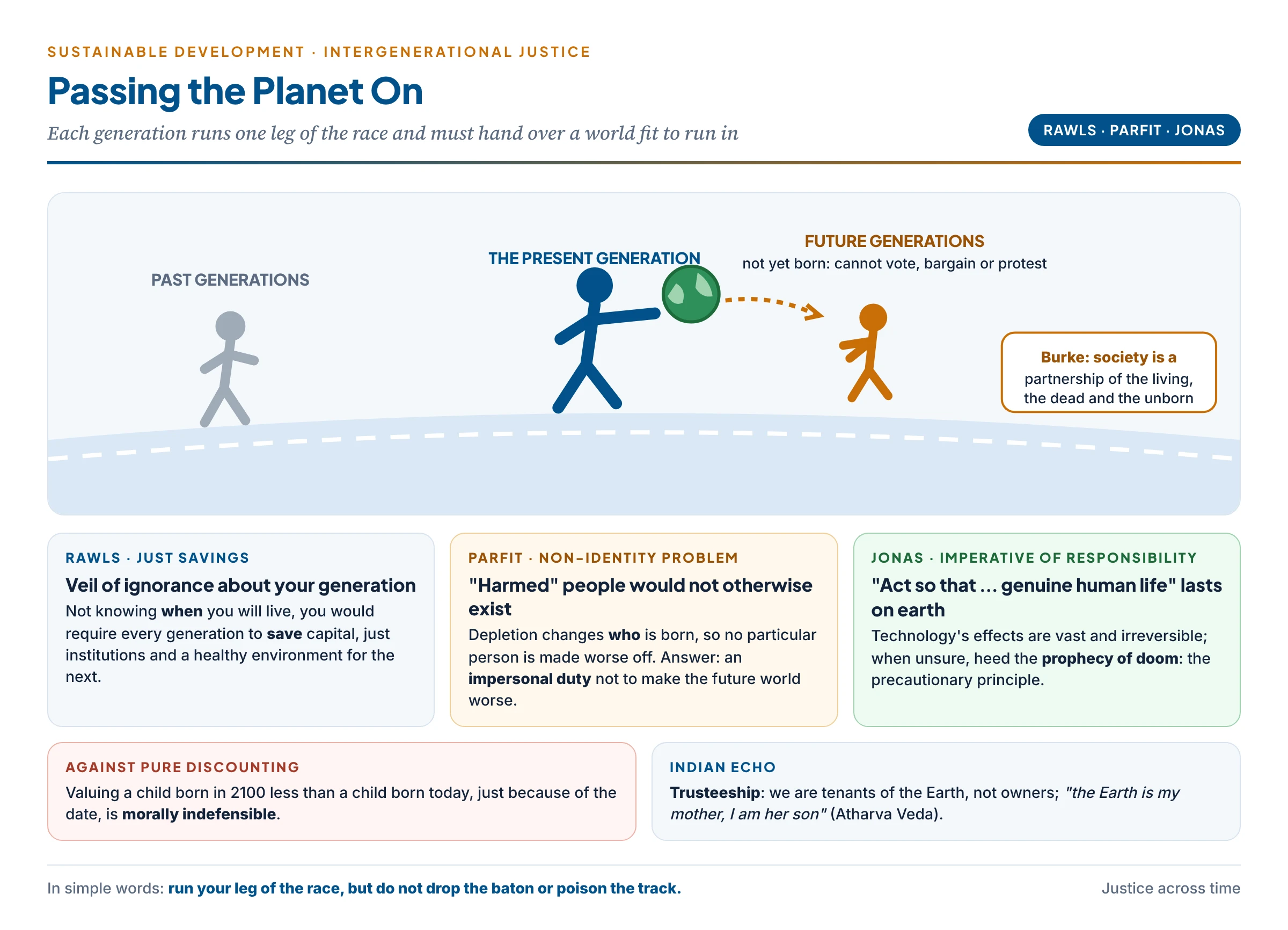
- Future people do not exist yet: they cannot vote, protest, bargain or sue.
- No reciprocity: they can do nothing for us; ordinary ideas of justice as mutual exchange do not fit.
- Uncertainty: we do not know their numbers, technology or preferences.
- Discounting: economists usually value future benefits and harms less than present ones. A high discount rate makes a disaster a century away look almost costless today. Critics say pure time-discounting (valuing future people less just because they live later) is morally indefensible: a child born in 2100 will suffer as much as a child born today.
John Rawls’s “just savings principle”:
- In Rawls’s original position, the parties choose principles of justice behind a veil of ignorance; they do not know their class, talents or which generation they belong to.
- Not knowing whether they will live early or late in history, they would agree that each generation must save enough (preserve capital, just institutions and a healthy environment) for those who come after, and would want all previous generations to have done the same.
- So justice requires each generation to pass on a world in which just institutions can be maintained.
Derek Parfit’s “non-identity problem” (Reasons and Persons, 1984):
- Suppose a society chooses between depletion (using up resources now, polluting freely) and conservation. The two policies change who meets whom and when children are conceived, so different people will be born under each policy.
- The people born after depletion would not have existed under conservation. Can we say depletion harmed them, if without it they would never have lived at all?
- The puzzle: “harm” usually means making someone worse off than they would otherwise have been; here there is no “otherwise” for those very people.
- The resolution most philosophers accept: our duties to the future rest not on harm to particular persons but on impersonal duties: to make sure that whoever lives in the future has the conditions for a worthwhile human and ecological life. Choosing depletion is wrong because it makes the future world worse, even if no identifiable person is “harmed”.
Hans Jonas’s ethics of responsibility (The Imperative of Responsibility, 1979):
- Traditional ethics dealt with near effects of action among neighbours. Modern technology gives human action vast, long-term and irreversible effects on nature and future humanity, so a new ethics is needed.
- His new imperative: “Act so that the effects of your action are compatible with the permanence of genuine human life on earth.”
- “Heuristics of fear”: when consequences are uncertain and possibly catastrophic, give more weight to the prophecy of doom than to the prophecy of bliss: the basis of the precautionary principle.
- Model of responsibility: the parent’s responsibility for a newborn child, which does not depend on any return.
Other voices:
- Edmund Burke described society as a partnership “between those who are living, those who are dead, and those who are to be born.”
- The “seventh generation” principle attributed to the Haudenosaunee (Iroquois) peoples: weigh every decision by its effect on the seventh generation to come.
- The present generation as tenant, not owner: we hold the Earth in trust for generations yet unborn, an idea close to Gandhi’s trusteeship.
Common confusion
Does Parfit’s non-identity problem show that we owe nothing to future generations? No. Parfit raised the puzzle precisely because he was sure that a policy of depletion is wrong. The puzzle shows only that the wrong cannot be explained as harm to particular future persons. It must be explained impersonally: we must not make the future worse than it need be for whoever lives in it. The problem changes the grounds of our duty, not its existence.
Environmental Ethics: Shallow and Deep Ecology
Anthropocentrism (human-centred ethics):
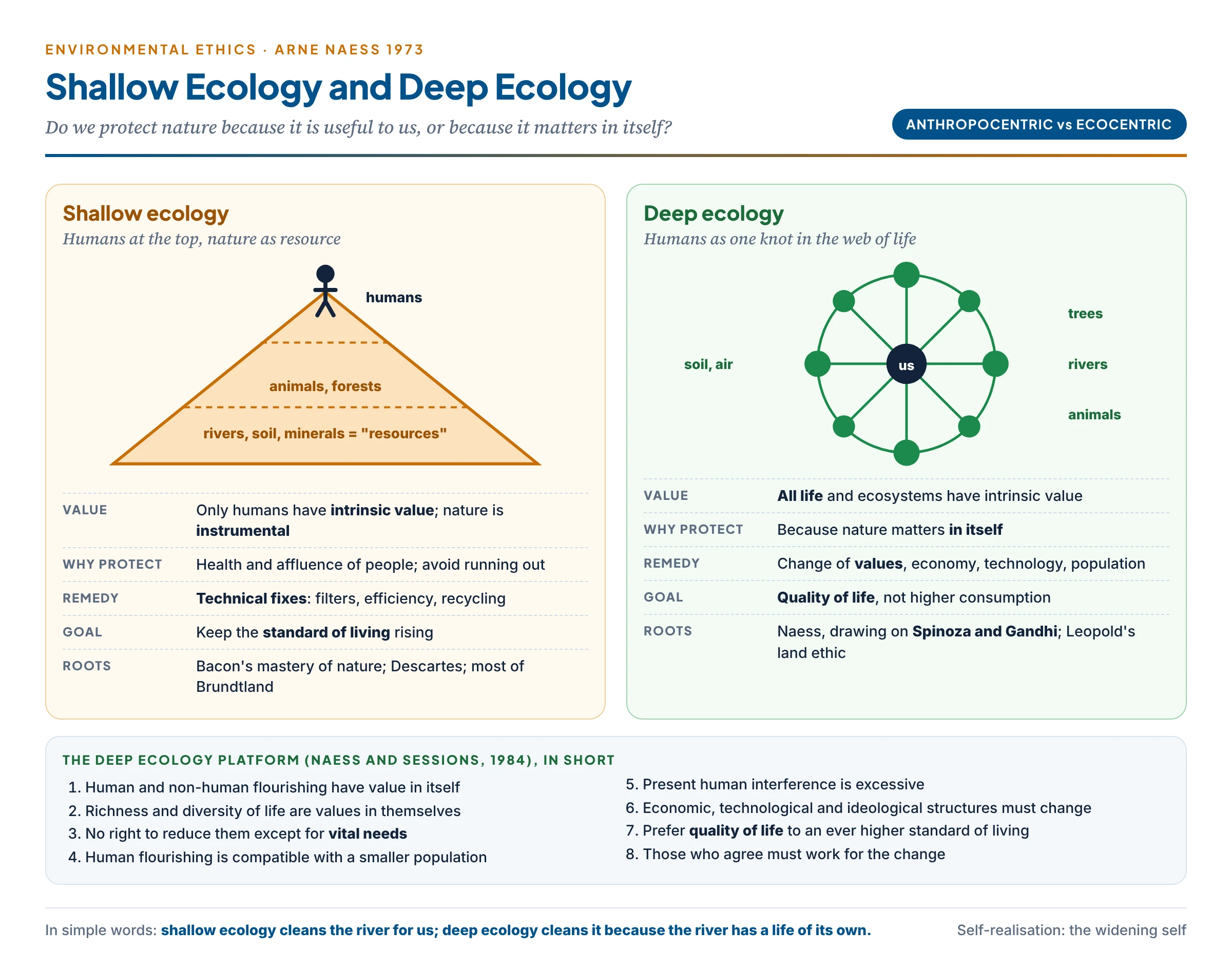
- Only human beings have intrinsic value (value in themselves); nature has instrumental value (value as a resource for human use).
- Its roots lie in a reading of Genesis (humans given “dominion”), in Francis Bacon’s project of mastering nature, in Descartes’s view of animals as machines, and in Kant’s view that cruelty to animals is wrong mainly because it hardens human character.
- Conservation on this view is pursued only to prevent resource exhaustion for humans (enlightened self-interest).
Shallow ecology (Arne Naess’s term, 1973):
- The mainstream environmental movement: fight pollution and resource depletion for the health and affluence of people in developed countries.
- Accepts the human–nature dualism and the goal of ever-rising consumption; seeks only technical fixes.
Deep ecology (Arne Naess, Norwegian philosopher, 1973):
- Rejects the human–nature dualism: humans are knots in the web of life, not masters above it.
- All living beings, species and ecosystems have intrinsic value (inherent worth), independent of their usefulness to humans.
- The deep ecology platform (Naess and George Sessions, 1984), main points:
- The flourishing of human and non-human life has value in itself.
- Richness and diversity of life forms are values in themselves.
- Humans have no right to reduce this richness and diversity except to satisfy vital needs.
- Human flourishing is compatible with a substantially smaller human population; non-human flourishing requires it.
- Present human interference with nature is excessive and worsening.
- Policies must change at the level of economic, technological and ideological structures.
- The ideological change is mainly towards quality of life rather than an ever higher standard of living.
- Those who accept these points have an obligation to work for the change.
- Self-realisation: Naess’s ultimate norm. The self grows by identifying with ever wider circles of life, until harming nature feels like harming oneself. Naess drew directly on Spinoza (God or Nature as one whole) and on Gandhi’s non-violence and the idea that all life is one.
Other ecocentric and biocentric views:
- Aldo Leopold’s land ethic (A Sand County Almanac, 1949): “A thing is right when it tends to preserve the integrity, stability, and beauty of the biotic community. It is wrong when it tends otherwise.”
- Albert Schweitzer’s “reverence for life”.
- Peter Singer (Animal Liberation, 1975): moral concern must extend to all beings that can suffer.
| Point | Shallow ecology (anthropocentric) | Deep ecology (ecocentric) |
|---|---|---|
| Who has intrinsic value? | Humans only | All living beings and ecosystems |
| Why protect nature? | For human health, wealth and future use | Because nature is valuable in itself |
| Human place | Above and apart from nature | One strand in the web of life |
| Solution | Technical fixes, efficiency, pollution control | Change in values, lifestyle, economy, population |
| Goal | Higher standard of living sustained | Better quality of life, simpler means |
| Relation to sustainable development | Close: Brundtland is largely anthropocentric | Critical: sustainable development is “too shallow” |
In simple words
A shallow ecologist protects a river because the town downstream needs drinking water and the fishermen need fish. A deep ecologist protects it even if no human ever drinks from it, because the river, its fish and its birds have a right to flourish of their own. Both want the river clean; they disagree about why, and so about what to do when human use and the river’s life collide.
Indian Connect — Indian Connect
- Jainism’s ahiṁsā extends non-injury to the tiniest living beings; the Bishnoi community of Rajasthan, following Guru Jambheshwar’s 29 rules, protects trees and animals. In 1730, Amrita Devi Bishnoi and over 360 Bishnois gave their lives at Khejarli to stop the felling of khejri trees.
- The Chipko movement (1973, Uttarakhand), led by Gandhians such as Chandi Prasad Bhatt and Sunderlal Bahuguna, with village women like Gaura Devi hugging trees, joined deep-ecological feeling with the livelihood needs of hill people. Bahuguna’s slogan: “Ecology is permanent economy.”
Critical Evaluation
The Critical Estimate of Sustainable Development
Criticisms:
- Ethically weak: care for nature is treated only as a means to protect human interests; nature has no value of its own.
- Shallow ecology: its attitude is utilitarian (it calculates benefits to humans), so it may sacrifice any ecosystem whose loss can be “compensated”.
- Vague and elastic: “needs” are not defined; corporations and governments can call almost anything “sustainable” (greenwashing).
- An oxymoron? Critics say “sustainable growth” is a contradiction: infinite growth in material use on a finite planet is impossible. Degrowth thinkers argue that rich countries must deliberately shrink material consumption.
- Northern bias: global rules often ask poor countries to restrain development while rich countries keep high consumption; hence India’s insistence on climate justice and common but differentiated responsibilities.
- Weak enforcement: many SDG targets are off track; climate pledges fall short of what Paris requires.
Significance:
- Practically the most suitable model: it is the only approach accepted by almost every government, company and international body, so it can actually guide policy.
- It joins development, equity and environment in one framework, and gives priority to the needs of the poor.
- It has produced real tools: environmental impact assessment, renewable-energy revolution, pollution laws, protected areas.
- It keeps the future generations in view in everyday decisions.
Critics and Defenders
Criticism — Critics
- Deep ecologists: “sustainable development” is shallow, human-centred and utilitarian.
- Degrowth thinkers: endless growth, even “green”, is impossible on a finite planet.
- Gandhians: it keeps industrial consumerism and only makes it cleaner.
- Post-development and ecofeminist critics: it is a new global management project that ignores local and women’s knowledge.
- Global South: environmental rules can become a new barrier to the poor’s right to develop.
Defence — Defenders and strengths
- Brundtland’s priority to the poor: it refuses to sacrifice the present poor for the future, or the future for the present.
- Rawls and Jonas: it has a solid basis in justice and responsibility to future people.
- Practicality: it is the only shared language of all governments; SDGs and Paris are built on it.
- Courts and constitutions: Vellore (1996), Ganesh Wood (1995) and Ranjitsinh (2024) turned it into enforceable law in India.
- It can deepen: “strong sustainability” and Mission LiFE move it beyond technical fixes towards lifestyle change.
Development and Tribal Values
India’s Scheduled Tribes are about 8.6% of the population (Census 2011), yet estimates cited by the Xaxa Committee (2014) suggest they form around 40% of all people displaced by development projects (dams, mines, industries, sanctuaries). The question whether development can be reconciled with tribal values is therefore a living one.
What Are Tribal Values?
- Community ownership: land, forest and water are held collectively; land is not a commodity to be sold but the basis of identity and the home of ancestors and deities.
- Harmony with nature: sacred groves, hills and rivers; taking only what is needed; deep ecological knowledge of plants, seeds and medicine.
- Sufficiency, not accumulation: an economy of subsistence and sharing rather than profit.
- Egalitarian and consensual life: decisions in village councils by consensus; relatively greater freedom for women in many tribes (though not all).
- Culture of the community: song, dance, festivals and oral traditions bound to the land and the seasons.
Where Development Clashes with These Values
- Displacement and loss of land for mines, dams and industries; inadequate compensation for people without formal land titles.
- Ecological destruction of the forests on which tribal life depends.
- Cultural erosion: schooling only in dominant languages, contempt for tribal religion and customs, labelling tribals “backward”.
- Exploitation by moneylenders, contractors and traders; alienation of tribal land to outsiders.
- Conflict: much of the Left-Wing Extremism belt lies in mineral-rich tribal districts of central India, where grievances over land, forest and displacement have been exploited.
Three Approaches to Tribal Development
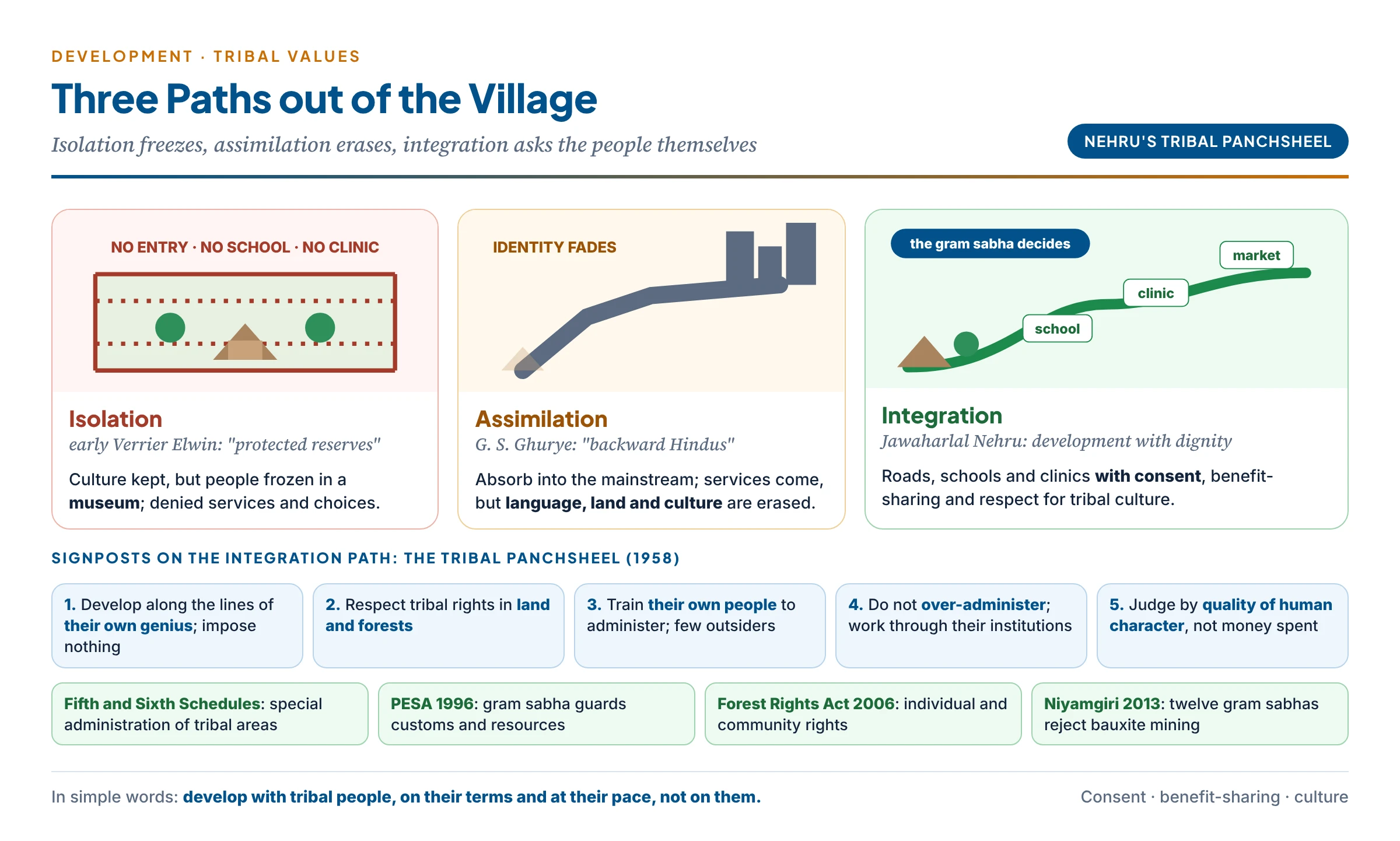
- Isolation: keep tribal areas apart, as protected “reserves”, to save their culture. Early Verrier Elwin, the anthropologist who lived among the Gonds and Baigas, leaned this way. Weakness: it denies tribals schools, hospitals and choices, and turns them into a museum.
- Assimilation: absorb tribals into the mainstream; the sociologist G. S. Ghurye called them “backward Hindus”. Weakness: it destroys culture and imposes outsiders’ values.
- Integration: development with respect for tribal identity, guided by tribal consent. This was Jawaharlal Nehru’s choice.
Nehru’s “Tribal Panchsheel” (1958, in his foreword to Elwin’s A Philosophy for NEFA):
- People should develop along the lines of their own genius; we should avoid imposing anything on them and encourage their own traditional arts and culture.
- Tribal rights in land and forests should be respected.
- We should try to train and build up a team of their own people to do the work of administration and development; outsiders should be few.
- We should not over-administer these areas or overwhelm them with a multiplicity of schemes; we should work through, not in rivalry to, their own social and cultural institutions.
- We should judge results not by statistics or the amount of money spent, but by the quality of human character that is evolved.
The Legal Framework of Reconciliation
- Article 46: the State shall promote the educational and economic interests of Scheduled Tribes and protect them from social injustice and exploitation.
- Fifth Schedule: special administration of Scheduled Areas in central India, with Tribes Advisory Councils and the Governor’s power to adapt laws. Sixth Schedule: Autonomous District Councils in parts of the North-East (Assam, Meghalaya, Tripura, Mizoram).
- Samatha judgment (1997): the Supreme Court held that transfer of tribal land in Scheduled Areas to private mining companies was void.
- PESA Act (1996): extended Panchayati Raj to Scheduled Areas and made the gram sabha competent to safeguard tribal traditions, customs, cultural identity, community resources and dispute resolution, and required consultation before land acquisition.
- Forest Rights Act (2006): recognised the individual and community forest rights of tribals and other traditional forest dwellers, and gave the gram sabha a central role.
- Niyamgiri judgment (2013): in Orissa Mining Corporation v. Ministry of Environment and Forests, the Supreme Court held that the gram sabhas must decide whether bauxite mining in the Niyamgiri hills of Odisha would affect the religious and cultural rights of the Dongria Kondh, for whom the hill is the abode of their deity Niyam Raja. All twelve gram sabhas rejected the project, and the Environment Ministry refused clearance.
- Land Acquisition, Rehabilitation and Resettlement Act (2013): social-impact assessment and consent requirements for acquisitions.
- UN Declaration on the Rights of Indigenous Peoples (2007): the principle of free, prior and informed consent.
Can Development Be Reconciled with Tribal Values?
Yes, under conditions:
- Consent, not imposition: the gram sabha’s free, prior and informed consent for projects on tribal land (PESA, FRA, Niyamgiri).
- Benefit-sharing: tribal communities must share in the wealth taken from their land (the District Mineral Foundations created by the 2015 amendment to the mining law).
- Community forest rights as development: Mendha-Lekha village in Gadchiroli (Maharashtra), whose people declared, “We elect the government in Delhi and Mumbai, but in our village we ourselves are the government”, won community forest rights and earned income from sustainable bamboo harvesting while protecting its forest.
- Culturally sensitive services: schooling in the mother tongue, health care that respects traditional healers, development of forest produce (the Van Dhan scheme for minor forest produce, 2018).
- Tribal knowledge as an asset: seed diversity, millets, ethnomedicine and forest management are resources for the whole nation’s sustainability.
- The capability view: tribals are agents, not objects of development. The question is not “how do we develop them?” but “what lives do they have reason to value, and what freedoms do they need to live them?”
Cautions on both sides:
- Against romanticism: tribal communities themselves want roads, schools, hospitals, jobs and mobile phones; freezing them in “tradition” is another form of domination. Some tribal customs (witch-hunting, certain gender restrictions) also need reform from within.
- Against developmentalism: national needs for minerals and energy cannot justify sacrificing a people’s land, culture and dignity.
- The balance: development with tribal people, on their terms, at a pace they choose, is both just and more lasting.
In simple words
Think of a family house that the town wants to widen into a road. The assimilation answer bulldozes it; the isolation answer forbids the family even to get electricity. The integration answer sits down with the family, asks what they want, shares the benefit of the road with them, and builds it so that their courtyard and temple survive. Reconciliation is that conversation, made a legal right.
Cross-Tradition Comparison
| Question | Western mainstream (Brundtland, Rawls) | Deep ecology (Naess, Leopold) | Indian traditions (Atharva Veda, Jainism, Gandhi, tribal ethics) |
|---|---|---|---|
| Value of nature | Mainly instrumental, for present and future humans | Intrinsic: all life valuable in itself | Sacred: Earth as mother; all life one; ahiṁsā |
| Duty to the future | Just savings; impersonal duties; responsibility | Preserve diversity and integrity of life | Trusteeship; ancestral land held for descendants |
| Means | Clean technology, policy, markets | Change of values, simpler living | Self-restraint (aparigraha), community ownership |
| Weakness | Shallow; growth-bound | Misanthropic risk; unrealistic population ideas | May romanticise tradition; weak on modern needs |
Indian Connect — Indian Connect
- Gandhi’s influence on Naess shows that Indian thought shaped modern environmental ethics: Naess called Gandhi’s teaching that “all life is one” a source of deep ecology.
- Tribal ethics and the Pṛthivī Sūkta both see the Earth as kin, not property: a strong form of sustainability long before the word existed.
Synthesis (Siddhānta)
- Sustainable development is the most practical framework for joining development with ecology, but in its common, anthropocentric form it is ethically shallow. Its moral depth comes from intergenerational justice (Rawls’s just savings, Jonas’s responsibility, impersonal duties beyond Parfit’s puzzle) and from ecocentric insights that nature has value of its own.
- A mature view combines strong sustainability (some natural wealth is irreplaceable), priority to the poor (Brundtland) and lifestyle change (Gandhi, Naess, Mission LiFE).
- Development can be reconciled with tribal values when tribals are treated as agents with rights: consent through the gram sabha, community forest rights, benefit-sharing and respect for culture, while avoiding both bulldozer developmentalism and museum romanticism. Nehru’s test still applies: judge results not by money spent but by the quality of human character that is evolved.
Previous Year Questions
- 2025Is it possible to reconcile the concept of development with tribal values to bring social and economic progress? Discuss.