

Development and Social Progress.
Official Syllabus: Paper II, Section A, Unit 8
Amartya Sen (born 1933, Nobel Prize in Economics 1998) changed the question that development asks. The old question was “How much does a country have?”; Sen’s question is “What are its people actually able to do and to be?” In Development as Freedom (1999) he defines development as “a process of expanding the real freedoms that people enjoy”. Income, growth, technology and industrialisation matter, but only as means; the end is the expansion of people’s capabilities, their real opportunities to live lives they have reason to value. This shift from commodities to capabilities and from people as objects of policy to agents is called the capability approach. It stands behind the Human Development Index, the Multidimensional Poverty Index and much of today’s development policy. This article explains functionings and capabilities, conversion factors, the starving and the fasting person, the constitutive and instrumental roles of freedom, the five instrumental freedoms and the sources of unfreedom, agency, democracy and development, human capital vs human capability, Martha Nussbaum’s list of ten capabilities, the HDI and MPI, and the main criticisms.
In simple words
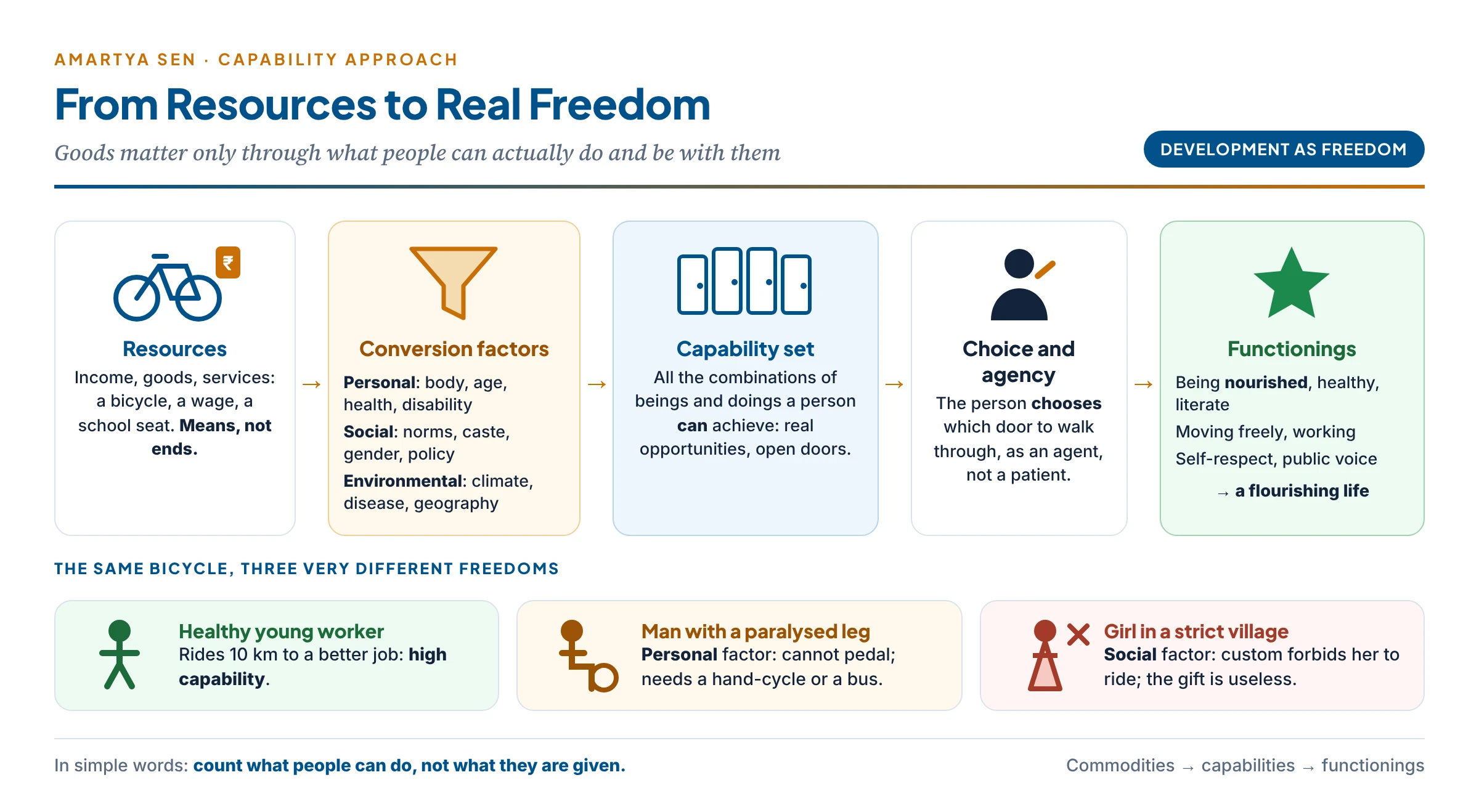
Give the same bicycle to two people. A healthy young man can ride it to a job ten kilometres away; a man with a paralysed leg cannot use it at all; a girl in a village where girls “should not” ride bicycles is not allowed to. The commodity is the same; what each person can do with it is very different. Sen says development should be judged not by the bicycles handed out but by the freedom to move that people actually gain.
Context & Problem
- Sen’s formative experience: as a nine-year-old boy in Bengal he saw the Bengal famine of 1943, in which around three million people died, although food output that year was not unusually low. In Poverty and Famines (1981) he showed that famines happen when people lose their entitlements (their command over food through wages, land or trade), not simply because food runs out.
- What he was reacting against:
- Income and GDP as the measure of welfare (the “opulence” view): it counts things, not lives.
- Utilitarianism, which counts happiness or desire-satisfaction. Sen’s objection is adaptive preferences: deprived people learn to want little in order to survive. A landless labourer, a woman taught she deserves less, or a “hopeless beggar” may report contentment; counting only their happiness would hide their deprivation.
- Rawls’s primary goods (rights, income, wealth, the bases of self-respect). Equal goods do not give equal freedom, because people convert goods into living differently (the bicycle problem). Sen’s 1979 lecture “Equality of What?” answered: equality of capabilities.
- Key works: Commodities and Capabilities (1985), Inequality Reexamined (1992), Development as Freedom (1999), The Idea of Justice (2009).
- The partner idea: Sen’s friend Mahbub ul Haq, a Pakistani economist, turned the approach into the Human Development Report and the HDI at the UNDP (1990).
Indian Connect — Indian Connect
Sen opens his discussion of development with a story from the Bṛhadāraṇyaka Upaniṣad. When the sage Yājñavalkya offers his wife Maitreyī a share of his wealth, she asks whether the whole earth full of wealth would make her immortal. Told that it would not, she replies: “What should I do with that by which I do not become immortal?” Sen uses her question to show that wealth is a means: we must always ask what it lets us do and be. Aristotle made the same point: “wealth is evidently not the good we are seeking; for it is merely useful and for the sake of something else.”
Core Doctrine
Means and Ends: Against the Opulence View
- The category error: the growth-centred view confuses the means of living with the ends of life. Income and wealth are instrumentally valuable (valuable for what they help us do); they are not intrinsically valuable (valuable in themselves).
- Evidence that income and lives can diverge:
- Sen showed that African-American men in the United States, though far richer than people in China or Kerala, had a lower chance of surviving to old age than men there.
- Kerala in the 1980s had income far below the Indian average but life expectancy, literacy and low infant mortality close to rich countries, because of public action in education, health and land reform.
- Sen’s essay “More than 100 million women are missing” (1990) showed how neglect of girls and women in parts of Asia and North Africa produced a huge shortfall of women in the population, invisible in income figures.
- Conclusion: we need an informational base (what we look at when we judge a society) that sees lives and freedoms, not just incomes.
Functionings and Capabilities
Functionings (beings and doings)
- The various things a person actually is or does that he or she values and has reason to value.
- Basic functionings: being well-nourished, being sheltered, being free from avoidable disease (such as malaria), being literate, being able to move about.
- Complex functionings: taking part in public debate, having self-respect, being socially integrated, being able to appear in public without shame (Adam Smith’s example of the linen shirt that an eighteenth-century labourer needed in order not to be ashamed).
Capabilities (real freedom to choose)
- A person’s capability set is the set of alternative combinations of functionings that he or she can actually achieve: the real opportunities open to that person.
- Capability is freedom: not what you do, but what you are effectively able to do.
Conversion factors Resources become capabilities only through conversion factors:
- Personal: metabolism, age, sex, pregnancy, disability, health. A pregnant woman needs more food to be equally nourished.
- Social: social norms, gender roles, caste, public policy, discrimination. A girl forbidden to cycle gains nothing from a bicycle.
- Environmental: climate, disease environment, geography. A family in a cold region needs more fuel and clothing to be equally warm.
The chain: commodities and income (means) → conversion factors → capability set (real freedoms) → choice and agency → functionings (achieved beings and doings) → human well-being.
The Starving and the Fasting Person
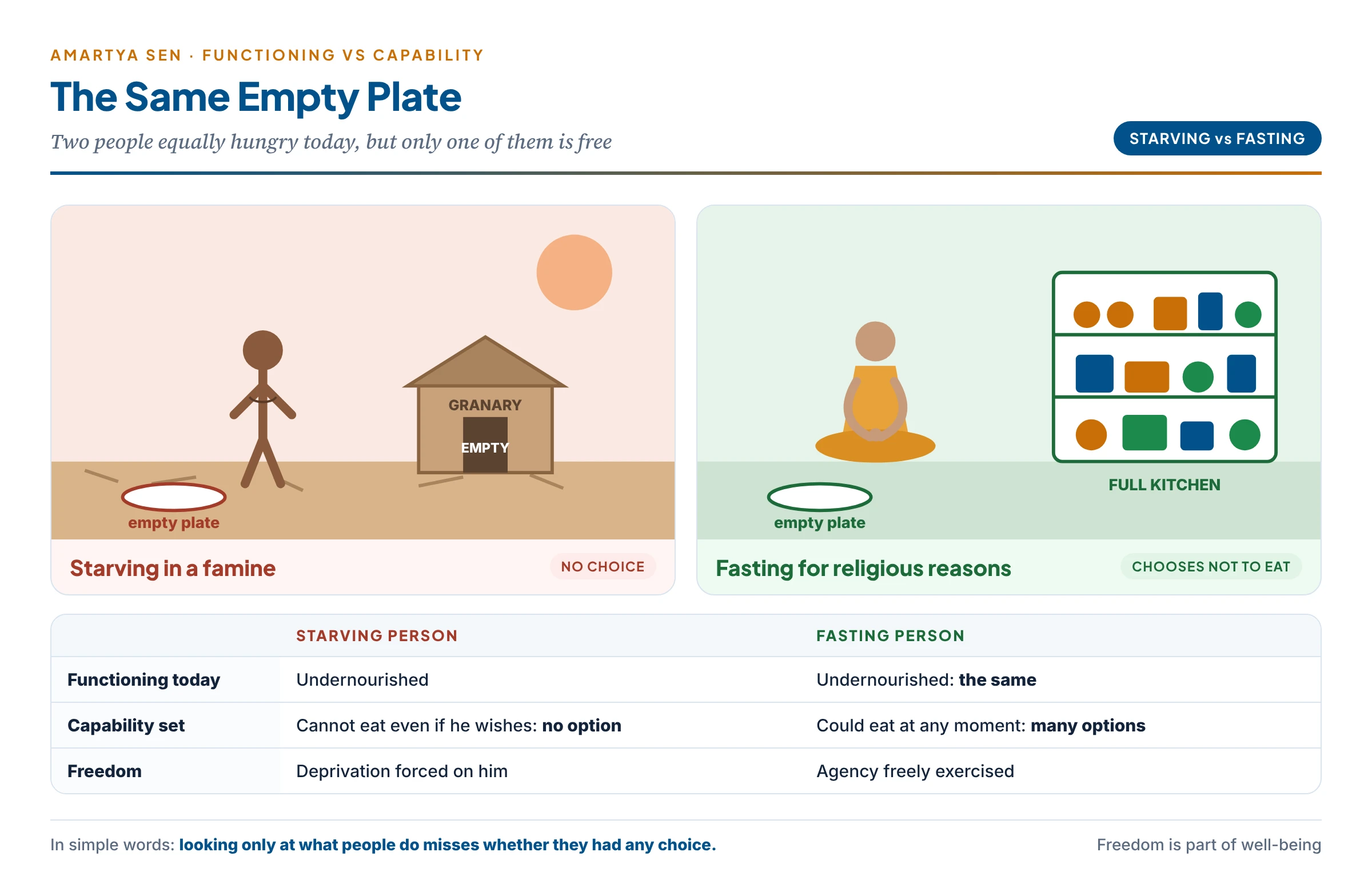
- A poor person starving in a famine and a wealthy person fasting for religious reasons have the same functioning: both are undernourished.
- Their capability sets are completely different: the one who fasts could eat but chooses not to; the one who starves has no choice.
- Lesson: freedom of choice is itself part of well-being. A good life is not only a set of achieved states but the freedom to choose among them. Looking at functionings alone would miss the difference; looking at capabilities captures it.
| Aspect | Functioning | Capability |
|---|---|---|
| Definition | Actual achievements and outcomes in life | Freedom or potential to achieve outcomes |
| Focus | Realised, concrete achievements | Freedom to pursue a range of possible outcomes |
| Nature | Relatively static: describes the present condition | Dynamic: reflects potential and adaptability |
| Agency | Outcome-based: what has been achieved | Freedom-based: what could be achieved |
| Evaluation | Easier to assess: concrete facts | Harder to assess: considers many opportunities |
| Example | Being employed, being healthy, having a degree | The capability to work, to get educated, to be healthy |
| Flexibility | Less flexible: specific and fixed | More flexible: wider range of possible achievements |
| Adaptability | Adapts poorly to changing circumstances | Adapts better to changing life situations |
In simple words
A menu card is your capability set; the dish you order is your functioning. A rich diner who orders plain dal has the same plate as a poor man who can only afford dal, but the rich diner’s menu was much larger. Development, for Sen, means enlarging everyone’s menu, and then letting each person order.
Development as Freedom: The Two Roles of Freedom
Sen gives freedom a double role:
- Constitutive role (freedom as the end): the expansion of freedom is the primary end of development. Freedoms such as being able to avoid starvation, undernourishment, preventable illness and premature death, being literate and numerate, enjoying political participation and uncensored speech, are themselves what development consists of. They do not need to be justified by their effect on GDP.
- Instrumental role (freedom as the means): freedom is also the principal means of development. Different freedoms help each other and also raise growth: a literate, healthy, free population is more productive, more innovative and better at holding governments to account.
Two reasons why freedom is central:
- The evaluative reason: the progress of a society must be judged primarily by whether the freedoms people have are enhanced.
- The effectiveness reason: the achievement of development depends on the free agency of people. People are not passive receivers of benefits but the engine of development.
Development is a broad, integrated process: it depends on many determinants beyond the economy: social arrangements (schools, hospitals) and political and civil rights (freedom to take part in public discussion). Viewing development as the expansion of freedoms contrasts with narrower views that identify it with GNP growth, rising incomes, industrialisation, technological advance or social modernisation.
The Five Instrumental Freedoms
Sen names five kinds of freedom that work as means and reinforce one another:
- Political freedoms (including civil rights): the opportunity to decide who governs and on what principles, to scrutinise and criticise authorities, to have free speech and an uncensored press, and to choose among parties.
- Economic facilities: the opportunity to use economic resources for consumption, production or exchange: access to markets, credit, jobs and fair prices.
- Social opportunities: arrangements for education and health care that shape a person’s substantive freedom to live better, and also help participation in economic and political life (illiteracy is a barrier to both).
- Transparency guarantees: the need for openness: the freedom to deal with one another under guarantees of disclosure and trust. They prevent corruption, financial irresponsibility and underhand dealings.
- Protective security: a social safety net that prevents people from falling into abject misery or even starvation: unemployment benefits, famine relief, emergency public employment, income support for the destitute.
How they reinforce each other: political freedom helps economic security (governments must respond to voters); social opportunities (education, health) make economic participation possible; economic facilities generate resources for social facilities.
Indian Connect — Indian Connect
Indian institutions can be read through Sen’s five freedoms:
- Political freedoms: universal adult franchise from 1950; a free press; Panchayati Raj (1992).
- Economic facilities: Jan Dhan bank accounts, Mudra loans, self-help groups and microfinance for rural women.
- Social opportunities: the Right to Education Act (2009), the mid-day meal (now PM-POSHAN) scheme, Ayushman Bharat.
- Transparency guarantees: the Right to Information Act (2005), social audits of MGNREGA.
- Protective security: MGNREGA (2005), a legal guarantee of 100 days of wage employment, and the National Food Security Act (2013).
Development as the Removal of Unfreedoms
- Sen’s own list: “Development requires the removal of major sources of unfreedom”: poverty as well as tyranny, poor economic opportunities as well as systematic social deprivation, neglect of public facilities as well as intolerance or overactivity of repressive states.
- In plain terms, the main unfreedoms are:
- Poverty and economic deprivation: hunger, homelessness, lack of basic capabilities to survive.
- Tyranny and authoritarianism: denial of civil liberties and political voice.
- Poor economic opportunities: no access to jobs, markets, fair credit or labour mobility (bonded labour is the extreme case).
- Systematic social deprivation and neglect of public facilities: no health care, sanitation, clean water or schools.
- Intolerance and repression: discrimination and persecution by caste, gender, race or religion, and over-active repressive states.
- Unfreedom is concrete: a woman who cannot work outside the home without her husband’s permission, a child labourer, a farmer who cannot sell his crop outside a single local monopoly, a citizen arrested for criticism, a family whose child dies of a preventable disease.
Common confusion
Are the “five unfreedoms” the same as the “five instrumental freedoms”? No. They are two different lists. The five instrumental freedoms (political freedoms, economic facilities, social opportunities, transparency guarantees, protective security) are the means that development must build. The sources of unfreedom (poverty, tyranny, poor economic opportunities, social deprivation and neglect of public facilities, intolerance and repressive states) are the obstacles it must remove. Many notes mix the two lists, or add items such as “corruption” to the unfreedoms; corruption is better understood as the failure of transparency guarantees.
Agency: People as Agents, Not Patients
- Agency means the ability to act and bring about change in line with one’s own values and goals. Sen wants people to be seen as agents of their own lives, not as patients passively receiving the benefits of clever development programmes.
- Agency freedom vs well-being freedom: a person may use agency for goals beyond his or her own well-being (a satyāgrahī who fasts for a cause sacrifices well-being but exercises agency).
- Women’s agency: in Development as Freedom Sen shows that female literacy and women’s paid work outside the home strongly reduce child mortality and fertility rates; empowering women’s agency improves the well-being of whole families. Kerala again is his example.
- Public action: development comes from democratic public action, people organising, protesting and demanding schools, health care and food (the Right to Food campaign in India).
Democracy and Development
The “Lee thesis”: Lee Kuan Yew, the long-serving Prime Minister of Singapore, argued that authoritarian discipline is better for growth than democracy: poor countries need order and quick decisions, not debate and elections. China’s rapid growth since 1978 and the earlier rise of South Korea and Taiwan under authoritarian governments seemed to support him.
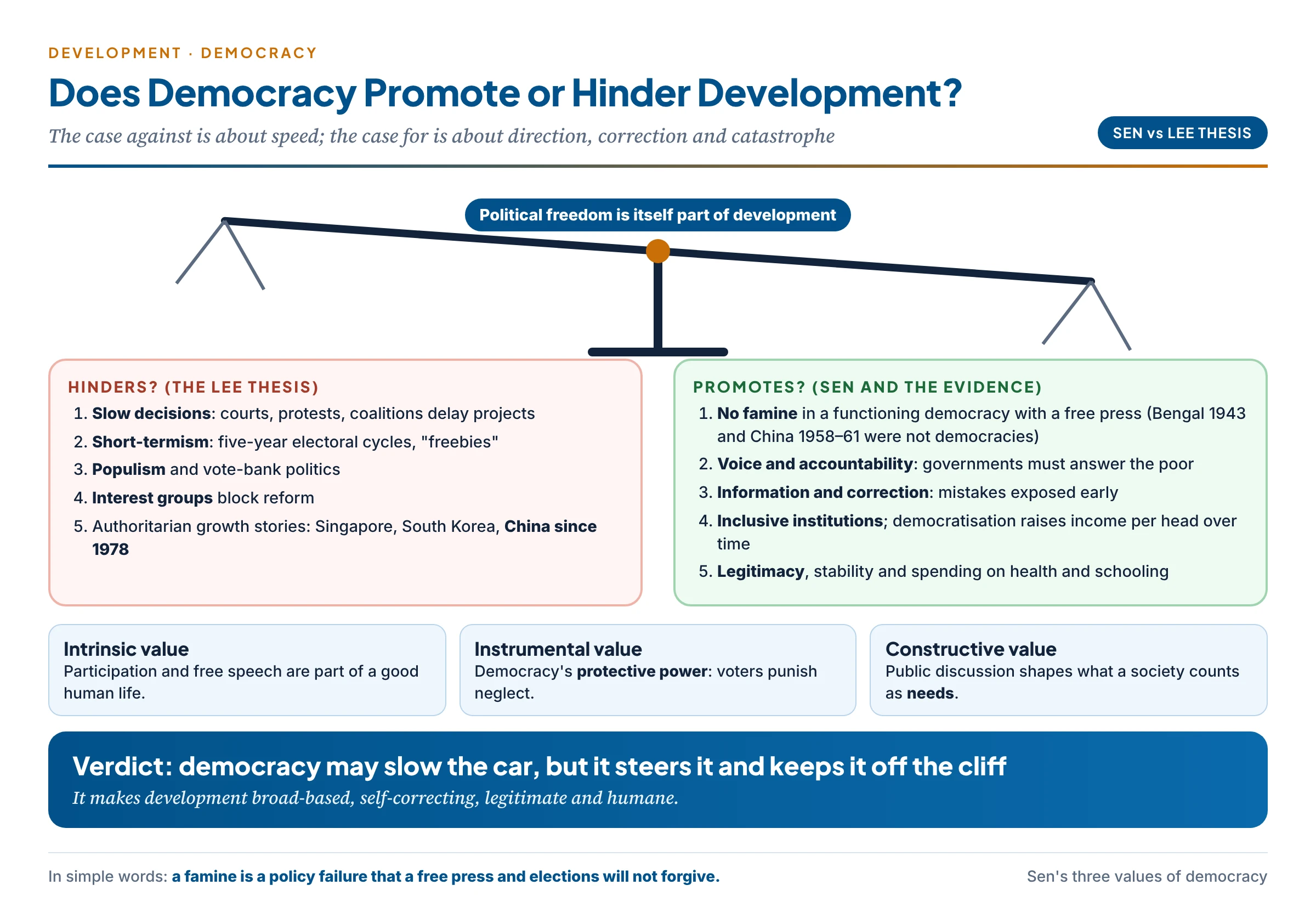
Arguments that democracy hinders development:
- Slow decisions: many veto points (courts, opposition, protests, coalition partners) delay infrastructure and reforms (long disputes over land acquisition).
- Short-termism: governments think in five-year electoral cycles and prefer visible handouts (“freebies”) to long-term investment.
- Populism and vote-bank politics: spending is targeted at groups that vote together, not at those who need it most.
- Capture by interest groups: lobbies of landlords, industrialists or organised workers block reforms.
- Instability: frequent changes of government interrupt policy.
Arguments that democracy promotes development (Sen’s reply and wider evidence):
- No general evidence for the Lee thesis: Sen argues that growth in East Asia came from “helpful policies”: openness to trade, land reform, mass education and health care, not from authoritarianism as such. Many authoritarian states (much of Africa and Latin America in the 1970s) stagnated. A large study, “Democracy Does Cause Growth” (2019), found that countries that democratise end up with about 20% higher income per head in the long run.
- The famine argument: “No famine has ever taken place in the history of the world in a functioning democracy” with regular elections, opposition parties and a free press. Famines are easy to prevent if a government tries; democratic governments must try because famine costs them votes and press criticism.
- The Bengal famine (1943) happened under colonial rule with a censored press.
- China’s famine of 1958–61 after the “Great Leap Forward” killed between 23 and 30 million people, with no free press to expose it.
- Independent India has had no major famine; the severe Maharashtra drought of 1972–73 was handled through public employment programmes without famine.
- Three values of democracy (Sen):
- Intrinsic importance: political participation and freedom are part of a good human life in themselves.
- Instrumental importance: democracy gives people voice, forcing governments to respond to their needs (the protective power of democracy).
- Constructive importance: public discussion helps a society form its values and priorities; even the idea of what counts as a “need” is shaped through debate.
- Information and correction: a free press and opposition expose mistakes and corruption early; authoritarian regimes repeat errors because no one can tell them.
- Inclusive institutions: economists Daron Acemoglu and James Robinson (Nobel Prize 2024, with Simon Johnson) argue in Why Nations Fail (2012) that nations prosper when they have inclusive political and economic institutions (secure rights, open competition, accountable power) rather than extractive ones that let a small elite capture wealth.
- Legitimacy and stability: development that people have chosen meets less violent resistance; peaceful transfer of power avoids civil war.
- Better human development: democracies tend to spend more on schooling and health for the majority, because the majority votes.
A balanced view:
- Democracy does not guarantee fast growth; a weak democracy with corruption and paralysis can stagnate, and some authoritarian states have grown fast.
- But democracy makes development broad-based, self-correcting, legitimate and humane; it protects against catastrophes (famine, mass repression) that authoritarian systems invite.
- For Sen the question is partly wrongly posed: political freedom is part of development, so a country that grows by suppressing freedom has not fully developed.
- Development, in turn, helps democracy: educated, economically secure citizens make democracy deeper (the modernisation thesis of Seymour Martin Lipset, 1959).
In simple words
An authoritarian government is like a driver who refuses to let anyone in the car speak. On a straight, empty road he may drive fast. But when he takes a wrong turn or nods off, nobody can warn him, and the crash can be total, as in a famine. A democracy is a noisier car with many back-seat drivers: slower at times, but someone always shouts before the cliff.
Human Capital vs Human Capability: Skill Education
- Human capital is the economist’s idea that education, training and health are investments that raise productivity: people are valued as inputs to production.
- Human capability (Sen) values education and health because they widen people’s freedom to live the lives they value, whether or not they raise output.
- Sen’s point (1997): the two are related but not the same. Human capital is narrower: it captures only the indirect, productive value of education. Capability adds:
- Direct value: being educated is itself a valued way of being (reading a letter, enjoying literature).
- Indirect social value: educated people take part in public debate, women’s education lowers child mortality.
- Indirect economic value: higher productivity and income (the only part human capital counts).
In simple words
Teach a village girl to stitch garments. An economist of human capital asks: how much more will the factory produce? Sen asks more: can she now earn her own money, choose whether and whom to marry, speak up in the panchayat, and send her own daughter to school? The same skill counted the first way is an input; counted the second way it is freedom.
- Skill education in this light:
- It enhances development when it gives young people real options: employment, self-employment, mobility, confidence and dignity. India has one of the world’s largest young populations; without skills the demographic dividend can turn into a burden of unemployment.
- Indian initiatives: the Skill India Mission (2015) with the PM Kaushal Vikas Yojana; the National Education Policy 2020, which brings vocational education into schools from the middle stage and aims to give at least half of all learners exposure to vocational education.
- Gandhi’s Nai Talīm (“basic education”, 1937) anticipated this: learning through productive craft, uniting hand, head and heart, so that education makes the child self-reliant and respects manual labour.
- Limits: skill education does not by itself enhance development if:
- Jobs are lacking: skills without demand only produce frustrated, “skilled unemployed” youth.
- Quality is poor or courses are outdated.
- Narrow vocational training replaces foundational literacy, critical thinking and citizenship: a person trained only as a tool of production gains human capital but not full capability.
- Social barriers (caste, gender norms) block the conversion of skills into opportunities.
- Conclusion: skill education enhances development when it is treated as an expansion of capability, joined to good basic education, job creation and social inclusion, not only as an input to GDP.
Martha Nussbaum’s Ten Central Capabilities
Martha Nussbaum, an American philosopher who worked with Sen, developed the approach in a more Aristotelian direction (Women and Human Development, 2000; Creating Capabilities, 2011). She argues that a just society must guarantee every citizen a threshold level of ten central capabilities, as constitutional entitlements:
- Life: living to the end of a normal human life, not dying prematurely.
- Bodily health: good health, adequate nourishment and shelter, including reproductive health.
- Bodily integrity: freedom of movement; security against violent assault, including sexual and domestic violence; choice in matters of reproduction.
- Senses, imagination and thought: using the mind in a truly human way, cultivated by education; freedom of expression and religious exercise.
- Emotions: being able to love, grieve, feel gratitude and justified anger, without fear and anxiety blighting emotional development.
- Practical reason: forming a conception of the good and reflecting critically on the planning of one’s life.
- Affiliation: living with and towards others, showing concern; having the social bases of self-respect and non-humiliation; protection against discrimination.
- Other species: living with concern for animals, plants and the world of nature.
- Play: being able to laugh, play and enjoy recreation.
- Control over one’s environment: political (effective participation in political choices) and material (holding property, seeking employment on an equal basis, freedom from unwarranted search and seizure).
| Point | Sen | Nussbaum |
|---|---|---|
| List of capabilities | Deliberately open; to be decided by public reasoning and democracy in each society | A fixed list of ten central capabilities |
| Purpose | A framework to evaluate and compare development and inequality | A basis for constitutional guarantees and a theory of minimum justice |
| Roots | Welfare economics, social choice, liberal democracy | Aristotle’s idea of human flourishing, Marx’s idea of truly human functioning |
| Threshold | No threshold; comparative judgements (more or less freedom) | A threshold of each capability below which life is not worthy of human dignity |
| Main worry | Imposing one list on all cultures | Without a list, the approach becomes relativist and cannot criticise unjust traditions |
Measuring Capabilities: HDI, MPI and Beyond
- Human Development Index (1990): average achievement in health (life expectancy at birth), education (mean and expected years of schooling) and standard of living (gross national income per head). India: 0.685, rank 130 of 193 (Human Development Report 2025, data for 2023).
- Related indices: the inequality-adjusted HDI (2010), the Gender Development Index and Gender Inequality Index, and planetary-pressures-adjusted HDI (2020), which lowers the score of countries with high carbon emissions and material use.
- Multidimensional Poverty Index (MPI, 2010): developed by the Oxford Poverty and Human Development Initiative with the UNDP; it counts a person as poor if deprived in a third or more of weighted indicators of health, education and living standards. India’s National MPI (NITI Aayog) uses 12 indicators, including nutrition, maternal health, schooling, cooking fuel, sanitation, drinking water, electricity, housing, assets and bank account. NITI Aayog estimated that about 24.82 crore Indians escaped multidimensional poverty between 2013–14 and 2022–23.
- Beyond GDP in rich countries: the Stiglitz–Sen–Fitoussi Commission (2008–09), set up by the President of France, recommended measuring well-being and sustainability, not just output; this is why the approach is also used to analyse social policy in advanced countries.
Critical Evaluation
Criticisms
- The list problem: Sen refuses to give a definite list of capabilities. Critics (including Nussbaum) say this leaves the approach too vague and open to relativism: if each society decides, an unjust tradition might decide that women need fewer capabilities.
- Measurement and weighting: capabilities (unlike income) are hard to observe and add up. How much is the freedom to vote “worth” compared with good nutrition? Any index (such as the HDI) uses arbitrary weights and captures only a few dimensions.
- Too individualistic: the approach judges freedoms of individuals; critics say it neglects collective capabilities (of communities, unions, tribes) and structures (class, caste, global markets) that shape them.
- Neglect of power: Marxist critics argue that Sen describes deprivation well but says too little about who causes it: capitalist exploitation and unequal property.
- Liberal and Western bias: post-development critics argue that “freedom” and “choice” reflect a Western liberal individualism; some cultures value duty, community and harmony more than choice.
- Paternalism: if people’s own preferences can be “adapted”, who decides what they really have reason to value? The approach may let experts override people’s stated wishes.
- Ecological blind spot: expanding everyone’s capabilities, including consumption, may exceed planetary limits unless sustainability is built in.
Replies and Strengths
- Openness is deliberate: Sen leaves the list open to respect democracy and public reasoning; core capabilities (life, health, literacy, political voice) are agreed almost everywhere.
- Measurement is possible: the HDI, MPI and national surveys show that capabilities can be measured well enough to guide policy.
- Agency includes collective action: Sen stresses public action, social movements and democratic participation, all collective.
- Adaptive preferences are a real problem: without the capability approach, the “contented” deprivation of oppressed groups would be invisible. Sen asks for reflective valuation, not expert dictation.
- Universality with sensitivity: freedom to choose includes the freedom to choose traditional ways of life; what it rejects is forced tradition.
- Sustainability can be added: Sen himself speaks of “sustainable freedom”: preserving and expanding the freedoms of present people without compromising those of future generations.
Critics and Defenders
Criticism — Critics
- Nussbaum: without a list, the approach cannot condemn unjust traditions.
- Measurement sceptics: capabilities cannot be observed or weighted objectively.
- Communitarians and post-development thinkers: “choice” is a Western, individualist ideal.
- Marxists: Sen describes deprivation but ignores exploitation and class power.
- Environmentalists: more capabilities for all may mean more consumption than the planet can bear.
Defence — Defenders and strengths
- Means–ends clarity: it ends the confusion of GDP with well-being.
- Sees hidden deprivation: adaptive preferences, “missing women”, disability, caste.
- Unites values: joins liberty (freedom) with equality (equal capability) and welfare (real lives).
- Policy power: HDI, MPI, SDGs and India’s National MPI all rest on it.
- Democracy and famine: a powerful, evidence-based defence of political freedom as part of development.
Cross-Tradition Comparison
| What should development equalise or maximise? | Utilitarianism | Rawls | Sen (capabilities) | Gandhi (swarāj) |
|---|---|---|---|---|
| Focus | Total happiness or desire-satisfaction | Primary goods (rights, liberties, income, self-respect) | Capabilities: real freedoms to be and do | Self-rule: moral and material freedom of the last person |
| Treats people as | Containers of utility | Free and equal citizens | Agents with diverse conversion needs | Moral beings with duties |
| Main weakness | Adaptive preferences; ignores distribution | Ignores differences in converting goods | Vague list; hard to measure | Hard to apply in a modern economy |
Indian Connect — Indian Connect
- Gandhi’s swarāj and Sen’s freedom share one core: development is self-rule, the capacity of people to shape their own lives. But Gandhi stresses self-restraint and duty, while Sen stresses choice and opportunity.
- Tagore’s Santiniketan, where Sen grew up and studied, combined freedom of the mind with rootedness in community, a background Sen often acknowledges.
- The Indian Constitution’s Preamble (justice, liberty, equality, fraternity, dignity) and Directive Principles read like a capability charter: livelihood, education, health, nutrition and decent work.
Synthesis (Siddhānta)
- Sen’s lasting contribution is to show that development is a moral idea: it is about what people can do and be, not about how much a country produces. Income remains important as a means; the end is substantive freedom.
- Freedom is both the goal and the engine of development: political freedoms, economic facilities, social opportunities, transparency and protective security reinforce one another.
- On democracy, the capability approach gives a clear verdict: democracy may sometimes slow growth, but it prevents catastrophes, corrects errors, gives voice to the poor and is itself part of development.
- Nussbaum’s list sharpens the approach into a theory of minimum justice; Sen’s openness keeps it democratic. Both together, joined to sustainability, offer the most widely accepted framework for judging development today.
“Development consists of the removal of various types of unfreedoms that leave people with little choice and little opportunity of exercising their reasoned agency.” — Amartya Sen
Previous Year Questions
- 2026Examine the relationship between democracy and development. Does democracy promote or hinder development?
- 2023In the present scenario, will the emphasis on skill education enhance development? Evaluate.
- 2022Do you agree that economic development does not on its own lead to human development and social progress? Give reasons and justifications for your answer.