

Anthropology Optional › Paper II › Unit 07: Scheduled Castes, Scheduled Tribes and OBCs
7.2 Social change and contemporary tribal societies: Impact of modern democratic institutions, development programmes and welfare measures on tribals and weaker sections.
Official Syllabus: Paper II, Unit 7.2
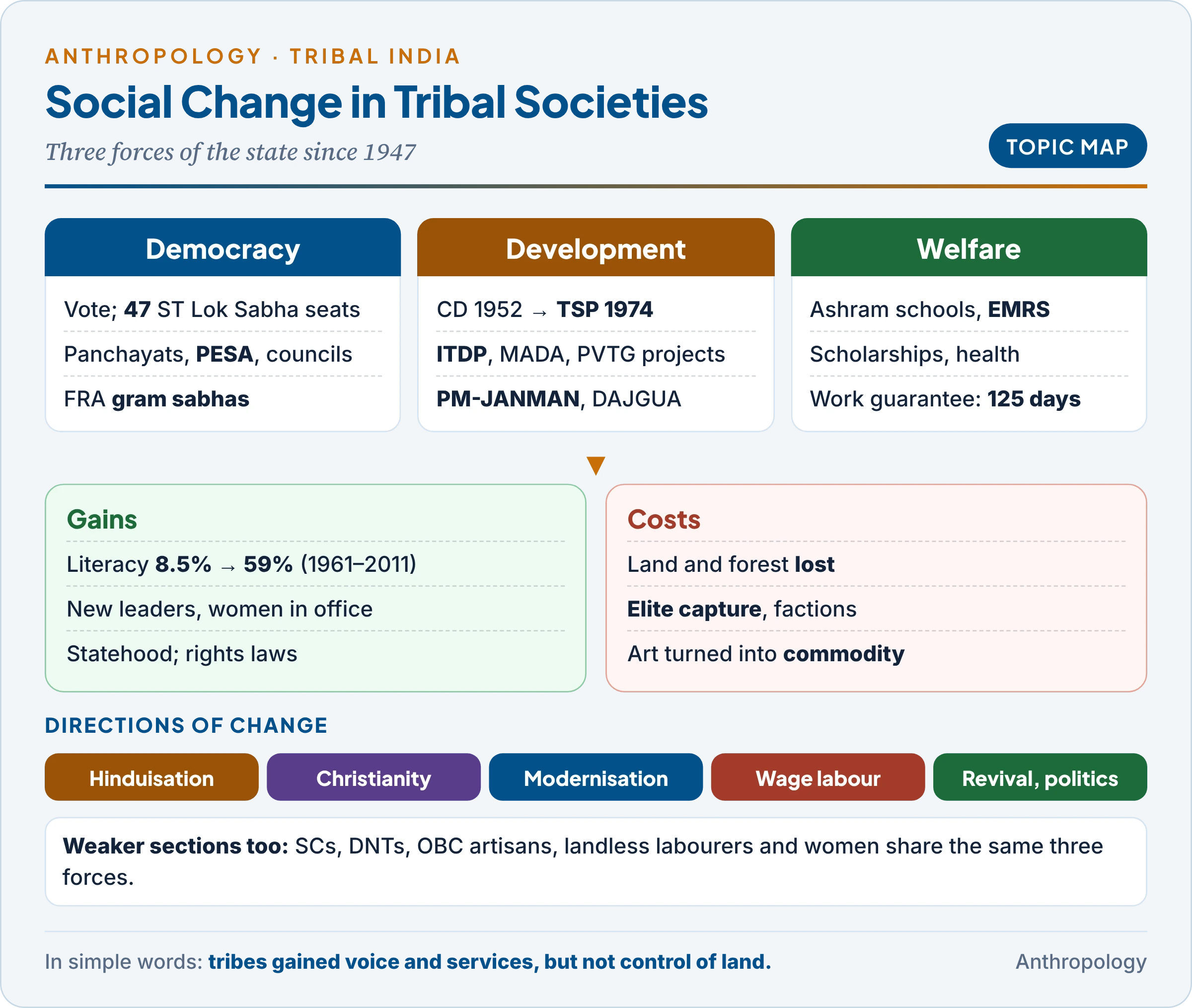
This article covers how democracy, planned development and welfare have changed tribal and other weaker sections since Independence. Safeguards and the Fifth and Sixth Schedules are in 7.1; PESA and Panchayati Raj in detail in 5.3b; tribal problems in 6.2; displacement in 6.3a; forest policy and FRA in 6.3b; ethnicity, movements and colonial-era change in 7.3; and tribal administration, PVTGs and NGOs in 9.1.
1. Understanding Change in Tribal Societies
In simple words
Tribal societies were never frozen; they have always traded, borrowed and changed. Since 1947 three new forces have speeded up change: voting and elected councils, government development programmes, and welfare schemes such as schools and scholarships. Change has brought new opportunities, but also new inequalities and the loss of control over land and forests.
Example first: the Munda and Oraon of Ranchi. In Culture Change in Tribal Bihar (1964), the Indian anthropologist Sachchidananda studied Munda and Oraon villages of Chotanagpur. He found the same villages pulled in several directions at once: Christian converts with mission schooling and jobs; Hinduised sections adopting caste-like purity rules and Hindu festivals; families entering mining, industry and government service; and a new class of educated political leaders. His later study, The Tribal Voter in Bihar (1976), showed that tribal voting was shaped by kin, village, religion and the Jharkhand demand as much as by party programmes. The lesson is that tribal change is plural: not one road from “primitive” to “modern” but many roads taken by different sections of the same tribe.
1.1 Agents of change
The forces that change tribal life can be grouped by their source. The table separates the older processes from the newer ones that this unit studies.
| Source | Agents | Example |
|---|---|---|
| Traditional, through contact | Hinduisation, Sanskritization (copying higher-caste customs), the tribe–caste continuum, trade at weekly markets | Bhumij and Gond groups claiming Kshatriya status |
| Colonial | Land revenue, forest laws, missionaries, courts, money economy | Mission schools among the Munda, Oraon, Khasi, Mizo |
| Modern, after 1947 | Democratic institutions, development programmes, welfare measures, industry, towns, media | Elections, panchayats, ITDPs, residential schools, steel towns |
The first two sources are dealt with in 3.2b and 7.3. This unit concerns the third, the directed change that the Indian state set out to produce.
1.2 Isolation, assimilation and integration
- Isolation: the British administrators J.H. Hutton and the anthropologist Verrier Elwin in his early writings argued for protecting tribes from outsiders; Elwin’s “national park” idea was criticised by the social worker A.V. Thakkar (Thakkar Bapa) as keeping tribes like museum pieces.
- Assimilation: the sociologist G.S. Ghurye called tribes “backward Hindus” who should be absorbed into Hindu society.
- Integration: India chose a middle path: development without loss of identity, set out in Nehru’s Tribal Panchsheel. The debate is in 4b.
1.3 Tribal Panchsheel and its relevance today
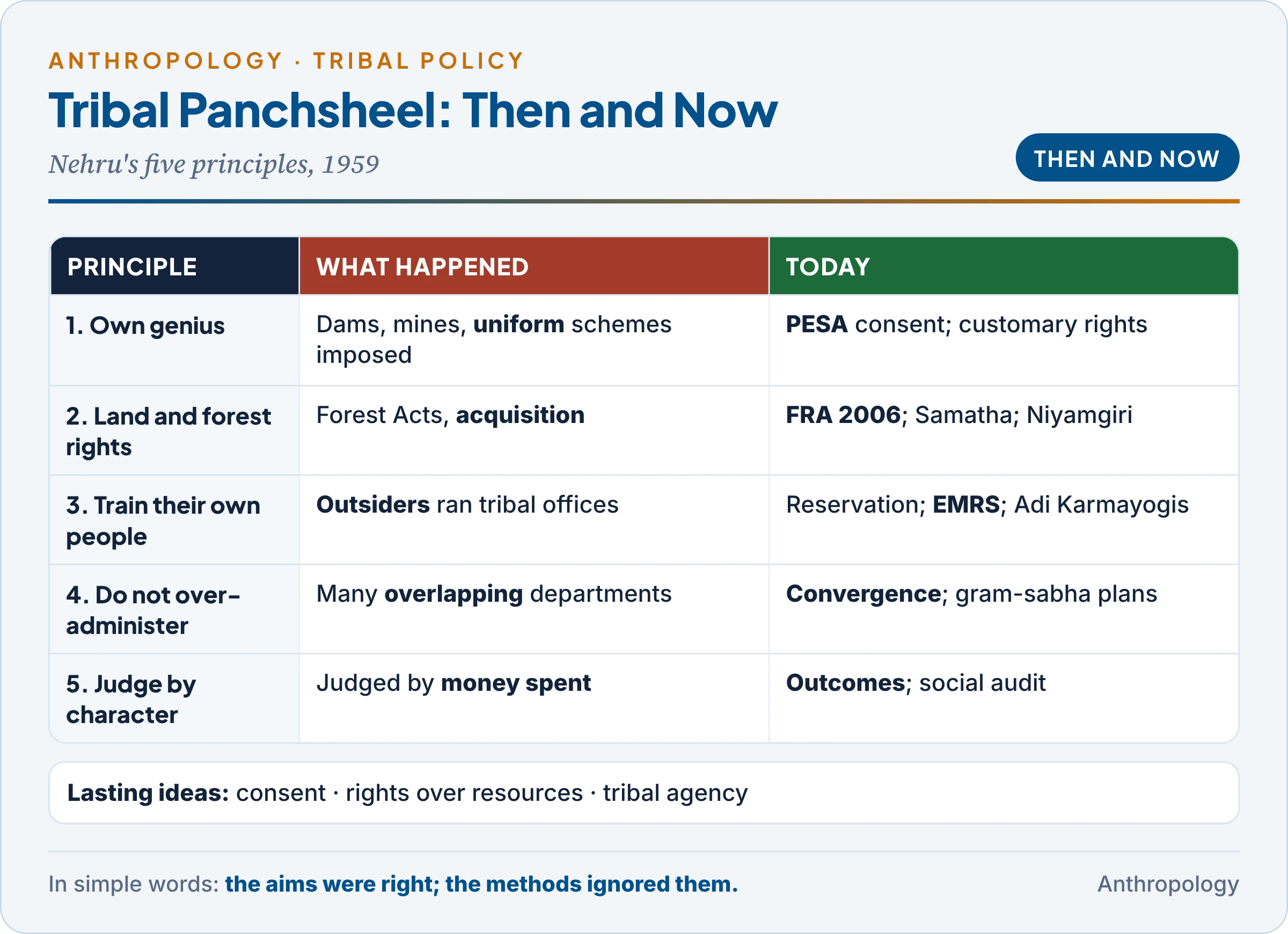
In his foreword to Verrier Elwin’s A Philosophy for NEFA (second edition, 1959), Prime Minister Jawaharlal Nehru set out five principles. The table gives each principle, how it fared, and why it still matters.
| Principle | What happened | Relevance today |
|---|---|---|
| 1. Develop “along the lines of their own genius”; do not impose | Dams, mines and uniform schemes were imposed | Basis of PESA gram-sabha consent and of FRA’s recognition of customary rights |
| 2. Respect rights in land and forests | Forest Acts and acquisition overrode them | FRA 2006, Samatha (1997), Niyamgiri (2013) |
| 3. Train their own people for administration | Outsiders dominated tribal offices | Reservation; EMRS; Adi Karmayogi volunteers (2025) |
| 4. Do not over-administer; work through their institutions | Many overlapping departments and schemes | Convergence drives (DAJGUA) and village vision plans made in gram sabhas |
| 5. Judge results by “the quality of human character”, not money spent | Plans judged by expenditure and targets | Outcome indicators (literacy, nutrition), social audit |
The Panchsheel’s ends remain widely accepted, but its means were overtaken by a planning state that measured progress by outlay. Its continuing relevance lies in three ideas: consent, rights over resources and tribal agency.
1.4 Directions of tribal change
The anthropologists of the 1950s–80s described several directions of change, often running together in one tribe.
- Hinduisation and Sanskritization: adopting Hindu deities, priests and caste-like purity rules (Bhumij, Gond Rajgonds).
- Christianisation: conversion with mission schooling, health care and new identities (Munda, Oraon, Kharia, Khasi, Mizo); detail in 8.1.
- Peasantisation and proletarianisation: from shifting cultivation and forest gathering to settled farming, then to wage labour in mines, plantations and towns.
- Modernisation: schooling, salaried jobs, new dress and housing; a small tribal middle class.
- Revivalism and politicisation: reassertion of tribal religion (the Sarna movement), identity politics and statehood demands (Jharkhand, 2000); detail in 7.3.
1.5 Impact of non-tribal contact on tribal institutions
Contact with traders, settlers, officials and missionaries has reshaped the institutions of many tribes, not only their economy.
- Youth dormitories such as the Muria ghotul of Bastar, described by Verrier Elwin in The Muria and their Ghotul (1947), declined as outsiders mocked them as immoral and schools took over the training of the young.
- Marriage payments: in some Hinduised groups bride-price gave way to dowry, lowering the standing of women.
- Land and inheritance: clan land became individual, saleable property recorded in revenue papers, which opened the way to alienation (6.2).
- Religion and language: Hindu festivals and priests, or Christian churches, replaced village deities in some sections; younger people shifted to the regional language.
- Leadership: the headman’s authority passed partly to the patwari (village accountant), the forest guard, the teacher and the elected representative.
The effect was uneven: groups that controlled the terms of contact (the Apa Tanis of Arunachal, studied by Haimendorf, used education and trade to prosper) gained, while those who met outsiders as debtors and labourers lost.
Common confusion
Is the “social change” of this unit the same as “social change during colonial and post-independent India” in 7.3? They overlap but differ in focus. 7.3 traces the historical course of change and the movements it produced. 7.2 asks a narrower question: what has the democratic and welfare state since 1947 (elections, panchayats, plans, schemes) done to tribal and other weaker sections?
2. Impact of Modern Democratic Institutions
In simple words
Universal adult franchise, reserved seats, panchayats and tribal councils gave tribes a vote and a voice they never had. They produced new leaders, statehood movements and, in places, real village self-rule. But they also weakened old councils, divided villages into factions, and often let an educated or wealthy few speak for everyone.
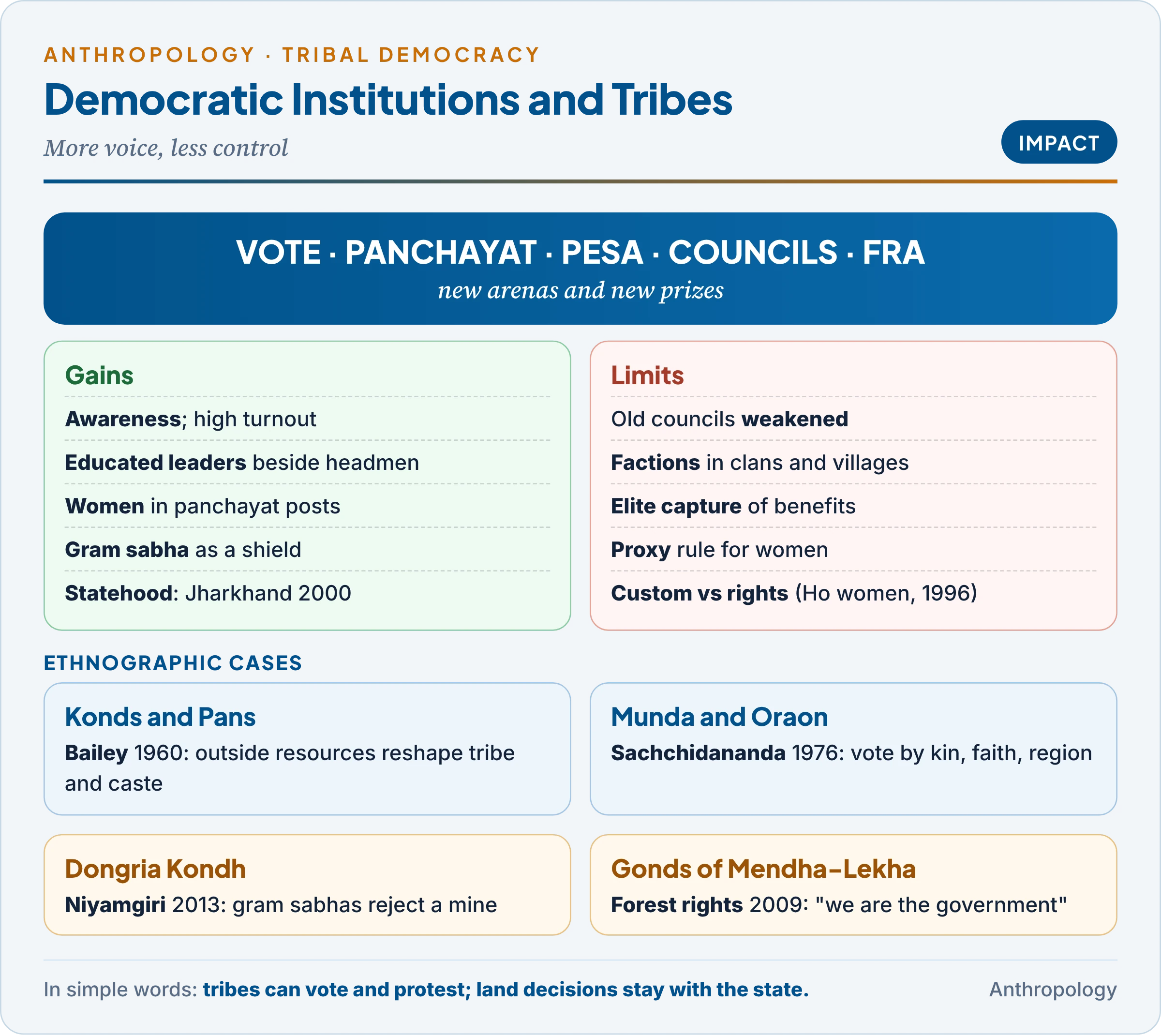
Example first: Bailey in the Kond hills. The British anthropologist F.G. Bailey studied the Kondmals of Orissa in the 1950s, when universal suffrage and new administration had just arrived. In Tribe, Caste and Nation (1960) he showed the Konds competing with caste Hindus for land and power, and the Pans (a Scheduled Caste who had long served the Konds) using schools, government posts and the police, resources outside the village, to challenge their inferior status. In Politics and Social Change: Orissa in 1959 (1963) he traced how parties and brokers linked villages to the state legislature. His point was that democracy did not simply replace tradition: it added new arenas and new prizes, and groups that learned to use them rose.
2.1 The institutions
- Universal adult franchise (from the 1951–52 elections) and reserved seats: 47 of 543 Lok Sabha seats for STs (Art. 330, 332).
- Panchayati Raj: reservation for STs and SCs in proportion to population (Art. 243D); PESA 1996 for Fifth Schedule areas, with the gram sabha at the centre (5.3b).
- Autonomous District Councils under the Sixth Schedule in the North-East (7.1).
- Gram sabhas under the Forest Rights Act, 2006, which decide claims and manage community forests.
- Political parties and statehood: the Jharkhand Party (founded by Jaipal Singh Munda) and later the Jharkhand Mukti Morcha (1972); the states of Jharkhand and Chhattisgarh (2000) and the north-eastern tribal states.
2.2 Positive impacts
- Political awareness and participation: tribal turnout is often high; elections brought outside leaders, ideas and promises into remote villages.
- New leadership: a Western-educated, salaried, younger leadership has replaced or joined the hereditary headman, priest and clan elder.
- Representation at the top: tribal ministers, chief ministers and, from 2022, President Droupadi Murmu, a Santal from Odisha.
- Women’s participation: reserved seats (at least one-third, 50% in many states) put tribal women in panchayat offices; PESA gram sabhas include all adult women, who had little place in clan councils.
- Gram sabha as a shield: in the Niyamgiri case (Supreme Court, 18 April 2013), Dongria Kondh gram sabhas rejected bauxite mining on their sacred hill; Mendha-Lekha, a Gond village of Gadchiroli with the motto “our government in Delhi and Mumbai, we are the government in our village”, was among the first to receive community forest rights (2009) and the right to sell bamboo (2011).
- Statehood and autonomy: democratic mobilisation produced Jharkhand, Chhattisgarh and the north-eastern states.
2.3 Problems and contradictions
- Weakening of traditional councils: the Dhebar Commission (1961) had advised that tribal councils, rooted in custom and religious sanction, be used alongside statutory panchayats; the Shilu Ao study team (1969) found that tribes saw the new panchayats as alien and incongruous with their customs; in many areas the statutory and traditional councils run side by side, with authority unclear.
- Factionalism: party competition split clans and villages; money and liquor entered elections.
- Elite capture: benefits and offices went to the educated, landed and well-connected; the sociologist Virginius Xaxa notes that a thin tribal middle class gains while the mass of tribes loses control over land and forests.
- Proxy rule: husbands or male relatives often act for elected women.
- Dominance of non-tribals in mixed areas and in the bureaucracy that implements decisions.
- Custom versus rights: in Madhu Kishwar v. State of Bihar (1996) the Supreme Court declined to strike down Ho customary law excluding women from inheriting land, showing the tension between community autonomy and individual equality.
- Self-rule against the state: the Pathalgadi movement (2017–18) in Khunti, Jharkhand, erected stone slabs declaring gram-sabha sovereignty under PESA and was met with sedition cases, showing how far apart state and tribal ideas of self-rule can be.
The balance is that democracy gave tribes voice more than control: they can vote and protest, but decisions over land, forests and mines still lie largely with the state.
2.4 PESA and women’s political participation
- Legal opening: under PESA every adult, including every woman, is a member of the gram sabha; the general one-third reservation of panchayat seats for women (50% in many states) also applies in Scheduled Areas, so tribal women now hold posts from ward member to sarpanch.
- What changed: women raise issues that clan councils ignored, such as drinking water, liquor, schooling, rations and forest produce; many gram sabhas have used PESA’s power over intoxicants to restrict liquor sales at women’s insistence.
- Limits: quorum rules are met on paper; meetings are often called by officials at short notice; male relatives act as proxies; and customary councils that exclude women still settle disputes on land and marriage.
- Assessment: PESA has widened formal participation much more than effective power, but it has given tribal women a legal platform that customary institutions never offered.
2.5 Traditional council and gram sabha
The table compares the two institutions that coexist in many tribal villages.
| Point | Traditional tribal council | Gram sabha under PESA |
|---|---|---|
| Membership | Elders, headmen, clan heads; mostly men | All adult voters, women included |
| Basis | Custom, kinship, ritual authority | Statute (PESA 1996, FRA 2006) |
| Functions | Disputes, marriage, ritual, land within the clan | Plans, beneficiaries, forest produce, markets, land, money-lending |
| Strength | Legitimacy, speed, consensus | Legal power, link to funds |
| Weakness | Excludes women and the young; no legal backing | Can become a formality run by officials |
Where the two are joined, as in villages that treat the gram sabha as a meeting of the whole community under customary leaders, PESA works best.
2.6 Ethnographic illustrations
| People and place | Ethnographer or case | What it shows |
|---|---|---|
| Konds and Pans (Kondmals, Orissa) | F.G. Bailey, Tribe, Caste and Nation (1960) | New arenas and outside resources reshape tribe–caste relations |
| Munda and Oraon (Chotanagpur) | Sachchidananda, The Tribal Voter in Bihar (1976) | Voting shaped by kin, religion and regional identity |
| Gonds (Adilabad, Andhra Pradesh) | C. von Fürer-Haimendorf, Tribes of India: The Struggle for Survival (1982) | Protective laws failed to stop land loss to settlers |
| Munda (Jharkhand) | Alpa Shah, In the Shadows of the State (2010) | Villagers kept the state at a distance; campaigns for “traditional” self-rule could serve local elites |
| Dongria Kondh (Niyamgiri, Odisha) | Supreme Court, 2013 | Gram sabha consent can stop a mine |
| Gonds (Mendha-Lekha, Maharashtra) | Community forest rights, 2009 | Village self-rule over forests |
3. Development Programmes
In simple words
Since 1952 the government has tried many ways to develop tribal areas: first general village programmes, then special tribal blocks, then a separate budget for tribes and special agencies, and now “saturation” missions that try to give every tribal household a house, road, water and electricity. Each phase corrected the last, but the gap between tribes and others has narrowed only slowly.
Example first: why the first programmes failed. The Community Development programme of 1952 covered tribal areas with the same blocks as the rest of the country. Reviews soon found that the better-off non-tribal residents took most of the loans, wells and seeds, so that tribal areas advanced but the gap between tribals and non-tribals widened. This lesson, that general programmes in mixed areas favour the advantaged, shaped every later strategy.
3.1 Phases of strategy
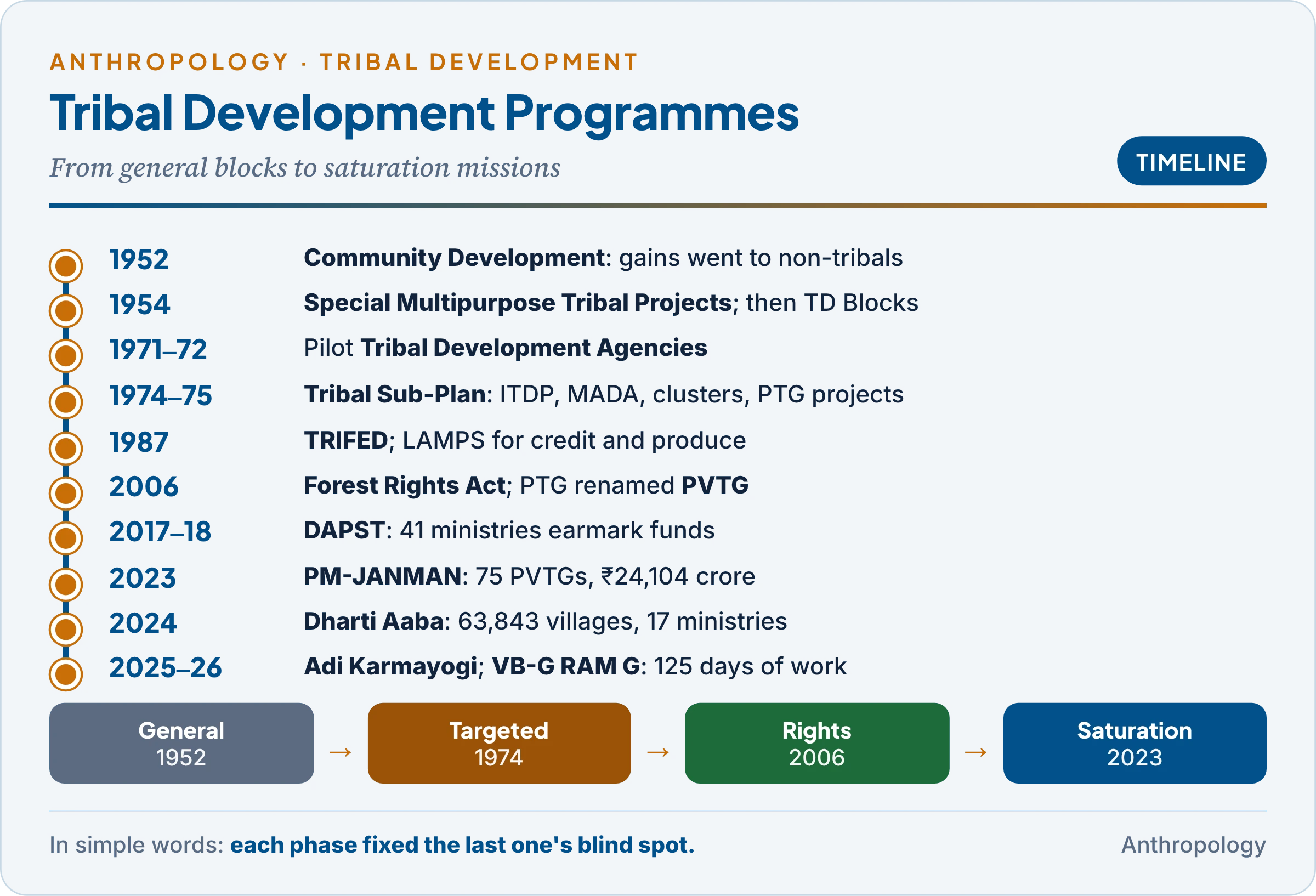
| Period | Programme | Idea and result |
|---|---|---|
| 1952 | Community Development blocks | Same model everywhere; benefits went to non-tribals |
| 1954 | Special Multipurpose Tribal Projects | Intensive pilot blocks; reviewed by a committee under Verrier Elwin (1959) |
| Third Plan | Tribal Development Blocks | About 500 blocks covering some 40% of STs; mainly developmental, weak on protection |
| 1971–72 | Pilot Tribal Development Agencies (Andhra Pradesh, Bihar, Madhya Pradesh, Orissa) | Target-group approach; mostly agriculture and roads |
| 1974–75 | Tribal Sub-Plan (Fifth Plan) | Area plus protection: ITDPs, later MADA pockets and clusters; micro-projects for primitive groups (1975) |
| 1987 | TRIFED | Marketing of forest and farm produce |
| 2006 | Forest Rights Act; “Primitive” renamed PVTG | Rights-based turn |
| 2017–18 on | Development Action Plan for STs (DAPST) | Earmarked funds in 41 ministries |
| 2018 | Van Dhan Vikas Kendras | Value addition by forest-produce collectors |
| 2023 | PM-JANMAN | Saturation of PVTG habitations |
| 2024 | Dharti Aaba Janjatiya Gram Utkarsh Abhiyan | Saturation of tribal-majority villages |
| 2025 | Adi Karmayogi Abhiyan | Training for responsive local governance |
| 2026 | VB-G RAM G Act replaces MGNREGA | 125 days of guaranteed rural work |
The sequence moves from general development to tribal targeting, then from welfare to rights, and lately to saturation and convergence: delivering a fixed package of services to every eligible household.
Common confusion
Are “welfare”, “development” and “rights” approaches the same? No. A welfare approach gives benefits (scholarships, rations, houses) to people seen as needy. A development approach tries to raise the productive capacity of an area (irrigation, roads, markets). A rights approach recognises what people are entitled to control, such as land, forests and the gram sabha’s consent (PESA, FRA). Tribal policy has moved through all three, and the strongest critiques ask for the third.
3.2 The Tribal Sub-Plan and ITDPs
- Idea: a separate component of every Central and State plan, at least in proportion to the ST population, non-divertible to other uses; shaped by the administrator B.D. Sharma.
- Delivery units: ITDPs/ITDAs for areas (blocks or tehsils) where STs form a majority; MADA pockets (population of 10,000 or more with at least 50% STs); clusters (5,000 or more, 50% STs); micro-projects for primitive groups; about 192 ITDAs/ITDPs existed in 2015.
- Objectives of ITDPs: narrow the gap between tribal and other areas; raise incomes through agriculture, horticulture, animal husbandry and forest produce; build roads, schools and health centres; and protect against land alienation, moneylending and exploitation.
- Achievement: roads, schools and hostels did reach tribal areas, and literacy rose sharply. But ITDPs became under-staffed and under-funded offices with little power over line departments; protection lagged far behind construction; and plans were made for, not with, the people.
- DAPST now: the TSP runs as the Development Action Plan for Scheduled Tribes. For 2026–27 about ₹1.39 lakh crore is earmarked across 41 ministries and departments besides the Ministry of Tribal Affairs. Civil-society budget analyses find that only a small share goes to schemes designed for STs; most is a notional share of general schemes.
3.3 MADA, LAMPS and TRIFED
- MADA (Modified Area Development Approach, Sixth Plan): extended the sub-plan to smaller pockets outside ITDP areas.
- LAMPS (Large-sized Agricultural Multipurpose Societies): cooperatives that give credit, buy forest and farm produce and sell consumer goods, so that the tribal need not go to the moneylender-trader; many became weak or captured by officials.
- TRIFED (Tribal Cooperative Marketing Development Federation of India, 1987): buys and markets tribal produce and crafts (Tribes India outlets); runs minimum support prices for minor forest produce, now 87 items, and the Van Dhan clusters (6.2).
3.4 Tribal Research Institutes
- What: state-level research bodies, 29 of them supported by the Ministry of Tribal Affairs (2025).
- Functions: research and evaluation of schemes; training of officials posted to tribal areas; documentation of languages, customs and arts; tribal museums; inputs on ST status claims and customary law; and support to FRA implementation.
- Significance: they are the main channel through which anthropological knowledge reaches tribal administration, though many are short of staff and independence.
3.5 Saturation missions
- PM-JANMAN (launched 15 November 2023, Khunti): ₹24,104 crore for the 75 PVTGs, 11 interventions through 9 ministries. By 31 December 2025, 4.74 lakh houses had been sanctioned and about 2.5 lakh completed; 750 mobile medical units were running.
- Dharti Aaba Janjatiya Gram Utkarsh Abhiyan (approved 18 September 2024, launched 2 October 2024): 25 interventions by 17 ministries in 63,843 tribal-majority villages of 549 districts, outlay ₹79,156 crore. Its targets (housing, water, electricity, health, schooling, livelihood) map onto several Sustainable Development Goals: poverty (SDG 1), health (SDG 3), education (SDG 4), water (SDG 6) and energy (SDG 7).
- Adi Karmayogi Abhiyan (launched 17 September 2025, Dhar): trains officials, self-help-group women and tribal youth as “Adi Karmayogis” for about one lakh tribal villages; by August 2026 about 15 lakh had been mobilised and 62,187 Tribal Village Vision 2030 plans approved by gram sabhas.
- Assessment: saturation delivers physical assets faster and reaches the remotest habitations, but risks top-down uniformity, and leaves land, forest and displacement questions untouched.
3.6 Appraisal of one programme: Eklavya Model Residential Schools
- Design: begun in 1997–98 under Article 275(1) grants to give tribal children quality residential schooling from Class VI to XII; expanded in 2018–19 to every block with over 50% ST population and at least 20,000 tribal persons; now run through a national society for tribal students’ education.
- Strengths: brings secondary schooling to remote blocks; free board, uniforms and books; sports and cultural facilities; some schools match good state schools in examination results.
- Weaknesses: slow construction (508 of 728 functional in July 2026); teacher shortages and frequent transfers; teaching only in English or the state language; risk of cutting children off from family, language and land-based knowledge.
- Suggestions: recruit tribal and local-language teachers; bridge courses in the mother tongue; involve parents and gram sabhas in school committees; track students into college and jobs, not only into Class XII.
3.7 PVTGs
- 75 groups in 18 states and one Union Territory, identified from 1975 by a pre-agricultural level of technology, stagnant or declining population, very low literacy and a subsistence economy; detail in 9.1.
- Renamed in 2006 from “Primitive Tribal Groups” because “primitive” was pejorative and misdescribed communities whose vulnerability came from history and dispossession, not backwardness of culture.
4. Welfare Measures and Their Impact
In simple words
Welfare measures such as scholarships, hostels, residential schools, health missions, employment guarantees and cheap credit have created the first educated generation in many tribal and Dalit families. But quality is uneven, many benefits reach the better-off first, and welfare cannot replace control over land and work.
4.1 Education
- Ashram schools (residential schools, an idea traced to Thakkar Bapa‘s Bhil Seva Mandal, 1922): advantages are that they reach children from scattered hamlets, provide food, clothing and care, keep children through the agricultural season, and can teach in a familiar cultural setting; problems are poor food and buildings, few trained teachers and cases of abuse.
- Eklavya Model Residential Schools: 728 approved, 508 functional (July 2026).
- Scholarships and hostels: the post-matric scholarship for SCs and STs dates from 1944–45.
- Outcome: ST literacy rose from 8.5% (1961) to 59.0% (2011); SC literacy from about 10% to 66.1%. The gap with the general population has narrowed but not closed, and widens at the higher secondary and college levels.
- Education as an instrument of change: education produced teachers, officials and leaders, the base of Dalit and Adivasi assertion; but where schools teach only in an unfamiliar language and ignore tribal knowledge, they produce drop-outs and alienation from community life.
4.2 Health, livelihood and credit
- Health: mobile medical units, the sickle-cell anaemia mission (2023) and nutrition schemes; ST children remain the most stunted group (NFHS-5: 40.9%) (6.2).
- Employment: MGNREGA (2006) gave tribal households lean-season work; it was replaced from 1 July 2026 by the VB-G RAM G Act, 2025, guaranteeing 125 days.
- Livelihoods and credit: self-help groups under the National Rural Livelihoods Mission, the National Scheduled Tribes Finance and Development Corporation (2001), Van Dhan and minimum support prices for forest produce.
- Land: titles under the Forest Rights Act have given many families legal security, though rejection rates of claims have been high in several states (6.3b).
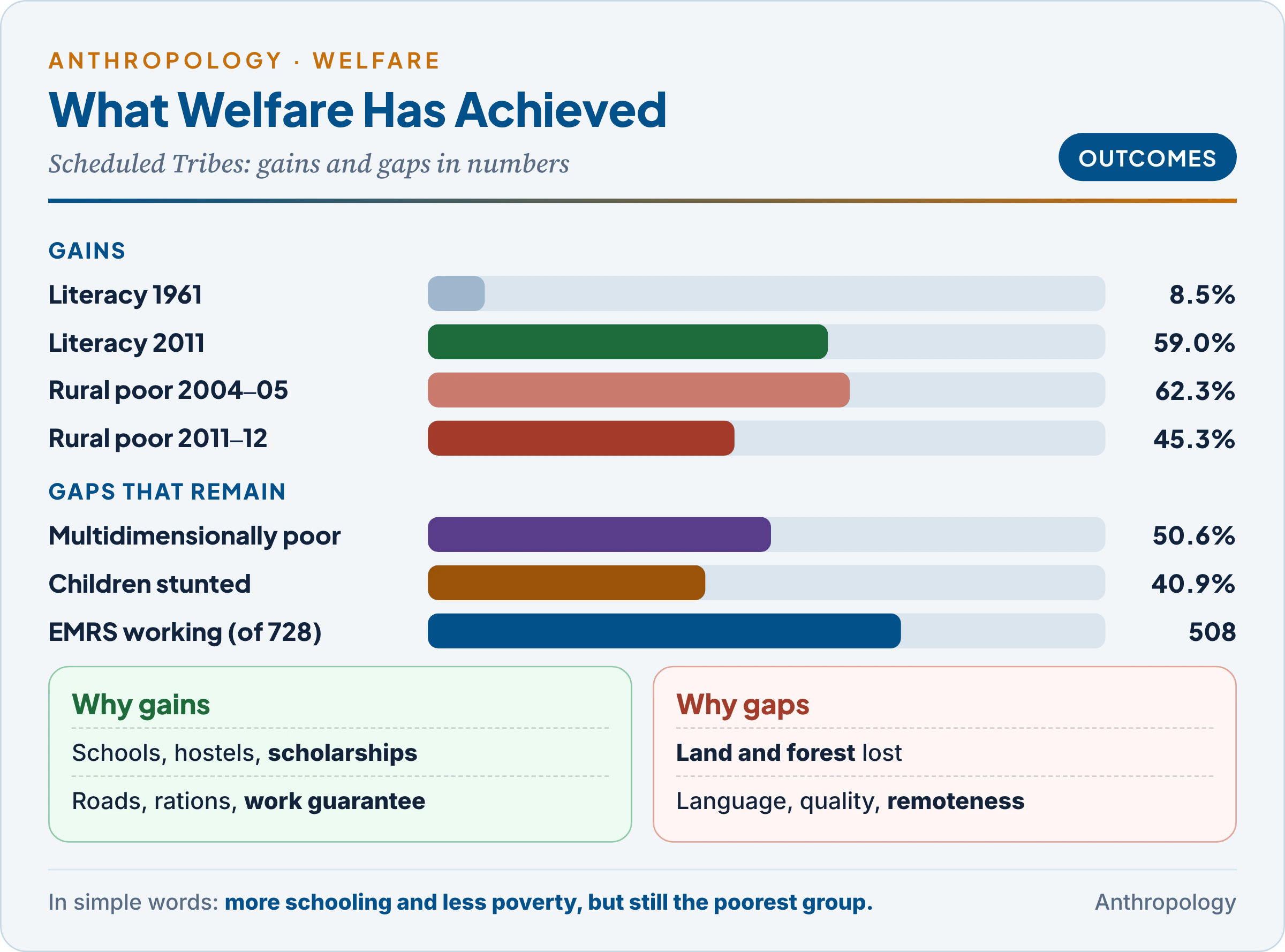
4.3 Outcomes in figures
The table compares where Scheduled Tribes stood earlier with recent figures.
| Indicator | Earlier | Recent |
|---|---|---|
| Literacy (Census) | 8.5% (1961) | 59.0% (2011) |
| Rural poverty (Tendulkar method) | 62.3% (2004–05) | 45.3% (2011–12) |
| Multidimensional poverty (Global MPI 2021) | — | 50.6%, highest of all groups |
| Child stunting (NFHS-5, 2019–21) | — | 40.9% |
| PVTG houses (PM-JANMAN) | — | 4.74 lakh sanctioned, 2.5 lakh built (Dec 2025) |
The figures show real gains in schooling and poverty, but tribes remain the poorest and most undernourished group, because welfare has not reversed the loss of land and forest. Behind the averages lie wide differences: Mizo, Khasi and Naga literacy approaches the national level, while PVTGs and the tribes of southern Odisha and Bastar lag far behind.
4.4 Other weaker sections
The “weaker sections” of Article 46 include more than tribes. The table outlines their segments and the approach suited to each.
| Segment | Main disadvantage | Suited approach |
|---|---|---|
| Scheduled Castes | Stigma, landlessness | Anti-untouchability law, land, education, reservation |
| Scheduled Tribes | Loss of land and forest, remoteness | Area protection, rights, culturally fitted services |
| PVTGs | Survival, isolation | Habitat-based, slow, consent-led programmes |
| Denotified and nomadic tribes | Criminal stigma, no fixed home | Identity documents, housing, SEED scheme (7.1) |
| OBC artisans and service castes | Lost markets, low skills | Credit, technology, marketing |
| Landless labourers and women | Wages, dependence | Employment guarantee, self-help groups |
- SC welfare: the Development Action Plan for SCs (about ₹1.96 lakh crore in 2026–27), scholarships and PM-AJAY (adarsh gram villages and grants to states).
- Democratic institutions and weaker sections: reserved panchayat posts have brought Dalit and tribal sarpanches to power; studies after the 73rd Amendment found that reserved heads directed more public goods (drinking water, roads) to their groups. Yet violence against assertive Dalit leaders, such as the killing of the Dalit panchayat president of Melavalavu in Tamil Nadu in 1997, shows that power on paper can provoke backlash (5.3b).
- Changing Dalit life: a survey of all Dalit households in two blocks of Uttar Pradesh (Azamgarh and Bulandshahr) by Devesh Kapur, Chandra Bhan Prasad, Lant Pritchett and D. Shyam Babu (2010) found that since 1990 Dalits had moved out of bonded farm ties, changed diets and dress, and were less often seated separately at weddings, showing that market growth and migration can erode caste practices.
- Green Revolution and the rural poor: the American political scientist Francine Frankel (India’s Green Revolution, 1971) found that gains went mainly to larger farmers in irrigated regions and sharpened class conflict; later rising farm wages and jobs helped labourers, but regional and class inequality widened, and tribal rainfed areas gained little.
4.5 NGOs as partners
- Roles: reaching remote areas, building people’s organisations, running health and education models, and linking communities with government schemes, banks and markets; they facilitate other stakeholders by translating between the state’s programmes and the community’s needs.
- Examples: SEARCH (Abhay and Rani Bang, Gadchiroli, 1986) for newborn and tribal health; Vivekananda Girijana Kalyana Kendra (H. Sudarshan, BR Hills, 1981) among the Soligas; PRADAN (1983) on livelihoods in Jharkhand and Odisha; Lok Biradari Prakalp (Amte family, Hemalkasa, 1973) among the Madia Gonds.
- Limits: dependence on donors, uneven quality, and a tendency to supply services without challenging the causes of deprivation (9.1).
4.6 Tribal art and its commodification
- Tribal art: wall and floor painting (Warli of Maharashtra, Saura of Odisha, Pithora of the Rathwa Bhils), metal casting (Dhokra), and Gond painting are tied to ritual, myth and seasonal life.
- Commodification: markets, museums and tourism have turned these into saleable goods. The Pardhan Gond artist Jangarh Singh Shyam, brought to Bharat Bhavan in Bhopal in the early 1980s, and the Warli painter Jivya Soma Mashe gained national fame.
- Gains: income, pride, recognition of tribal creativity.
- Costs: art is cut off from its ritual meaning, designs are copied by outsiders without credit, middlemen take most of the value, and tribes are displayed as exotic spectacles, as in the “human safari” around the Jarawa.
5. Assessing Social Change
In simple words
Overall, democracy and welfare have given tribal and other weaker sections more schooling, more say and more services. But development projects have also taken their land and forests, and benefits have concentrated among a small educated section. The best results come where communities themselves control planning and resources.
5.1 Gains and costs
| Gains | Costs |
|---|---|
| Literacy, health services, roads, housing | Land and forest lost to projects and towns |
| Political voice, new leaders, statehood | Factionalism, elite capture, proxy rule |
| A tribal and Dalit middle class | Widening inequality within tribes |
| Legal rights (PESA, FRA) | Weak implementation, bypassing gram sabhas |
| Cultural pride and recognition | Commodification and loss of meaning |
The table shows that change has been double-edged. The anthropologist Virginius Xaxa argues that tribes became citizens but lost their position as communities in control of their territory; welfare compensated individuals while development dispossessed groups.
The classic studies differ in emphasis. Haimendorf stressed the failure of protective laws; Bailey, the new arenas that democracy opened; Sachchidananda and L.P. Vidyarthi, who studied tribal workers around the industrial towns of Ranchi and Bokaro, the plural paths of change; Xaxa and Alpa Shah, the inequalities and ambiguities that the state’s own interventions created. Read together, they show that who controls the terms of change matters more than the speed of change.
5.2 Toward people-centred development
- Participation: plans prepared in gram sabhas (as in the Tribal Village Vision 2030 exercise), not only for them; social audits.
- Rights before schemes: implement PESA and FRA, restore alienated land, and obtain free, prior and informed consent for projects.
- Culturally fitted services: mother-tongue schooling, tribal teachers, respect for customary healers and food systems.
- Differentiated strategy: separate plans for PVTGs, dispersed tribes, urban tribal migrants and the advanced sections.
- Anthropological input: understand tribal organisation and values, find the areas of least resistance to innovation, train officials in tribal culture, and monitor whether measures weaken social solidarity.
Key Terms
| Term | Meaning in simple words |
|---|---|
| Directed change | Change planned and pushed by the state |
| Tribal Panchsheel | Nehru’s five principles for tribal development (1959) |
| Integration | Joining national life without losing identity |
| Community Development | The 1952 programme for all villages |
| Tribal Sub-Plan / DAPST | A share of every plan earmarked for STs |
| ITDP / ITDA | Project office for a tribal-majority area |
| MADA pocket | Small tribal pocket outside ITDP areas |
| LAMPS | Cooperative giving tribals credit and buying their produce |
| TRIFED | National body marketing tribal produce and crafts |
| Tribal Research Institute | State body for research and training on tribes |
| PVTG | Particularly Vulnerable Tribal Group, formerly “Primitive” |
| Saturation | Giving every eligible household a full set of services |
| Elite capture | A few powerful people taking most benefits |
| Proxy rule | A relative governing on behalf of an elected woman |
| Ashram school | Residential school for tribal children |
| Commodification | Turning culture into goods for sale |
Contemporary Developments
- Adi Karmayogi Abhiyan (2025–26): about 15 lakh trained volunteers and 62,187 gram-sabha village plans.
- PM-JANMAN: 4.74 lakh PVTG houses sanctioned and about 2.5 lakh completed by December 2025; a household survey of PVTGs began in 2026.
- DAPST 2026–27: about ₹1.39 lakh crore across 41 ministries.
- Employment: the VB-G RAM G Act replaced MGNREGA from 1 July 2026, with 125 days of work.
- EMRS: 508 of 728 schools functional (July 2026).
Diagrams to Master
- Topic map: three forces (democracy, development, welfare) → gains and costs → directions of change.
- Democratic institutions panel: institutions → gains → limits, with Bailey, Sachchidananda, Niyamgiri and Mendha-Lekha.
- Programme timeline: 1952 → 1954 → 1974 → 2006 → 2018 → 2023 → 2024 → 2025 → 2026.
- Panchsheel then and now: five principles, the practice, and their present form.
- Welfare outcomes: literacy, poverty, MPI, stunting and scheme figures.
Revision Grid
| Scholar or body | Work (year) | Key idea |
|---|---|---|
| Jawaharlal Nehru | Foreword, A Philosophy for NEFA (1959) | Tribal Panchsheel |
| F.G. Bailey | Tribe, Caste and Nation (1960); Politics and Social Change (1963) | Democracy adds new arenas and prizes |
| Sachchidananda | Culture Change in Tribal Bihar (1964); The Tribal Voter in Bihar (1976) | Plural directions of change; tribal voting |
| C. von Fürer-Haimendorf | Tribes of India: The Struggle for Survival (1982) | Protective laws fail against land loss |
| Francine Frankel | India’s Green Revolution (1971) | Gains to larger farmers; class conflict |
| Alpa Shah | In the Shadows of the State (2010) | Distance from the state; elite use of “tradition” |
| Virginius Xaxa | State, Society and Tribes (2008) | Citizens gained, communities dispossessed |
| Kapur, Prasad, Pritchett, Babu | “Rethinking Inequality” (2010) | Caste practices eroding among Dalits in UP |
| Shilu Ao Study Team | Report (1969) | Panchayats seen as alien |
| Supreme Court | Niyamgiri (2013) | Gram sabha decides on mining |
Previous Year Questions
7.2 Social change and contemporary tribal societies: Impact of modern democratic institutions, development programmes and welfare measures on tribals and weaker sections.
- 2026Discuss the impact of democratic institutions on the tribal populations of India.
- 2025Discuss the role of NGOs in the socioeconomic and political development of weaker sections and the manner in which they facilitate other stakeholders.
- 2024Critically discuss the recent welfare measures initiated by the Government for the Particularly Vulnerable Tribal Groups (PVTGs). Comment why PVTGs were erroneously called Primitive Tribal Groups (PTGs).
- 2024How is PESA Act empowering local self-governance and impacting women’s political participation?
- 2023Critically examine the impact of modern democratic institutions on contemporary tribal societies. Illustrate with suitable ethnographic examples.
- 2022Discuss the objectives of Integrated Tribal Development Projects (ITDPs). How far have these objectives been achieved?
- 2022Compare the functioning of traditional ‘Tribal Council’ with that of ‘Gram Sabha’ under PESA.
- 2020Describe the functions of Tribal Research Institutes in India.
- 2019Critically assess the existing plans and programmes meant for tribal welfare.
- 2017Give a critical appraisal of any one tribal development programme during XIIth Five-Year plan. Give your suggestions for any improvement in the programme.
- 2016Describe how various tribal development programmes and plans have impacted the process of social transformation among tribes.
- 2015Write a note in 150 words on Relevance of tribal Panchsheel today.
- 2015Discuss the nature of social change in tribal India under the impact of developmental programmes.
- 2013Examine the impacts of green revolution on rural poor.
- 2013Examine the impact of non-tribal contract on socio-cultural institutions of tribal people with suitable examples.
- 2012Examine the relevance of Tribal Panchsheel by Jawaharlal Nehru in the light of emerging developing practices.
- 2012Write a note in 150 words on Commodification of Tribal Art.
- 2011Write a note in 150 words on Tribal Panchsheel.
- 2008How have modern democratic institutions influenced the Indian tribal societies ? Assess.
- 2006Critically review the processes of social changes the contemporary Indian society is undergoing.
- 2006Write a note on Programmes for ‘Tribal Development.
- 2000Write a note on MADA, LAMPS TRIFED.
- 1998Write a note on ITDA.
- 1997Estimate the role of democratic institutions/ organisation for the development of weaker sections and the welfare measures adopted by them.
- 1995Write a note on People’s participation in tribal development.
- 1994Describe the efficacy of the legislative measures adopted by the Government to tackle the socio-economic problems of the scheduled castes. What other measure would you suggest to tackle these problems?
- 1993Write a note on Direction of tribal change.
- 1986Write a note on Advantages of Ashram school in tribal areas.
- 1985Write a note on Tribes in transition.
- 1985Write a note on Tribal art in India.
- 1984Make an evaluation of welfare measures adopted by the government for the betterment of scheduled tribes in India.
- 1983What are the distinct segments in the backward population of India ? What special approaches do you recommend to suit the development of different segments?
- 1982Discuss the role of education as an instrument of socio-economic change among the weaker section of India.
Related questions from other units
- 2026Unit 9.1: ‘Dharti Aaba Janjatiya Gram Utkarsh Abhiyan aims to meet some of the Sustainable Development Goals’. Discuss.
- 2026Unit 9.1: Write an account on Development Action Plan for Scheduled Tribes (DAPST).
- 2021Unit 5.3: Discuss the role of Panchayati Raj Institutions in transforming traditional power hierarchy in rural India.
- 2020Unit 9.1: Discuss the effect of job reservation in alleviating unemployment among the tribal people of India.
- 2017Unit 9.1: Discuss the emergence, salient features and limitations of Tribal sub-plan.
- 2010Unit 5.3: Write a note in 150 words on Panchayati Raj and the tribes.
- 2007Unit 6.3: Illustrate, with suitable examples, the impact of development programmes on tribal and weaker sections.
- 2002Unit 9.1: What do you understand by the integrated tribal and rural development programmes? How would you evaluate the success or failure of these programmes ?
- 2001Unit 9.1: Mention various developmental programmes implemented for the socio-economic well-being of Scheduled Castes. Do these programmes fulfil their aspiration ? Discuss.
- 1988Unit 6.3: Discuss the people’s response and participation in development programmes in tribal areas.
More from Scheduled Castes, Scheduled Tribes and OBCs: all notes of this unit · every PYQ of this unit · Anthropology Optional hub