

Anthropology Optional › Paper II › Unit 07: Scheduled Castes, Scheduled Tribes and OBCs
7.3 The concept of ethnicity; Ethnic conflicts and political developments; Unrest among tribal communities; Regionalism and demand for autonomy; Pseudo-tribalism; Social change among the tribes during colonial and post-independent India; National integration
Official Syllabus: Paper II, Unit 7.3
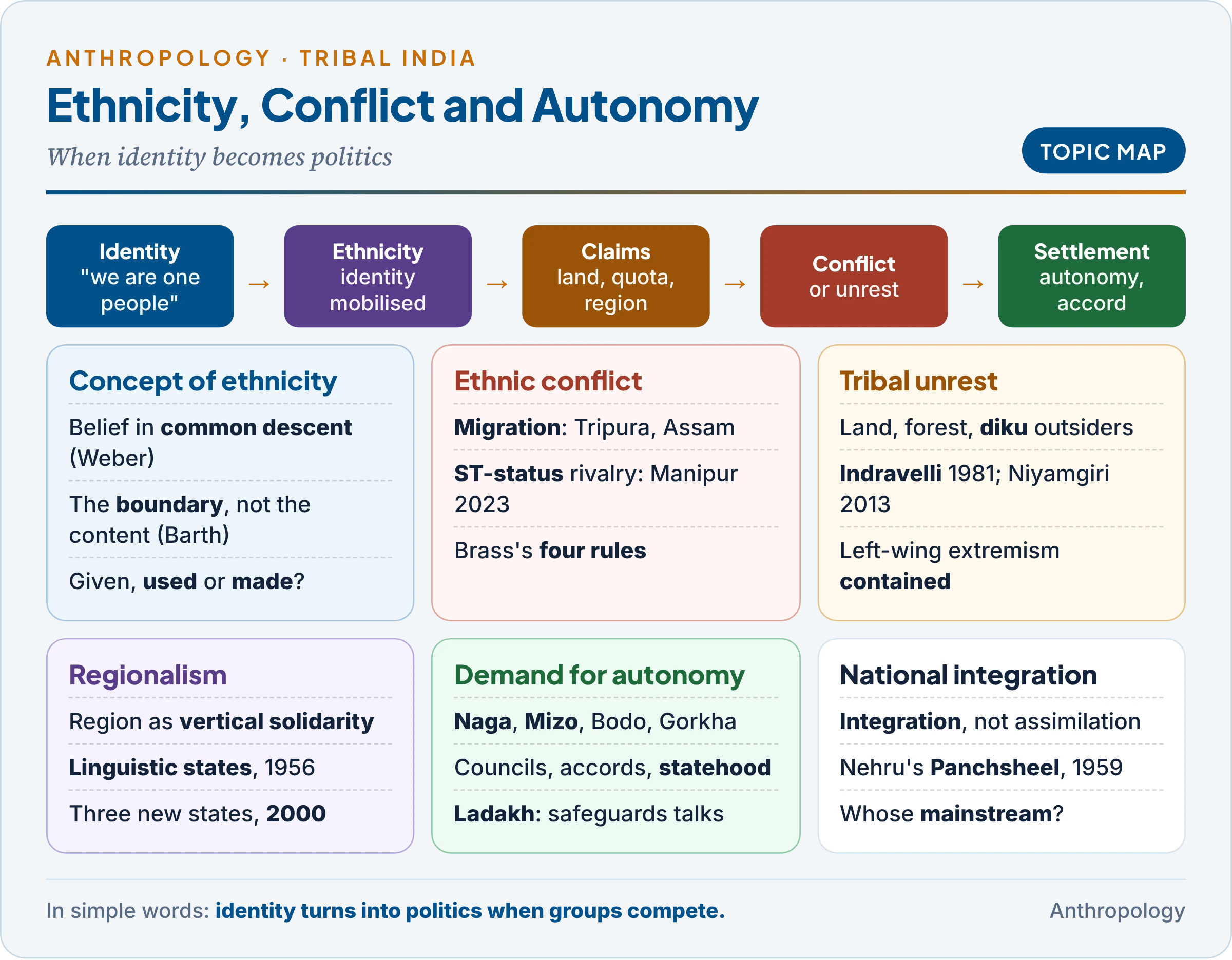
This article covers ethnicity, ethnic conflict, tribal unrest, regionalism and autonomy and national integration. Pseudo-tribalism and social change among tribes in colonial and post-independent India are in 7.3b; the history of tribal movements (Santhal hul, Birsa Munda’s ulgulan, Tana Bhagat) is in 7.4; the Fifth and Sixth Schedules are in 7.1.
1. The Concept of Ethnicity
In simple words
An ethnic group is a group of people who believe they share a common origin and culture, and who are seen as different by others. Ethnicity is what happens when that sense of difference becomes important in social and political life, especially when groups compete for land, jobs or power. It is not fixed at birth: it grows, shrinks and changes with the situation.
Example first: how the Nagas became “Naga”. In the nineteenth century the hill villages of present-day Nagaland belonged to many separate tribes (Angami, Ao, Sema, Konyak, Lotha and others) with different languages, tribal endogamy and frequent village feuds. The plains Assamese and then the British called all of them “Naga”. Mission schools, the Roman script and a shared trade language, Nagamese (a pidgin of Assamese and Naga languages), linked the tribes. Facing outside rule, the label they had not chosen became their own: the Naga National Council (1946) claimed to speak for one Naga people. An ethnic identity can be made by contact, administration and political struggle, not merely inherited.
1.1 Ethnic group, ethnic identity and ethnicity
The words come from Greek ethnos (a people). Four related terms need to be kept apart; the table separates them.
| Term | Meaning | Indian example |
|---|---|---|
| Ethnic category | A classification made by outsiders (census, state, scholars), whether or not the people feel it | “Naga” or “Kuki” as colonial census labels |
| Ethnic group | A group whose members believe in a common descent, share some culture and are seen as distinct by others | Bodo, Mizo, Santhal |
| Ethnic identity | The feeling of belonging to that group, held by individuals | A Santhal child learning Santali and the Sarna rites |
| Ethnicity | The social and political use of that identity to claim rights, resources or power | The Bodo demand for Bodoland |
Ethnic identity is a feeling; ethnicity is a process. A group can have a strong identity and no politics; ethnicity appears when the identity becomes a basis of collective action.
- Max Weber, the German sociologist (Economy and Society, published 1922), called ethnic groups those human groups that “entertain a subjective belief in their common descent“. The stress is on belief, not biology: descent need not be real.
- Thomas Hylland Eriksen, a Norwegian anthropologist (Ethnicity and Nationalism, 1993), treats ethnicity as an aspect of social relationship between groups who see themselves as culturally distinct. It exists between groups, never inside one group alone.
Common confusion
Is ethnicity the same as race? No. Race, in the older physical anthropology, meant groups classified by inherited physical traits; modern genetics shows those traits vary in gradients (clines), not in boxes. Ethnicity rests on a shared belief about descent and culture, and people can change ethnic labels within a lifetime. The old “Negrito problem” (whether a Negrito racial strand once existed in India, proposed by B.S. Guha and doubted by others) is a question of race history, covered in 2a; it says nothing about how ethnic identities act in politics today.
1.2 The social psychology of “us” and “them”
- Ethnocentrism: the American sociologist William Graham Sumner (Folkways, 1906) coined the term for judging other groups by the standards of one’s own. Many peoples call themselves simply “the people”: the self-name Inuit means exactly that.
- Social identity theory: the British social psychologists Henri Tajfel and John Turner (1979) showed that people sort the world into in-groups and out-groups and raise their self-esteem by favouring their own group. This explains why ethnic appeals stir emotion, though not when they turn political.
- Manifest and latent identities: every person carries several identities (caste, religion, language, region, tribe). Only one is manifest (active) at a time; the others stay latent. A man may act as a Rajput in a village dispute, a Bihari in a Mumbai job market and a Hindu in a riot. Which identity surfaces depends on the boundary being drawn at that moment, so ethnicity is fluid.
1.3 Three theories of ethnicity
Scholars disagree on where ethnicity comes from. The table sets out the three main positions; each is explained below.
| Approach | Ethnicity is… | Key scholars | Indian illustration |
|---|---|---|---|
| Primordialist | A given, deep attachment to blood, language, religion and custom, felt as natural | Edward Shils (1957), Clifford Geertz (1963) | The emotional force of language in the Telugu and Tamil movements |
| Instrumentalist | A resource that leaders and groups use to compete for power and wealth | Abner Cohen (1969), Paul Brass (1991) | Parties building vote banks on tribe or language |
| Constructivist (transactional) | A boundary made and remade through interaction | Fredrik Barth (1969), Benedict Anderson (1983) | “Naga” and “Jharkhandi” identities formed through contact |
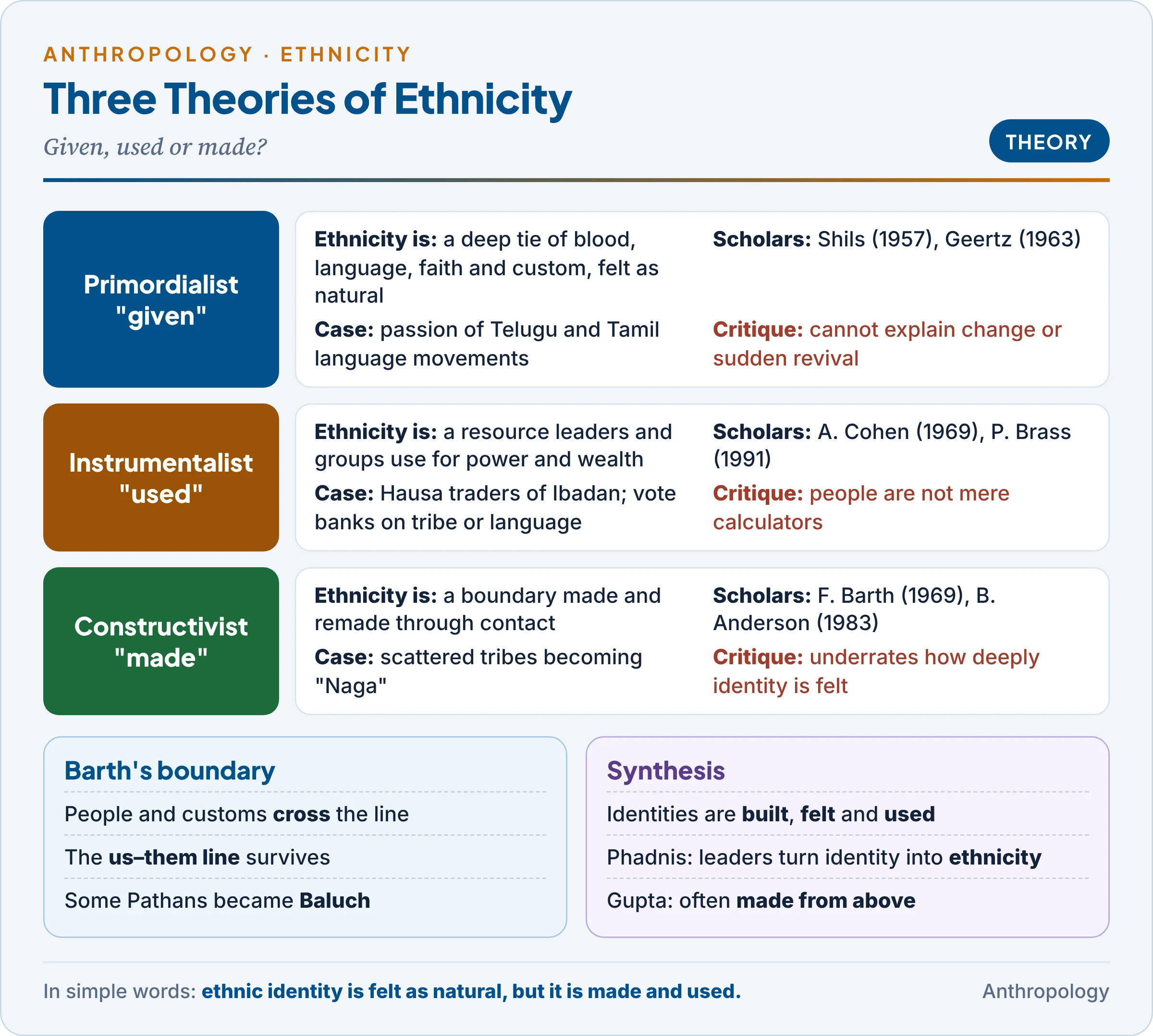
Primordialism. The American sociologist Edward Shils (“Primordial, Personal, Sacred and Civil Ties”, 1957) described primordial ties as bonds felt to be given by birth. The American anthropologist Clifford Geertz (“The Integrative Revolution”, 1963) argued that the new states of Asia and Africa faced a clash between primordial sentiments (blood, language, region, religion, custom) and the civil loyalty a modern state demands. Strength: it explains why people die for identities that bring them no gain. Weakness: it cannot explain why identities change, or lie quiet for decades and then erupt.
Instrumentalism. The British social anthropologist Abner Cohen (Custom and Politics in Urban Africa, 1969) studied Hausa migrants in the Yoruba city of Ibadan (Nigeria). The Hausa kept separate customs and joined a distinct religious order because this helped them control the long-distance cattle and kola trade: ethnicity was an informal political organisation of an interest group. The American political scientist Paul Brass (Ethnicity and Nationalism, 1991) showed how Indian elites select symbols (Urdu, Punjabi, Maithili) and mobilise groups behind them. Strength: it explains timing and leadership. Weakness: it treats people as calculators and cannot explain why followers bear great personal cost.
Constructivism. The Norwegian anthropologist Fredrik Barth (Ethnic Groups and Boundaries, 1969) turned attention from the “cultural stuff” inside a group to the boundary around it. Groups persist even when people cross the line: some Pathan families of the Afghan–Pakistan borderland became Baluch when they could no longer live up to Pathan ideals, yet the Pathan category survived. The boundary is kept by self-ascription and ascription by others. Benedict Anderson (Imagined Communities, 1983) added that large groups are imagined: members never meet but feel a bond through print, schools and maps. Weakness: constructivism can underrate how deeply people feel identities once made.
Evaluation. The positions are complementary: identities are built (constructivism), felt as natural (primordialism) and used in competition (instrumentalism). Ethnicity is best seen as a dynamic process in which a group regroups itself as an adaptive strategy under pressure.
1.4 Indian scholars on ethnicity
- Urmila Phadnis, an Indian political scientist (Ethnicity and Nation-building in South Asia, 1989): ethnic identity is necessary but not sufficient. The mobilisation of identity by leaders produces ethnicity, which then works as an ideology and a device to claim a larger share of power.
- Dipankar Gupta, an Indian sociologist (The Context of Ethnicity: Sikh Identity in a Comparative Perspective, 1996): ethnic politics is often manufactured by state actors and parties rather than rising from below. His test: why, of many possible identities, are only certain pairs activated, and only at certain times?
- Hamza Alavi, a Pakistani sociologist: ethnic boundaries are not given in advance. When interests change, an identity based on religion can give way to one based on language or region.
- Brass’s analogy: ethnic group is to ethnicity as class is to class consciousness. Ethnicity is the “ethnic group for itself”, its political self-assertion.
1.5 Characteristics of ethnicity
- Ascriptive base: markers acquired at birth or early in life (language, religion, region, tribe, caste).
- Relational: it exists only against an out-group, often a reference group against which relative deprivation (feeling worse off than those one compares oneself with) is felt.
- Territorial and numerical: effective ethnic politics needs a concentrated, sizeable population and symbols of distinctiveness (script, flag, festival, hero).
- Situational and interest-bearing: labels shift with circumstances, and groups left out of development use ethnicity to press claims about status, jobs, land and power.
2. Ethnic Conflicts and Political Developments
In simple words
Ethnic conflict happens when groups that see themselves as different clash over land, jobs, political power or recognition. Most such conflicts are not ancient hatreds: they grow from new competition, migration, unequal development and political choices. The state can calm them by sharing power and resources, or worsen them by delay and force.
Example first: Manipur since May 2023. On 27 March 2023 a single judge of the Manipur High Court directed the state to consider recommending Scheduled Tribe (ST) status for the Meitei, the largest community, living mainly in the Imphal valley. The hill Kuki-Zo and Naga tribes feared losing protected hill land and reserved jobs. Violence broke out on 3 May 2023, the day of a Tribal Solidarity March, and the state split into a Meitei valley and Kuki-Zo hills; official figures put the dead at more than 260 and the displaced at about 60,000. The High Court deleted the contested direction on 21 February 2024, since courts cannot alter the ST list (State of Maharashtra v. Milind, 2000). President’s Rule ran from 13 February 2025 to 4 February 2026; in 2026 Kuki-Zo–Naga clashes added a new strand. The mix is classic: land, reservation, demographic fear, armed groups and delayed state response.
2.1 From ethnic identity to ethnic conflict
Ethnic conflict is the end of a chain, and each link is a point where it can be stopped. The image traces the chain.
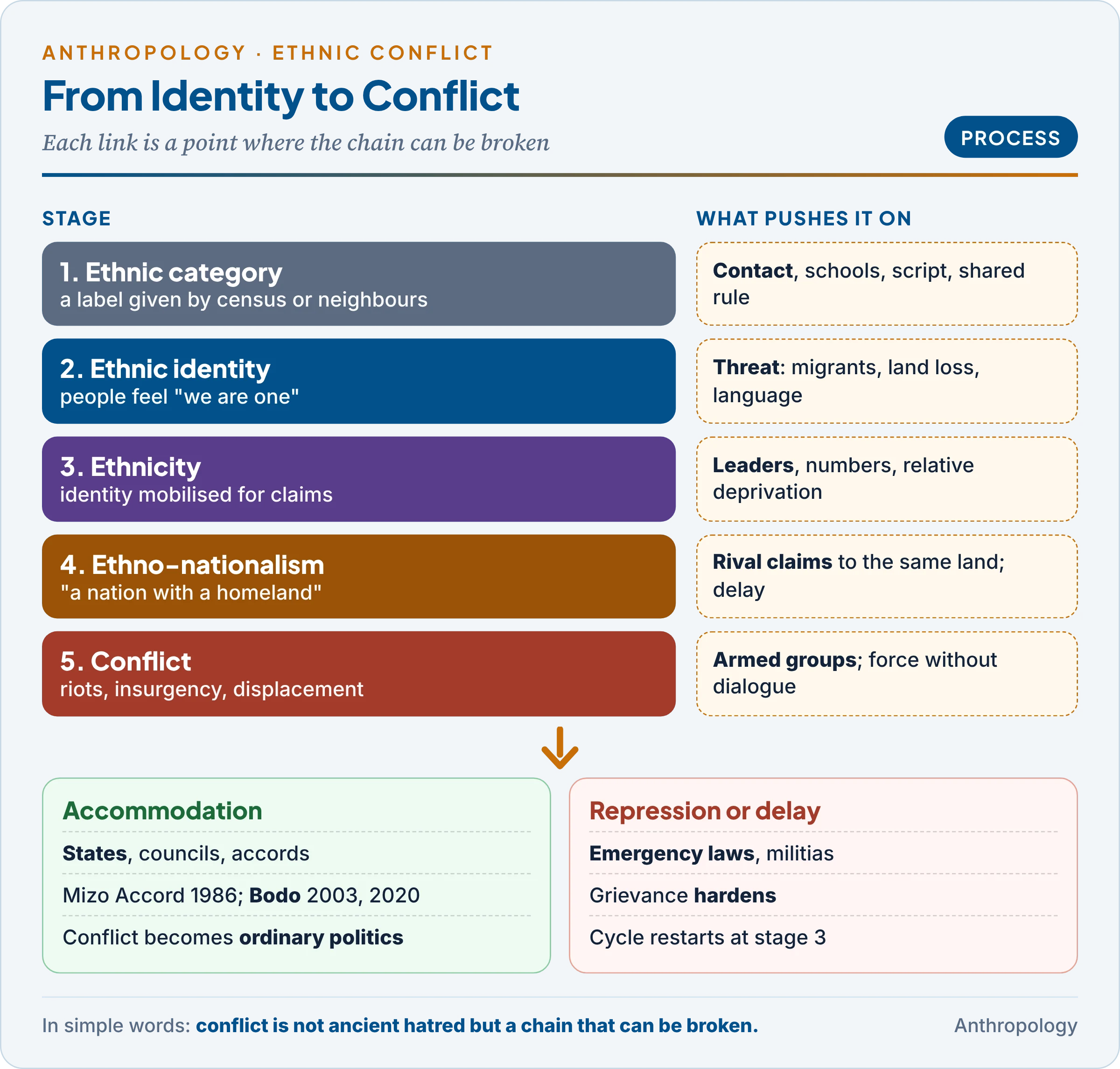
- Identity becomes ethnicity when a group feels threatened or deprived and has leaders, organisation and numbers to act.
- Ethnicity becomes ethno-nationalism when the group claims to be a nation entitled to territory and self-rule. The American political scientist Walker Connor (Ethnonationalism, 1994) argued that loyalty to one’s ethnic nation often runs deeper than loyalty to the state, and that modernisation can sharpen it.
- Ethno-nationalism becomes conflict when the claim meets resistance from the state, from rival groups on the same land, or both.
- Ranked and unranked groups: Donald Horowitz (Ethnic Groups in Conflict, 1985) noted that unranked groups, each with its own elite (like hill and valley communities), fight mainly over territory and power, while ranked groups fight over status.
2.2 Causes of ethnic conflict in tribal and other areas
The causes rarely act alone. The table groups them with Indian cases.
| Cause | How it works | Indian case |
|---|---|---|
| Migration and demographic change | Newcomers outnumber or compete with natives; fear of becoming a minority at home | Tripura: tribal share fell from about 51% (1941) to 28.4% (1981); 31.8% in 2011 |
| Land and resources | Loss of land, forest and minerals to outsiders or the state | Chotanagpur mining belt; Bodo areas of Assam |
| Competition for ST status | A larger group’s claim to ST status alarms existing STs | Meitei claim in Manipur; Gujjar agitation in Rajasthan (2007–08), opposed by Meena |
| Uneven development | A region sees its wealth leave while it stays poor | Jharkhand’s minerals and tribal poverty |
| Elite mobilisation | Leaders turn local grievances into identity politics | Cases noted by Brass and Gupta |
| Cultural and linguistic threat | Fear that a dominant language or religion will swamp one’s own | Kokborok in Tripura; Bodo script demand |
| Security-centred response | Force, emergency laws and delayed talks deepen alienation | Armed Forces (Special Powers) Act, 1958 in the North-East |
Migration is the most explosive factor in the North-East. The American political scientist Myron Weiner (Sons of the Soil, 1978) showed that when migrants hold jobs and land in a region whose natives are becoming educated and want those jobs, a “sons of the soil” movement follows. The Assam Movement (1979–85) against “foreigners”, ended by the Assam Accord of 15 August 1985, is his central case.
2.3 Major Indian cases in brief
- Assam: clashes between Bodo and Santhal (Adivasi) settlers in 1996 and 1998, and between Bodo and Bengali-speaking Muslims around Kokrajhar in 2012, displaced lakhs of people; the roots were land in tribal belts, settler growth and the Bodo homeland demand (4.4).
- Tripura: the Tripura National Volunteers insurgency of the 1980s grew from tribal loss of land and majority status.
- Karbi Anglong (Assam): decades of Karbi armed groups ended in the Karbi Anglong Agreement of 4 September 2021, which strengthened the autonomous council.
- Rajasthan: the Gujjar demand for ST status (2007–08) led to deaths in police firing and to tension with the Meena, who already held ST status; Rajasthan later gave Gujjars and four other groups a separate Most Backward Classes quota (5%, 2019).
- Caste violence: caste conflict follows the same logic of identity and interest. Violence against Dalits rises where they assert rights to land, education or office and dominant castes resist: Khairlanji (Maharashtra, 2006), where four members of a Dalit family were killed after a land dispute; Mirchpur (Haryana, 2010); Bhima Koregaon (Maharashtra, 1 January 2018). Protective laws are in 7.1.
2.4 Ethnicity and nation-building: two readings of the North-East
How one explains the North-East’s conflicts shapes the remedy. Two readings exist.
| Point | Nation-building reading | Federation-building reading |
|---|---|---|
| Diagnosis | A strain of modernisation: tradition against modernity, old against new leaders, expectations unmet | A centralising state built the nation on dominant groups’ terms and treated the region as a periphery |
| Writers | Myron Weiner, B.G. Verghese, S.K. Chaube | Sanjib Baruah (India Against Itself, 1999), Sajal Nag, Sanjoy Hazarika |
| Remedy | Development, education, integration into national institutions | Genuine federalism, real autonomy, an end to rule by emergency laws |
The two are not exclusive. The first explains why educated, mobile youth join movements; the second explains why their demands turn against the Indian state. Phadnis made the same point for South Asia: leaderships defined the nation by the majority’s idea of nationhood.
2.5 How the state responds: Brass’s four rules
Paul Brass, in Language, Religion and Politics in North India (1974), set out four working rules of the central government towards regional and ethnic demands:
- No secession: demands short of secession may be voiced; secessionist demands are put down, by force if necessary.
- Language yes, religion no: demands based on language and culture are accommodated, those openly based on religion are not. The Punjabi Suba was conceded only when presented as a language demand.
- Broad popular support: a demand is conceded only after it shows mass support in the region.
- Agreement of the groups involved: a demand opposed by another major group of the region waits until that dispute is settled.
Why the rules matter: they explain why Jharkhand took fifty years, why the Naga sovereignty demand has never been conceded, and why accords follow long agitation. They also show the state’s accommodative side: states, councils and accords have absorbed many movements into ordinary politics.
Remedies for ethnic conflict:
- Power-sharing: statehood, Sixth Schedule councils, territorial councils, Article 371-type provisions (7.1).
- Land protection: tribal belts, inner-line permits, PESA (1996) and the Forest Rights Act (2006).
- Inclusive development to close the gaps that feed relative deprivation.
- Civic ties: the political scientist Ashutosh Varshney (Ethnic Conflict and Civic Life, 2002) found that cities with strong associational links across communities (business bodies, trade unions, professional groups) avoided riots; everyday neighbourly contact sufficed in villages but not in large cities.
- Timely, fair state action: neutral policing and quick dialogue, before armed groups take over.
3. Unrest among Tribal Communities
In simple words
Tribal unrest means protest, agitation and sometimes armed revolt by tribal people. Most of it grows from losing land and forests, being cheated by outsiders, being displaced by projects, and feeling that the government does not listen. The forms differ: village assemblies, mass protest, demands for a state, or support for armed groups.
Example first: Indravelli, 1981. In Adilabad (then Andhra Pradesh, now Telangana), Gond cultivators had been losing land to settlers and moneylenders for decades and had formed a Gond Sabha. On 20 April 1981 a Gond gathering at Indravelli against land loss and debt met police firing under prohibitory orders many had not heard of; the official count was 13 dead. The Austrian anthropologist Christoph von Fürer-Haimendorf recorded it in Tribes of India: The Struggle for Survival (1982). As Vinay Kumar Srivastava observed, such incidents cement group loyalty and turn a land grievance into a separate regional identity.
3.1 Causes of tribal unrest
- Land alienation: tribal land passes to non-tribals through debt, fraud, benami (proxy) deals and state acquisition, despite laws such as the Chota Nagpur Tenancy Act (1908) (6.2).
- Loss of forest rights: forest laws turned common forests into state property and forest dwellers into “encroachers” (6.3b).
- Displacement by dams, mines and industries with poor rehabilitation (6.3a).
- Exploitation by outsiders: the Mundari word diku (outsider, exploiter) names the moneylender, trader, landlord and petty official; its target has shifted from zamindars to upper-caste non-tribals and later to migrants from north Bihar.
- Cultural threat and political marginalisation: pressure on language, religion and customary law; weak voice in decisions; police action that hardens grievance.
- Rights over resources: Niyamgiri (Odisha) is the model case. After the Supreme Court in April 2013 asked village assemblies (gram sabhas) to decide, all 12 chosen assemblies of the Dongria Kondh and neighbours rejected bauxite mining on their sacred hill.
- New assertion through law: in the Pathalgadi campaign of 2017–18 in Khunti (Jharkhand), Munda villages erected stone slabs inscribed with Fifth Schedule and PESA provisions and declared gram sabha self-rule: unrest in a constitutional idiom.
3.2 Central India and the North-East compared
Tribal unrest takes different shapes in the two main tribal regions. The table compares them, and the image summarises the contrast.
| Point | Central and Eastern India | North-East |
|---|---|---|
| Demographic position | Tribes are minorities in most states, mixed with non-tribals | Tribes are majorities in Nagaland, Mizoram, Meghalaya, Arunachal Pradesh |
| Core grievance | Land, forest, displacement, exploitation | Identity, autonomy, migration, sovereignty |
| Main forms | Agrarian and forest movements, statehood, left-wing extremism | Ethno-nationalist insurgency, autonomy movements, inter-tribe clashes |
| Constitutional frame | Fifth Schedule, PESA | Sixth Schedule, Article 371A–371H |
| Typical outcome | New states, tenancy and forest laws | Accords, autonomous councils, new states |
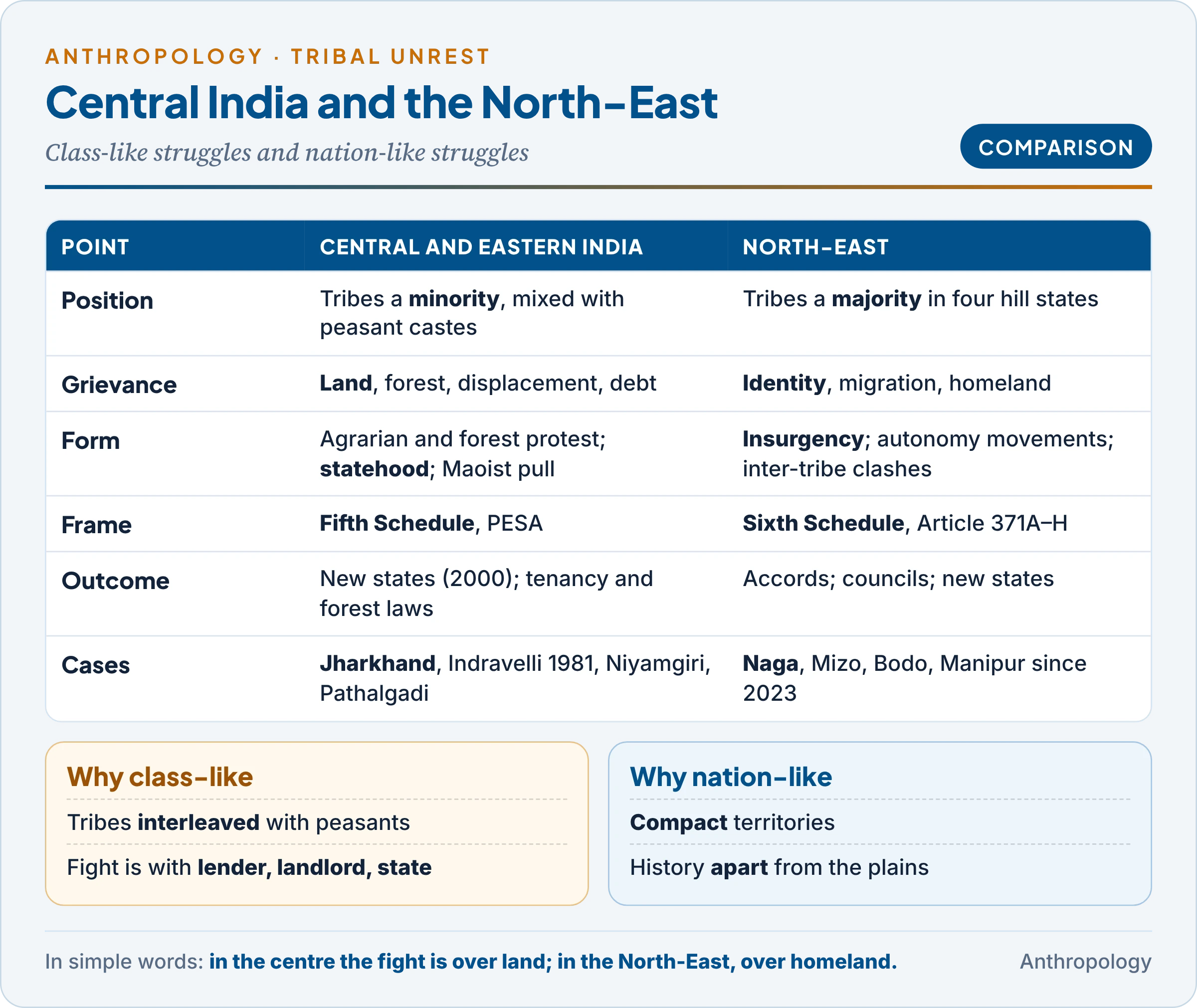
Why the difference: in Central India tribes are interleaved with peasant castes, so their struggles are class-like (land, wages, debt). In the North-East they are territorially compact majorities with histories of independence from the plains, so their struggles are nation-like (homeland, self-rule). Status in 2026: left-wing violence in the central belt has been contained (3.3); in the North-East the Naga settlement is unconcluded and Manipur unsettled.
3.3 Left-wing extremism and tribals
- Origin: the Naxalbari rising of 1967 in north Bengal named the movement; its later strongholds lay in the forested tribal belt of Chhattisgarh, Jharkhand, Odisha, Maharashtra and Andhra Pradesh–Telangana.
- Why tribals were drawn in: where the state appeared mainly as forest guard, police and contractor, Maoist cadres took up immediate grievances: rates for tendu leaf (used to roll bidis), harassment by forest staff, land disputes. The appeal was practical, not ideological.
- Caught between two forces: the Indian sociologist Nandini Sundar (Subalterns and Sovereigns: An Anthropological History of Bastar, 1997) showed Gond groups of Bastar squeezed between insurgents and the state. The state-backed Salwa Judum (from 2005) armed tribal youth as Special Police Officers and emptied hundreds of villages into roadside camps; in Nandini Sundar v. State of Chhattisgarh (5 July 2011) the Supreme Court held the use of such SPOs unconstitutional.
- Government action: the National Policy and Action Plan on Left Wing Extremism (2015) combined security operations with roads, mobile towers, schools and land and forest rights.
- Present status: in April 2026 the Ministry of Home Affairs informed the states that no district remained “LWE-affected”; 37 former districts were classed as “Legacy and Thrust” districts and one as a “District of Concern”, needing continued support. The lesson remains: without secure land, forest rights and a responsive local state, the old grievances can return.
4. Regionalism and Demand for Autonomy
In simple words
Regionalism is a strong attachment to one’s own region, its language, culture and interests, and the demand that the region get a fair deal. It can be healthy, when it asks for development and self-government within the country, or dangerous, when it turns against other regions or the nation. Many tribal groups have used it to win new states or self-governing councils.
Example first: Jharkhand, from idea to state. The Chotanagpur plateau’s mines and forests fed Bihar’s revenue while its Munda, Oraon, Ho and Santhal people lost land to dikus and stayed poor. Educated Christian tribals founded the Chhotanagpur Unnati Samaj in 1915; in 1928 it asked the Simon Commission for a separate province. In 1939 the Adivasi Mahasabha, under the Oxford-educated Munda leader Jaipal Singh, formally demanded Jharkhand. Opened to non-tribals as the Jharkhand Party (1 January 1950), it won over thirty seats in Bihar in 1952, but the States Reorganisation Commission rejected the demand in 1955 and the party merged with the Congress in 1963. The Jharkhand Mukti Morcha (early 1970s; Binod Bihari Mahato, Shibu Soren, A.K. Roy) rebuilt the movement on tribals, Kurmi-Mahato peasants and mine workers. After a Jharkhand Area Autonomous Council (1995), Jharkhand became a state on 15 November 2000. A tribal identity had widened into a “Jharkhandi” regional identity to win majority support: ethnicity turning into regionalism.
4.1 What is regionalism?
- Region: a territory whose people share language, culture, history or economic interests. M.N. Srinivas described it as a unit of vertical solidarity, binding different castes and classes together, with flexible boundaries.
- Regionalism: loyalty to the region and the demand that its interests be served, ranging from development demands to statehood, autonomy and, at the extreme, secession.
- Types: supra-state (several states on shared interests), inter-state (disputes over boundaries or rivers, such as Belagavi) and intra-state (a region seeking a new state or council, such as Gorkhaland in West Bengal).
- Factors (detail in 9.3): human diversity, uneven development, identity crisis and “sons of the soil” feeling, mobilisation by regional parties, geography (hill isolation) and colonial history (separate administration of tribal tracts).
Regionalism as opportunity and threat. The same force can serve or strain the nation.
| As an opportunity | As a threat |
|---|---|
| Brings government closer to people; deepens federalism | Sons-of-the-soil hostility to migrants and minorities |
| Protects languages and cultures | Inter-state disputes over water and boundaries |
| Gives backward regions a voice for development | Ethnic cleansing of rivals in claimed homelands |
| Channels protest into elections and councils | Secession where demands become sovereignty claims |
The balance depends on response. Where demands were met in time (linguistic states, Mizoram), regionalism became ordinary politics; where the state delayed or used only force, it hardened into insurgency.
Common confusion
Is every demand for autonomy a separatist demand? No. Autonomy asks for more self-rule inside the Union (a council, a state, special protection of land and custom); secession asks to leave the Union. Most Indian movements (Jharkhand, Bodoland, Gorkhaland, Ladakh) sought autonomy. Only a few, such as the early Naga and Mizo movements, claimed sovereignty, and the Mizo one later settled for statehood.
4.2 Linguistic states: the first great accommodation
- The States Reorganisation Commission (appointed 1953, chaired by Fazl Ali) reported in 1955; the States Reorganisation Act, 1956 redrew most states on linguistic lines.
- Effect: many feared division, but linguistic states reduced conflict by giving regional elites a stake in the Union and allowing administration and schooling in the people’s language. Costs: border disputes (Belagavi), linguistic minorities stranded in new states, and chauvinism against migrants.
- The tribal exception: no tribal language held a majority over a large compact area outside the North-East, so tribal regionalism had to argue from ethnicity, ecology and backwardness, not language alone.
4.3 The three states of 2000
- Jharkhand (from Bihar, 15 November 2000): tribal-led, but tribes are only about 26% of its population (Census 2011), so the movement had to become regional.
- Chhattisgarh (from Madhya Pradesh, 1 November 2000): about 31% ST; a regional and developmental demand with Gond and other tribes as one strand.
- Uttarakhand (from Uttar Pradesh, 9 November 2000, first named Uttaranchal): a hill regionalism of mainly non-tribal hill people, with Jaunsari, Tharu, Bhotia and Buksa tribes among them.
- Common thread: resource-rich, neglected hinterlands of large states.
4.4 Autonomy movements in the North-East and the hills
The North-East has seen the widest range of autonomy demands, from district councils to sovereignty. The timeline gathers the main ones.
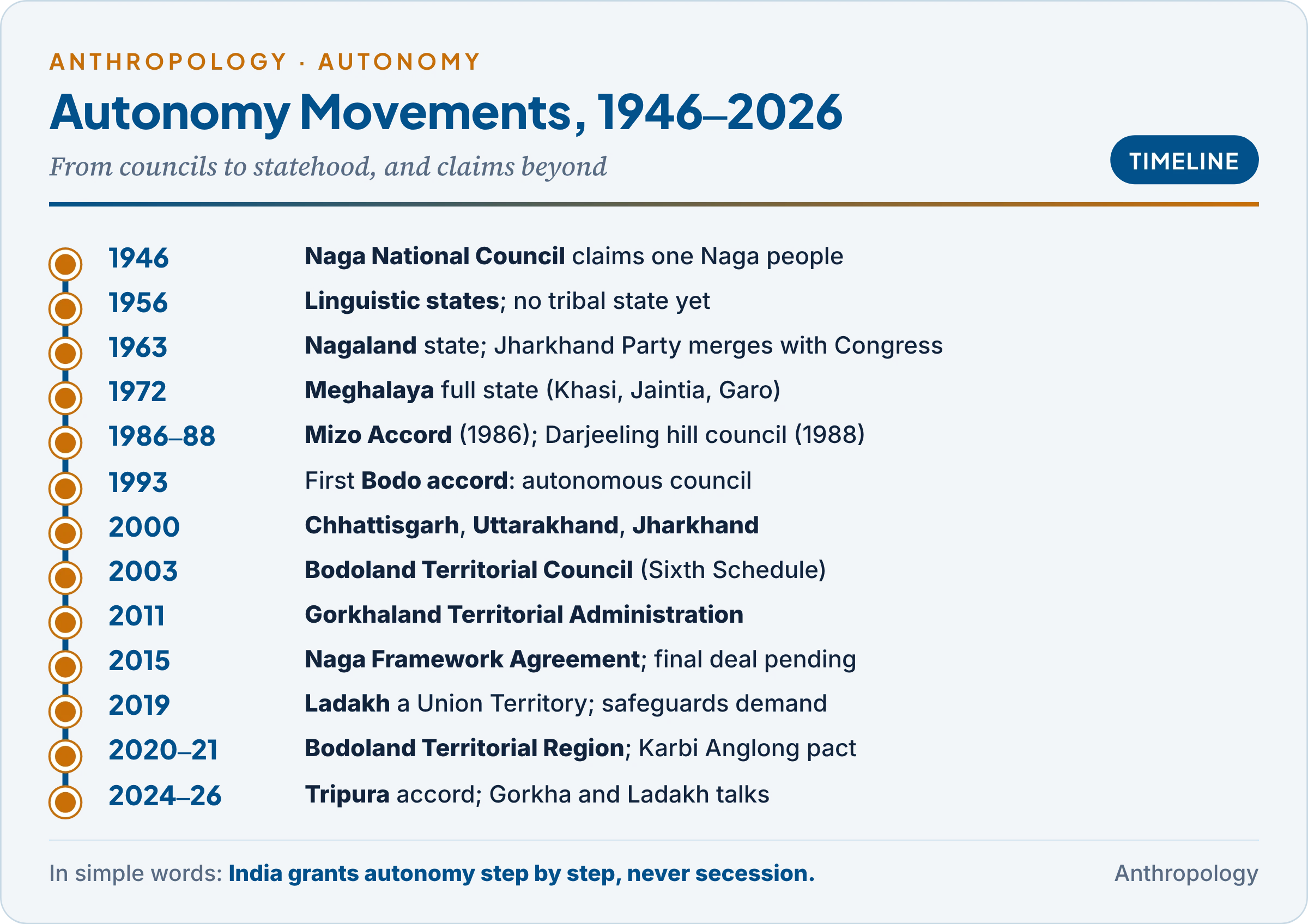
- Nagas: the Naga National Council (1946), led by A.Z. Phizo, claimed independence, held a “plebiscite” (1951) and boycotted the 1952 elections. Nagaland became a state on 1 December 1963. The Shillong Accord (1975) was rejected by those who formed the NSCN (1980), which split in 1988. A ceasefire with NSCN (IM) began in 1997 and a Framework Agreement was signed on 3 August 2015; in 2026 talks remained stalled over its demand for a separate Naga flag and constitution and the integration of Naga areas (“Nagalim”), which the Centre rejects.
- Mizos: after the 1959 bamboo-flowering famine (mautam) and poor relief, the Mizo National Front under Laldenga rose in 1966. The Mizo Accord (30 June 1986) ended the insurgency, and Mizoram became a state on 20 February 1987: the clearest full settlement.
- Meghalaya: a peaceful Khasi, Jaintia and Garo hill-state movement won an autonomous state within Assam (1970) and full statehood (21 January 1972).
- Tripura: the tribal council formed in 1982 came under the Sixth Schedule in 1985; the TIPRA Motha demand for “Greater Tipraland” led to a tripartite accord on 2 March 2024.
- Bodos: the All Bodo Students’ Union under Upendra Nath Brahma began the Bodoland movement in 1987. Three accords followed: the Bodoland Autonomous Council (1993, failed for want of a clear territory), the Bodoland Territorial Council under the Sixth Schedule (2003) and the Bodoland Territorial Region (27 January 2020).
- Gorkhas (Darjeeling hills): the Gorkha National Liberation Front under Subhash Ghisingh led the 1986–88 Gorkhaland agitation, ended by the Darjeeling Gorkha Hill Council (accord of 22 August 1988). The Gorkha Janmukti Morcha revived the demand in 2007; a 2011 tripartite agreement created the Gorkhaland Territorial Administration; a 104-day shutdown followed in 2017. An interlocutor (October 2025) now heads a committee (August 2026) to draft a “permanent political solution”; the state government opposes division.
- Ladakh: a Union Territory without a legislature since 31 October 2019. The Leh Apex Body and Kargil Democratic Alliance demanded Sixth Schedule status and statehood; protests in Leh on 24 September 2025 left four dead, and Sonam Wangchuk was detained under the National Security Act. An in-principle understanding of 22 May 2026 on Article 371-type safeguards and an elected UT-level body stalled in October 2026 when the leaders rejected the Centre’s draft.
- Kuki-Zo: since 2023 Kuki-Zo bodies have demanded a separate administration (a Union Territory with a legislature), opposed by Meitei and Naga groups.
4.5 The ladder of autonomy
Autonomy is not one thing. Demands and settlements fall on a ladder from least to most self-rule.
| Rung | Form | Example |
|---|---|---|
| 1. Development council | Hill council with limited funds and powers | Ladakh Autonomous Hill Development Councils (1995, 2003) |
| 2. District council | Sixth Schedule council with law-making power over land, forest, custom | Karbi Anglong, Garo Hills |
| 3. Territorial council | Larger multi-district council with more subjects | Bodoland Territorial Region (2020) |
| 4. Special provision | Article 371-type protection of land, customary law, religion | 371A (Nagaland), 371G (Mizoram) |
| 5. Statehood | Full state within the Union | Jharkhand, Mizoram, Meghalaya |
| 6. Sovereignty claim | Demand for a separate nation | NSCN (IM) demand |
The Indian pattern is to concede the lower rungs to avoid the top one. Brass’s first rule caps the ladder at statehood; the rest is bargaining space. Councils often disappoint because states delay funds and subjects, which is why the Bodo and Gorkha cases needed more than one accord.
5. National Integration
In simple words
National integration means people of different languages, religions, tribes and regions feeling that they belong to one country, while keeping their own identities. It does not mean making everyone the same. It grows when every group is treated fairly and shares in power and development.
5.1 Integration, not assimilation
- Assimilation: a weaker group loses its culture and merges into the dominant one. Isolation: a group is kept apart to protect it (colonial “excluded areas”; Verrier Elwin’s early “national park” idea).
- Integration: groups join national life on equal terms without losing identity. Nehru’s five principles of tribal policy (Panchsheel), in his foreword to the 1959 edition of Elwin’s A Philosophy for NEFA, took this path: tribes should develop “along the lines of their own genius”, keep their land and forest rights and be administered through their own institutions (the policy shift is traced in 7.3b).
- Unity in diversity: M.N. Srinivas saw India’s unity as politico-geographic (one territory, one Constitution) and cultural (pilgrimage networks, shared epics), and held that diversity need not be feared.
- Cross-cutting loyalties: each Indian belongs at once to a caste, village, language, religion and region; these overlapping ties, in balanced opposition (E.E. Evans-Pritchard’s idea from the Nuer), limit any single cleavage.
5.2 What is the “mainstream”?
The phrase “bringing tribes into the mainstream” raises the question: whose mainstream? Vinay Kumar Srivastava weighed the answers.
- Hinduism and caste: they spread a common idiom, but equating them with the mainstream contradicts secularism and ignores Nagas, Mizos and Khasis, who stayed outside caste.
- Gandhian values: N.K. Bose placed the mainstream in religious neutrality and freeing the masses from the classes.
- Modern values: democracy, secularism, a modern economy and equality. Srivastava’s view: the mainstream is where diversities meet as equals, including hunters, shifting cultivators and pastoralists; its core is equality, not uniformity.
5.3 Divisive factors and remedies
| Divisive factor | Remedy |
|---|---|
| Communalism | Secular, neutral state; civic links across communities |
| Casteism and caste violence | Anti-atrocity laws; social reform |
| Linguism and language imposition | Three-language formula; Eighth Schedule recognition |
| Regional imbalance | Balanced development; funds for backward regions |
| Ethnic separatism | Autonomy within the Constitution; timely dialogue |
| Tribal alienation | Land and forest rights, PESA, mother-tongue schooling |
- Language and identity: Raghunath Murmu’s Ol Chiki script (1925) for Santali, and the inclusion of Santali and Bodo in the Eighth Schedule (92nd Amendment, 2003), honour identity within the nation and reduce the pull of separatism.
- Institutions: the National Integration Council, set up after the National Integration Conference of 1961, brought leaders together on communalism, casteism, regionalism and linguism.
- Tribes in the mainstream without losing identity: secure land and forest rights, early schooling in the mother tongue, governance through customary institutions (PESA, Sixth Schedule), development with consent, and recognition of tribal languages and religions. Integration that respects identity lasts longer than assimilation.
Key Terms
| Term | Meaning in simple words |
|---|---|
| Ethnic group | A group whose members believe they share descent and culture and are seen as different by others |
| Ethnic identity | An individual’s feeling of belonging to an ethnic group |
| Ethnicity | The use of ethnic identity in social and political life to claim rights or power |
| Ethnocentrism | Judging other groups by the standards of one’s own |
| Primordialism | The view that ethnic ties are given by birth and deeply felt |
| Instrumentalism | The view that ethnicity is a tool used by groups and leaders for gain |
| Constructivism | The view that ethnic identities are made and remade through interaction |
| Ethnic boundary | The line of “us” and “them” that keeps a group distinct |
| Ethno-nationalism | The claim of an ethnic group to be a nation with a right to self-rule |
| Relative deprivation | Feeling worse off than a group one compares oneself with |
| Sons of the soil | Movements of natives against migrants who take local jobs and land |
| Diku | Mundari for outsider and exploiter |
| Regionalism | Loyalty to a region and the demand that its interests be served |
| Autonomous council | An elected body with powers over land, forest and custom in a tribal area |
| National integration | Belonging to one nation while keeping one’s own identity |
Contemporary Developments
- Manipur: over 260 dead (official count) since 3 May 2023; President’s Rule ended on 4 February 2026, Kuki-Zo–Naga clashes followed, and the Suspension of Operations pact with Kuki-Zo armed groups lapsed in September 2026.
- Ladakh: the 22 May 2026 understanding on Article 371-type safeguards stalled in October 2026.
- Left-wing extremism: no district classed as LWE-affected from April 2026; 38 former districts keep special support.
- Gorkhaland: a committee under the Centre’s interlocutor (August 2026) is drafting a “permanent political solution”.
- Naga talks: stalled in 2026, more than ten years after the 2015 Framework Agreement.
Diagrams to Master
- Topic map: five themes, one Indian case each.
- Three theories of ethnicity: primordialist, instrumentalist, constructivist; one scholar and one criticism each; Barth’s boundary.
- From identity to conflict: category, identity, ethnicity, ethno-nationalism, conflict; triggers at the side; accommodation or repression.
- Central India versus North-East: demography, grievance, form, constitutional frame, outcome.
- Autonomy timeline: Nagaland 1963, Meghalaya 1972, Mizo Accord 1986, Darjeeling council 1988, the three states of 2000, Bodo accords 1993, 2003, 2020, Ladakh 2019.
Revision Grid
| Scholar | Work (year) | Key idea |
|---|---|---|
| W.G. Sumner | Folkways (1906) | Ethnocentrism; in-group and out-group |
| Max Weber | Economy and Society (1922) | Subjective belief in common descent |
| Clifford Geertz | “The Integrative Revolution” (1963) | Primordial sentiments against civil loyalty |
| Fredrik Barth | Ethnic Groups and Boundaries (1969) | The boundary, not the cultural content, defines the group |
| Abner Cohen | Custom and Politics in Urban Africa (1969) | Hausa of Ibadan: ethnicity as interest-group organisation |
| Paul Brass | Language, Religion and Politics in North India (1974) | Four rules of state response to regional demands |
| Myron Weiner | Sons of the Soil (1978) | Migration and nativist conflict |
| Benedict Anderson | Imagined Communities (1983) | Nations as imagined communities |
| Donald Horowitz | Ethnic Groups in Conflict (1985) | Ranked and unranked ethnic systems |
| Urmila Phadnis | Ethnicity and Nation-building in South Asia (1989) | Leaders turn identity into ethnicity |
| Walker Connor | Ethnonationalism (1994) | Loyalty to the ethnic nation over the state |
| Dipankar Gupta | The Context of Ethnicity (1996) | Ethnic politics manufactured from above |
| Sanjib Baruah | India Against Itself (1999) | Federation-building for the North-East |
| Ashutosh Varshney | Ethnic Conflict and Civic Life (2002) | Associational links prevent riots |
| Nandini Sundar | Subalterns and Sovereigns (1997) | Bastar tribals between state and insurgents |
Previous Year Questions
7.3 The concept of ethnicity; Ethnic conflicts and political developments; Unrest among tribal communities; Regionalism and demand for autonomy; National integration
- 2025Write notes on: Regionalism and Autonomy.
- 2025Discuss the rising ethnic conflicts in India and propose their possible remedial measures.
- 2024Elucidate the resurgence of ethno-nationalism from an anthropological lens.
- 2023Distinguishing between ethnic identity and ethnicity, discuss the factors responsible for ethnic conflict in tribal areas.
- 2022Write notes on: Regionalism as an opportunity and threat to national integration.
- 2022Compare the nature of tribal movements between North-East and Central India. Briefly mention the current status of existing tribal movements in these areas.
- 2021Identify the causes of tribal unrest with special reference to North-East India.
- 2020Explain the reasons of caste violence in India with suitable examples.
- 2020Write short note on the Concept of Ethnicity in about 150 words.
- 2019Write a note in 150 words on Ethnicity and regionalism.
- 2018Discuss the various factors resulting in tribal unrest in various parts of India.
- 2017Write a note in 150 words on Ethnicity and regionalism.
- 2016Give a critical assessment of ‘Negrito Problem’ in India.
- 2016Write a note in 150 words on The role that regionalism plays in demand for autonomy among Indian tribes.
- 2015Write a note in 150 words on Rights over resources and tribal unrest.
- 2014Discuss the rise of ethno-nationalism among Indian tribes with specific example.
- 2014What are the significant factors responsible for tribal unrest ?
- 2013Write a note in 150 words on Government Action towards Left Wing Extremism.
- 2011Write a note in 150 words on Left-wing extremism and tribals in India.
- 2010Analyse the factors influencing tribal regionalism, citing Indian examples.
- 2009Write a note on Tribal unrest in Central India.
- 2008Write a note on Concept of Ethnicity.
- 2007Discuss the anthropological understanding of rising ethnicity among Indian tribes in the context of nation-building.
- 2003What is regionalism ? Evaluate how regionalism has stimulated political movements in India.
- 1997Discuss the significance of the regionalism and communalism in Indian context and its role in ethno-political movements in the present political system.
- 1995Write a note on : Identify the factors responsible for regionalism in contemporary India.
- 1993Write a note on Ethnicity.
- 1992Discuss the divisive factors which disrupt national integration in India. What would you suggest to counteract the divisive forces ?
- 1990Write a note on Cultural pluralism and national integration.
- 1989Define the concept of ‘ethnic identity’. Discuss how it is emerging in the context of tribal unrest in some regions of country.
- 1989What are the major issues of National Integration in India ? Discuss how it has been eroded in recent years. What remedial measures would you suggest for National Integration ?
- 1988Write a note on Regional Disparity and National Integration.
- 1988Assertion of ethnic identity and ethnic solidarity has been a pervasive process in India after Independence. Analyse this in relation to constitutional safeguards and emerging national integration.
- 1987What suggestions would you like to make as an anthropologist for bringing the tribal peoples in the national mainstream without obliterating their separate identity.
- 1987Examine the advantages and disadvantages of linguistic States in India in the context of national Integration.
- 1986Write a note on Issues relating to national integration.
- 1985Write a note on Role of ethnic groups in national integration.
- 1984Discuss the divisive factors which disrupt national integration in India. Suggest solutions to counteract the divisive forces.
Related questions from other units
- 2025Unit 9.3: Critically evaluate the concept of Nation-State and describe its impact on indigenous societies.
- 2020Unit 9.3: Discuss the regionalism and demand for autonomy in India from Anthropological perspective with respect to Kashmir/Nagaland/Bodoland/Gorkhaland agitation.
- 2016Unit 9.3: Write a note in 150 words on Anthropological interpretation of ethnic and political movements.
- 2013Unit 7.4: Write a note in 150 words on Ethnic movements in India.
- 2009Unit 9.3: In what ways has anthropology contributed to the understanding of ethnic & political movements in India?
- 2004Unit 7.4: Classify the tribal movements in contemporary India in a regional perspective and analyse the contributive factors.
- 2000Unit 7.4: Assess the political and economic role of tribal and rural movements in the creation of the new states of Uttaranchal Jharkhand and Chhattisgarh.
- 1999Unit 7.4: Write a note on Jharkhand Movement.
- 1995Unit 9.3: To what extent, ethnicity is responsible for the tribal movements in India? Elaborate with suitable examples.
- 1990Unit 7.4: Discuss the role of sociopolitical movements in the emergence of tribal identity in the Indian context.
More from Scheduled Castes, Scheduled Tribes and OBCs: all notes of this unit · every PYQ of this unit · Anthropology Optional hub