

Sub-Divisional Magistrate pay at 7th CPC Level 10-11 — the basic pay, the DA-driven in-hand figure, why the number moves state to state, and the executive, revenue and magisterial powers that make the SDM the citizen’s first point of contact with the state.
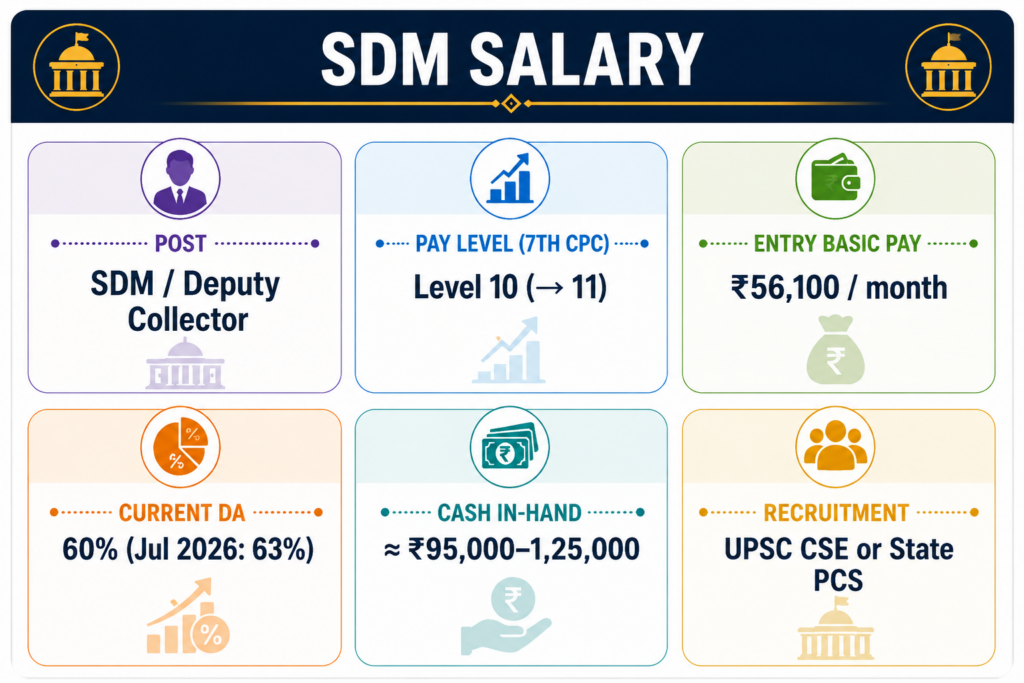
An SDM (Sub-Divisional Magistrate) — whether an IAS officer on first posting or a State PCS Deputy Collector — is almost always placed at Pay Level 10 of the 7th Pay Commission, basic pay ₹56,100. With Dearness Allowance at 60% (central rate, effective 1 January 2026) — moving to a calculated 63% from 1 July 2026 — plus Transport Allowance and standard deductions, cash in-hand for a fresh SDM runs approximately ₹95,000-1,10,000 a month, before an official vehicle and, where government accommodation is provided, a rent-free residence. The pay level is broadly uniform nationally; what genuinely varies by state is the DA cycle, HRA city classification, and specific state allowances — not a separate salary scale.
Quick Answer
Who is an SDM?
A Sub-Divisional Magistrate sits directly below the District Collector and above the Tehsildar in India’s field-administration ladder. A typical district is split into three to six sub-divisions, each headed by an SDM — also called, depending on the state, a Sub-Divisional Officer (SDO), Assistant Collector, Sub-Collector, Revenue Divisional Officer (RDO), or Assistant Commissioner. Whatever the local title, the job is the same: executive, revenue and magisterial charge of a sub-division, and, in practice, the level of government at which most citizens first encounter the state directly.
Crucially — and this is the single most misunderstood fact about this post — “SDM” is a field posting, not one fixed national pay grade. It is filled by three different routes, and the pay rule that applies depends entirely on which service the officer belongs to.
IAS vs. State PCS: Who Actually Sets the Pay?
| Route | Governing Pay Rule | Reliable Starting Benchmark | What Can Vary |
|---|---|---|---|
| IAS (Junior Time Scale) posted as SDM | IAS (Pay) Rules, 2016 — central, uniform nationwide | Level 10, ₹56,100 basic | Allowances, city HRA class, accommodation |
| State PCS officer (Deputy Collector) posted as SDM | That state’s own civil-service pay rules | Usually Level 10 or an equivalent 7th-CPC-linked scale — confirm via the state’s latest pay notification | Pay level itself, state DA rate/date, HRA, grade progression speed |
| Promoted departmental officer (Tehsildar/Naib-Tehsildar cadre) | State departmental service rules | No single all-India figure | Grade, seniority, qualifying service, state-specific promotion rules |
This is why two officers doing near-identical SDM work in two different states can end up with different monthly figures — and why any table that assigns one blanket number to “SDM salary” nationwide is, at best, an approximation.
7th CPC Pay Matrix for an SDM
For the IAS entrant — and for most State PCS cadres, which have broadly aligned their entry scales to the central 7th CPC matrix — the SDM post sits at the very base of the Group A gazetted ladder.
| Pay Level | Grade | Basic Pay Range (₹) | Typical Post | Service Stage |
|---|---|---|---|---|
| Level 10 | Junior Time Scale | 56,100 – 1,77,500 | SDM / Assistant Collector / Deputy Collector | 0–4 yrs (first posting) |
| Level 11 | Senior Time Scale | 67,700 – 2,08,700 | Additional District Magistrate / senior SDM charge | 4–9 yrs |
| Level 12 | Junior Administrative Grade | 78,800 – 2,09,200 | District Collector / DM | 9–16 yrs |
An officer enters Level 10 at Cell 1 (₹56,100) and rises by roughly 3% with each annual increment, drawn every 1 July, until promotion — usually to Additional District Magistrate charge at Level 11 — moves them into the next column.
Current DA and Why State Pay “Varies”
The Union Cabinet raised central Dearness Allowance from 58% to 60%, effective 1 January 2026. Based on Labour Bureau CPI-IW data through June 2026, the next revision works out to 63% from 1 July 2026; the formal Cabinet order and official memorandum typically follow a few months after the effective date, with arrears.
⏱ Current-Affairs Update
On ₹56,100 basic, 60% DA equals ₹33,660; at 63% it rises to ₹35,343. Treat 63% as the reliable working figure for any calculation dated July 2026 onward.
Here is the part most explainers get wrong: State PCS officers do not automatically receive the central DA rate on the central effective date. Each state government issues its own DA order, on its own timeline, sometimes weeks or months apart from the Centre’s. In 2026 alone, Assam, Bihar, Odisha, Tamil Nadu, Arunachal Pradesh and Uttar Pradesh each announced separate state DA hikes on their own schedules. So a UP Deputy Collector’s DA percentage and effective date is not guaranteed to match a central IAS officer’s DA on the same calendar day — even though both may eventually converge to a similar rate.
Full In-Hand Salary Breakup (Level 10, Cell 1)
| Component | @ DA 60% (Jan 2026) | @ DA 63% (Jul 2026) |
|---|---|---|
| Basic Pay | 56,100 | 56,100 |
| Dearness Allowance | 33,660 | 35,343 |
| Transport Allowance + DA on TA | 9,360 | 9,504 |
| HRA (X-city, if accommodation not provided) | 16,830 | 16,830 |
| Gross (with X-city HRA) | ≈ 1,15,950 | ≈ 1,17,777 |
| Less: NPS/UPS contribution (10% of Basic+DA) | −8,976 | −9,144 |
| Less: CGEGIS, professional tax & misc. | −1,200 | −1,200 |
| Net Cash In-Hand | ≈ 1,05,800 | ≈ 1,07,400 |
Figures assume an X-category (metro) posting city and standard central-scale deductions. Where government accommodation is provided instead of HRA, or where TA rates differ by city class, the net figure typically settles closer to ₹95,000-1,00,000. State PCS figures will track this pattern closely but not exactly, per the state-DA point above.
State-wise SDM / Deputy Collector Salary Comparison
Rather than a vague “it depends on the state,” here is what current state PCS pay notifications actually show:
| State & Exam | Pay Level / Grade Pay | Basic Pay | Approx. In-Hand |
|---|---|---|---|
| Uttar Pradesh — UPPCS (Deputy Collector) | Level 10, GP ₹5,400 | ₹56,100 | ₹90,000 – 1,10,000 |
| Madhya Pradesh — MPPSC (Deputy Collector) | Level 10, GP ₹5,400 | ₹56,100 | ₹87,000 – 1,00,000 |
| Bihar — BPSC (Deputy Collector/SDM) | Pay Band-3 equivalent, GP ₹5,400 | ₹56,100 | ₹85,000 – 1,00,000 |
| Maharashtra — MPSC (Deputy Collector) | Level 10, GP ₹5,400 | ₹56,100 | ₹95,000 – 1,15,000 (higher in Mumbai/Pune, an X-category HRA effect) |
| Rajasthan — RPSC (RAS, SDM charge) | Level 10-equivalent, GP ₹5,400 | ₹56,100 | ₹85,000 – 1,00,000 |
| Tamil Nadu — TNPSC Group 1 (Deputy Collector) | Level 10-equivalent | ₹56,100 | ₹85,000 – 1,00,000 |
| Central Pool — IAS (first SDM posting, any cadre state) | Level 10 | ₹56,100 | ₹95,000 – 1,10,000 |
⚠ Read the Table Correctly
Notice the basic pay column is nearly identical across every row. The real driver of the in-hand spread is not a “premium state pay scale” — it’s the combination of (a) the state’s own DA order and effective date, (b) whether the posting city is classified X, Y or Z for HRA, and (c) whether government accommodation is available.
A Deputy Collector posted in Mumbai or Pune draws noticeably more than one posted in a Z-category town on the very same pay level, for exactly the same reason a central-government officer in Delhi draws more than one in a small district headquarters.
Always confirm figures against the specific state’s latest pay notification or recruitment advertisement before quoting them as fact — state DA orders and HRA city classifications are revised periodically.
Allowances & Perks
- Official vehicle: provided for duty use, though this is a functional benefit, not unrestricted personal transport.
- Government accommodation or HRA: where a government residence is available, HRA is not paid in cash; treat the housing as the benefit itself.
- Medical cover: CGHS for central-cadre officers in notified cities, or the equivalent state health scheme elsewhere.
- Leave Travel Concession, phone reimbursement, and similar benefits follow the specific service and state rules that apply to the officer.
- Security: not automatic; it follows the sensitivity of the sub-division, similar to the norm at the Collector’s level.
Powers of the SDM
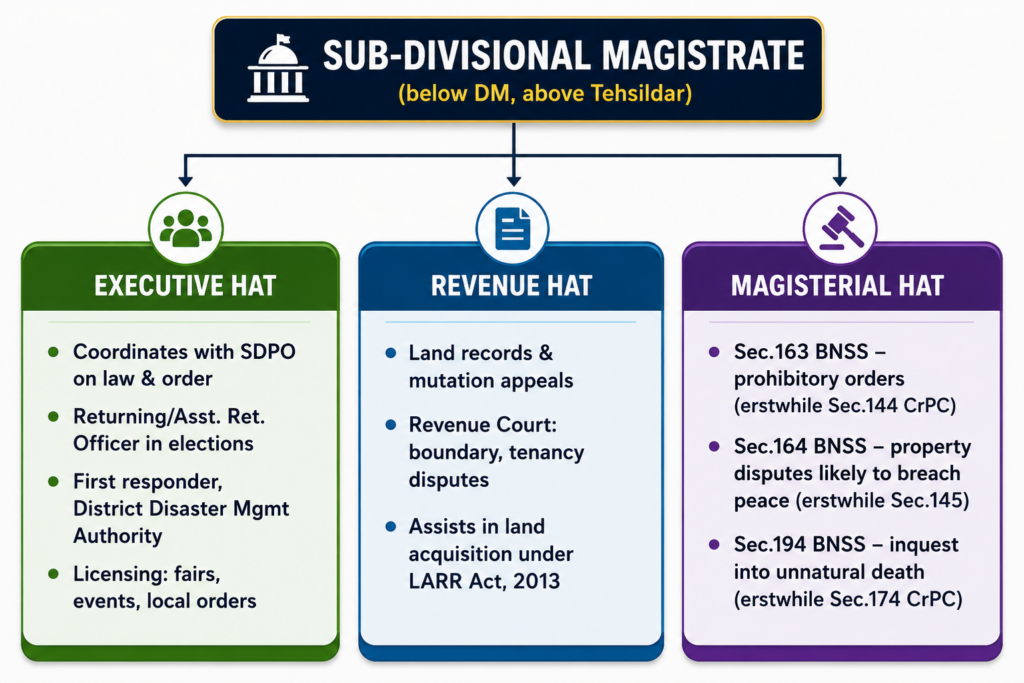
Like the District Collector one level above, the SDM carries a compressed version of the same three-hat structure — at sub-division scale.
⏱ Law Update Most Articles Miss
An SDM‘s three signature magisterial powers all carry new section numbers since the Bharatiya Nagarik Suraksha Sanhita (BNSS), 2023 replaced the CrPC on 1 July 2024: prohibitory orders moved from Section 144 CrPC to Section 163 BNSS; disputes over immovable property likely to cause a breach of peace moved from Section 145 CrPC to Section 164 BNSS; and the police inquest into an unnatural death, reported to the Executive Magistrate, moved from Section 174 CrPC to Section 194 BNSS. The substance of each power is essentially unchanged — only the numbering and the surrounding code are new. Know both sets of numbers for Prelims; cite the current one in Mains.
📚 Case Study — Possession, Not Title
Under Section 164 BNSS (the old Section 145 CrPC), when two parties dispute possession of land or water likely to trigger a breach of peace, the SDM‘s job is narrowly preventive: to record who is in actual possession and preserve that status quo, not to decide who legally owns the property. Courts have repeatedly held that this proceeding cannot be used as a shortcut to settle a title dispute that properly belongs before a civil court — a useful line to cite in any Mains answer distinguishing executive-magistracy powers from judicial adjudication.
SDM Pay vs. Other Level 10 Posts
| Post | Pay Level | Entry Basic | Approx. In-Hand |
|---|---|---|---|
| SDM (IAS, first posting) | 10 | 56,100 | 95,000 – 1,10,000 |
| SDM / Deputy Collector (State PCS) | 10 | 56,100 | 85,000 – 1,15,000 |
| Assistant Superintendent of Police (IPS, entry) | 10 | 56,100 | 90,000 – 1,05,000 |
| Assistant Commissioner of Income Tax (IRS) | 10 | 56,100 | 90,000 – 1,05,000 |
| Deputy Superintendent of Police (State cadre) | 10-equivalent | 56,100 | 85,000 – 1,05,000 |
| Income Tax Inspector (SSC CGL) | 7 | 44,900 | 75,000 – 88,000 |
Pay parity at Level 10 is close across almost every Group A entry post. The real differentiator between an SDM and, say, an ASP of similar seniority is not the pay slip — it’s the accommodation quality, the posting’s public-facing prestige, and above all the career trajectory that follows.
Career Growth After SDM
IAS Trajectory
| Stage | Typical Post | Service Years | Pay Level |
|---|---|---|---|
| 1 | SDM / Assistant Collector | 0–4 yrs | 10 |
| 2 | Additional District Magistrate | 4–9 yrs | 11 |
| 3 | District Collector / DM | 9–16 yrs | 12 |
| 4 | Divisional Commissioner / Secretary (State) | 16–24 yrs | 13 |
| 5 | Principal Secretary (State) / Joint Secretary (GoI) | 24–30 yrs | 14-15 |
| 6 | Secretary to Government of India / Chief Secretary | 30+ yrs | 17 |
State PCS Trajectory
State Civil Service officers follow state-specific timelines, but a common pattern is: SDM → Additional District Magistrate in roughly 8-12 years; ADM → DM in some states after another 7-8 years, though this is far less assured than for IAS officers.
The ceiling for most PCS officers is Additional Secretary or Principal Secretary rank; Secretary-level and Cabinet Secretary posts are reserved for the IAS cadre. A limited quota of senior PCS officers cross over into the IAS itself each year through promotion (via the Limited Departmental Competitive Examination or the non-LDCE route), which is the main route by which a PCS-origin officer can eventually become a Collector, Commissioner, or Secretary.
How to Become an SDM
Route 1 — UPSC Civil Services Examination (IAS)
- Clear the UPSC CSE and secure an IAS allocation. In the CSE 2025 cycle, 958 candidates were finally recommended across all services against a general-category cut-off of 963 marks.
- Complete foundational training and district-level attachment at LBSNAA, Mussoorie.
- Receive the first field posting as SDM or Assistant Collector, typically within year 1-3 of service.
- Move to Additional District Magistrate, then to Collector around year 9-16.
Route 2 — State Public Service Commission (PCS)
Each state runs its own administrative-service examination, entering officers directly into a Deputy Collector/SDM-equivalent field posting without the residential LBSNAA training:
- Uttar Pradesh — UPPSC (PCS)
- Madhya Pradesh — MPPSC (State Service Exam)
- Rajasthan — RPSC (Rajasthan Administrative Service, RAS)
- Maharashtra — MPSC
- Tamil Nadu — TNPSC Group 1
- Karnataka — KPSC (Karnataka Administrative Service, KAS)
- Bihar — BPSC
- Delhi & UT cadre — DANICS, via SSC/UPSC-conducted examinations
PCS officers generally have a state cadre and cannot be posted outside their state except on deputation, and career growth is slower than the IAS track.
Route 3 — Promotion from Subordinate Services
In several states, officers from the subordinate revenue or executive services (such as Naib-Tehsildar) can rise to SDM grade after a minimum qualifying period and departmental examinations — entirely state-specific in both timeline and eligibility.
Critical Evaluation: Is the SDM Overloaded?
The Second Administrative Reforms Commission flagged a persistent structural problem at this level: SDMs carry a heavy load of routine regulatory and certificate work (income, caste, domicile and residence certificates; licence renewals) alongside genuinely urgent executive-magistracy and disaster-response duties, with comparatively thin staff support underneath them. The recurring reform proposals are broadly threefold — push routine certificate issuance onto e-governance and Common Service Centre platforms so the SDM’s personal bandwidth is freed for judgment-intensive work; strengthen the Tehsildar and revenue-inspector layer so escalation to the SDM becomes the exception rather than the default; and be explicit about where an SDM’s preventive, executive powers end and where a proper judicial or civil-court process should instead take over — a line courts continue to police, as the case study above illustrates.
A well-rounded Mains answer treats the SDM less as a standalone office to defend or dismantle, and more as a case study in the broader tension between India’s generalist, colonial-origin field administration and the specialised, technology-enabled service delivery a modern welfare state demands.