

Sub-Divisional Magistrate — the Executive Magistrate under Section 14 BNSS who combines revenue administration, magisterial power, certificates, elections, disaster response and scheme delivery into one field charge. Everything a UPSC aspirant needs, in one place.
The SDM full form is Sub-Divisional Magistrate. Under Section 14(4) of the Bharatiya Nagarik Suraksha Sanhita (BNSS), 2023, a State Government places an Executive Magistrate in charge of a sub-division, and that officer is called the Sub-Divisional Magistrate — reporting to the District Magistrate, one tier above the Tehsildar. The post combines six roles: executive magistracy, revenue administration, certificate/attestation work, election Returning Officer duty, disaster first-response, and development-scheme coordination. It is typically the first independent field posting for a junior IAS officer (Pay Level 10, ₹56,100 basic) or a senior State Civil Service officer, usually held for 1-4 years before promotion toward District Collector.
Quick Answer
What Does SDM Mean? Three Precise Words
The SDM full form is Sub-Divisional Magistrate, and UPSC tends to test each half of that phrase separately.
- Sub-Divisional identifies the territorial unit — a sub-division sits between a district and a tehsil/taluka, and typically bundles together two to four tehsils.
- Magistrate signals executive-magisterial authority: preventive, regulatory and inquest powers, not the power to try and convict in a criminal trial.
The official BNSS term is written “Sub-divisional Magistrate” (one hyphenated compound); “Sub Divisional” and “Subdivisional” are informal variants of the same office, not different posts.
📌 India Focus — Executive vs. Judicial Magistrate
The SDM is an Executive Magistrate, answerable through the State Government’s administrative chain (DM → SDM). A Judicial Magistrate — First Class or Second Class — conducts criminal trials and functions under the control of the High Court. This separation was formalised by the 1973 CrPC amendment (implementing Article 50’s directive principle on separation of judiciary from the executive) and has been carried forward unchanged into the BNSS, 2023. Confusing the two chains is one of the most common Prelims traps on this topic.
Legal Basis: Section 14 BNSS and the 2024 Transition
From 1 July 2024, the Bharatiya Nagarik Suraksha Sanhita replaced the Code of Criminal Procedure, 1973. The SDM’s foundational authority now sits in Section 14 of the BNSS, within Chapter II (“Constitution of Criminal Courts and Offices”). The operative sub-section reads, in substance: the State Government may place an Executive Magistrate in charge of a sub-division, and the Magistrate so placed shall be called the Sub-divisional Magistrate; the State Government may delegate this power to the District Magistrate, and other Executive Magistrates within the sub-division are subordinate to the SDM. This replaced Section 20 of the old CrPC, which performed the identical function.
Old CrPC Section → New BNSS Section: The Full Map for SDM Powers
UPSC has begun directly testing the renumbering. Every power an SDM commonly exercises has moved to a new section number since 1 July 2024 — the substance is, in each case, essentially preserved.
| Power | Old CrPC Section | New BNSS Section |
|---|---|---|
| SDM appointment / charge of sub-division | Section 20 | Section 14(4) |
| Prohibitory orders in urgent nuisance/danger (“Section 144”) | Section 144 | Section 163 |
| Security for keeping the peace & good behaviour | Sections 106-110 | Sections 125-129 |
| Conditional order for removal of public nuisance | Section 133 | Section 152 |
| Disputes over land/water likely to cause breach of peace | Section 145 | Section 164 |
| Inquest into unnatural/suspicious death | Section 174 | Section 194 |
⏱ Law Update
If a question (or an older coaching note) frames a power as “Section 144,” the current, correct citation is Section 163 BNSS. Know both numbers for Prelims — the old one still appears in pre-2024 case law and in casual usage — but cite the current one in Mains.
Six Functions of the SDM
1. Executive Magistrate — the Magisterial Half
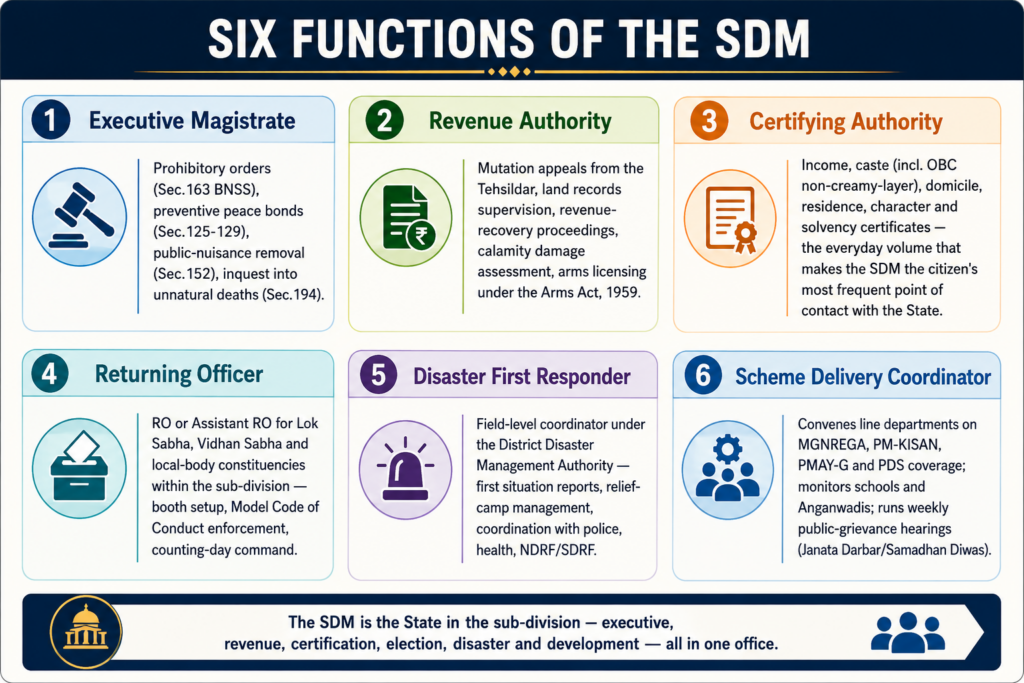
Operating under the delegated authority of Section 14 BNSS, the SDM’s four signature preventive powers are Section 163 (prohibitory orders — the erstwhile “Section 144”), Sections 125-129 (bonds for keeping the peace and good behaviour, aimed at persons likely to commit a breach or a cognisable offence), Section 152 (conditional orders to remove a public nuisance such as an unsafe structure or a polluting trade), and Section 194 (the inquest that must follow any unnatural, suspicious or sudden death, with the report forwarded to the District Magistrate).
📚 Case Study — The Ratlam Principle
In Municipal Council, Ratlam v. Vardhichand (1980), the Supreme Court held that the nuisance-removal power (then Section 133 CrPC, now Section 152 BNSS) is a mandatory public duty, not a discretionary favour to be granted or withheld — the Magistrate cannot decline to act merely because the local authority pleads a shortage of funds. This remains the governing principle for how an SDM must approach Section 152 orders today, and it is a clean citation for any Mains answer on administrative accountability or public-nuisance law.
2. Revenue Authority — the Older Half
Revenue administration predates the criminal-procedure code by decades and is, in most sub-divisions, the SDM’s heaviest workload: hearing mutation appeals against Tehsildar orders, supervising land records (called the Record of Rights, jamabandi or khatauni depending on the state), running revenue-recovery proceedings under the state’s Public Demands Recovery Act, assessing calamity damage for relief disbursal, processing land-conversion permissions, and issuing or cancelling arms licences.
3. Certificate & Attestation Work
For most citizens, this is the SDM’s face: income certificates that gate EWS reservation and scholarship eligibility, caste certificates (including OBC non-creamy-layer determination), domicile and residence certificates for state-quota admissions, character certificates for government employment and passport verification, solvency certificates for tender bids, and affidavit attestation.
4. Returning Officer for Elections
During Lok Sabha, Vidhan Sabha and local-body elections, the Election Commission of India routinely deploys SDMs as Returning Officers or Assistant Returning Officers for constituencies falling within their sub-division — covering booth logistics, EVM/VVPAT custody, Model Code of Conduct enforcement, and result declaration, all under the overall coordination of the District Election Officer (the DM).
5. Disaster First Responder
See the dedicated section below — this is one of the most examinable angles of the post.
6. Scheme Delivery & Development Coordination
The Second Administrative Reforms Commission specifically recommended shifting the SDM’s centre of gravity from regulation toward development. In practice this now means monthly review meetings with line departments on flagship schemes (MGNREGA, PMAY-G, PM-KISAN), PDS ration-coverage checks, school and Anganwadi monitoring visits, Direct Benefit Transfer verification, and fixed-cadence public grievance hearings.
Where the SDM Fits: District Administration Hierarchy
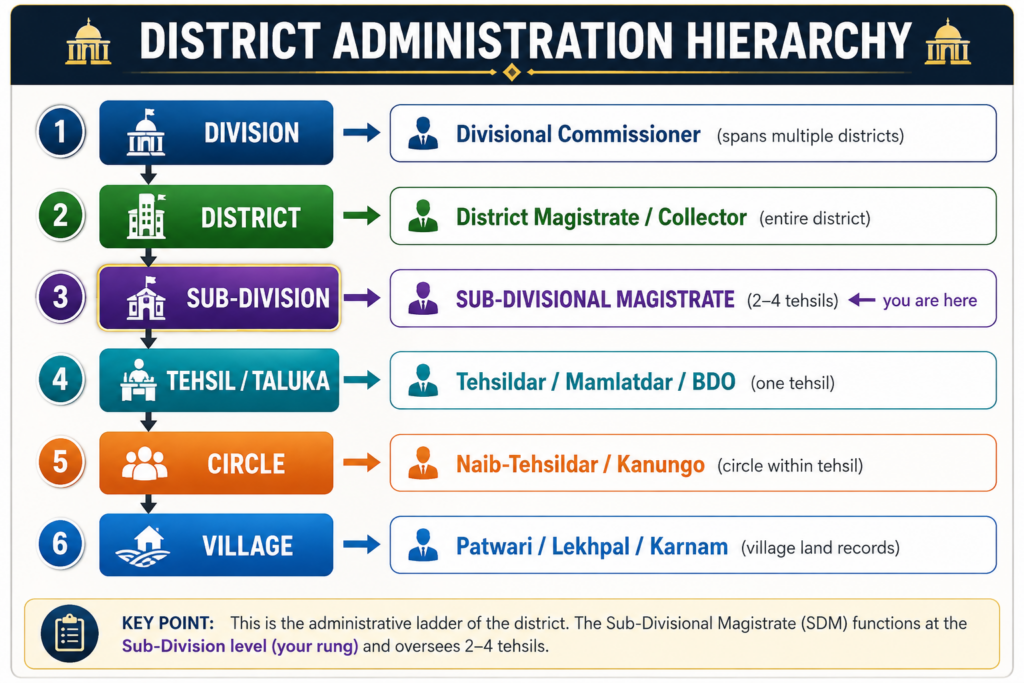
The DM depends on SDMs for ground-truth reporting from the field; for most citizens, the SDM and everything below is the only layer of “district administration” they ever actually meet in person.
SDM vs. DM:
| Parameter | SDM | DM (District Magistrate) |
|---|---|---|
| Jurisdiction | Sub-division (part of a district) | Entire district |
| Typical incumbent | Junior IAS (Year 1-4) or senior State Civil Service officer | Mid-career IAS (typically Year 9-16) |
| Pay matrix level | Level 10 (Junior Time Scale) | Level 12 (Junior Administrative Grade) and above |
| Magisterial powers | Delegated, exercised within the sub-division | Original holder of executive-magistracy power for the district |
| Section 163 BNSS orders | Exercises when specially empowered/delegated | Original power-holder for the district |
| Disaster authority | Field coordinator, sub-division level | Chairs the District Disaster Management Authority |
| Election role | Returning/Assistant Returning Officer, constituency level | District Election Officer, district level |
| Reports to | District Magistrate | Divisional Commissioner |
SDM vs. SDO: A Title Difference, Not a Function Difference
Several states use “SDO” (Sub-Divisional Officer) instead of “SDM.” The underlying office and BNSS powers are the same; the local title reflects administrative tradition rather than a different job.
| State / Region | Title in Common Use |
|---|---|
| UP, Bihar, Rajasthan, Punjab, Haryana, Delhi, MP, Uttarakhand | SDM |
| West Bengal | SDO is the headline title; SDM refers to the magisterial function within the same office |
| Maharashtra; parts of Gujarat | Sub-Divisional Officer (Revenue) / Prant Adhikari |
| Tamil Nadu | Revenue Divisional Officer (RDO) |
| Karnataka | Assistant Commissioner / Sub-Divisional Magistrate (both used) |
🧠 Exam Rule of Thumb
If the function is “Executive Magistrate in charge of a sub-division” under BNSS, the officer is an SDM for UPSC purposes — whatever the local nameplate says.
SDM Salary at a Glance
An SDM — whether IAS or State PCS — is almost always placed at Pay Level 10 of the 7th CPC, basic pay ₹56,100. With central DA at 60% (effective 1 January 2026, moving to a calculated 63% from 1 July 2026), Transport Allowance and standard deductions, cash in-hand runs approximately ₹95,000-1,10,000 a month, before an official duty vehicle and, where provided, rent-free government housing. State PCS Deputy Collectors sit on a broadly similar Level 10 scale, though the exact figure shifts with the state’s own DA order and the posting city’s HRA classification rather than a fundamentally different pay scale.
📌 Want the Full Breakdown?
For the complete in-hand salary table, state-by-state comparison (UP, MP, Bihar, Maharashtra, Rajasthan, Tamil Nadu), pension options (OPS/NPS/UPS), and perks, see our dedicated SDM Salary 2026 guide.
The SDM as a Quasi-Judicial Revenue Court
One of the most testable and least-discussed angles of this post: under each state’s own land revenue legislation — the UP Revenue Code, 2006; the Bihar Tenancy Act; the Rajasthan Land Revenue Act, 1956; the MP Land Revenue Code, 1959, among others — the SDM is designated a revenue court for a defined set of disputes. This includes mutation appeals against Tehsildar orders, partition suits, boundary disputes after patwari demarcation, tenancy disputes over allotment or resumption of land, and encroachment removal on government or Gram Sabha land. The procedure mirrors a civil court — written pleadings, evidence, witnesses, reasoned written orders, and a right of appeal — though the SDM is not a civil judge. Appeals from an SDM’s revenue-court orders typically lie with the District Collector, and then with the Divisional Commissioner or the state’s Board of Revenue, depending on the state.
SDM and Disaster Management: The DDMA Framework
Under the Disaster Management Act, 2005, the District Disaster Management Authority (DDMA) is chaired by the District Magistrate and includes the Superintendent of Police, the Chief Medical Officer, and the Executive Engineer of Public Works — with the SDM serving as the lead field officer for the affected sub-division: pre-disaster vulnerability mapping and evacuation drills; first situation reports and NDRF/SDRF deployment during an event; and post-disaster damage assessment and ex gratia disbursal once the immediate crisis has passed.
⏱ Current-Affairs Update
The Disaster Management (Amendment) Bill, 2024 was passed by both Houses of Parliament and received Presidential assent on 29 March 2025, coming into force on 9 April 2025 as the Disaster Management (Amendment) Act, 2025.
Key changes relevant to field officers: NDMA and SDMAs now directly prepare disaster management plans (a function earlier held by the National and State Executive Committees); new Urban Disaster Management Authorities (UDMAs) for state capitals and large municipal-corporation cities (excluding Delhi and Chandigarh); statutory status for State Disaster Response Forces (SDRFs); a new National and State Disaster Database; and a civil-penalty provision (Section 60A) of up to ₹10,000 for non-compliance with disaster-risk-reduction directives. Cite the Act by its correct 2025 name, not “2024,” in any current-affairs answer.
SDM and the Right to Information Act, 2005
Most state governments designate the SDM, or an officer within the SDM’s office, as the Public Information Officer (PIO) for the sub-division, and the SDM commonly functions as the First Appellate Authority for RTI appeals against PIOs in the tehsil and block offices reporting to them.
That places the SDM at a routine interface with the transparency regime — receiving applications, processing fee waivers for BPL applicants, and disposing first appeals, typically within the Act’s 30-day window. RTI volumes at the SDM level have risen steadily since the mid-2010s, and timely disposal is now a standard performance metric in most states’ e-governance dashboards.
A Day in the Life of an SDM
Useful both for an examiner-facing answer and for an aspirant trying to actually picture the job rather than memorise a list.
- 9:00 AM — Office opens: the Tehsildar’s overnight report — law-and-order incidents, accidents, deaths, fresh disputes.
- 10:00 AM — Public hearing: citizens queue for certificates, mutation appeals and grievances; simple cases disposed on the spot, others sent for verification.
- 12:00 noon — Field visit: a flood-hit village, an under-construction school, a polluting unit — verified in person rather than on paper.
- 2:00 PM — Coordination meeting: health, education, public works and police convened on a scheme review or an upcoming event.
- 4:00 PM — Court duty: revenue appeals heard as a quasi-judicial authority, with arguments from advocates and parties.
- 7:00 PM — Reports: daily situation report to the DM. On a disaster day, this entire schedule dissolves and runs on the situation rather than the clock.
Historical Evolution: From Bengal Regulation, 1793 to BNSS, 2023
- 1772: Warren Hastings establishes the Collector system in Bengal’s districts.
- 1793: The Bengal Regulation formalises the District Collector’s revenue role under the Permanent Settlement.
- 1860s onward: Districts are split into sub-divisions as a single Collector proves unable to supervise an entire district — the sub-divisional tier, and the SDM post, is born.
- 1947: Independence preserves the structure; the IAS replaces the ICS as the cadre staffing senior posts.
- 1966-70: The First Administrative Reforms Commission examines district administration.
- 1973: The CrPC amendment formally separates Executive and Judicial Magistrates — the SDM sits in the Executive stream.
- 2005-09: The Second ARC recommends shifting the SDM toward development coordination and reducing the routine regulatory load.
- 2023-24: The BNSS, 2023 replaces the CrPC from 1 July 2024. Section 14 now governs SDM appointment; Section 163 replaces the old Section 144.
SDM in Ethics (GS Paper IV) and the Personality Test
SDM scenarios are the single most common case-study pattern in the Ethics paper and the interview, for a simple reason: the SDM is typically the most senior officer routinely making consequential decisions in front of citizens, alone, often within hours and with limited backup.
🎯 Representative Scenarios
Communal tension at a procession: weighing Section 163 BNSS orders, force deployment, and dialogue with community leaders against the citizen’s right to free movement and assembly.
A land-records dispute under political pressure: discharging a quasi-judicial duty transparently, without favouring either side, and recording written reasons.
Disaster relief with limited resources: triaging beneficiaries with compassion, without favouritism, and maintaining an auditable trail.
Encroachment removal of a religious structure: following due notice and court orders while remaining sensitive to community feeling.
A whistleblower from within a department: protecting confidentiality and keeping the inquiry separate from any retaliatory administrative action.
Common SDM-Related Prelims Traps
- Executive vs. Judicial Magistrate: the SDM is Executive. Judicial Magistrates (First/Second Class) fall under the High Court, not the State Government.
- Section 144 vs. Section 163: since BNSS 2023, “Section 144” is no longer the operative citation — use Section 163 BNSS.
- SDO vs. SDM: different local titles (West Bengal’s SDO, Tamil Nadu’s RDO), same underlying BNSS function.
- Pay level: SDM sits at Level 10 (Junior Time Scale); DM sits at Level 12 (Junior Administrative Grade) and above. Do not conflate the two.
- Election role: SDM is RO/ARO at constituency level; DM is District Election Officer at district level.
- Disaster authority: the DDMA is chaired by the DM, not the SDM — the SDM is a field-level member/coordinator.
Critical Evaluation: The Reform Agenda
The Second Administrative Reforms Commission flagged a structural problem that persists today: SDMs carry a heavy load of routine certificate and licensing work alongside genuinely urgent executive-magistracy and disaster-response duties, with thin staff support beneath them. The consistent reform direction since has been threefold — push routine certificate issuance onto e-governance and Common Service Centre platforms (several states have already legislated time-bound service-delivery guarantees with appeal mechanisms for SDM-issued certificates); strengthen the Tehsildar and revenue-inspector layer so escalation to the SDM is the exception rather than the default; and keep the line between an SDM’s preventive executive power and a proper judicial or civil-court process clearly drawn — the very line the Ratlam case and the Section 164 “possession, not title” principle continue to police.
A strong Mains answer treats the SDM less as an office to defend or dismantle outright, and more as the sharpest illustration of the wider tension in Indian field administration: a colonial-origin, generalist post being asked to double as a digital-era, citizen-facing public-service node.