

Official syllabusPaper II · Unit 2 · Psychological Well Being and Mental Disorders
Causal factors in mental disorders (schizophrenia and delusional disorders).
Definition
“By the term ‘dementia praecox’ or ‘schizophrenia’ we designate a group of psychoses whose course is at times chronic, at times marked by intermittent attacks, and which can stop or retrograde at any stage, but does not permit a full restitutio ad integrum. The disease is characterized by a specific type of alteration of thinking, feeling, and relation to the external world which appears nowhere else in this particular fashion.”
Bleuler (1911)
Schizophrenia and delusional disorder are primary psychotic disorders, marked by lost reality testing. Schizophrenia disturbs perception, thought, emotion and volition together; delusional disorder confines the disturbance to one belief system.
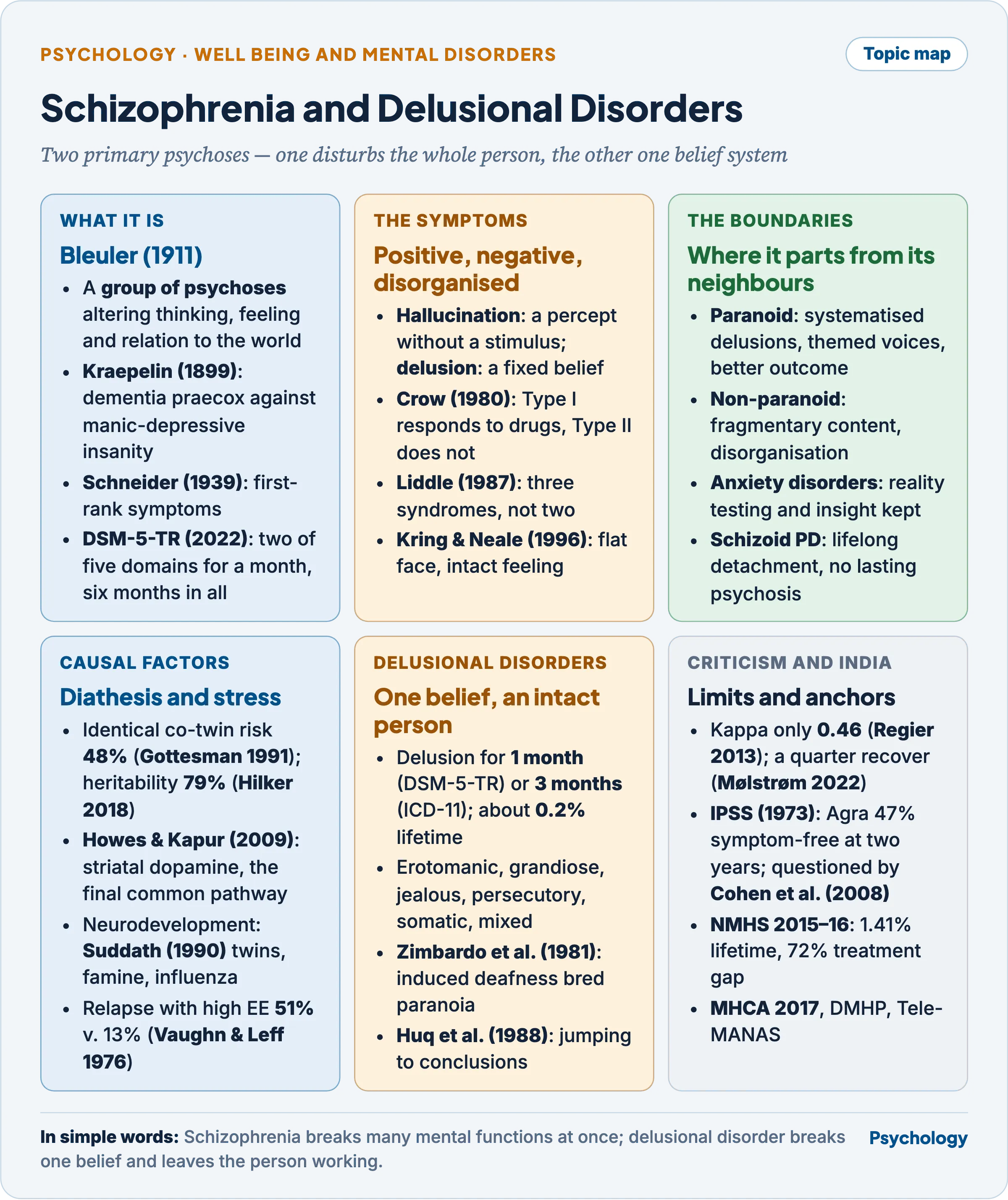
The top row defines the illness and its borders; every box in the bottom row qualifies it — several causes, a narrower cousin, a contested diagnosis.
Schizophrenia: from dementia praecox to the present classification
- Kraepelin (1893, definitive 1899) united hebephrenia, catatonia and paranoid states as dementia praecox, an early-onset, deteriorating illness, and set it against manic-depressive insanity.
- Bleuler (1911) renamed it schizophrenia (Greek schizein, to split; phren, mind) for the splitting of psychic functions from one another, not for a “split personality”.
- His fundamental symptoms were loosened associations, blunted affect, ambivalence and autism (withdrawal into inner life); hallucinations and delusions were accessory (Liddle, Carpenter and Crow, 1994).
- Schneider (1939; English 1959) named first-rank symptoms: audible thoughts, voices arguing, voices commenting, somatic passivity, thought withdrawal, insertion and broadcasting, delusional perception, and “made” feelings, impulses and actions.
- DSM-5-TR (2022) requires two or more of delusions, hallucinations, disorganised speech, grossly disorganised or catatonic behaviour and negative symptoms for one month, at least one being among the first three; signs persist six months, with functional decline.
- Tandon and colleagues (2013): DSM-5 removed the special weight of bizarre delusions and first-rank symptoms, which proved non-specific.
- ICD-11 (6A20), in force from 2022, requires two symptoms for one month, one from a core list: persistent delusions, persistent hallucinations, thought disorder, and experiences of influence, passivity or control.
Clinical picture and special features of schizophrenia
- Lack of insight is the commonest feature: 97 per cent of the core schizophrenia group in the International Pilot Study (WHO, 1973), followed by auditory hallucinations (74 per cent), delusions of reference (67) and of persecution (64).
- Onset falls in late adolescence and early adulthood, earlier in men; lifetime morbid risk is about 1 per cent (Gottesman, 1991).
- Course is heterogeneous: Mølstrøm and colleagues (2022), pooling 14 prospective studies of 20 years or more, found 24.2 per cent recovered and 40.3 per cent with poor outcome.
- Cognitive impairment and decline in work, relationships and self-care accompany the psychosis.
Hallucinations and delusions
| Dimension | Hallucination | Delusion |
|---|---|---|
| What is disturbed | Perception: a percept without an external stimulus | Thought content: a fixed belief unchanged by contrary evidence |
| Criteria | Vivid, involuntary, experienced as real | Jaspers (1913): certainty, incorrigibility, impossibility of content |
| Forms | Auditory (commonest), visual, tactile, olfactory, gustatory, somatic | Persecution, reference, control, grandeur, guilt, nihilistic, jealousy, love |
| Example | Hearing a dead father’s voice comment on each meal | Belief that neighbours poison the family’s water tank |
| Also seen in | Delirium, substance use, bereavement, hypnagogic states | Mood disorder, delusional disorder, dementia |
- For Maher (1974) a delusion is often a normal explanation of an abnormal experience — someone hearing voices infers an implanted transmitter.
- An illusion misperceives a real stimulus; an overvalued idea is held strongly but without delusional fixity.
Positive, negative, disorganised and cognitive symptoms
- Positive symptoms are excesses or distortions of normal function (hallucinations, delusions); negative symptoms are deficits — alogia, affective flattening, avolition, anhedonia, asociality — rated on Andreasen’s (1982) SANS, with positives on her SAPS (1984).
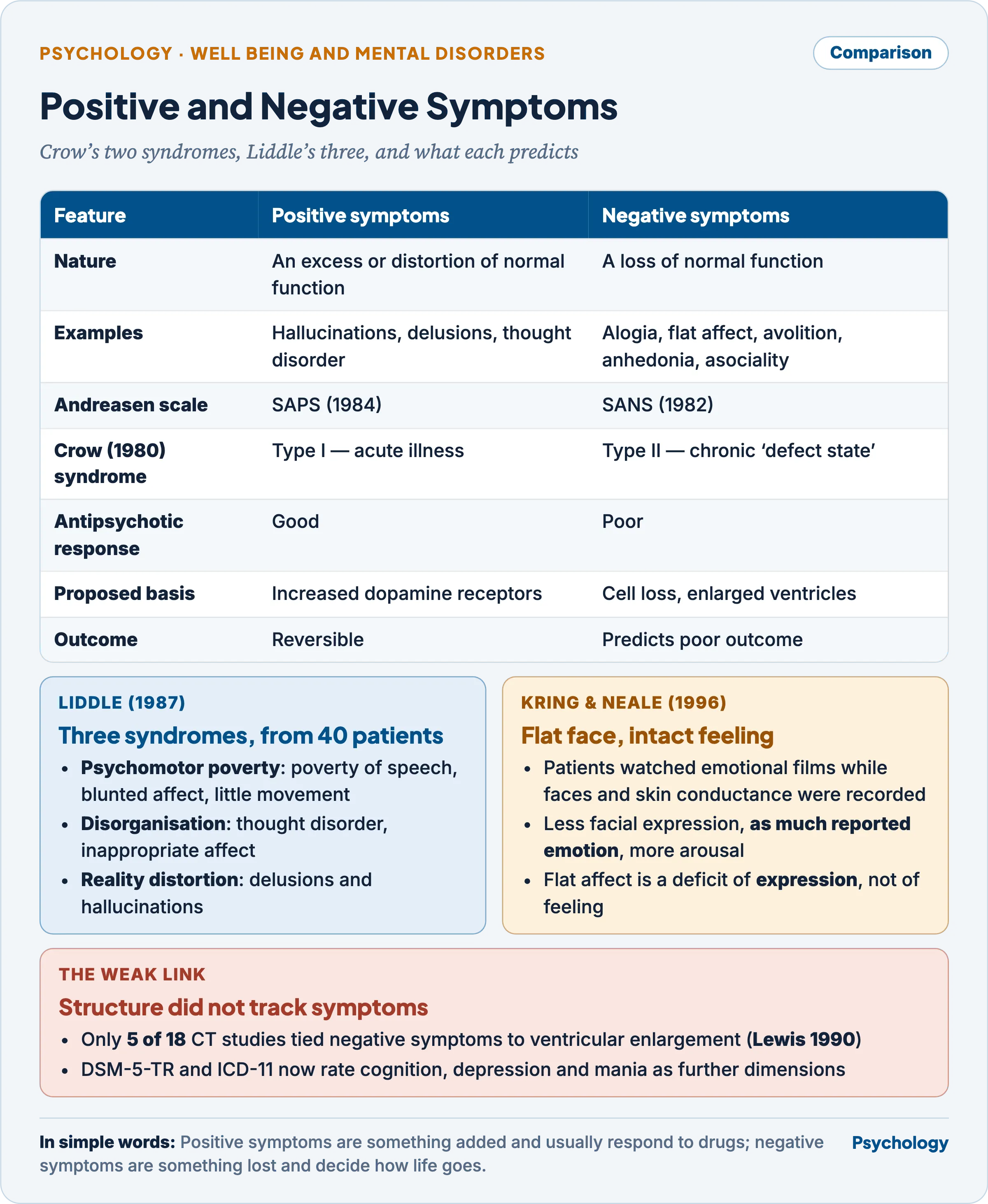
Positive symptoms respond to dopamine blockade; the negative and cognitive deficits that decide outcome mostly do not.
| Feature | Type I — Crow (1980) | Type II |
|---|---|---|
| Symptoms | Hallucinations, delusions, thought disorder | Flat affect, poverty of speech, loss of drive |
| Typical illness | Acute | Chronic, “defect state” |
| Response to neuroleptics | Good | Poor |
| Outcome | Reversible | Possibly irreversible |
| Intellectual impairment | Absent | Sometimes present |
| Proposed pathology | Increased dopamine receptors | Cell loss, enlarged ventricles |
- Liddle (1987), factor-analysing symptoms in 40 chronic patients, found three syndromes, not two: psychomotor poverty, disorganisation (formal thought disorder, inappropriate affect) and reality distortion.
- Kring and Neale (1996) filmed faces and recorded skin conductance while patients and controls watched emotional films: patients were less expressive, yet reported as much emotion and were more aroused.
- Flat affect is therefore a deficit of expression, not of feeling. Limitation: a small, unmedicated sample.
- Crow’s structural link was weak: only 5 of 18 CT studies tied negative symptoms to ventricular enlargement (Lewis, 1990).
Paranoid and non-paranoid schizophrenia
- DSM-IV-TR kept five subtypes — paranoid, disorganised (hebephrenic), catatonic, undifferentiated and residual. DSM-5 (2013) and ICD-11 dropped them for limited diagnostic stability, low reliability and poor validity (Tandon and colleagues, 2013).
- The contrast turns on organisation, not frequency: Winokur and colleagues (1974) found hallucinations equally common in both.
- Delusional content. Paranoid delusions are systematised, coherent and mostly persecutory or grandiose — a clerk sure his superiors tap his phone to block promotion. In hebephrenia, delusions are “fleeting and fragmentary” (ICD-10, 1992): shifting, bizarre, often hypochondriacal — “my intestines are stone”.
- Hallucinatory content. In paranoid cases the voices threaten or command (ICD-10, 1992) and arise from the delusional system (Meissner, 1981); in hebephrenia they are equally fragmentary, tied to no theme, amid giggling and incongruous affect.
- Magaro (1980) described paranoid cognition as top-down hyperorganisation, with a delusional schema biasing perception; non-paranoid cognition is perception-driven disorganisation.
- Ross and Magaro (1976), eight patients a group: on ambiguous slides, paranoid patients followed the dominant conceptual cue more than non-paranoid ones, tending to persist when it misled.
- Paranoid cases begin later and have better outcomes (Fenton and McGlashan, 1991; Kendler and colleagues, 1994), but subtypes did not breed true within families in the Roscommon study.
Schizophrenia and other mental disorders
Schizophrenia and anxiety disorders
| Dimension | Schizophrenia | Anxiety disorders |
|---|---|---|
| Core disturbance | Perception, thought, volition | Fear, worry, avoidance |
| Reality testing | Lost during episodes | Intact |
| Insight | Usually absent | Usually present |
| Intrusive thoughts | Experienced as inserted from outside | Worries, and in OCD obsessions, felt as one’s own |
| Course | Prodrome, episodes, often residual deficit | Fluctuating, no deterioration of personality |
| Function | Marked decline | Restricted by avoidance |
| Main causes | Genetic and neurodevelopmental loading; dopamine dysregulation | Conditioned fear, threat-biased appraisal, stress |
| Example | A student hears classmates’ voices through the ceiling and stops eating “poisoned” food | A clerk dreads lifts, climbs twelve floors, and calls the fear absurd |
- Psychosis against neurosis is traced in Abnormality, Classification and the Causal Factors of Mental Disorders.
- They co-occur: Achim and colleagues (2011), across 52 studies, found an anxiety disorder in 38.3 per cent of patients with schizophrenia. Anxiety itself is set out in Anxiety Disorders: Types and Causal Factors.
Schizoid personality disorder and schizophrenia
- A personality disorder is an enduring, pervasive, inflexible pattern of experience and behaviour that deviates from cultural expectations, begins by early adulthood and causes distress or impairment (DSM-5, 2013).
- Schizoid personality disorder is a lifelong pattern of detachment from relationships and restricted emotional expression; any psychosis is brief, lasting minutes to hours under stress. It is ego-syntonic, stable and reality-tested.
- Schizophrenia is episodic psychosis with decline from a previous level; DSM-5-TR marks schizoid traits preceding it as “premorbid”.
- Kety and colleagues (1968) found spectrum disorders in 8.7 per cent of schizophrenic adoptees’ biological relatives against 1.9 per cent of controls’; schizoid personality also rose after prenatal famine (Susser, Hoek and Brown, 1998).
- The personality side is set out in Personality Disorders.
Causal factors in schizophrenia
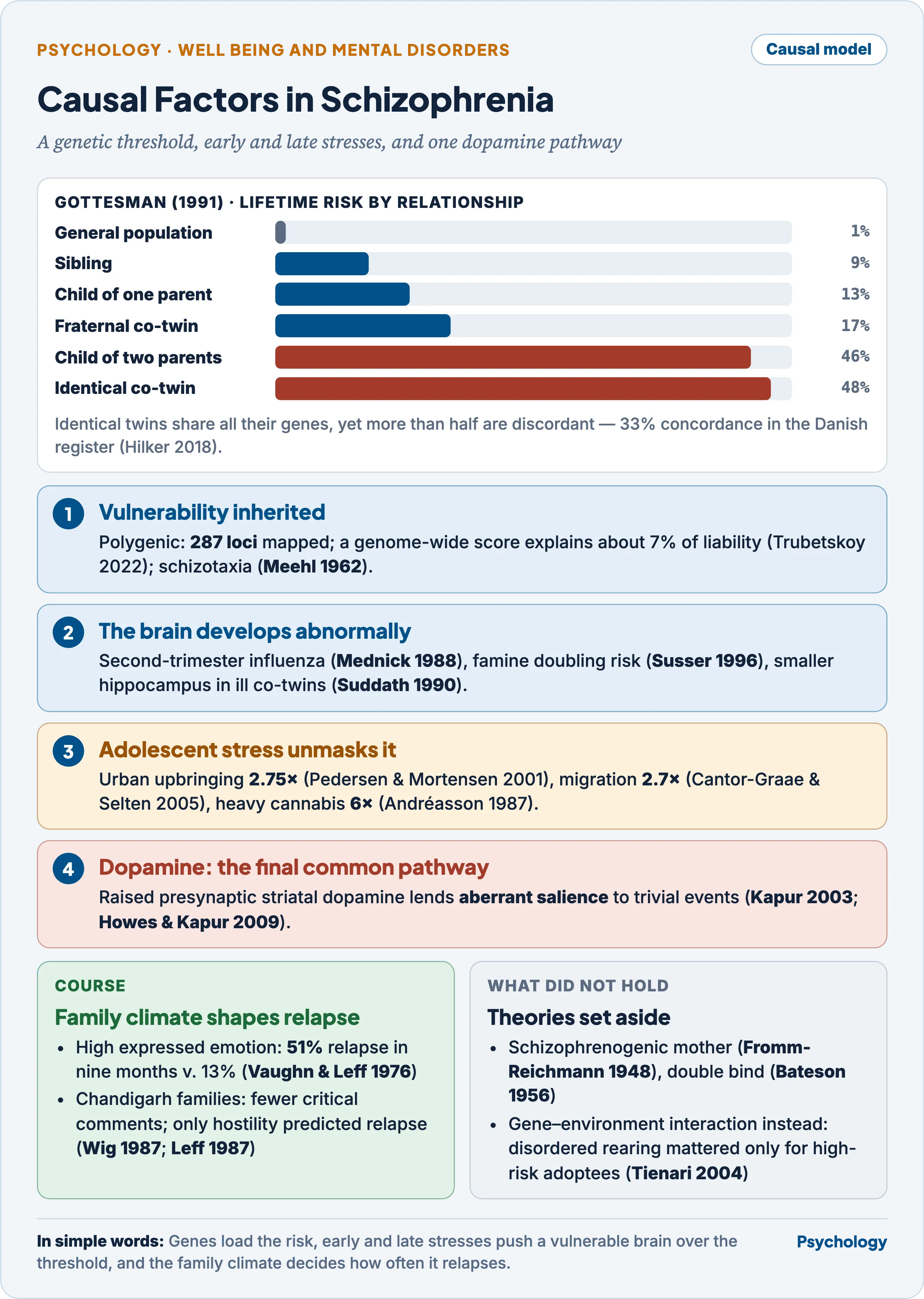
Each risk factor alone is weak; genes set the threshold, and early and late stresses push a vulnerable brain across it.
Genetic factors
- In Gottesman’s (1991) pooled European studies (1920–1987), lifetime risk rises from 1 per cent in the population to 9 for siblings, 13 for children of one affected parent, 17 for fraternal co-twins, 46 for children of two, and 48 for identical co-twins.
- Hilker and colleagues (2018), in 31,524 Danish twin pairs, found concordance of 33 per cent in identical and 7 in fraternal pairs, and heritability of 79 per cent.
- Heston (1966) followed children of hospitalised schizophrenic mothers in Oregon, separated within days of birth, against adoptee controls.
- Five of 47 developed schizophrenia; none of 50 controls did.
- Limitation: small sample, and prenatal environment was shared with the mother.
- Tienari and colleagues (2004) showed gene–environment interaction in Finnish adoptees: disordered adoptive rearing predicted spectrum disorder only in high-risk adoptees (morbid risk of schizophrenia 13.04 per cent in dysfunctional against 1.49 in healthy families; Tienari and colleagues, 2002).
- Trubetskoy and colleagues (2022) mapped 287 loci in 76,755 cases; the polygenic score explains about 7.3 per cent of liability.
Neurochemical factors: dopamine and glutamate
- Version I. Antipsychotic potency correlated with dopamine-receptor blockade (Creese, Burt and Snyder, 1976; Seeman and colleagues, 1976); amphetamine, which releases dopamine, mimics positive symptoms.
- Version II. Davis and colleagues (1991) proposed subcortical excess with prefrontal deficit, to fit negative symptoms.
- Version III. Howes and Kapur (2009) located the abnormality in raised presynaptic striatal dopamine synthesis, a final common pathway on which genes, obstetric complications, stress and drugs converge.
- Kapur (2003): excess dopamine assigns aberrant salience to trivial events; a delusion is the person’s explanation of that salience.
- Glutamate. Javitt and Zukin (1991) noted that phencyclidine, an NMDA-receptor antagonist, reproduces positive, negative and thought-disorder symptoms, which amphetamine does not.
- Krystal and colleagues (1994) gave 19 healthy volunteers ketamine and placebo double-blind: ketamine produced positive and negative symptoms and frontal test deficits. Limitation: an acute drug state, not a developmental illness.
Brain structure and the neurodevelopmental model
- Johnstone and colleagues (1976) found enlarged ventricles on CT; Weinberger, Berman and Zec (1986) found hypofrontality — low dorsolateral prefrontal activation on the Wisconsin Card Sorting Test.
- Suddath and colleagues (1990) compared, by blind MRI, 15 identical twin pairs discordant for schizophrenia: the ill twin had the smaller left hippocampus in 14 pairs and the larger left ventricle in 14; control pairs showed no such difference.
- With identical genes, the cause is at least partly non-genetic. Limitation: cross-sectional, so cause and consequence cannot be separated.
- The neurodevelopmental hypothesis (Weinberger, 1987; Murray and Lewis, 1987) places an early lesion that stays silent until adolescent maturation, when excessive synaptic pruning (Feinberg, 1982) unmasks it.
- Prenatal insults fit: second-trimester exposure to the 1957 influenza epidemic (Mednick and colleagues, 1988) and conception at the height of the Dutch Hunger Winter, which doubled risk (Susser and colleagues, 1996).
Psychosocial and sociocultural factors
- Family-causation theories — the “schizophrenogenic mother” (Fromm-Reichmann, 1948), the double bind (Bateson and colleagues, 1956), marital schism and skew (Lidz and colleagues, 1957) — found no support as causes of onset.
- Expressed emotion (critical comments, hostility, emotional over-involvement in the Camberwell Family Interview) predicts relapse, not onset.
- Brown, Birley and Wing (1972) and Vaughn and Leff (1976): nine-month relapse was about 51 per cent in high-EE homes against 13 in low-EE homes, and 92 per cent with high EE, over 35 hours of weekly contact and no medication.
- Limitation: correlational and bidirectional, since a more disturbed patient provokes criticism.
- Social causation against drift. Poverty may cause schizophrenia, or illness may cause downward drift: Goldberg and Morrison (1963) found patients’ fathers of ordinary class, the patients fallen.
- Urbanicity: fifteen years of upbringing in Copenhagen carried 2.75 times the rural risk, rising with every urban year (Pedersen and Mortensen, 2001).
- Migration: relative risk 2.7 for first-generation and 4.5 for second-generation migrants (Cantor-Graae and Selten, 2005), who proposed chronic social defeat sensitising dopamine systems.
- Cannabis: among 45,570 Swedish conscripts followed 15 years, heavy users had six times the risk (Andréasson and colleagues, 1987); early prodromal use could not be excluded.
- Learning accounts (Ullmann and Krasner, 1975) explain how ward contingencies shape bizarre behaviour, not onset.
The diathesis-stress integration
- Meehl (1962) proposed an inherited neural defect (schizotaxia) producing a personality organisation (schizotypy) that becomes schizophrenia only under adverse learning and stress.
- Zubin and Spring (1977) generalised this as the vulnerability model: an episode occurs when stress exceeds the person’s threshold. The general model is set out in Abnormality, Classification and the Causal Factors of Mental Disorders.
Delusional disorders
Concept, criteria and types
- Kraepelin separated paranoia — slowly developing, referential, non-bizarre delusions without hallucinations and with little deterioration — from paranoid dementia praecox (Kendler, 2018). Winokur (1977) coined “delusional disorder”.
- DSM-5-TR (2022): delusions for at least a month; schizophrenia’s Criterion A never met; hallucinations, if any, minor and on theme; functioning intact apart from the delusion; mood episodes brief; not due to substance, medical illness, OCD or body dysmorphic disorder.
- ICD-11 (6A24) requires the delusion to persist for at least three months. DSM-5-TR (2022) puts lifetime prevalence at about 0.2 per cent.
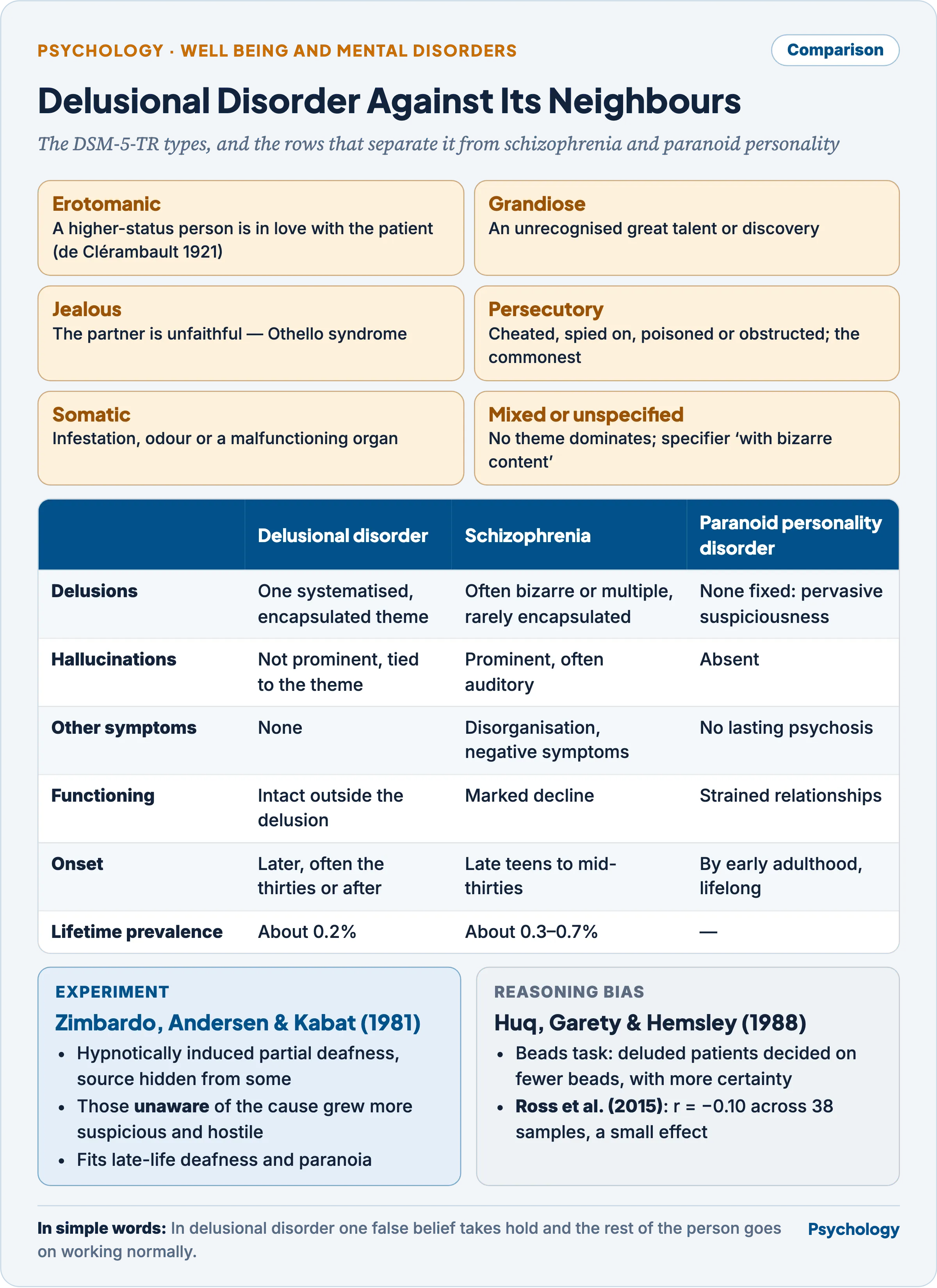
One belief is disturbed and the rest of the person keeps working — the feature that separates this disorder from schizophrenia on every row.
- Types, by dominant theme:
- Erotomanic — a person, usually of higher status, is in love with the patient (de Clérambault, 1921).
- Grandiose — unrecognised great talent or discovery. Jealous — the partner is unfaithful (Othello syndrome, Todd and Dewhurst, 1955).
- Persecutory — being cheated, spied on, poisoned or obstructed; the commonest. Somatic — infestation, odour, malfunctioning organs.
- Mixed and unspecified, with a “with bizarre content” specifier.
- Freud (1911), from the memoirs of the judge Daniel Paul Schreber, derived persecution, erotomania, jealousy and grandeur as four contradictions of a repressed homosexual wish. No controlled evidence supports this.
Distinguishing features
- From schizophrenia: the delusion is systematised and encapsulated, with no disorganisation, negative symptoms or prominent hallucinations, later onset and preserved work and marriage. DSM-5 reclassified as delusional disorder the cases meeting schizophrenia only through one first-rank symptom — under 2 per cent (Tandon, 2014).
- From paranoid personality disorder: pervasive suspiciousness from early adulthood without a fixed false belief, detailed in Personality Disorders.
- From mood disorder with psychotic features: delusions there are mood-congruent and confined to episodes.
- From OCD or body dysmorphic disorder with absent insight, and from shared delusions (folie à deux, Lasègue and Falret, 1877), now coded as other specified psychotic disorder.
Causal factors in delusional disorders
- Zimbardo, Andersen and Kabat (1981) hypnotised volunteers into partial deafness in a social setting, some told the source and some not.
- Those unaware of the source became more suspicious, hostile and paranoid, matching the clinical link between late-life deafness and paranoia.
- Limitation: brief, artificially induced states in a small sample.
- Huq, Garety and Hemsley (1988): on the beads task, deluded patients asked for fewer beads before deciding and were more certain — the jumping-to-conclusions bias.
- Ross and colleagues (2015), in 38 samples, found the association small (r = −0.10) and not significant among currently deluded patients.
Criticisms and limitations
- Reliability. Schizophrenia’s pooled test–retest kappa in the DSM-5 field trials was only 0.46 (Regier and colleagues, 2013).
- Kraepelin’s deterioration claim fails: a quarter recover at twenty years (Mølstrøm and colleagues, 2022).
- The continuum. Psychotic experiences occur in 7.2 per cent of the general population, and only 7.4 per cent of those reporting them develop a disorder (Linscott and van Os, 2013).
- Genetic inference. Joseph and Leo (2006) argue that pooled twin figures use proband concordance and rest on the untested equal-environment assumption; pairwise identical-twin concordance in studies since 1963 was 21 per cent.
- Dopamine. Antipsychotics act downstream of the presynaptic abnormality (Howes and Kapur, 2009) and barely touch negative and cognitive symptoms.
- Expressed emotion did not independently predict outcome in Hogarty (1985) once medication was controlled (Falloon, 1988).
Indian context
- International Pilot Study of Schizophrenia (WHO, 1973) — 1,202 patients in nine centres including Agra, with standardised interviews.
- At two years, 47 per cent of Agra and 58 per cent of Ibadan patients were symptom-free (Sartorius, Jablensky and Shapiro, 1978), against 8 per cent in Aarhus (WHO, 1979).
- Limitation: clinic, not population, samples.
- The Determinants of Outcome study (Jablensky and colleagues, 1992), with Agra and Chandigarh among twelve centres, found narrowly defined schizophrenia equally frequent across cultures and outcome better in developing countries.
- Wig and colleagues (1987) found Chandigarh relatives voiced fewer critical comments and less over-involvement than Danish relatives; only hostility predicted relapse (Leff and colleagues, 1987).
- Cohen, Patel, Thara and Gureje (2008), reviewing 23 studies in 11 low- and middle-income countries, found outcomes varied widely, with excess mortality and poor outcome for untreated patients.
- Thara (2004), the Madras Longitudinal Study, followed 90 first-episode patients for 20 years: of 61 assessed, five had recovered completely and five were continuously ill; functioning exceeded developed-country norms.
- National Mental Health Survey 2015–16 (Hegde and colleagues, 2023): schizophrenia-spectrum disorders had lifetime prevalence of 1.41 per cent, current 0.42, and a 72 per cent treatment gap; caregivers lost a median ten workdays in three months.
- Delusional themes vary: persecution led at Chandigarh (54.5 per cent; Grover and colleagues, 2007), infidelity at NIMHANS (44.6 per cent of 455; Kulkarni and colleagues, 2016).
- COPSI (Chatterjee and colleagues, 2014) randomised 282 patients at three Indian sites to lay-worker community care plus clinic care, or clinic care alone.
- Disability fell modestly, with nearly three times the odds of good adherence; rural Tamil Nadu gained most.
- Mental Healthcare Act, 2017 (Ministry of Health and Family Welfare) — capacity judged per decision (s. 4), advance directives (s. 5), services in every district (s. 18), a right to community living (s. 19). It operationalises autonomy despite fluctuating insight.
- District Mental Health Programme (National Mental Health Programme of 1982; added 1996 on the Bellary model; 767 districts) operationalises community care that keeps the family as the therapeutic resource.
- Tele-MANAS (Ministry of Health and Family Welfare, 10 October 2022; helpline 14416) — over 47.75 lakh calls by October 2026 (PIB, 2026). It operationalises early help-seeking to shorten untreated psychosis.
- Rights of Persons with Disabilities Act, 2016 (Department of Empowerment of Persons with Disabilities) — mental illness is a specified disability, assessed on the Indian Disability Evaluation and Assessment Scale under 2024 guidelines. It operationalises disability as measured functional impairment.
- Treatment and rehabilitation: Prevention and Rehabilitation of the Mentally Ill (Unit 3).
Previous Year Questions
- 2024Distinguish hallucinations and delusions with suitable examples.
- 2023Give a comparative analysis of positive and negative symptoms of schizophrenia.
- 2020How are schizophrenic disorders different from anxiety disorders? Explain with examples.
- 2017Explain how hallucinations and delusional contents differ in paranoid and non-paranoid schizophrenia.
- 2012What do you understand by ‘personality disorders’? Distinguish between schizoid personality disorder and schizophrenia.
- 2011Explain delusional disorders and highlight their distinguishing features.
- 2005Write a short note on: Symptoms and etiology of schizophrenia.
- 2001Discuss the special features of schizophrenia and describe the clinical picture in schizophrenia.