

Official syllabusPaper II · Unit 2 · Psychological Well Being and Mental Disorders
Causal factors in mental disorders (personality disorders).
Definition
“A personality disorder is an enduring pattern of inner experience and behavior that deviates markedly from the expectations of the individual’s culture, is pervasive and inflexible, has an onset in adolescence or early adulthood, is stable over time, and leads to distress or impairment.”
American Psychiatric Association, DSM-5 (2013)
A personality disorder is a style of being that has become a source of harm: the pattern belongs to the person rather than happening to them, which is why its owner experiences it as normal while others experience it as the problem. The field is midway through a change of model, from ten categorical types to one disorder graded by severity and described by traits, and psychopathy is where this territory meets the criminal law.
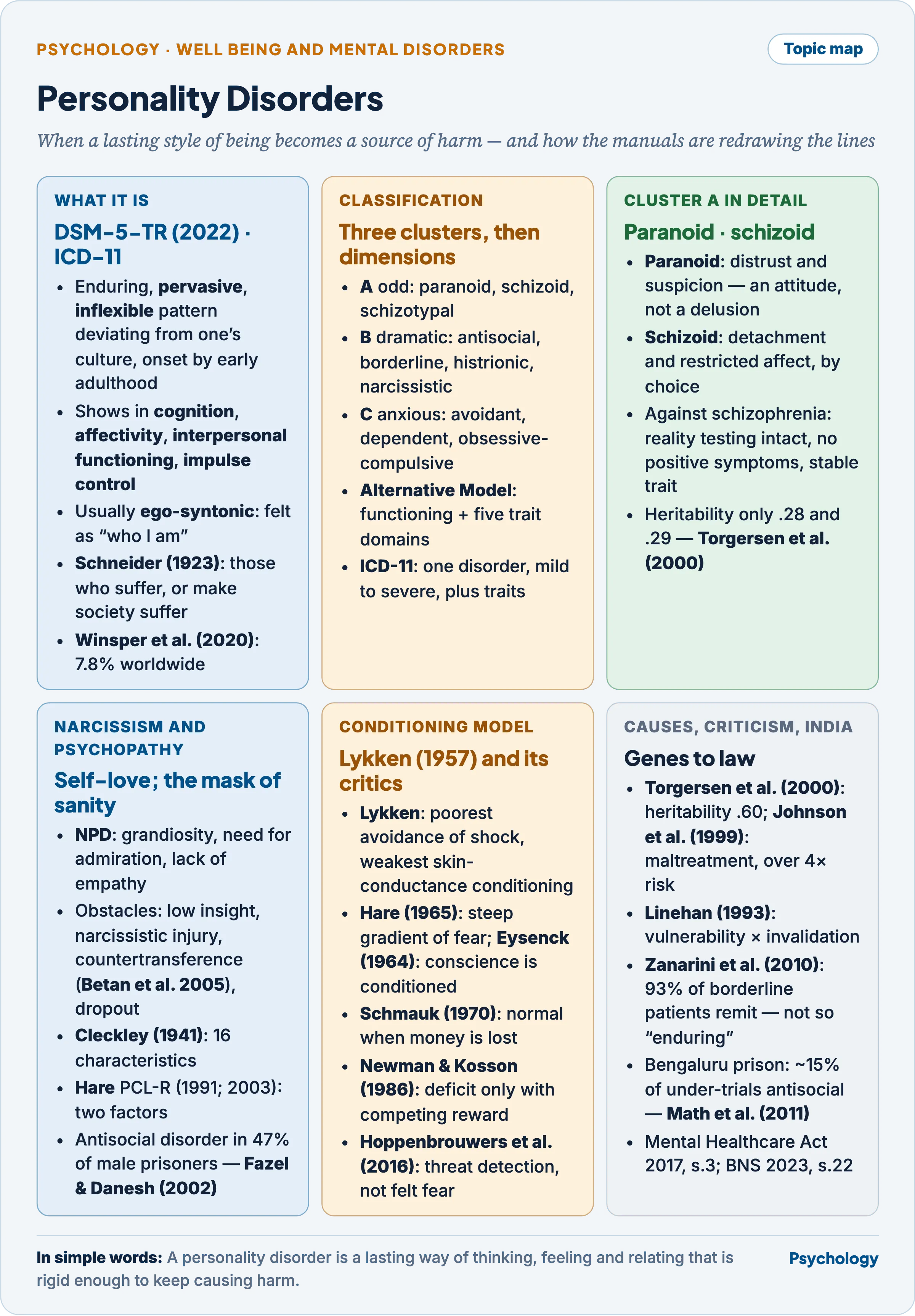
One tension runs through the topic: personality is continuous, but diagnosis draws lines across it.
Personality disorders as mental disorders: the defining features
- DSM-5-TR (2022) keeps six general criteria.
- A: deviation from cultural expectations in two or more of cognition, affectivity, interpersonal functioning and impulse control; B: inflexible and pervasive; C: distress or impairment.
- D: stable, with onset by adolescence or early adulthood; E–F: not better explained by another disorder, a substance or a medical condition.
- ICD-11 (adopted May 2019, in effect 1 January 2022) asks for problems in functioning of the self — identity, self-worth, self-view, self-direction — or interpersonal dysfunction, lasting two years or more and not explained by social or cultural factors.
- The traits are typically ego-syntonic — felt as “who I am”, not as symptoms — so the person presents with depression or a crisis, and much of the distress falls on others.
- Kurt Schneider (1923), in translation: “Psychopathic personalities are those abnormal personalities who suffer from their abnormality or from whose abnormality society suffers.” The term then meant personality disorder generally; modern psychopathy is narrower.
- Winsper and colleagues (2020) pooled 46 community studies from 21 countries: any personality disorder 7.8 per cent — Cluster A 3.8, B 2.8, C 5.0 — and 9.6 per cent in high-income against 4.3 in poorer countries.
- Normal trait structure: The Big Five Factor Theory of Personality (Paper I).
Classification: the three clusters and the alternative models
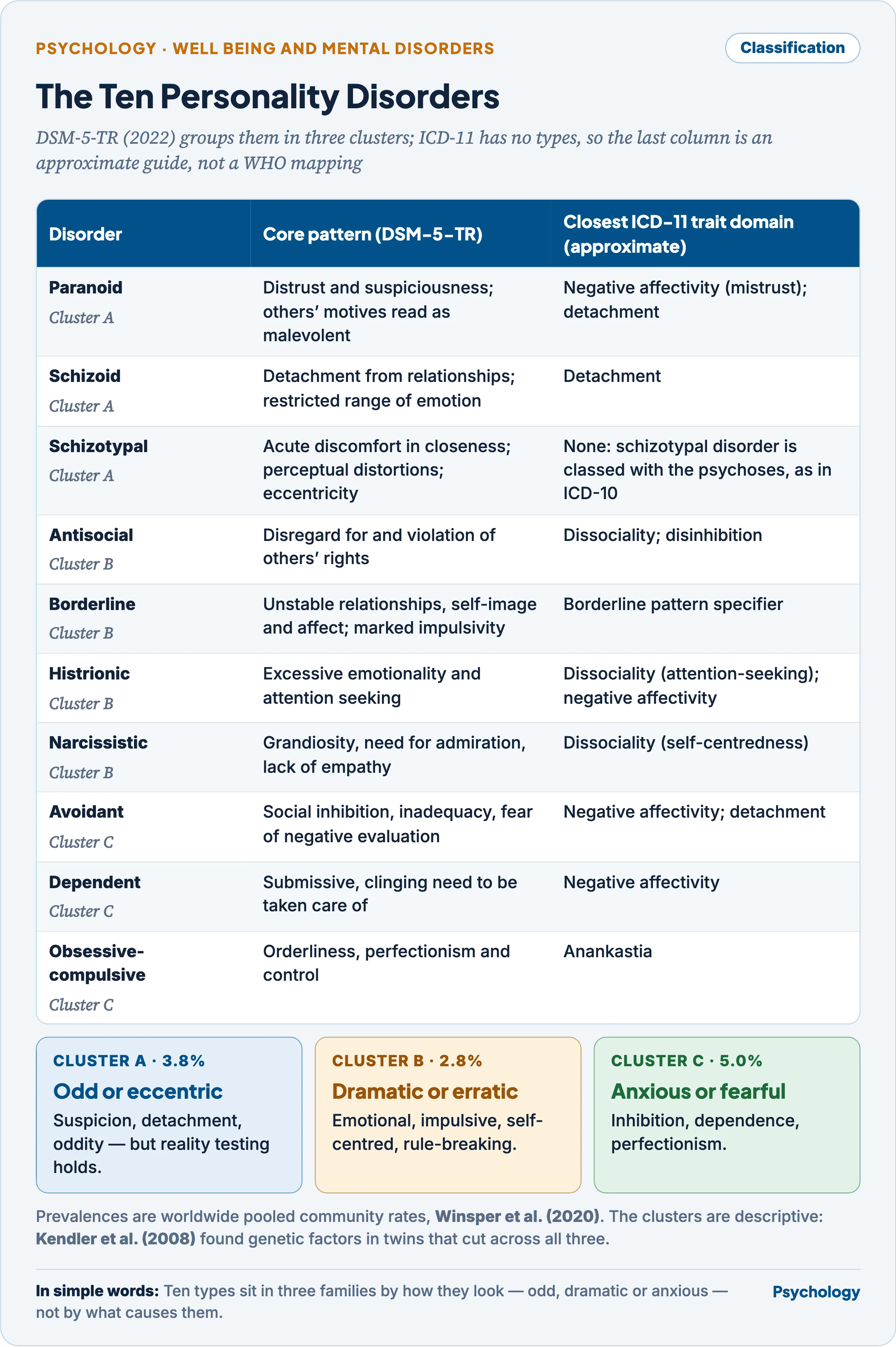
The clusters group disorders by surface resemblance — odd, dramatic, anxious — not by shared causes.
- DSM-5-TR (2022) keeps ten categories in three clusters.
- Cluster A, odd or eccentric: paranoid, schizoid, schizotypal.
- Cluster B, dramatic, emotional or erratic: antisocial, borderline, histrionic, narcissistic.
- Cluster C, anxious or fearful: avoidant, dependent, obsessive-compulsive.
- The Alternative Model for Personality Disorders (DSM-5 Section III, unchanged in DSM-5-TR) requires at least moderate impairment in personality functioning — identity, self-direction, empathy, intimacy — plus traits in five domains: negative affectivity, detachment, antagonism, disinhibition, psychoticism. Six named disorders survive; the rest become trait specified.
- Older labels: ICD-10’s anankastic is obsessive-compulsive, emotionally unstable is borderline; DSM-I’s sociopathic personality disturbance (1952) became DSM-II’s antisocial personality (1968). Depressive and passive-aggressive types were only research criteria in DSM-IV-TR.
Paranoid and schizoid personality disorders
Paranoid personality disorder
- DSM-5-TR: pervasive distrust and suspiciousness, four or more of seven — suspects exploitation without basis; doubts friends’ loyalty; reluctant to confide; reads threat into benign remarks; bears grudges; perceives unseen attacks and counter-attacks; suspects a partner’s fidelity.
- Excluded if it occurs only during a psychotic disorder; if it preceded schizophrenia it is recorded as “premorbid”.
- The suspicion is an attitude, not a fixed false belief, and reality testing holds — the line against persecutory delusional disorder in Schizophrenia and Delusional Disorders. Hostile vigilance provokes the coolness it expects, which then serves as proof.
- Causal factors.
- Torgersen and colleagues (2000) estimated heritability at only 0.28; Kendler and colleagues (1993), in the Roscommon Family Study, found a modest excess among relatives of schizophrenia patients.
- Johnson and colleagues (1999) linked documented childhood maltreatment to later paranoid personality disorder.
- Beck and Freeman (1990) place the core belief that people are malicious and deceptive at its centre.
Schizoid personality disorder
- DSM-5-TR: pervasive detachment from social relationships and restricted emotional expression, four or more of seven — neither desires nor enjoys close relationships; chooses solitary activities; little interest in sex; few pleasures; no close friends beyond family; indifferent to praise or criticism; emotional coldness.
- Kretschmer (1921) proposed a schizothymic–schizoid–schizophrenic continuum; Fairbairn (1940) read schizoid withdrawal as a defence against the fear that one’s own love destroys.
- Boundaries: the avoidant person wants closeness but fears rejection, the schizoid does not want it; unlike schizotypal disorder, there is no magical thinking or perceptual oddity.
- Causes are weakly specified: heritability 0.29 (Torgersen and colleagues, 2000); a modest familial link with schizophrenia (Kendler and colleagues, 1993); and Kendler and colleagues (2008) found a genetic factor loading specifically on schizoid and avoidant disorder.
Schizoid personality disorder and schizophrenia
| Dimension | Schizoid personality disorder | Schizophrenia |
|---|---|---|
| Core | Lifelong detachment, restricted affect | Psychosis: delusions, hallucinations, disorganisation |
| Reality testing | Intact | Impaired in active phases |
| Course | Stable trait from early adulthood | Decline from premorbid level; six months’ disturbance |
| Overlap | Resembles negative symptoms, no positive ones | Negative and positive symptoms |
| Experience | Ego-syntonic, chosen solitude | Distressing, with loss of insight |
| Rule | Not diagnosed if present only during psychosis | May follow a “premorbid” personality disorder |
| Familial link | Modest (Kendler and colleagues, 1993) | Strong; schizotypal is the closest personality disorder |
| ICD-11 | Closest trait domain: detachment | 6A20, primary psychotic disorders |
Narcissistic personality disorder
Why it is a personality disorder
- DSM-5-TR: pervasive grandiosity, need for admiration and lack of empathy, five or more of nine — grandiose self-importance; fantasies of unlimited success; belief in being special; need for admiration; entitlement; exploitation; lack of empathy; envy; arrogance.
- It meets every general criterion: pervasive across work, intimacy and therapy; inflexible, one self-enhancing strategy whatever the feedback; enduring from early adulthood; impairing through exploited relationships and rage at criticism; and ego-syntonic, since grandiosity feels like accurate self-appraisal.
- Cain and colleagues (2008) separated grandiose from vulnerable narcissism: shame-prone, fragile self-esteem lies beneath the display, which the DSM criteria largely miss.
- Kohut (1971) traced it to an arrested self left needing mirroring when parental empathy failed; Kernberg (1975) to a pathological grandiose self defending against envy and rage.
- Stinson and colleagues (2008), interviewing 34,653 American adults, reported lifetime prevalence of 6.2 per cent; Dhawan and colleagues (2010) found a mean of 1.06 per cent across seven studies — a sign of an unstable category.
- ICD-11 dissolves it into dissociality, whose self-centredness includes entitlement and expectation of others’ admiration.
Obstacles faced by clinicians
- Low insight: the presenting problem is depression or a work crisis, so motivation ends with the crisis.
- Fragile self-esteem: confrontation is felt as humiliation — narcissistic injury — and met with rage or withdrawal; the therapist is idealised, then devalued (Kernberg, 1975).
- Countertransference: Betan and colleagues (2005) surveyed 181 clinicians — narcissistic patients evoked anger, dread, feeling devalued and a wish to end treatment; Tanzilli and colleagues (2015) replicated this with 250 clinicians, whatever their orientation.
- Dropout: Ellison and colleagues (2013) found that grandiosity predicted client-initiated termination among 60 outpatients, though not slower early symptom change.
- No evidence base: Dhawan and colleagues (2010) found no controlled treatment trial; comorbid substance use and mood disorder complicate further (Stinson and colleagues, 2008).
- Transference-focused and mentalisation work is in Psychodynamic Therapies, schema-focused work in Cognitive Therapies: Beck and Cognitive-Behavioural Therapy (both Unit 3).
Psychopathic personality and antisocial personality disorder
Characteristics of psychopathic personality: Cleckley and Hare
- Its ancestors are Pinel’s manie sans délire (1801) and Prichard’s moral insanity (1835): intact reasoning, disordered conduct.
- Cleckley (1941), The Mask of Sanity, drew on hospitalised patients and listed 16 characteristics, grouped by Patrick (2018) into three sets.
- Mask: superficial charm and good intelligence; no delusions; no nervousness; suicide rarely carried out.
- Behavioural deviance: unreliability; inadequately motivated antisocial behaviour; failure to learn by experience; impersonal sex life; no life plan.
- Shallow and deceptive: untruthfulness; lack of remorse or shame; poverty of affect; egocentricity and incapacity for love; loss of insight.
- Hare’s Psychopathy Checklist–Revised (1991; second edition 2003) rates 20 items 0–2 from interview and records, maximum 40, cut-off 30.
- Factor 1, interpersonal–affective: glibness, grandiosity, lying, conning, lack of remorse, shallow affect, callousness.
- Factor 2, lifestyle–antisocial: stimulation-seeking, parasitism, impulsivity, irresponsibility, poor controls, juvenile delinquency, criminal versatility.
- Coid and colleagues (2009) found it, on the screening version, in 0.6 per cent of 638 British household adults; Hare (1996), in 15–20 per cent of offenders.
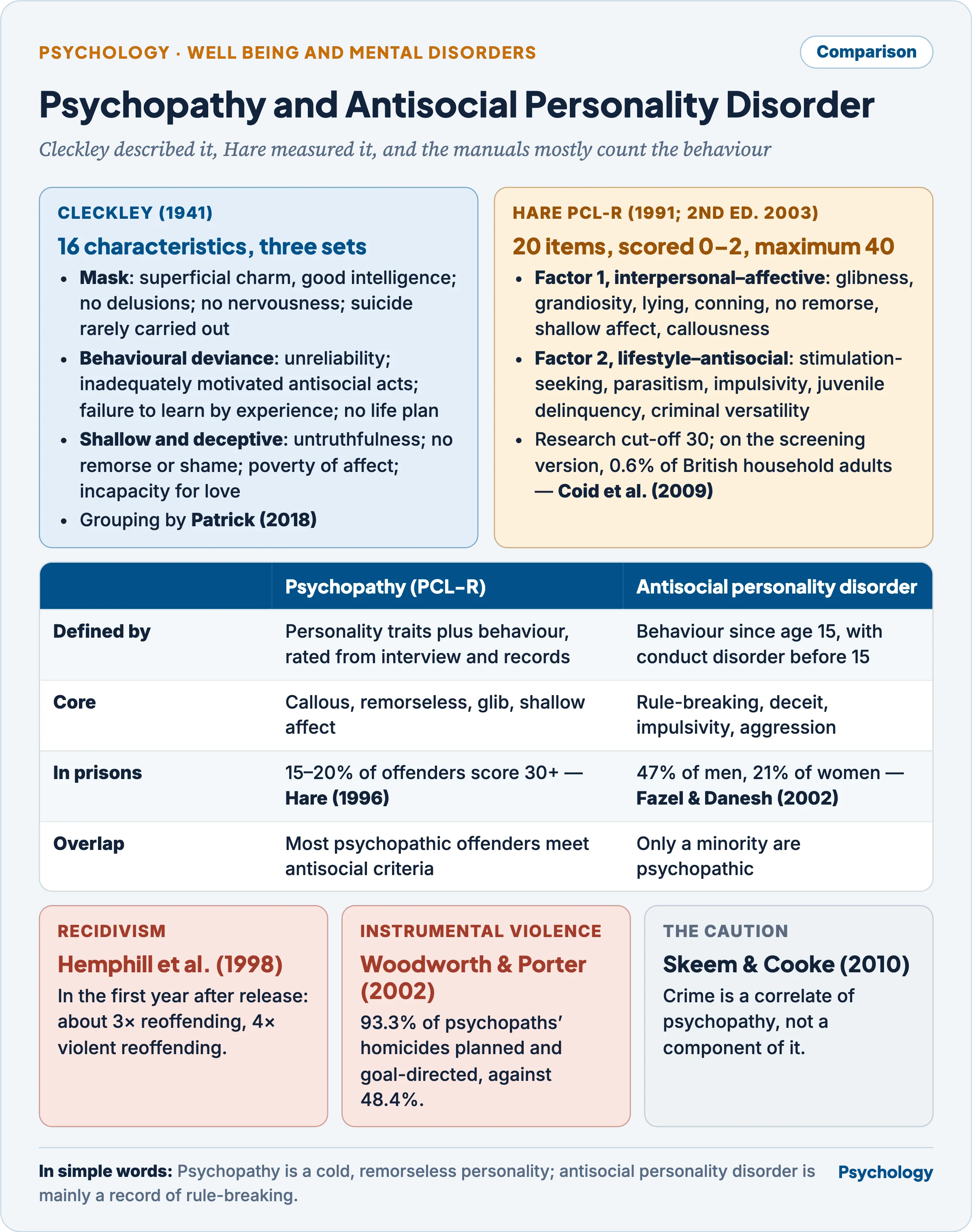
Psychopathy is the personality core; antisocial personality disorder is mostly the behaviour — so the second is far commoner in prisons.
Psychopathy and antisocial personality disorder
- DSM-5-TR antisocial personality disorder: violation of others’ rights since age 15, three of seven — unlawfulness, deceit, impulsivity, aggression, recklessness, irresponsibility, lack of remorse — with conduct disorder before 15.
- DSM-III (1980) built the diagnosis on behaviour for reliability, dropping Cleckley’s personality features, so the overlap is asymmetric (Hare, 1996): most psychopathic offenders meet antisocial criteria; few antisocial offenders are psychopathic.
- Fazel and Danesh (2002), pooling 62 surveys of 22,790 prisoners, found antisocial personality disorder in 47 per cent of men and 21 per cent of women.
- Lykken (1995) separated the constitutionally fearless primary psychopath from the sociopath produced by failed socialisation. The Alternative Model adds a “with psychopathic features” specifier; ICD-11 uses dissociality plus disinhibition.
Relation to deviant and criminal behaviour
- Hemphill, Hare and Wong (1998): within a year of release, psychopaths were about three times as likely to reoffend and four times as likely to reoffend violently.
- Woodworth and Porter (2002), studying 125 Canadian homicide offenders, found 93.3 per cent of psychopaths’ homicides primarily instrumental — planned and goal-directed — against 48.4 per cent of non-psychopaths’.
- The deviance is wider than crime: Coid and colleagues (2009) found psychopathy scores tracking violence, homelessness, drug dependence and suicide attempts.
- Psychopathy is not criminality. Skeem and Cooke (2010) argue that offending is a correlate, not a component, of psychopathy, and that equating the checklist with the construct confuses measure with concept.
The conditioning model of psychopathy
- Socialisation depends on conditioned anticipatory fear of punishment, whose reduction reinforces avoidance — the two-factor account of Mowrer (1947) in Escape, Avoidance and Learned Helplessness (Paper I). Acquire that fear poorly, and punished acts go uninhibited.
- Lykken (1957) made the first test.
- Design: 19 primary sociopaths closest to Cleckley’s criteria, 20 neurotic sociopaths, 15 controls; a 20-point “mental maze” shocked one wrong option at each point, so avoiding it was rewarded only by anxiety reduction; skin conductance was conditioned to a buzzer.
- Outcome (Lykken, 1957): primaries showed the least avoidance of shocked errors, the weakest conditioned skin response and the lowest anxiety scores.
- Limitation: small, clinician-selected groups; only 34 took the maze; controls were students.
- Hare (1965) used a count-down — numbers 1–12 in sequence, shock at 8: skin conductance rose later and less in student high scorers on the MMPI psychopathic deviate scale, a steep temporal gradient of fear arousal.
- Eysenck (1964), in Crime and Personality, made conscience a conditioned response that extraverts acquire poorly, through cortical inhibition, recast as low cortical arousal in 1967 (see Trait and Type Approaches to Personality, Paper I).
- Fowles (1980) recast it in the terms of Gray (1975): a weak behavioural inhibition system explains poor passive avoidance and low electrodermal response to threat, beside a normal activation system.
- Patrick, Bradley and Lang (1993): among 54 incarcerated offenders, unpleasant slides potentiated the startle blink in non-psychopaths but not psychopaths — a Factor 1 deficit invisible in self-report.
Critical evaluation of the conditioning model
- Punishment type. Schmauk (1970) assigned 90 men to shock, verbal disapproval or loss of money: primary sociopaths learned poorly with the first two but normally when money was at stake — a motivational deficit, not a general inability to condition.
- Competing reward. Newman and Kosson (1986): among 60 prisoners, psychopaths made more passive-avoidance errors only when reward and punishment competed — the response modulation hypothesis: failure to pause and process punishment cues once a reward set is running.
- Attention. Newman and colleagues (2010) measured fear-potentiated startle in 125 prisoners: normal when attention was on the threat, virtually absent when it was elsewhere.
- Which fear. Hoppenbrouwers and colleagues (2016) meta-analysed the evidence: automatic threat detection is impaired, conscious fear experience is not.
- Heterogeneity. Newman, Widom and Nathan (1985) found the deficit only in low-anxious psychopathic delinquents; anxious delinquents lack it.
- Revision. The triarchic model of Patrick, Fowles and Krueger (2009) keeps low fear as boldness, one facet beside meanness and disinhibition; Gudjonsson (2016) judged support for Eysenck’s extraversion link mixed.
- What survives: punishment learning is impaired but conditionally, so deterrence by punishment alone fails; attention-training targeted at the deficit has improved performance (Baskin-Sommers and colleagues, 2015).
Causal factors in personality disorders
The general causal models are in Abnormality, Classification and the Causal Factors of Mental Disorders.
- Genetic. Torgersen and colleagues (2000) interviewed 92 identical and 129 fraternal Norwegian twin pairs: heritability 0.60 overall — narcissistic 0.79, borderline 0.69, schizotypal 0.61 — with no shared-family effect. Limitation: moderate sample; antisocial disorder too rare to model.
- Gene–environment. Caspi and colleagues (2002) followed 442 Dunedin males: those maltreated and carrying low-activity MAOA were 12 per cent of the cohort but committed 44 per cent of its violent convictions; low MAOA without maltreatment did not predict antisocial outcome.
- Early adversity. Johnson and colleagues (1999) followed 639 New York youths: documented abuse or neglect made a personality disorder more than four times as likely. Limitation: only 31 documented cases, and records and self-reports barely agreed.
- Attachment. Fonagy and colleagues (2000) trace borderline pathology to insecure attachment that stunts mentalising, the reading of one’s own and others’ minds.
- Cognitive. Beck and Freeman (1990) give each disorder a core belief and an overdeveloped strategy — the paranoid’s vigilance, the schizoid’s self-sufficiency.
- Biosocial. Linehan (1993): borderline personality disorder arises from emotional vulnerability — high sensitivity, intense reactions, slow return to baseline — transacting with an invalidating environment; its therapy is in Cognitive Therapies: Beck and Cognitive-Behavioural Therapy (Unit 3).
Categorical against dimensional: the ICD-11 model
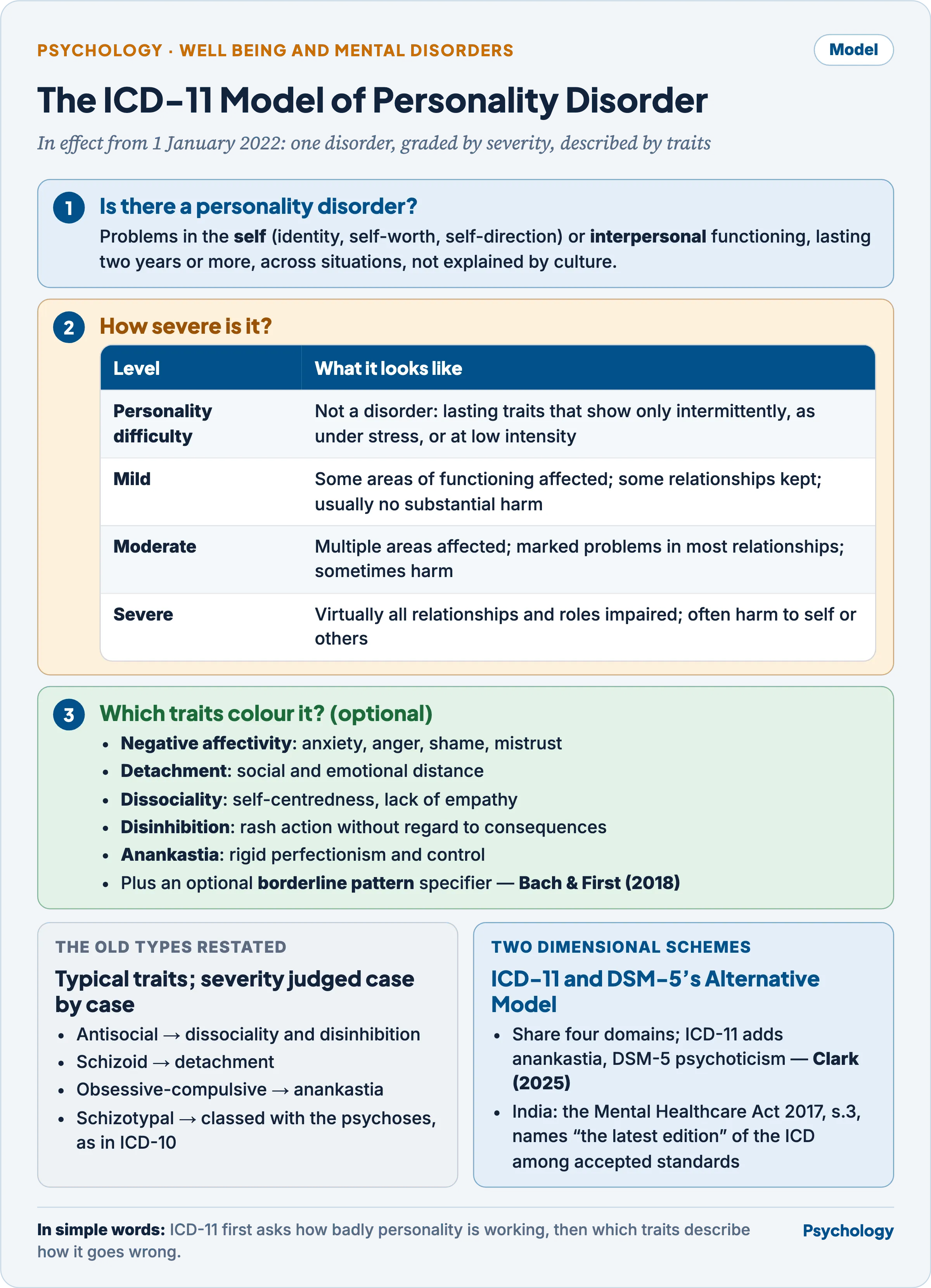
ICD-11 asks two questions — how severe, then which traits — and the old type names fall away.
- ICD-11 abolishes the types: one personality disorder, graded mild, moderate or severe, with personality difficulty below threshold.
- Five optional trait domain specifiers: negative affectivity, detachment, dissociality, disinhibition and anankastia; a borderline pattern specifier survives for clinical utility (Bach and First, 2018), and schizotypal disorder stays with the psychoses, as in ICD-10.
- Severity is set case by case: Bach and First recode an ICD-10 dissocial case as “severe personality disorder with dissociality and disinhibition”.
- The two dimensional schemes share four domains; ICD-11 adds anankastia, the Alternative Model psychoticism (Clark, 2025).
Criticisms and limitations
- Arbitrary thresholds. Five of nine criteria allow 256 combinations for one borderline diagnosis, so two patients can share a label and few features; comorbidity is the rule.
- Clusters lack a genetic basis. Kendler and colleagues (2008) found genetic factors in Norwegian twins cutting across all three clusters, though environmental factors followed them.
- “Enduring” is overstated. Zanarini and colleagues (2010) followed 290 borderline inpatients for ten years: 93 per cent achieved two-year symptomatic remission, but only 50 per cent recovered good social and vocational functioning.
- Stigma. Lewis and Appleby (1988) gave psychiatrists vignettes: a prior personality disorder label made the same patient seem manipulative and less deserving of care.
- Disorder or deviance? Ego-syntonic traits that trouble mainly others risk turning disapproval into diagnosis — the harmful-dysfunction problem.
- Cultural validity. Criteria built on individualist norms travel uncertainly, and low rates in poorer countries may reflect method as much as reality (Winsper and colleagues, 2020).
- Circularity. Defining psychopathy partly by offending makes its link to crime circular (Skeem and Cooke, 2010).
- Pessimism is unwarranted given these remission rates; rehabilitation is in Prevention and Rehabilitation of the Mentally Ill (Unit 3).
Indian context
- The National Mental Health Survey 2015–16 used MINI 6.0 and reported only ICD-10 groups F10–F48, so personality disorders were not estimated (Pradeep and colleagues, 2018).
- Community and clinic data.
- Reddy and Chandrashekar (1998), meta-analysing 13 Indian surveys of 33,572 people, found personality disorders, counted in seven, significantly commoner in males, at a weighted prevalence of only 0.6 per 1,000.
- Gupta and Mattoo (2012) found 1.07 per cent across ten years of a North Indian general-hospital psychiatric clinic, anxious-avoidant and borderline commonest.
- Sharan (2010) attributes such low rates to insensitive screening and unstructured diagnosis: Naidu and Issac (1999) confirmed only 36.3 per cent of clinically diagnosed inpatients on structured interview.
- NIMHANS was one of 14 centres in 11 countries in the WHO field trial of the International Personality Disorder Examination (Loranger and colleagues, 1994), which established reliable assessment across cultures.
- Prisons.
- Math and colleagues (2011) assessed 5,024 prisoners at Bengaluru Central Prison for NIMHANS: about 15 in 100 under-trials had antisocial personality disorder, seven to eight times the general rate.
- Ayirolimeethal and colleagues (2014) found 19.2 per cent among 255 prisoners in Kozhikode.
- Mental Healthcare Act, 2017 (Ministry of Health and Family Welfare).
- Section 3 requires diagnosis by accepted standards notified by the Centre, “including the latest edition of the International Classification of Disease” — the route for ICD-11’s model.
- Section 3(3)(b) bars diagnosis from “non-conformity with moral, social, cultural, work or political values” — the principle that deviance is not disorder.
- Bharatiya Nyaya Sanhita, 2023, section 22 (Ministry of Home Affairs; in force 1 July 2024, replacing IPC section 84).
- It excuses only a person “incapable of knowing the nature of the act” or its wrongness — a cognitive test that leaves psychopathy, with knowledge of wrong intact, outside the defence.
- Prakash Nayi v. State of Goa (2023) restated that the test is legal, not medical, insanity.
- Sharan and colleagues (2023), in Indian Psychiatric Society guidelines, map borderline disorder onto ICD-11’s moderate or severe disorder with borderline pattern, and note a Hindi version of the examination.
- Sharan (2010) observes that the label’s connotation of immutability sits uneasily with non-Western traditions, Indian among them, stressing the perfectibility of human nature; the relational self is in Culture, Child-Rearing and the Indian Self (Paper I).
Previous Year Questions
- 2025Critically evaluate the conditioning model of psychopathic personality disorder.
- 2019Why is Narcissistic personality disorder considered as a personality disorder? What are the obstacles faced by the clinicians to treat these types of clients?
- 2017Explain psychopathic personality and state how it is related to deviant behaviour.
- 2012What do you understand by ‘personality disorders’? Distinguish between schizoid personality disorder and schizophrenia.
- 2011Explain paranoid and schizoid personality disorders.
- 2005Write a short note on: Personality Disorder.
- 1999Discuss the common characteristics of psychopathic personality.