

Religion without God.
Official Syllabus: Paper II, Section B, Unit 7
Religion without God in India is not limited to the “heterodox” Jainas and Buddhists. Two of the six orthodox (āstika) schools — Sāṃkhya and Pūrva Mīmāṃsā — accept the authority of the Veda and yet have no creator God. Sāṃkhya explains the whole universe by the unconscious evolution of Prakṛti for the sake of conscious Puruṣas, and says simply that “God is not proved” (īśvarāsiddheḥ). Mīmāṃsā builds a complete religion of Vedic ritual — sacrifices, deities, heaven — in which the Veda has no author, the gods are little more than names in the mantras, and the ritual brings its fruit by its own unseen power (apūrva), with no God to dispense it. Even Advaita Vedānta places the personal God below the impersonal Brahman. This article examines these orthodox non-theisms, contrasts them with the Cārvāka, who rejected not only God but religion itself, and compares liberation with and without God.
In simple words
Imagine a cricket match with no umpire. Usually that would be chaos. But suppose the rules are written into the ball and the bat themselves — a no-ball always signals itself, a boundary always counts. Then the match runs perfectly without an umpire. Mīmāṃsā thought the Vedic ritual was like that: the rule (the Veda) is eternal, and the result follows from the act itself. The umpire — God — is simply not needed.
Context & Problem
Non-theism inside Orthodoxy
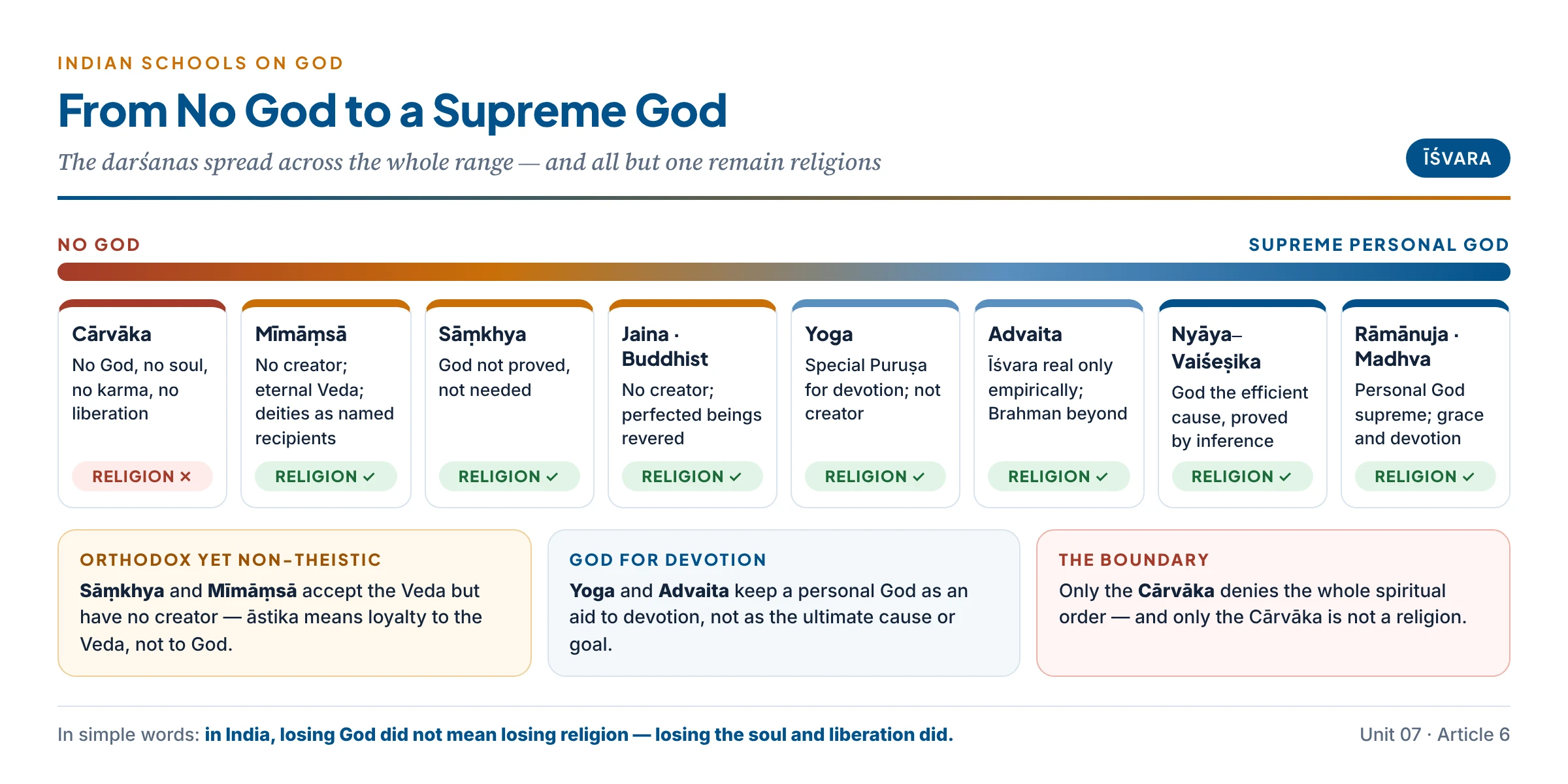
- Orthodox does not mean theistic. The six orthodox systems (āstika darśanas) — Nyāya, Vaiśeṣika, Sāṃkhya, Yoga, Mīmāṃsā and Vedānta — are defined by acceptance of the Veda, not of God. Their positions on Īśvara range from none to supreme.
- Why this matters. It shows that the Indian religious tradition — even its most Veda-loyal schools — did not regard a creator God as essential to religion. Non-theism is not only a “heterodox” protest but a mainstream option within Hindu thought.
- The spectrum of Indian positions on God.
- Cārvāka — no God, no soul, no karma, no liberation: atheism without religion.
- Mīmāṃsā — no creator; eternal Veda; gods as recipients named in rituals; ritual religion without God.
- Sāṃkhya — God not proved and not needed; liberation religion without God.
- Jainism and Buddhism — no creator; perfected beings revered (Articles 4–5).
- Yoga — a special soul (Īśvara) as an object of devotion and an aid to meditation, but not creator.
- Advaita — the personal God (Īśvara) real only at the empirical level; the ultimate is impersonal Brahman.
- Nyāya–Vaiśeṣika — God as efficient cause of the world, proved by inference.
- Rāmānuja and Madhva — a personal God as the supreme reality, the object of devotion and the giver of grace.
Core Doctrine
1. Classical Sāṃkhya: “Because God Is Not Proved”
- Nirīśvara Sāṃkhya. Classical Sāṃkhya is non-theistic (nirīśvara, “without a Lord”). Īśvarakṛṣṇa‘s Sāṃkhya Kārikā (the classical text) never mentions God; the later Sāṃkhya Sūtra states the reason in two words: “because God is not proved” (īśvarāsiddheḥ).
- Not dogmatic atheism. Sāṃkhya is not “atheistic” in the sense of trying to prove that God cannot exist, as the Cārvāka and the later Jaina and Buddhist logicians do. It only shows that there is no reason for supposing there is one: God is not perceived, not validly inferred, and not taught by the Veda.
- The Vedic passages. Being orthodox, Sāṃkhya must explain Vedic verses that seem to speak of a Lord. It reads them as eulogies of liberated souls or of perfected beings endowed with supernatural yogic powers, not as evidence of a creator.
- Prakṛti and Puruṣa are enough.
- Prakṛti — unconscious primal nature, made of the three guṇas (sattva, rajas, tamas). When their balance is disturbed, Prakṛti evolves (prakṛti-pariṇāmavāda) into intellect, ego, mind, senses and the elements — the whole world.
- Puruṣas — innumerable pure consciousnesses, eternally inactive witnesses.
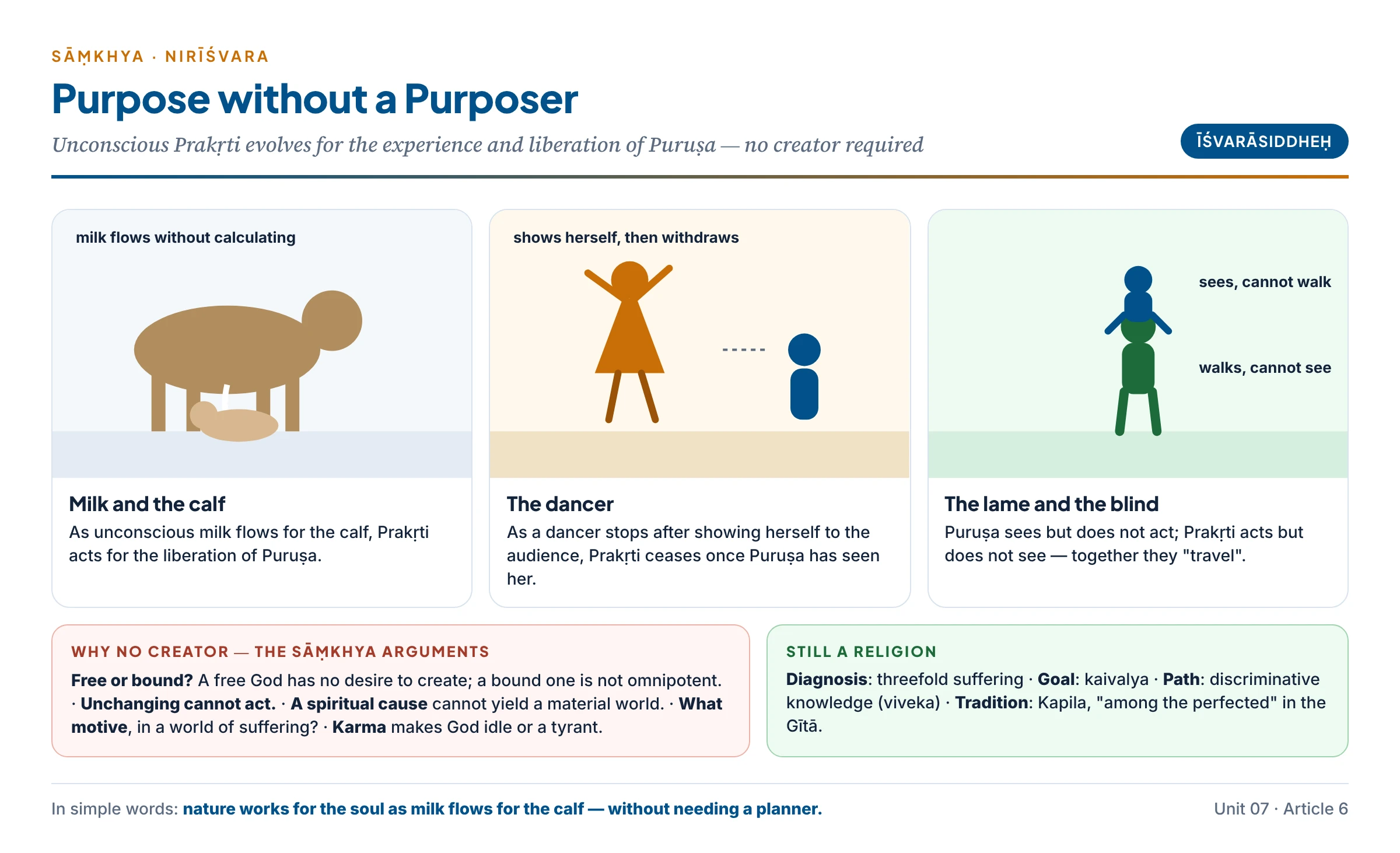
- Why does Prakṛti evolve? For the experience (bhoga) and the liberation (apavarga) of the Puruṣas. Prakṛti has an inherent, blind purpose — teleology without a conscious designer.
- The analogies of blind purpose.
- Milk and the calf. “As unconscious milk flows for the nourishment of the calf, so Prakṛti acts for the liberation of the Puruṣa.”
- The dancer. “As a dancer ceases to dance after showing herself to the audience, so Prakṛti ceases after manifesting herself to the Puruṣa.”
- The lame and the blind. Puruṣa (conscious but inactive) and Prakṛti (active but unconscious) co-operate like a lame man riding on the shoulders of a blind man — the one sees, the other walks.
- The Sāṃkhya arguments against a creator.
- The free-or-bound dilemma. Is God liberated or bound? If liberated, he has no desire and would not create; if bound, he is ignorant and limited like us, not omnipotent.
- The unchanging cannot act. An eternal, immutable God cannot be the active cause of a changing world; only a changing cause — Prakṛti — can.
- Not the material cause. By satkāryavāda (the effect pre-exists in its cause), a material, changing world cannot come from a spiritual, unchanging God.
- What motive? Not his own good — a perfect being lacks nothing; not the good of others — a world so full of suffering shows no such kindness.
- Karma. If God follows karma, karma is enough and God is idle; if not, he is a tyrant.
- The souls. If souls are parts of God, they should share his powers; if created by him, they could be destroyed — but the Puruṣas are eternal.
- Why Sāṃkhya is a religion.
- A diagnosis — threefold suffering: from oneself (ādhyātmika — bodily and mental), from other beings (ādhibhautika), and from supernatural or natural forces (ādhidaivika).
- A goal — kaivalya, the “isolation” of Puruṣa from Prakṛti, the final end of suffering.
- A path — discriminative knowledge (viveka, vivekakhyāti) that the self is not the body-mind.
- A tradition — Kapila as the first teacher, honoured even in the Gītā (“among the perfected, I am the sage Kapila”).
- Later theistic Sāṃkhya. Vijñānabhikṣu (16th century) argued that Sāṃkhya denies only an active creator; God may be admitted as the eternally perfect spirit whose mere presence stirs Prakṛti, as a magnet moves iron.
In simple words
A mother cow does not calculate that her calf needs milk — the milk simply flows when the calf is near. Sāṃkhya says nature is like that milk: it works for the soul’s good without knowing it, and so it needs no planner behind it. The theist’s reply is that milk flows only because the cow is alive and loves her calf — and that is exactly the point in dispute.
Common confusion
Does modern cosmology prove Sāṃkhya right that no creator is needed? Some notes claim that the Big Bang and the second law of thermodynamics, by showing a mechanical origin of the universe, rule out a creator, as Sāṃkhya did. This is too quick. A temporal beginning of the universe is actually used by theists (the kalām argument) as evidence for a creator; and Sāṃkhya itself held that Prakṛti is beginningless, not that the world began in a single event. Science describes how the universe evolves; it neither proves nor disproves a creator. Sāṃkhya’s real point is philosophical: an explanation by nature’s own powers leaves God with no work to do.
2. Yoga: God Added for Devotion, Not for Creation
- Same world-picture. Patañjali’s Yoga accepts the whole Sāṃkhya metaphysics — Prakṛti, Puruṣas, evolution, liberation by discrimination.
- But adds Īśvara. Īśvara is “a special Puruṣa, untouched by afflictions, actions, their fruits and latent impressions” — eternally free, the teacher even of the ancient teachers, expressed by the sacred syllable Om.
- His role.
- Not creator — Īśvara does not create Prakṛti or the souls.
- Object of devotion — “devotion to the Lord” (Īśvara-praṇidhāna) is one of the means to concentration (samādhi), offered as an alternative path.
- Remover of obstacles — devotion to him helps remove the obstacles to meditation.
- What it shows. Yoga moves away from Sāṃkhya’s strict non-theism by admitting a supreme consciousness, but only as a practical aid to the religious life. A system can be complete without God as cosmic cause and still find God useful for devotion — the same pattern seen in Advaita and in Mahāyāna Buddhism.
3. Pūrva Mīmāṃsā: Ritual Religion without God
- The concern of Mīmāṃsā is dharma — the rightness of Vedic action. “Dharma is that good which is known through the Vedic injunction.” Its whole effort is to interpret the Veda’s commands correctly and to show that the ritual works.
- The eternal, authorless Veda (apauruṣeyatva).
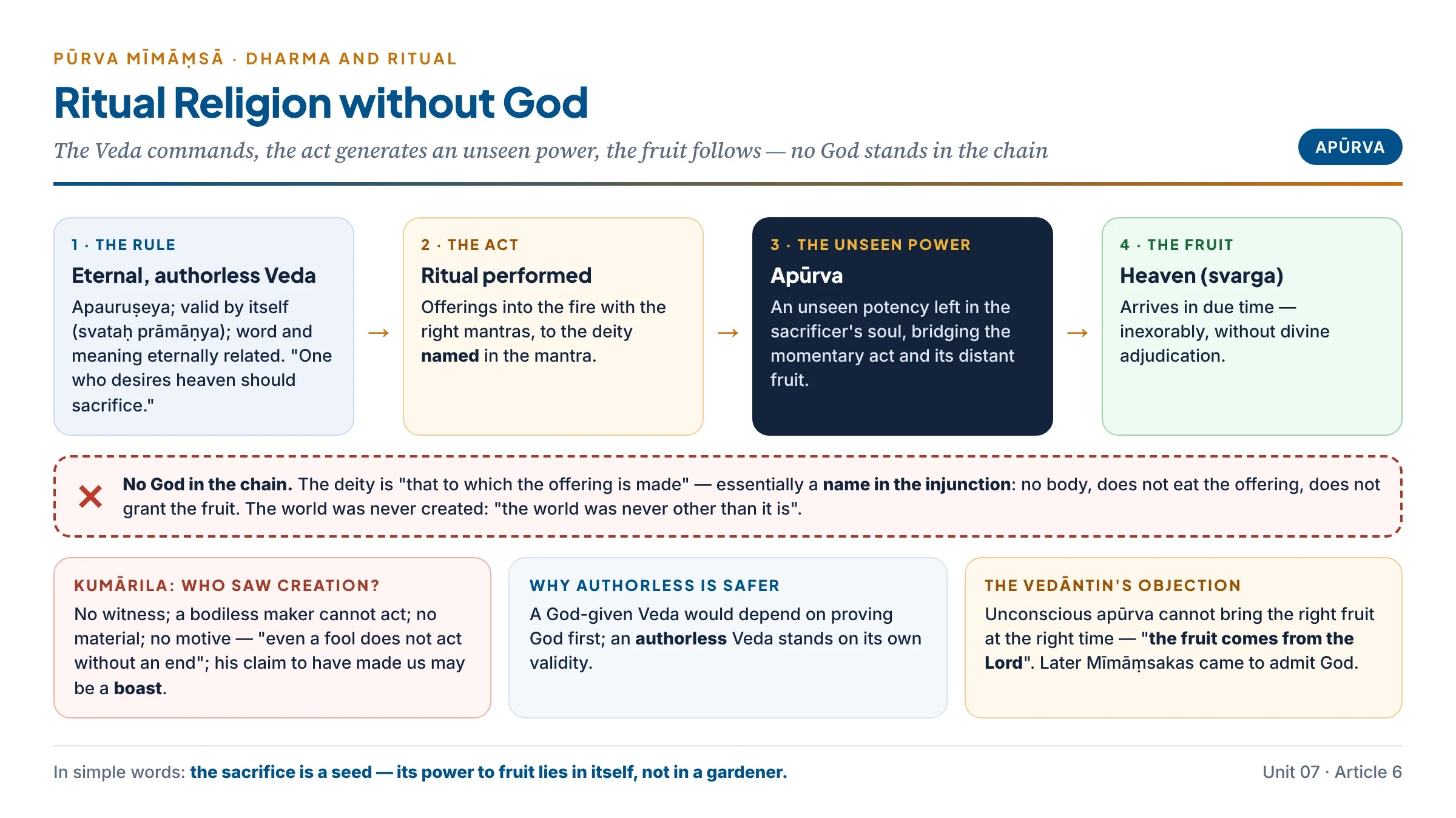
- The Veda is eternal, beginningless and authorless — neither human nor divine. Its validity is intrinsic (svataḥ prāmāṇya): it needs no author to vouch for it.
- The relation between a word and its meaning is also eternal; it was never fixed by anyone.
- If God were the author of the Veda, its authority would depend on God’s reliability — and God’s existence would have to be proved first. An authorless Veda is more secure than a God-given one.
- Apūrva — the unseen potency. A sacrifice performed now may bring its fruit (heaven, svarga) only after death. How can a momentary act produce a distant result? Mīmāṃsā answers: the act generates an unseen potency (apūrva) in the sacrificer’s soul, which inexorably produces the fruit at the right time. No divine adjudication is needed — the moral and ritual order works by itself.
- The gods without God.
- Mīmāṃsā keeps the Vedic deities — Indra, Agni and others — but in a surprising way. A deity (devatā) is simply that to which the offering is directed, as specified by the mantra.
- Mīmāṃsakas argued that the gods have no bodies, do not literally eat the offerings, and do not grant the fruits; the deity exists for the ritual essentially as a name in the injunction (śabda-mātra).
- The sacrifice does not work by pleasing a god; it works by its own power (through apūrva).
- No creation, no dissolution. The world was never created and will never be wholly dissolved: “the world was never other than it is” (na kadācid anīdṛśaṃ jagat). Things come and go within the world, but the world as a whole has no beginning.
- Kumārila’s arguments against a creator (7th century; Unit 02):
- No witness — before creation there was no one to see the creator or tell others about him.
- The body dilemma — a bodiless creator cannot desire or act; an embodied one needs a maker of his own body.
- No material, no means — even the spider spins from saliva produced by the flies it eats.
- The motive dilemma — not compassion (there were no beings to pity, and a compassionate creator would make only happy beings); not play (a contented being needs no amusement); “without some end in view, even a fool does not act“.
- His own word proves nothing — if the creator told the first beings “I made you”, he might be boasting.
- Creation passages are praise (arthavāda) meant to encourage action, not literal history.
- Why Mīmāṃsā is remarkable for this unit. It is a religion of sacrifice, mantra, deities and heaven — everything that seems most “religious” in the ordinary sense — yet it has no supreme God. It shows that even ritual and worship can exist without a creator.
- Later developments. Śaṅkara and the Vedāntins criticised Mīmāṃsā: an unconscious apūrva cannot by itself bring the right fruit at the right time; “the fruit comes from the Lord“. Some later Mīmāṃsakas came to admit God as the one to whom all acts are offered — a sign of the theistic pressure within Indian thought.
In simple words
A seed planted today becomes a tree years later — no gardener has to remember to turn the seed into a tree; the power is in the seed. Mīmāṃsā said the sacrifice is like the seed: it leaves an unseen power (apūrva) that ripens into its fruit in due time. The god named in the mantra is like the name written on the seed packet — necessary for planting correctly, but not the one who makes the seed grow.
4. Advaita Vedānta: The Personal God below the Impersonal Absolute
- Brahman beyond God. For Śaṅkara, the ultimate reality is Brahman — pure, attributeless (nirguṇa) consciousness, beyond all distinctions. It is not a person who creates, judges or loves.
- Īśvara — God for the empirical world. Brahman, seen through the lens of māyā, appears as Īśvara — the personal Lord, creator, sustainer and dispenser of karma. Īśvara is real at the empirical level (vyāvahārika), where the world itself is real; but from the transcendental standpoint (pāramārthika), even Īśvara is an appearance of Brahman.
- Liberation by knowledge. Mokṣa is the realisation “I am Brahman” (ahaṃ brahmāsmi) — the disappearance of the distinction between worshipper and worshipped. Devotion (bhakti) to Īśvara is a valuable means of purifying the mind, but knowledge (jñāna) alone liberates.
- Significance. Advaita is not atheistic — it affirms Īśvara. But it shows that within the greatest Hindu philosophy the personal God is not ultimate. Religion’s final goal is an impersonal reality — a kind of supra-theism in which God is a stage on the way, not the end.
In simple words
A single white light in a cinema projector appears on the screen as a king on a throne. While you watch the film, the king is real enough — you fear him, admire him, pray for him to win. When the film ends, there is only the light. For Advaita, Īśvara is the king on the screen: real while the world-film runs, but at the end there is only Brahman, the light.
5. The Cārvāka: Atheism without Religion
- Global atheism. The Cārvāka (Lokāyata) rejects not only God but every suprasensible entity: the soul (consciousness is a product of the body, as intoxicating power arises from fermented ingredients), karma, rebirth, heaven and hell, liberation, and the authority of the Veda — whose authors it called “buffoons, knaves and demons“.
- Its arguments. Perception alone is valid; inference cannot establish a universal rule for what is never perceived; everything happens by its own nature (svabhāva) — “Fire is hot, water is cold, the wind is cool to the touch: by whom was this variety made? It comes from their own nature.”
- Its ethics. The goal of life is pleasure (kāma), with wealth (artha) as its means; “while life is yours, live joyously”.
- Is the Cārvāka a religion? No — and the contrast is instructive. It has no sacred, no goal beyond worldly happiness, no path of self-transcendence, no community of worship. It shows that what makes Jainism, Buddhism, Sāṃkhya and Mīmāṃsā religions is not belief in God but belief in a spiritual order — soul, karma, liberation — which the Cārvāka alone denies.
- Its value. As a critic, the Cārvāka forced every other school to justify its belief in suprasensible realities; its demand for evidence is the Indian ancestor of modern scepticism (Paper I, Cārvāka unit).
Indian Connect — Ṛta: a moral order older than the gods
- Already in the Ṛg Veda, the cosmic and moral order ṛta is something the gods guard and follow — Varuṇa is its guardian, not its author. The idea of an impersonal moral law that binds even the gods runs from ṛta to dharma and karma.
- This is why Indian non-theism could keep morality and justice without God: the moral order was never thought to be a divine invention in the first place.
6. Liberation with and without God: Is There an Essential Difference?
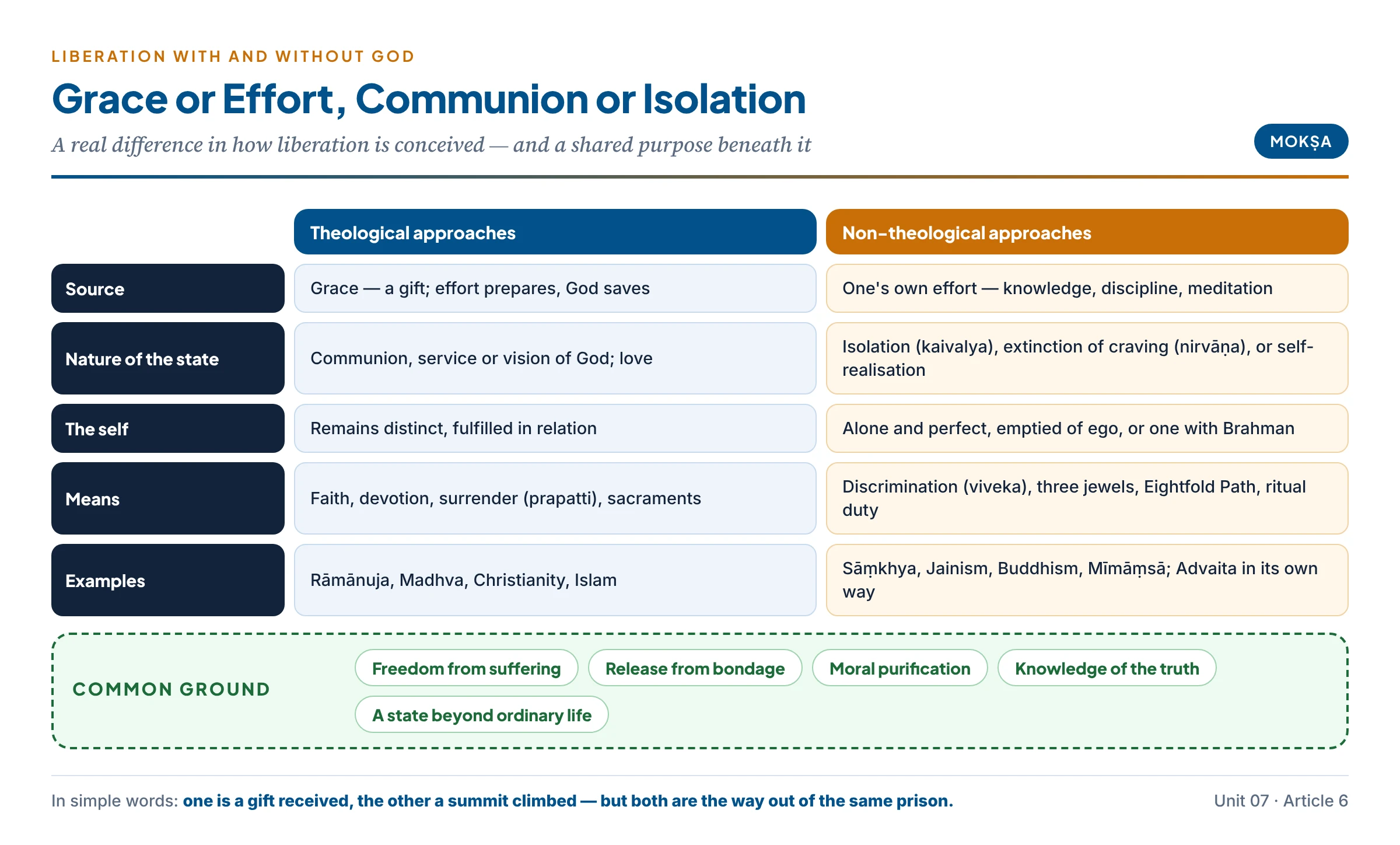
- Theological approaches (Rāmānuja, Madhva, Christianity, Islam):
- Source — liberation is a gift of grace; human effort prepares but God saves.
- Nature — a relation: communion with God, service of God, the vision of God; the self remains distinct and finds its fulfilment in love.
- Means — faith, devotion, surrender (prapatti), sacraments.
- Non-theological approaches (Sāṃkhya, Jainism, Buddhism, Mīmāṃsā’s heaven, and in its own way Advaita):
- Source — the self’s own effort: knowledge, discipline, austerity, meditation.
- Nature — isolation (kaivalya of Puruṣa; the Jaina soul alone at the Siddhaśilā), extinction of craving (nirvāṇa), or realisation of one’s true nature (Advaita); no relation to a Lord.
- Means — discrimination (viveka), the three jewels, the Eightfold Path, ritual duty.
- The essential difference lies in source and form: grace versus effort; relationship versus isolation or realisation.
- The deep agreement. Both seek freedom from suffering and bondage; both require moral purification and knowledge; both point to a state beyond ordinary experience. In practice, too, they mix: Yoga and Advaita add devotion; Mahāyāna adds grace; theistic schools demand effort.
- Verdict. There is a real difference in how liberation is conceived, but not in what religion is for. Both are forms of the same human quest: release from a radically unsatisfactory condition into a limitlessly better one.
7. Rebirth in the Anti-theistic Religions
- The question. Is it philosophically significant that the anti-theistic religions (Jainism, Buddhism, Sāṃkhya, Mīmāṃsā) all keep karma and rebirth?
- Yes, for three reasons.
- Justice without a judge. Rebirth lets karma bear fruit across lives, explaining unequal fortunes at birth without blaming God — a non-theistic theodicy (Unit 03).
- Moral seriousness. Without God, rebirth keeps the long-term consequences of conduct real; morality is not left to this life alone.
- A religious horizon. Rebirth gives the non-theistic religions a beyond — the cycle to be escaped — and so a goal (liberation) that makes them religions rather than mere ethics.
- Different models. Jainism and Sāṃkhya keep an eternal soul that transmigrates; Buddhism has rebirth without a soul — a causal stream passing on like a flame from lamp to lamp (Article 4; Unit 04).
- Critique. Theists ask how karma can operate across lives without a conscious dispenser, and critics ask for evidence of rebirth; but as a structure of religious thought, karma-and-rebirth is what allows Indian religion to be fully religious without God.
Critical Evaluation
Assessing Indian Non-theism
- Strengths.
- Economy — Sāṃkhya and Mīmāṃsā explain the world and the ritual order without postulating a being no one perceives.
- Freedom from the problem of evil — no all-good creator is charged with the world’s suffering.
- Moral realism without command — ṛta, dharma, karma and apūrva make morality part of the structure of reality, not an arbitrary decree.
- Religious completeness — each system has a diagnosis, a goal, a path and a tradition.
- Weaknesses (pressed mainly by Nyāya and Vedānta).
- Unconscious purpose — Prakṛti, apūrva and karma are unconscious; can they really act purposefully and precisely? Milk flows only in a living cow (Śaṅkara).
- The first disturbance — what moves Prakṛti from equilibrium if not an intelligent being?
- An authorless text — the idea of words without a speaker is hard to defend; most of the world’s texts have authors.
- Gods as mere names — Mīmāṃsā’s deities seem to empty worship of its meaning.
- The pressure towards theism — later Sāṃkhya (Vijñānabhikṣu), later Mīmāṃsā and Yoga all brought God back in some form, suggesting that pure non-theism was hard to sustain.
Critics and Defenders
Criticism — Critics of orthodox non-theism
- Śaṅkara: unconscious Prakṛti cannot act purposefully; milk flows only from a living cow.
- Vedāntins: unconscious apūrva cannot deliver the right fruit — “the fruit comes from the Lord”.
- Nyāya: the order of the world and of karma needs an intelligent controller.
- Theists: gods reduced to names in a mantra make worship empty.
- History: later Sāṃkhya, Mīmāṃsā and Yoga all admitted God in some form.
Defence — Defenders of Indian non-theism
- Sāṃkhya: God is not proved; Prakṛti and the Puruṣas explain everything.
- Kumārila: no witness, no material, no motive — and an eternal Veda needs no author.
- Ṛta, dharma, karma: the moral order binds even the gods; it was never God’s invention.
- Advaita: even Īśvara is an appearance of the impersonal Brahman.
- Religious completeness: each system offers a diagnosis, a goal, a path and a tradition.
Cross-Tradition Comparison
The Orthodox Non-theisms Compared
| Point | Sāṃkhya | Mīmāṃsā | Advaita |
|---|---|---|---|
| God | Not proved, not needed | No creator; deities as named recipients | Īśvara real only empirically |
| Ultimate | Many Puruṣas; Prakṛti | Eternal Veda and dharma | Impersonal Brahman |
| What runs the world | Prakṛti’s blind purpose | Its own eternal order; apūrva for ritual | Brahman through māyā (as Īśvara) |
| Goal | Kaivalya | Heaven (later, liberation) | Mokṣa — “I am Brahman” |
| Means | Discriminative knowledge | Vedic ritual duty | Knowledge, with devotion as purifier |
Indian and Western Non-theism
| Point | Indian non-theism | Western non-theism (Articles 7–8) |
|---|---|---|
| Spiritual realities | Kept — soul, karma, rebirth, liberation | Mostly rejected — naturalism |
| The sacred | Liberation, dharma, perfected souls | Humanity, society, nature, objective value |
| Orientation | Inward — ascetic, contemplative | Outward — social, scientific, humanist |
| Moral order | Cosmic (ṛta, karma) | Human (reason, solidarity) |
| Goal | Release from rebirth | Human flourishing in this world |
| Historical status | Ancient, living religions | Modern proposals, few followers |
Indian Connect — Takeaways
- Orthodoxy in India meant loyalty to the Veda, not to God; two orthodox schools had no creator at all.
- Mīmāṃsā proves that even ritual and deities can exist without a supreme God; Sāṃkhya proves that a complete liberation-religion can.
- What separates religion from irreligion in India is not God but belief in a spiritual order — which only the Cārvāka denied.
Synthesis (Siddhānta)
- Indian non-theism is varied and orthodox. Sāṃkhya keeps the soul and liberation but finds God unproved; Mīmāṃsā keeps the Veda, ritual and deities but finds a creator unnecessary; Advaita keeps God but places him below the impersonal Absolute; Yoga adds God only as an aid to devotion.
- The Cārvāka marks the boundary: deny God and the spiritual order, and religion disappears. Deny God alone, and religion remains — as Sāṃkhya, Mīmāṃsā, Jainism and Buddhism show.
- Liberation with and without God differ in source (grace or effort) and form (communion or isolation and realisation), but agree in purpose — release from suffering into a higher state.
- The theistic critique — that unconscious nature, karma and apūrva cannot act purposefully — is serious, and the later re-entry of God into Sāṃkhya, Mīmāṃsā and Yoga shows its force. But it does not undo the main lesson: in India, religion was never defined by a creator God.
- Contemporary relevance.
- Naturalism in science echoes Sāṃkhya’s “nature is enough” — while leaving the question of meaning to philosophy and religion.
- The idea of an impersonal moral order (ṛta, karma) offers a resource for secular ethics grounded in consequences.
- Indian secularism and law, which treat non-theistic faiths as full religions, draw on this long history.
“As unconscious milk flows for the nourishment of the calf, so Prakṛti acts for the liberation of the Puruṣa.” — Sāṃkhya Kārikā
Previous Year Questions
- 2025Discuss Cārvāka’s critique of the belief in the existence of suprasensible entities.
- 2018How far is it plausible to argue that the anti-theistic religions’ stand on the concept of rebirth is philosophically significant?
- 2017Is there an essential difference between the concept of Liberation in theological and non-theological approaches to life? Discuss.
- 1992“There is no need for God in Sāṃkhya and Yoga systems, as these are fully consistent even without the idea of God.” Notes.