

Religion without God.
Official Syllabus: Paper II, Section B, Unit 7
Jainism is perhaps the purest example of a religion without a creator God — and, at the same time, a religion full of divinity. Jainas hold that the universe is uncreated and eternal, that karma is a kind of fine matter that binds the soul and falls away by the soul’s own effort, and that no being made the world or governs it. Yet Jainas build some of India’s most magnificent temples, worship the Tīrthaṅkaras daily, go on pilgrimage, keep fasts and festivals, and call the liberated souls God (paramātman). The key is that for Jainism God is not the maker of the world but the goal of every soul: “the soul itself is the Supreme Soul“. This article sets out the Jaina uncreated universe, the Jaina arguments against a world-maker, the Jaina idea of God as the perfected soul and its “proofs” of an omniscient being, the meaning of worship directed to beings who cannot answer it, the path of liberation by self-purification, and the question whether Jainism is a religion or merely an ethical code.
In simple words
In a school, the toppers’ photos hang on the wall. No student thinks the toppers set the exam or will mark his paper; they cannot even see him. Yet students look at the photos every morning — not to beg for marks, but to remind themselves: “they did it; I can do it too“. Jaina temples are like that wall. The Tīrthaṅkaras are the toppers of the spiritual path, not the examiners. Every soul is a student who can become what they became.
Context & Problem
The Jaina Tradition
- Jainism is the religion of the Jinas — “conquerors” who have conquered attachment and aversion. Its followers are Jainas, “followers of the conquerors”.
- The Tīrthaṅkaras. Jainism recognises twenty-four Tīrthaṅkaras (“ford-makers” — those who make a crossing over the river of rebirth) in our present time-cycle, from Ṛṣabha (Ādinātha) to Pārśva (23rd) and Mahāvīra (24th, 6th–5th century BCE, a contemporary of the Buddha). They are human teachers who reached perfection and showed the way.
- Two sects. Digambara (“sky-clad”, whose monks renounce even clothing) and Śvetāmbara (“white-clad”); both reject a creator God.
- The question. If there is no creator, no ruler and no giver of grace, what do Jainas worship, and is Jainism a religion at all — or, as some Western writers called it, only a rigorous ethical code?
Core Doctrine
1. The Uncreated, Eternal Universe
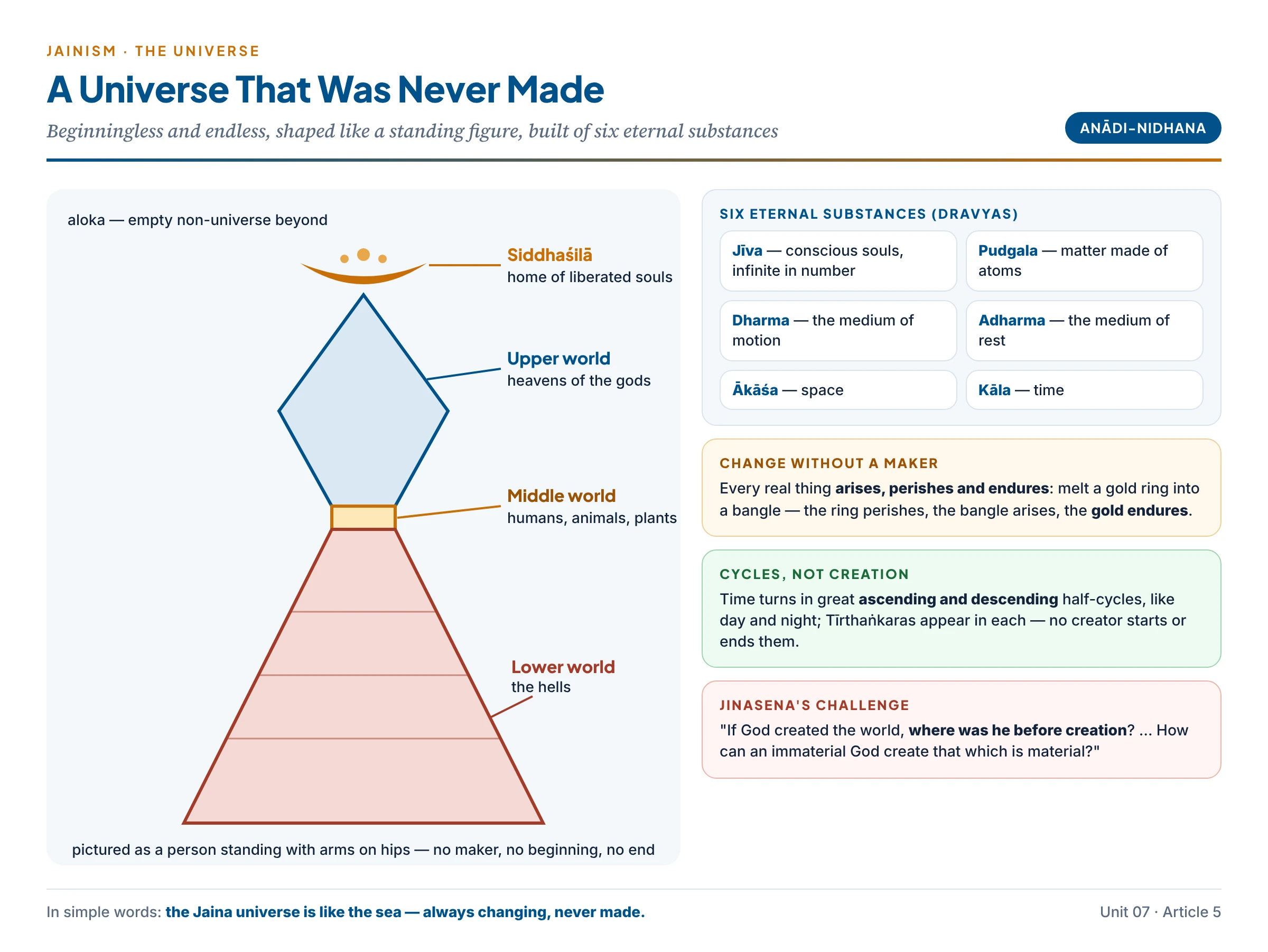
- Beginningless and endless. The universe is anādi-nidhana — without beginning and without end. It was never created and will never be destroyed as a whole.
- Made of six eternal substances (dravyas).
- Jīva — souls, conscious, infinite in number;
- Pudgala — matter, made of atoms;
- Dharma — the medium of motion;
- Adharma — the medium of rest;
- Ākāśa — space;
- Kāla — time.
- Eternal substances, changing modes. These substances, the sentient jīva and the non-sentient ajīva, are eternal; only their modes change (Paper I, Jaina unit).
- Change without a maker. Every real thing arises, perishes and endures (utpāda-vyaya-dhrauvya): a gold ring is melted (its ring-form perishes), a bangle is made (a new form arises), but the gold endures. The world changes ceaselessly by the nature of its substances, not by anyone’s will.
- Cosmic cycles without creation. Time moves in great ascending and descending half-cycles (utsarpiṇī and avasarpiṇī), in which human life rises and declines and Tīrthaṅkaras appear in each cycle — but the cycles are natural, like day and night, not acts of a creator.
- The shape of the universe (loka). The inhabited universe is often pictured as a cosmic human figure standing with arms on hips: the lower world of hells, the middle world where humans live, the upper world of heavens — and at the very top, the crescent Siddhaśilā, where liberated souls dwell. Beyond it lies empty non-universe (aloka). No one made this shape; it is how reality is.
2. Jaina Arguments against a World-maker
The Jainas did not merely ignore God; they argued against a creator in detail (Unit 02).
- Jinasena’s verses (9th century, in the Mahāpurāṇa). “Some foolish men declare that a creator made the world. The doctrine that the world was created is ill-advised and should be rejected. If God created the world, where was he before creation? If you say he was transcendent then and needed no support, where is he now? … How could God have made this world without any raw material? If you say he made this first, and then the world, you are faced with an endless regress. … No single being had the skill to make this world — for how can an immaterial God create that which is material?”
- Hemacandra and Malliṣeṇa (12th–13th century) list the Nyāya claims — “there is a maker of the world; he is one; he is everywhere; he is independent; he is eternal” — as “obstinate fancies”, and refute them one by one:
- “There is a maker.” We perceive mountains and trees, but never their maker; the rule “every effect has a maker” holds for pots and houses, not for the world. And if the maker has a body, we should see it; if he has no body, he cannot act like a potter.
- “He is one.” Many agents can co-operate perfectly: bees build one hive, ants one anthill, many masons one palace. Unity of the work does not prove a single worker.
- “He is everywhere.” If God pervades everything, he must directly experience even hell and every impurity, and nothing is left outside him.
- “He is independent.” If he creates according to the karma of beings, he is not independent; if not, he is unjust, making some happy and others miserable for no reason.
- “He is eternal.” An eternal, unchanging God should produce all his effects at once and always; producing them at different times means he changes.
- Guṇaratna (15th century) shows that the Nyāya reason “being an effect” has no clear meaning that would prove a maker, and points out that wild grass and forest plants are products that no one planted.
- The motive and the problem of evil. If God created to satisfy a desire, he was imperfect; if out of play (līlā), he is frivolous — and cruel, since his play produces disease, torment and starvation. And “who made God?” — if God needs no maker, the world may need none either.
In simple words
Look at a beehive: thousands of perfect six-sided cells, one beautiful structure. Did one master-bee design it and order the rest? No — each bee follows its nature, and together they build one hive. The Jainas said the universe is like that: its order comes from the natures of countless eternal substances working together, not from one commander.
3. God in Jainism: The Perfected Soul
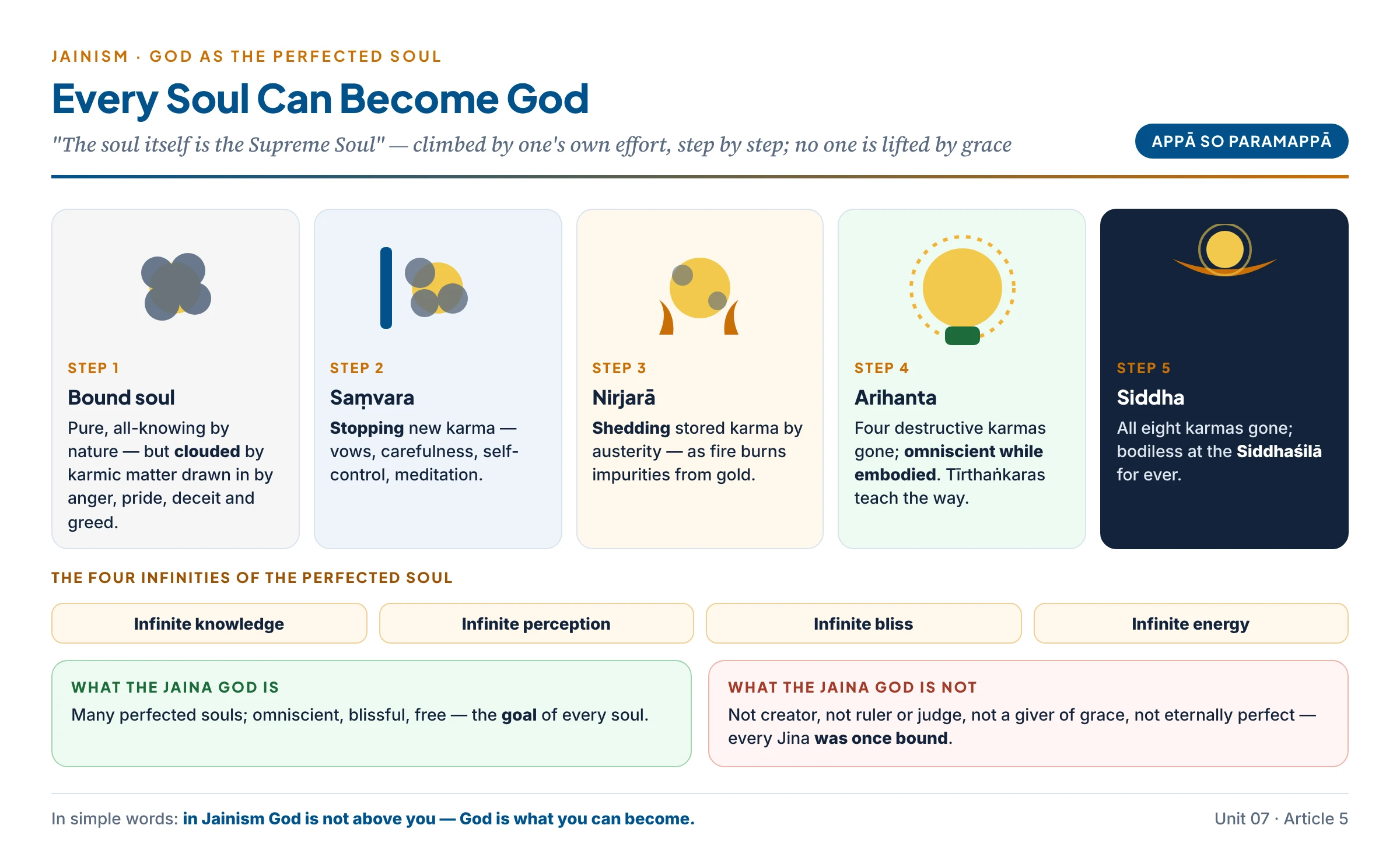
- Godhood without God. Jainism rejects a creator, not divinity. Every soul is by nature pure, conscious, blissful and all-knowing, but its natural qualities are covered by karmic matter, as the sun is covered by clouds. When the clouds are removed, the soul shines as it truly is — God.
- “The soul itself is the Supreme Soul” (appā so paramappā). There is no God above souls; God is what a soul becomes when it is perfect. So there are many Gods — as many as there are liberated souls — and every soul can become one.
- The four infinities (ananta-catuṣṭaya). A perfected soul possesses infinite knowledge, infinite perception, infinite bliss and infinite energy.
- Two grades of perfection.
- Arihanta (or arhat, “the worthy one”) — a soul that has destroyed the four destructive (ghātiya) karmas that obscure knowledge, perception, bliss and energy, and has become omniscient (kevalin) while still living in a body. The Tīrthaṅkaras are arihantas who teach the path and found the fourfold community.
- Siddha (“the perfected”) — a soul that, at death, has shed all eight kinds of karma, including those that bind it to a body. It rises to the Siddhaśilā at the summit of the universe, where it dwells forever in pure knowledge and bliss, free from body and from all activity.
- What the Jaina God is not.
- Not a creator — the universe was never created.
- Not a ruler or judge — karma works by itself.
- Not a giver of grace — a liberated soul is free from attachment (vītarāga) and free from aversion; it cannot be pleased by praise or angered by neglect, and so cannot grant favours or punish.
- Not eternally perfect — every Jaina God was once a bound soul who freed itself; this is the opposite of the Yoga Īśvara, a special Puruṣa never touched by bondage.
- The Namokāra mantra. The most sacred Jaina prayer salutes not persons but states of perfection: “I bow to the Arihantas; I bow to the Siddhas; I bow to the Ācāryas (heads of the order); I bow to the Upādhyāyas (teachers); I bow to all the Sādhus (monks) in the world.” It names no individual and asks for nothing — it honours virtue wherever it is found.
4. The Jaina “Proofs for the Existence of God”
- What is being proved. When UPSC asks for “the proofs for the existence of God as propounded in Jainism”, the honest answer is that Jainism proves the existence of an omniscient, perfected being — “God” in the Jaina sense — not of a creator.
- Samantabhadra’s inference (in his examination of the true teacher, the Āptamīmāṃsā): “Things that are subtle, hidden in time and distant in space are directly known by someone, because they are objects of inference — like fire on a hill.” Whatever we can only infer, someone better placed can see; so there must be a being who directly sees everything — the omniscient one.
- The argument from degrees and veils.
- Knowledge is seen to increase by degrees as obstacles are removed — a child knows less than a scholar, a scholar less than a sage.
- Knowledge is the nature of the soul, covered by karmic veils (jñānāvaraṇīya karma).
- As gold shines fully when its impurities are burnt away in fire, the soul’s knowledge shines fully when all veils are removed.
- What grows by degrees has a highest limit — omniscience (kevala-jñāna) — and the Tīrthaṅkaras have reached it.
- The argument from the teacher. The Jaina scriptures teach truths about the soul, karma and liberation that no ordinary mind could discover; their source must be a teacher who knew these truths directly — an omniscient arihanta.
- Evaluation.
- Strength — consistent with the doctrine that knowledge is the soul’s nature; parallels Yoga‘s argument from the degrees of knowledge and Aquinas‘s fourth way (degrees of perfection).
- Weakness — “inferable, therefore seen by someone” assumes that every knowable thing is in fact known by some mind; and a quantity that grows by degrees need not have an actual maximum (speed has degrees, but no one runs infinitely fast).
- What it shows about religion — Jainism keeps the perfections traditionally ascribed to God — omniscience, bliss, freedom — but gives them to perfected souls. It removes creatorship, oneness, omnipotence and grace.
Common confusion
Do Jainas offer “proofs for the existence of God” in the theistic sense? Many notes list “Jaina proofs for God” as: the world is eternal so needs no creator; the Tīrthaṅkaras have infinite knowledge; karma ensures justice. The first and third are actually arguments against a creator God. What Jainas prove is the existence of omniscient, liberated souls — by Samantabhadra’s inference and by the argument from the gradual removal of karmic veils. “God” in Jainism means the perfected soul (arihanta, siddha), many in number, who neither creates nor rules the world.
5. Worship without a Giver: Aspiration, Not Petition
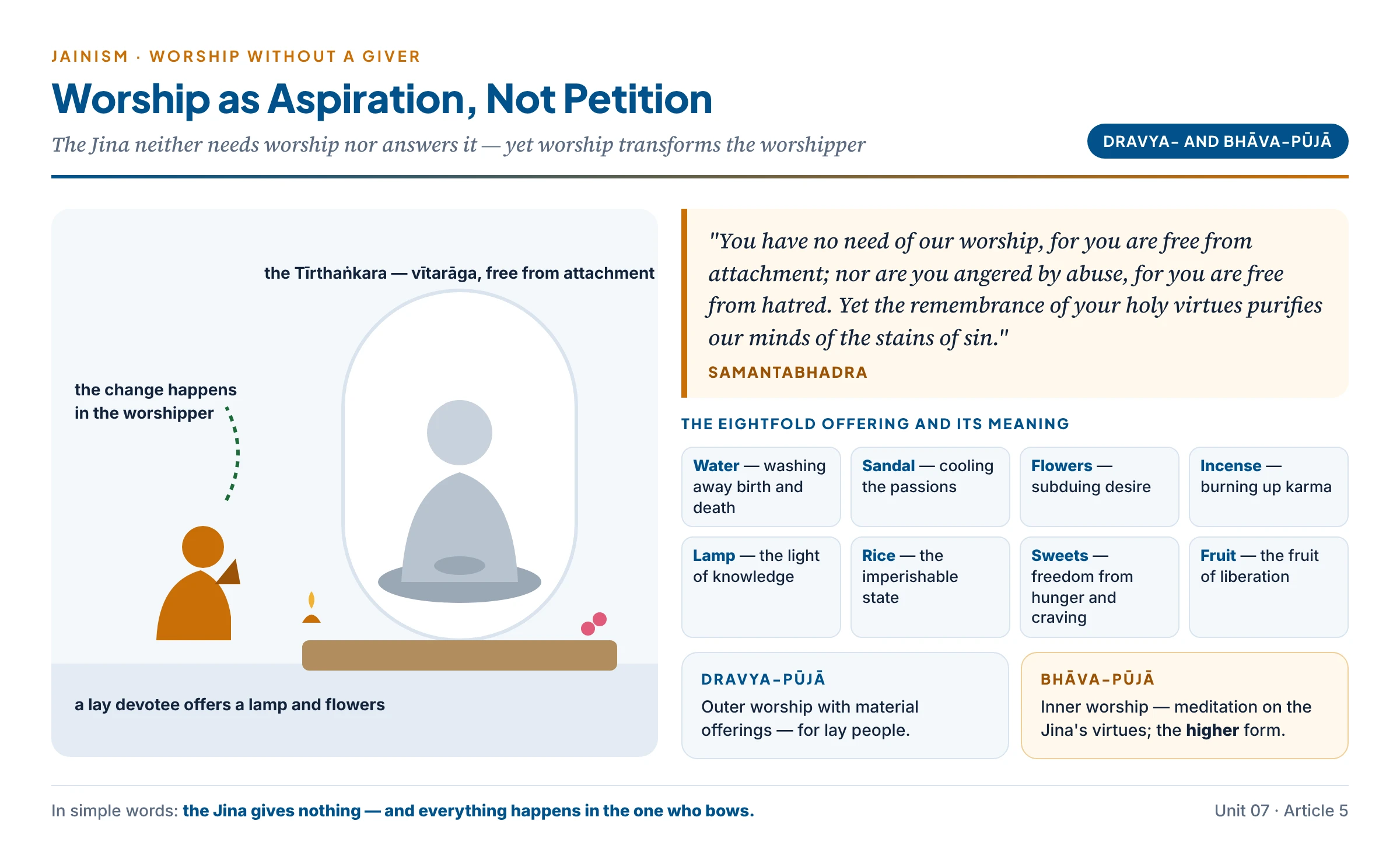
- Jainas do worship. Daily pūjā before the image of a Tīrthaṅkara; the eightfold offering (aṣṭaprakārī pūjā) of water, sandalwood paste, flowers, incense, a lamp, rice, sweets and fruit; hymns, recitation of the Namokāra, and pilgrimage.
- But to whom, and why? The Tīrthaṅkara, being vītarāga, does not receive the worship and cannot reward it. The great Jaina teacher Samantabhadra addressed the Jina in a famous verse:
“You have no need of our worship, for you are free from attachment; nor are you angered by abuse, for you are free from hatred. Yet the remembrance of your holy virtues purifies our minds of the stains of sin.” — Samantabhadra
- The meaning of Jaina worship.
- Recollection — keeping the ideal of perfection before the mind.
- Self-purification — the act of worship itself reduces passions (kaṣāyas) and generates good dispositions.
- Renunciation — the offerings symbolise giving up attachment: rice for the imperishable state, the lamp for the light of knowledge, fruit for the fruit of liberation.
- Emulation — “what he did, I too can do“.
- Two levels — dravya-pūjā (worship with material offerings, for lay people) and bhāva-pūjā (inner worship by meditation on the Jina’s qualities, which is higher).
- So Jaina devotion (bhakti) exists, but it is devotion to an ideal rather than to a benefactor: prayers are acts of reverent contemplation and ethical emulation, never petitions for forgiveness of sins or worldly favours.
In simple words
A runner keeps a picture of a champion on the wall. The champion will never know, will never send medals, will never be offended if the picture falls down. Yet looking at it every day changes how the runner trains. That is Jaina worship: the Jina gives nothing, and everything happens in the worshipper.
6. Liberation by the Soul’s Own Effort
- Karma is matter. Karma is a fine material substance — karmic particles (kārmaṇa vargaṇā) that fill the universe and are drawn to the soul by its activities of body, speech and mind, and stick to it because of the four passions (kaṣāyas): anger, pride, deceit and greed.
- The seven realities (tattvas) describe the whole drama of bondage and liberation:
- Jīva — the soul;
- Ajīva — the non-soul, including karmic matter;
- Āsrava — the inflow of karma;
- Bandha — the binding of karma to the soul;
- Saṃvara — the stopping of new inflow, by vows, carefulness, self-control and meditation;
- Nirjarā — the shedding of accumulated karma, especially by austerity (tapas);
- Mokṣa — liberation, the complete freedom of the soul from karma.
- The three jewels (triratna). “Right faith, right knowledge and right conduct together constitute the path to liberation.”
- Right faith (samyak darśana) — conviction in the truths taught by the Jinas;
- Right knowledge (samyak jñāna) — correct understanding of the soul, matter and karma;
- Right conduct (samyak cāritra) — the five vows: non-violence (ahiṃsā), truthfulness, non-stealing, chastity and non-possession (aparigraha) — kept fully by monks (the great vows) and partially by lay people (the lesser vows).
- Radical non-violence. Since every living being — even plants, water and earth-bodies — has a soul, ahiṃsā extends to the smallest creature. Monks sweep the path before them and cover their mouths; lay Jainas avoid professions that harm life.
- No divine intervention. Liberation is strictly the soul’s own purificatory task. No God forgives sins: karma must be shed by the soul, as dirt must be washed from cloth. “The soul is its own friend and its own enemy.“
In simple words
A white cloth stained with oil and dust does not become clean because someone forgives the stains. You must stop new dirt falling on it (saṃvara) and wash out the old dirt (nirjarā). Jainism sees the soul exactly so: no God can pardon karma away — the soul must be washed clean by its own effort, and then it shines as it always was.
7. Is Jainism a Religion or Merely an Ethical System?
The case that it is only an ethical code:
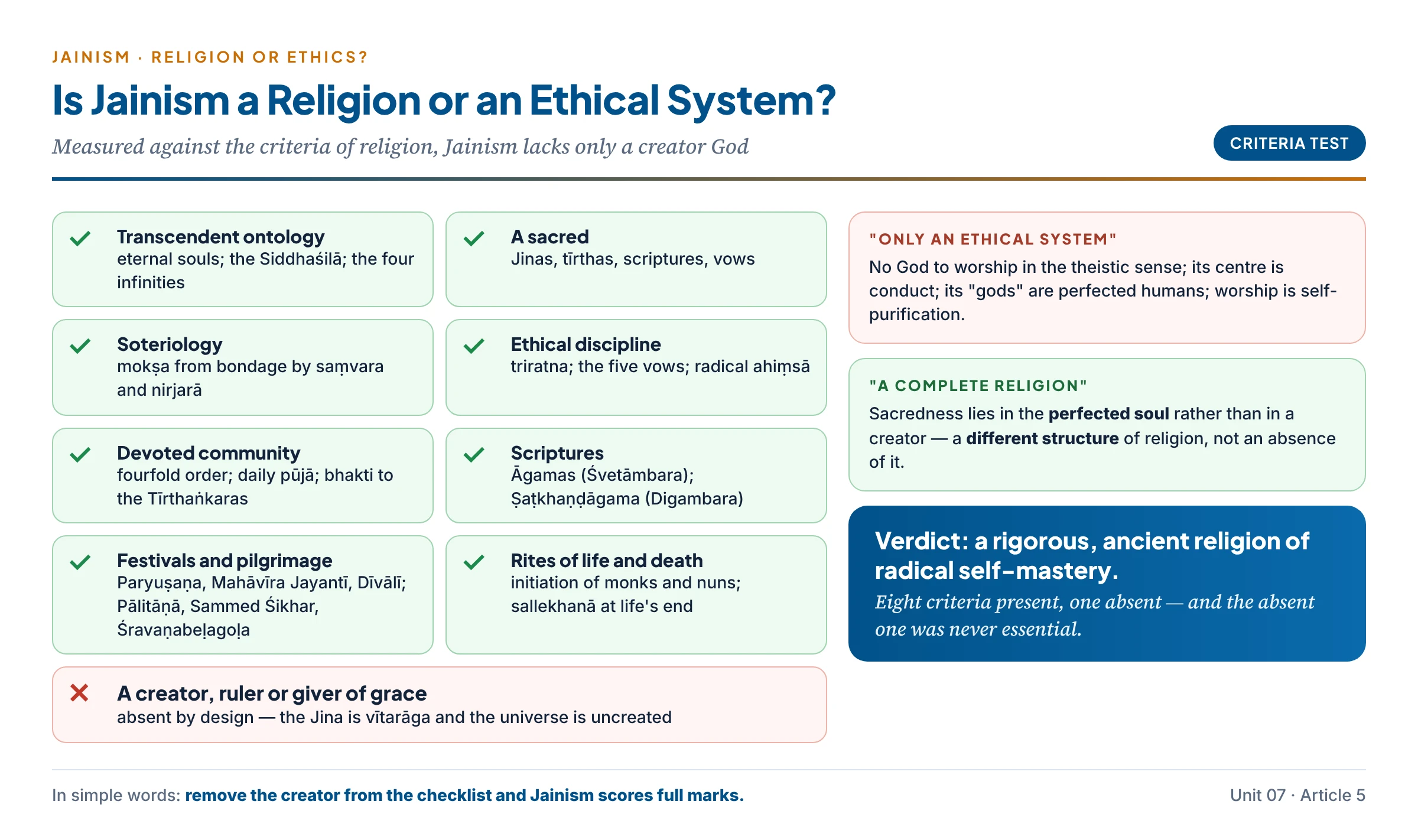
- It has no God to worship in the theistic sense, no creator, no grace — so on narrow Western definitions (Martineau, Galloway) it is not a religion.
- Its centre is conduct — vows, non-violence, austerity — which looks like an ethical system.
- Its “gods” are perfected humans, and its worship is admitted to be self-purification, not relation with a higher being.
The case that it is a genuine religion — the criteria of religion fulfilled:
- A transcendent ontology — eternal souls, the realm of the liberated at the Siddhaśilā, the four infinities of the perfected soul.
- A theory of the sacred — the Jinas, the tīrthas (holy places), the scriptures, the sacred vows.
- A soteriology — mokṣa as absolute liberation from karmic bondage (bandha), achieved by saṃvara and nirjarā.
- Ethical discipline — the triratna and the five vows.
- Communal devotion — the fourfold order (caturvidha saṅgha) of monks, nuns, laymen and laywomen; daily pūjā; devotion (bhakti) towards the Tīrthaṅkaras as perfected ideals.
- Scriptures — the Āgamas (Aṅgas and Upāṅgas) of the Śvetāmbaras; the Ṣaṭkhaṇḍāgama and later texts of the Digambaras.
- Festivals and pilgrimage — Paryuṣaṇa (the annual season of fasting and forgiveness, ending with the plea “Micchāmi dukkaḍaṃ” — “may my faults be forgiven”), Mahāvīra Jayantī, Dīvālī (marking Mahāvīra’s liberation); pilgrimage to Śatruñjaya (Pālitāṇā), Sammed Śikhar, and Śravaṇabeḷagoḷa, where the colossal statue of Bāhubali is anointed in the great Mahāmastakābhiṣeka about every twelve years.
- Rites of passage and death — including sallekhanā (also called santhārā), a voluntary, gradual fast at the end of life undertaken as a religious vow to die with a calm mind.
- The verdict. Jainism is not a secular ethical philosophy but a complete, rigorous and ancient religion founded on radical self-mastery. Its lack of a creator is not an absence of religion but a different structure of religion — sacredness located in the perfected soul rather than in a creator.
Indian Connect — Jainism in Indian public life
- Sallekhanā reached the courts: in 2015 the Rajasthan High Court treated it as suicide, but the Supreme Court stayed that ruling within weeks, allowing the practice to continue while the question is decided — a live debate on how far religious freedom protects a non-theistic religious practice.
- Jainas were notified as a national minority community in 2014; the Supreme Court has repeatedly cited Jainism, with Buddhism, as proof that religion in India is “not necessarily theistic“.
- Gandhi’s ahiṃsā owed much to Jaina influence, especially to the Jaina jeweller-saint Shrimad Rajchandra, whom he called his guide in spiritual matters.
Critical Evaluation
Objections from Theism
- Karma cannot work by itself. Unconscious karmic matter cannot choose the right fruit for each soul; a conscious dispenser is needed (Nyāya). The Jaina replies that karma’s fruit follows from its nature — its kind, duration, intensity and quantity are fixed at the moment of binding — as a medicine works by its own properties without the doctor standing by.
- Worship without a recipient is empty. If the Jina cannot hear or respond, Jaina pūjā seems to be addressed to no one. The Jaina replies that worship’s value lies in what it does to the worshipper — purification and inspiration — not in pleasing a recipient.
- The many perfected souls are gods in all but name. With omniscience, infinite bliss and images in temples, the Tīrthaṅkaras function like gods; the theist sees here a hidden theism. The Jaina replies that the difference is decisive: they neither create nor rule nor save.
- The Nyāya replies to the anti-creator arguments — a maker needs knowledge, will and effort, not a body; bees co-operate because they follow one natural plan; God’s eternal will produces each effect at its proper time — keep the debate open (Unit 02).
Objections from Within Philosophy
- A beginningless world may only postpone the question why there is any world at all.
- Austerity and elitism. The demanding path of vows and fasting suits monks far better than ordinary householders; this is the typical danger of non-theistic religion — a discipline too hard for most people.
- The ethics of sallekhanā raises questions about the value of life and the line between renunciation and self-harm; Jaina defenders distinguish it sharply from suicide, which is done in passion, whereas sallekhanā is undertaken without passion at the natural end of life.
Strengths
- Coherence. Jainism gives a complete account of the world, bondage and liberation without a creator.
- Moral seriousness. Its ethics of non-violence to all life is among the most demanding in any religion, and needs no divine command to support it.
- Dignity of the soul. Every soul is potentially divine; no one is eternally subordinate to another.
- Freedom from the problem of evil. Since no all-good being made the world, suffering is explained by karma, not charged to God.
Critics and Defenders
Criticism — Critics of Jaina non-theism
- Nyāya: unconscious karmic matter needs an intelligent dispenser.
- Theists: worship addressed to a being who cannot respond is empty.
- Western observers: Jainism is an ethical code, not a religion.
- Hidden theism: omniscient Tīrthaṅkaras worshipped in temples are gods in all but name.
- Practical critics: the path of austerity is too demanding for ordinary people.
Defence — Jaina replies and strengths
- Jinasena, Malliṣeṇa, Guṇaratna: a world-maker is incoherent; bees build one hive with no master.
- Samantabhadra: worship purifies the worshipper; the Jina needs nothing.
- Appā so paramappā: every soul is potentially God — divinity without a creator.
- The criteria of religion — ontology, sacred, soteriology, discipline, community, scripture, festivals — are all fulfilled.
- Karma by its nature delivers its fruit, as a medicine works by its own properties.
Cross-Tradition Comparison
God in Jainism, Yoga and Theism
| Point | Jainism | Yoga (Patañjali) | Theism (Nyāya, Christianity) |
|---|---|---|---|
| Creator | None — the universe is uncreated | None — Prakṛti evolves by itself | God creates or orders the world |
| What “God” means | Any soul that has become perfect | A special Puruṣa, eternally free | One supreme, eternal being |
| Number | Many | One | One |
| Was God ever bound? | Yes — every Jina was once a bound soul | Never | Never |
| Grace | None — the Jina is vītarāga | Helps the devotee through devotion | Central |
| Role in liberation | Ideal and teacher | Object of devotion, a help to concentration | Saviour and judge |
Jainism and Buddhism as Religions without God
| Point | Jainism | Buddhism |
|---|---|---|
| Soul | Eternal, infinite souls | No permanent self (anattā) |
| Karma | Subtle matter clinging to the soul | Intention and its results |
| Goal | Kaivalya / mokṣa — the soul alone and perfect at the Siddhaśilā | Nirvāṇa — the unconditioned, the end of craving |
| “Divine” beings | Arihantas and Siddhas, many | Buddhas (and in Mahāyāna, Bodhisattvas) |
| Path | Triratna; austerity; radical ahiṃsā | Eightfold Path; the middle way |
| Worship | Pūjā to Tīrthaṅkaras as ideals | Veneration of the Buddha, relics, stūpas |
Indian Connect — Takeaways
- Jainism keeps every perfection of God — omniscience, bliss, freedom — but gives them to the perfected soul; it drops creatorship, rule and grace.
- Jaina worship shows that devotion can exist without a benefactor: “the remembrance of your virtues purifies our minds”.
- “Every soul can become God” is the most democratic idea of divinity in world religion.
Synthesis (Siddhānta)
- Jainism is a religion without a creator, but not without God. Its “God” is the perfected soul — the arihanta and the siddha — and its central conviction is that every soul can attain that state by its own effort: “the soul itself is the Supreme Soul”.
- Its rejection of a creator rests on a coherent metaphysics of eternal substances and self-working karma, and on sharp arguments — Jinasena’s “where was God before creation?”, Malliṣeṇa’s bees and masons, Guṇaratna’s wild grass, the dilemma of motive and evil.
- Its proofs are proofs of an omniscient being, not of a creator: Samantabhadra’s inference and the argument from the removal of karmic veils.
- Its worship is aspiration, recollection and self-purification — real bhakti without a giver of favours.
- It is a religion, not merely an ethical code, because it fulfils every criterion of religion: a transcendent ontology, a sacred, a soteriology, a discipline, a devoted community, scriptures, festivals, pilgrimage and rites.
- The lesson for the unit. Jainism shows most clearly that the essence of religion lies in the transformation of the self towards a sacred perfection — and that this perfection can be within the soul rather than above it.
- Contemporary relevance. Jaina ahiṃsā inspires modern environmental and animal ethics and the Gandhian politics of non-violence; Jaina anekāntavāda (many-sidedness) is invoked in inter-religious dialogue; the sallekhanā debate tests the limits of religious freedom for a non-theistic practice.
“Some foolish men declare that a creator made the world … If God created the world, where was he before creation?” — Jinasena, Mahāpurāṇa
Previous Year Questions
- 2022Discuss the nature of Soul and Bondage according to Jainism.
- 2019State and evaluate the proofs for the existence of God as propounded in Jainism.
- 2003When a religion is defined as ‘religare’, is Buddhism or Jainism a religion? What are the criteria for an organisation to be called a religion? Should there be a transcendental reality in a religion? Discuss.