

Religious Experience: Nature and Object (Indian and Western).
Official Syllabus: Paper II, Section B, Unit 6
Rudolf Otto (1869–1937), a German Lutheran theologian and historian of religions at Marburg, asked what is peculiar to religion — what remains when we subtract its morality and its theology. His answer, in Das Heilige (1917; English, The Idea of the Holy, 1923), is the numinous: a unique, non-rational experience of a “wholly other” reality that is at once terrifying and fascinating — mysterium tremendum et fascinans. Otto held that this is the innermost core of every religion. His analysis also raises a further question for the syllabus: how is this numinous experience of a holy Other related to the mystical experience of union, in which all otherness seems to vanish?
In simple words
Stand on a dark seashore during a thunderstorm. You feel small, almost nothing, before something vast and powerful (tremendum); you cannot understand or measure it (mysterium); and yet you cannot tear yourself away — it draws you (fascinans). Otto says that when this feeling is directed not at the sea but at the Holy itself, we have the root of religion — the numinous.
Context & Problem
Otto’s Question: What Is Peculiar to Religion?
- “Holy” had been moralised. In ordinary usage “holy” had come to mean morally perfect — “completely good”. Kant had reduced religion to “the recognition of all our duties as divine commands“. Theology spoke of God through rational attributes: spirit, reason, purpose, goodness, omnipotence.
- Otto’s objection. These rational and moral ideas are true and necessary, but they are predicates that we attach to a subject we cannot fully grasp by them. Something more lies beneath — the non-rational element of religion, felt before it is thought.
- The method of subtraction. Take the word “holy”, subtract the moral and rational factor, and what remains — the “overplus” of meaning — is the specifically religious element. Otto coins a new word for it from the Latin numen (divine power, a deity’s presence): the numinous.
- Influences. Otto built on Schleiermacher‘s idea that religion is a matter of feeling, on Kant‘s notion of a priori categories, and on his own wide study of world religions; travels in India (1911) deepened his interest in Hinduism. He later compared Śaṅkara and Meister Eckhart in Mysticism East and West (1926) and Christian grace with Rāmānuja’s bhakti in India’s Religion of Grace (1930).
A Category That Can Only Be Evoked
- A priori and sui generis. The numinous is a category of value, an a priori capacity of the human spirit, unique of its kind (sui generis). It cannot be reduced to anything else — not to fear, not to the sublime, not to morality.
- Not definable, only evoked. Since it is unique, the numinous cannot be strictly defined; it can only be evoked in the reader’s mind by pointing to analogies and examples. Otto famously asks the reader to recall a moment of deeply felt religious experience — and advises anyone who cannot recall any such moment to read no further, since for him the book will mean nothing.
Core Doctrine
1. Creature-Feeling — and Otto’s Criticism of Schleiermacher
- Creature-feeling (Kreaturgefühl) is the first effect of the numinous on the self: “the emotion of a creature, submerged and overwhelmed by its own nothingness in contrast to that which is supreme above all creatures”.
- The biblical example. Abraham, pleading with God for Sodom, says: “I who am but dust and ashes” — the self feels like nothing before the presence.
- Against Schleiermacher. Schleiermacher’s “feeling of absolute dependence” is, Otto says, inadequate in two ways:
- It is only a difference of degree from ordinary feelings of dependence (on parents, on nature), whereas creature-feeling is different in kind.
- It is a feeling about oneself — from which God is then inferred as the cause. Otto insists the order is the reverse: the numinous is felt first as an objective presence outside the self, and creature-feeling is only “the shadow” that this presence throws on the self.
2. Mysterium Tremendum et Fascinans
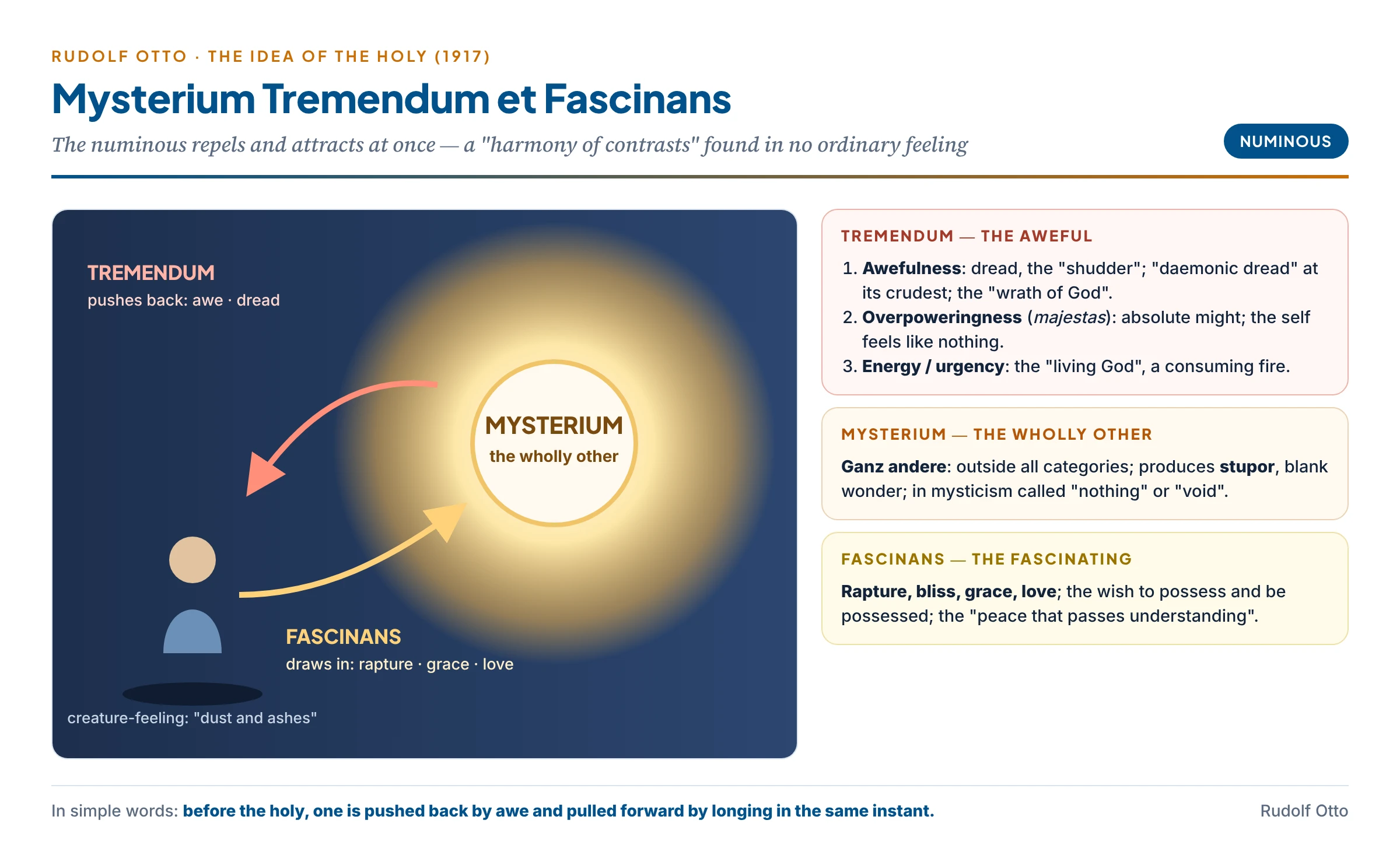
The numinous is analysed into three moments. Each is felt together with the others; they are aspects of a single experience.
(a) Tremendum — the aweful
- Awefulness (tremor, Scheu). Not ordinary fear but a peculiar dread or awe — the “shudder” (Schauder) that runs through us before the uncanny. In primitive form it is “daemonic dread“, the creepy fear of ghosts; in its highest form it is the hushed awe of worship. Its objective side is the “wrath of God” — not moral anger but a mysterious, almost natural force that “burns” like electricity on those who come too near.
- Overpoweringness (majestas). The sense of absolute might and majesty; the self feels annihilated — “dust and ashes”. This is the objective correlate of creature-feeling; in mysticism it leads to the annihilation of the self and the sense that only the transcendent truly is.
- Energy or urgency. The numinous is felt as living — will, force, passion, movement, activity. Hence the “living God” of the Bible, the “consuming fire”, Luther’s sense of God’s restless omnipotence.
(b) Mysterium — the wholly other
- The numinous is wholly other (ganz andere): beyond the usual, the intelligible and the familiar; it falls outside all our categories.
- Its first effect is stupor — blank wonder, astonishment, “stunned” silence.
- In mysticism the wholly other is pressed to its limit: it is described as “nothing” (Eckhart’s divine nothingness) or “void” (the Buddhist śūnya) — not because it is empty, but because it is unlike any thing.
(c) Fascinans — the fascinating
- The numinous does not only repel; it attracts, captivates and transports — it is rapture, bliss, grace, love. The worshipper wishes to possess it and be possessed by it.
- In its intoxicating form it is the “Dionysian” element in religion; in its higher forms it becomes the “peace that passes understanding” and the bliss of salvation.
- Harmony of contrasts (Kontrastharmonie). The strange double movement — repelled in dread, drawn in fascination — is what makes the experience unique; no ordinary emotion combines the two in this way.
In simple words
A child meeting a lion in a zoo for the first time presses back against her father’s leg — and at the same moment cannot take her eyes off it. She is both afraid and enchanted. Otto’s “harmony of contrasts” is like this, except that the lion is in a cage; the numinous is not. The worshipper before the holy is pushed back by awe and pulled forward by longing in the same instant.
3. The August, the Sense of Unworthiness and the Need for Atonement
- The numinous as value. Besides its power, the numinous carries supreme worth: it is the august (augustum), the sanctum — that before which one feels profane.
- Numinous unworthiness. Hence the cry of Isaiah in the temple: “Woe is me! For I am lost; for I am a man of unclean lips” — not first a sense of moral guilt but a sense of being profane before the holy.
- Atonement. From this arises the need for covering or consecration — purification, sacrifice, atonement — so that the profane creature may approach the holy. Sin, in its religious meaning, is this numinous unworthiness, not mere moral fault.
4. Schematisation — How the Non-Rational Joins the Rational
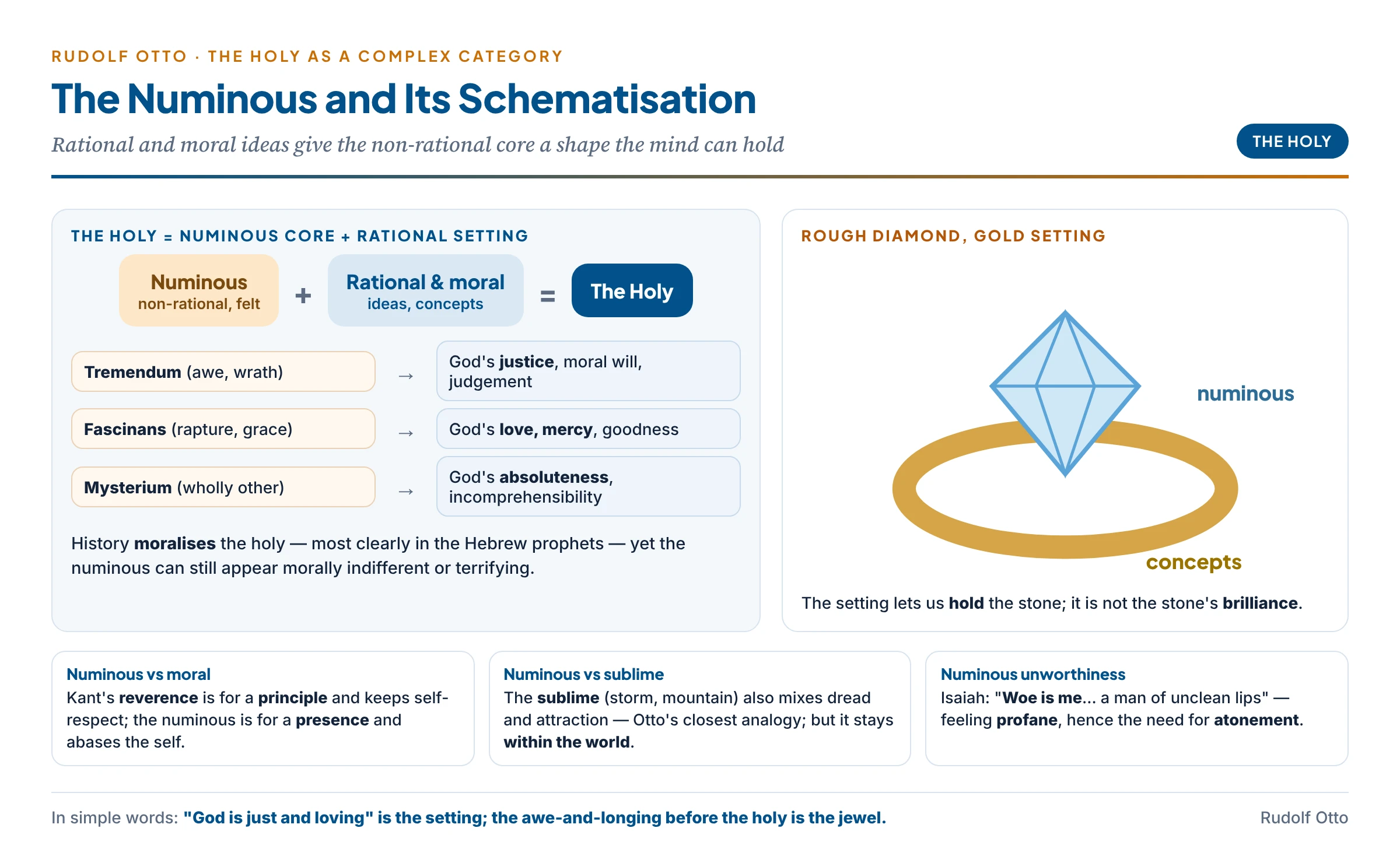
- The holy is a complex category. “Holy” in developed religion = the numinous + rational and moral elements. Otto borrows Kant’s word: the rational ideas schematise the numinous — give it a form the mind can grasp.
- Examples. The tremendum is schematised as the justice, moral will and wrath of God; the fascinans as his goodness, mercy and love; the mysterium as his absoluteness and incomprehensibility.
- The moralisation of the holy. In history the numinous was progressively moralised and rationalised — most clearly in the Hebrew prophets, for whom the Holy One demands justice. That the two can be fused shows they are distinct: the numinous can appear in morally indifferent or even terrifying forms.
- Divination. Otto also speaks of a faculty of divination — the capacity to recognise the holy in its appearances: in nature, in history, in a person (for Christians, in Christ).
In simple words
Think of a rough diamond and the gold ring in which it is set. The ring gives the stone a shape you can hold and wear; but the ring is not the diamond’s brilliance. In the same way, ideas like “God is just” and “God is loving” are the setting — they shape the holy for our minds — while the numinous itself is the stone that shines through them.
5. Expressions of the Numinous
- Indirect means. Because it cannot be said directly, the numinous is evoked by analogues:
- The sublime in art — vast temples, cathedrals, the Egyptian pyramids.
- Darkness and half-light — the gloom of a temple’s sanctum, the dim interior of a cathedral.
- Silence — “the Lord is in his holy temple; let all the earth keep silence before him”.
- Emptiness and void — in Chinese and Buddhist art and architecture; the empty space that speaks of what cannot be shown.
- In primitive religion, the magical and the uncanny — ghosts, demons — are degraded or crude forms of the numinous.
- Classic cases. Moses before the burning bush (“put off your shoes from your feet, for the place on which you are standing is holy ground”; “Moses hid his face, for he was afraid to look at God”); Jacob after his dream: “How dreadful is this place! This is none other than the house of God”; Isaiah’s vision (“Holy, holy, holy is the Lord of hosts”); Job, to whom God answers not with reasons but with the overwhelming mystery of creation — Behemoth and Leviathan.
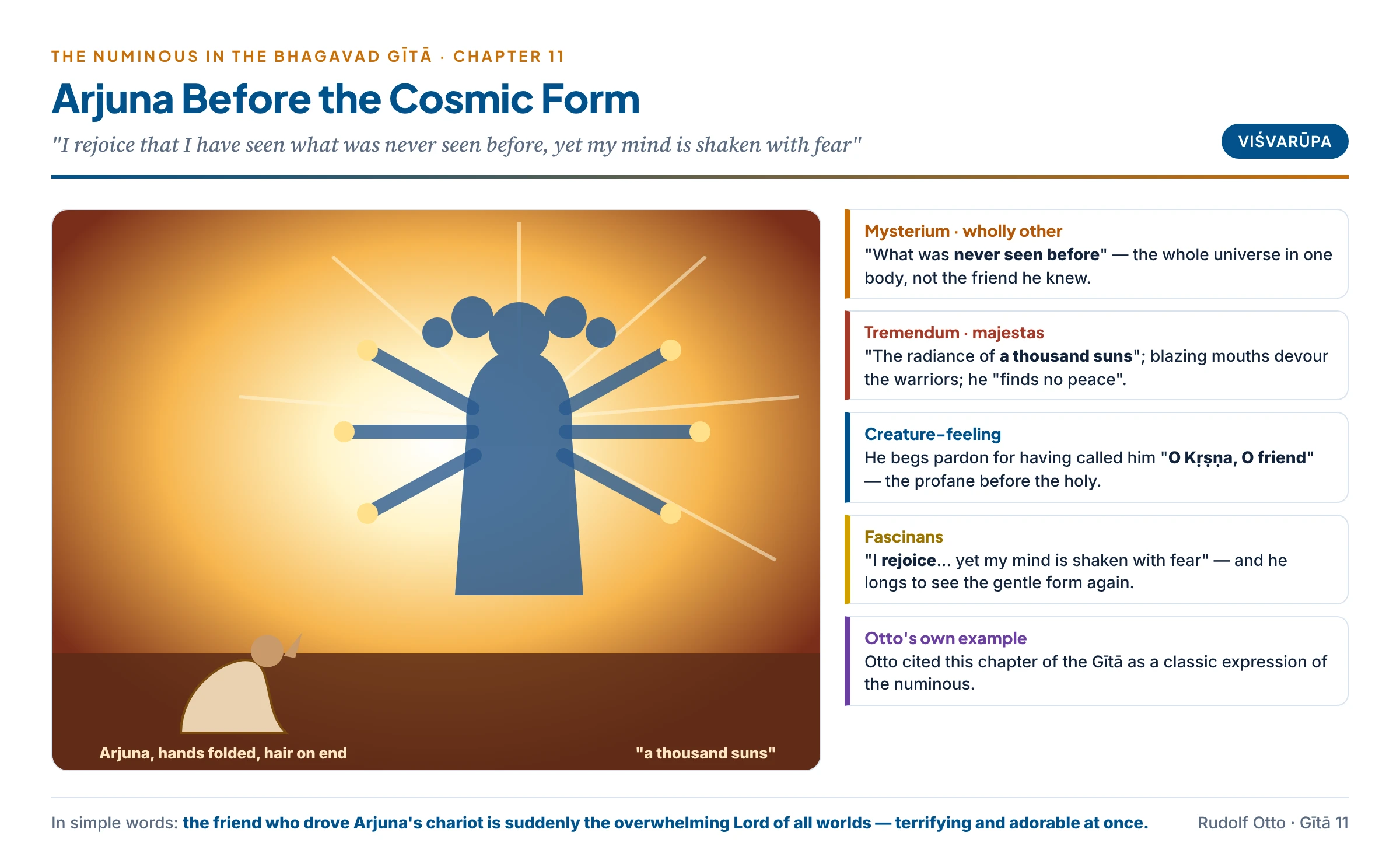
- The Bhagavad Gītā, Chapter 11. Otto himself cited Arjuna’s vision of Kṛṣṇa’s cosmic form (Viśvarūpa) as a supreme example of the numinous (below).
6. Features of the Numinous Experience
- A personal quality. The experiencer feels he is in communion with a Holy Other — a separate self, will or power that forces itself upon his consciousness unexpectedly and profoundly. Its focus may be a person (Jesus, Kṛṣṇa), an object (an icon, a sacred stone) or no identifiable object at all.
- Two aspects. (i) the raw experience itself, and (ii) the experience as interpreted by ideas (as God, Brahman, Allah).
- Three claims made for it.
- Irrefutable — it is felt as beyond doubt, both as an experience and with regard to its object.
- Directed to an object of cognition — “God” or “the Other” is not just the name of a feeling but the object to which it is directed. Just as perceiving is a mental act that reveals an object such as a table, a chair, a rose, the numinous experience reveals the mysterium tremendum — the presence of a God of love.
- Self-validating — this uncanny experience is always of a deity, and as such its cognition is felt to be indubitable.
- Otto’s strong thesis. Otto saw the numinous as the common factor in all religious experience, independent of culture — the one truly religious experience, of which others are developments.
Indian Connect — Arjuna’s vision as a numinous experience
- Mysterium. Arjuna sees “what was never seen before” — the universe within one body, a form “wholly other” than the friend and charioteer he knew.
- Tremendum and majestas. “If the radiance of a thousand suns were to burst at once into the sky, that would be like the splendour of that Mighty One.” Before the blazing mouths that devour the warriors, Arjuna “loses his sense of direction and finds no peace”; his hair stands on end.
- Creature-feeling and unworthiness. He begs forgiveness for having addressed Kṛṣṇa casually as “O Kṛṣṇa, O friend” — the profane creature before the holy.
- Fascinans. “I rejoice that I have seen what was never seen before, yet my mind is shaken with fear” — and he begs to see again the gentle, familiar form: the harmony of contrasts in one verse.
7. The Sacred and the Holy as the Object of Religion
- Why generic names were needed. Many religions — Buddhism, Jainism, Advaita, early tribal religions — have no God in the monotheistic sense. Scholars therefore sought a neutral name for “whatever religion is about“. “Sacred” and “Holy” came to serve as generic names for the object of religion.
- Three accounts of the sacred.
- Otto — the Holy is the numinous, experienced as mysterium tremendum et fascinans.
- Émile Durkheim — the sacred is what a society sets apart from the profane and protects by prohibitions; religion is the system of beliefs and practices relating to sacred things, which unites believers into a moral community.
- Mircea Eliade — the sacred manifests itself in the ordinary world (a hierophany): a stone, a tree, a mountain, a river becomes sacred because something “wholly other” shows itself through it.
- Can God be the object of religion? Yes — in theistic religions God is the supreme object; Otto’s numinous has a personal quality, the meeting with a Holy Other, which is exactly what “God” names. But “Sacred” and “Holy” are wider than “God”: every God is holy, yet not everything holy is God — nirvāṇa, Brahman, the Tao and sacred places are holy without being a personal God. The generic terms keep room for non-theistic religions.
8. The Numinous, the Moral and the Aesthetic
- Numinous vs moral. Kant’s reverence for the moral law is directed at a principle and is compatible with self-respect — indeed it raises us. The numinous is felt towards a presence, not a principle, and it annihilates self-worth. Otto’s historical point is decisive: the holy was only gradually moralised, and it can still appear in morally indifferent or terrifying forms — so the two are distinct even where fused.
- Numinous vs aesthetic. Here the line is thinner. Otto himself uses the sublime as his closest analogy: the sublime, too, combines dread and attraction before what exceeds our measure (a storm, a mountain). The claimed difference: the aesthetic sublime remains within the world and leaves the self intact; the numinous makes a claim of absolute worth and a demand on the subject. But since the numinous can only be evoked, not defined, this difference can be pointed at rather than argued.
Numinous and Mystical Experience — the Difference
Two Strands of Religious Experience
- Ninian Smart’s distinction. The historian of religion Ninian Smart distinguished two great strands:
- The numinous strand — the experience of a holy Other that inspires awe and worship; it dominates the prophetic religions (Judaism, Christianity, Islam) and devotional Hinduism (bhakti).
- The mystical (contemplative) strand — the inward experience of unity, reached by contemplation; it dominates Upaniṣadic and Advaita Hinduism, Buddhism, Jainism and the contemplative streams of the West.
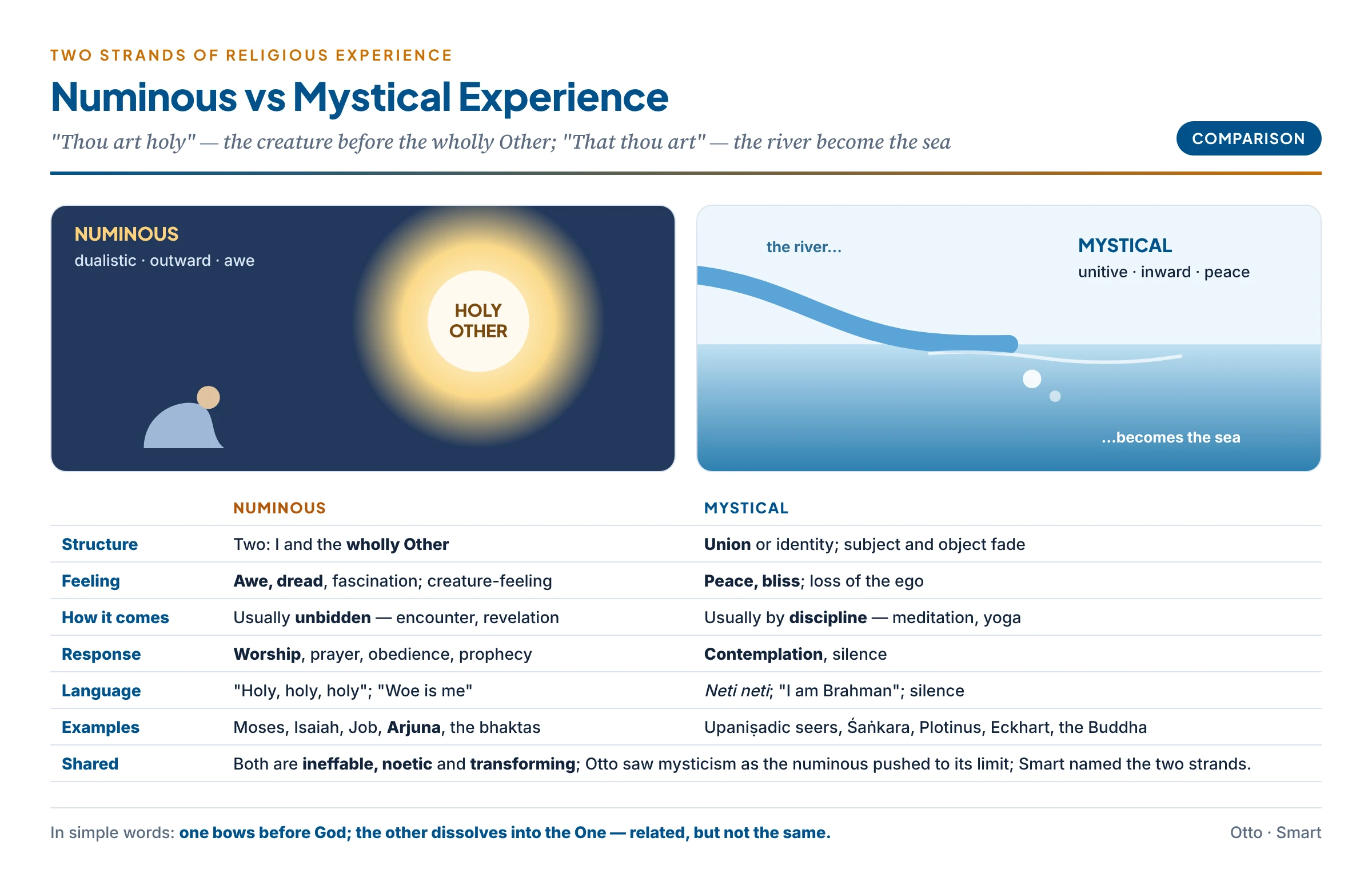
- Dualistic vs unitive. Numinous theistic experiences are dualistic: God and the subject remain clearly distinct — the worshipper is “dust and ashes” before the Holy One. Theistic mysticism speaks of union, or even identity, with God; non-theistic mysticism speaks of an undifferentiated unity or a void.
| Point | Numinous experience | Mystical experience |
|---|---|---|
| Structure | Dualistic — I and the wholly Other | Unitive — union or identity; subject–object distinction fades |
| Direction | Outward — an Other breaks in upon me | Inward — consciousness withdraws and empties |
| Typical feeling | Awe, dread and fascination; creature-feeling | Peace, bliss, serenity; loss of the ego |
| The self | Felt as nothing, profane, unworthy | Dissolved or expanded into the One |
| How it comes | Usually unbidden, as encounter or revelation | Usually through discipline — meditation, contemplation, yoga |
| Typical response | Worship, prayer, obedience, prophecy | Contemplation, silence, meditation |
| Typical language | “Holy, holy, holy”; “Woe is me” | Neti neti; silence; “I am Brahman”; “the One” |
| Examples | Moses, Isaiah, Job, Arjuna, the bhaktas | Upaniṣadic seers, Śaṅkara, Plotinus, Eckhart, the Buddha |
| Religions | Prophetic theism, bhakti | Advaita, Buddhism, Sāṃkhya–Yoga, contemplative streams |
How They Are Related
- Not simply opposites. Otto himself treated mysticism as a form of the numinous in which the mysterium (the wholly other) is stressed to the point of identity with the self, and the fascinans reaches its height. So for Otto, mysticism grows out of the numinous.
- Overlap. Both are ineffable, noetic and transforming; both are often called self-authenticating. A single tradition can contain both: the Gītā has the numinous theophany of Chapter 11 and the calm, mystical yogin of Chapter 6; Christianity has Isaiah’s awe and Eckhart’s union.
- Tension. Theistic traditions often resist the mystic’s claim of identity: for them the creature can never become the Creator. This is why al-Hallāj, who cried “I am the Truth” (God), was executed, and why Christian authorities were suspicious of Eckhart. Advaita, by contrast, treats the numinous sense of a separate God as a lower, devotional stage before the realisation of non-duality.
- Why the difference matters philosophically. If religious experiences are of two different kinds — encounter and union — then Otto’s claim that the numinous is the one core of all religion is too narrow; and the question of the object of religious experience (Article 7) becomes sharper: is it a Person to be worshipped or a Reality to be realised?
Common confusion
Did Otto say the numinous and the mystical are the same, or that they are opposites? Neither exactly. Otto held that the numinous is the core of all religion and that mysticism is a development of it — the numinous with its “wholly other” and “fascinating” moments pushed to the limit. The contrast between a dualistic numinous strand and a unitive mystical strand was sharpened by later writers, above all Ninian Smart. So the balanced answer is: different in structure (dualistic vs unitive), related in origin and overlapping in features.
In simple words
Numinous experience is like a pilgrim prostrating before a vast, shining temple deity — the pilgrim tiny, the god immense, two beings face to face. Mystical experience is like a river reaching the sea — the river does not bow before the ocean; it becomes the ocean. The first is “Thou art holy”; the second is “That thou art”.
Critical Evaluation
Objections to Otto
- From feeling to object. Otto describes a state of consciousness and then claims that it reveals an object. But a feeling of a “wholly other” presence does not show that such a presence exists: it may be a projection — of the father-figure (Freud) or of society itself (Durkheim, for whom the sacred is society worshipping itself).
- Unfalsifiable. Since the numinous is non-rational and can only be evoked, nothing could count against Otto’s claims; those who lack the experience are simply told to stop reading.
- Too narrow — not the core of all religion. The Advaitin’s realisation of Brahman is not an encounter with an Other but the collapse of the subject–object distinction; Buddhist nirvāṇa has no numinous object. So the numinous may describe theistic experience, not religious experience as such.
- A Christian, Protestant bias. Otto’s scheme culminates in Christianity and reflects Lutheran themes (the wrath of God, sin and atonement); critics say he reads other religions through this lens.
- The a priori claim. To call the numinous an “a priori category” borrows Kant’s term loosely; a feeling found in some people and not in others is hard to call a universal a priori structure of the mind.
- Boundary with the aesthetic. As noted, the line between the numinous and the sublime is not argued, only asserted.
- Irrefutable and self-validating? Feelings of certainty accompany error as readily as truth (Article 8); and some people describe uncanny experiences of an Other in mental illness.
Otto’s Strengths
- Religion is its own province. Otto showed decisively that religion cannot be reduced without remainder to ethics (against Kant) or to theory (against rationalist theology).
- Faithful phenomenology. His description of awe, majesty, mystery and fascination rings true to an immense range of testimonies — biblical, Indian, Islamic, tribal.
- A bridge between traditions. Otto’s comparative work (Śaṅkara and Eckhart; Rāmānuja and Luther) opened the comparative study of religious experience.
- Influence. Eliade’s sacred, Smart’s numinous strand, Hick’s account of religious experience, and the modern phenomenology of religion all build on Otto.
Critics and Defenders
Criticism — Critics
- Freud and Durkheim: the “wholly other” is a projection — of the father or of society.
- Advaita and Buddhism: the highest experience has no Other to stand before; the numinous is only theistic.
- Philosophers of science: an experience that can only be evoked, never tested, is unfalsifiable.
- Comparativists: Otto reads world religions through Lutheran theology.
- Aestheticians: the numinous is only the sublime under another name.
Defence — Defenders and strengths
- Phenomenologists (Eliade, Smart): the numinous is a real and recurring type of experience across cultures.
- Against reductionism: religion is more than morality or theory — the holy has an irreducible core.
- Origin is not validity: a projection theory explains the psychology, not whether an Other is there.
- Otto’s own comparisons: he recognised mysticism as a development of the numinous, not denied it.
- Moral fruits: the sense of the holy has produced humility, worship and reverence for life.
Cross-Tradition Comparison
The Numinous in Indian and Western Religion
| Point | Western examples | Indian examples |
|---|---|---|
| Theophany | Moses’ burning bush, Isaiah’s vision, Paul’s light | Arjuna’s Viśvarūpa; Yaśodā seeing the universe in child Kṛṣṇa’s mouth |
| Creature-feeling | Abraham: “dust and ashes”; Isaiah: “Woe is me” | Arjuna’s plea for forgiveness; the bhakta’s dainya (humility) |
| Tremendum | “Wrath of God”; “a fearful thing to fall into the hands of the living God” | Rudra and Kālī — the terrible forms of the divine |
| Fascinans | Divine love, grace, the beatific vision | Rasa and ānanda of bhakti; the gopīs drawn to Kṛṣṇa’s flute |
| Mysterium | “My thoughts are not your thoughts” | Neti neti; Brahman “from which words turn back” |
| Mystical counterpart | Plotinus, Eckhart, John of the Cross | Upaniṣads, Śaṅkara, the Buddha, Ramana |
Indian Connect — Takeaways
- Indian religion holds both strands together: bhakti is richly numinous (awe and love before a personal Lord), while jñāna and yoga are mystical (realisation of the Self, stilling of the mind).
- Otto himself compared Rāmānuja’s religion of grace with Luther’s and Śaṅkara’s Brahman with Eckhart’s Godhead — recognising in India both the numinous and the mystical.
- Advaita places the numinous worship of Īśvara as a stage on the way to non-dual knowledge; Viśiṣṭādvaita keeps the numinous distinction of God and soul even in liberation.
Synthesis (Siddhānta)
- Otto’s discovery. The numinous — mysterium tremendum et fascinans — is a real and distinctive form of religious experience. It shows that religion has a non-rational core that morality and theology can schematise but cannot replace.
- Its limits. It is not the whole of religious experience. Alongside the dualistic encounter with a holy Other stands the unitive mystical experience of the One; the two differ in structure, direction and feeling, though they overlap in being ineffable, noetic and transforming, and Otto himself saw mysticism as growing out of the numinous.
- Its object. “Sacred” and “Holy” are the right generic names for the object of religion because they cover both the personal God of theism and the impersonal ultimates of Indian thought; God is the supreme object within theism.
- Contemporary relevance. Studies of awe in psychology now find that experiences of vastness — before nature, art or the sacred — make people humbler, kinder and less self-centred: a modern echo of Otto’s creature-feeling and its moral fruits.
Previous Year Questions
- 2018The terms ‘Sacred’ and ‘Holy’ have come to serve as generic names for the object of religion. Do you agree that one can have God as the object of religion? Discuss.
- 2007The difference between numinous and mystical experience. Critical notes.
- 2006The difference between numinous and mystical experience. Critical notes.