

Religious Experience: Nature and Object (Indian and Western).
Official Syllabus: Paper II, Section B, Unit 6
Mysticism is religious experience in its purest and most concentrated form — the most acute, intense and living experience of the supreme reality. Mystics claim a direct and intimate knowledge of the divine, beyond the senses and beyond reasoning; its common theme is union or identity — with God in Western religion, with Brahman or nirvāṇa in Eastern religion. Mysticism raises the deepest questions of this unit: what kind of consciousness is this, what forms does it take, what do mystics teach, is it an escape from life or the source of love — and is it religious at all, or a human experience that religions later interpret?
In simple words
Ordinary knowing is like learning about sugar from a chemistry book — its formula, its sources, its uses. Mystical knowing is like tasting it — and even more, like a grain of salt that dissolves in water and can no longer say where it ends and the water begins. Mystics say God or the Absolute is known not by description but by direct contact — and, at its height, by becoming one with it.
Context & Problem
Meaning and History of the Word
- Etymology. “Mysticism” comes from the Greek mystikos, connected with myein, “to close” (the eyes or lips) — hence “to conceal“. In the Hellenistic world “mystical” referred to secret religious rites (the mystery religions).
- Christian development. In early Christianity the term came to mean the hidden, allegorical meaning of Scripture and hidden presences such as Christ’s in the Eucharist. Only later did it denote “mystical theology” — direct experience of the divine. Medieval theologians called it cognitio Dei experimentalis: experiential knowledge of God.
- Definition. Mysticism is a doctrine or discipline maintaining that one can gain knowledge of reality not accessible to sense perception or to rational, conceptual thought. It is generally tied to a religious tradition and may be theistic (Jewish, Christian, Islamic) or non-theistic (Buddhism, some forms of Hinduism).
- A path, not only a moment. Mystics, theistic or not, usually see their experience as part of a larger undertaking aimed at human transformation, not as the end of their effort. So mysticism is best seen as a whole constellation of practices, texts, institutions, traditions and experiences aimed at transforming the person.
- East and West. In the West the most celebrated name is Plotinus, whose life aim was “the flight of the alone to the Alone“. But mysticism is a distinctive feature of Indian religion, found in its most undiluted form in the Upaniṣads, Advaita, the Bhakti movement, Kabīr and Sri Ramakrishna. (Western observers have even called Indian thought as a whole “mystical” — a label that is only partly fair, since Indian schools also developed rigorous logic and epistemology.)
Core Doctrine
1. Mystical Consciousness vs Ordinary Consciousness
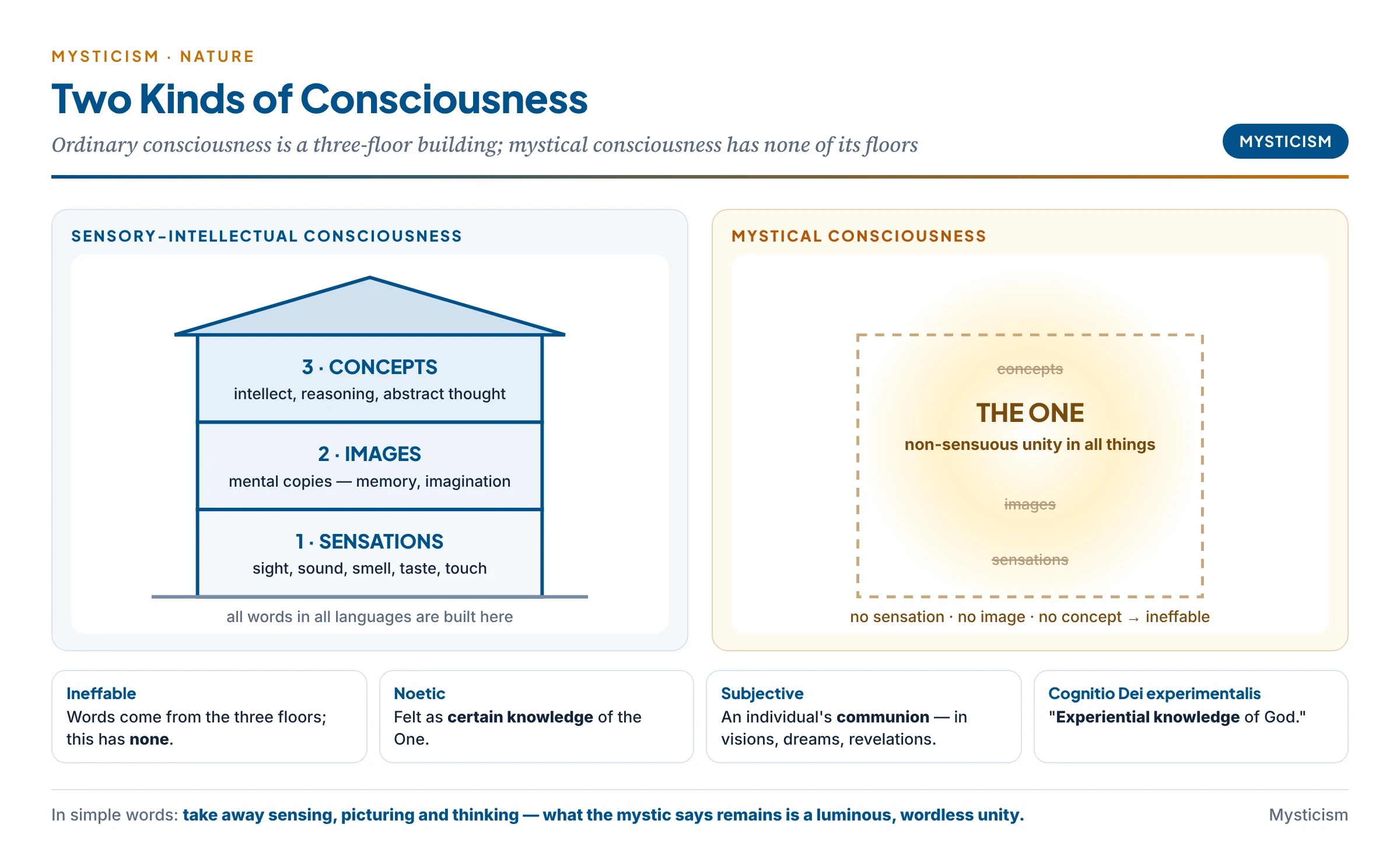
- A building of three floors. Ordinary consciousness can be pictured as a building with three floors:
- Ground floor — sensations: sights, sounds, smells, tastes, touch and bodily sensations.
- First floor — images: mental copies of sensations (memory, imagination).
- Second floor — concepts: the intellect, where abstract thinking and reasoning take place.
The whole structure is sensory-intellectual consciousness.
- Mystical consciousness has none of these. It is destitute of sensations, images and concepts — of perceptions, thoughts, emotions and desires, which are the necessary elements of ordinary experience. It is absolutely different from ordinary experience.
- Hence ineffability. All words in all languages are products of sensory-intellectual consciousness. An experience that transcends it entirely has no words suited to it — “it is such an experience about which nothing can be said”. This indescribability is what makes it mystical.
- What remains. In fully developed mystical experience there is “an apprehension of an ultimate non-sensuous unity in all things — a oneness or a One to which neither the senses nor the reason can penetrate”.
- Subjective yet cognitive. There is a great element of subjectivity; mystical experience is usually understood as an individual’s communion with the supreme reality, God or goddess, and may come as visions, dreams or revelations. Yet for the mystic it is knowledge — the most certain knowledge there is.
2. Characteristics of Mystical Experience
The classic list is William James‘s four marks (Article 2), to which later writers add three more:
- Ineffability — no adequate report of its content can be given in words. It is an essentially extra-rational element in religion, sui generis (unique of its kind), which cannot be assimilated to any other experience or brought under the categories of thought; its true nature is understood only by the one who has it.
- Noetic quality — it is a kind of revelation and illumination, an insight into the depth of truth. In spite of its subjectivity it is cognitive for those who have it: direct knowledge of certain and indubitable truths beyond ordinary experience and reason.
- Transiency — it cannot be sustained for long, though it may recur, and recurrence increases its depth and intensity. In exceptional cases it lasts long: Sri Ramakrishna‘s mystic trance (samādhi) sometimes lasted for long periods, even days; it came to him frequently, and he could even induce it in others.
- Passivity — the mystic feels his will subordinated, wholly grasped by a superior will; in the experience he seems to lose freedom of will. Afterwards it survives in fragmented memories, yet leaves a deep impact on the personality.
- Unity — a sense of the oneness of all things, of a “One” behind the many.
- Loss of the ego — the boundaries of the individual self seem to melt away.
- Peace and blessedness — a deep joy, serenity and sense of the holy.
Common confusion
Is “mysticism” the same as magic, occultism or the paranormal? No. Mysticism, in philosophy of religion, means the direct experience of ultimate reality — union with God, Brahman or the One. Occultism, magic, telepathy and clairvoyance claim hidden powers or knowledge within the world. The two were mixed up in popular culture — the late 19th century saw a surge of interest in mysticism together with occultism, and Theosophy popularised both; at the end of the 20th century books like Conversations with God became best-sellers. But serious mystical traditions, like Yoga, treat paranormal powers (siddhis) as distractions from the real goal.
3. Stace: Extrovertive and Introvertive Mysticism
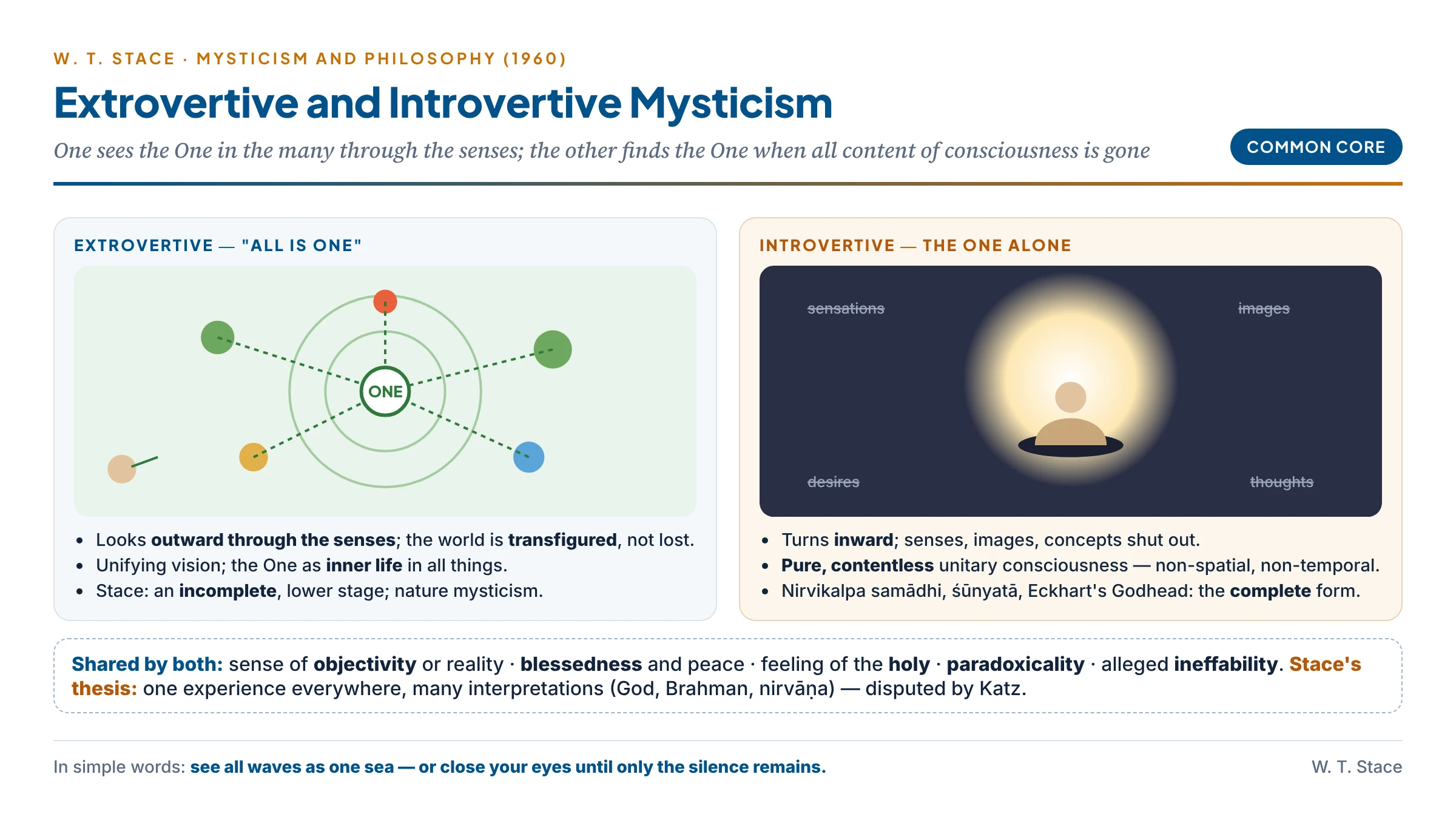
W. T. Stace (Mysticism and Philosophy, 1960) argued that beneath cultural differences there is a common core of mystical experience, which takes two forms:
- Extrovertive mysticism. The mystic looks outward through the senses and perceives an underlying unity behind the multiplicity of nature — “All is One“. The world does not vanish; it is seen as transfigured, alive, one.
- Its characteristics: the unifying vision that all things are one; the sense that the One is an inner life or presence in all things; a sense of objectivity or reality; blessedness and peace; a feeling of the holy; paradoxicality; alleged ineffability.
- Stace regards it as a lower, incomplete stage — an initial step towards the full experience. Some go further and say it is not “real” mysticism, since the mystic still uses the senses and does not reach a consciousness different from the ordinary.
- Introvertive mysticism. The mystic turns inward, shuts out sensations, images and concepts, and reaches pure, contentless, unitary consciousness — “the One“, “the Void“, “pure consciousness“. All contents of ordinary consciousness — emotions, feelings, desires — vanish.
- Its characteristics: unitary consciousness without any content; non-spatial and non-temporal; plus the same last five features (reality, blessedness, holiness, paradox, ineffability).
- Examples: Advaita’s nirvikalpa samādhi, the Buddhist experience of śūnyatā, Eckhart’s “desert of the Godhead”. Stace considers this the highest, complete form of mysticism, found across cultures.
- Experience and interpretation. Stace insisted on separating the experience (the same everywhere) from its interpretation (as union with God, identity with Brahman, nirvāṇa) — a thesis challenged by Steven Katz (Article 7).
In simple words
Watch the ocean from a cliff: a thousand waves, each different — and suddenly you see that it is all one water moving. That is like extrovertive mysticism: the many are still there, but seen as one. Now close your eyes, let every thought and picture fall away, until there is only quiet awareness with nothing in it. That is like introvertive mysticism: not one-in-the-many, but the One alone.
4. Other Classifications
- Theistic and non-theistic.
- Theistic mysticism involves an experience of God (a personal God). It is usually described as granted by God and so not under the mystic’s control; theistic mystics feel closeness to God but usually regard claims of identity of the self with God as heretical.
- Non-theistic mysticism is of a reality other than God — Brahman, nirvāṇa, the Tao — or of no reality at all. It is more often described as one that can be induced and controlled by the mystic, in which the distinction between self and reality, subject and object, is revealed as illusory.
- A useful note: “non-theist” simply means one who does not hold a theistic view — a neutral description; “atheist” usually carries an added note of criticism and denial.
- Even an atheist can be a mystic. Nature mysticism — a sense of oneness with the natural world — and the Buddhist experience of śūnyatā (emptiness) show that mystical experience does not require belief in God.
- R. C. Zaehner’s three types (Mysticism Sacred and Profane, 1957):
- Nature (panenhenic) mysticism — “all-in-one”: a sense of unity with nature, without God (Zaehner even discussed such naturalistic experiences induced by drugs).
- Monistic mysticism — the soul realises its own isolated, eternal self or its identity with an impersonal Absolute (Sāṃkhya‘s kaivalya, Advaita).
- Theistic mysticism — the soul is united with a personal God in love, while remaining distinct (Christian mystics, Rāmānuja, bhakti).
Zaehner, against Stace, held that these are different experiences, not one experience differently interpreted — and ranked theistic mysticism highest.
- F. C. Happold’s two types and three aspects (Mysticism: A Study and an Anthology, 1963):
- The mysticism of love and union — the longing to escape loneliness and separateness. Two urges govern us: to be an individual, and to be accepted as part of something; they are constantly in conflict. They arise because we are in some way sharers in “the Divine Life” — so, despite our individuality, we are always trying to get back to God.
- The mysticism of knowledge and understanding — the urge to find out “the secret of the universe“, the meaning of life — not piece by piece, but “the whole story”. This is sought through experience of God.
- Three aspects: soul-mysticism — finding the soul and complete self-fulfilment, without the God of classical theism (close to some Buddhist and Hindu thought); nature-mysticism — God is immanent, everywhere, and can be “united with” in nature; God-mysticism — the soul’s desire to return to God, which requires the soul to become like God.
- Super-sense-perceptual and sub-sense-perceptual. Experiences may be classified by whether they go beyond sense perception (introvertive) or include sense content (extrovertive). Some extrovertive experiences are numinous rather than unitive — sensing God’s presence while gazing at a snowflake.
5. Union and Identity
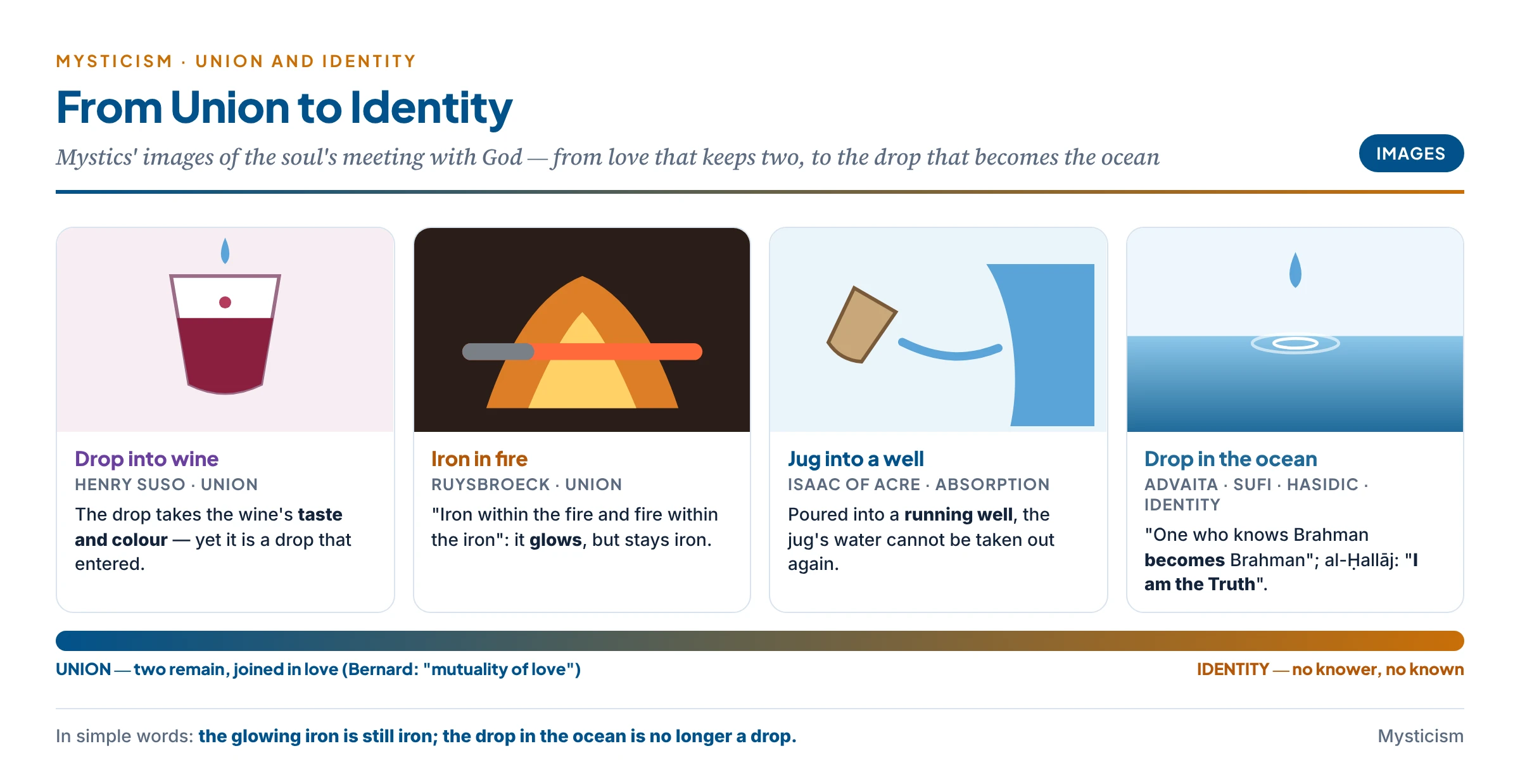
- Union with God. “Union” signifies a whole family of experiences: a falling away of the separation between a person and God, short of identity.
- Bernard of Clairvaux described it as a “mutuality of love“.
- Henry Suso likened it to a drop of water falling into wine, taking on the taste and colour of the wine.
- Jan van Ruysbroeck described it as “iron within the fire and the fire within the iron” — the iron glows with the fire’s heat and light, yet remains iron.
- Identity with God. Sometimes mystics speak as if they were fully absorbed into, or identical with, God:
- The Sufi al-Ḥusayn ibn Manṣūr al-Ḥallāj: “I am the Truth” (anā al-Ḥaqq), “the Truth” being a name of God.
- The Jewish kabbalist Isaac of Acre: the soul absorbed into God “as a jug of water into a running well“.
- The Hasidic master Shneur Zalman of Liadi: a person is like a drop of water in the ocean of the Infinite, with only an illusory sense of separate individuality.
- Meister Eckhart: “The eye with which I see God is the same eye with which God sees me.”
- In Indian form: “If I am to know God directly, I must become completely He and He I, so that this He and this I become and are one I“; “one who knows Brahman becomes Brahman” (brahmavid brahmaiva bhavati). There is no knower and no known; both become one.
Whether such statements assert real identity (a pantheistic or cosmic claim) or are poetic exaggerations of union is still disputed.
In simple words
Put an iron rod into a blacksmith’s fire. Soon it glows red; it gives off heat and light like the fire itself — yet take it out and it is still iron. That is union: the soul shines with God’s life but remains a soul. Now pour a cup of water into a river: you can never take the same cup out again. That is identity: the drop has become the ocean.
6. The Mystic Way — Stages and Means
- Ways and means. Almost all religions describe ways to the mystical state:
- In India — yoga, especially meditation, and detachment (vairāgya); self-enquiry (“Who am I?”) as taught by Ramana Maharshi.
- Elsewhere — prayer, fasting, bodily discipline, renunciation of worldly concerns, rituals, self-reflection, chanting (dhikr, japa).
- In some cultures — mind-altering substances called entheogens (“generating the divine within”).
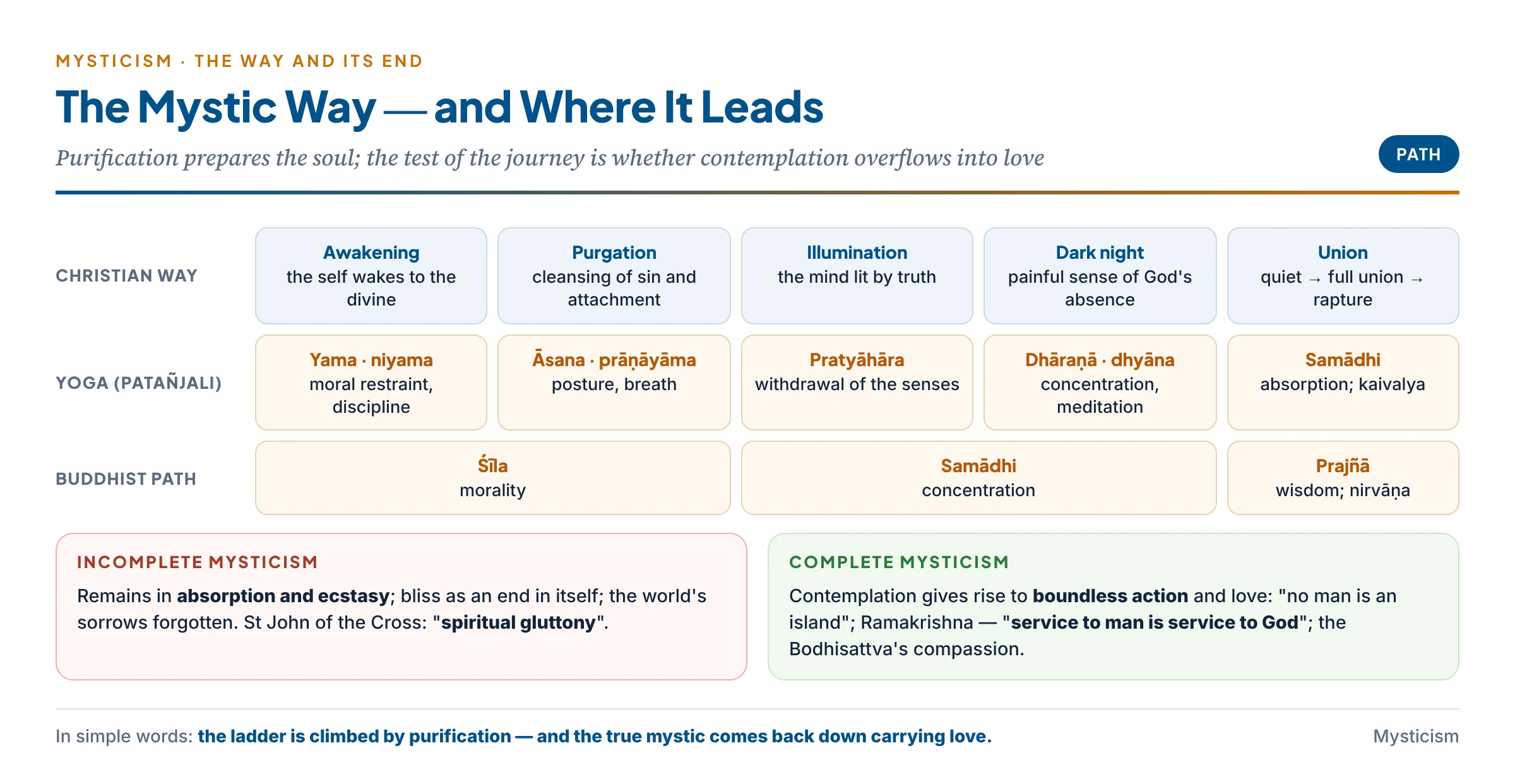
- The Christian mystic way. Medieval writers describe three classic stages — purgation (purifying the soul of sin and attachment), illumination (the mind lit by divine truth) and union. Within union itself they distinguished quiet (a prelude), full union and rapture — being “carried away” beyond oneself. Evelyn Underhill (Mysticism, 1911) gave five stages: awakening, purgation, illumination, the “dark night of the soul” (St John of the Cross’s term for a painful sense of God’s absence) and union.
- The Indian parallel. Patañjali’s eight limbs lead from moral restraint (yama, niyama) through posture, breath and withdrawal of the senses to dhāraṇā, dhyāna and samādhi; the Buddhist path moves from śīla (morality) through samādhi (concentration) to prajñā (wisdom).
7. Complete and Incomplete Mysticism — the Ethics of Mysticism
- The charge of escapism. It is sometimes said that mysticism is an escape from life and its duties: the mystic retreats into a private ecstasy, turns his back on the world and forgets not only his own sorrows but the needs and sorrows of others.
- Incomplete mysticism. To treat the bliss of mystical consciousness as an end in itself is psychologically possible — this is incomplete mysticism: the mystic remains in absorption and ecstasy. St John of the Cross condemned it as “spiritual gluttony“.
- Complete mysticism. Here contemplation gives rise to boundless action, creation and love: high value is placed on social service, on lifting up the downtrodden and lessening human suffering. The Christian mystics insist that union with God brings an intense, burning love of God that must overflow into the world as love of fellow human beings — shown in deeds of charity and mercy, not merely in words.
- Mysticism as the source of ethics. Some mystics claim that mysticism is the metaphysical basis of love — “the secret fountain of love, human as well as divine” — and love is the source of true moral action.
- True love follows from realising that “my brother and I are the same“; the distinctions between “I”, “you”, “he” and “she” are seen as superficial.
- The dissolution of the narrow ego expands the personality; total, unconditional love accompanies it.
- Separateness breeds egoism and “the war of all against all”; for one with no touch of mystical vision “all men would be islands”. Mysticism makes us realise that “no man is an island“.
- Indian examples. Ramakrishna‘s teaching “service to man is service to God” (śiva jñāne jīva sevā) and Vivekananda‘s practical Vedānta turned mystical experience into social service; the Gītā’s karma-yoga joins inner realisation with action for the good of the world (lokasaṃgraha).
Indian Connect — Complete mysticism in India
- Vivekananda took his master’s realisation into the Ramakrishna Mission, dedicated to education, relief and medical service.
- Gandhi called God “Truth” and found him in “Daridranārāyaṇa” — God in the poor.
- The Gītā describes the realised person as “rejoicing in the welfare of all beings” (sarvabhūtahite ratāḥ) — mystic vision issuing in compassion.
- Buddhism‘s Bodhisattva ideal — postponing one’s own nirvāṇa to save all beings — is the classic case of wisdom (prajñā) joined to compassion (karuṇā).
8. Is the Mystic Neurotic?
- The charge. Mystical states are sometimes dismissed as neurotic or pathological — trances, visions and self-loss look like symptoms.
- The reply. A neurotic state lacks two things: social adjustment and mental integration. In the great mystics both are found in supreme abundance.
- The company of mystics is highly valued; it brings regenerative changes — friendliness, a sense of community, peace of mind; it broadens vision and deepens the meaning of life.
- Mystics like Ramakrishna show great humanism — “service to mankind is service to God”.
- So mystics cannot be called neurotic; their states are better called supernormal than subnormal.
- James’s balance. William James granted that religious geniuses often had a nervous temperament, but argued that this does not discredit their experiences: judge them by their fruits, not by their roots (Article 2).
9. Is Mysticism Religious?
It is commonly assumed that mystical experience is necessarily a religious experience. Stace argued that this is far from correct: the connection between mysticism and religion is important but not direct.
- Grounds for saying mystical experience is not in itself religious.
- Stripped of interpretation, mystical experience is an undifferentiated unity; there seems nothing specifically religious about undifferentiated unity as such. “Union with God” is an interpretation, not the experience itself.
- The same experience is interpreted differently in different cultures: as the Trinitarian God by Eckhart and Ruysbroeck, as the one God of Islam by Muslim mystics, and as the impersonal Absolute by Advaita Vedānta.
- The Buddhist experience of śūnyatā — grasping the impermanent nature of reality through the Eightfold Path — is not interpreted as any kind of God at all; Buddhism denies a supreme being. It is “not clothed in any religious garb” in the theistic sense.
- Why mysticism nevertheless usually takes a religious form.
- Melting away of the self. A common thread in all introvertive experience is the melting away of individuality into the Infinite. Phrases like “melting away”, “passing away” are found in the mystical literature of all religions; among the Sufis it is called fanā’. Since the Infinite is, in most minds, identified with God, the experience acquires a religious meaning.
- Beyond space and time. The undifferentiated unity is necessarily felt as beyond space and time — “the Eternal Now“. In religious minds the Eternal, like the Infinite, is another name for God.
- Exalted peace and joy. Mystics universally testify to a consciousness of peace and blessedness; this is identified with “the peace of God“. Even in Buddhism, where it is not called God, it becomes nirvāṇa.
In simple words
Two friends watch the same sunrise in silence and feel a deep, wordless peace. One says, “I felt God.” The other says, “I felt one with the universe.” A third, a Buddhist, says, “For a moment there was no ‘I’ at all.” Stace’s point is that the silent experience may have been the same; the words they chose came from their different beliefs. The experience becomes “religious” when it is named — as God, Brahman or nirvāṇa.
10. Mysticism and Epistemology
- Feeling and knowledge. Mysticism is both a feeling and a form of knowledge. Along with ineffability it has a noetic quality, by which it becomes cognitive. So it forms one of the sources or foundations of religious knowledge, alongside revelation, reason and faith.
- Its claim. Mystics claim knowledge of ultimate reality that is certain, distinct and indubitable. In the context of epistemology, mysticism refers to using non-rational methods to arrive at beliefs and taking these beliefs to be knowledge.
- “The power of spiritual access to domains closed to ordinary thought.” This description captures the mystic’s claim: there are domains of reality — the One, the Self, God — that the senses and discursive reason cannot reach, but to which the purified spirit has direct access.
- In its favour: the noetic character of the experience; the remarkable convergence of testimony across cultures (James’s “neither birthday nor native land”); the transforming fruits in the lives of mystics; and the fact that our ordinary faculties are limited — there may be more than they reveal.
- Against it: the ineffability that guarantees its depth also removes it from public checking; there is no agreed criterion to distinguish genuine insight from pathology, suggestion or drugs; the content reported varies with the tradition; and the feeling of certainty accompanies error as readily as truth.
- Balanced view: mystical experience is strong evidence for the one who has it and weak as public proof. It functions in religious life much as anubhava does in Advaita — the confirmation of what scripture teaches, not an independent public demonstration (validity is treated fully in Article 8).
11. The Chief Doctrines of Mysticism
Across traditions, mystics teach a strikingly similar set of doctrines:
| Doctrine | What it says | Examples |
|---|---|---|
| 1. Unity of reality | Behind the many there is one reality | “All is One”; sarvaṃ khalv idaṃ brahma; Plotinus’ One |
| 2. Reality beyond sense and reason | The real cannot be grasped by perception or concepts; it is ineffable | Neti neti; Dionysius’ negative theology; “the Tao that can be told is not the eternal Tao” |
| 3. Direct knowledge is possible | The ultimate can be known immediately — “experiential knowledge of God” | Aparokṣānubhūti; the beatific vision; satori |
| 4. The divine within | The deepest self is divine or akin to the divine | Ātman is Brahman; Eckhart’s “spark of the soul”; “the kingdom of God is within you” |
| 5. Union or identity as goal | The soul’s end is union with or realisation of the One | Fanā’; mokṣa; spiritual marriage |
| 6. A way of purification | The goal is reached by detachment, discipline and love | Purgation–illumination–union; the eight limbs; the Eightfold Path |
| 7. Eternity in the present | The experience is of the eternal now, beyond time | Turīya; nunc stans |
| 8. Love and ethics | Union overflows into universal love and service | Bodhisattva; “service to man is service to God” |
| 9. The world re-seen | The world is seen as transfigured — or as appearance (māyā) | Extrovertive vision; Advaita’s vyavahāra |
Critical Evaluation
Objections to Mysticism
- Subjectivity and privacy. The experience is private; there is no public test of whether it was a meeting with the real or a state of one’s own brain.
- Ineffable but described. Mystics say nothing can be said — and then write volumes. If it is truly ineffable, it can neither be reported nor serve as evidence (Article 9).
- Contradictory interpretations. The Christian finds the Trinity, the Muslim the one God, the Advaitin the impersonal Brahman, the Buddhist śūnyatā. They cannot all be right — unless all are interpretations of a common, uninterpreted core, which is itself disputed.
- Natural causes. Drugs, fasting, sensory deprivation and brain states can produce similar experiences (James’s nitrous oxide; modern neuroscience — Article 8).
- Escapism and quietism. Incomplete mysticism can lead to withdrawal from social duty; some critics (including Ambedkar in the Indian context) saw an otherworldly mystical outlook as indifferent to social injustice.
- Anti-intellectualism. By placing the highest truth beyond reason, mysticism can shelter superstition and authoritarian gurus from criticism.
Defences and Strengths
- Convergence. Testimony from different ages and cultures — Upaniṣadic sages, Plotinus, Sufis, Christian contemplatives, Zen masters — shows deep agreement on unity, ineffability, peace and love.
- Fruits. The lives of mystics — Teresa’s reforms, Ramakrishna’s humanism, Kabīr’s critique of caste and ritual, Vivekananda’s service — show integration, not pathology.
- Ineffable is not meaningless. Mystics mean that no concept is adequate, not that nothing at all can be said; they speak by negation, paradox and metaphor (Article 9).
- Natural mechanisms do not settle truth. That the brain is involved in mystical states no more shows them false than the brain’s role in seeing a tree shows trees unreal.
Critics and Defenders
Criticism — Critics
- Empiricists and positivists: private, uncheckable states give no knowledge of reality.
- Psychologists: mystical states are regressions, trances or neurotic symptoms.
- Neuroscientists and drug research: the same states can be produced chemically or electrically.
- Social critics: incomplete mysticism withdraws from the world’s suffering.
- Constructivists (Katz): there is no common core; each tradition produces its own experience.
Defence — Defenders and strengths
- James: mystical states are authoritative for the one who has them and break the monopoly of ordinary consciousness.
- Stace: a common core — introvertive unity — appears across cultures.
- Complete mysticism: contemplation issues in love and service (St John of the Cross, Ramakrishna, Vivekananda).
- Against the neurosis charge: mystics show social adjustment and mental integration in abundance.
- Bergson: the great mystics are the source of an “open”, universal morality of love.
Cross-Tradition Comparison
Western and Indian Mysticism
| Point | Western mysticism | Indian mysticism |
|---|---|---|
| Classic figures | Plotinus, Eckhart, Teresa of Avila, John of the Cross; Rūmī and al-Ghazālī (Islam); the Kabbalists | Upaniṣadic seers, Śaṅkara, the Ālvārs and Nāyanārs, Kabīr, Caitanya, Ramakrishna, Ramana |
| Dominant form | Theistic union in love; identity claims often suspect | Both monistic identity (Advaita) and theistic devotion (bhakti) |
| Means | Prayer, contemplation, asceticism, grace | Yoga, meditation, self-enquiry, devotion, guru’s grace |
| Stages | Purgation → illumination → (dark night) → union | Yama-niyama → dhyāna → samādhi; śravaṇa → manana → nididhyāsana |
| Goal | Union with God; beatific vision | Mokṣa, kaivalya, nirvāṇa — liberation |
| Status in religion | Often a minority stream, sometimes suspected by authority | Close to the centre of the religion; the scriptures are the record of mystic insight |
Indian Connect — Takeaways
- Indian traditions treat mystical realisation as the normal goal of religion rather than a rare exception; that is why Indian thought has been called “mystical”.
- The Upaniṣadic formula “one who knows Brahman becomes Brahman” is the clearest statement of identity mysticism anywhere; Rāmānuja‘s bhakti is the clearest statement of theistic union that preserves distinction.
- Indian systems built mysticism into epistemology: Nyāya and Yoga accept yogic perception (yogaja pratyakṣa) as a valid way of knowing; Advaita gives final place to anubhava.
Synthesis (Siddhānta)
- What mysticism is. Mysticism is the direct, unitive experience of ultimate reality — beyond sensation, image and concept — marked by ineffability, noetic quality, transiency, passivity, unity, loss of ego and peace. It may be extrovertive or introvertive, theistic or monistic, and is reached through a path of purification.
- Its doctrines. Mystics across the world teach the unity of reality, its transcendence of sense and reason, the possibility of direct knowledge, the divine within, union as the goal, a way of purification, the eternal now and universal love.
- Religious, but not only religious. Stripped of interpretation, the core experience is an undifferentiated unity; it becomes religious because the Infinite, the Eternal and the peace it reveals are, for most minds, names of God — while Buddhism shows it can be religious without God.
- Complete mysticism. Its highest form is not escape but love in action; the test of the mystic is the life that follows. As a “power of spiritual access” to what ordinary thought cannot reach, mysticism carries real authority for the one who has it — and a standing invitation to others — but not a public proof.
- Contemporary relevance. Meditation and contemplative practices — mindfulness, vipassanā, yoga — are now practised worldwide and studied scientifically, often stripped of their religious setting; the old question of Stace and Zaehner returns: is the experience the same everywhere, and is it religious in itself?
Previous Year Questions
- 2016State and evaluate the nature and validity of mystic experience.
- 2013What is the nature of mystical experience?
- 2005“Mysticism is the power of spiritual access to domains of knowledge closed off to ordinary thought.” Critical notes.
- 2000State and explain the chief doctrines of Mysticism.