

Individual and State: Rights; Duties and Accountability.
Official Syllabus: Paper II, Section A, Unit 3
A right is the language in which the individual speaks to society and the state: “this is due to me.” The idea is so familiar today — right to life, right to vote, right to education — that we rarely ask what it means. Is a right a claim, a freedom, a power or a shield? Is it created by law or does law only recognise it? Can it ever be absolute? This article explains the meaning and elements of a right, the four kinds of legal relation that Hohfeld found hidden in the one word “right”, the will and interest theories, the main classifications (negative and positive; civil, political and social; legal and moral), the idea of inalienable rights, the danger of unconditional rights, Dworkin’s “rights as trumps”, and why the right of free speech depends on an independent judiciary. The theories that justify rights — natural, legal, historical, social-welfare and idealist — follow in the next article.
In simple words
When you buy a cinema ticket, you get a right to a seat. That one ticket gives you several things at once: a claim (the cinema must let you in), a freedom (you may stay or leave mid-film), a power (you can give the ticket to a friend) and a protection (the manager cannot cancel it on a whim). Philosophers simply take this everyday bundle apart and look at each piece.
Context & Problem
Why Rights Became Central
- From duties to rights. Ancient and medieval thought — Indian and Western — spoke mainly of duties: what each person owes according to his station, dharma or divine law.
- Modern turn. From the seventeenth century, thinkers such as Grotius, Hobbes and Locke began to speak of what each person may claim. The English Bill of Rights (1689), the American Declaration of Independence (1776) and the French Declaration of the Rights of Man and of the Citizen (1789) turned this language into law.
- Today. Constitutions (Part III of the Indian Constitution), the Universal Declaration of Human Rights (1948) and courts all speak the language of rights. The philosophical question is what gives a right its force.
What Is a Right?
- Basic definition. A right is a justified claim of an individual, recognised by society and usually protected by the state, to have, do or receive something that is necessary for his well-being and self-development — exercised without compromising the same right of others.
- Classic definitions:
- Laski: “Rights are those conditions of social life without which no man can seek, in general, to be himself at his best.”
- Green: a right is a power of acting for one’s own ends, recognised by society as contributing to the common good.
- Bosanquet: a right is a claim recognised by society and enforced by the state.
- Dworkin: rights are “trumps” held by individuals that override ordinary goals of collective welfare.
- Rights and the state. The state does not simply create rights at will; it recognises, defines and protects claims that society accepts as necessary for a good life. (Whether rights exist before the state is the debate between natural-rights and legal theories, discussed in the next article.)
Elements of a Right
- A claim by the individual — something demanded as due, not begged as a favour.
- Social recognition — the claim must be accepted by society as reasonable; a claim to steal is not a right.
- Legal protection — for a legal right, the state backs it with courts and sanctions.
- A correlative duty — someone else (individuals or the state) must respect or provide it.
- Universality — the same right is available to all similarly placed persons.
- Limitation — a right is limited by the equal rights of others and by the common good.
- Purpose — rights exist for the development of personality and social well-being.
Core Doctrine
Hohfeld’s Four Incidents: Four Meanings Hidden in “Right”
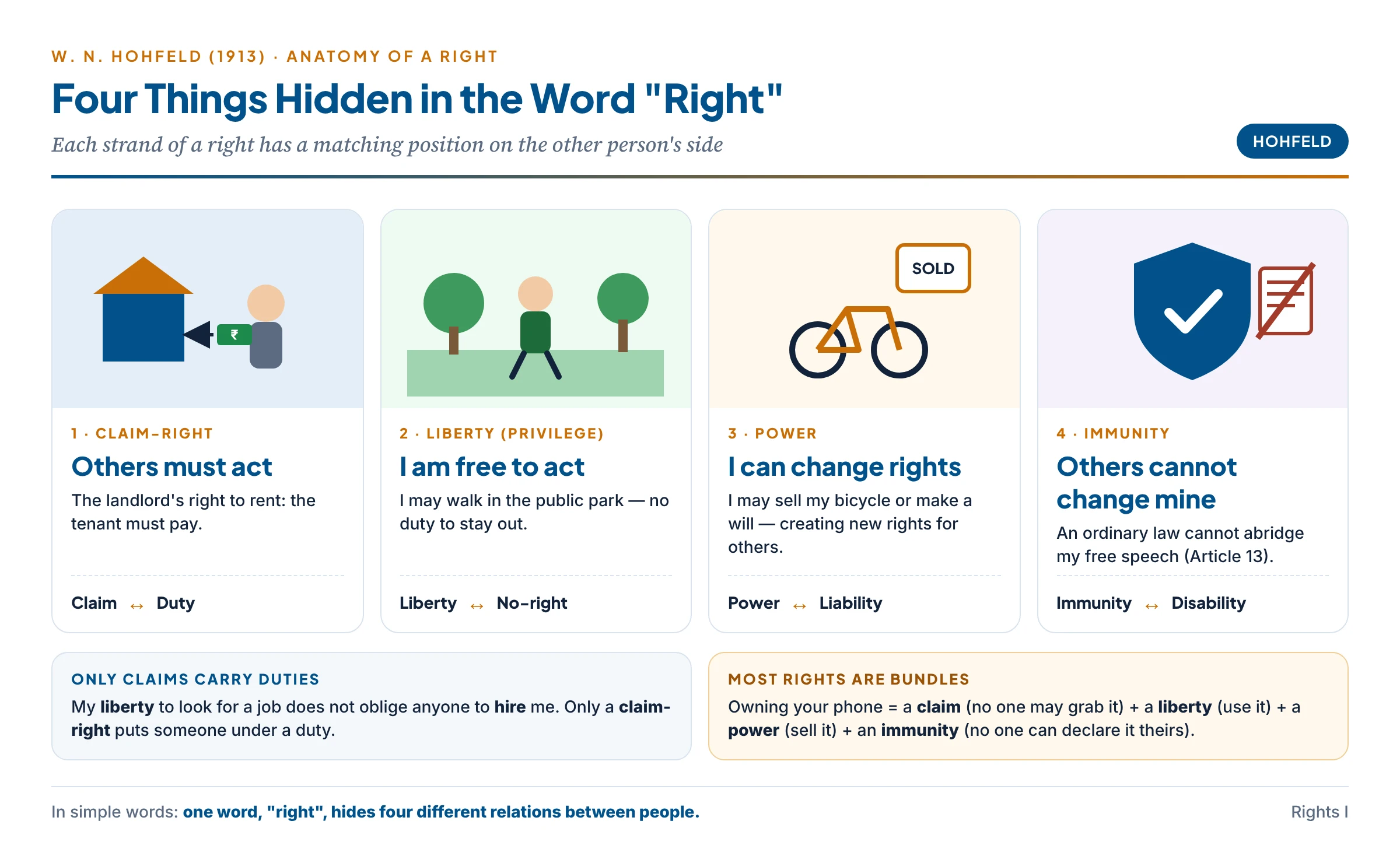
The American jurist Wesley Newcomb Hohfeld (1913) showed that lawyers use “right” for four different relations, each paired with a matching position of another person.
| Incident | What it means | Its partner on the other side | Everyday example |
|---|---|---|---|
| 1. Claim-right | Others must act or not act towards me in a certain way | Duty | A landlord’s right to rent — the tenant has a duty to pay |
| 2. Liberty (privilege) | I am free to do or not do something; I have no duty not to | No-right — others cannot demand that I stop | My liberty to walk in a public park — no one can demand I stay out |
| 3. Power | I can change legal relations — create, transfer or end rights | Liability — others are exposed to the change | My power to sell my bicycle or make a will |
| 4. Immunity | Others cannot change my legal position | Disability — others lack the power to change it | My freedom of speech is immune from abridgement by an ordinary law (Article 13) |
- Why Hohfeld matters.
- Only claim-rights strictly correlate with duties. A liberty does not create a duty in others to help me — my liberty to look for a job does not oblige anyone to hire me.
- It clears up confused debates: “Do I have a right to protest?” may mean a liberty (no one can forbid it), a claim (police must protect me) or an immunity (Parliament cannot ban it). Each needs a different argument.
- Most real rights are bundles of incidents — property is a claim, a liberty, a power and an immunity together.
In simple words
Your right to use your own phone is a bundle. Claim: no one may grab it. Liberty: you may switch it off or on as you like. Power: you may sell it or gift it. Immunity: a neighbour cannot simply announce that it now belongs to him. Lose any one strand and your “right” to the phone is weaker.
Will Theory and Interest Theory
- The question. What is the point of having a right?
- Will (choice) theory — H. L. A. Hart.
- A right gives its holder control over another’s duty — he may demand, waive or enforce it.
- A right is a zone of sovereign choice.
- Difficulty: babies, people in a coma and animals cannot choose — do they have no rights? And some rights cannot be waived (one cannot sell oneself into slavery).
- Interest (benefit) theory — Joseph Raz, Neil MacCormick.
- A person has a right when an aspect of his well-being is important enough to hold others under a duty.
- Explains the rights of children, the unconscious and future generations.
- Difficulty: too wide — many people benefit from a contract (the beneficiary of a gift) without holding the right to enforce it.
- Balanced view. The will theory captures the dignity of choice; the interest theory captures the protection of the vulnerable. Most modern accounts use both.
Legal Rights and Moral Rights
- Legal rights are recognised and enforced by the law of a state — the right to vote at 18, to a fair trial, to property under Article 300A.
- Moral rights rest on morality or conscience, whether or not the law recognises them — the right of an old parent to respect from children, the right to be told the truth.
- Relation.
- Many legal rights grew out of moral claims (the abolition of slavery, votes for women).
- A legal right may be morally wrong (apartheid-era laws gave whites privileges as “rights”).
- Human rights are moral rights that claim universal validity and press to become legal rights everywhere.
- Natural rights — moral rights believed to belong to human beings by nature, before any state (Locke’s life, liberty and property).
Negative Rights and Positive Rights
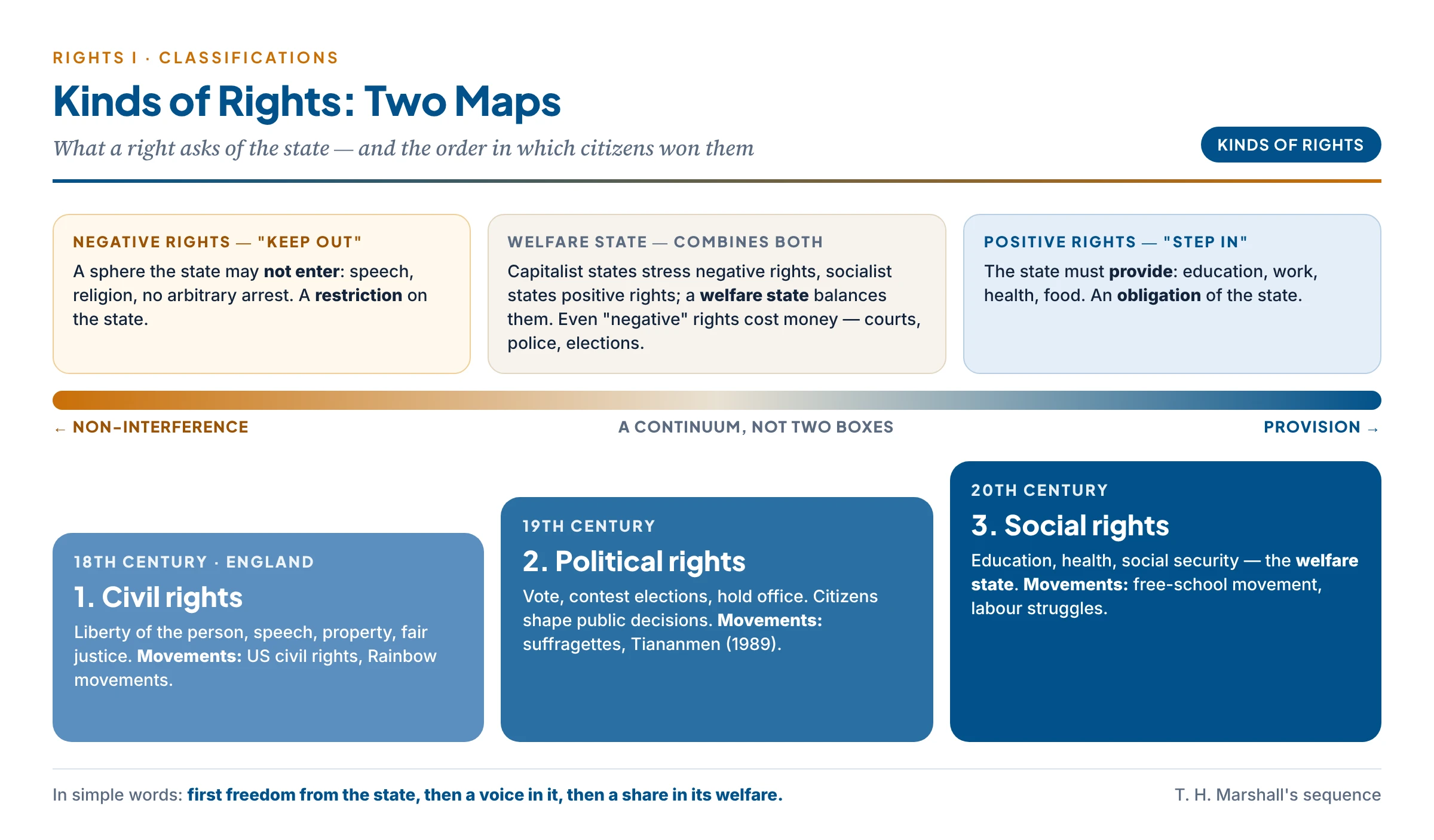
- Negative rights mark a sphere the state (and others) may not enter — they ask for non-interference. Examples: freedom of thought and expression, freedom of religion, protection from arbitrary arrest.
- Positive rights require the state to take positive steps to improve the quality of life — they ask for provision. Examples: the right to education, to work, to health care, to food.
- Restrictions vs obligations. Negative rights are restrictions on the state; positive rights are obligations of the state.
- A continuum, not two boxes. Even “negative” rights cost money — a free press needs courts, police and elections; a fair trial needs judges and legal aid. Positive and negative rights are better treated as a continuum.
- Political orientation.
- A capitalist (libertarian) state gives precedence to negative rights.
- A socialist state gives precedence to positive rights.
- A welfare state tries to combine them as far as possible.
- India. Part III (Fundamental Rights) is largely negative and enforceable; Part IV (Directive Principles) is positive and non-justiciable. Courts have read positive content into Article 21 — the right to livelihood (Olga Tellis, 1985), to food (the PUCL right-to-food case), to shelter and health — and the 86th Amendment (2002) made education a fundamental right (Article 21A).
Civil, Political and Social Rights
| Kind | Meaning | Examples | Movements that fought for it |
|---|---|---|---|
| Civil rights | Actions affecting the individual and his autonomy | Equality before law, personal liberty, freedom of expression, property | American civil rights movement for Black citizens; Rainbow (LGBTQ) movements |
| Political rights | The individual’s share in making laws and government | Right to vote, contest elections, hold office, petition | Tiananmen Square protests (1989) for democratic rights; suffragettes |
| Social rights | A decent standard of economic and social welfare; a share in the social heritage | Education, health, social security | Free school movement in the USA; welfare-state struggles |
- T. H. Marshall’s sequence (Citizenship and Social Class, 1950), drawn from English history:
- Civil rights (eighteenth century) — liberty of the person, speech, property, justice — created an atmosphere in which democracy could grow.
- Political rights (nineteenth century) — the extension of the vote — let citizens take part in public life and influence decisions.
- Social rights (twentieth century) — the welfare state: education, health, social security.
- Lesson. Each kind of right prepared the ground for the next; full citizenship needs all three.
Other Classifications
- Economic rights — to work, fair wages, rest and leisure; cultural rights — to one’s language, culture and heritage (Articles 29–30).
- Individual and group rights — held by persons or by communities (minorities, indigenous peoples); discussed in the article on group rights.
- Fundamental rights — rights given special constitutional protection, enforceable by courts (Article 32, the “heart and soul” of the Constitution in Ambedkar’s words).
- Human rights — rights held by every human being as human; discussed in their own article.
Inalienable (Unalienable) Rights
- Meaning. A right is inalienable when it cannot be given away by the holder or taken away by anyone else — not by sale, contract, consent or law.
- Classic statements.
- Locke — no one can give another more power over his life than he has himself; a person cannot enslave himself.
- Hobbes — even in the Leviathan, the right of self-preservation cannot be surrendered.
- American Declaration of Independence (1776) — all men “are endowed by their Creator with certain unalienable Rights, that among these are Life, Liberty and the pursuit of Happiness.”
- UDHR (1948), Preamble — “the inherent dignity and … the equal and inalienable rights of all members of the human family.”
- Arguments for inalienable rights.
- Dignity — some goods are part of being a person; to alienate them is to stop being a free agent.
- Protection against tyranny — if rights can be taken away by law, a majority or dictator can legalise anything.
- Protection against oneself — the law refuses to enforce contracts of slavery or sale of organs, even if “voluntary”.
- Arguments against.
- Bentham — rights come from law; “inalienable” rights are rhetorical nonsense that invite resistance to every law.
- In practice rights are limited — liberty is taken away by imprisonment, property by taxation and acquisition, and in some states life by capital punishment.
- Who decides which rights are inalienable? Lists vary across cultures and centuries.
- A middle position: non-derogable rights. Most rights may be limited, but a core may not be suspended even in emergencies. The International Covenant on Civil and Political Rights (1966) lists rights that cannot be suspended even in a public emergency — the right to life, freedom from torture and slavery, and freedom of thought, conscience and religion among them.
- Indian experience. During the Emergency, the Supreme Court in ADM Jabalpur (1976) held that the right to approach courts for personal liberty could be suspended. The 44th Amendment (1978) provided that Articles 20 and 21 cannot be suspended even during an emergency, and in K. S. Puttaswamy (2017) the Court declared ADM Jabalpur wrongly decided — life and personal liberty are inalienable to human existence, not gifts of the state.
Common confusion
Does “inalienable” mean that a right can never be limited in any way? No. “Inalienable” means the right cannot be transferred or extinguished — you cannot sell your liberty or sign away your life, and no government can abolish these rights. It does not mean the right is unlimited in exercise. Your liberty is inalienable, yet it can be restricted by just law after due process (a jail sentence for a crime). The precise modern term for rights that cannot even be suspended is non-derogable.
Are Rights Absolute? Do Unconditional Rights Lead to Anarchy?
- What an unconditional right would mean. A right that holds in every circumstance, with no limits from others’ rights, the common good or law.
- Arguments that unconditional rights lead to anarchy.
- Hobbes’s state of nature is the model: each person has a right to everything, even to another’s body — and the result is the war of all against all.
- Rights collide. My unconditional free speech would override your reputation and privacy; my unconditional property would override public need. Without a rule to settle clashes, force settles them.
- Bentham called the French Declaration’s absolute rights “anarchical fallacies“: if every citizen may resist any law that touches his “imprescriptible” rights, no law is safe.
- Rights need duties and order. A right exists only where others recognise and the state protects it; unconditional claims destroy the social fabric that makes rights possible.
- Arguments that they need not.
- A small core of rights can be close to absolute without chaos — no torture, no slavery, no punishment without trial. Recognising these strengthens order.
- Libertarians (Nozick) treat rights as side-constraints on everyone’s action; this yields a minimal state, not anarchy.
- Anarchy comes from the absence of an umpire, not from the strength of rights — constitutional courts settle rights-clashes peacefully.
- The Indian approach — reasonable restrictions. Article 19(1) freedoms are limited by Article 19(2)–(6) on grounds such as sovereignty and integrity, security of the state, public order, decency, morality and defamation; in Maneka Gandhi (1978) the Court required any law restricting liberty to be just, fair and reasonable; the test of proportionality (Puttaswamy; Anuradha Bhasin, 2020) checks whether limits go further than necessary.
- Balanced view. Rights are strong but not unconditional. Unlimited rights would turn into a war of claims; rights with no firm core become gifts of the ruler. The answer is a firm core plus reasonable, reviewable limits.
In simple words
Think of a highway. If every driver had an unconditional right to drive at any speed, in any lane, there would be crashes everywhere — anarchy. If the police could stop anyone at any time for any reason, there would be no freedom to travel. Traffic rules give a firm right to use the road, limited only by the equal right of others to use it safely.
Dworkin: Rights as Trumps
- Ronald Dworkin (Taking Rights Seriously, 1977) — a right is a trump card: it overrides ordinary arguments of collective welfare or majority preference.
- Why trumps? Utilitarian calculation may show that the majority would be happier if a minority religion were banned or a hated person jailed without trial. Rights block such calculations: some things may not be done to a person even for the general good.
In simple words
In a card game the trump card beats any ordinary card, however high. Dworkin’s rights work the same way: if ninety people would enjoy watching one person humiliated, their combined pleasure is a pile of ordinary cards — the one person’s right to dignity is the trump that beats them all.
- Ground of rights. Every person is entitled to equal concern and respect from the government.
- Limits. A trump can be overridden only by another right or by a grave emergency — not by mere convenience or cost.
- Criticism. Utilitarians reply that trumps make policy rigid; communitarians say Dworkin neglects the common good and duties.
Free Speech and an Independent Judiciary
- The claim to examine. “The right of free speech implies a genuinely independent judiciary and its complete separation from the executive.”
- Why the claim is largely true.
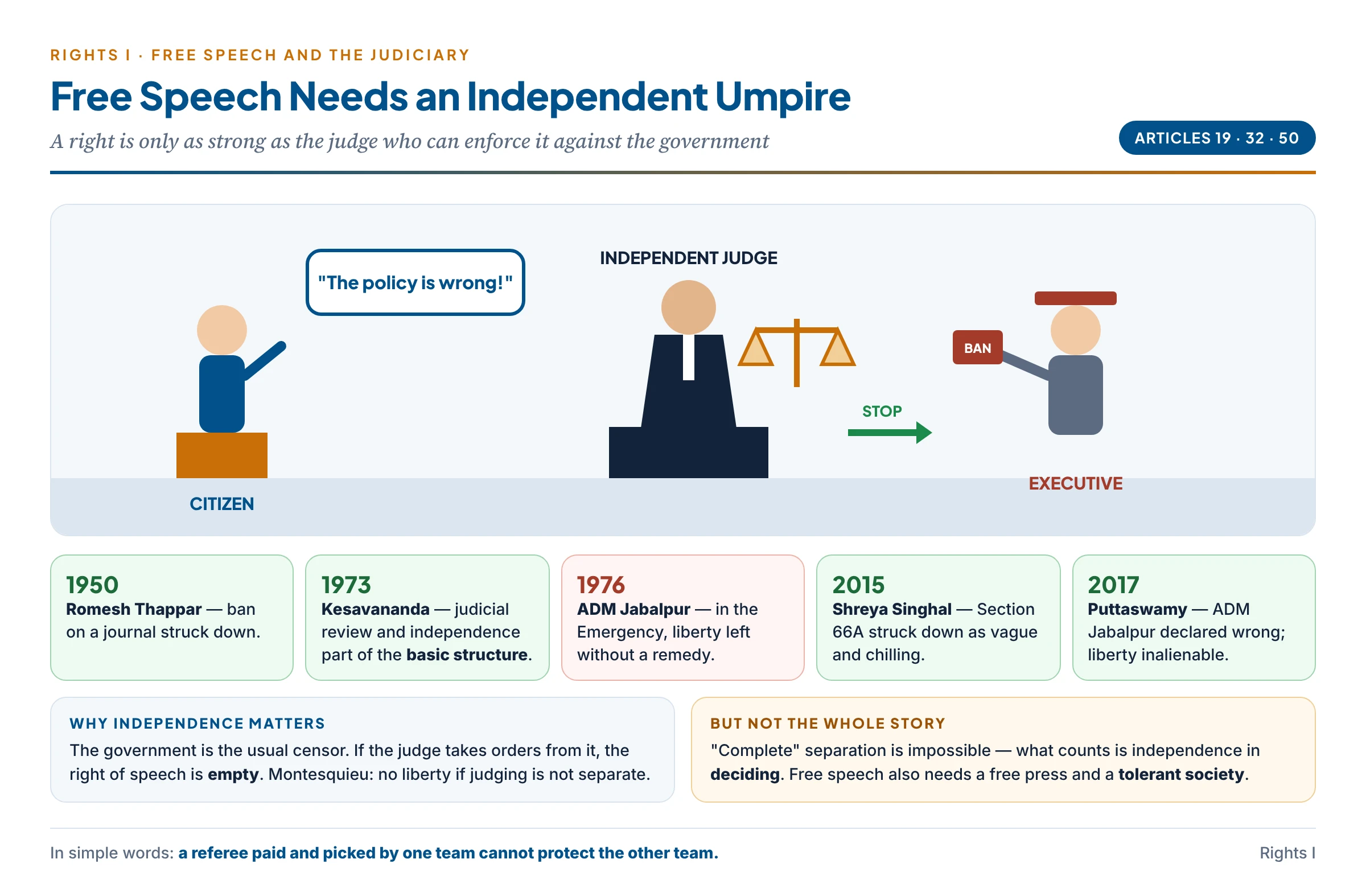
- The executive is the usual threat. Governments are the main censors — banning books, jailing critics, cutting the internet. If the judge who decides a free-speech case takes orders from the same government, the right is empty.
- Rights need a neutral umpire. A right is only as strong as the remedy behind it. Ambedkar called Article 32 (the right to move the Supreme Court) the “heart and soul” of the Constitution.
- Montesquieu’s separation of powers — “there is no liberty if the power of judging is not separated from the legislative and executive powers.”
- Mill’s arguments for free speech protect the unpopular opinion; only a body insulated from majority and government pressure will protect it.
- Indian record. Romesh Thappar (1950) struck down a ban on a journal; Shreya Singhal (2015) struck down Section 66A of the IT Act as vague and chilling; the ADM Jabalpur episode (1976) showed how a pliant judiciary leaves citizens without remedy.
- Constitutional design. Article 50 directs the state to separate the judiciary from the executive; judicial independence is part of the basic structure (Kesavananda Bharati, 1973), and the Supreme Court invoked it in striking down the National Judicial Appointments Commission (2015).
- Qualifications.
- “Complete” separation is impossible. Judges are appointed, paid and their orders enforced by the executive; what matters is independence in decision-making, not total isolation.
- Free speech also needs a free press, plural media, civil society and a tolerant culture — courts alone cannot save it (Ambedkar: rights are protected finally by the social and moral conscience of society).
- Courts themselves can restrict speech — contempt of court powers are sometimes criticised as chilling criticism of judges.
- Conclusion. Free speech implies an independent judiciary as its necessary guarantee, though not its only one.
Critical Evaluation
Debates about the Idea of Rights
- Are rights individualistic? Communitarians (Sandel, MacIntyre) and Marx argue that rights-talk treats people as separate atoms and neglects community and duty.
- Are rights only Western? Critics in Asia and Africa have argued that rights reflect liberal Western culture (taken up in the human-rights article).
- Rights inflation. When every desire is called a “right”, the word loses force; serious rights get diluted.
- Rights without duties. Gandhi and many Indian thinkers warn that a culture of claims without obligations corrodes society (taken up in the rights–duties article).
Critics and Defenders
Criticism — Critics
- Bentham: natural or “inalienable” rights are “nonsense upon stilts”; absolute rights are “anarchical fallacies”.
- Marx: rights of man are the rights of egoistic, separated man.
- Communitarians: rights-talk neglects community, virtue and duty.
- Utilitarians: Dworkin’s trumps make public policy rigid.
- Realists: rights on paper mean little without power — the poor cannot use their formal freedoms.
Defence — Defenders and strengths
- Hohfeld makes rights precise — claim, liberty, power and immunity.
- Locke and the Declarations made rights the shield of the individual against tyranny.
- Dworkin: without trumps, minorities are always at the mercy of majority calculations.
- Marshall: civil, political and social rights together make full citizenship.
- Indian courts show that rights, backed by an independent judiciary, protect the weak — from Maneka Gandhi to Puttaswamy.
Cross-Tradition Comparison
| Theme | Western idea | Indian idea |
|---|---|---|
| Basic moral language | Rights (claims of the individual) | Dharma (duties of one’s station); adhikāra (entitlement or eligibility) |
| Immunity from power | Rights as trumps; constitutional immunity | Rājadharma binds the king to dharma, but subjects have no enforceable claim |
| Positive rights | Welfare state, social rights | King’s duty to support the old, widows, orphans and the sick (Kautilya) |
| Free expression | Mill’s four arguments | Śāstrārtha debate culture; Aśoka’s edicts urging respect for other sects’ views |
Indian Connect — Indian Connect
- Adhikāra. Indian thought had a concept close to “entitlement” — adhikāra, the eligibility or entitlement to perform a ritual, study a text or hold an office. But adhikāra was usually graded by birth, stage of life and gender, not equal for all — the very inequality modern rights reject.
- Duty-first ethics and rights. In a dharma-based order my duty to you secures your good — so a right exists indirectly, as the shadow of another’s duty. Modern rights reverse the direction: you hold the claim directly, and others’ duties follow.
- Constitutional synthesis. The Indian Constitution joins both — enforceable Fundamental Rights (Part III), directive welfare duties of the state (Part IV) and Fundamental Duties of citizens (Part IVA).
Synthesis (Siddhānta)
- A right is a structured claim — Hohfeld’s four incidents show its anatomy, the will and interest theories its purpose.
- Rights come in families — negative and positive, civil, political and social — and full citizenship needs them all; the old divide between them is a continuum.
- Rights are strong but not unconditional — a firm, non-derogable core (life, liberty, freedom from torture) with reasonable limits judged by an independent court.
- Rights need institutions and culture — an independent judiciary as umpire, and a society whose conscience accepts the rights the law declares.
- Contemporary relevance.
- Digital rights — privacy, data protection and internet access — are new strands in the old bundle.
- Internet shutdowns and online censorship test the reasonableness of restrictions on free speech.
- Socio-economic rights — food, health, education — keep widening Article 21.
- Conclusion. Rights are the individual’s shield and ladder: a shield against abuse of power and a ladder to self-development. They are secure only when society recognises them, the state protects them and an independent judiciary stands guard.
“Rights are those conditions of social life without which no man can seek, in general, to be himself at his best.” — Harold J. Laski
Previous Year Questions
- 2022Does the idea of unconditional rights necessarily lead to anarchy? Critically examine.
- 2016Evaluate the statement that all human beings have certain unalienable rights.
- 2016“The right of free speech implies the genuine-independence judiciary and its complete separation from the executive.” Evaluate.