

Individual and State: Rights; Duties and Accountability.
Official Syllabus: Paper II, Section A, Unit 3
The contract theorists made the individual the starting point of politics. The nineteenth and twentieth centuries asked a harder question: once the state exists, how much may it do to the individual, and for him? J. S. Mill drew a protective circle around the individual; Hegel and the British idealists (Green, Bradley, Bosanquet) argued that true freedom is found inside a rational state; Laski judged every state by the rights it maintains; Marx and the anarchists saw the state as an instrument of domination that should disappear; and Gandhi dreamt of an “enlightened anarchy” in which each person rules himself. This article explains each answer to the individual–state question, compares them, and tests them against each other.
In simple words
Think of a school. One principal says: “As long as you do not disturb other students, how you study is your business” (Mill). Another says: “You become your best self only by living the school’s traditions and rules” (Hegel). A third says: “My job is to remove what stops you from learning — hunger, missing books, bullying” (Green). A fourth says: “This school only serves the rich students’ parents” (Marx). A fifth says: “We don’t need a principal at all — let students govern themselves” (the anarchists and Gandhi).
Context & Problem
- From origin to limits. Hobbes, Locke and Rousseau explained why the state exists. Industrial society raised new questions: factory exploitation, mass democracy, public opinion, poverty and nationalism.
- Two dangers to the individual.
- The state itself — taxation, censorship, war.
- Society and the majority — custom, public opinion and the “tyranny of the majority” (Tocqueville, Mill).
- Two answers. Negative (classical) liberals want to keep the state out of the individual’s life. Positive liberals and idealists want the state to help the individual become free in a fuller sense. Radicals (Marx, anarchists) say the problem is the state itself. Gandhi wants to replace coercion with self-rule and duty.
Core Doctrine
J. S. Mill: The Sovereign Individual
Background
- John Stuart Mill (1806–1873), son of James Mill, raised in the utilitarian school of Jeremy Bentham; works: On Liberty (1859), Considerations on Representative Government (1861), Utilitarianism (1863), The Subjection of Women (1869).
- Revision of Bentham. Bentham measured pleasures only by quantity. Mill added quality: intellectual and moral pleasures are higher than bodily ones.
“It is better to be a human being dissatisfied than a pig satisfied; better to be Socrates dissatisfied than a fool satisfied.” — J. S. Mill
- Why this matters for the state. If human well-being means developing our higher faculties, then people need freedom to think, choose and experiment — utility itself demands liberty.
The harm principle
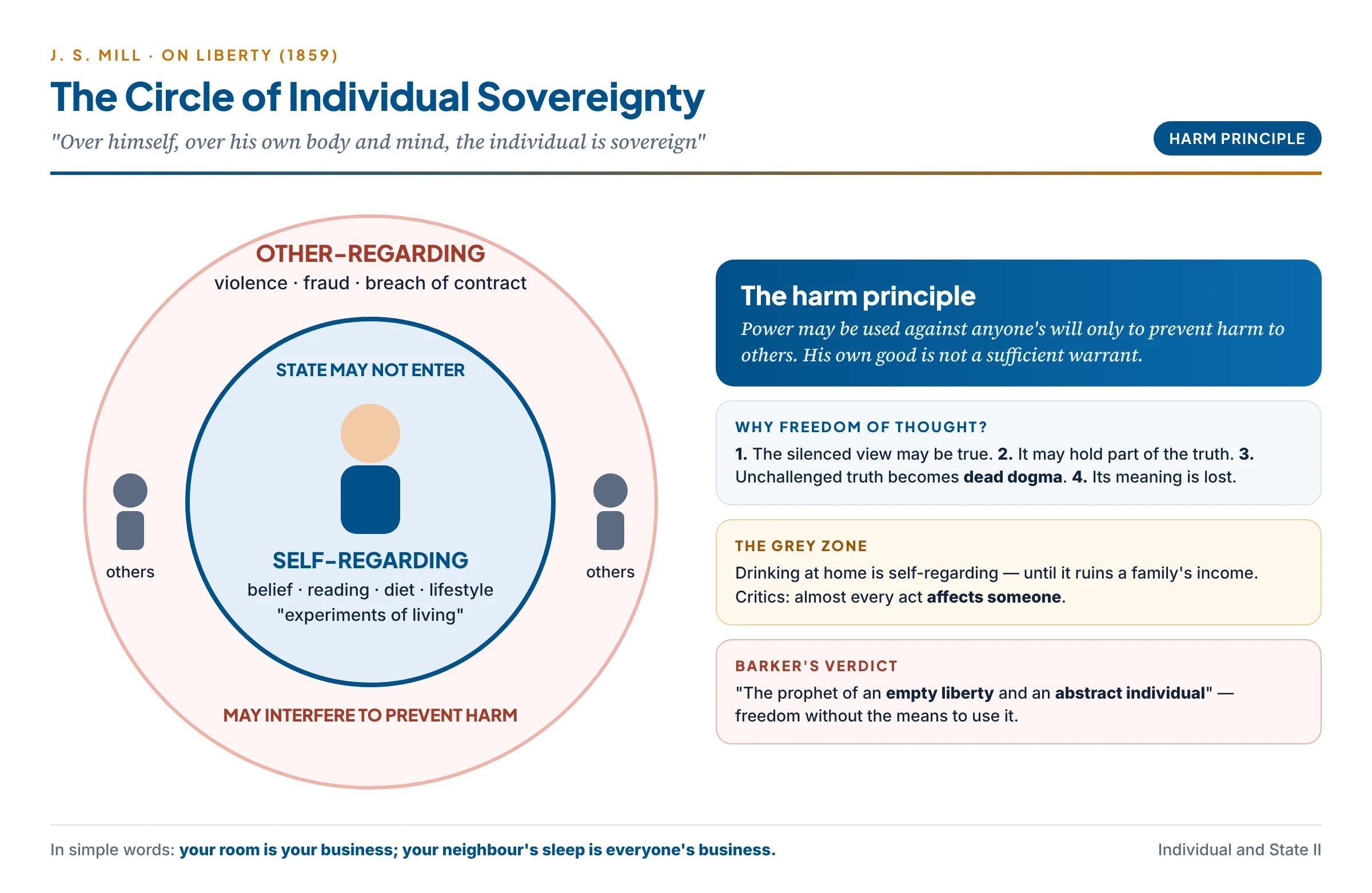
- Statement. “The only purpose for which power can be rightfully exercised over any member of a civilised community, against his will, is to prevent harm to others. His own good, either physical or moral, is not a sufficient warrant.”
- Self-regarding vs other-regarding actions.
- Self-regarding actions affect mainly the agent himself — what he eats, reads, believes, how he spends his time. Here the individual is sovereign.
- Other-regarding actions affect others — fraud, violence, breach of contract. Here society and the state may interfere.
“Over himself, over his own body and mind, the individual is sovereign.” — J. S. Mill
Liberty of thought and expression — four arguments
- The silenced opinion may be true. To suppress it is to assume we are infallible.
- It may contain part of the truth; the accepted view is rarely the whole truth.
- Even if the accepted view is wholly true, unless it is challenged it is held as a dead dogma, not a living truth.
- Its meaning will be lost; people repeat words without understanding.
“If all mankind minus one were of one opinion, … mankind would be no more justified in silencing that one person than he, if he had the power, would be justified in silencing mankind.” — J. S. Mill
Individuality
- Individuality is an element of well-being. People should be free to make “experiments of living”; genius needs an atmosphere of freedom.
- Tyranny of the majority. The greatest danger in a democracy is not only the law but social pressure — custom and public opinion that crush originality.
- “A state which dwarfs its men … will find that with small men no great thing can really be accomplished.”
Mill on government and democracy
- Representative government is the ideal form — but Mill is a “reluctant democrat”:
- Plural voting — extra votes for the educated, to check the ignorance of the masses.
- Proportional representation to give minorities a voice.
- Open (not secret) ballot, as voting is a public trust.
- Votes for women — radical for his age.
- Democracy not for all peoples. Mill held that representative government suits only societies at an advanced stage; “despotism is a legitimate mode of government in dealing with barbarians, provided the end be their improvement” — a defence of colonial rule, including in India where he worked for the East India Company.
- The Subjection of Women (1869). The legal subordination of women is wrong in itself and a chief hindrance to human improvement; Mill compared the position of married women to slavery.
Criticisms of Mill
- The line cannot be drawn. Almost every action affects others (James Fitzjames Stephen) — drunkenness harms a family; self-regarding and other-regarding blur.
- Abstract individual. Ernest Barker called Mill “the prophet of an empty liberty and an abstract individual” — freedom from interference is empty without the means to use it.
- Elitism and colonialism. Plural voting and “despotism for barbarians” sit uneasily with equal dignity.
- Bridge to positive liberalism. Yet in later work Mill accepted state action on education, factory hours and land — he stands at the transition from negative to positive liberalism.
In simple words
Mill’s rule is like the rule in a hostel: what you eat in your room, which books you read, when you sleep — that is your business. Playing loud music at 2 a.m. or stealing a roommate’s food is everyone’s business. The hard cases are in between — like smoking in a shared corridor.
Hegel: The State as the Actuality of Concrete Freedom
Background
- G. W. F. Hegel (1770–1831); main political work: Elements of the Philosophy of Right (1821). His dialectical philosophy sees history as the progress of Spirit (Geist) towards self-conscious freedom.
Abstract freedom and concrete freedom
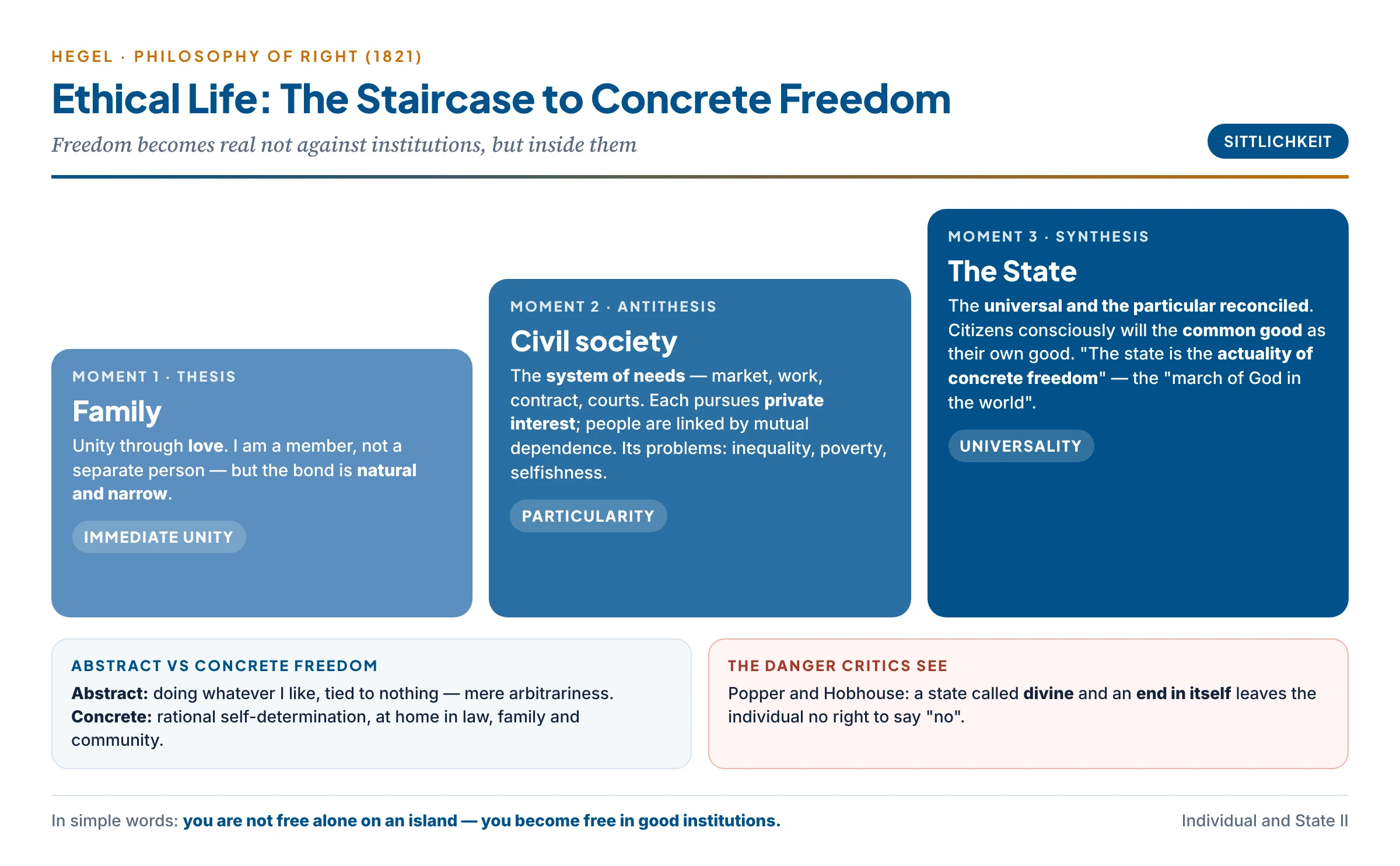
- Abstract freedom — freedom as doing whatever one likes, free from all ties. Hegel calls this arbitrariness; it is empty because it has no content except one’s passing desires.
- Concrete freedom — freedom as rational self-determination, realised when a person wills what is rational and finds himself “at home” in the institutions of his community.
Ethical life (Sittlichkeit) — three moments
- Family — unity through love; the individual is a member, not a separate person. Its weakness: it is natural and limited.
- Civil society — the world of market, work and private interest, a “system of needs“; individuals pursue their own ends and are linked by economic dependence, courts, police and corporations. Its weakness: inequality, poverty and selfishness.
- The state — the synthesis: the universal and the particular reconciled. In the state, individuals consciously will the common good as their own good.
“The state is the actuality of concrete freedom”
- Meaning. Freedom is not something the individual has against the state; freedom becomes real (“actual”) only in the rational state, where personal interests are fully developed and pass over into the interest of the universal.
- The state as rational. “The state is the actuality of the ethical Idea”; it is “the march of God in the world” — the rational order of Spirit on earth.
- The individual’s highest duty is to be a member of the state; the state is not a joint-stock company formed for protection of property (the Lockean picture), but the community in which persons become fully ethical.
- War and the nation. Hegel saw war as preserving the “ethical health” of peoples against stagnation, and states as not bound by a higher law between them.
Is Hegel’s state totalitarian?
- Arguments that it is:
- The state is called divine and an end in itself; the individual’s duty is membership.
- Popper listed Hegel among the “enemies of the open society“; L. T. Hobhouse wrote The Metaphysical Theory of the State (1918) blaming Hegelian state-worship for German militarism.
- Fascists and Nazis cited the over-emphasis on the nation-state.
- Arguments that it is not:
- Hegel’s state is a constitutional monarchy with rule of law, an independent civil service and representative estates.
- Civil society keeps a sphere of private rights, property, contract and free choice of occupation.
- The “state” he praises is the rational idea of the state, not any existing government.
- His aim is to realise freedom, not to abolish it — a correction of empty, atomistic liberalism.
- Balanced view. Hegel’s insight is that freedom needs institutions — family, market, law, state. His danger is giving the state a moral authority with no clear right of the individual to say “no”.
Common confusion
Did Hegel mean that any government, however bad, is “God on earth”? No. Hegel distinguishes the rational state — the idea that existing states only partly realise — from actual governments, which may be defective. “The march of God in the world” describes the state as the rational form of human freedom in history. The real danger is that this distinction is easy to forget, which is how later nationalist and fascist writers misused him.
T. H. Green: “Will, not Force, Is the Basis of the State”
Background
- Thomas Hill Green (1836–1882), Oxford philosopher; Lectures on the Principles of Political Obligation (published 1886). He joined Hegelian idealism with English liberalism to create positive (social) liberalism.
Positive freedom
- Freedom is not merely the absence of restraint. It is “a positive power or capacity of doing or enjoying something worth doing or enjoying, and that, too, something that we do or enjoy in common with others.”
- A labourer free to sign any contract, but starving and uneducated, is not really free.
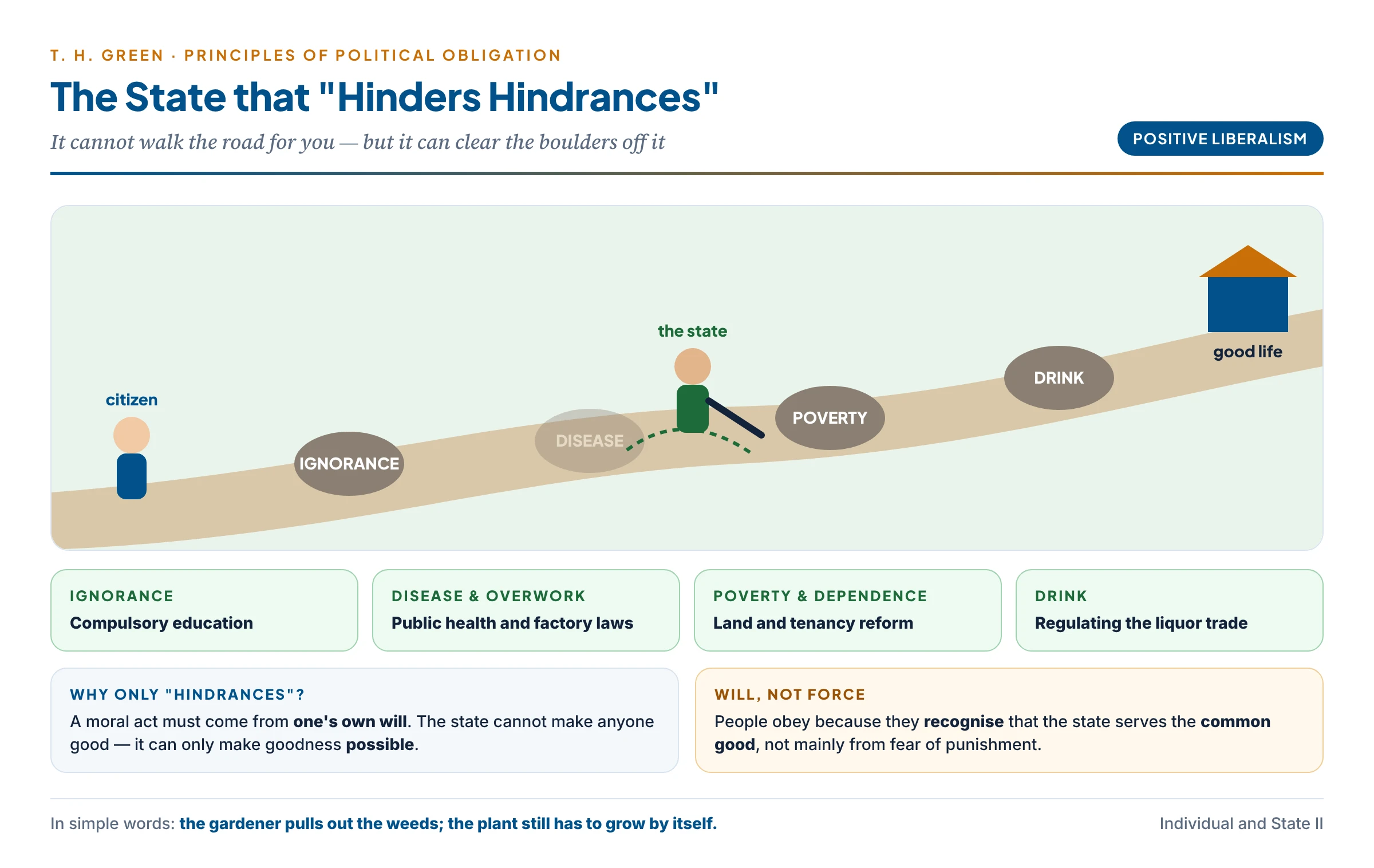
The state’s function: to “hinder hindrances”
- Morality cannot be compelled. A moral act must come from the agent’s own will; the state cannot force anyone to be good.
- But the state can remove obstacles to the good life. Green’s examples:
- Compulsory education — ignorance hinders moral development.
- Regulation of the liquor trade — drunkenness destroys families and wills.
- Factory and public-health laws — overwork and disease cripple capacities.
- Land reform — insecure tenancy keeps peasants dependent.
Rights and political obligation
- Rights are powers recognised by society as necessary for the common good — a right needs both a moral capacity in the person and social recognition.
- Will, not force. People obey the state mainly because they recognise that it serves the common good, not from fear. Force is a fact of every state but not its foundation.
- Limits of obedience. Since the state’s authority comes from the common good, a citizen may in extreme cases be justified in resisting a law that clearly violates it — but only in the name of the common good, and after weighing the danger of disorder.
In simple words
A good gardener cannot make a plant grow — growth comes from the plant itself. But he can pull out the weeds, keep away the goats and water the soil. Green’s state is that gardener: it cannot make you moral, but it can clear the weeds of ignorance, hunger and disease so that you can grow.
Bradley and Bosanquet: Idealism Moves Closer to Hegel
- F. H. Bradley (“My Station and Its Duties”, 1876) — the individual is real only as a member of the social whole; morality consists in fulfilling the duties of one’s station in society.
- Bernard Bosanquet (The Philosophical Theory of the State, 1899):
- Develops Rousseau’s real will — the state is the embodiment of the real will of its members, so obedience to the state is obedience to one’s true self.
- The state is the guardian of a whole moral world; it is not bound by private morality in the same way as individuals.
- Less room for resistance than Green.
- Criticism. Hobhouse attacked Bosanquet’s “metaphysical theory” as dangerously close to state-worship; the idealist claim to know the citizen’s “real will” invites authoritarianism.
Harold Laski: The State Judged by the Rights It Maintains
- Rights as conditions of self-development. “Rights are those conditions of social life without which no man can seek, in general, to be himself at his best.”
- The state exists for rights. Rights are not created by the state; they are claims the state must recognise to be legitimate. “Every state is known by the rights that it maintains.“
- Rights are not prior in time (as in natural-rights theory) but prior in moral importance: they are the yardstick of the state’s performance.
- Conditional obedience. A citizen’s loyalty is earned; the state is one association among many (see the article on Laski’s pluralism under Sovereignty).
- Liberty with equality. Without economic equality, political liberty is formal; Laski moved towards democratic socialism.
Karl Marx: The State as an Instrument of Class Rule
- The state is not neutral. “The executive of the modern state is but a committee for managing the common affairs of the whole bourgeoisie” (Communist Manifesto, 1848). Political power is “the organised power of one class for oppressing another”.
- Rights of the egoistic man. In On the Jewish Question (1843) Marx argued that the “rights of man” in bourgeois declarations are the rights of egoistic man, separated from other men and from the community — liberty as the right to be left alone, property as the right to enjoy one’s goods without regard to others.
- Political vs human emancipation. Equal rights before the law (political emancipation) leave real inequality in economic life untouched; human emancipation needs the end of class society.
In simple words
A rich man and a poor man both have the “equal right” to sleep in a five-star hotel. On paper they are equal; in life only one can use the right. Marx’s point is that bourgeois rights are often like this — equal in law, unequal in reality — and that real freedom needs the means to use it.
- Dictatorship of the proletariat → withering away. After revolution the workers’ state suppresses the old ruling class; once classes disappear, the state “withers away” (Engels).
- Individual freedom in community. “Only in community … has each individual the means of cultivating his gifts in all directions; only in the community, therefore, is personal freedom possible.”
- Criticism. In practice communist states became more, not less, powerful; individual rights were sacrificed to the party-state.
The Anarchists: The State as an Unnecessary Evil
- Core claim. All states, always and everywhere, rest on coercion and serve the few; human beings can live in voluntary cooperation without a state.
- Main thinkers.
- William Godwin (Political Justice, 1793) — reason and moral education make government unnecessary.
- P.-J. Proudhon — “Property is theft“; “whoever lays his hand on me to govern me is a usurper and a tyrant.”
- Mikhail Bakunin — revolutionary anarchism; against Marx’s workers’ state, which he predicted would become a new tyranny.
- Peter Kropotkin (Mutual Aid, 1902) — cooperation, not struggle, is the law of social life.
- Leo Tolstoy — Christian anarchism: the state is organised violence, against the Sermon on the Mount.
- Is individual freedom consistent with state sovereignty?
- Anarchist answer: no. Sovereignty means a final power to command; freedom means obeying only oneself. A sovereign state is, by definition, a standing threat to autonomy.
- Reply: yes, within limits. Constitutional states limit sovereignty by rights, courts and elections; without some final authority, the stronger simply dominate the weaker — as Hobbes warned.
- Criticisms of anarchism.
- Utopian — assumes human beings are naturally good and rational.
- Sees only the negative side of the state and ignores schools, hospitals, roads and protection of the weak.
- Hobbes’s warning — even bad authority is better than chaos (collapse of order after a regime falls).
- Anarcho-syndicalism replaces the “state monster” with a “group monster” — powerful unions or communes can be as oppressive.
- Modern problems — terrorism, communal violence, pandemics, climate change — need coordinated public power.
Gandhi: Enlightened Anarchy, Swaraj and Rāma Rājya
- The state as concentrated violence. “The State represents violence in a concentrated and organised form. The individual has a soul, but as the State is a soulless machine, it can never be weaned from violence to which it owes its very existence.”
- Enlightened anarchy. The ideal is a society where everyone is his own ruler, so that no political power is needed. “Political power is not an end but one of the means of enabling people to better their condition in every department of life.”
- “That government is best which governs the least” — Gandhi accepted Thoreau’s motto.
- Swarāj — self-rule in the double sense of national independence and self-control of the individual.
- Practical ideal. Since the perfect stateless society is unattainable, Gandhi accepted a predominantly non-violent, decentralised state:
- Village republics organised as an “oceanic circle” — expanding circles with the individual at the centre, not a pyramid.
- Trusteeship — the rich hold wealth in trust for society.
- Sarvodaya — the welfare of all.
- Rāma Rājya — a moral polity of justice and duty, where everyone gives priority to his duty and thereby all enjoy their rights.
- Satyagraha. When the state is unjust, the citizen has the right and duty of non-violent resistance (developed in the article on accountability and civil disobedience).
Indian Connect — Gandhi and the Western anarchists
- Shared: distrust of centralised coercive power; faith in voluntary cooperation; decentralisation (Kropotkin’s communes, Gandhi’s village republics). Tolstoy deeply influenced Gandhi.
- Different: Gandhi’s anarchism is spiritual and non-violent, grounded in self-discipline and duty; Bakunin accepted revolutionary violence. Gandhi accepted a minimal state as a practical necessity, not an immediate abolition.
To Whom Do We Primarily Owe Obligations — Individuals or the State?
- Liberal answer (Locke, Mill): to individuals first. Our basic duties — not to harm, cheat or kill — are owed to other persons who hold rights. The state is a trustee that helps us keep these duties; our obligation to it is derived and conditional.
- Idealist answer (Hegel, Bosanquet): to the state. Since the individual becomes fully ethical only in the state, the duty of membership is the highest duty.
- Green’s middle answer: to the common good. We owe obligations to the community of persons whose common good the state serves; obedience to the state is owed because and so far as it serves that good.
- Marxist and anarchist answer: to fellow human beings, not the state. Solidarity is owed to the community of workers or humanity; the class state commands no moral loyalty.
- Gandhi’s answer: to truth and to all beings. Duties flow outward from self to family, village, nation and humanity; when the state demands what conscience forbids, the higher duty is to truth (satya).
- Balanced view. Duties are owed primarily to persons (each other) and through the state to the community; the state’s claim is strong when it is just and weakens as it becomes unjust.
The Thinkers Compared
| Thinker | Individual is … | State is … | Basis of obedience |
|---|---|---|---|
| Mill | Sovereign over self-regarding acts | Limited by the harm principle | Utility; protection from harm |
| Hegel | Free only as member of the rational whole | Actuality of concrete freedom | Rational recognition; duty |
| Green | A moral agent seeking self-realisation | Enabler that hinders hindrances | Will, not force; common good |
| Bosanquet | Expression of the real will | Guardian of the moral world | Real will (strong obligation) |
| Laski | Bearer of rights for self-development | Judged by rights it maintains | Conditional; earned |
| Marx | Free only in classless community | Class instrument; will wither away | None, in class society |
| Anarchists | Autonomous and cooperative | Unnecessary evil | None — voluntary cooperation |
| Gandhi | Self-ruling soul (swarāj) | Concentrated violence; minimal in practice | Conditional; duty-based; satyagraha |
Critical Evaluation
Negative vs Positive Liberalism
- Mill’s strength. The clearest defence of free speech, privacy and individuality ever written; the root of modern civil liberties.
- Mill’s weakness. Freedom without means is formal; he largely ignored poverty and power.
- Green’s strength. Shows why freedom needs education, health and economic security — the philosophical base of the welfare state.
- Green’s weakness. The idea of a “common good” defined by the state can become paternalism; who decides what counts as a hindrance?
Idealism under Fire
- Popper and Hobhouse: idealism dissolves the individual into the state.
- Defence: idealists such as Green kept a right of resistance and stressed that morality cannot be compelled; their target was empty atomism.
Radical Critiques Tested
- Marx is right that formal rights hide real inequalities and that the state often serves powerful interests.
- But history shows that abolishing “bourgeois rights” produced states with no rights for anyone. Civil liberties turned out to be the shield of workers too.
- Anarchists are right that power corrupts and that cooperation is natural; but a stateless world gives no answer to organised violence.
Critics and Defenders
Criticism — Critics
- Stephen and others: Mill’s self-regarding/other-regarding line is unworkable.
- Barker: Mill offers an empty liberty and an abstract individual.
- Popper, Hobhouse: Hegel and Bosanquet deify the state.
- Isaiah Berlin: positive liberty (Green, idealists) can be twisted into “forcing people to be free”.
- Liberals against Marx and the anarchists: utopian, and in practice destructive of individual rights.
Defence — Defenders and strengths
- Mill gave the world the harm principle and the case for free expression still cited by courts.
- Hegel showed that freedom needs institutions, not just the absence of law.
- Green justified compulsory education, labour laws and public health — the welfare state.
- Laski made rights the test of every state’s legitimacy.
- Marx exposed the gap between formal and real freedom; Gandhi joined freedom with self-discipline and duty.
Cross-Tradition Comparison
| Western idea | Indian parallel or contrast |
|---|---|
| Mill’s harm principle | Jaina ahiṃsā as a limit on action towards others; Aśoka’s edicts on restraint in speech and respect for other sects |
| Hegel’s ethical life and duties of one’s station | Svadharma — duties of one’s station in life (Bhagavad Gītā); Bradley’s “my station and its duties” echoes it |
| Green’s positive freedom | Rājadharma as welfare: the king must provide for the helpless (Kautilya) |
| Marx’s withering away of the state | Gandhi’s enlightened anarchy — but by moral self-rule, not class war |
| Anarchist decentralisation | Gandhi’s village republics, gram swaraj; Panchayati Raj (73rd Amendment, 1992) |
Indian Connect — Indian Connect
- Svadharma and Bradley. “My station and its duties” is close to the Gītā’s teaching that one should perform one’s own duty; both find the individual’s fulfilment in a social role. Both also face the same objection — roles can be unjustly assigned (caste, gender).
- Gandhi and Green. Both hold that morality cannot be compelled; Green would have the state remove hindrances, Gandhi would have individuals purify themselves so that the state becomes almost unnecessary.
- Ambedkar’s caution. Against both Hegelian and Gandhian community-centred views, Ambedkar insisted that the individual is the unit of the Constitution and that community must not override the individual’s rights.
Synthesis (Siddhānta)
- No single thinker is enough. Mill protects the individual from the state; Green and Hegel show what the state can do for the individual; Laski makes rights the test; Marx and Gandhi remind us that the state can become an instrument of domination.
- The modern democratic state combines them: civil liberties (Mill), a welfare role (Green), rights as the measure of legitimacy (Laski), decentralisation and moral citizenship (Gandhi), and attention to economic power (Marx).
- Contemporary relevance.
- Free speech online — hate speech, fake news and platform moderation reopen Mill’s harm principle.
- Paternalist laws — helmet rules, bans on alcohol, sugar taxes — test the line between self- and other-regarding conduct.
- Welfare rights — right to food, education and health in India continue Green’s “hinder hindrances”.
- Surveillance states show the anarchist fear of concentrated power is not idle.
- Conclusion. The individual and the state are partners in a tense balance: the state must be strong enough to protect and enable, but limited enough that the individual remains its end, never its instrument.
“Every state is known by the rights that it maintains.” — Harold J. Laski
Previous Year Questions
- 2017Discuss in the context of Anarchy whether the freedom of an individual is consistent with the sovereignty of the state?
- 2008Do rights necessarily imply corresponding obligations? To whom does one primarily owe obligations – individuals or state? Discuss.
- 2005Critically examine – “State is the actuality of concrete freedom“.