

Social and Political Ideals: Equality, Justice, Liberty.
Official Syllabus: Paper II, Section A, Unit 1
John Rawls (1921–2002), in A Theory of Justice (1971), gave the most influential modern theory of justice. He called it justice as fairness. His question: what principles should govern the basic structure of a society of free and equal persons — its constitution, economy, property system and family? His answer: the principles that rational people would choose if they did not know their own place in society. Imagined behind a veil of ignorance, they would choose two principles — equal basic liberties for all, and a rule that social and economic inequalities are allowed only if they benefit the least advantaged and are attached to positions open to all under fair equality of opportunity — with the first principle lexically prior to the second. This article explains the social contract tradition Rawls revived, his rejection of utilitarianism, the original position, primary goods, the two principles and their priority rules, the difference principle, pure procedural justice, the well-ordered society, and how far Rawls continues Plato, differs from Gandhi, and can deal with gender and caste. The criticisms of Rawls by Nozick, the communitarians, feminists and Sen follow in the next three articles.
In simple words
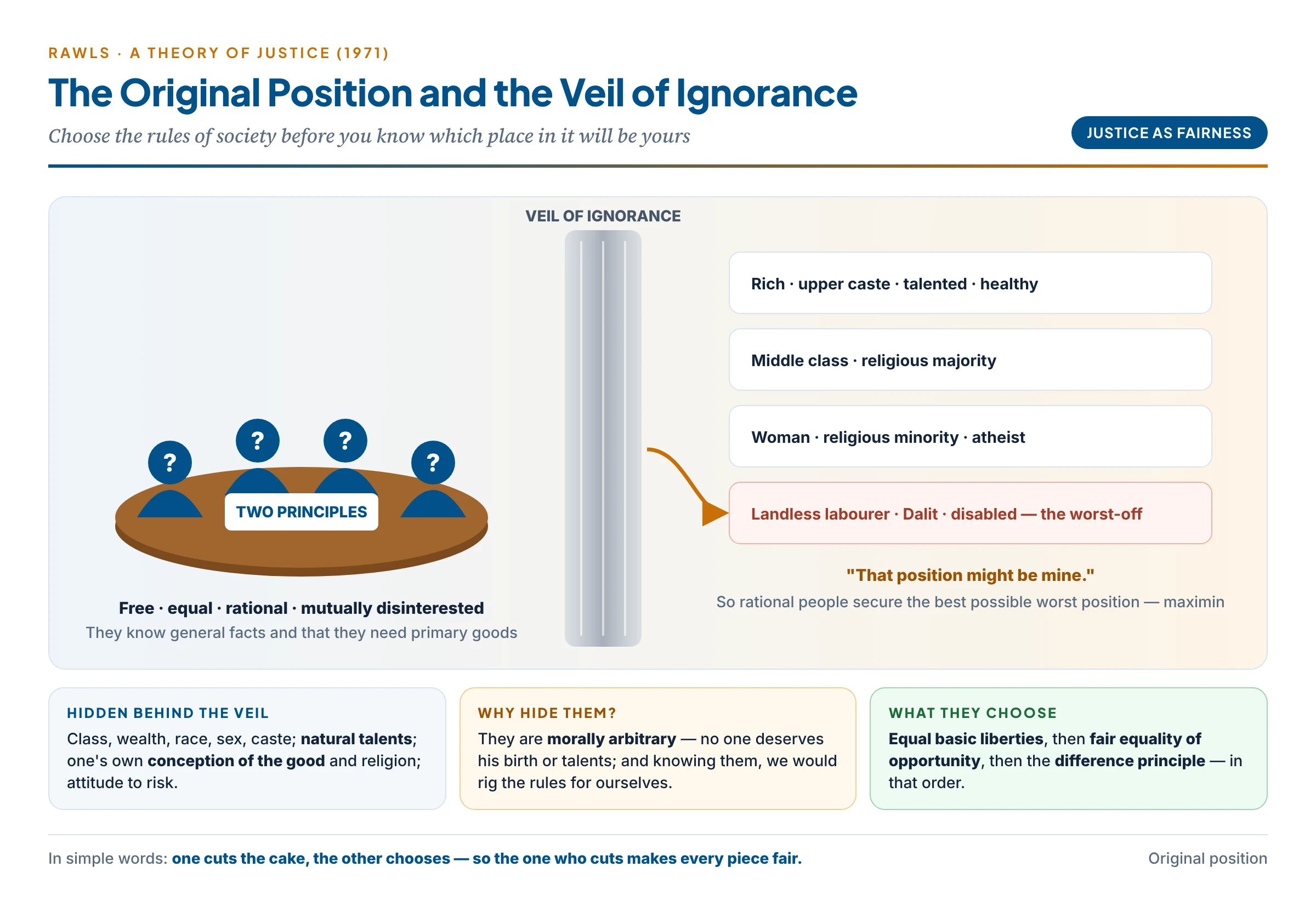
Two children must share a cake. The fairest rule is: one cuts, the other chooses first. The child who cuts does not know which piece he will get, so he cuts the pieces as equally as he can. Rawls makes the same move for a whole society: choose the rules before you know which slice of life you will get, and you will choose rules that are fair to everyone.
Context & Problem
The Social Contract Tradition: Origin and Development
Rawls presented his theory as a social contract theory “at a higher level of abstraction”. The 2024 paper asked for a brief account of the origin and development of social contract theory.
- Ancient roots. In Plato’s Republic, Glaucon suggests that justice is an agreement among people not to harm each other, made because each fears being harmed. The Epicureans also saw justice as a compact for mutual advantage.
- Indian roots. The Buddhist Aggañña Sutta tells how, when disorder arose, people chose one among them — the Mahāsammata, “the Great Elect” — to keep order in return for a share of rice. Kauṭilya and the Mahābhārata tell a similar story of people escaping matsya-nyāya by making a king.
- Thomas Hobbes (Leviathan, 1651):
- The state of nature is a war of all against all; life there is “solitary, poor, nasty, brutish, and short”.
- Out of fear of death, people agree to give up their natural freedom to an absolute sovereign.
- The contract creates obligation and peace; the sovereign is not a party to it, so cannot break it.
- John Locke (Two Treatises of Government, 1690):
- The state of nature is governed by natural law; people have natural rights to life, liberty and property.
- They form government by consent only to protect these rights better.
- Government is limited; if it violates rights, the people may resist and replace it.
- Jean-Jacques Rousseau (The Social Contract, 1762):
- “Man is born free, and everywhere he is in chains.”
- Each gives himself wholly to the community and receives back civil and moral freedom under the general will.
- Sovereignty belongs to the people and cannot be transferred.
- Immanuel Kant treated the contract as an idea of reason, not a historical event: a law is just if all could have agreed to it.
- Critics of the tradition:
- David Hume — no such contract ever happened; “tacit consent” is like saying a man carried on board a ship while asleep has agreed to stay because he does not jump into the sea.
- Edmund Burke — society is a partnership between the living, the dead and the unborn, not a business deal.
- Hegel and Marx — the state is not a contract among individuals; the “free individual” of contract theory is a product of bourgeois society.
- Feminist and race critics — Carole Pateman’s “sexual contract” and Charles Mills’s “racial contract” argue that the classical contracts silently excluded women and colonised peoples.
- Revival in the twentieth century. Rawls revived the contract as a hypothetical device — not to explain where states came from, but to discover principles of justice. After him come contractarians (who stress mutual advantage) and contractualists (who stress what no one could reasonably reject).
Against Utilitarianism
- Utilitarianism (Bentham, J. S. Mill) says society should maximise total happiness (the sum of everyone’s welfare).
- Rawls’s objection: utilitarianism “does not take seriously the distinction between persons“. It adds up happiness as if society were one big person, so it can allow some to be sacrificed for greater gains to others.
- An example. A serial killer is on the loose; the public is terrified. The police could frame an innocent person, announce that the killer has been caught, and calm everyone. Total happiness rises — yet this is plainly unjust. A just society protects each individual’s rights even at the cost of social utility.
- The right before the good. For utilitarians, the right act is whatever promotes the good (maximum welfare). For Rawls, the right is prior to the good: people have different conceptions of the good life; justice provides a fair framework of rights and opportunities within which each can pursue his own conception, provided he allows others the same.
- Against intuitionism. Rawls also rejects “intuitionism” — weighing many principles case by case with no ranking — because it gives no clear guidance. Hence his insistence on a clear priority among principles.
“Justice is the first virtue of social institutions, as truth is of systems of thought.” — John Rawls
Core Doctrine
The Subject of Justice: The Basic Structure
- Society as a cooperative venture. We live together, impose burdens on each other and create benefits; we need principles to allocate these benefits and burdens. Those principles are principles of justice.
- The basic structure. Justice applies first to society’s major political, economic and social institutions — the constitution, legal system, property, the market, the family — because their effects on people’s life-chances are profound and present from birth.
- Circumstances of justice. Following Hume: moderate scarcity and people with their own plans who are not wholly altruistic.
Primary Goods
- Primary goods are things every rational person wants whatever else he wants — whatever his conception of the good life:
- Basic rights and liberties.
- Freedom of movement and choice of occupation, against a background of diverse opportunities.
- Powers and prerogatives of offices and positions.
- Income and wealth.
- The social bases of self-respect — which Rawls calls perhaps the most important primary good.
- Example. Everyone needs freedom of religion whatever his religion — and even an atheist needs it, since it includes the freedom to have no religion. Everyone needs job opportunities whatever job he wants, and money whatever his plan of life.
The Original Position and the Veil of Ignorance
- The original position is an imagined meeting of free, equal, rational and mutually disinterested representatives who must choose the basic principles of justice. “Mutually disinterested” means each cares about advancing his own interests, not about others’ interests — not out of selfishness but because each wants the means to pursue his own plan.
- The veil of ignorance. The parties do not know:
- Their class, social status, wealth, race or sex.
- Their natural assets — intelligence, strength, health, talents.
- Their own conception of the good — religion, life-plan, even their psychological tendencies (such as love of risk).
- The particular circumstances of their own society or generation.
- What they do know: general facts of politics, economics and psychology, and that they will need primary goods.
- Why the veil? Two reasons:
- Natural and social contingencies are arbitrary. If I knew I was talented, I would choose a tax system that favours the talented. But I did nothing to deserve being lucky; such morally arbitrary facts should not shape the rules.
- We are autonomous agents. What matters most is our capacity to frame, revise and pursue a conception of the good. If we knew our own religion, we would protect only the freedoms our group needs — and neglect those of others.
- Fundamental equality. Rawls assumes that all persons are worthy of equal concern and respect and are autonomous moral agents. The original position is a position of equality; its result is a fair agreement — hence “justice as fairness“.
- Formal constraints. Principles chosen must be general, universal in application, public, able to rank conflicting claims, and final (the last court of appeal).
In simple words
Imagine you must design the rules for a new country — but you will be born into it as someone you cannot choose: perhaps a rich man’s son, perhaps a landless labourer’s daughter, perhaps a person with a disability. Would you allow untouchability, slavery, or a system that leaves the poorest to starve? No — because that might be you. This is the veil of ignorance.
The Maximin Rule
- Under deep uncertainty, Rawls argues, rational parties will follow maximin: choose the arrangement whose worst outcome is the best among the alternatives — “maximise the minimum“.
- Why maximin here? Three features of the original position:
- There is no basis for estimating probabilities of ending up in any position.
- The parties care little for gains above a decent minimum that the principles guarantee.
- The rejected alternatives carry grave risks — slavery, persecution, starvation — that no one could accept.
- Rawls’s image of the chain: if the expectations of the most advantaged rise and this lifts the least advantaged, it also lifts all those in between (“chain connection“). A popular way of putting it: “a chain is only as strong as its weakest link“.
The Two Principles of Justice
Rawls’s final formulation in A Theory of Justice:
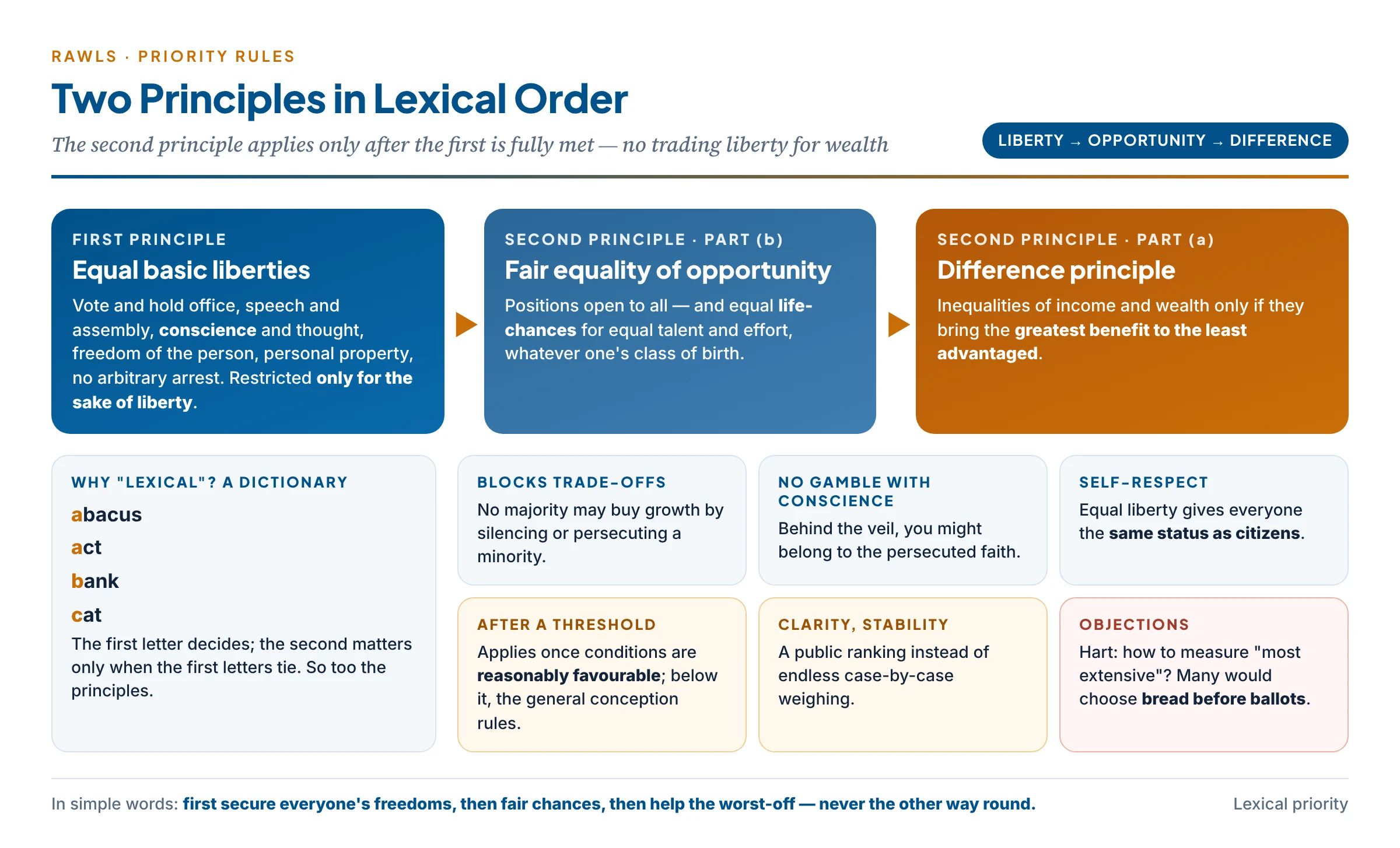
- First principle — the principle of equal liberty. Each person is to have an equal right to the most extensive total system of equal basic liberties compatible with a similar system of liberty for all.
- The basic liberties: political liberty (the right to vote and to hold office), freedom of speech and assembly, liberty of conscience and freedom of thought, freedom of the person (including from psychological oppression and physical assault), the right to hold personal property, and freedom from arbitrary arrest.
- Second principle — social and economic inequalities are to be arranged so that they are both:
- (a) to the greatest benefit of the least advantaged, consistent with the just savings principle (fairness to future generations) — the difference principle; and
- (b) attached to offices and positions open to all under conditions of fair equality of opportunity — the fair equality of opportunity principle.
Common confusion
Did Rawls give “three principles of justice”? No. Some notes list three principles — equal liberty, fair equality of opportunity and the difference principle. Rawls gave two principles; the second has two parts (fair equality of opportunity and the difference principle). Counting three is a convenient memory aid, but the correct statement is two principles, the second in two parts, ranked in lexical order.
Lexical Priority: Why the Principles Are Ranked
The priority rules:
- First priority rule — the priority of liberty. The first principle comes before the second. Liberty can be restricted only for the sake of liberty, never for economic gain. Two cases are allowed: a less extensive liberty must strengthen the total system of liberty shared by all; a less than equal liberty must be acceptable to those with the lesser liberty.
- Second priority rule — the priority of justice over efficiency and welfare. Within the second principle, fair equality of opportunity comes before the difference principle.
What “lexical” means. In a dictionary, words are ordered first by the first letter; the second letter matters only when the first letters are the same. Likewise, the second principle comes into play only after the first is fully satisfied. There is no trading of a little liberty for a lot of wealth. Rawls also calls this a serial order.
Why Rawls thinks lexical order is necessary (asked in 2026):
- To block utilitarian trade-offs. Without priority, a majority could buy economic growth by taking away the liberties of a minority — banning a religion, silencing critics. Lexical order makes basic liberties non-negotiable; they are not “bargained for” in the calculus of social interests.
- Rational choice behind the veil. Parties who do not know their religion or views would not gamble with liberty of conscience: they might turn out to belong to the persecuted minority. Liberty is the condition of pursuing any conception of the good.
- Self-respect. Equal basic liberties give everyone the same public status as equal citizens. This is the social basis of self-respect, the most important primary good. Inequalities of income are tolerable when all share equal citizenship; unequal liberty would brand some as inferior.
- Rising importance of liberty with welfare. Once a society reaches a level of reasonably favourable conditions where basic needs can be met, the value of further economic gains falls compared with the value of liberty. So the priority applies only after this threshold.
- Clarity and stability. A clear ranking avoids the intuitionist balancing of everything against everything; it is public, predictable and supports a stable sense of justice.
- Justice before efficiency. By the same logic, fair equality of opportunity comes before the difference principle: no one should be shut out of positions — even if shutting them out would raise output that might trickle down to the poor.
The general and the special conception. Rawls’s general conception says all social primary goods are to be distributed equally unless an unequal distribution benefits the least advantaged. Under very poor conditions only this general conception applies. The special conception — two principles in lexical order — applies once conditions are reasonably favourable.
Objections to lexical priority:
- H. L. A. Hart asked how “the most extensive” liberty can be measured, and why liberty may be limited only for liberty when liberties conflict with other important interests. (In Political Liberalism Rawls changed “most extensive” to a “fully adequate scheme” of basic liberties.)
- Real choices. Many people, especially outside the West, might prefer bread to ballots — to give priority to something like the difference principle over civil liberties. Sen also questions an absolute priority of liberty over, say, freedom from famine.
- Formal liberty. Marxists say equal liberties mean little to those without the means to use them. Rawls replies with the fair value of political liberties — measures (such as public funding of elections) so that the poor are not shut out of politics by money.
Fair Equality of Opportunity
- Formal equality of opportunity (“careers open to talents”) only forbids legal barriers: anyone may apply.
- Fair equality of opportunity goes further: those with similar talent and similar willingness to use it should have similar life-chances, whatever social class they are born into. This requires, for example, good public education and limits on the passing down of huge privilege.
- Debate on affirmative action. One reading says the principle only forbids discrimination on arbitrary grounds (race, sex) and so does not itself demand preferential hiring. Another reading, closer to Rawls’s aim of correcting social contingencies, supports measures that remove the effects of past exclusion — for example, in education. In India, the constitutional scheme of reservations is usually defended on this second line.
The Difference Principle
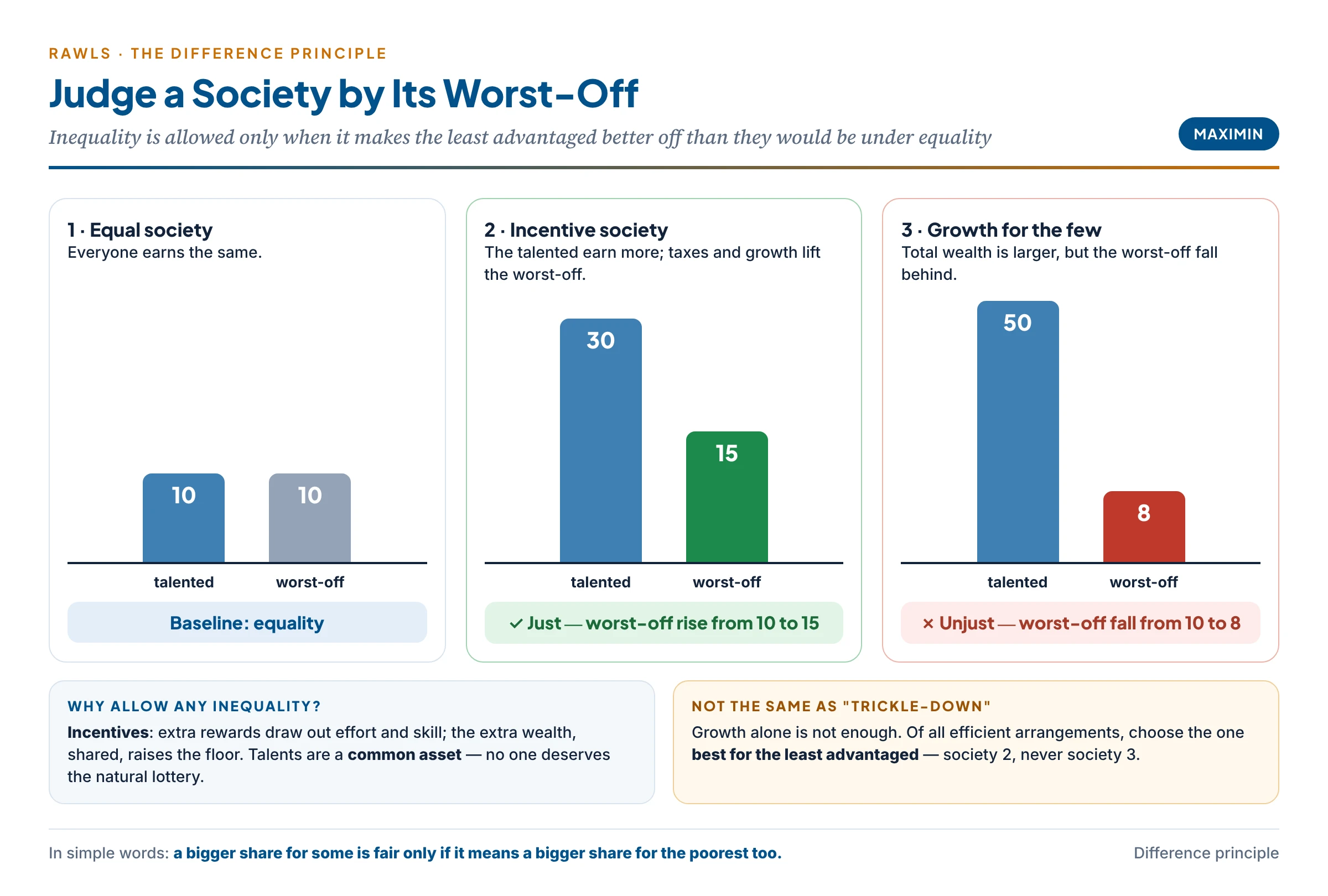
- Equality as the default. Income and wealth should be equal unless an unequal distribution benefits the worst-off. Inequality, not equality, needs justification — a radical idea.
- Why inequality might benefit the worst-off. Incentives: talented people may work harder if rewarded more; the extra wealth, taxed and shared, can make the worst-off better off than under strict equality.
- Natural talents as a common asset. No one deserves his natural talents or his family background; they are a matter of the natural lottery. So talents should be used in ways that benefit everyone, especially the least fortunate. The talented may gain, but only on terms that improve the situation of those who lost out.
- An example in plain numbers.
- Equal society: everyone earns 10.
- Unequal society with incentives: the talented earn 30, the worst-off earn 15. The difference principle prefers this — the worst-off are better off.
- Unequal society without trickle-down: the talented earn 50, the worst-off earn 8. The difference principle forbids this — the worst-off are worse off than under equality, however much the total grows.
- Pareto improvement. The move from the equal society to the incentive society makes at least one person better off and no one worse off; economists call this “Pareto superior“. The difference principle accepts such moves — but adds that among efficient arrangements, we must choose the one best for the worst-off.
In simple words
A group of fishermen agree: whoever catches the most fish may keep a bigger share — as long as the rule also brings more fish to the old and the sick who cannot go to sea. If the “bigger share” rule only fattens the best fishermen while the old get less, it is unjust. That is the difference principle.
Pure Procedural Justice
Rawls distinguishes three kinds of procedural justice:
- Perfect procedural justice — there is an independent standard of a fair result and a procedure guaranteed to reach it. Example: cake-cutting — the one who cuts takes the last piece.
- Imperfect procedural justice — there is an independent standard, but no procedure guaranteed to reach it. Example: a criminal trial — the right outcome is to convict the guilty, but even a fair trial can err.
- Pure procedural justice — there is no independent standard; the outcome is fair whatever it is, provided the procedure was fair and was actually followed. Example: a fair gamble — if bets are made voluntarily and the game is not rigged, the resulting distribution is fair.
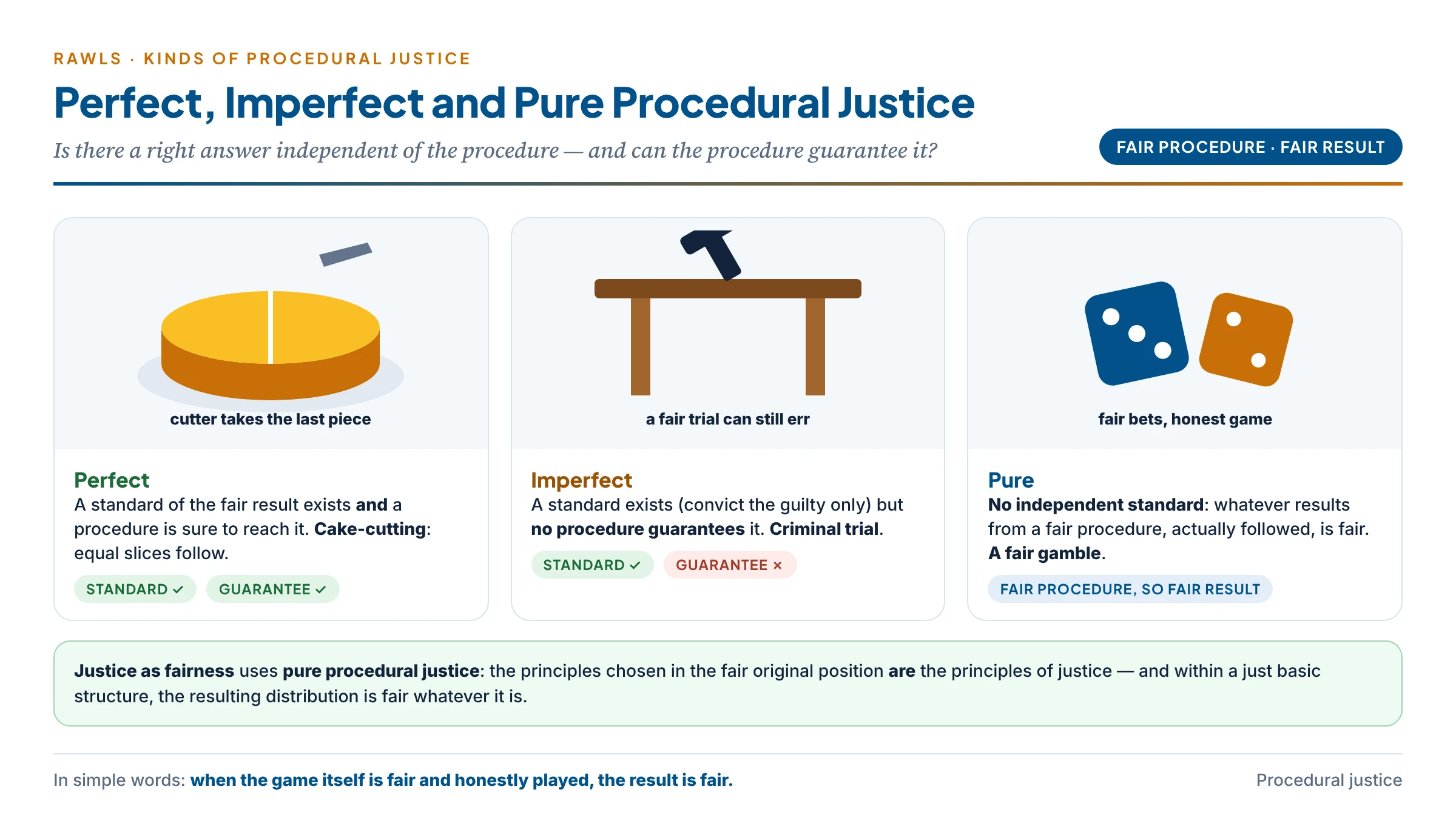
- Justice as fairness uses pure procedural justice at the deepest level: whatever principles would be chosen in the fair original position are the principles of justice. Within a just basic structure, the resulting distribution of income is also fair, whatever it turns out to be.
The Well-Ordered Society
The 2016 paper asked whether a well-ordered society is effectively regulated by a public conception of justice.
- Rawls’s definition. A society is well-ordered when:
- Everyone accepts, and knows that others accept, the same principles of justice.
- The basic institutions generally satisfy these principles, and this is publicly known.
- Citizens have an effective sense of justice — they generally comply with the institutions they see as just.
In simple words
A cricket match works smoothly when both teams know the rules, accept them, and know that the other side accepts them too. Then disputes are settled by pointing to the rulebook, not by fighting. Rawls’s well-ordered society is a whole society that plays by a public rulebook of justice that everyone accepts.
- Why it matters. A public conception of justice provides a shared point of view from which citizens can settle their claims; it gives stability “for the right reasons” — not by force, but because people come to want to act justly. Rawls argues that people who grow up under just institutions develop such a sense of justice (his moral psychology: from the morality of authority, to the morality of association, to the morality of principles).
- Publicity. The principles must be public: people must know them and know that others follow them. This rules out ruling through noble lies (contrast Plato).
- Do we agree? Arguments in favour:
- Law alone cannot hold a society together; a shared sense of justice reduces coercion.
- Publicity supports trust and self-respect.
- Arguments against:
- Unrealistic. No actual society agrees on one conception of justice; modern societies show reasonable pluralism of religions and moral views.
- Communitarians say a shared public conception requires more shared values than Rawls’s neutral liberalism allows.
- Marxists say class conflict makes such consensus impossible or ideological.
- Sen says we do not need agreement on a single ideal to remove clear injustices.
- Rawls’s own revision. In Political Liberalism (1993) Rawls admitted that A Theory of Justice assumed too much agreement. A well-ordered society under modern pluralism rests on an overlapping consensus: citizens holding different religions and philosophies can each, from within their own view, endorse the same political conception of justice.
Reflective Equilibrium
- How do we know the two principles are right? Rawls’s method is reflective equilibrium: we move back and forth between our considered judgements about cases (“slavery is wrong”, “religious persecution is wrong”) and general principles, adjusting each until they fit together.
- The original position is one part of this method: if it yielded principles that clashed with our firmest convictions, we would redesign it.
Critical Evaluation
Rawls and Plato: Continuity or Break?
Continuities:
- Justice as the master virtue of the social order. For Plato justice is the virtue of the whole city; for Rawls it is “the first virtue of social institutions“. Both make justice a property of the basic structure, not only of individual acts.
- Ideal theory. Both describe a well-ordered ideal society that serves as a standard for judging actual ones.
- Harmony and stability. Plato seeks harmony of classes; Rawls seeks stability through a shared sense of justice.
- Reason as the guide. Plato’s philosopher reasons to the Good; Rawls’s parties reason to principles.
- Opportunity by talent. Plato’s myth of the metals lets gold children of bronze parents rise; Rawls’s fair equality of opportunity also breaks the link between birth and position.
Breaks:
- Equality vs hierarchy. Plato assumes natural inequality of souls; Rawls begins from the fundamental equality of persons.
- Liberty. Plato gives no protected liberties; for Rawls equal basic liberties have priority over everything else.
- Knowledge vs ignorance. Plato’s rulers rule because they know the Good; Rawls’s principles are chosen behind a veil of ignorance about the good.
- Perfectionism vs neutrality. Plato’s state imposes one idea of the good life; Rawls’s state is neutral among reasonable conceptions of the good.
- Noble lie vs publicity. Plato allows rulers to deceive; Rawls requires principles to be public.
- Function vs fairness. Plato’s justice is doing one’s own job; Rawls’s justice is fair terms of cooperation among equals.
- Verdict. Rawls continues Plato’s structural, ideal approach to justice but replaces Plato’s hierarchy of knowledge with fairness among equals. He keeps the question, not the answer.
Rawls and Gandhi
| Issue | Rawls | Gandhi |
|---|---|---|
| Nature of morality | Reciprocal regard among persons; secular, public reason | An absolute value rooted in Truth (satya) and non-violence (ahiṃsā) |
| Individual | Rational negotiators seeking primary goods for themselves | Individual finds fulfilment in the well-being of all |
| Rights and duties | Rights and duties interdependent; rights stressed | Priority of duty over rights — rights flow from duties well done |
| Well-being | More primary goods for each | Meeting minimum needs and spiritual well-being; limit wants |
| Basis of concern for the worst-off | Rational choice under uncertainty (maximin) | The moral urge to serve — sarvodaya, welfare of all |
| Property | Compatible with private ownership (and with a regulated market economy) | Trusteeship — the rich hold wealth in trust for society |
| Economy | Compatible with a regulated market | Decentralised village economy; critical of industrial capitalism |
| Social order | Equal citizenship | Early Gandhi defended an idealised varṇa (not caste or untouchability); later stressed equality of all labour |
- Similarities:
- Both oppose utilitarianism: Gandhi’s sarvodaya means the welfare of all, not of the greatest number.
- Gandhi’s talisman — “recall the face of the poorest and the weakest man you have seen, and ask yourself if the step you contemplate is going to be of any use to him” — is close to the difference principle’s focus on the least advantaged.
- Both include elements of community: the good of one is contained in the good of all.
- Both care about the outcome for the weakest, not only about formal rules.
Indian Connect — Gandhi’s talisman and the difference principle
Gandhi’s talisman asks every decision-maker to judge a policy by its effect on the poorest and the weakest. Rawls’s difference principle judges the whole basic structure by the position of the least advantaged. The routes differ — Gandhi’s is moral compassion (sarvodaya, antyodaya — “the rise of the last”), Rawls’s is rational choice behind a veil — but both reject a society that grows richer while its weakest members fall behind.
Can Justice as Fairness Address Gender Discrimination?
- Yes, in principle:
- Behind the veil, parties do not know their sex; they would never choose rules that systematically disadvantage one sex — they could turn out to be women.
- The first principle guarantees equal political and civil liberties to women; fair equality of opportunity demands equal access to education and jobs; the difference principle demands attention to those worst-off, who are disproportionately women.
- But with limits (developed by Susan Moller Okin — see the article on the critics of Rawls):
- Rawls imagined the parties as heads of households, and long left the family outside the scope of justice, though the gendered division of unpaid work begins there.
- Gender-neutral laws may still produce gendered results under existing social expectations.
- Verdict. Rawls’s framework, extended to the family, is a powerful tool against gender discrimination — more powerful than Rawls himself first used it.
Which Principle of Justice Can Address Caste Discrimination?
- Rawls’s principles help directly:
- Caste is a clear case of a morally arbitrary fact (birth) shaping life-chances — exactly what the veil of ignorance excludes.
- Equal basic liberties forbid untouchability and denial of entry to temples, wells and public places.
- Fair equality of opportunity demands real access to education and jobs for those historically excluded.
- The social bases of self-respect — Rawls’s most important primary good — are precisely what untouchability destroys.
- The difference principle justifies special measures as long as they improve the position of the least advantaged.
- Other principles compared:
- Aristotle’s proportional equality can be misused to justify caste (“unequals unequally”).
- Walzer’s communitarian particularism admits that in a caste society goods may be distributed by caste meanings — a serious weakness here.
- Ambedkar’s principle of liberty, equality and fraternity, and Sen’s focus on removing manifest injustice, complement Rawls by adding fraternity (social endosmosis) and attention to actual lives.
- Verdict. Rawls’s fair equality of opportunity and social bases of self-respect, joined with Ambedkar’s fraternity, offer the strongest principled basis — reflected in Articles 15(4), 16(4) and 17 of the Indian Constitution.
Is the Difference Principle Consistent with Liberalism’s Advocacy of Freedom?
- The charge (libertarian). Taxing the talented to help the worst-off treats their talents as common property and limits their freedom to use what they earn (Nozick: taxation is like forced labour).
- Rawls’s replies:
- Liberty has priority: the difference principle operates only after equal basic liberties are secured. It does not touch freedom of speech, conscience or person.
- Economic freedom beyond personal property (for example, unlimited ownership of means of production) is not among the basic liberties.
- Freedom has worth only if one has the means to use it. Rawls distinguishes liberty from the worth of liberty; the difference principle raises the worth of liberty for the poor.
- No one deserves his natural talents; so no one has a pre-social claim to all the gains they bring.
- Verdict. The difference principle is consistent with egalitarian liberalism, which values the equal worth of freedom, though not with libertarian liberalism, which values freedom from interference above all (see the next article).
Further Criticisms (in brief)
- Dworkin: a hypothetical contract is “not simply a pale form of an actual contract; it is no contract at all” — it cannot bind anyone. Rawls’s reply: the contract is a device for discovering what justice requires, not the source of the obligation; we are bound because the principles are just.
- Risk aversion: maximin assumes very cautious parties; many people gamble.
- Reciprocity and disability: a theory of cooperation among “fully cooperating members” may leave out the severely disabled (Martha Nussbaum’s Frontiers of Justice).
- Talent and incentives — G. A. Cohen: in a truly just society, the talented themselves would not demand unequal incentives.
- Brute luck vs choice: the difference principle does not distinguish those who are poor through bad luck from those poor through their own choices.
- Sen: primary goods ignore differences in converting goods into capabilities; the search for a perfectly just society is neither necessary nor sufficient.
These are treated fully in the next three articles.
Critics and Defenders
Criticism — Critics
- Nozick: redistribution violates self-ownership.
- Communitarians: the “unencumbered self” is a fiction.
- Feminists: the family is left outside justice.
- Marxists: liberal justice within capitalism.
- Sen: transcendental, institution-focused.
- Hart: priority of liberty unclear.
Defence — Defenders and strengths
- Fairness: no one gains from morally arbitrary luck.
- Priority of liberty blocks utilitarian sacrifice.
- Difference principle puts the worst-off first.
- Publicity and stability: justice citizens can endorse.
- Political Liberalism: overlapping consensus.
- Combines liberty, equality and fraternity.
Cross-Tradition Comparison
| Theme | Rawls | Indian thought and practice |
|---|---|---|
| Choosing rules impartially | Veil of ignorance | The king’s rājadharma: protect all subjects like one’s own children, without partiality |
| The least advantaged | Difference principle | Gandhi’s talisman, antyodaya, sarvodaya |
| Fair opportunity | Fair equality of opportunity | Articles 15(4), 16(4): special provisions for backward classes, SCs, STs |
| Self-respect | Most important primary good | Ambedkar: dignity and annihilation of caste; Article 17 |
| Liberty first | Lexical priority of basic liberties | Fundamental Rights (Part III) enforceable; Directive Principles (Part IV) guide policy |
| Social contract | Hypothetical original position | Mahāsammata (Buddhist); king made to end matsya-nyāya |
Indian Connect — Rawls and the Indian Constitution
The Constitution’s design echoes Rawls’s ordering. Part III (Fundamental Rights) protects equal basic liberties and is enforceable in court; Part IV (Directive Principles) directs the state towards fair distribution (Article 39) and welfare of the weaker sections (Article 46). The Supreme Court in Minerva Mills (1980) called Articles 14, 19 and 21 a “golden triangle” — equality, freedom and life with dignity — and held that Fundamental Rights and Directive Principles must be harmonised, not traded off. Reservations under Articles 15(4) and 16(4), and the creamy layer rule from Indra Sawhney (1992) that keeps benefits for the genuinely disadvantaged, follow the logic of fair equality of opportunity and the difference principle.
Synthesis (Siddhānta)
- Rawls’s achievement. He replaced the utilitarian sum of happiness with a theory of fair terms of cooperation among free and equal persons, joining liberty (first principle) and equality (second principle) under the idea of fairness.
- The core moves: a veil of ignorance that removes morally arbitrary advantages; maximin reasoning; lexical priority of equal liberty; fair equality of opportunity; and the difference principle that makes the position of the least advantaged the test of the whole system.
- Practical implications:
- The first principle supports civil liberties, constitutional government and a market economy within limits.
- Fair equality of opportunity governs access to public offices and positions and demands public education.
- The difference principle supports the welfare state and affirmative action, while setting a limit: welfare must not go so far that it lowers the position of the least advantaged themselves.
- Significance: an ethically justified case for the welfare of disadvantaged sections; a balanced view in which liberty and justice co-exist; a point where liberal, egalitarian and communitarian concerns partly converge.
- His limits: idealisation, the family left outside, a hypothetical contract, possible neglect of individual responsibility and of real-world comparisons — which later thinkers pressed hard.
- His lasting relevance: every debate on progressive taxation, public education, health care, reservations, minimum wages and welfare schemes asks a Rawlsian question — does this arrangement benefit the least advantaged, without sacrificing anyone’s basic liberties? Rawls showed how substantive justice can be reached through a fair procedure — the bridge between the liberal and the socialist ideals of justice.
Previous Year Questions
- 2026Why does Rawls consider it necessary that the two principles of justice be applied in lexical order? Explain.
- 2024Present a brief account of origin and development of Social Contract Theory.
- 2023What is meant by justice as fairness? Explain Rawls’ theory of justice.
- 2019How far do you think John Rawls is continuing with Plato’s concept of justice?
- 2016A well-ordered society, according to Rawls, is effectively regulated by a public conception of justice. Do you agree? Give reasons.
- 2013What is meant by ‘justice’ as fairness? Explain the basic tenets of Rawls’ theory of justice.
- 2011The fundamental idea of the conception of justice is fairness. Discuss.
- 2011Can issue relating to gender discrimination be met by the conception of justice as fairness? Discuss.
- 2011Which principle of justice can, in your view, be most helpful in addressing the issues related to caste discrimination and why?
- 2007According to some liberal political thinkers, social and economic inequalities can be justified only if they work to the advantage of the least advantaged members of the society. Is this view consistent with the liberalism’s cardinal advocacy of individual freedom? Discuss.