

Social and Political Ideals: Equality, Justice, Liberty.
Official Syllabus: Paper II, Section A, Unit 1
Three years after Rawls, Robert Nozick (1938–2002) answered him in Anarchy, State, and Utopia (1974) with the most powerful libertarian theory of justice. Where Rawls asked “what pattern of distribution would fair people choose?”, Nozick asked “how did people come to hold what they hold?” If a person acquired something justly, or received it by free exchange or gift, he is entitled to it — and no state may take it from him to help others, however unequal the result. Justice, for Nozick, is historical, not a pattern; taxation for redistribution is like forced labour; and only a minimal state — a “night-watchman” that protects against force, theft and fraud — can be justified. This article explains the libertarian view of justice, Nozick’s entitlement theory and its three principles, the famous Wilt Chamberlain argument, his critique of Rawls, the related views of F. A. Hayek and Milton Friedman, the debate on whether the free market can deliver social justice, and the strong criticisms of all these views.
In simple words
You grow mangoes on land you cleared yourself. You sell some to a neighbour, give some to your sister, and keep the rest. Nozick says: everything you now hold is yours by right, because each step was fair. If the government takes your mangoes to give to someone poorer — even with good intentions — it is, in his eyes, taking what belongs to you. Whether the final result is “equal” does not matter; what matters is whether each step was just.
Context & Problem
The Libertarian Perspective on Justice
- Liberty as the individual’s own problem. Egalitarian liberals like Rawls treat substantive liberty — liberty with the means to use it — as the central problem of justice. Libertarians treat liberty as freedom from interference: what matters is that no one, including the state, coerces you.
- Formal liberty and the minimal state. Libertarians defend formal liberty (no legal barriers) and a minimal role of the state: protect life, liberty and property, enforce contracts — and nothing more.
- Main thinkers. Robert Nozick (philosopher), F. A. Hayek (economist and political thinker), Milton Friedman (economist), and earlier Herbert Spencer and the classical economists.
- Their target. The welfare state and every theory — Rawls’s included — that asks the state to redistribute income and wealth to realise a pattern of “social justice”.
Nozick’s Starting Point: Rights as Side-Constraints
- “Individuals have rights, and there are things no person or group may do to them (without violating their rights).” These famous opening words state Nozick’s whole approach.
- Side-constraints. Rights are not goals to be maximised but limits on what may be done to anyone. You may not violate one person’s rights even to prevent more violations elsewhere.
- Kant’s principle. Each person is an end in himself, never merely a means. Using one person’s earnings or labour to benefit others, without his consent, treats him as a means.
- Self-ownership. Each person owns himself — his body, his talents, his labour and what he produces with them.
- The separateness of persons. Nozick turns Rawls’s own objection to utilitarianism against him: there is no social entity that gains when one person loses; “there are only individual people, with their own individual lives”. To take from one to give to another is a sacrifice of one person for another.
Core Doctrine
From Anarchy to the Minimal State
- Against the anarchist. In Part I of his book Nozick argues, against anarchists, that a state can arise without violating anyone’s rights.
- In a state of nature (as in Locke), people would join protective associations to defend their rights.
- By an “invisible hand” process — no one planning it — one dominant protective agency would emerge in each territory.
- It becomes an ultra-minimal state when it holds a monopoly of force, and a minimal state when it also protects those who are not paying members (compensating independents for forbidding them to enforce their own rights).
- Against the welfare state. In Part II he argues that no more than the minimal state can be justified. Any state that does more — especially redistribution — violates rights.
- Utopia. In Part III the minimal state is presented as a framework for utopia: within it, people can freely form whatever communities they like — religious, socialist, commercial — as long as membership is voluntary.
Common confusion
Was Nozick an anarchist who rejected the state? No. Nozick argued against the anarchist: a minimal state — the “night-watchman” that protects people against force, theft and fraud and enforces contracts — is legitimate. What he rejected was the more-than-minimal state, especially the welfare state that redistributes income.
The Entitlement Theory of Justice in Holdings
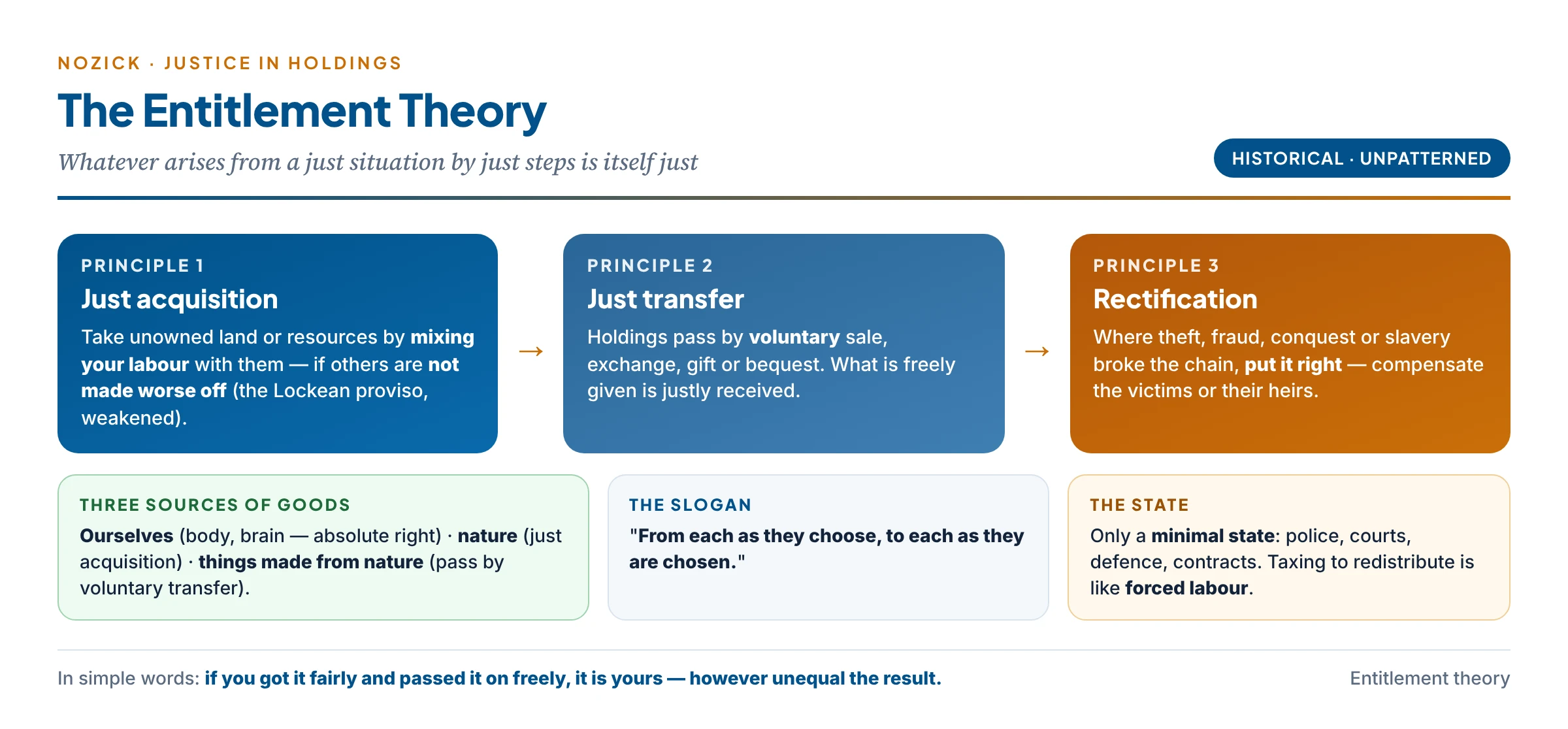
Nozick calls his theory of distributive justice the entitlement theory. A distribution is just if everyone is entitled to the holdings he possesses. Entitlement comes from three principles:
- Justice in acquisition — how people may come to own unowned things (land, water, natural resources).
- Following Locke, one acquires a thing by mixing one’s labour with it, subject to the Lockean proviso — that “enough and as good” is left for others.
- Nozick weakens the proviso: an acquisition is just if it does not worsen the situation of others compared with the situation before the thing was owned.
- Justice in transfer — how holdings may pass from one person to another: by voluntary exchange, sale, gift or bequest. What is freely given is justly received.
- Justice in rectification — how to correct past injustices in acquisition or transfer (theft, fraud, conquest, slavery).
- The definition. “Whatever arises from a just situation by just steps is itself just.” A distribution is just if it came about by just acquisition and just transfers, or has been put right by rectification.
- The three sources of goods. People obtain goods from three sources:
- Themselves — their bodies and brains; over these they have an absolute right.
- The natural world — land, water and resources; here entitlement follows the rules of just acquisition.
- Things people make by working on nature — agricultural and industrial products; these pass to others through voluntary transfer.
Historical vs End-State Principles; Patterned vs Unpatterned
- End-state (current time-slice) principles judge a distribution only by its present shape — “who has how much now”. Utilitarianism (maximise total welfare) and strict equality are end-state principles.
- Historical principles judge a distribution by how it came about. Two identical distributions can differ in justice: one may have come from honest trade, the other from theft.
- Patterned principles say that holdings should vary according to some natural dimension: “to each according to his _” — need, merit, effort, contribution, moral worth. Rawls’s difference principle, Marx’s “to each according to his needs” and Aristotle’s “according to merit” are all patterned.
- Nozick’s entitlement theory is historical and unpatterned. It has no formula of the form “to each according to…”. If one must be given, it is: “From each as they choose, to each as they are chosen.”
The Wilt Chamberlain Argument: “Liberty Upsets Patterns”
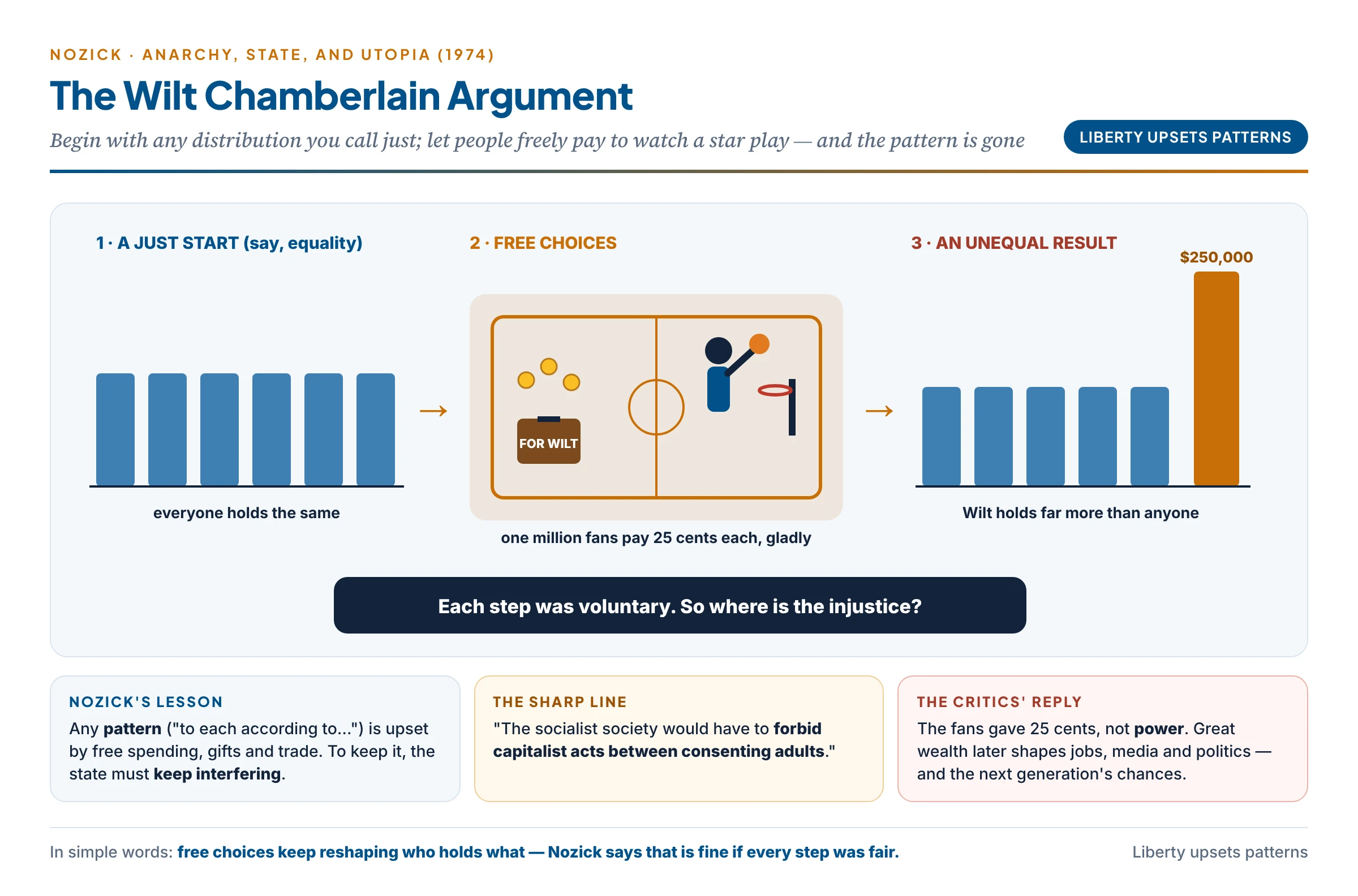
- Step 1. Start with whatever distribution you think is just — say, perfect equality. Call it the just starting point.
- Step 2. Wilt Chamberlain, a famous basketball star, signs a contract: for every home game, 25 cents of each ticket goes directly into a box for him.
- Step 3. Over a season, one million people happily drop their 25 cents in the box to see him play. Chamberlain ends up with $250,000 — far more than anyone else.
- Step 4. The new distribution is unequal. But is it unjust? Each fan gave his money voluntarily, out of a share everyone agreed was just. No one’s rights were violated.
- The lessons:
- “Liberty upsets patterns.” Any patterned distribution will be upset by people’s free choices — spending, gifting, trading.
- To keep a pattern, the state would have to continually interfere — forbidding exchanges or constantly taking money back.
- “The socialist society would have to forbid capitalist acts between consenting adults.”
In simple words
At the start of term, every student in a hostel has the same pocket money. One student plays the guitar beautifully, and fifty classmates each give him ten rupees to perform on weekends. By the end of the month he has much more than the others. Nobody was cheated; everyone paid freely to hear him. Nozick asks: where is the injustice? And if the warden takes back the money to restore equality, isn’t he overriding the free choices of fifty students?
Taxation as Forced Labour
- “Taxation of earnings from labour is on a par with forced labour.” If the state takes the earnings of, say, five hours of your weekly work to give to others, it is as if it forced you to work five hours a week for them.
- Redistribution makes the state a part-owner of persons: it gives others a property right in you, your labour and its fruits.
- In the words of the critics of the welfare state, welfarism makes the productive into “partial slaves” or bonded labourers of the needy.
- Taxation is legitimate only for the minimal state’s functions — police, courts, defence — which protect everyone’s rights.
Nozick’s Critique of Rawls
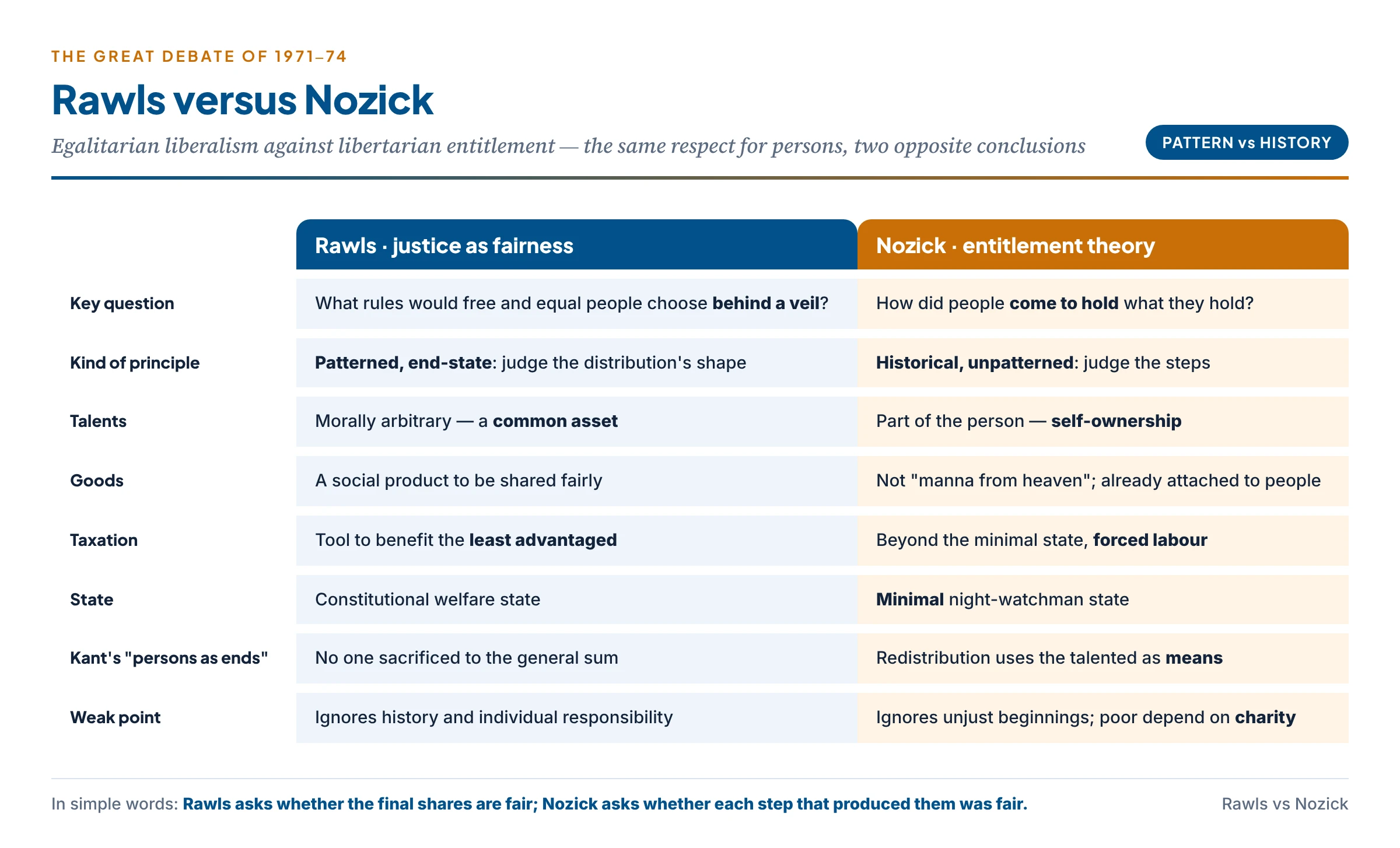
- Rawls treats goods as “manna from heaven”. The original position imagines goods as if they fell from the sky and only needed to be divided. But goods come into the world already attached to people who made or acquired them.
- Rawls’s principles are patterned and end-state, so they ignore history — how holdings were actually acquired.
- Natural talents are not a “common asset”. Rawls says no one deserves his talents. Nozick replies: even if you do not deserve them, you are entitled to them — they are part of you. Treating them as common property denies self-ownership and the separateness of persons.
- The difference principle uses the talented as means for the welfare of others — a violation of Kant’s principle, which Rawls himself claims to honour.
- Why should the better-endowed agree? Social cooperation benefits the less endowed more than the better endowed; the difference principle asks the better-off to accept even more burdens.
Rectification: Is Nozick Against All Redistribution?
- Rectification may require large transfers. If present holdings came from past injustice — conquest, slavery, theft of land — the principle of rectification may justify taking from present holders to compensate victims or their descendants.
- Nozick even admits that, since we cannot trace all past injustices, a rough rule of thumb might be to redistribute in favour of the worst-off in the short run — “although to introduce socialism as the punishment for our sins would be to go too far”.
- Critics reply that once rectification is taken seriously, almost every existing holding is tainted by history, and the entitlement theory loses its practical force.
Critical Evaluation
Criticisms of Nozick
- Initial acquisition is mostly unjust. Much present property traces back to conquest, colonial plunder, enclosure of commons, slavery and landlordism. In India, the zamindari system and the dispossession of tribal communities are examples. A theory that starts from “just acquisition” has little to say about a world built on unjust acquisition.
- The weak Lockean proviso. Nozick’s proviso allows someone to appropriate land and resources as long as others are not made worse off than in a state of nature — a very low bar that permits enormous inequality.
- Self-ownership does not imply world-ownership. G. A. Cohen argued that even if we own ourselves, it does not follow that we may own unlimited external resources; the world’s resources might belong to all in common.
- Freedom of the poor. Libertarian “freedom” protects the property-owner, but a person with no property has no real freedom — he must accept the terms of those who own. The Wilt Chamberlain fans gave up 25 cents; but the resulting concentration of wealth later gives Chamberlain power over others, including the fans’ children.
- Justice replaced by charity. Nozick makes the welfare of the poor depend on charity, not justice. A destitute child has no claim on anyone.
- Maintains oppression. Critics say Nozick wants to keep the prevailing oppression in the name of justice. His rectification principle is aimed at clear cases of theft — such as the assets seized by some states — but not at the wealth built up by huge tycoons and manipulators of the market.
- Rights without foundation. Nozick asserts rights to property without fully arguing for them; Thomas Nagel called this “libertarianism without foundations”.
- Nozick’s own second thoughts. In later writings (The Examined Life, 1989), Nozick said the libertarian position he had put forward now seemed to him seriously inadequate, partly because it did not fully weave in the importance of joint and social concerns.
Indian Connect — Trusteeship against entitlement
Gandhi accepted that the rich may keep their wealth — but as trustees, holding it for the welfare of society, taking only what they need. Nozick says the rich are owners, entitled to everything acquired by just steps. The Indian Constitution leans towards Gandhi and Rawls: the right to property was removed from the Fundamental Rights by the 44th Amendment (1978) and became a legal right under Article 300A, so that land reforms and redistribution would not be blocked. Yet the Supreme Court in Property Owners Association v. State of Maharashtra (2024, nine judges, by majority) held that not all private property counts as “material resources of the community” under Article 39(b) — a reminder that the libertarian concern for private property has not disappeared from Indian constitutional debate.
Hayek: Social Justice as a “Mirage”
F. A. Hayek (The Road to Serfdom, 1944; The Constitution of Liberty, 1960; Law, Legislation and Liberty, vol. II: The Mirage of Social Justice, 1976) places liberty above every other political ideal, including equality and justice.
- Liberalism as minimum coercion. He defines liberalism as the doctrine that minimises the coercive power of government.
- Justice belongs to conduct, not to society. Only actions of persons can be just or unjust. The market’s outcomes are the unintended result of millions of free choices; no one designed them, so it makes no sense to call them “unjust” — any more than it makes sense to call the weather unjust.
- Limited resources. Society does not have enough to satisfy everyone’s claims.
- Arbitrariness. A policy of social justice needs a central authority to decide who deserves what; in practice this leads to arbitrary distribution shaped by bureaucracy and pressure from interest groups.
- The road to serfdom. Planning for equal outcomes requires ever more control over people’s lives and leads towards totalitarianism.
In simple words
A sudden hailstorm ruins one farmer’s crop and spares his neighbour’s. We call this bad luck, not injustice — no one did it. Hayek says the market is like the weather: its results come from millions of free choices that no one planned. So, for him, it makes no sense to call them “unjust”. His critics reply: unlike the weather, the rules of the market — property, tax, inheritance, labour law — are made by people, and people can change them.
- Natural inequality. People differ greatly in skills and abilities; this natural tendency towards inequality can be countered only by authoritarian suppression of individual talents and aspirations.
- Justice as procedure. For Hayek, justice is simply a procedure designed to promote freedom: each individual should get the maximum opportunity to pursue his interests according to his own understanding, under general rules (the rule of law).
- Economic inequality and progress. A society that allows inequality progresses faster in technology and prosperity; the rich try new goods first, and these later reach everyone.
Criticism of Hayek:
- Indifferent to the poor. Hayek wants to promote excellence, but is not concerned with the plight of the poor and the unlucky.
- Against humanitarianism. He rejects not only “social justice” but, in effect, the humanitarian impulse that society should care for its members.
- Inconsistent. He begins by treating the individual as an end in himself, but ends by treating many individuals as means to market efficiency and progress.
- Outcomes can be judged. Even if no one intended market outcomes, a society chooses the rules that produce them — property, inheritance, tax, labour law — and can be held responsible for those choices.
Milton Friedman: Capitalism as the Condition of Freedom
Milton Friedman (Capitalism and Freedom, 1962; Free to Choose, 1980):
- Competitive capitalism is a necessary condition for freedom. Economic freedom is both a freedom in itself and a means to political freedom, because it disperses power away from the state.
- Equality must be given up for freedom: “A society that puts equality — in the sense of equality of outcome — ahead of freedom will end up with neither equality nor freedom.”
- Government as umpire. Government is needed only to sustain and supplement the market: make and enforce the rules, protect property, maintain money — and nothing beyond that. (He did propose a limited negative income tax as a minimal safety net instead of many welfare schemes.)
- Criticism:
- Friedman fails to distinguish a simple exchange economy (independent producers trading) from a capitalist economy, in which most people have no capital of their own and so have no real choice in the market — they must sell their labour.
- Capitalism blocks a worker’s attempt to use his labour creatively and by free choice; he is coerced by market forces beyond his control.
- The only way out is a regulatory welfare state — which Friedman opposes.
Herbert Spencer: Survival of the Fittest
- Herbert Spencer applied evolutionary ideas to society: competition sorts the fit from the unfit; state help to the poor interferes with this natural process. He coined the phrase “survival of the fittest“.
- Criticism. Human society is not a jungle; “fitness” in a market reflects inherited advantage as much as ability; and a moral community does not leave its weakest members to perish.
Is a Free Market Economy the Only Way to Attain Social Justice?
Arguments that the market is the means of just distribution:
- Efficiency — markets produce more wealth than any planned system, leaving more for all.
- Liberty — market exchanges are voluntary; no one is forced.
- Desert — rewards follow contribution as valued by others.
- Information — prices carry knowledge no planner could gather (Hayek).
- Dispersal of power — economic power spread among many protects political freedom (Friedman).
In simple words
A free market is like a running race with fair rules but unfair starting lines: one runner starts at the 10-metre mark with good shoes, another starts 50 metres behind, barefoot. The referee is perfectly neutral — yet no one would call the result a fair test of speed.
Arguments that the market cannot be the means of just distribution:
- Fairness in the market is a myth. Equal rules are applied to unequal individuals — the rich child and the poor child enter the race at different points.
- Equality is the main element of justice, but the market creates and widens inequality.
- Justice includes need-based distribution, which the market cannot provide — it serves purchasing power, not need.
- Market failures — monopolies, externalities (pollution), public goods (roads, research), and information gaps.
- Some goods should not be for sale — votes, organs, justice in courts, basic education and health (see Walzer’s spheres in the next article).
- Conclusion. The market may be a means of just distribution — but not the unregulated market. It must be joined with elements of a welfare state: public education and health, social security, labour protection and progressive taxation. If left unregulated, certain sections will be forced to lead a sub-human life, which is gross injustice. India’s own path — liberalisation since 1991 combined with welfare schemes for food security, rural employment and health insurance — reflects this mixed answer.
Which Individual Strengthens the State More: the Liberal or the Socialist?
- The liberal (libertarian) individual strengthens the state by enterprise, innovation and independence: he creates wealth, pays taxes, resists tyranny and keeps the state limited and accountable. But unchecked, he may weaken the social bonds and solidarity a state needs, and turn citizens into mere consumers.
- The socialist individual strengthens the state by solidarity, civic duty and concern for the common good: he supports public institutions and the welfare of all. But he may become dependent on the state and less inventive, and an over-powerful state may endanger liberty.
- Balanced view. A healthy democratic state needs the liberal’s freedom and initiative together with the socialist’s sense of fraternity and justice — the combination found in egalitarian liberalism (Rawls), democratic socialism (Laski, Nehru) and Ambedkar’s trinity of liberty, equality and fraternity.
Critics and Defenders
Criticism — Critics
- Cohen: self-ownership is not world-ownership.
- History: most holdings began in conquest and plunder.
- Charity, not justice: the poor have no claim.
- Formal freedom only: the propertyless have no choice.
- Hayek ignores the poor and the unlucky.
- Friedman forgets that workers own no capital.
Defence — Defenders and strengths
- Separateness of persons taken seriously.
- History matters: how goods were acquired counts.
- Liberty upsets patterns: free choices create inequality.
- Limits state power; guards against serfdom.
- Rectification can address past injustice.
- Markets create wealth and spread power.
Cross-Tradition Comparison
| Theme | Nozick, Hayek, Friedman | Rawls | Indian thought |
|---|---|---|---|
| Basis of justice | Entitlement: just acquisition and transfer | Fair choice behind the veil | Dharma — duty to society; Gandhi’s trusteeship |
| Talents | Owned by the individual | A common asset | Talents as gifts to be used in service (sevā) |
| Taxation | Forced labour (beyond minimal state) | Tool to benefit the least advantaged | Kauṭilya: fair taxes like the bee that takes nectar without harming the flower |
| State | Minimal, night-watchman | Welfare-oriented, constitutional | Welfare state (Directive Principles) |
| Inequality | Just if it arose by just steps | Just only if it benefits the worst-off | Gandhi: limit wants; equality of all labour |
| Freedom | Freedom from interference | Equal liberty with fair value | Swarāj — self-rule and self-control |
Indian Connect — Kauṭilya on taxation
The Arthaśāstra compares the ideal king to a gardener who plucks ripe fruit and to the bee that gathers honey without hurting the flower: taxes should be taken without destroying the people’s capacity to produce. Kauṭilya, unlike Nozick, did not think taxation unjust in itself; he thought it unjust when it was excessive or oppressive. His king also had duties to protect the helpless, orphans, the aged and widows — an early idea of public welfare that a minimal state would not accept.
Synthesis (Siddhānta)
- Nozick’s lasting insight is that history and free choice matter to justice: an outcome cannot be judged only by its shape; persons are separate; and the state must not treat anyone merely as a means.
- Hayek and Friedman show that markets create wealth, carry knowledge and disperse power, and that a state that tries to fix every outcome may threaten liberty.
- Their failure is to treat formal freedom as the whole of freedom, to ignore unjust beginnings, and to reduce care for the poor to charity. A destitute person is not free in any meaningful sense.
- The balanced position — reached by egalitarian liberals and reflected in the Indian Constitution — accepts markets and private property but within a framework of justice: equal basic liberties, fair equality of opportunity, a social minimum, and progressive taxation. Libertarianism is best read as a warning against an overbearing state, not as a complete theory of justice.
“Individuals have rights, and there are things no person or group may do to them (without violating their rights).” — Robert Nozick
Previous Year Questions
- 2021Discuss critically the distributive theory of justice as propounded by R. Nozick.
- 2010Which type of individual according to you can contribute more to strengthen the state – a liberalist or a socialist?
- 2007Free market economy is the only way to attain social justice.