

Public sector in modern India; Forms of Public Sector Undertakings; Problems of autonomy, accountability and control; Impact of liberalization and privatization.
This article: Public sector in modern India (meaning, rationale and objectives: commanding heights, Industrial Policy Resolutions of 1948 and 1956, the Mahalanobis model, regional balance, employment, model employer; growth in number and investment; contribution and current data from the Public Enterprises Survey 2024–25; why performance lagged); forms of public sector undertakings (departmental undertaking, statutory corporation, government company under section 2(45) of the Companies Act, 2013, holding company and sector corporation, joint venture and joint sector, other forms; the committees on choice of form and a comparison); the managing machinery (administrative ministries, Department of Public Enterprises, DIPAM, PESB; Schedules A–D; Maharatna, Navratna and Miniratna); problems of autonomy, accountability and control (ministerial control and directives, parliamentary control and COPU, CAG audit, judicial control under Article 12, vigilance and Lokpal, RTI, boards and PESB, corporate governance, workers’ participation); the MoU system; the autonomy–accountability dilemma and its theory.
Official Syllabus: Paper II · Unit 2-03 Public Sector Undertakings
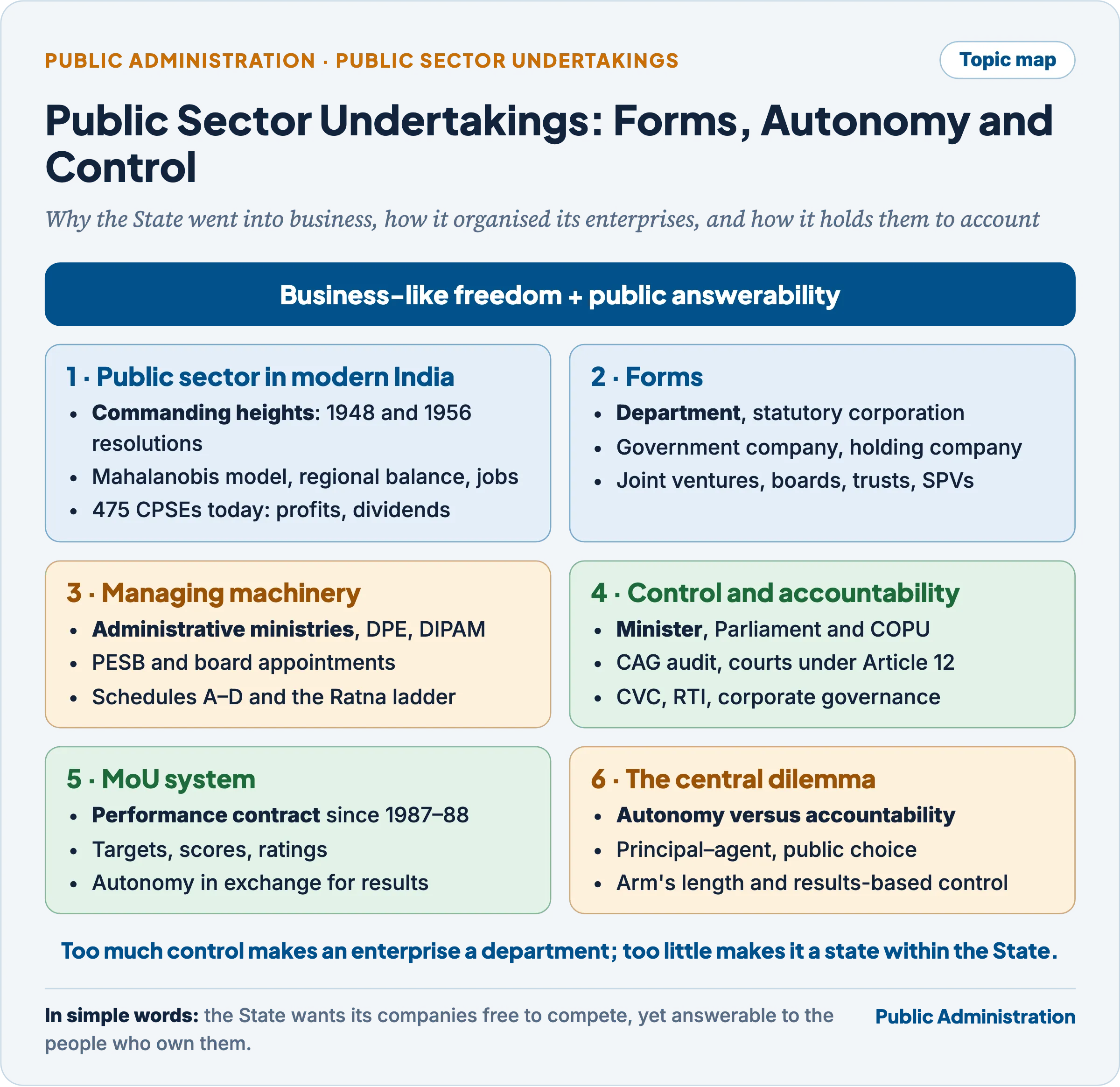
A public sector undertaking (PSU) is a business owned and controlled by the State: a steel plant, a power utility, an oil refiner, an insurer or a railway. After Independence India built hundreds of them to industrialise a poor, agrarian economy, and they still earn a large share of corporate profits, pay large dividends to the Union and run strategic sectors. Their administration poses one enduring question: how can an enterprise be free enough to compete like a business and yet answerable enough to satisfy a democracy that owns it? The choice of organisational form, the machinery of control and the MoU system are three successive answers to that question.
In simple words
Imagine a family that owns a shop but appoints a manager to run it. If the family checks every purchase, the manager cannot respond to customers and the shop loses business. If the family never checks, the manager may waste money or help his friends. The family needs a middle path: agree targets at the start of the year, leave daily decisions to the manager, and check the results at the end. That is the PSU problem in miniature.
1. The Public Sector in Modern India
In simple words
After 1947 India had little industry, few roads and power plants, and not enough private capital to build steel mills or dams. So the government itself became an investor and a manager. The public sector was meant to build the base on which the rest of the economy could grow.
1.1 Meaning: public sector, public enterprise and PSU
- Public sector in its widest sense covers all activities of government: social services, administration and business. The Bureau of Public Enterprises (annual report 1973–74) used the term more narrowly for the industrial and commercial undertakings of government organised as corporations or companies.
- Public enterprise is a body that is owned and/or controlled by a public authority and sells its output at a price, aiming at least to break even. Social services given free (schools, police) are not public enterprises; a railway or postal service, though run as a department, is one because it charges for its service.
- Public sector undertaking is the common Indian name for such enterprises; the official term today is Central Public Sector Enterprise (CPSE) for those in which the Union holds more than half the equity (and their Indian subsidiaries). Enterprises owned by States are State Level Public Enterprises (SLPEs).
- Other names: nationalised industry (the British usage, since most British enterprises came from nationalisation), government corporation, state-owned enterprise (SOE, the international usage).
- What the Public Enterprises Survey covers: government companies with more than 50 per cent Central equity, their subsidiaries and certain statutory corporations. It excludes departmental undertakings, public sector banks and insurance companies, which is why the Railways, SBI and LIC do not appear in the CPSE count.
Defining features of a public enterprise:
- State ownership: wholly or majority owned by the Union, a State, a local body or another public enterprise.
- State control: government appoints the board, approves major investments and issues policy directions.
- Public accountability: because it uses public money, it answers to the legislature, the minister, the auditor and the courts.
- Autonomy: it is meant to be free from day-to-day interference so that it can act on business lines.
- Public purpose: profit is one goal among several; social objectives may sometimes override it.
The contrast with a private firm shows why public enterprises are harder to manage.
| Aspect | Public enterprise | Private enterprise |
|---|---|---|
| Motive | Service plus surplus; social goals may override profit | Profit for shareholders |
| Owners | Citizens, through Parliament and the minister | Identifiable shareholders |
| Capital | Often capital-intensive, long-gestation sectors | Chooses sectors with quicker returns |
| Risk | Borne by the taxpayer, not by managers personally | Borne by owners |
| Openness | Disclosure, audit, RTI, parliamentary questions | Commercial secrecy, market disclosure only |
| Market | Often monopoly or dominant position historically | Mostly competitive |
The table explains the “multiple goals, multiple principals” problem. A private firm has one owner and one bottom line; a PSU has many owners’ agents (ministry, Parliament, auditor, investigators) and several goals (profit, prices, jobs, regions), and every one of them can be used to question a commercial decision.
1.2 Rationale: why India chose a large public sector
- Missing capital and entrepreneurs. In 1947 private capital was small, risk-averse and concentrated in trade and light industry. Steel, heavy engineering, power and mining needed huge investment with long gestation (years before any return). The State stepped in because no one else could. The economic historian Alexander Gerschenkron (Economic Backwardness in Historical Perspective, 1962) argued that late industrialisers need institutions such as the State or big banks to substitute for missing prerequisites; India’s public sector fits that pattern.
- Market failure and natural monopolies. Railways, power grids, ports and telecom networks are natural monopolies or public utilities where private ownership could exploit consumers.
- Directive Principles. Article 39(b) directs the State to distribute the ownership and control of the material resources of the community to subserve the common good, and Article 39(c) to prevent concentration of wealth and means of production to the common detriment. Article 38 asks for a social order of justice. A public sector was seen as a direct instrument for these goals.
- Self-reliance and security. Defence production, atomic energy and strategic minerals could not be left to private or foreign hands.
- Planning. Under the Five Year Plans, public enterprises were the instruments through which investment targets were met.
The policy milestones:
- Industrial Policy Resolution, 1948 divided industry into four categories: an exclusive Central monopoly (arms and ammunition, atomic energy, railways); a mixed category where new units would be set up by the State (coal, iron and steel, aircraft, shipbuilding, telephones, mineral oils) while existing private units continued; a category under State regulation and control; and the rest left to private enterprise.
- Socialistic pattern of society. Parliament accepted this goal in December 1954 and the Congress adopted it at its Avadi session (January 1955).
- Industrial Policy Resolution, 1956 placed 17 industries in Schedule A as the exclusive responsibility of the State, 12 in Schedule B to be progressively State-owned with private participation, and left Schedule C to the private sector. It gave the public sector the “commanding heights of the economy”: control of the basic and strategic industries on which everything else depended.
- The Mahalanobis model. P.C. Mahalanobis, the statistician who drafted the framework of the Second Five Year Plan (1956–61), gave priority to heavy and capital-goods industries, which in practice meant public investment in steel, machine-building, power and mining. The three steel plants at Bhilai (Soviet help), Rourkela (West German help) and Durgapur (British help) under Hindustan Steel became its symbols. Jawaharlal Nehru called such projects, beginning with the Bhakra-Nangal dam, the “temples of modern India”.
- Nationalisations widened the sector: life insurance (LIC, 1956), 14 major banks (1969) and six more (1980), general insurance (1972–73), coal (1971–73), and the takeover of sick private units such as textile mills, to protect jobs.
1.3 Objectives assigned to public enterprises
Planning documents, the Industrial Policy Resolutions and the Directive Principles gave public enterprises a long list of goals.
- Accelerate growth and the rate of capital formation.
- Build infrastructure for industrialisation: power, transport, steel, fertiliser, machine tools.
- Prevent concentration of economic power and monopolies in private hands.
- Self-reliance in strategic fields and reduced dependence on foreign technology.
- Balanced regional development: plants placed in backward regions (Bhilai, Rourkela, Bokaro, Neyveli) to create growth poles.
- Employment and better living standards, including townships, schools and hospitals around plants.
- Balance of payments: import substitution and export earnings.
- Support small and ancillary industries around large plants.
- Generate surpluses for reinvestment and public revenue.
- Redistribute income and wealth and keep the prices of essential goods stable, acting as price benchmarks (administered prices of steel, fertiliser, petroleum products).
The model employer. Public enterprises were also expected to set standards for the rest of industry: fair wages, job security, welfare facilities, reservations for Scheduled Castes, Scheduled Tribes and Other Backward Classes, and observance of labour laws. Because courts treat most of them as “State” under Article 12, they must follow Articles 14 and 16 in recruitment and fairness in dismissal, which reinforces this role.
The tension built into the list. Several objectives conflict: maximising surplus versus holding prices down; efficiency versus employment; location by cost versus location by regional balance. No ranking was ever laid down for most enterprises, and the micro-objectives of individual enterprises were seldom specified, a point made repeatedly by parliamentary committees and the first Administrative Reforms Commission. This vagueness of objectives became the first explanation of poor performance.
1.4 Growth in number and investment
The public sector grew from a handful of units to the largest corporate group in the country.
| Year | Central public enterprises | What drove the change |
|---|---|---|
| 1951 | 5 (investment of about ₹29 crore) | Pre-Independence units, early post-war projects |
| 1969 | 84 | Second and Third Plans: steel, heavy engineering, oil, fertiliser |
| 1970s–1980s | Rapid expansion to well over 200 | Nationalisations, takeover of sick units, new sectors |
| 2011–12 | 260 | New subsidiaries in power, finance, infrastructure |
| 2024–25 | 475 (291 operating) | Subsidiaries, special purpose vehicles for power transmission, defence companies |
- Phases. The 1950s–1980s saw the public sector move from infrastructure into consumer goods, hotels, bakeries and textiles, partly by taking over failing private firms. This entry into low-priority areas was criticised by parliamentary committees as a dispersal of scarce resources.
- The “leviathan” paradox. The number of CPSEs keeps rising even after 1991 because of new subsidiaries, joint ventures and special purpose vehicles (for example, 28 power transmission SPVs awaiting transfer under tariff-based competitive bidding in 2024–25), even while the government sells shares and closes loss-making units. Growth in number therefore does not mean growth in the State’s control of the economy.
1.5 Contribution and current position
The Public Enterprises Survey is the annual report on CPSEs prepared by the Department of Public Enterprises. It began in 1960–61 after the Estimates Committee’s 73rd Report (Second Lok Sabha, 1959–60) asked for a consolidated account. The 2024–25 Survey (the 65th, released in December 2025) gives the current picture.
| Indicator (CPSEs) | 2024–25 | Remark |
|---|---|---|
| Total CPSEs | 475 | 291 operating; 81 under construction; 75 under closure, liquidation or non-operating |
| Listed CPSEs | 66 | Rest owned wholly by government or other CPSEs |
| Profit-making CPSEs | 226, net profit about ₹3.09 lakh crore | Down from ₹3.43 lakh crore in 2023–24 |
| Loss-making CPSEs | 63, losses about ₹0.18 lakh crore | Losses concentrated in a few units |
| Dividend declared | About ₹1.39 lakh crore | Up 13 per cent over 2023–24 |
| Contribution to Central Exchequer | About ₹4.94 lakh crore | Excise duty is the largest part (about 44 per cent) |
| Net worth | About ₹22.33 lakh crore | Up about 12 per cent |
| Foreign exchange earnings | About ₹1.57 lakh crore | Led by refining and gas companies |
| CSR spending | About ₹6,437 crore by 183 eligible CPSEs | Mandatory under the Companies Act, 2013 |
- Concentration of profit. A few sectors (petroleum refining and marketing, coal, crude oil, finance and power) earn most of the profit, and in 2023–24 the top ten CPSEs earned over 60 per cent of it. A handful of large enterprises carry the reputation of the whole sector.
- Dividends to the Union (the government’s share of dividends) reached a record of about ₹74,000 crore in 2024–25.
- Employment has fallen steadily: regular CPSE employees numbered about 8.1 lakh in 2023–24, against over 22 lakh in 1991, as enterprises automated, used contract labour and offered voluntary retirement.
- Capital expenditure. CPSEs remain a major channel of public investment; the Department of Public Enterprises now monitors their capital expenditure against annual targets.
Indian Connect — Asset and liability: NTPC and BSNL
NTPC, set up in 1975 as a government company, grew into India’s largest power producer, a Maharatna and a steady dividend payer; it illustrates the public sector as an asset. BSNL, carved out of the Department of Telecommunications in 2000, lost money for years against private competitors and needed three revival packages from the Union (₹69,000 crore in 2019, ₹1.64 lakh crore in 2022 and ₹89,047 crore in 2023), justified partly by its rural and strategic role. It reported its first quarterly profit since 2007 (₹262 crore, October–December 2024). The two cases show that the same ownership can produce very different results, depending on market position, managerial freedom, technology and the social obligations imposed by government.
1.6 Why performance lagged
Public enterprises were long criticised as being “neither adequately public nor truly enterprising”: not public enough because Parliament and citizens could not see inside them, and not enterprising because they were run like government offices. The reasons were identified by parliamentary committees, the ARC and later studies.
- Policy problems: unclear and conflicting objectives; entry into non-priority consumer areas; administered pricing that held prices below cost for social reasons.
- Project problems: poor feasibility studies, political choice of locations (the Committee on Public Undertakings found that two fertiliser plants, at Namrup and Gorakhpur, were sited without proper techno-economic evaluation, on the idea that every State should have one), delays and cost overruns.
- Financial problems: over-capitalisation, heavy interest burdens, weak budgeting, slow sanctions, and dependence on budgetary support.
- Personnel problems: deputation of generalist civil servants to top posts with short tenures; overstaffing at lower levels; pay not competitive with the private sector for managers; weak appraisal; poor industrial relations driven by politically linked unions.
- Materials and marketing: excessive inventories, slow purchase procedures, little customer orientation.
- Control problems: excessive, informal and overlapping control by ministries and auditors, with “multiple principals and multiple goals” pushing managers into a bureaucratic rather than commercial mode of behaviour.
Pricing policy. A public enterprise can price in several ways: no profit, no loss (cover costs only), administered prices fixed by government, cost-plus pricing, or market prices. A monopoly utility needs regulated prices to protect consumers; a semi-monopoly may price at cost plus a fair return; a firm in competition must follow the market. A permanent no-profit-no-loss rule leaves nothing for replacement, expansion or return to the taxpayer, which is why the Plans from the 1960s onwards expected enterprises to generate surpluses. Today the DIPAM dividend guidelines (2024) expect a minimum annual dividend, which implicitly rules out a no-profit policy for commercial CPSEs.
1.7 From commanding heights to a strategic presence
The New Industrial Policy of 1991 cut the list of industries reserved for the public sector, began disinvestment of minority shares, sent sick units to the BIFR and promised more autonomy through MoUs; after 1999 governments added strategic sales, and the New Public Sector Enterprise Policy (2021) limits the State to a bare minimum presence in four strategic sectors. These changes, their record and their critique are covered in full in the article on Liberalisation, Privatisation and Disinvestment of Public Sector Undertakings.
2. Forms of Public Sector Undertakings
In simple words
The government can run a business in three main ways. It can run it like any government office (a department), create a special body by passing a law for it (a corporation), or register an ordinary company and own most of its shares (a government company). Each way gives a different mix of freedom and control.
2.1 Why the form matters
The organisational form decides how a public enterprise is created, financed and staffed, whether it can sue and be sued, how its accounts are audited, and how far the minister and Parliament can reach into it. Paper I treats these forms in general (see the article on Structure and Forms of Public Organisations); here the focus is on how India used them.
- India’s practice moved in a recognisable sequence: departmental undertakings first (simple, under direct control), then statutory corporations for utilities and finance, then the government company as the dominant form for industry and trade, and later holding companies, joint ventures and special purpose vehicles.
- Every move away from the department was a search for autonomy; every complaint from Parliament was a demand for accountability.
2.2 Departmental undertaking
A departmental undertaking is an enterprise organised as a wing of a government department, under the direct control of the minister and the secretary.
Features (as set out by the UN Economic Commission for Asia and the Far East seminar of 1956, and accepted in Indian writing):
- Financed by annual appropriations from the treasury; all or most of its revenue goes back into the treasury.
- Subject to the same budget, accounting and audit controls as other government activities.
- Staffed by civil servants, recruited and serving on the same terms as other government servants.
- Organised as a sub-division of a department, under the direct control of its head.
- Shares the sovereign immunity of the State: it has no separate legal personality and cannot be sued in its own name.
Indian examples: the Indian Railways (whose separate Railway Budget was merged into the General Budget from 2017–18), the Department of Posts, the Government of India Presses, and departmentally run irrigation and power works in the States. The Ordnance Factories were departmental for over two centuries until their corporatisation on 1 October 2021 into seven defence public sector companies.
Merits:
- Full ministerial responsibility and full parliamentary control: Parliament votes its money, and the minister answers for every act.
- Suits strategic, security or sovereign activities (defence production, mints, atomic energy) and services where uniform national policy matters.
- Revenue for the treasury and easy coordination with government policy.
Limitations (listed by the Krishna Menon Committee among others):
- Civil service rules prevent promotion on merit and prompt discipline.
- Tardy financial procedures: sanction needed for each item of expenditure; receipts cannot be reused without special sanction.
- Government accounting unsuited to commercial costing; departmental purchase and sale methods too slow for business.
- Red tape, risk aversion and lack of initiative; decisions depend on the ministry’s convenience, not the market.
Why departments were placed under full control. The departmental form was deliberately chosen where the activity was a public service or sovereign function whose policy, prices and coverage Parliament wanted to decide directly (railway fares, postal tariffs, defence production). Full control was the price of their public character, not an accident. The trend since the 1990s has been to corporatise commercial departments where competition has arrived: telecom services became BSNL (2000), the currency presses and mints became SPMCIL (2006) and the Ordnance Factories became seven companies (2021).
Indian Connect — Corporatisation of the Ordnance Factory Board (2021)
The Ordnance Factory Board, a departmental organisation of 41 factories under the Ministry of Defence, was dissolved and its units were transferred on 1 October 2021 to seven new defence public sector companies (for example, Munitions India, Armoured Vehicles Nigam and Advanced Weapons and Equipment India). The aim was to give each commercial autonomy, accountability for results and the ability to compete for domestic and export orders, while keeping them wholly government-owned. It is the clearest recent case of moving from the departmental to the company form without privatisation.
2.3 Statutory (public) corporation
A statutory corporation is an autonomous body created by a special Act of Parliament or a State legislature, which defines its powers, duties, immunities, management and relations with the ministry.
Classic statements:
- Herbert Morrison, the British Labour minister, in Socialisation and Transport (1933), described the public corporation as a combination of public ownership, public accountability and business management for public ends.
- Franklin D. Roosevelt, proposing the Tennessee Valley Authority to the US Congress in 1933, called for “a corporation clothed with the power of government but possessed of the flexibility and initiative of a private enterprise”.
- W.A. Robson, the British scholar of nationalised industry (Nationalized Industry and Public Ownership, 1960), counted the public corporation among the most important institutional innovations of the twentieth century in government.
- Marshall E. Dimock, the American administrative scholar, defined it as a publicly owned enterprise chartered by law for a particular business or financial purpose.
Features:
- Wholly owned by the State in its classic form (later practice allows minority private holdings, as in the listed LIC since 2022).
- Created by a special statute, which is its charter.
- Body corporate: a separate legal person that can sue and be sued, contract and own property in its own name.
- Independently financed except for capital and loss-covering appropriations; it borrows, earns revenue and reuses its revenue.
- Exempt from most rules on the expenditure of public funds and from the ordinary budget, accounting and audit laws of departments, though its own Act may impose audit by the CAG.
- Own employees, not civil servants, recruited on terms it fixes (top managers may still come from the civil services).
- Board management, with the minister’s power limited to appointments, policy directions and approvals that the Act specifies.
Indian examples:
| Corporation | Statute | Field |
|---|---|---|
| Reserve Bank of India | RBI Act, 1934 (functioning from 1935) | Central bank; nationalised 1949 |
| Damodar Valley Corporation | DVC Act, 1948 | Multi-purpose river valley development on the TVA model |
| Employees’ State Insurance Corporation | ESI Act, 1948 | Social insurance for workers |
| Air India International and Indian Airlines | Air Corporations Act, 1953 | Civil aviation (converted to companies in 1994) |
| State Bank of India | SBI Act, 1955 | Banking |
| Life Insurance Corporation | LIC Act, 1956 | Life insurance |
| Oil and Natural Gas Commission | ONGC Act, 1959 | Oil exploration (became a company in 1994) |
| Food Corporation of India | Food Corporations Act, 1964 | Procurement, storage, distribution of foodgrains |
| National Highways Authority of India | NHAI Act, 1988 | Highways |
| Airports Authority of India | AAI Act, 1994 | Airports and air navigation |
States created road transport corporations under the Road Transport Corporations Act, 1950, financial corporations under the State Financial Corporations Act, 1951 and State Electricity Boards under the Electricity (Supply) Act, 1948 (since unbundled into companies after the Electricity Act, 2003).
Merits:
- Autonomy in day-to-day administration and freedom from political pressure, at least in design.
- Financial and personnel flexibility: it can borrow, reuse revenue, and pay and promote on business lines.
- Legislative definition of autonomy: Parliament debates the Act and fixes the limits of ministerial power, which suits utilities and finance where public trust matters.
- A synthesis of business efficiency with public accountability.
Limitations:
- Rigidity: every structural change needs an amending Act.
- Blurred line between “policy” and “day-to-day administration”: ministries treat corporations as their branches and issue orders, so the promised autonomy is often illusory.
- Accountability gap: in the other direction, a corporation may become a self-perpetuating group with power but little democratic control. The British scholar A.H. Hanson warned that the freedom this form confers can be so large that public accountability becomes very difficult.
“Exhausted leviathans.” By the 1990s several corporations (Indian Airlines, the State Electricity Boards, the road transport corporations, the FCI’s burden of food subsidy costs) had become huge, loss-making and politically managed. Critics called them exhausted leviathans: giant bodies that had lost both entrepreneurial energy and clarity of public purpose. The remedies applied were conversion into companies (air corporations, ONGC, IFCI), unbundling (SEBs) and, in some cases, privatisation.
2.4 Government company
Section 2(45) of the Companies Act, 2013 (formerly section 617 of the 1956 Act) defines a government company as a company in which not less than 51 per cent of the paid-up share capital is held by the Central Government, by any State Government or Governments, or partly by the Centre and partly by one or more States, and includes a subsidiary of such a company. It is the most widely used form of public enterprise in India.
Features:
- Created by executive decision and registered under the Companies Act; no legislation is needed.
- Body corporate with separate legal personality.
- Governed by its Memorandum and Articles of Association, which the government, as majority shareholder, drafts and can amend. The Articles usually reserve powers to the President of India to issue directives and to appoint and remove directors.
- Wholly owned or mixed-ownership: where private shareholders hold part of the capital it is a mixed-ownership company.
- Funds from government equity and loans, private shareholders, borrowing and its own revenue.
- Not subject to government budget and accounting rules; audited under the Companies Act with a CAG-appointed auditor and CAG supplementary audit.
- Own employees, apart from officers on deputation.
Merits (why it became the most popular form):
- Ease and speed of creation and of later change (amend the Articles, not an Act).
- Flexibility in finance, personnel and commercial decisions, and the same legal framework as private firms, which suits competition.
- Association with private and foreign partners in joint ventures.
- Easy changes of ownership: government can buy or sell shares; selling below 51 per cent ends government-company status without legislation.
- Expansion through subsidiaries.
Limitations:
- “A fraud on the Companies Act and on the Constitution.” A former Comptroller and Auditor General used this phrase because, with the government as sole or dominant shareholder, company-law provisions on shareholder meetings and control become a fiction: the “company” is in substance a branch of the ministry, yet it escapes the scrutiny Parliament exercises over departments and statutory corporations.
- “Imperium in imperio” (a state within a state): Lanka Sundaram, the parliamentarian who first proposed a separate parliamentary committee on public undertakings (1953), used this phrase for companies that spent public money outside parliamentary sight.
- Autonomy is not guaranteed by form. The Estimates Committee observed that many companies were “more or less extensions of departments”, run almost on departmental lines.
- Accountability depends on the shareholder ministry’s behaviour, not on any statute.
Why it is popular despite the criticism: governments value speed, control and flexibility; the company can be created without facing Parliament and wound up or sold the same way. Statutory corporations remain for functions where public trust, regulation or social insurance demand a legal charter (RBI, LIC, FCI, AAI).
Common confusion
Is every body with “Corporation” in its name a statutory corporation? No. The Food Corporation of India, LIC and the Damodar Valley Corporation are statutory corporations created by their own Acts. But Indian Oil Corporation Ltd, Oil and Natural Gas Corporation Ltd, NTPC Ltd and the Shipping Corporation of India Ltd are government companies registered under the Companies Act; “Corporation” is only part of their name. The test is the legal basis (a special Act or the Companies Act), shown by the word “Limited” in a company’s name. Several bodies have moved from one form to the other: the Oil and Natural Gas Commission (statutory, 1959) became ONGC Ltd in 1994.
2.5 Holding company and sector corporation
A holding company owns a controlling share in several subsidiary companies operating in the same field or in related fields, and manages them under a common strategy.
- Examples: Steel Authority of India Ltd (formed in 1973 as a holding company for the steel plants and later restructured into a single company with plant-level units); Coal India Ltd (1975), the holding company for regional coal companies such as Mahanadi Coalfields and Northern Coalfields; the General Insurance Corporation (1972), which held the four public general insurers until they were delinked in 2002; ONGC, which holds ONGC Videsh and MRPL.
- Sector corporation. The first Administrative Reforms Commission (1967) recommended single sector corporations for oil, coal, steel, fertilisers, electricals and similar sectors, to coordinate policy among units, avoid duplication, pool research and marketing, develop managers, and reduce the minister’s span of control by confining government control to strategic points. The government did not accept the general scheme.
- The Arjun Sengupta Committee (1984) again recommended holding companies for the main sectors, to stand between the ministry and operating units.
Can a holding structure add to efficiency?
- Yes: it gives a professional layer between ministry and units, allows economies of scale in finance, purchase, research and training, moves resources across units, and lets the minister deal with one board instead of many. Coal India’s subsidiaries share planning and design services; SAIL’s integration allowed common marketing of steel.
- But: a holding company can become another bureaucratic layer, centralise decisions far from the plant, cross-subsidise weak units at the cost of strong ones, and reduce competition among units. Parliament also sees subsidiaries even less clearly. The result depends on whether the holding board is genuinely professional and whether operating units keep real autonomy.
2.6 Joint venture and joint sector
A joint venture is an enterprise in which government or a public enterprise shares ownership with private (domestic or foreign) partners. The joint sector idea was put forward by the Industrial Licensing Policy Inquiry Committee (1969), chaired by Subimal Dutt, which proposed that public financial institutions convert loans into equity and take part in managing large private projects.
Why governments enter joint ventures:
- To attract private capital and technology where the State lacks resources (Maruti Udyog with Suzuki of Japan in the early 1980s is the best-known Indian case).
- To stretch limited public funds across more sectors.
- To convert loans into equity in private firms financed by public institutions.
- To regulate a private monopoly or protect the public interest from inside.
- To rescue sick or mismanaged private units and protect jobs.
- In nationalisation, to keep the previous management for continuity or limit compensation to foreign owners.
The critique. Critics argued that the joint sector blurred accountability: decisions shaped by private partners were shielded from parliamentary scrutiny; organised unions used political links to resist rationalisation; and entry into low social-priority areas dispersed public resources. That combination left some enterprises politically unaccountable, managerially ineffective and financially non-viable.
2.7 Other forms
- Control boards: set up by executive resolution to manage multi-purpose river valley projects (the old Bhakra Control Board, the Tungabhadra board). Some were later placed on a statutory basis: the Bhakra Beas Management Board was constituted under section 79 of the Punjab Reorganisation Act, 1966.
- Public trusts: bodies created by statute to manage services, such as the old major port trusts (replaced under the Major Port Authorities Act, 2021 by port authorities).
- Commissions: statutory developmental bodies, such as the Khadi and Village Industries Commission (1956 Act).
- Commodity boards: statutory promotional bodies such as the Coffee Board, Rubber Board, Tea Board and Spices Board.
- Registered societies: non-profit public bodies registered under the Societies Registration Act, 1860, used for promotional and research work.
- Development corporations: bodies that promote rather than operate activity, for example State industrial development corporations and the National Small Industries Corporation: they finance, subsidise and coordinate projects that would otherwise not come up, or come up slowly or in the wrong places.
- Operating or management contracts: government owns the asset but hires a private party to run it for a fee (used today in some airports, hotels and urban services).
- Special purpose vehicles (SPVs): project-specific companies, now the largest single reason for the rising CPSE count (power transmission SPVs, rail and port SPVs).
- Section 8 companies: not-for-profit companies, used for promotional bodies.
2.8 Committees on the choice of form
The choice between corporation and company was debated for three decades.
| Body | Year | View on form |
|---|---|---|
| A.D. Gorwala, Report on the Efficient Conduct of State Enterprises | 1951 | Early review; stressed autonomy and business-like management of enterprises such as the DVC |
| First Five Year Plan | 1951 | Accepted the company form as convenient for industrial enterprises |
| Paul H. Appleby, Re-examination of India’s Administrative System with special reference to the administration of government’s industrial and commercial enterprises | 1956 | Warned that pre-audit, Finance Ministry controls and parliamentary scrutiny were stifling enterprise |
| Krishna Menon Committee (Congress Parliamentary Party) | 1958–59 | Broad parliamentary supervision without day-to-day interference; more powers for chairmen; criticised the departmental form |
| Estimates Committee, Lok Sabha | April 1960 | No clear principles governed choice of form; statutory corporations should be the rule, companies only in special cases such as private participation |
| Administrative Reforms Commission (Chairman K. Hanumanthaiya) | 1967 | Statutory corporation in general for industrial and manufacturing projects; company form for joint ventures, trading concerns, small units or particular business areas; promotional bodies as corporations or departments; sector corporations |
| Arjun Sengupta Committee | 1984 | Holding companies; MoU system; greater autonomy with accountability for results |
- The government’s response. It defended the company form for its flexibility and did not accept the ARC’s general preference for statutory corporations, agreeing only that the corporation suits utilities, basic infrastructure and enterprises handling very large public funds.
- The lesson drawn by later scholars is that legal form alone does not secure autonomy. Whether an enterprise is a corporation or a company, its real freedom depends on conventions and working precedents: how ministers use directives, how appointments are made, and how auditors and investigators behave.
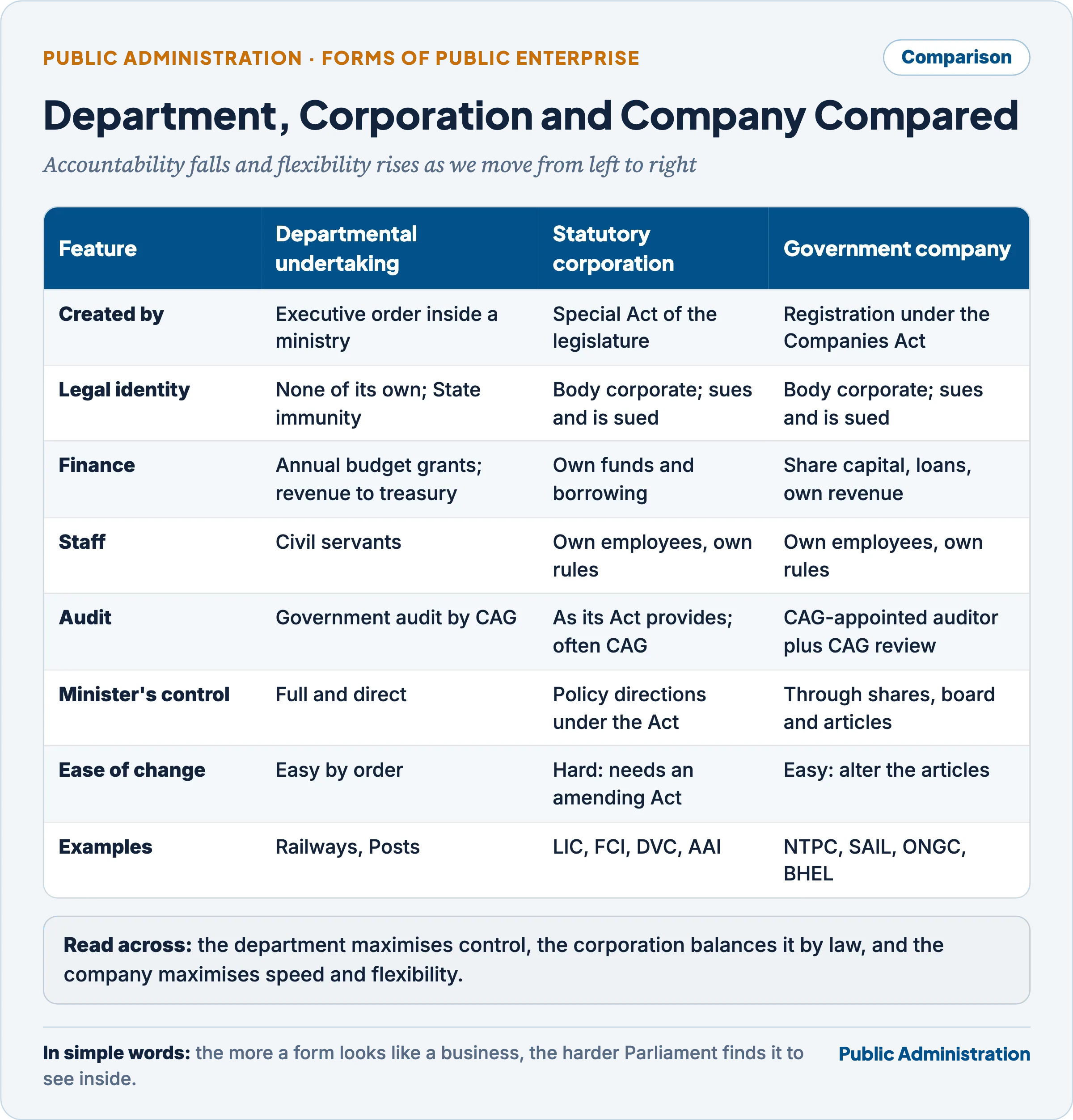
| Feature | Departmental undertaking | Statutory corporation | Government company |
|---|---|---|---|
| Created by | Executive order inside a ministry | Special Act | Registration under the Companies Act |
| Legal personality | None; State immunity | Body corporate | Body corporate |
| Finance | Annual appropriations | Own funds, borrowing | Equity, loans, own revenue |
| Staff | Civil servants | Own employees | Own employees |
| Audit | Government audit | As its Act provides | CAG-appointed auditor plus CAG audit |
| Ministerial control | Full and direct | Directions as the Act allows | Through shares, Articles, board |
| Parliamentary control | Full; votes its money | Annual reports, COPU | Annual reports, COPU, CAG comments |
| Flexibility | Least | Moderate; change needs an Act | Highest |
| Examples | Railways, Posts | LIC, FCI, DVC, AAI | NTPC, SAIL, BHEL, ONGC |
Reading across the table, accountability falls and flexibility rises from the department to the company. India’s preference for the company form was therefore a preference for flexibility and executive control over parliamentary control, which is exactly why the accountability debate never ended.
3. The Machinery for Managing Public Enterprises
In simple words
Each public company has a “parent” ministry that owns it on the government’s behalf, a central department that makes common rules for all public companies, and a selection board that chooses their top bosses. The government also grades its companies: the best ones are given bigger powers and fancy titles such as Maharatna.
3.1 Administrative ministries
- Each CPSE is under an administrative ministry or department (Petroleum, Power, Steel, Coal, Heavy Industries, Defence, Railways and others), which acts as the owner’s agent.
- Its powers: proposing board appointments, issuing directives, approving investments beyond delegated limits, budgetary support, signing the MoU, and answering for the enterprise in Parliament.
- The problem: the ministry is at once owner, policy-maker and often regulator of the same sector, so it may use the enterprise to serve policy (low prices, rural coverage, employment) without paying for it, and may protect it from competition. Separating these roles is a recurring reform proposal.
3.2 Department of Public Enterprises
- Origin. The Estimates Committee’s 52nd Report (Third Lok Sabha) asked for a central coordinating unit to appraise the performance of public enterprises continuously. This led to the Bureau of Public Enterprises (BPE) in 1965 in the Ministry of Finance.
- Moves. In September 1985 the BPE went to the Ministry of Industry; in May 1990 it became a full Department of Public Enterprises (DPE); it later sat in the Ministry of Heavy Industries and Public Enterprises and, from July 2021, is again part of the Ministry of Finance.
- Functions:
- Policy coordination on matters common to all CPSEs: autonomy, financial delegation, pay, personnel, board structure.
- Performance evaluation through the MoU system and the Public Enterprises Survey.
- Categorisation of CPSEs (Schedules A–D) and grant of Ratna status.
- Corporate governance guidelines, wage policy for executives and guidance on wage negotiation for workers.
- Advice on revival, restructuring or closure, counselling and retraining of employees who take voluntary retirement.
- Review of capital projects and capital expenditure.
- Links with the Standing Conference of Public Enterprises (SCOPE) and the International Centre for Public Enterprises.
- DIPAM. The Department of Investment and Public Asset Management (the Department of Disinvestment set up in 1999, renamed in 2016), also in the Finance Ministry, handles the government’s equity: disinvestment, dividend and capital restructuring policy, and asset monetisation.
3.3 Public Enterprises Selection Board
- The Public Enterprises Selection Board (PESB) is a high-powered body that now rests on a Government resolution of 3 March 1987 (amended several times since). It selects chief executives (Level I) and functional directors (Level II) of CPSEs, advises on their tenure, extension and termination, on board structure, on performance appraisal of top managers and on a code of conduct.
- Selection policy: internal candidates are preferred unless markedly better outsiders exist; mobility within the public sector is encouraged; civil servants are placed only in special cases. Appointments are approved by the Appointments Committee of the Cabinet (ACC).
- Problems: delays leave top posts vacant or held by stop-gap officers; short residual tenures; ministerial preferences can still shape the outcome.
3.4 Classification: Schedules A–D
- DPE places CPSEs in Schedules A, B, C and D on quantitative factors (investment, capital employed, sales, profit, employees, number of units) and qualitative factors (national importance, complexity of problems, technology, competition, prospects for expansion).
- The schedule decides the pay scales of board-level executives (Schedule A highest), the seniority of posts, and other matters such as which officers fall under the CVC’s jurisdiction (executives of E-8 and above in Schedules A and B; E-7 and above in Schedules C and D).
3.5 Maharatna, Navratna and Miniratna
The Ratna scheme delegates greater financial and managerial powers to the boards of well-performing CPSEs. It is not a legal form: a Ratna is an ordinary government company that has earned more autonomy.
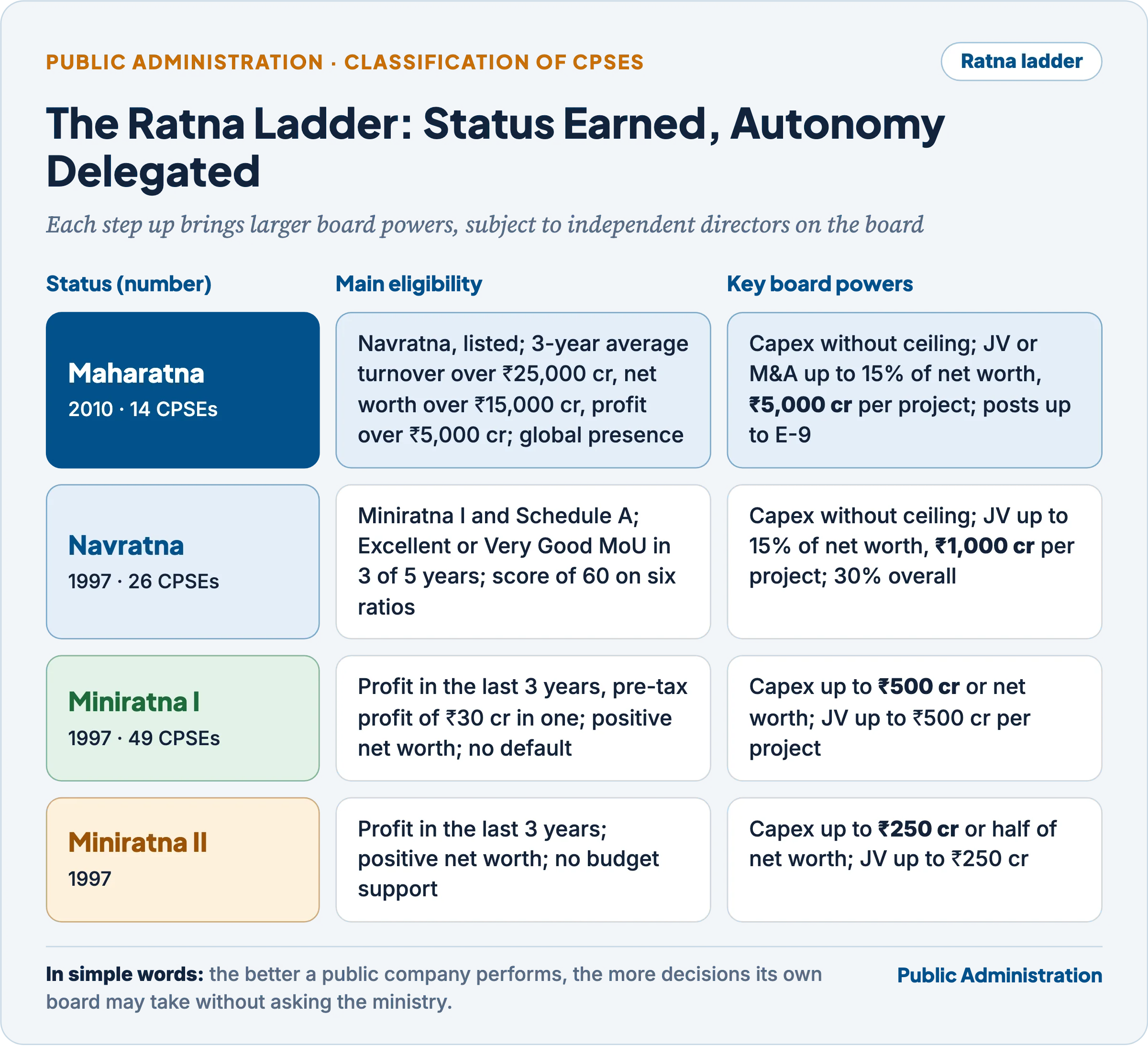
- Navratna (1997). Introduced in July 1997 to help selected CPSEs become “global giants”; nine were chosen first and two more the same year. Eligibility: a Miniratna Category I and Schedule A CPSE with an “Excellent” or “Very Good” MoU rating in three of the last five years and a composite score of 60 or more on six indicators (net profit to net worth, manpower cost to total cost, PBDIT to capital employed, PBIT to turnover, earnings per share, and inter-sectoral performance).
- Powers: capital expenditure without monetary ceiling; equity in joint ventures and wholly owned subsidiaries up to 15 per cent of net worth, limited to ₹1,000 crore in one project, and 30 per cent overall; mergers and acquisitions; technology alliances; organisational restructuring; raising debt.
- Miniratna (1997). Category I: profit in the last three years continuously, pre-tax profit of ₹30 crore or more in at least one of them, positive net worth. Category II: profit in the last three years and positive net worth. Both must not have defaulted on government loans or depend on budgetary support or guarantees.
- Powers: capital expenditure up to ₹500 crore or net worth (Category I) and ₹250 crore or half of net worth (Category II), whichever is lower; joint ventures within similar ceilings.
- Maharatna (2010). Introduced by DPE’s order of 4 February 2010 to let mega CPSEs become multinationals. Eligibility: Navratna status; listed with minimum public shareholding; three-year averages of turnover above ₹25,000 crore, net worth above ₹15,000 crore and net profit after tax above ₹5,000 crore; significant global presence.
- Powers: equity investment in joint ventures, subsidiaries and mergers in India or abroad up to 15 per cent of net worth, limited to ₹5,000 crore in one project (30 per cent overall); creation of posts up to the E-9 level; the Cabinet Committee on Economic Affairs is only informed of investments abroad.
- Conditions attached: boards must be professionalised with a minimum number of independent (non-official) directors (at least four for Maharatnas and Navratnas, three for Miniratnas) and audit committees; proposals must be professionally appraised and placed before the board with risk analysis.
- Grant and review. An Inter-Ministerial Committee and an Apex Committee headed by the Cabinet Secretary recommend Maharatna and Navratna status, and the Finance Minister approves; Miniratna status is handled by the administrative ministry. Performance is to be reviewed every three years, and status can be withdrawn.
- Numbers (early 2026): 14 Maharatnas (BHEL, BPCL, Coal India, GAIL, HAL, HPCL, IOC, NTPC, ONGC, Oil India, PFC, Power Grid, REC, SAIL), 26 Navratnas and about 59 Miniratnas (49 in Category I).
Assessment of the Ratna scheme:
- Strengths: a real, rule-based delegation of investment powers; faster decisions on capital spending; a status incentive that makes boards chase MoU ratings and profits; Maharatnas such as ONGC (through ONGC Videsh), NTPC and IOC have invested abroad and in renewables.
- Weaknesses: powers exist on paper but approvals still flow upward for large or politically sensitive decisions; boards often lack the required independent directors, which technically suspends delegated powers; status is rarely withdrawn; Ratna CPSEs are still used for government purposes such as buying shares of other CPSEs during disinvestment, paying special dividends or absorbing price controls (oil marketing companies). In a liberalised, competitive market, autonomy granted by status remains revocable autonomy.
Common confusion
Are Maharatna, Navratna and Miniratna forms of public enterprise? No. The forms are department, statutory corporation and government company. The Ratna titles are statuses within the government-company form (and occasionally statutory corporations such as the Central Warehousing Corporation, a Navratna), granted by executive decision to delegate more power to the board. They can be withdrawn, and they do not change the enterprise’s legal basis or its accountability to Parliament, the CAG and the CVC.
4. Problems of Autonomy, Accountability and Control
In simple words
A public company must be free to take quick business decisions, but because it spends public money it must also explain itself to ministers, Parliament, auditors, courts and citizens. Too many checks make managers afraid to act; too few checks invite waste and misuse.
4.1 The three ideas
- Autonomy means freedom to act, especially freedom in internal management: to decide investments, prices, purchases, recruitment, pay and organisation without prior approval. It does not mean freedom from all control; the enterprise remains answerable to Parliament through the minister. Its main kinds are operational, financial, personnel and commercial autonomy.
- Accountability means the obligation to render an account of what has been done with public resources, to the minister, Parliament and ultimately the people, who are the real owners. S.S. Khera, a former Cabinet Secretary, in Government in Business (1963), argued that accountability of public enterprises is a measurement of the performance of top management and must serve a useful purpose, not merely satisfy curiosity.
- Control is the active power to direct, restrain or stimulate an organisation; accountability is the passive obligation to explain. Control facilitates accountability: a body can only give a true account if someone has the power to call for it and act on it.
- Purposes of control over public enterprises:
- to ensure that government policy is implemented;
- to keep operations consistent with the objectives for which the enterprise was set up;
- to coordinate enterprises with other programmes in the same field;
- to secure efficiency, economy and legality;
- to supply enough information for Parliament and the public to judge performance.
4.2 Ministerial control
Ministerial control is the most real of all controls, more than is formally admitted. It operates through both formal and informal means.
Formal means:
- Appointment and removal of the chairman, directors and functional directors (through PESB and the ACC), and of government nominee directors.
- Directives. Statutes give ministers power to issue directions on matters of policy: the LIC Act, 1956 (section 21) requires the corporation to follow directions on policy involving public interest given in writing; the RBI Act (section 7) lets the Centre give directions to the Reserve Bank after consulting the Governor. In companies, the Articles of Association usually let the President issue directives (a BPE circular of 1988 required such a clause).
- Approval of investments beyond delegated limits, of borrowing and of the annual capital budget.
- Budgetary support, equity infusion and guarantees.
- The MoU, which fixes annual targets and commitments.
- Powers to call for information and to approve pay scales, wage settlements and senior posts.
Informal means: telephone instructions, “suggestions” in meetings, pressure on purchases, recruitment, transfers, locations and pricing, and the power of the ministry’s officers over a board on which they sit.
Factors that decide how heavy ministerial control is:
- the attitude of the government of the day towards planning and the market;
- the nature of current policy (price control, social schemes routed through PSUs);
- how ministers interpret their ministerial responsibility to Parliament;
- the availability of competent managers whom ministers trust;
- the role assigned to the enterprise and its dependence on the budget;
- the presence of pressure groups: unions, suppliers, local politicians.
Problems:
- Interference in day-to-day matters behind the screen of “policy”; directives are rarely issued formally, so responsibility for decisions dictated by the ministry stays with the board.
- Blurred responsibility: when things go wrong, the minister blames management and management blames directions it never received in writing.
- Generalist secretaries sitting on boards and in ministries second-guess technical decisions.
Indian Connect — The LIC–Mundhra affair and the Chagla Commission (1958)
In 1957 the newly nationalised Life Insurance Corporation bought shares in companies controlled by Haridas Mundhra at above-market prices. The Chagla Commission (Justice M.C. Chagla, 1958) found that the Finance Ministry had in effect dictated the transaction and treated the corporation as a wing of the ministry, despite its statutory autonomy. The Finance Minister, T.T. Krishnamachari, resigned. The affair exposed the classic failure: informal ministerial control without formal responsibility. It strengthened the demand for written directives, professional boards and a dedicated parliamentary committee.
4.3 Parliamentary control
Parliament’s control is justified because it votes the capital, guards the public interest, approves the statutes and must ensure that ministers do not run a “state capitalism” beyond its sight.
Means:
- Questions, limited by convention to matters of policy and ministerial responsibility, not day-to-day administration.
- Debates: on the demands for grants of the parent ministry, on the annual reports and accounts (laid before both Houses; for companies under section 394 of the Companies Act, 2013, formerly section 619A), on Bills creating or amending corporations, and on motions and calling-attention notices.
- Financial committees: the Public Accounts Committee and the Estimates Committee examined enterprises until 1964.
- Committee on Public Undertakings (COPU).
- Origin: Lanka Sundaram proposed a separate committee in 1953; the Krishna Menon Committee, set up by the Congress Parliamentary Party in April 1958, reported in 1959 on reconciling parliamentary supervision with autonomy; the Lok Sabha adopted a motion in 1963 and COPU began work from 1 May 1964.
- Composition: constituted under Rule 312B of the Lok Sabha Rules; not more than 22 members, 15 elected by the Lok Sabha and up to 7 from the Rajya Sabha, by proportional representation by single transferable vote; one-year term; the chairperson is appointed by the Speaker from among its members; ministers cannot be members. (It began with 15 members.)
- Functions: to examine the reports and accounts of the undertakings listed in the Fourth Schedule to the Lok Sabha Rules and the CAG’s reports on them, and to see whether, in the context of their autonomy and efficiency, they are managed in accordance with sound business principles and prudent commercial practices. It took over the functions earlier exercised by the PAC and the Estimates Committee for these bodies.
- Exclusions: major government policy as distinct from business functions; day-to-day administration; and matters for which a special statute provides other machinery.
- Methods: comprehensive, horizontal and audit-based subjects; study groups; site visits; evidence from officials and non-officials; action-taken reports within six months.
Limits of parliamentary control:
- It is largely post-mortem: COPU examines past accounts and CAG findings long after decisions.
- Members lack technical and commercial expertise and time; the committee’s recommendations are advisory.
- Questions and debates often turn on local and political grievances (a factory’s location, a recruitment, a contract) rather than on performance, and fear of questions makes managers risk-averse.
- Experience shows that the degree of parliamentary control has sometimes been too much, cramping managerial initiative, while at other times companies escaped scrutiny altogether. The balance Parliament has struck is general supervision of policy and results, not day-to-day intervention.
4.4 Audit control: the CAG
- Constitutional basis: Articles 148–151; the Comptroller and Auditor General’s (Duties, Powers and Conditions of Service) Act, 1971 (section 19 deals with government companies and corporations).
- Government companies: under the Companies Act, 2013, the CAG appoints the statutory auditor (section 139(5)), may conduct a supplementary audit and comment on the auditor’s report (section 143(6)), and may order a test audit (section 143(7)). The CAG’s comments are placed with the annual report before Parliament.
- Statutory corporations: audited as their Acts provide; for many (for example AAI, FCI) the CAG is the sole auditor, for others it conducts supplementary audit.
- Scope: financial and compliance audit, propriety audit (whether expenditure was wise and fair), and performance audit of economy, efficiency and effectiveness. The CAG’s reports on CPSEs go to COPU, which examines them.
- Internal audit within each enterprise supplements external audit.
Problems:
- Delay: audit reports arrive years after decisions, so Parliament can only conduct a post-mortem and censure.
- Routine, legalistic audit that judges commercial decisions by government-department standards, punishing risks that failed but ignoring opportunities missed.
- Fear of audit paras makes managers prefer slow, tender-based, rule-bound decisions, damaging efficiency and profitability. Paul Appleby argued as early as 1956 that the auditor’s role and pre-audit controls were stifling enterprise.
- The defence: CAG audit remains the most effective instrument of parliamentary control; its performance audits have exposed costly decisions (in coal allocation, telecom spectrum, defence procurement) that no other channel revealed. The remedy is commercially informed, timely audit, not less audit.
4.5 Judicial control: CPSEs as “State” under Article 12
Article 12 defines “the State” for Part III to include “other authorities”. Through a line of judgments the Supreme Court brought most public enterprises within it, so that Fundamental Rights can be enforced against them by writ.
| Case | Year | Holding |
|---|---|---|
| Sukhdev Singh v Bhagatram Sardar Singh Raghuvanshi | 1975 | ONGC, LIC and IFC are “authorities”; their statutory regulations have the force of law |
| Ramana Dayaram Shetty v International Airport Authority | 1979 | An instrumentality or agency of government is “State”; Article 14 governs its contracts and tenders |
| Ajay Hasia v Khalid Mujib Sehravardi | 1981 | Six tests of instrumentality; a registered society can be “State” |
| Som Prakash Rekhi v Union of India | 1981 | A government company (Bharat Petroleum) is “State” |
| Central Inland Water Transport Corporation v Brojo Nath Ganguly | 1986 | A government company is “State”; a “hire and fire” service rule is unconscionable and void under Article 14 |
| Delhi Transport Corporation v DTC Mazdoor Congress | 1990 | Termination of permanent employees without inquiry under a regulation is arbitrary and void |
| Pradeep Kumar Biswas v Indian Institute of Chemical Biology (seven judges) | 2002 | The test is whether the body is financially, functionally and administratively dominated by government; control must be deep and pervasive, not merely regulatory; overruled Sabhajit Tewary (1975) |
| Zee Telefilms v Union of India | 2005 | BCCI is not “State”: no deep and pervasive governmental control |
The six Ajay Hasia tests (indicative, not exhaustive):
- The entire share capital is held by government.
- Government financial assistance meets almost all its expenditure.
- It enjoys monopoly status conferred or protected by the State.
- There is deep and pervasive State control.
- Its functions are of public importance and closely related to governmental functions.
- A government department has been transferred to it.
Consequences for administration:
- Recruitment must follow Articles 14 and 16: open advertisement, fair selection, reservations.
- Service rules, discipline and dismissal must be fair, non-arbitrary and follow natural justice.
- Contracts and tenders must be fair and non-discriminatory.
- But PSU employees are not civil servants: they do not enjoy the protection of Article 311.
- The autonomy cost. Being “State” pulls PSUs towards government-like procedures: elaborate tendering, litigation over every recruitment, judicial review of commercial decisions. Managers argue that Article 12 status, together with audit and vigilance, constrains them in competition with private firms.
- Judicial restraint on commercial matters. Courts generally decline to second-guess economic policy and business judgement (pricing, investment, disinvestment) unless the decision is illegal, arbitrary or mala fide.
Common confusion
Is every government company automatically “State” under Article 12, and are its employees civil servants? Neither. After Pradeep Kumar Biswas (2002) a body is “State” only if it is financially, functionally and administratively dominated by government; government shareholding alone is not enough. Most CPSEs pass this test, so Articles 14 and 16 bind them. But their employees are not members of a civil service of the Union and cannot claim Article 311 protection; their rights come from service rules, labour law and Article 14.
4.6 Vigilance and anti-corruption control
- Central Vigilance Commission: under the CVC Act, 2003 and a notification of 2007, the CVC’s jurisdiction covers chief executives, board-level executives and officers of E-8 and above in Schedule A and B CPSEs, and E-7 and above in Schedule C and D CPSEs. Each CPSE has a Chief Vigilance Officer, usually from outside the enterprise.
- CBI investigates offences under the Prevention of Corruption Act, 1988; PSU employees are public servants under that Act.
- Lokpal: the Lokpal and Lokayuktas Act, 2013 brings senior officers of bodies and companies owned or controlled by the Centre within the Lokpal’s jurisdiction.
- The “three Cs” fear. Managers speak of the fear of the CBI, CVC and CAG: honest commercial decisions that later turn out badly can be treated as misconduct. The result is decision paralysis, preference for the lowest tender over best value, and reluctance to settle disputes or take risks.
- Safeguard: the Prevention of Corruption (Amendment) Act, 2018 added section 17A, requiring prior approval of the competent authority before any inquiry into a decision or recommendation made by a public servant in the discharge of official functions. It protects bona fide commercial judgement, but critics fear it can also shield wrongdoing.
4.7 RTI, markets and public scrutiny
- CPSEs are public authorities under section 2(h) of the RTI Act, 2005, so citizens can seek information; section 8(1)(d) protects commercial confidence, trade secrets and competitive position unless the larger public interest warrants disclosure.
- Listing as accountability. The 66 listed CPSEs must follow SEBI’s Listing Obligations and Disclosure Requirements (LODR) Regulations, 2015: quarterly results, disclosure of material events, independent directors and audit committees. Share prices and analysts provide a continuous market judgement on performance.
- Consumers and media add pressure, especially for utilities (power, telecom, gas).
4.8 Boards, personnel and the PESB
Board structure. A CPSE board normally has functional (whole-time) directors, government nominee directors (DPE guidelines limit them to a small number, traditionally not more than one-sixth of the board and at most two) and non-official (independent) directors, who should be at least one-third of the board, or half where the chairman is an executive.
Problems:
- Vacancies in independent-director posts, which ministries fill slowly, leave many boards non-compliant with company law and listing rules.
- Government directors dominate policy discussions and tilt decisions in the ministry’s favour, reducing the board to a near-department.
- Short tenures of chief executives and gaps between appointments.
- Deputation of civil servants to top posts, common in the early decades and still frequent in State enterprises, brought bureaucratic culture, short tenures and weak commitment, and demoralised internal managers whose promotion was blocked.
- Pay for senior managers is far below private-sector levels, making it hard to attract and retain talent; pay revision committees (for example the Justice M. Jagannadha Rao committee, 2008) linked part of pay to performance.
A separate public enterprise cadre?
- History. The Industrial Management Pool (IMP), set up in November 1957 with UPSC selection, was meant to staff public enterprises with professional managers. It filled few posts and was wound up in the 1970s. The ARC’s study team on personnel found that it was “a service without posts”, that a cross-enterprise cadre weakens loyalty to any one enterprise, and that central control of key appointments dilutes management’s accountability. The first ARC (1967) also recommended that temporary deputation of government officers to public undertakings should cease.
- The case for an Indian Public Enterprises and Industrial Service: a professional, mobile pool of managers with commercial training; less dependence on generalist deputation; career paths across sectors; quicker filling of top posts.
- The case against: it would be another bureaucracy with seniority-based careers and civil-service security, exactly what public enterprises need to escape; it would weaken each enterprise’s ownership of its managers; and today’s market for managers (lateral hiring, internal development, PESB search) offers more flexibility. The prevailing view favours professional boards, internal talent development and market-linked pay over a new service.
4.9 Corporate governance
Corporate governance is the system of rules and practices by which a company is directed and controlled, balancing the interests of shareholders, managers and other stakeholders.
- DPE Guidelines on Corporate Governance for CPSEs were issued in June 2007 on a voluntary, experimental basis and made mandatory from 14 May 2010.
- Board composition with the required share of independent directors, and their induction and training.
- Audit committee with a majority of independent directors and an independent chairman; a remuneration committee.
- Oversight of subsidiaries, disclosures, related-party transactions, a code of conduct and risk management.
- Quarterly compliance reports through the administrative ministry, and grading of CPSEs on compliance.
- Companies Act, 2013 (independent directors in listed companies, board committees, CSR under section 135) and SEBI LODR, 2015 for listed CPSEs. The Centre has used its power to exempt government companies from some Companies Act provisions where the ministry, not the board, appoints and evaluates directors.
- International benchmark: the OECD Guidelines on Corporate Governance of State-Owned Enterprises (2005, revised 2015 and 2024) recommend separating the State’s ownership function from its policy and regulatory roles, professional boards free of political interference, equal treatment of minority shareholders and transparency.
- The gap: in CPSEs the “owner” is a ministry that also makes policy for the sector, appoints the directors and often regulates prices, so independent boards remain independent mainly on paper.
4.10 Workers’ participation in management
- Article 43A (added by the 42nd Amendment, 1976) directs the State to secure the participation of workers in the management of undertakings.
- Schemes of 1975 (shop-floor and plant councils) and 1983 (participation at shop-floor, plant and board levels in central public enterprises) were introduced.
- Stages: information sharing, joint consultation, joint decision-making and, ideally, self-management.
- Problems: selection of worker representatives, multiple and politicised unions, managerial reluctance, and token functioning. The idea survives mainly in joint councils and wage negotiation forums.
5. The Memorandum of Understanding System
In simple words
An MoU is a yearly agreement between a public company and its ministry. The company promises targets (sales, production, profit, investment), and the ministry promises to leave it alone and give the support it needs. At the end of the year the company gets marks, like a report card.
5.1 Origin and idea
- The Committee to Review Policy for Public Enterprises, chaired by Arjun Sengupta (then Special Secretary to the Prime Minister), was set up in September 1984 and reported on 31 December 1984. It recommended a memorandum of understanding between government and each enterprise to replace ad hoc control with agreed objectives and accountability for results.
- The system was introduced in 1986, and the first four MoUs were signed for 1987–88. It drew on performance contract systems abroad, such as France’s contrats de programme and South Korea’s performance evaluation of state enterprises. The 1991 policy statement extended it and promised to place MoUs before Parliament.
- Core logic: autonomy in exchange for accountability. Government stops controlling inputs and processes (each purchase, post or project) and instead judges outputs and outcomes at the end of the year. The DPE describes it as a system of management audit.
- Aims: to increase management autonomy, remove fuzziness of goals, evaluate management on objective criteria, and give incentives for better performance.
5.2 How it works
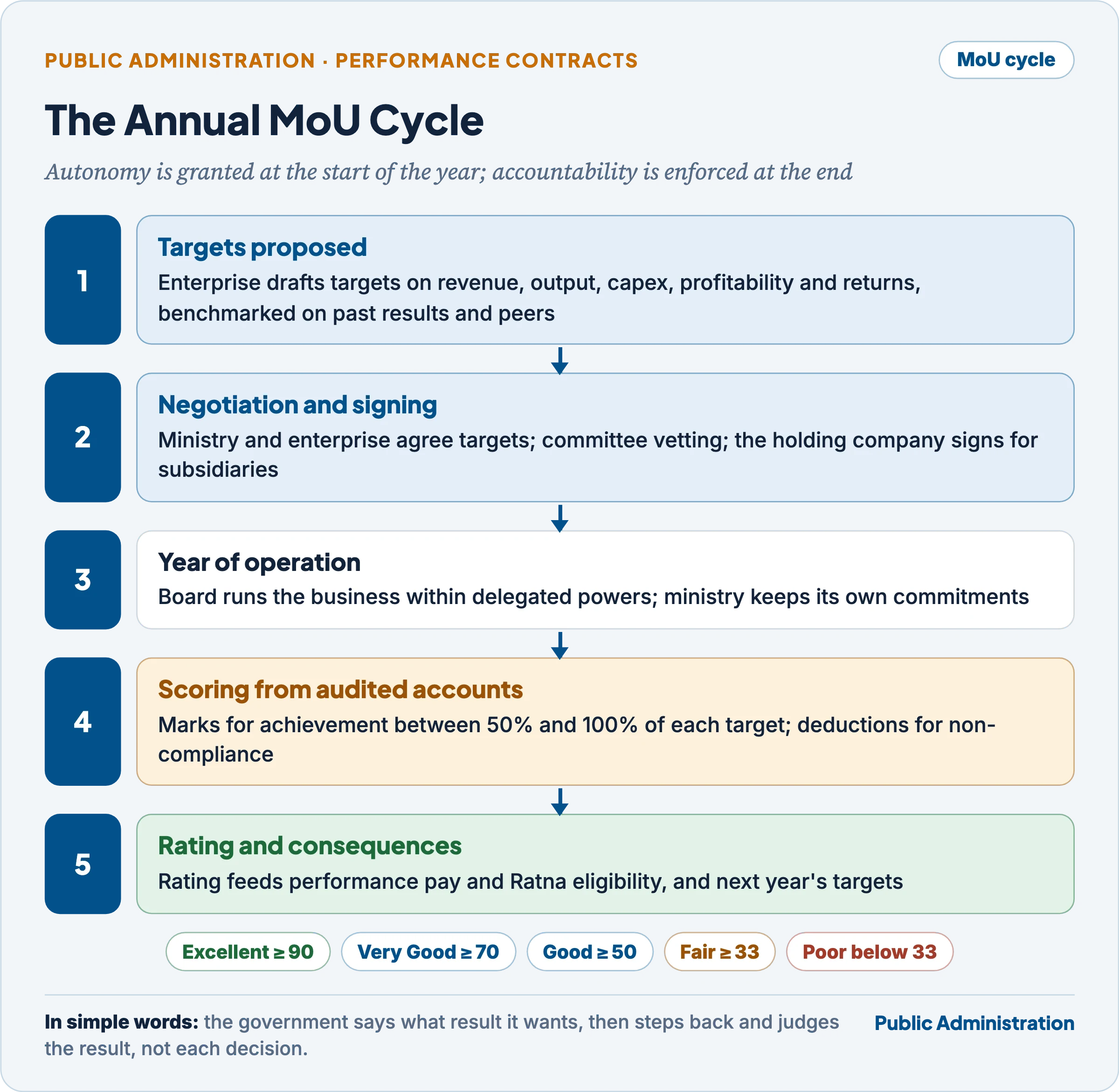
- Coverage: all CPSEs sign MoUs; holding companies sign with their ministries and subsidiaries with their holding companies (DPE finalises the MoUs of subsidiaries that are Maharatnas or Navratnas).
- Institutions: a High Power Committee chaired by the Cabinet Secretary oversees the system and sets principles; inter-ministerial committees vet targets and evaluations; DPE runs the process.
- Targets are benchmarked on past performance, future projections, the ministry’s vision and peer comparison.
- Evaluation uses audited accounts: marks are given in proportion to achievement between 50 and 100 per cent of each target; nothing below 50 per cent; no adjustment for price or exchange-rate changes, which are treated as normal business risk.
- Rating scale: Excellent (90 and above), Very Good (70–90), Good (50–70), Fair (33–50), Poor (below 33).
- Consequences: ratings feed performance-related pay of executives, eligibility for Navratna status and next year’s targets.
The 2024–25 MoU guidelines show how far the system has moved towards market-oriented, shareholder-style indicators.
| Group | Parameters (marks out of 100) |
|---|---|
| Scale and investment | Revenue from operations (5); physical output or value of production (20); capital expenditure against budget (10); exports and import reduction (4 + 4) |
| Profitability | EBITDA as a share of revenue (10); return on net worth or capital employed (15); asset turnover (5) |
| Procurement and receivables | Timely payment to micro and small enterprises (5); procurement through GeM (2); trade receivables (3); R&D spending (2) |
| Shareholder value | Earnings per share for unlisted, total return to shareholders for listed CPSEs (15) |
| Compliance deductions | CSR (−1); corporate governance under company law or SEBI rules (−3); procurement from MSEs (−3); health and safety (−1) |
The weightage shows that the MoU is now a shareholder’s report card rather than a list of ministry wishes: about half the marks go to profitability and shareholder returns, while governance and social compliance are enforced through deductions rather than rewards. A new MoU framework applies from 2025–26 onwards, consolidating and superseding earlier guidelines.
5.3 Assessment: has the MoU improved performance?
Achievements:
- Clarity of goals: every enterprise now has measurable annual targets agreed in advance.
- Shift from process to results, at least in principle, and a culture of performance measurement inside CPSEs.
- Linkage with incentives (performance pay, Ratna status) and with delegation of powers.
- Transparency: targets and results are published, creating peer pressure among enterprises.
Shortcomings:
- Soft targets and rating inflation. When targets are negotiated, enterprises bargain for easy ones; for years a large share of CPSEs were rated Excellent or Very Good even as many lost money (in 2002–03, 64 of 97 MoU-signing enterprises were rated Excellent or Very Good).
- One-sided commitments. The ministry’s obligations (timely approvals, freedom from interference, payment of subsidies) are written into MoUs but never evaluated or enforced.
- No real autonomy in return. Informal interference, audit and vigilance continue unchanged, so the bargain at the heart of the MoU is incomplete.
- Factors beyond management’s control: administered prices, government-imposed social obligations and global commodity prices drive results.
- A paper exercise in some ministries, prepared by staff and signed without real negotiation.
Verdict. The MoU has improved measurement and focus, and its recent redesign (audited data, market indicators, peer benchmarks) reduces gaming. But it has improved overall performance only where it was matched by genuine delegation and competitive pressure; it cannot by itself convert a controlled enterprise into an autonomous one.
6. The Autonomy–Accountability Dilemma
In simple words
Freedom and answerability pull in opposite directions. Every extra check makes managers safer but slower; every extra freedom makes them faster but harder to check. The question is not “how much control” but “what kind of control”.
6.1 The nature of the dilemma
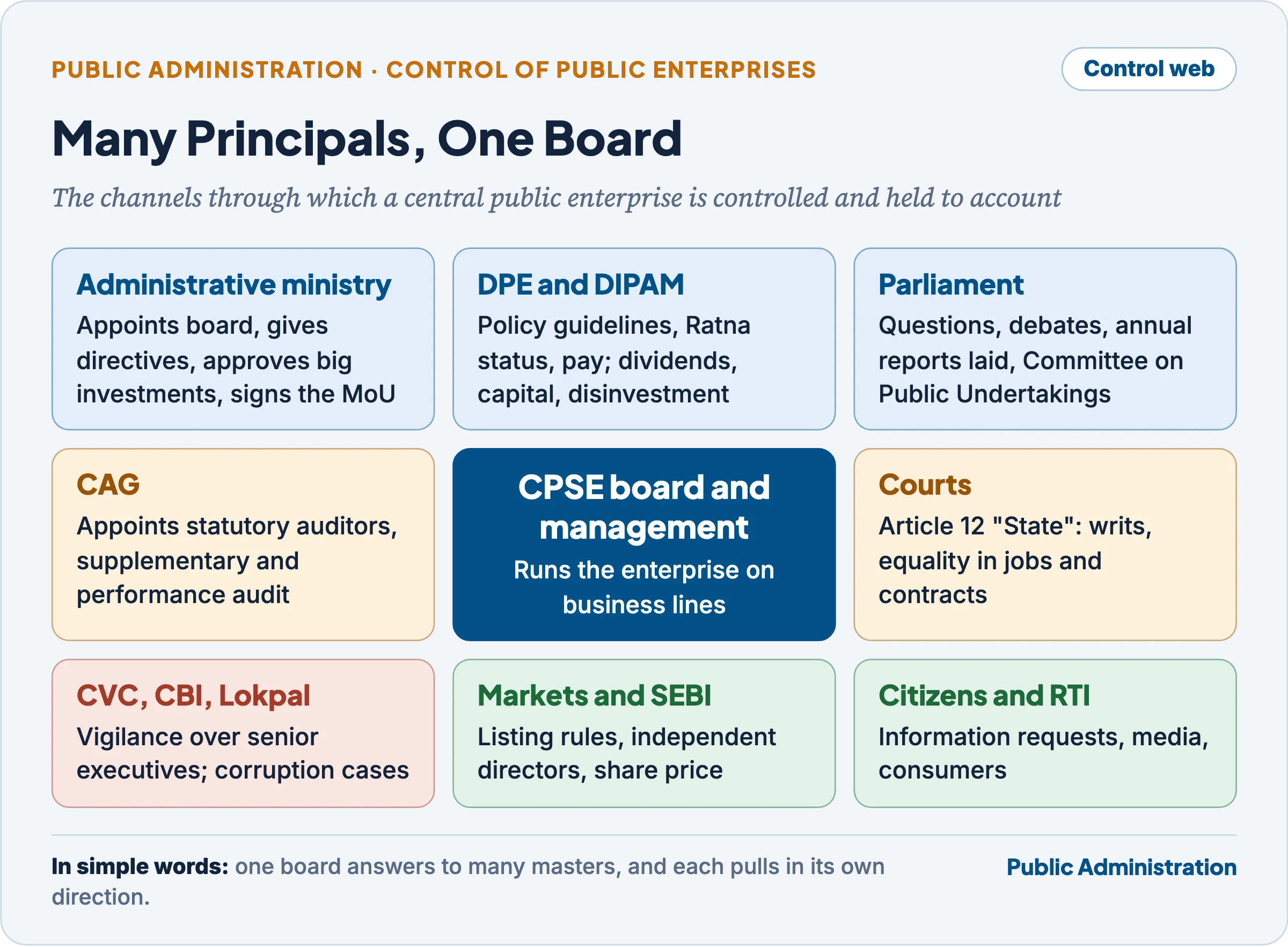
- Why autonomy is needed: commercial success demands speed, risk-taking, flexible pricing, purchase and hiring, and freedom from political pressure. Without it, a PSU cannot compete with private firms and multinationals in an open economy.
- Why accountability is needed: the enterprise uses public capital, often enjoys monopoly or protection, and serves public purposes; Parliament and citizens must know whether that capital is used well and honestly.
- The structural problem: many principals. A CPSE answers to its ministry, DPE, DIPAM, Parliament and COPU, the CAG, the courts, the CVC, the CBI, the Lokpal, SEBI and RTI applicants. Each pursues its own goal (policy, dividend, legality, propriety, probity, disclosure), and no one is responsible for the enterprise’s overall commercial health.
- The result: accountability for processes, not results; managers protect themselves by following procedure rather than seizing opportunities.
- Why the dilemma persisted in India: the company form was chosen for autonomy, yet ministries treated companies like departments; parliamentary and audit scrutiny was post-facto and procedural; appointments were political; and objectives were never clearly ranked.
“Autonomy and accountability cannot walk together”? The claim is too strong. They conflict only when accountability means detailed control of inputs and individual decisions. They can coexist when accountability means answering for agreed results, judged after the event, with freedom in between. Indian studies of public enterprise and later reform committees summed this up as: “not more accountability, but better accountability”.
6.2 Was failure caused by departures from autonomy?
The original concept of the public corporation (Morrison) and the public enterprise (Nehru’s era) assumed arm’s length relations: policy from the minister, management by the board. Many enterprises failed because practice departed from this concept.
- Evidence for the claim: political choice of locations, overstaffing for patronage, price controls without compensation, appointments of civil servants and political favourites, interference in purchases and contracts, and fear of auditors and investigators all came from eroded autonomy.
- Evidence against a single-cause explanation: some failures came from managerial weakness, obsolete technology, poor project planning, militant industrial relations and exposure to competition after 1991, which autonomy alone would not have cured. Enterprises in the same ownership structure (NTPC and BSNL, ONGC and the old SEBs) performed very differently.
- The bureaucratic structure argument. Critics argue that public sector performance suffered because enterprises were run by generalist, rule-bound bureaucracy: deputationists without commercial skill, file-based decision-making, seniority promotion and risk aversion transferred from government. The counter-argument is that the deeper cause is the incentive structure of political ownership, which a different bureaucracy alone would not change.
6.3 Reconciling autonomy and accountability
- Arm’s length relationship: ministers set policy and targets, boards manage; directives only in writing and laid before Parliament, so that responsibility follows control.
- Accountability for results, not processes: the MoU and management by objectives; evaluation on audited outcomes; incentives and sanctions tied to results.
- Professional, empowered boards: timely independent-director appointments, fewer government nominees, PESB selection with fixed tenures and a pipeline of internal talent.
- Graded delegation: Ratna-type powers linked to performance and withdrawn for poor performance.
- Separation of the ownership function from policy and regulation (the OECD model), for example through a holding entity or a dedicated ownership unit, so that the shareholder pursues value while the ministry pursues policy and the regulator protects consumers.
- Compensation for social obligations: if government wants a CPSE to sell below cost or serve unprofitable areas, it should pay for the obligation openly (as with BSNL’s viability-gap funding for rural lines), so that commercial accounts stay clean.
- Smarter oversight: COPU focused on policy and performance trends; CAG performance audit with commercial benchmarks and timelier reports; section 17A protection and clear vigilance guidelines that distinguish bona fide commercial risk from corruption.
- Markets as a check: listing, minority shareholders and disclosure create a continuous, non-political form of accountability.
Criticism — “Autonomy to public undertakings is a myth”
- Appointments of chief executives and directors are controlled by the ministry and the ACC; vacancies and political preferences shape the board.
- Delegated powers are revocable and are routinely overridden by “suggestions” from the ministry; Ratna boards still seek informal clearance for big decisions.
- Government uses CPSEs as instruments: buying shares of other CPSEs to meet disinvestment targets, paying special dividends to meet fiscal targets, absorbing fuel and fertiliser price controls, and funding politically chosen projects.
- Politicians at every level use enterprise budgets for patronage: jobs, contracts, CSR spending and locations in their constituencies.
- Audit, vigilance and Article 12 litigation treat commercial decisions like government decisions, so managers cannot take risks.
- Independent directors are often government nominees in all but name, and boards are dominated by the shareholder ministry.
Defence — The case that autonomy is real and growing
- The Ratna scheme gives boards unlimited capital-expenditure powers and large investment ceilings; Maharatnas have made major overseas acquisitions and renewable investments on board approval.
- The MoU system now judges CPSEs mostly on audited, market-oriented results, reducing discretionary control.
- Listing and SEBI rules impose disclosure, independent directors and minority-shareholder protection that bind the government too.
- Competition since 1991 forces CPSEs to act commercially; many (NTPC, Power Grid, BEL, HAL, Coal India) earn high profits and dividends, which would be impossible without real managerial freedom.
- Section 17A and CVC guidelines now protect bona fide commercial decisions.
- Autonomy can never be absolute in a democracy: the State as owner is entitled to set strategy and demand returns, as any private shareholder does.
The debate shows that autonomy in India is conditional and uneven: wide for profitable, listed, competitive enterprises with strong boards, and narrow for loss-making, unlisted or socially burdened ones. The State has learnt to grant autonomy as a reward for performance rather than as a principle of organisation.
Theory lens: reading public enterprises through Paper I ideas
- Principal–agent theory (Michael Jensen and William Meckling, 1976): the citizens (principals) delegate to ministers, who delegate to boards (agents). Information asymmetry and divergent goals create agency costs. In CPSEs the problem is worse because there are multiple principals with conflicting goals, so the agent can play one against another or freeze. MoUs and performance pay are textbook agency remedies: contracts plus monitoring plus incentives.
- Public choice theory (William Niskanen, Bureaucracy and Representative Government, 1971; Andrei Shleifer and Robert Vishny, “Politicians and Firms”, 1994): politicians use state firms to buy votes through excess employment, low prices and favoured locations, paid for by taxpayers. This explains overstaffing, political siting of plants and resistance to closure (see the article on New Public Administration and Public Choice).
- Soft budget constraint (János Kornai, Economics of Shortage, 1980): an enterprise that expects to be bailed out has weak incentives to control costs. Repeated revival packages for loss-making CPSEs illustrate it; the 2021 policy of closing or selling non-strategic units is an attempt to harden the constraint.
- Organisational form theory (Herbert Morrison and W.A. Robson): the public corporation was designed to combine public ownership with business management; Indian experience shows that legal form does not guarantee autonomy without supporting conventions (see the article on Structure and Forms of Public Organisations).
- Gulick’s principles (Luther Gulick, “Notes on the Theory of Organization”, 1937): the departmental form follows unity of command and POSDCORB control by the chief executive; corporations and companies deliberately place work outside that hierarchy. The ARC’s sector corporations and holding companies were justified by Gulick’s span of control: one minister cannot supervise dozens of boards effectively.
- New Public Management and agencification (Christopher Hood, “A Public Management for All Seasons?”, 1991; the British Next Steps agencies of 1988): separate policy from delivery, give managers freedom, hold them to performance contracts. India’s MoU is a performance contract, and the Ratna scheme is graded agencification (see the article on New Public Management and After).
- Accountability theory (Barbara Romzek and Melvin Dubnick, 1987; Jonathan Koppell’s “multiple accountabilities disorder”, 2005): enterprises face hierarchical, legal, professional and political accountability at once; when every form is pressed simultaneously, the organisation becomes dysfunctional. CPSE managers’ “three Cs” fear is a case of this disorder (see the article on Accountability and Control).
- Weber and Riggs: the transfer of Weberian rule-bound bureaucracy into commercial enterprises produced procedure-driven management; Riggs’ formalism (the gap between formal rules and actual behaviour) describes autonomy that exists in statutes and Ratna orders but not in practice (see the articles on Weber and Bureaucracy and on Riggsian Models).
Key Terms
| Term | Meaning in simple words |
|---|---|
| Public sector undertaking (PSU) | A business owned and controlled by government |
| CPSE | Central Public Sector Enterprise: a company or corporation in which the Union holds more than half the equity |
| SLPE | State Level Public Enterprise, owned by a State government |
| Commanding heights | The basic and strategic industries the 1956 Resolution reserved for the State |
| Departmental undertaking | An enterprise run as a wing of a government department, financed by the budget |
| Statutory corporation | A body set up by its own Act, with legal personality and defined autonomy |
| Government company | A company in which governments hold at least 51 per cent of paid-up capital (s.2(45), Companies Act, 2013) |
| Holding company | A company that owns controlling stakes in subsidiaries and manages them as a group |
| Sector corporation | One integrated corporation for a whole industrial sector (ARC, 1967) |
| Joint sector | Enterprises jointly owned and managed by government and private partners |
| Directive | A formal policy instruction from the minister or President to an enterprise |
| COPU | Committee on Public Undertakings: 22-member parliamentary committee examining PSU reports and CAG audits |
| Supplementary audit | The CAG’s second-level audit of a government company after the statutory auditor |
| Propriety audit | Audit of whether spending was wise, fair and economical, not merely legal |
| Article 12 “State” | Bodies against which Fundamental Rights can be enforced; includes most CPSEs |
| Deep and pervasive control | The test of whether government dominates a body financially, functionally and administratively |
| Schedules A–D | DPE’s size-and-importance grading of CPSEs, which fixes top-level pay scales |
| Ratna status | Maharatna, Navratna or Miniratna: performance-based delegation of powers to boards |
| MoU | Annual performance agreement between a CPSE and its ministry or holding company |
| PESB | Public Enterprises Selection Board, which selects CPSE chief executives and directors |
| Independent director | A non-official director with no material relationship with the company |
| Soft budget constraint | The expectation of a bailout that weakens a firm’s cost discipline |
| Multiple principals | Several authorities controlling one agent with different goals |
| Arm’s length relationship | Government sets policy and targets but does not interfere in management |
| Three Cs | Managers’ fear of the CBI, CVC and CAG that slows decisions |
Commissions, Committees and Judgments
The table lists, in order, the committees, statutes and judgments that shaped the form, control and accountability of public enterprises.
| Body or case | Year | Key point |
|---|---|---|
| Industrial Policy Resolution | 1948 | Four categories; State monopoly in arms, atomic energy, railways |
| A.D. Gorwala, Report on the Efficient Conduct of State Enterprises | 1951 | Early review of enterprise management and autonomy |
| Industrial Policy Resolution | 1956 | Schedule A (17), B (12), C; commanding heights for the public sector |
| Paul H. Appleby, report on government’s industrial and commercial enterprises | 1956 | Excessive pre-audit and financial controls stifle enterprise |
| Chagla Commission (Justice M.C. Chagla) | 1958 | LIC–Mundhra deal dictated by Finance Ministry; autonomy breached |
| Krishna Menon Committee (V.K. Krishna Menon, Congress Parliamentary Party) | 1958–59 | Parliamentary supervision without day-to-day interference; powers for chairmen |
| Estimates Committee, 73rd Report (Second Lok Sabha) | 1959–60 | Asked for an annual consolidated report: the Public Enterprises Survey |
| Estimates Committee report on forms | 1960 | Statutory corporation as the rule; company only in special cases |
| Committee on Public Undertakings | 1964 | Separate parliamentary committee from 1 May 1964; now 22 members |
| Estimates Committee, 52nd Report (Third Lok Sabha) | 1964 | Central coordinating unit, leading to the BPE (1965) |
| ARC Report on Public Sector Undertakings (K. Hanumanthaiya; study team under Ravindra Varma) | 1967 | Statutory corporation form, sector corporations, end of deputation |
| Industrial Licensing Policy Inquiry Committee (Subimal Dutt) | 1969 | Joint sector concept |
| CAG (Duties, Powers and Conditions of Service) Act, s.19 | 1971 | CAG audit of government companies and corporations |
| Sukhdev Singh v Bhagatram | 1975 | ONGC, LIC, IFC are “authorities”; regulations have force of law |
| R.D. Shetty v International Airport Authority | 1979 | Instrumentality of State; Article 14 binds its contracts |
| Ajay Hasia v Khalid Mujib Sehravardi | 1981 | Six tests for “other authorities” |
| Som Prakash Rekhi v Union of India | 1981 | Government company (Bharat Petroleum) is “State” |
| Arjun Sengupta Committee (Committee to Review Policy for Public Enterprises) | 1984 | MoU system, holding companies, autonomy with accountability |
| Central Inland Water Transport Corp v Brojo Nath Ganguly | 1986 | Unconscionable hire-and-fire rule void under Article 14 |
| PESB resolution | 1987 | Present basis of selection of CPSE top management |
| C. Rangarajan Committee on disinvestment | 1993 | Disinvestment levels and machinery (see the companion article) |
| Navratna and Miniratna schemes | 1997 | Delegated powers to high-performing CPSEs |
| Pradeep Kumar Biswas v Indian Institute of Chemical Biology | 2002 | Seven judges: “financially, functionally, administratively dominated” test |
| CVC Act | 2003 | Vigilance jurisdiction over senior CPSE officers |
| Zee Telefilms v Union of India | 2005 | BCCI not “State”; limits of Article 12 |
| DPE Guidelines on Corporate Governance | 2007 / 2010 | Voluntary in 2007, mandatory from 14 May 2010 |
| Maharatna scheme | 2010 | Mega CPSEs: JV/M&A up to ₹5,000 crore per project |
| Companies Act, s.2(45), 139(5), 143(6), 394 | 2013 | Definition of government company; CAG audit; reports to Parliament |
| Prevention of Corruption (Amendment) Act, s.17A | 2018 | Prior approval before probing official decisions |
| DIPAM revised capital restructuring guidelines | 2024 | Minimum dividend of 30 per cent of profit or 4 per cent of net worth |
| DPE MoU framework | 2025 | New MoU evaluation framework from 2025–26 |
Articles and Acts at a glance:
| Provision | Relevance |
|---|---|
| Article 12 | Most CPSEs are “State”; Fundamental Rights enforceable against them |
| Articles 14 and 16 | Equality in contracts, recruitment and service matters |
| Article 19(6)(ii) | Laws may create State or State-owned corporation monopolies in any trade |
| Article 298 | Executive power of the Union and States extends to carrying on any trade or business |
| Article 39(b) and (c) | Distribution of material resources; prevention of concentration of wealth |
| Article 43A | Workers’ participation in management (42nd Amendment, 1976) |
| Articles 148–151 | CAG and audit reports to the legislature |
| List I, Entry 43; List II, Entry 32 | Incorporation of trading corporations (Union); other corporations (States) |
| Companies Act, 2013, s.2(45) | Definition of government company |
| Companies Act, 2013, s.139(5), 143(6)–(7) | CAG appoints auditors; supplementary and test audit |
| Companies Act, 2013, s.394 | Annual report on government companies laid before Parliament |
| CAG (DPC) Act, 1971, s.19 | Audit of government companies and corporations |
| LIC Act, 1956, s.21 | Written policy directions from the Centre |
| RBI Act, 1934, s.7 | Directions to the Bank after consulting the Governor |
| CVC Act, 2003, s.8 | Superintendence over vigilance in CPSEs |
| RTI Act, 2005, s.2(h), 8(1)(d) | CPSEs as public authorities; commercial-confidence exemption |
| Lokpal and Lokayuktas Act, 2013, s.14 | Officers of Centre-controlled companies within Lokpal’s reach |
| PC Act, 1988, s.17A (2018) | Prior approval for inquiry into official decisions |
Contemporary Developments
- December 2025: Public Enterprises Survey 2024–25. The 65th Survey counted 475 CPSEs (291 operating, 66 listed), net profit of profit-making CPSEs of about ₹3.09 lakh crore, dividends declared of about ₹1.39 lakh crore and a contribution to the Central Exchequer of about ₹4.94 lakh crore.
- June 2026: consolidated guidelines on Ratna review. DPE consolidated its earlier orders on reviewing the performance of Navratna and Miniratna CPSEs and on granting or withdrawing their status (Apex Committee under the Cabinet Secretary for Navratnas; inter-ministerial committee for Miniratnas; review every three years).
- March 2025: new MoU framework. DPE issued an MoU framework applicable from 2025–26, superseding earlier guidelines, with evaluation from audited data against benchmarked targets; the consolidated 2024–25 guidelines (March 2025) gave about half the marks to profitability and shareholder returns.
- March 2025: two new Navratnas. IRCTC and IRFC were made Navratnas on 3 March 2025, taking the number to 26.
- October 2024: HAL becomes the 14th Maharatna (order of 12 October 2024), on the recommendation of the inter-ministerial and apex committees and with the Finance Minister’s approval.
- November 2024: capital restructuring guidelines. DIPAM’s revised guidelines (18 November 2024) require a minimum annual dividend of 30 per cent of profit after tax or 4 per cent of net worth, whichever is higher, interim dividends for listed CPSEs, and rules for buybacks, bonus shares and splits; dividend receipts of the Union reached a record of about ₹74,000 crore in 2024–25.
- February 2025: BSNL’s first quarterly profit since 2007 (₹262 crore for October–December 2024), after revival packages of 2019, 2022 and 2023 totalling over ₹3.2 lakh crore.
Revision Grid
| Thinker or body | Work or report (year) | Key idea |
|---|---|---|
| Herbert Morrison | Socialisation and Transport (1933) | Public corporation: public ownership, accountability, business management for public ends |
| Franklin D. Roosevelt | Message on the TVA (1933) | Corporation with the power of government and the flexibility of private enterprise |
| W.A. Robson | Nationalized Industry and Public Ownership (1960) | Public corporation as a major institutional innovation |
| P.C. Mahalanobis | Second Five Year Plan model (1956) | Heavy industry first, through public investment |
| A.D. Gorwala | Report on State Enterprises (1951) | Early review of enterprise management |
| Paul H. Appleby | Report on government enterprises (1956) | Controls and pre-audit stifle enterprise |
| Krishna Menon Committee | Report on State undertakings (1959) | Parliamentary supervision without day-to-day interference |
| S.S. Khera | Government in Business (1963) | Accountability as measurement of top management’s performance |
| A.H. Hanson | Writings on public enterprise | Too much freedom makes accountability difficult |
| Administrative Reforms Commission | Report on Public Sector Undertakings (1967) | Statutory form, sector corporations, no deputation |
| Arjun Sengupta Committee | Report (1984) | MoU system; holding companies |
| Alexander Gerschenkron | Economic Backwardness in Historical Perspective (1962) | State substitutes for missing prerequisites in late industrialisers |
| Jensen and Meckling | “Theory of the Firm” (1976) | Principal–agent costs |
| William Niskanen | Bureaucracy and Representative Government (1971) | Budget-maximising bureaucrats |
| Shleifer and Vishny | “Politicians and Firms” (1994) | Politicians use state firms for votes |
| János Kornai | Economics of Shortage (1980) | Soft budget constraint |
| Romzek and Dubnick | Accountability study (1987) | Four types of accountability |
| Jonathan Koppell | “Multiple accountabilities disorder” (2005) | Too many accountabilities make organisations dysfunctional |
| Christopher Hood | “A Public Management for All Seasons?” (1991) | NPM: managerial freedom, performance contracts |
Previous Year Questions
- 2024“Autonomy to Public Undertakings is a myth.” Analyse.
- 2024Public sector undertakings have been the bedrock of welfarism in India for many decades. Evaluate the pros and cons of current disinvestment scenario.
- 2022“The New Economic Reforms during the past three decades have not only reduced the scope of industrial licensing and areas reserved exclusively for Public Sector but also infringed the autonomy of existing public sector undertakings”. Examine.
- 2018“Contracting out tasks without effective accountability mechanisms can be counter-productive for effective service delivery.” Comment.
- 2016Evaluate the performance and efficacy of the Maharatna, Navratna and Miniratna type of Public Sector Undertakings in the context of Liberalization, Privatization and Globalization (LPG).
- 2015Explain fully how a balance can be struck between autonomy and accountability of India’s public enterprises.
- 2015Argue the case for and against creating Indian Public Enterprises and Industrial Service for boosting the moribund public sector in India.
- 2014“Public sector undertakings must learn to survive and be entrepreneurial, without assured government budgetary support.” In the light of this statement give your suggestions for strengthening their autonomy and reviving the health of sick Public Sector Undertakings.
- 2013“Autonomy to public sector undertakings is a myth.” Analyse in the context of the use of government expenditures by politicians who control governments at different levels.
- 2012“’Memorandum of Understanding’ scheme between the Government and Public enterprises has forced public undertakings to improve their overall performance.” Do you agree with this statement?
- 2011Can the holding company’s structure act as an institutional change to add to efficiency? Give your answer with appropriate illustrations.
- 2010Is it correct to state that “one of the major reasons for the failure of many …… Public sector undertakings was due to departures from the original concept of autonomy”?
- 2007“The blame for our poor public sector performance can be laid on the way our bureaucracy is structured.” Comment.
- 2007“Memorandum of understanding scheme’ between government and public enterprise has forced public undertakings to improve the overall performance.” Comment.
- 2003“The size of the leviathan goes on expanding, despite the country’s recent commitment to downsizing or rightsizing.” Comment.
- 2003“The steady expansion and the gradual decline of the public sector has been one in post-Independence India.” Discuss this statement and suggest measures to arrest the decline of the public sector in India.
- 2002“Public undertakings on longer occupy ‘commanding heights’.” Comment.
- 2000Discuss the major problems of management and working of Public Sector Undertakings in India. Give suggestions in the light of liberalization policy to improve their performance.
- 1999“The Public Corporations in India are like exhausted Leviathans.” Comment.
- 1998“Indian public enterprises are neither adequately ‘public’ nor truly ‘enterprising’.” Comment.
- 1995“The departmental public undertakings have necessarily been placed under the full control of the Government and Parliament.” Comment.
- 1994“The public sector has to grow. It has a strategic importance.” Comment.
- 1993“The Comptroller and Auditor General’s audit of Public Undertakings is an effective instrument of parliamentary control, but the form, content and the approach of this audit have affected the efficiency and profitability of the Public Undertakings in India.” Comment.
- 1993“The Departments, the directorates, the corporations, the companies and the Boards have different organisational purposes and statutory functions in State administration.” Discuss.
- 1992‘With the fall of the Soviet System, the fervor socialist administration has declined. Examine the statement in the light of recent policy decisions in the Government of India with regard to public undertakings.
- 1991‘The company form of organization in public sector is said to be a fraud on the principle of parliamentary accountability. Yet it is the most popular enterprise in the field of public sector organization in India.’ Comment.
- 1990Public Undertakings of the Central Government could be booked upon both as an asset and a liability. Which measures would you suggest to enhance their utility as an asset and to reduce their drag as a liability? Examine in depth the working of one central public undertaking in this context.
- 1989‘Pricing Polity for Products and Services have to be different for monopolistic, semi-monopolistic and competitive kinds of Public Enterprise. A policy of No Profit, No Loss cannot be recommended as the long-term goal or as a permanent policy for most State Undertakings in India.’ Comment.
- 1988“The development of the Joint Sector, the availability of organised trade unions and the entry of the Public Sector into low Social priority areas have rendered the administration of public enterprises politically unaccountable, managerially ineffective and financially non-viable.” Comment.
- 1987‘The poor performance of Public Undertakings in the Core Sectors of Indian economy has sparked off problems of political accountability and labour participation in management.’ Comment.
- 2018“Form of an organisation influences the success of a public enterprise, but the choice of a form has always remained problematic.” Discuss the statement in the context of the comparative merits and limitations of departments, corporations, companies and boards. Give illustrations.
- 2016“The autonomy of Public Corporations raised a great debate about their internal working and external relation with the Ministers and the Parliament.” Discuss.
- 2008“To claim that a company or a corporation form is always more effective than an outdated view. The real test of a sound structure is its capacity to balance decisional autonomy and operational flexibility with optimal accountability.” Critically examine this statement.
- 2006“Autonomy and accountability in Public Enterprises cannot walk together”. Explain.
- 2002“Public corporations are not an end in thems-elves but an extension of the government activities designed to promote public welfare.” – Substantiate.
- 1992‘The Departmental pattern of undertaking does not offer the necessary, autonomy, flexibility and entrepreneurship to Management’. Examine.
- 1991‘A Public Corporation is a combination of Public ownership, public accountability and business managements for public ends. Comment.