

Public sector in modern India; Forms of Public Sector Undertakings; Problems of autonomy, accountability and control; Impact of liberalization and privatization.
This article: Impact of liberalisation and privatisation on public sector undertakings: causes of the policy shift; the New Industrial Policy of 1991, dereservation and sick-unit policy; meaning and forms of privatisation (disinvestment, strategic sale, denationalisation, contracting out, PPP, franchising, leasing, asset monetisation) and the case for and against; India’s disinvestment journey (Rangarajan Committee, Disinvestment Commission, Department and Ministry of Disinvestment, DIPAM, National Investment Fund, ETFs, minority and strategic sales, BALCO, Hindustan Zinc, Air India, Neelachal Ispat, BPCL, Shipping Corporation, IDBI Bank); the New Public Sector Enterprise Policy 2021 and the National Monetisation Pipeline; the changing role of PSUs (competition, regulators, Ratna autonomy, closures, BRPSE); effects on employees, reservation and social objectives; the constitutional-values debate; global experience (United Kingdom, China’s SASAC, Temasek, OECD guidelines); receipts and dividends; the theory lens.
Official Syllabus: Paper II · Unit 2-03 Public Sector Undertakings
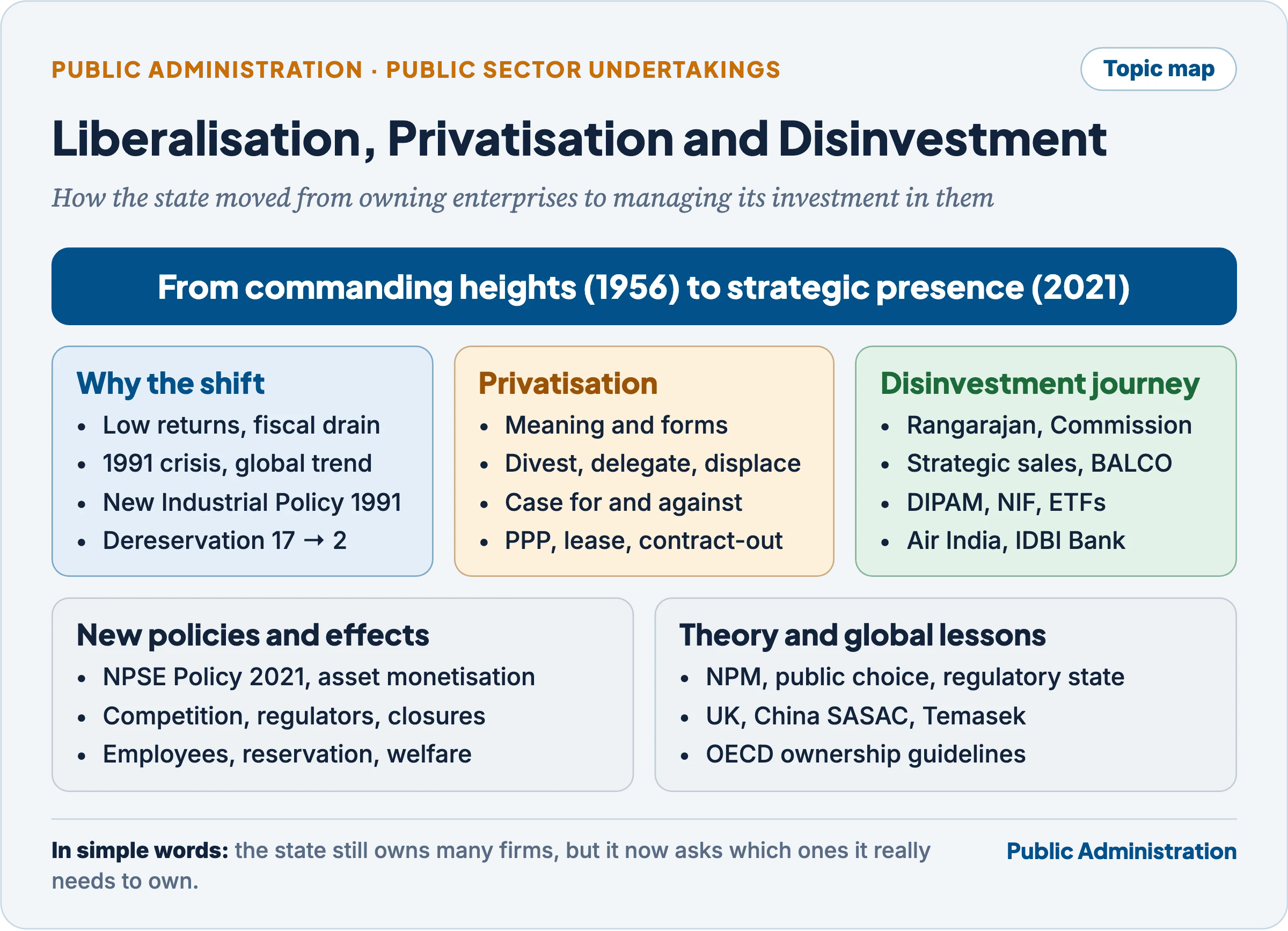
For four decades after independence the public sector was India’s chosen instrument for industrialisation, self-reliance and social justice. The 1991 crisis and the New Industrial Policy of July 1991 reversed the direction of travel: the state began to open reserved sectors to private firms, sell part of its shares in public enterprises, and later sell control of some of them. Over thirty-five years this has changed what a public sector undertaking (PSU) is, whom it answers to, and why the state owns it at all. The question is no longer only “how should the state run its enterprises?” but also “which enterprises should the state own, and on what terms?“
In simple words
Think of a family that once ran a bakery, a taxi service, a tailoring shop and a school because nobody else in the village would. Years later, many shops have opened. The family now asks: should we still run the bakery and the taxis, or sell them, rent them out, or just set rules for everyone? It may keep the school because the poor depend on it. India’s government has been asking the same questions about its companies since 1991.
What this article builds on. The rationale of public enterprise (the “commanding heights” of the Industrial Policy Resolution, 1956), the three classic forms (departmental undertaking, statutory corporation, government company), the role of the Department of Public Enterprises, the Maharatna, Navratna and Miniratna scheme, the MoU system, and the problems of autonomy, accountability and control (COPU, CAG, ministerial directives) are taught in the article on Public Sector Undertakings: Evolution, Forms, Autonomy, Accountability and Control. This article takes them as known and studies what liberalisation and privatisation did to that system.
1. Why the Policy Changed: From Commanding Heights to Liberalisation
In simple words
Public companies were built when private firms were too weak to set up steel plants or power stations. By the late 1980s many of these companies were earning very little, the government was short of money, and the world was turning towards markets. India’s 1991 foreign-exchange crisis forced a rethink.
1.1 The pre-1991 design in one paragraph
- The Industrial Policy Resolution, 1956 reserved 17 industries (its Schedule A) for the state, aimed at a “socialistic pattern of society“, and gave public enterprises the commanding heights of the economy (steel, heavy machinery, mining, power, railways, oil, aviation, telecom).
- Between 1965 and 1985 many private firms were nationalised by Acts of Parliament: banks (1969, 1980), coal (1971–73), the oil companies of Burmah Shell, Esso and Caltex (which became BPCL and HPCL), and loss-making private firms taken over to save jobs (such as Maruti Udyog and several textile mills).
- Government investment in central public sector enterprises (CPSEs) rose from about ₹81 crore in 1956 to about ₹99,315 crore by 1990 (Department of Public Enterprises data).
1.2 Internal causes: the public sector’s own record
The domestic case for change rested on the poor return from this huge investment.
- Low returns. In 1989–90, 229 central enterprises with capital employed of about ₹84,341 crore earned a combined net profit of only about ₹3,782 crore, a return of roughly 4.5 per cent. 98 loss-making enterprises accounted for nearly 78 per cent of accumulated losses. Government borrowed at far higher rates than the public sector returned, so the taxpayer was subsidising it.
- Budgetary burden. Loss-makers needed repeated equity, loans and write-offs from the Union budget; the fiscal deficit was unsustainable.
- Management problems: overstaffing, outdated technology, poor project management, high debt-equity ratios, multiple and conflicting objectives, civil servants on deputation at the top, and frequent ministerial interference in pricing, recruitment and purchases.
- Poor capacity utilisation and no clear pricing policy: administered prices kept many enterprises in permanent loss.
- Weak industrial relations and low productivity in many units.
- A “sick” portfolio: many enterprises were private firms taken over only to protect jobs, and they never recovered.
1.3 External causes: the world and the crisis
- The 1991 balance-of-payments crisis. The Gulf War oil shock, falling remittances and political instability left India with foreign-exchange reserves sufficient for only about two weeks of imports. Gold was pledged abroad; the IMF and World Bank lent on conditions that included fiscal correction and structural reform.
- The global turn to markets. Margaret Thatcher‘s Britain and Ronald Reagan‘s United States had made privatisation and deregulation the policy fashion of the 1980s; the collapse of the Soviet bloc (1989–91) discredited central planning.
- The East Asian example. Japan and the “Asian Tigers” showed that export-led, competitive growth could outpace autarkic planning.
- Technological change (telecom, computing) made old state monopolies look slow and costly.
- Early domestic moves. Partial relaxation had begun earlier: the Arjun Sengupta Committee (1984) recommended fewer reserved industries and performance contracts (the MoU system adopted from the late 1980s), and Rajiv Gandhi‘s government relaxed licensing. 1991 turned these steps into a new direction.
1.4 Three words that define the era
The 1991 reforms are summed up as LPG: liberalisation, privatisation and globalisation.
| Term | Meaning | Main instruments in India |
|---|---|---|
| Liberalisation | Moving from a restrictive to a free regime: reducing and dismantling controls on economic activity | Delicensing, MRTP relaxation, FERA replaced by FEMA (1999), trade and price decontrol |
| Privatisation | Increasing the role of the private sector in ownership, management or provision | Disinvestment, strategic sale, dereservation, contracting out, PPP |
| Globalisation | Integrating the national economy with the world economy | Foreign direct investment, lower tariffs, entry of multinational corporations |
The three are linked but different. Liberalisation changes the rules of the game; privatisation changes who plays it; globalisation changes where it is played. A public enterprise can be fully state-owned and still be affected by all three, because it must now compete with private and foreign firms.
2. The New Industrial Policy, 1991 and the Public Sector
In simple words
In July 1991 the government told its own companies: you will no longer be protected by law from competition, the budget will not keep rescuing you, and some of your shares will be sold to the public. In return, the best of you will get more freedom to run your own affairs.
2.1 The Statement on Public Sector Policy (24 July 1991)
The Statement on Industrial Policy of 24 July 1991 covered five areas: industrial licensing, foreign investment, foreign technology, the public sector and the MRTP Act. Its public sector part made these decisions:
- Portfolio review. Public investment would focus on strategic, high-technology and essential infrastructure areas.
- Selective dereservation. Some areas reserved for the public sector would be opened to private firms; equally, public enterprises could enter areas not reserved for them.
- Sick enterprises that were “chronically sick and unlikely to be turned around” would be referred to the Board for Industrial and Financial Reconstruction (BIFR) for revival or closure.
- Social safety net. A social security mechanism would protect workers affected by restructuring (this became the National Renewal Fund, 1992).
- Partial disinvestment. A part of government shareholding would be offered to mutual funds, financial institutions, the general public and workers, to raise resources and bring market discipline.
- Professional boards with greater powers.
- MoU system. Management would get more autonomy and be held accountable for results through Memoranda of Understanding; MoUs would be placed before Parliament.
- Reduced budgetary support to public enterprises.
2.2 The seven elements of restructuring
The policy can be read as the restructuring of seven things at once:
- the policy environment (competition replacing protection);
- the portfolio of public investment;
- the equity or ownership pattern (disinvestment);
- the boards of enterprises;
- the interface between government and boards;
- sickness of enterprises (revival or exit);
- a safety net for workers.
Of these, restructuring of equity became the pacesetter: once private shareholders entered, boards, disclosure, pricing and the ministry’s behaviour all had to change. The retention of 51 per cent government equity remained the political limit for most of the 1990s.
2.3 Dereservation: from seventeen industries to two
Dereservation means removing an industry from the list reserved exclusively for the public sector, so that private (and often foreign) firms may enter.
| Year | Change in the reserved list |
|---|---|
| 1956 | 17 industries in Schedule A of the Industrial Policy Resolution |
| 1991 | Cut to 8: arms and defence equipment, atomic energy, coal and lignite, mineral oils, specified minerals and metals, atomic minerals, railway transport |
| 1993 | Two more deleted |
| 1998 | Two more deleted |
| 2001 | Defence production opened to private firms (May 2001); 3 left: atomic energy, atomic minerals, rail transport |
| 2009, 2014 | Atomic energy narrowed by notification (2009); railway infrastructure opened to private and foreign investment (2014) |
| Today | 2: atomic energy and railway operations (other than construction, operation and maintenance of specified railway infrastructure such as high-speed rail, freight lines, terminals, rolling-stock units and suburban PPP corridors) |
- Effect. Telecom, civil aviation, power generation, oil refining, coal mining (commercial coal mining from 2020), insurance and banking were progressively opened. Public enterprises in these fields lost legal monopoly and now face domestic and multinational competitors.
- The pattern of dereservation was gradual and sector-specific: it was typically paired with a regulator (TRAI for telecom in 1997, the electricity regulatory commissions from 1998, IRDA for insurance in 1999).
2.4 Sick enterprises: from BIFR to the Insolvency Code
- 1991: the Sick Industrial Companies (Special Provisions) Act, 1985 (SICA) was amended so that government companies could also be referred to the BIFR (set up in 1987).
- Voluntary Retirement Scheme (“golden handshake”). Introduced from 1988 to shed surplus staff with a lump-sum payment.
- National Renewal Fund (1992) financed VRS, retraining and redeployment of workers; it was wound up in 2000.
- Board for Reconstruction of Public Sector Enterprises (BRPSE), December 2004. An advisory board to recommend revival, restructuring or closure of sick CPSEs. The government wound it up on 9 November 2015 to remove a layer of decision-making; administrative ministries became responsible for timely revival or closure, under DPE guidelines (October 2015) that also created an early-warning category of “weak CPSEs“.
- SICA repealed, BIFR dissolved (1 December 2016); revival and liquidation now run through the Insolvency and Bankruptcy Code, 2016 and the National Company Law Tribunal.
- Time-bound closure. DPE guidelines of 2016, revised with Cabinet approval in June 2018, set milestones for closing loss-making CPSEs and disposing of their land and assets, with VRS for employees. The Public Enterprises Survey 2024–25 counted 75 CPSEs under liquidation, closure or non-operation.
Common confusion
Is disinvestment the same as privatisation? No. Disinvestment is any sale of government equity. If the government sells a minority stake and keeps over 50 per cent and management control (Coal India, NTPC, LIC), the enterprise stays a government company: this is disinvestment without privatisation. Privatisation in the strict sense happens only when ownership and management control pass to private hands (a strategic sale, as with BALCO or Air India). India deliberately used the softer word “disinvestment” in the 1990s because a minority sale was politically easier to defend.
3. Privatisation: Meaning, Forms and Methods
In simple words
Privatisation is not only selling a company. The government can also hire a private firm to run a service, lease out a highway, or simply allow private firms to compete where it once had a monopoly. All of these make society rely a little more on the market and a little less on the state.
3.1 Meaning: narrow and broad
- Narrow meaning: the transfer of ownership of a state enterprise to private owners (denationalisation).
- Broad meaning: any measure that increases the role of the private sector in producing goods and services that the state once produced, whether by changing ownership, management, financing or market entry rules.
- E.S. Savas, the American scholar of privatisation, in Privatization: The Key to Better Government (1987) and Privatization and Public-Private Partnerships (2000), defined privatisation as relying more on private institutions and less on government to satisfy people’s needs.
- Mohit Bhattacharya, the Indian scholar of public administration, notes that privatisation, in this broad sense, is a new way of looking at society’s needs and at the role of government, and can be government-strengthening rather than anti-public sector, because it frees the state to concentrate on core tasks.
3.2 The four forces behind privatisation (Savas)
| Force | Goal | Indian illustration |
|---|---|---|
| Pragmatic | Better, more cost-effective government | Selling loss-making hotels and food units the state need not run |
| Ideological | A smaller role for the state in society | “Government has no business to be in business” rhetoric around the 2021 policy |
| Commercial | More business for private firms from public spending | Private bidders for airports, highways, defence production |
| Populist | Give people more choice and power over their needs | Wider share ownership through retail quotas in public offers |
3.3 Savas’s three methods: divestment, delegation, displacement
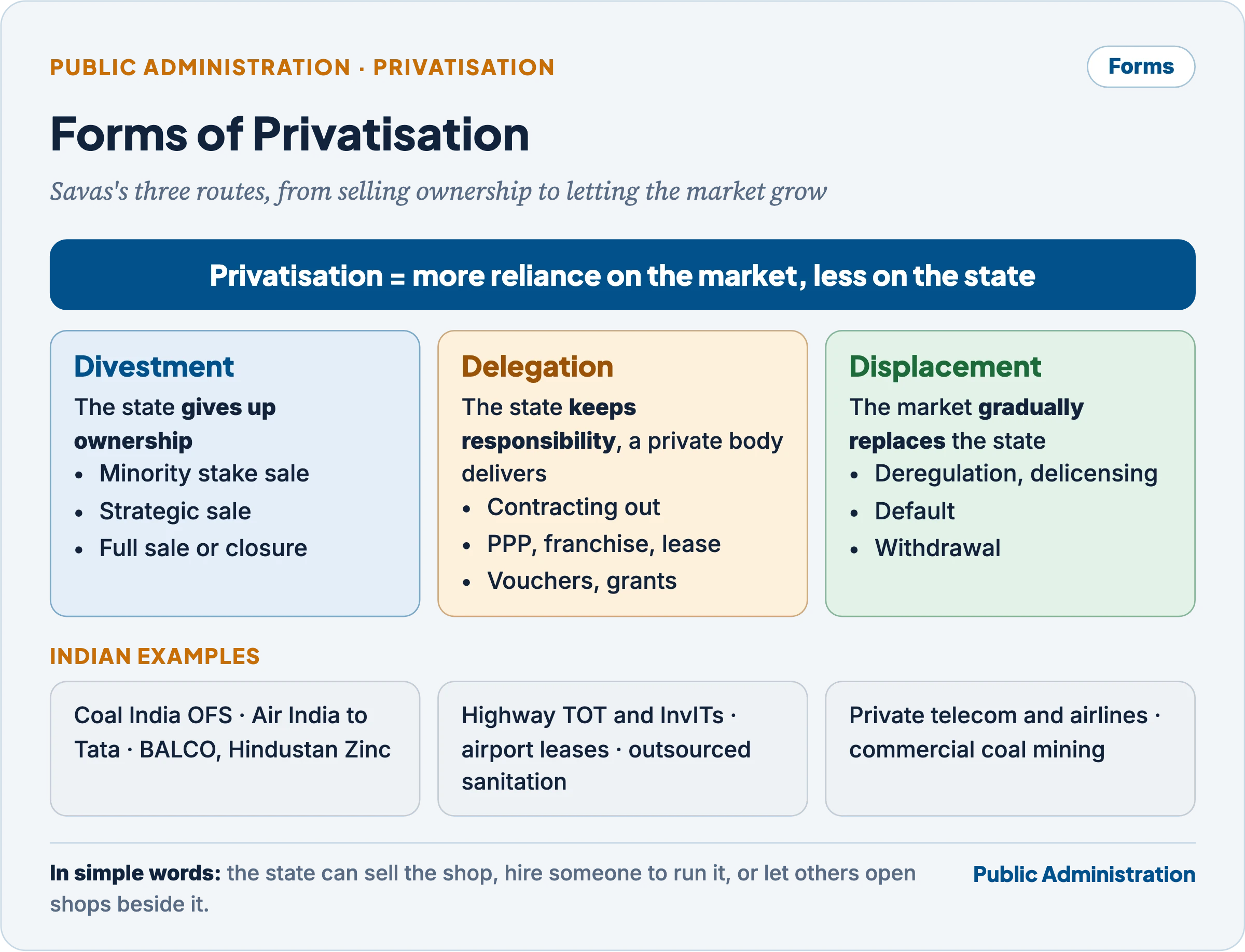
- Divestment: the state gives up ownership. It sells an enterprise or its assets, gives it away (for example to employees), or closes it and sells the assets. Indian examples: offers for sale of Coal India shares; sale of Air India to the Tata group.
- Delegation: the state keeps responsibility, a private body delivers. Government stays accountable for the result but uses:
- contracts (contracting out or outsourcing: municipal waste collection, hospital laundry, data entry);
- franchises (a private firm gets the exclusive right to serve an area, as in electricity distribution franchises in Bhiwandi);
- grants and subsidies to private providers;
- vouchers given to citizens to buy services (school vouchers, the reimbursement of fees for poor children’s seats in private schools under the Right to Education Act);
- mandates requiring private firms to provide a service.
- Displacement: the market replaces the state gradually.
- by default, when the state fails to meet demand and private firms fill the gap (private buses, private schools and clinics);
- by withdrawal, when the state deliberately vacates a field;
- by deregulation, when private firms are allowed to challenge a public monopoly (private airlines after 1994, private telecom after 1994–99).
3.4 A wider list of forms with Indian examples
The forms named in Indian policy debates map onto Savas’s three methods.
| Form | What changes | Indian example |
|---|---|---|
| Denationalisation | Full or majority ownership transferred | Modern Food Industries (2000), BALCO (2001) |
| Disinvestment (minority) | Some shares sold; government keeps control | Offers for sale in Coal India, NTPC; the LIC IPO (2022) |
| Strategic sale | Large stake plus management control sold to one buyer | Air India (2022), Neelachal Ispat (2022) |
| Deregulation / dereservation | Entry barriers removed | Telecom, aviation, insurance, commercial coal mining |
| Contracting out | A service bought from a private firm | Outsourced housekeeping, IT services, toll collection |
| Management contract | Private firm manages a public asset for a fee | Hotel management contracts; operation and maintenance contracts |
| Leasing / concession | Private firm runs an asset for a period, pays the state | Airport leases (Ahmedabad, Lucknow and others, 2020–21) |
| Franchising | Exclusive right to serve an area | Distribution franchisees in power |
| Public-private partnership | Long-term contract sharing risk and investment | Build-Operate-Transfer highways, metro lines |
| User charges | Users pay full or partial cost | Tolls, user fees in public hospitals |
| Asset monetisation | Revenue rights of a brownfield asset transferred for a period; ownership retained | Toll-Operate-Transfer highways, InvITs, pipeline monetisation |
- Privatisation of management without ownership (management contracts, leases) shows that control over operations, not formal ownership, is what changes behaviour. This is why some argue that “efficiency is a function of management, not of ownership“.
- User charges are a form of privatisation of financing: the service stays public, but the cost moves from taxpayer to user. They improve cost recovery but can exclude the poor unless there are exemptions.
- PPPs occupy the middle ground; their design, risk sharing and regulation are taught in the article on Regulatory Authorities and Public-Private Partnerships. Two Indian anchors: the 2nd Administrative Reforms Commission (11th Report, Promoting e-Governance, 2008) favoured PPP for suitable components of e-governance projects with transparent partner selection; the Kelkar Committee on Revisiting and Revitalising the PPP Model of Infrastructure (2015) warned that PPP must not become a way for government to evade its service-delivery responsibility, urged better risk allocation, an Infrastructure PPP Adjudication Tribunal, independent sector regulators, and an amendment to the Prevention of Corruption Act to separate honest errors from corruption.
3.5 How India actually sells shares: methods of disinvestment
| Method | How it works | Example |
|---|---|---|
| Initial / follow-on public offer (IPO/FPO) | New or existing shares sold to the public through a prospectus | LIC IPO (May 2022, about 3.5 per cent) |
| Offer for sale through stock exchange (OFS) | Government sells existing shares on the exchange in a day or two; retail quota | Coal India, NHPC, IRFC (2026) |
| Strategic sale | Two-stage bidding: expression of interest, then financial bids; control passes | Air India, IMPCL (2026) |
| Exchange-traded funds | A basket of CPSE shares sold as one fund | CPSE ETF (2014), Bharat 22 ETF (2017) |
| Buyback | Cash-rich CPSE buys back its own shares from government | Coal India, NMDC buybacks (2016–17) |
| CPSE-to-CPSE sale | One public enterprise buys government’s stake in another | HPCL to ONGC (2018), REC to PFC (2019) |
| Employee offer, institutional placement | Shares to employees or qualified institutions | Small tranches in several CPSEs |
- Who decides. For strategic sales the chain is: NITI Aayog (identifies candidates) → Core Group of Secretaries on Disinvestment (CGD) → an Alternative Mechanism of ministers (the Finance Minister, the Minister of Road Transport and Highways and the administrative minister, set up by the CCEA in 2017) → CCEA. Transaction advisers, independent valuers and an Independent External Monitor support the process.
- CPSE-to-CPSE sales raise money for the budget but change neither ownership nor management culture: the state simply moves its money from one pocket to another.
4. The Case for and against Privatisation
In simple words
Supporters say private owners run companies better because their own money is at stake, and the government can use the sale money for schools and hospitals. Critics say public companies were set up for jobs, fair prices and poor regions, and selling them cheaply to big business hurts both workers and citizens.
4.1 Arguments for privatisation
- Efficiency and market discipline. Private owners face the threat of loss and takeover; they cut waste, upgrade technology and respond to customers. Privatised firms must “survive on their own financial strength or cease“.
- Freeing public resources. Money locked in non-strategic enterprises (hotels, bread, watches, scooters) can be redeployed to basic health, primary education, family welfare and essential infrastructure.
- Stopping the drain. Selling or closing chronic loss-makers stems further budgetary outflow and reduces public debt.
- Transferring commercial risk from the taxpayer to private investors willing to bear it.
- Releasing administrative capacity: senior officials and ministers spend less time running businesses and more on governance.
- Ending political interference in pricing, recruitment, purchase and location decisions.
- Deeper capital markets. More listed public shares give the market depth and liquidity, better benchmarks for valuation and easier fund-raising by the enterprises themselves.
- Wider share ownership among small investors and employees.
- Better use of strategic sale proceeds. A strategic partner brings fresh investment and technology, and market perception improves once the firm is no longer a government company.
- Evidence from Indian cases. Hindustan Zinc, Maruti and VSNL expanded output, profits and tax payments after control passed to private owners; the government earned more from its residual stake and taxes than it had from full ownership.
4.2 Arguments against privatisation
- Undervaluation and “selling the family silver”. Critics allege that assets, especially land, are sold below value; former British Prime Minister Harold Macmillan famously likened the Thatcher sales to selling off the family silver. In India the CAG and parliamentary debates questioned valuations in BALCO and the ITDC hotel sales.
- Fiscal myopia. Sale proceeds are a one-time capital receipt; using them to meet routine deficits sells future dividends for present consumption. The Rangarajan Committee itself cautioned against fixing annual budget targets.
- Private monopoly. Selling a public monopoly without competition and regulation merely replaces a public monopoly with a private one.
- Strategic and security concerns in defence, energy, shipping and critical minerals.
- Loss of social objectives: regional development, price stability, service to remote areas, employment of disadvantaged groups.
- Employment and reservation. Private firms are not bound by the constitutional scheme of reservation in public employment; privatisation shrinks the pool of reserved jobs.
- Loss of public accountability. A privatised firm escapes Article 12, the RTI Act, CAG audit and parliamentary committees.
- Crony capitalism. Few bidders, opaque processes and political links can turn privatisation into a transfer of public wealth to favoured groups.
- Ownership is not the main problem. Many argue that what PSUs need is real autonomy, professional management and competition, not new owners. Profitable Maharatnas such as NTPC, ONGC and Coal India show that public firms can perform when allowed to.
Criticism — The case against privatisation
- Treats public assets as budget fillers; one-time proceeds replace recurring dividends.
- Risks undervaluation and crony transfers when bidders are few.
- Creates private monopolies unless regulation is strong.
- Weakens social justice: reservation, regional balance, last-mile service.
- Removes enterprises from Article 12, RTI, CAG and Parliament.
- Ignores that efficiency depends on management and competition, not ownership alone.
Defence — The case for privatisation
- Ends the drain of taxpayer money into chronic loss-makers.
- Brings capital, technology and managerial freedom that ministries cannot give.
- Frees the state to focus on health, education, security and regulation.
- Market discipline and takeover threat improve performance.
- Indian cases (Hindustan Zinc, Maruti, VSNL) show higher output, taxes and residual value.
- Regulation, not ownership, can protect consumers and social goals can be funded openly.
4.3 What the evidence suggests
- Competition matters more than ownership. Public enterprises improved most where they faced competition (telecom, aviation, oil marketing after decontrol), whether or not they were privatised. Privatisation without competition (some infrastructure concessions) produced rent-seeking and renegotiation.
- Context matters. Strategic sale worked where buyers were serious and the firm had valuable assets (Hindustan Zinc); it stalled where liabilities, land titles or employee issues were heavy (Shipping Corporation, BEML, Pawan Hans, Central Electronics).
- The Indian pattern is cautious. Between 1991 and 2020 only about ten genuine privatisations took place out of some 250 operating CPSEs; roughly four-fifths of disinvestment receipts came from minority stake sales (findings of the National Institute of Public Finance and Policy’s history of disinvestment, 2022).
5. India’s Disinvestment Journey, 1991–2026
In simple words
India first sold small slices of its companies to raise money. Around 2000 it began selling a few companies outright. After 2004 it went back to small slices. Since 2016 it has treated its shares as an investment to be managed, sold control of Air India, and in 2026 chose a buyer for IDBI Bank.
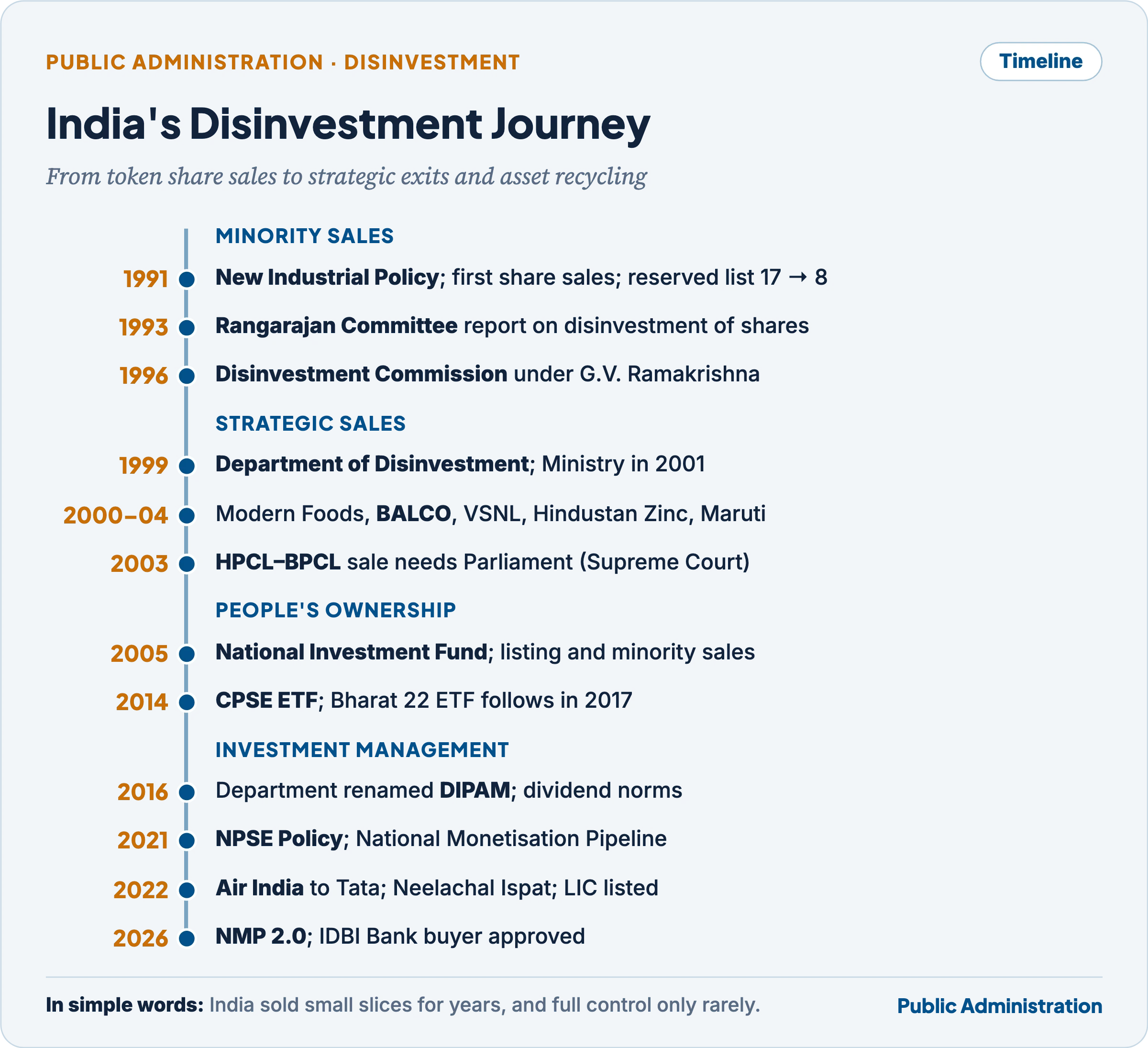
5.1 Phase I (1991–1999): minority sales and institution building
- The first announcement. The interim budget of 1991–92 announced that government would disinvest up to 20 per cent of its equity in selected PSUs in favour of mutual funds and financial institutions in the public sector, expecting ₹2,500 crore. Shares of 31 CPSEs were sold in “bundles” in 1991–92.
- Early criticism. The Public Accounts Committee (1994) found the bundled sales undervalued: weak and strong shares were sold together, and only public-sector institutions could bid.
- Rangarajan Committee on Disinvestment of Shares in Public Sector Enterprises. Constituted in 1992 under the economist Dr C. Rangarajan (later RBI Governor); report 1993. Main points:
- Disinvestment should aim at efficiency, not just revenue; it warned against annual budget targets.
- Equity to be divested could go up to 49 per cent in industries reserved for the public sector and 74 per cent or more in others.
- Methods: public offer, auction of shares to a wide group, and transfer of controlling interest to a strategic buyer; full privatisation was suggested for non-reserved sectors.
- Pricing depends on investor perception, so outcomes should not be judged only by the price realised.
- A standing body to plan and supervise disinvestment, which became the Disinvestment Commission.
- Disinvestment Commission (August 1996). Set up under the United Front government as an advisory body, with G.V. Ramakrishna (former SEBI chairman) as full-time chairman.
- About 50 PSUs were referred to it initially; it submitted 12 reports between 1997 and 1999 covering most of them.
- It examined each enterprise, classified sectors into core and non-core (strategic and non-strategic), and recommended strategic sale in many non-core units (BALCO, ITDC hotels, Modern Foods, Hindustan Zinc, IPCL, Shipping Corporation and others), minority sales in others and no disinvestment for some (ONGC, NTPC).
- It also recommended a Disinvestment Fund, a better VRS, protection for employees, and dismantling of administered prices in petroleum before selling oil firms.
- A reconstituted Commission (2001–2004) gave further reports.
- Record. Against a cumulative target of about ₹34,300 crore (1991–92 to 1998–99), only about ₹16,800 crore was realised, with an average dilution of under 9 per cent in 39 CPSEs and no transfer of control. Oil-sector cross-holdings (one oil PSU buying another’s shares) began in this phase.
5.2 Phase II (1999–2004): the strategic-sale years
- 1999 Cabinet decision classified enterprises: strategic (arms, ammunition and defence equipment; atomic energy; railway transport), where government would keep control, and non-strategic, where government equity could fall to 26 per cent or below. The Budget 2000–01 stated the policy: restructure viable PSUs, close those that cannot be revived, cut equity in non-strategic PSUs to 26 per cent or lower, and protect workers.
- Department of Disinvestment created on 10 December 1999; made a full Ministry of Disinvestment on 6 September 2001 (minister Arun Shourie).
- Strategic sales (about twelve, including two CPSE-to-CPSE deals):
- Modern Food Industries (January 2000): 74 per cent to Hindustan Lever; the first strategic sale.
- BALCO (Bharat Aluminium Company, March 2001): 51 per cent to Sterlite Industries for ₹551.5 crore.
- CMC (2001) to Tata Consultancy Services; VSNL (2002, 25 per cent with control) to the Tata group; IPCL (2002) to Reliance; IBP (2002) to Indian Oil.
- Hindustan Zinc (2002): 26 per cent to Sterlite, which later raised its holding to about 65 per cent through open offer and call option; the government retains a minority stake.
- Maruti Udyog: control passed to Suzuki in 2002 through a rights issue; government exited by 2007.
- Several ITDC hotels sold through slump sales.
- Realisation. About ₹24,600 crore against targets of about ₹58,500 crore (2000–04).
- Controversies: valuation methods, CAG criticism of some hotel sales, worker protests (a long strike at BALCO in 2001), the failed first attempt to sell Air India, and a 2002 ban on CPSEs bidding in disinvestment.
- Two Supreme Court judgments set the legal frame:
- BALCO Employees’ Union v. Union of India (decided 10 December 2001; reported as (2002) 2 SCC 333): disinvestment is a policy decision on economic matters; courts will not test its wisdom, only whether it is illegal, arbitrary or mala fide; government has a right to “trial and error“; workers have no right to a hearing before such a policy decision; the Disinvestment Commission’s advice is advisory; Parliament is the forum for questioning economic policy.
- Centre for Public Interest Litigation v. Union of India (16 September 2003): HPCL and BPCL were created by nationalisation Acts (Esso 1974, Burmah Shell 1976, Caltex 1977) whose purpose was that oil distribution vest in the State; they cannot be sold so as to cease being government companies without amending or repealing those Acts. Parliament’s sanction is needed where a statute embodies the public-ownership purpose.
5.3 Phase III (2004–2014): “people’s ownership” and minority stakes
- The National Common Minimum Programme (2004) said profit-making CPSEs would not normally be privatised; Navratnas would be retained; disinvestment on a case-by-case basis.
- The Ministry was folded back as the Department of Disinvestment in the Ministry of Finance from 27 May 2004.
- National Investment Fund (NIF). Approved in January 2005, operational from November 2005, kept outside the Consolidated Fund:
- the corpus (disinvestment proceeds) was to be permanent and professionally managed by public sector mutual funds;
- 75 per cent of its income for social sector schemes (education, health, employment); 25 per cent for capital investment in profitable and revivable CPSEs;
- after a temporary relaxation (2009–13), it was restructured in 2013: proceeds now go to the Public Account under NIF and are used for approved capital purposes (recapitalising public sector banks and insurers, rights issues to keep government at 51 per cent, railway and metro capital, and similar uses).
- November 2009 policy: listed profitable CPSEs to meet minimum public shareholding (10 per cent then, 25 per cent from 2014 for all listed companies under SEBI rules); unlisted profitable CPSEs to be listed; the stated aim was “people’s ownership” while keeping 51 per cent and management control.
- New instruments: OFS through stock exchanges (2012), and the first CPSE ETF (March 2014).
- No strategic sales in this decade; realisation of about ₹1.14 lakh crore against much larger targets.
5.4 Phase IV (2014 onwards): from disinvestment to investment management
- DIPAM. The Department of Disinvestment was renamed the Department of Investment and Public Asset Management (DIPAM) on 14 April 2016, signalling that government would manage its investment in CPSEs (dividends, buybacks, bonus shares, capital structure), not only sell it.
- Capital restructuring guidelines (27 May 2016): every CPSE to pay a minimum annual dividend of 30 per cent of profit after tax or 5 per cent of net worth, whichever is higher (the net-worth floor was later eased to 4 per cent); cash-rich CPSEs to consider buybacks and bonus shares; inter-ministerial monitoring of dividends.
- NITI Aayog given the role of identifying CPSEs for strategic sale; in-principle approval given to over 30 strategic sales from 2016.
- New avenues: Bharat 22 ETF (November 2017), sale of enemy property shares, holdings in the Specified Undertaking of the Unit Trust of India (SUUTI), and CPSE-to-CPSE sales: HPCL to ONGC (January 2018, about ₹36,915 crore) and REC to PFC (2019).
- Clearing the HPCL–BPCL hurdle. The nationalisation Acts behind BPCL were repealed by Parliament through a repealing and amending law in 2016, removing the bar identified in the 2003 judgment.
- Completed strategic sales:
- Air India to Talace (a Tata Sons subsidiary): bid accepted 8 October 2021; enterprise value ₹18,000 crore (about ₹2,700 crore cash and about ₹15,300 crore debt taken over); handed over on 27 January 2022. Earlier attempts (2001, 2018) had failed.
- Neelachal Ispat Nigam (Odisha), a joint venture of four CPSEs (MMTC, NMDC, BHEL, MECON) and two Odisha PSUs: 93.71 per cent sold to Tata Steel Long Products at an enterprise value of ₹12,100 crore (2022), the first sale under the 2021 policy.
- Ferro Scrap Nigam (a subsidiary of MSTC) to Japan’s Konoike Transport for ₹320 crore.
- Indian Medicines Pharmaceutical Corporation Ltd (IMPCL), an AYUSH ministry company: 100 per cent sold to Skymap Pharmaceuticals for about ₹121 crore (approved May 2026).
- Failed or abandoned sales:
- BPCL: expression-of-interest process called off in May–June 2022 after bidders withdrew amid volatile fuel markets.
- Central Electronics Ltd: the successful bidder was disqualified and the sale terminated (September 2022). Pawan Hans: sale stalled after the winning consortium faced legal issues.
- Shipping Corporation of India (demerged its non-core assets to make sale possible) and CONCOR: stuck over land and asset issues; by 2026 both were effectively dropped, the government choosing to strengthen SCI as a national carrier for energy security after West Asian disruptions. BEML and several others remain stalled.
- IDBI Bank: the big test. The government (30.48 per cent) and LIC (30.24 per cent) together offered 60.72 per cent with management control.
- Expressions of interest invited on 7 October 2022; RBI “fit and proper” checks and MHA security clearance followed.
- Initial bids (January 2026) fell below the reserve price and were rejected; best-offer bids were then invited.
- On 14 October 2026 the CCEA approved Fairfax Financial Holdings (through a Canadian subsidiary) as the strategic buyer at ₹81 per share, a consideration of about ₹52,878 crore; regulatory approvals and definitive agreements were still to follow.
- Critics, including a former Union secretary, alleged undervaluation and demanded an inquiry; DIPAM defended the valuation (two independent valuers, market-multiple and asset methods).
- Listing of LIC. The LIC IPO (May 2022) sold about 3.5 per cent, the largest IPO in India at the time, and placed LIC under SEBI’s listing obligations.
- Bank and insurance privatisation. Budget 2021–22 announced privatisation of two public sector banks and one general insurer; the General Insurance Business (Nationalisation) Amendment Act, 2021 removed the requirement of at least 51 per cent central ownership in public general insurers. No bank or insurer had been privatised by 2026.
5.5 Receipts, targets and dividends
Annual disinvestment targets have usually been missed, while dividends have become the steadier source of revenue.
| Year | Disinvestment target (₹ crore) | Disinvestment realised (₹ crore) | CPSE dividend to government (₹ crore) |
|---|---|---|---|
| 2017–18 | 72,500 | 1,00,037 | 46,499 |
| 2018–19 | 80,000 | 84,972 | 43,052 |
| 2019–20 | 1,05,000 | 50,300 | 35,543 |
| 2020–21 | 2,10,000 | 32,886 | 39,750 |
| 2021–22 | 1,75,000 | 13,534 | 59,294 |
| 2022–23 | 65,000 | 35,294 | 59,533 |
| 2023–24 | 51,000 | 16,507 | 64,030 |
| 2024–25 | no separate target | 10,163 | 74,129 |
| 2025–26 | no separate target | 16,886 (plus 28,420 from asset monetisation) | 78,438 |
- Change in budgeting. Since 2024–25 the budget does not state a separate disinvestment target; it shows a combined figure for miscellaneous capital receipts (disinvestment plus asset monetisation): ₹47,000 crore in BE 2025–26 (revised to ₹33,837 crore; ₹45,306 crore actually realised) and ₹80,000 crore in BE 2026–27. By early August 2026, about ₹27,568 crore had been raised in 2026–27, mostly through offers for sale in Coal India, NHPC, Central Bank of India, GIC, IRFC and others.
- Dividends now matter more. CPSE dividends to government rose every year after 2020–21 and set records in 2024–25 and 2025–26; ₹75,000 crore is budgeted for 2026–27. The shift reflects the DIPAM dividend norms and a view that holding profitable CPSEs may yield more than selling them.
- Reading the table. The two big years (2017–18 and 2018–19) were driven by ETFs, CPSE-to-CPSE sales and buybacks, which move money within the public sector. The 2020–22 targets assumed BPCL, Air India and LIC sales; only Air India and part of LIC happened.
Common confusion
Did the Rangarajan Committee and the Disinvestment Commission do the same job? No. The Rangarajan Committee (1992–93) was a one-time expert committee that laid down the principles: how much equity could be sold in reserved and other industries, how to sell it, and the need for a standing body. The Disinvestment Commission (1996, G.V. Ramakrishna) was that standing advisory body: it examined individual enterprises and recommended, company by company, whether to sell a minority stake, sell control or not sell at all. Execution later passed to the Department (1999) and Ministry (2001) of Disinvestment, and now to DIPAM.
6. The New Public Sector Enterprise Policy, 2021 and Asset Monetisation
In simple words
In 2021 the government drew a line. In a few strategic sectors it will keep a small number of companies. In all other sectors it intends to sell or close its companies. Separately, it rents out roads, pipelines and airports to private firms for some years to raise money without selling them.
6.1 The policy
- Origins. The Atmanirbhar Bharat package (May 2020) promised a new public sector policy with a minimum presence in strategic sectors (the announcement spoke of ordinarily one to four enterprises in each). The Cabinet approved the New Public Sector Enterprise Policy for Atmanirbhar Bharat on 27 January 2021; the Finance Minister announced it in the Budget speech of 1 February 2021; DIPAM notified it on 4 February 2021.
- Scope. Existing CPSEs, public sector banks and public sector insurance companies. It does not apply to not-for-profit companies, CPSEs supporting vulnerable groups, or those with developmental or promotional roles.
- Criteria for “strategic”: national security, energy security, critical infrastructure, provision of financial services and availability of important minerals.
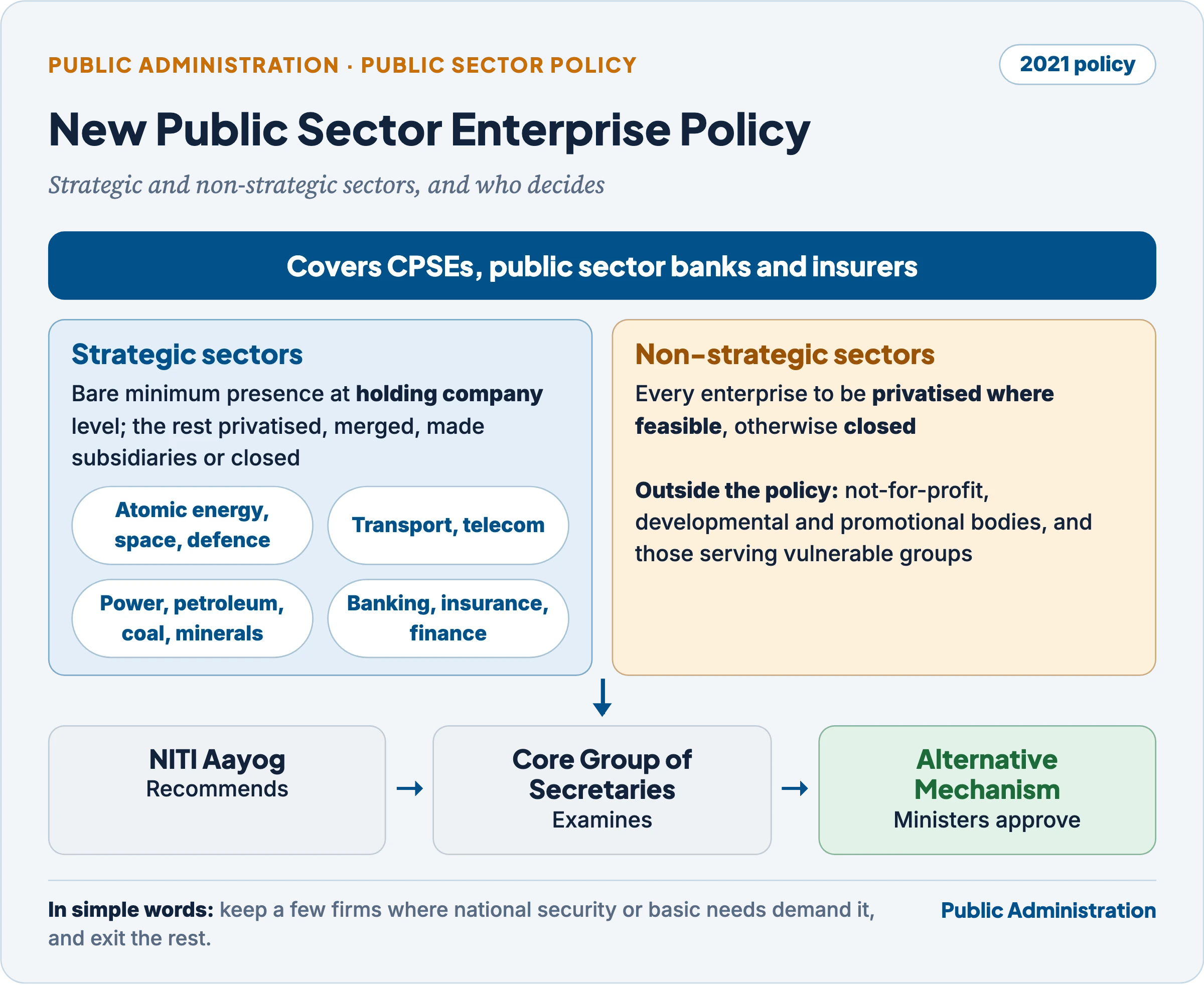
- Strategic sectors (four groups):
- atomic energy, space and defence;
- transport and telecommunication;
- power, petroleum, coal and other minerals;
- banking, insurance and financial services.
- Rule for strategic sectors: a bare minimum presence of public enterprises at the holding-company level stays under government control; the rest are to be privatised, merged, made subsidiaries of another PSE, or closed.
- Rule for non-strategic sectors: CPSEs to be privatised where feasible, otherwise closed.
- Decision chain: NITI Aayog recommends which enterprises to retain or exit → Core Group of Secretaries on Disinvestment → the ministerial Alternative Mechanism approves.
- Follow-up instruments: DPE guidelines for non-strategic CPSEs (December 2021); DIPAM orders of 2022 empowering boards of holding PSEs to recommend and carry out disinvestment or closure of their subsidiaries and joint ventures, and allowing other PSEs and state governments to take part in strategic sales in specified cases.
6.2 What the policy changed, and what it did not
- A shift in the burden of proof. Earlier policy asked “why sell?“; the 2021 policy asks “why keep?“. Outside four sector groups the default is exit.
- From case-by-case to sector-wide. It replaces the 1999 three-sector list and decades of ad hoc choices with a rule-based map.
- Implementation gap. By 2026 only a handful of sales had closed (Air India, Neelachal Ispat, Ferro Scrap Nigam, IMPCL); BPCL, Shipping Corporation, CONCOR and the two public sector banks were dropped or deferred, often after resistance by the administrative ministries that own them. In August 2026 the government told ministries that the remaining sale list would not be diluted further, with new strategic sales to be identified after the IDBI Bank deal.
- Strategic sectors are wide. “Transport”, “minerals” and “financial services” cover a large share of today’s CPSEs, so the policy also allows a large retained public sector if the “bare minimum” is read generously.
Common confusion
Does the 2021 policy mean the government will close or sell all public enterprises? No. It applies only to commercial enterprises. Not-for-profit, developmental and welfare-oriented bodies are outside it, and in the four strategic sector groups the government will retain a bare minimum of enterprises at the holding-company level. The formal policy text does not fix a number; the “one to four” figure comes from the May 2020 announcement. What the policy does say is that in non-strategic sectors the government intends to exit completely, by sale or closure.
6.3 Corporatisation of the Ordnance Factory Board: rationale and link to disinvestment
- What happened. The Ordnance Factory Board, a departmental undertaking of the Ministry of Defence running 41 factories with roots in the colonial era, was converted on 1 October 2021 into seven 100 per cent government-owned Defence PSUs (Munitions India, Armoured Vehicles Nigam, Advanced Weapons and Equipment India, Troop Comforts, Yantra India, India Optel and Gliders India). The Essential Defence Services Act, 2021 barred strikes in essential defence establishments during the transition.
- Rationale:
- autonomy and accountability: each company has its own board, profit-and-loss account and MoU targets, ending the “cost-plus” captive supply model;
- competitiveness and exports in an opened defence sector where private firms now bid for the same orders;
- specialisation by product line and clearer performance measurement;
- several expert committees on defence reform since 2000 had recommended corporatising the ordnance factories.
- Link with disinvestment policy. Defence is a strategic sector under the 2021 policy, so these companies are to be retained under government control; corporatisation is not privatisation. But corporatisation is the legal precondition for any later listing or minority sale, and it applies the same logic of commercial discipline that underlies disinvestment: separate the enterprise from the department, give it a balance sheet, and judge it by results.
6.4 Asset monetisation
- Meaning. Asset monetisation transfers the revenue rights of an operating, de-risked (brownfield) public asset to a private investor for a fixed period, in return for upfront or periodic payment. Ownership stays with the state and the asset returns at the end of the contract.
- Instruments: Toll-Operate-Transfer (TOT) concessions, Infrastructure Investment Trusts (InvITs), operation-maintenance-development agreements for airports, long leases of stations, pipelines, transmission lines, warehouses, stadiums and telecom towers.
- National Monetisation Pipeline 1.0 (launched 23 August 2021, prepared by NITI Aayog): about ₹6 lakh crore over 2021–22 to 2024–25, across 13 sectors led by roads, railways, power, pipelines and telecom. About ₹5.3 lakh crore (some 89 per cent) was achieved.
- NMP 2.0 (launched 23 February 2026): an estimated ₹16.72 lakh crore over 2025–26 to 2029–30, including about ₹5.8 lakh crore of private investment, across 12 sectors (highways, railways, power, petroleum and gas, civil aviation, ports, warehousing, urban infrastructure, coal, mines, telecom, tourism).
- Why governments prefer it: it raises money without the politics of selling, recycles capital into new projects, and brings in pension and sovereign funds through InvITs.
- Concerns: higher user charges, valuation of long concessions, private monopolies over essential networks, weak contract regulation and renegotiation risk; monetisation needs regulatory capacity to manage long contracts.
7. The Changing Role and Governance of PSUs after Liberalisation
In simple words
Even the public companies that were not sold have changed. They now compete with private firms, answer to regulators and stock-market rules, pay regular dividends, and are judged by profits and targets. Some have become very strong; others have been closed.
7.1 From monopoly to competition
- Telecom: BSNL and MTNL went from monopoly to small market shares as private operators grew after 1994–99; both needed repeated revival packages from 2019.
- Aviation: Indian Airlines and Air India lost their dominance to private airlines; Air India’s losses ultimately led to its sale.
- Oil: after the administered price mechanism was dismantled (2002), public refiners and marketers compete with private ones; private refiners now hold a large share of capacity.
- Coal: Coal India retains most output, but commercial coal mining by private firms began in 2020.
- Banking and insurance: public banks and LIC face private and foreign rivals; LIC’s market share has fallen steadily since IRDA opened insurance in 1999–2000.
- The 2017 PYQ point. Public enterprises face competition from both Indian private firms (some of which grew very fast after 1991) and multinational corporations, without matching freedom in pay, procurement, hiring and firing, and with social obligations that private rivals do not carry.
7.2 New tools of autonomy and accountability after 1991
- Ratna scheme. Navratna (1997, initially nine and then eleven enterprises), Miniratna (1997, about 97 enterprises) and Maharatna (2009–10) status gave the best performers greater financial, investment and joint-venture powers and professional boards with independent directors. These enterprises (ONGC, NTPC, IOC, Coal India, Power Grid, BHEL, SAIL and others) became the public sector’s global players, a direct response to liberalisation.
- MoU system. Performance contracts between ministries and enterprises, rated by the DPE, were expanded after 1991; the government’s claim is that they forced managements to set and meet targets; critics note soft targets, ratings concentrated in “excellent” and “very good”, and weak links to rewards.
- Details of both, and the autonomy–accountability balance, are in the article on Public Sector Undertakings: Evolution, Forms, Autonomy, Accountability and Control.
7.3 The regulatory state and capital-market discipline
- Separation of roles. Liberalisation split the state’s three roles over an industry: policy (the ministry), regulation (an independent regulator) and ownership (the enterprise and DIPAM). Telecom (TRAI, 1997), electricity (CERC 1998 and state commissions), insurance (IRDA, 1999), petroleum and natural gas (PNGRB, 2006), airport tariffs (AERA, under a 2008 Act) are examples.
- Competition law. The Competition Act, 2002 applies to public enterprises; Coal India was penalised by the Competition Commission for abuse of dominance (2013).
- Listing obligations. About 66 CPSEs are listed (2024–25); they must follow SEBI’s listing and disclosure regulations on independent directors, audit committees and related-party transactions. Delays in appointing independent directors have been a recurring compliance problem.
- DPE corporate governance guidelines (2010) and CSR duties under section 135 of the Companies Act, 2013.
7.4 Has liberalisation increased or reduced PSU autonomy? (the 2022 debate)
- Autonomy gained: freedom from licensing; Ratna powers; capital-market funding; boards with independent directors; fewer DPE guidelines (hundreds withdrawn in the late 1990s and again in 2016).
- Autonomy lost or infringed:
- Fiscal use of CPSEs. Enterprises were directed to make CPSE-to-CPSE purchases (ONGC buying HPCL, PFC buying REC, LIC buying a majority in IDBI Bank in 2019), special dividends, buybacks and capital spending to meet budget needs, decisions that their own boards might not have taken.
- Government as majority shareholder still appoints and removes chairmen, sets pay, and uses presidential directives.
- Market pressure from minority shareholders and analysts adds a new principal alongside the ministry.
- Fear of the “3 Cs” (CBI, CVC, CAG) continues to make managers cautious.
- Net assessment. Liberalisation increased formal autonomy for the strong enterprises but subjected all CPSEs to new controls: market discipline, regulators and the Finance Ministry’s revenue needs. The old problem of ministerial micromanagement was partly replaced by fiscal instrumentalism.
7.5 Performance today
- Scale. The Public Enterprises Survey 2024–25 covered 475 CPSEs, of which 291 were operating; 226 made profits and 63 made losses.
- Profit. Net profit of all operating CPSEs was about ₹2.9 lakh crore in 2024–25 (about ₹3.2 lakh crore in 2023–24), and total dividends declared about ₹1.39 lakh crore.
- Employment. CPSEs employed about 15.4 lakh people in 2024–25, with a rising share of contract and casual workers and a falling number of regular employees.
- The paradox. India has more CPSEs today (including many new subsidiaries, power transmission SPVs and corporatised units) than in 1991, even as it has sold some. Liberalisation reshaped the public sector more than it shrank it.
8. Effects on Employees, Social Objectives and Constitutional Values
In simple words
When a public company is sold, its workers worry about their jobs, Dalit and tribal job-seekers lose reserved posts, and citizens lose the right to ask questions under RTI. The courts have said that selling companies is the government’s policy choice, but the Constitution’s promise of a welfare state still applies.
8.1 Employees
- Downsizing without mass retrenchment. Workforce shrinkage came mainly through VRS (from 1988), funded at first by the National Renewal Fund; total CPSE employment fell from over 22 lakh around 1991 to about 15 lakh by the 2020s, with regular staff falling faster.
- Privatised firms. Sale agreements usually protect employees for a period (Air India’s buyer agreed to retain all employees for at least a year and then offer VRS); studies of the 1999–2004 sales found no retrenchment directly due to strategic sale, though VRS followed.
- Trade union opposition was strongest in BALCO (2001), the oil companies (2003), BPCL (2019–20) and Ordnance Factories (2021).
- Contractualisation. Within remaining CPSEs, more work is done by contract labour, with lower pay and weaker security.
8.2 Reservation and social justice
- Reservation applies in CPSEs and public sector banks by government directions, as they are “State” under Article 12 and bound by Articles 14–16.
- Reservation ends once control passes to a private owner; the pool of reserved jobs shrinks with every sale. This has fed demands for reservation in the private sector, which no central law requires.
- Article 12 and writ remedies. In R.S. Madireddy v. Union of India (16 May 2024), the Supreme Court held that Air India ceased to be “State” under Article 12 after its sale to Talace, so writ petitions by its employees under Article 226 were no longer maintainable even though filed before privatisation; employees could still pursue other legal remedies. The judgment shows concretely how privatisation moves an organisation outside public law.
8.3 Social objectives
- What public enterprises provided beyond profit: regional development (steel towns of Bhilai, Rourkela, Durgapur), price stabilisation (fuel, fertiliser, food), last-mile service (BSNL in remote and border areas, LPG and kerosene distribution), import substitution, strategic capacity (defence, atomic energy, shipping), and model employment practices.
- After liberalisation, these functions are increasingly delivered through regulation (universal service obligations in telecom), targeted subsidies (direct benefit transfer), CSR spending, and the retained strategic CPSEs.
- The OECD principle that public-service obligations of state enterprises should be clearly mandated by law, disclosed and funded transparently (rather than hidden as losses) offers a middle path between full privatisation and the old cross-subsidy model.
8.4 Does privatisation undermine constitutional values?
- The concern. The Preamble (with “socialist” added by the 42nd Amendment, 1976) and the Directive Principles (Article 38 on a just social order; Article 39(b) on distributing the material resources of the community to subserve the common good; Article 39(c) against concentration of wealth) were read as mandating a large public sector. Privatisation, critics argue, concentrates wealth, weakens equality of opportunity in employment and removes institutions from democratic accountability.
- The courts’ answer:
- Delhi Science Forum v. Union of India (1996) upheld the opening of telecom services to private operators: national policy choices belong to the executive and Parliament.
- BALCO (2001) held disinvestment to be an economic policy choice, reviewable only for illegality, arbitrariness or mala fides.
- CPIL (2003) added a rule-of-law limit: where Parliament has vested an undertaking in the State by statute, only Parliament can undo it.
- Property Owners Association v. State of Maharashtra (nine judges, 5 November 2024) held that not every privately owned resource is a “material resource of the community” under Article 39(b), rejecting the expansive socialist reading of that clause and noting India’s shift to a mixed, market-oriented economy.
- Dr Balram Singh v. Union of India (25 November 2024) upheld the words “socialist” and “secular” in the Preamble and held that “socialist” in India denotes a welfare state committed to equality of opportunity; it does not mandate any particular economic policy and does not restrict private enterprise or the right to trade under Article 19(1)(g).
- Balanced view. The Constitution is ownership-neutral: it permits a large or small public sector. What it does demand is welfare outcomes, equality of opportunity, fair procedure and accountability. Privatisation is therefore constitutional, but how it is done (transparent valuation, protection of workers, regulation of private monopolies, continued delivery of public services) is where constitutional values bite.
9. Global Experience
In simple words
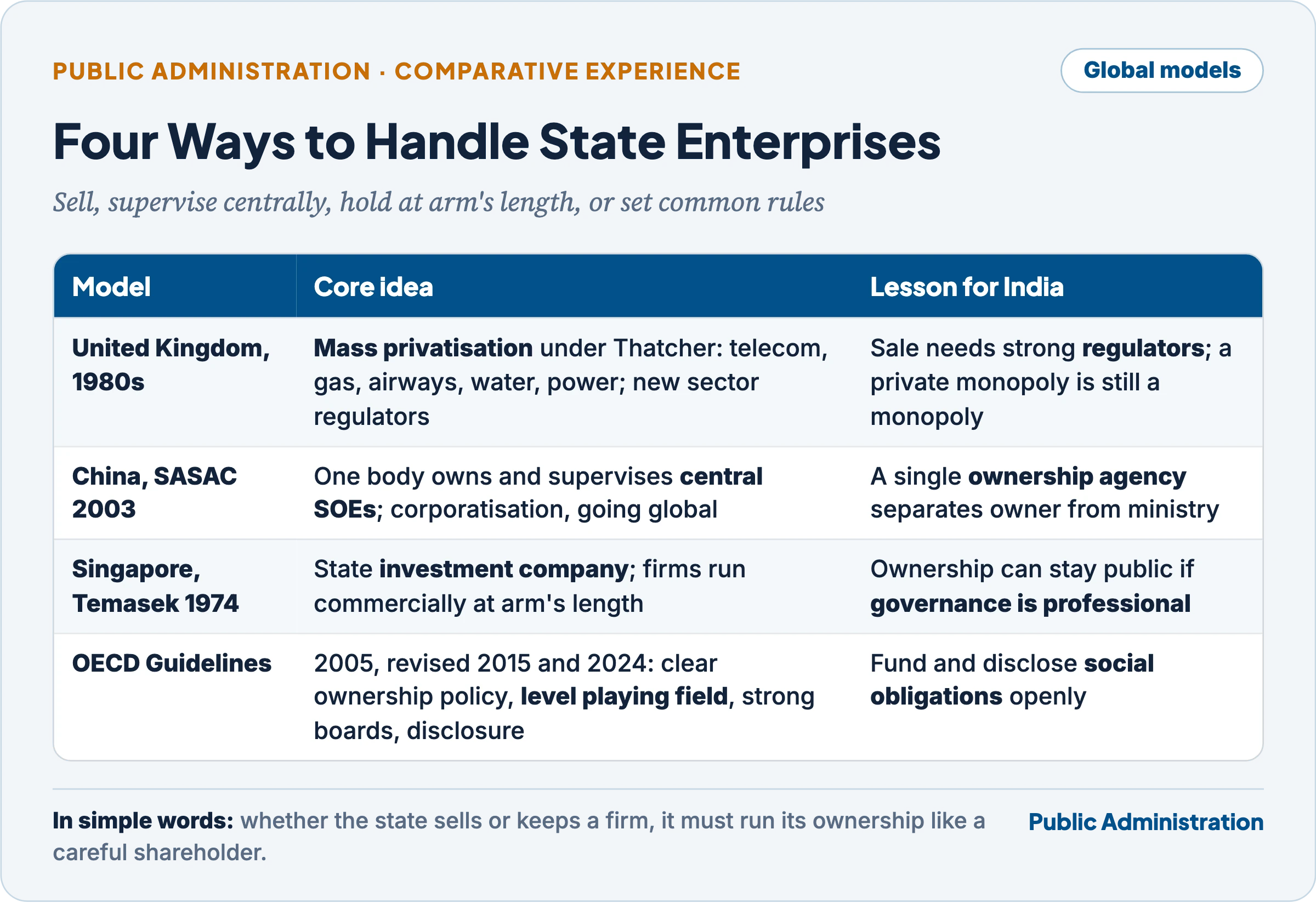
Other countries have tried very different paths. Britain sold almost everything in the 1980s. China kept its big firms but put them under one supervising body. Singapore keeps ownership through an investment company that runs firms like a private investor. The OECD has written common rules for all governments that own companies.
9.1 United Kingdom: privatisation under Thatcher
- Margaret Thatcher‘s Conservative governments (1979–90) and their successor sold most nationalised industries: British Telecom (1984), British Gas (1986), British Airways (1987), British Steel (1988), the water companies (1989), electricity (1990–91) and later British Rail (1994–97).
- Aims: efficiency, lower public borrowing, weaker public-sector unions, and a “share-owning democracy” through retail share offers.
- Regulation followed sale: sector regulators (Oftel 1984, Ofgas 1986, Ofwat 1989, Offer 1989) with price-cap (“RPI minus X”) regulation.
- Results: gains in telecom and steel productivity; problems in natural monopolies. Railtrack collapsed in 2001 and was replaced by the not-for-profit Network Rail; rail passenger franchises have since been brought back under public control; several water companies faced heavy debt and pollution penalties.
- Ownership function. The UK later created a Shareholder Executive (2003), now UK Government Investments (2016), to act as a professional shareholder for remaining state companies.
- Lesson for India: privatising a monopoly without strong, independent regulation shifts rents to private owners; sale is the start, not the end, of public responsibility.
9.2 China: SASAC and corporatised state capitalism
- Reform path: in the 1990s China “kept the large and let go of the small“, privatising or closing thousands of small state firms while corporatising big ones under a “modern enterprise system” with four pillars: clear property rights, clear responsibilities, separation of government from enterprise, and scientific management.
- State-owned Assets Supervision and Administration Commission (SASAC), 2003, under the State Council: took central state-owned enterprises away from many line ministries and placed them under one owner-supervisor that appoints and removes top executives, drafts rules on state assets, and guards against asset stripping. Local SOEs are owned by local governments.
- “Going global”: state support for overseas acquisitions and investment by SOEs (in oil, minerals and technology).
- Mixed-ownership reform since 2013 allows private and foreign minority investors into SOEs while keeping state control.
- Lesson for India: a single ownership agency separate from line ministries can professionalise ownership; but China’s model also shows the risk of soft budget constraints and political control persisting under corporate forms.
9.3 Singapore: Temasek and arm’s-length ownership
- Temasek Holdings, set up in 1974 and wholly owned by Singapore’s Minister for Finance, holds the state’s stakes in government-linked companies such as Singapore Airlines, SingTel and DBS Bank.
- Arm’s length: the government does not direct business decisions; boards are professional; companies list on the stock exchange and compete; Temasek acts like a commercial investor judged by long-term returns.
- Lesson for India: ownership can stay public if governance is professional. India has borrowed the idea partly: the P.J. Nayak Committee (2014) on bank boards proposed a Bank Investment Company to hold government shares in public sector banks at arm’s length (leading to the Banks Board Bureau, 2016); proposals for a CPSE holding company and DIPAM’s investment-management mandate reflect the same thinking.
9.4 Other OECD practice
- New Zealand: the State-Owned Enterprises Act, 1986 required SOEs to operate as successful businesses; a specialist monitoring unit advises the ministers who hold shares.
- France: the Agence des participations de l’État (2004) coordinates the state’s shareholdings and limits day-to-day intervention.
- Norway, Germany, Australia: general company law applies equally to state and private firms; clear separation of ownership and regulation; in Norway ownership is largely centralised in one ministry.
9.5 The OECD Guidelines on Corporate Governance of State-Owned Enterprises
- Adopted 2005, revised 2015, revised again in 2024 (adopted by the OECD Council in May 2024); the leading international standard for state ownership.
- Main principles:
- a clear rationale and ownership policy for why the state owns each enterprise;
- the state as an active, informed and professional owner, ideally through a centralised ownership entity, without day-to-day interference;
- a level playing field with private competitors (no hidden subsidies, same laws, commercial terms of finance);
- equitable treatment of all shareholders, including minority investors;
- boards with the authority, competence and objectivity to set strategy and appoint or remove the CEO;
- high standards of disclosure, audit and transparency;
- public-service obligations to be mandated by law, disclosed and funded;
- a new chapter (2024) on sustainability and responsible business conduct.
- Lessons commonly drawn for India: separate ownership from governance; create a nodal ownership agency with professional staff; give boards real power with minimum government representation; align board pay with long-term performance; monitor performance through regular information systems; and cost and disclose social obligations rather than hide them as losses.
10. Liberalisation and the State: Theory and Assessment
In simple words
Different theories explain why India sold or kept its companies. Some say the state is too slow and selfish to run businesses; others say a strong state is needed for development and fairness. The truth in India has been a middle path: a smaller but still significant public sector, with more rules and regulators.
10.1 From the Nehruvian model to the liberalisation model: the milestones
- 1948 and 1956 industrial policy resolutions: mixed economy, public sector at the commanding heights.
- 1969–80: nationalisation of banks, coal, insurance and oil; peak of state control.
- 1984–90: Arjun Sengupta Committee, MoU system, partial delicensing under Rajiv Gandhi.
- 1991: New Industrial Policy, dereservation, first disinvestment.
- 1996–2004: Disinvestment Commission, strategic sales, regulators (TRAI, CERC, IRDA).
- 2004–14: “people’s ownership”, NIF, minority stakes, Maharatna scheme.
- 2014–26: DIPAM, NPSE Policy 2021, Air India sale, asset monetisation, corporatisation of ordnance factories, IDBI Bank sale approved.
Theory lens: reading liberalisation and privatisation through Paper I ideas
- New Public Management and reinventing government. Christopher Hood (“A Public Management for All Seasons?”, 1991) described NPM’s stress on markets, competition, disaggregation and private-sector management styles; David Osborne and Ted Gaebler in Reinventing Government (1992) urged government to “steer rather than row“. Disinvestment, corporatisation (Ordnance Factory Board), MoUs, contracting out and PPPs are the Indian application: the state steers through policy and regulation while enterprises, often private, row. See the article on New Public Management and After.
- Public choice. William Niskanen, in Bureaucracy and Representative Government (1971), argued that bureaucrats maximise budgets; James Buchanan and Gordon Tullock showed how politicians and officials pursue self-interest. Over-manning, politically chosen locations, soft pricing and repeated bail-outs of loss-making PSUs fit this diagnosis, and privatisation is its prescribed cure. See the article on New Public Administration and the Public Choice Approach.
- Soft budget constraint. János Kornai, the Hungarian economist, showed that state firms expecting rescue face a soft budget constraint and lose cost discipline. India’s BIFR years and revival packages illustrate it; hard closure guidelines (2018) and the IBC are attempts to harden the constraint.
- Principal–agent theory. Michael Jensen and William Meckling (1976) analysed how owners (principals) control managers (agents). A PSU has many principals (ministry, Finance Ministry, Parliament, CAG, now minority shareholders) with conflicting goals, so managers are accountable to everyone and answerable to no one. Privatisation reduces the principals to one; reformed public ownership (single ownership agency, clear mandate) tries to clarify the chain.
- Strong state versus market. The World Bank‘s World Development Report 1997: The State in a Changing World argued for matching the state’s role to its capability; Peter Evans‘s Embedded Autonomy (1995) and Chalmers Johnson‘s idea of the developmental state (1982) showed that a capable state can drive industrialisation. India’s path (shrinking direct production while expanding regulation, infrastructure finance and welfare) reflects this middle position. See the article on Bureaucracy and Development, the State versus Market Debate and Liberalisation.
- The regulatory state. Giandomenico Majone described the “rise of the regulatory state” (1994): as governments stop owning, they regulate. India’s sector regulators, the Competition Commission and SEBI’s rules for listed CPSEs are this shift. See the article on Regulatory Authorities and Public-Private Partnerships.
- The New Public Service critique. Janet and Robert Denhardt (“The New Public Service: Serving Rather than Steering”, 2000) argued that citizens are not just customers and that public interest and democratic accountability must come first. Concerns about reservation, RTI, CAG audit and welfare after privatisation, and about using PSUs as cash cows, echo this critique.
- The LPG paradox. LPG and NPM aimed to shrink government, yet public functions and spending have grown: regulators, welfare transfers, infrastructure finance, digital public infrastructure and the management of contracts all require state capacity. Selling enterprises changes the form of state action (from producer to regulator, financier and contract manager), not its volume. See the article on Challenges of Liberalisation, Privatisation and Globalisation; Good Governance.
10.2 Assessment
- What changed: the public sector lost its legal monopoly, became more commercial, listed and regulated, and the state’s attitude moved from owner-operator to investor-regulator.
- What did not: India never had a Thatcher-style sell-off; political consensus has repeatedly limited strategic sales; receipts usually missed targets; the most successful CPSEs remain public.
- Has the bureaucratic model lost its significance? The departmental, hierarchical model of running enterprises (the Ordnance Factory Board, the old Department of Telecommunications) has given way to corporatised, contract-based and networked forms. But Weberian qualities (rule-bound procedure, impartiality, record-keeping) matter even more in a liberalised state, because regulators, valuers and contract managers must be neutral and predictable; what has declined is bureaucracy as producer, not bureaucracy as guardian of rules.
- Has privatisation hurt welfarism? The welfare role has partly moved from enterprises to targeted schemes, regulation and transfers; it has not disappeared. Where privatisation removed services without regulation or funding, the welfare loss is real; where competition improved quality (telecom, aviation), consumers gained.
- Reform, not only exit. The recurring lesson (from the 1991 policy’s emphasis on autonomy, from the OECD and from Temasek) is that efficiency depends on governance and competition: professional boards, freedom from micromanagement, a clear ownership policy and transparent funding of social obligations, whether the state keeps the enterprise or sells it.
Key Terms
| Term | Meaning in simple words |
|---|---|
| Liberalisation | Reducing government controls on economic activity |
| Privatisation | Increasing the private sector’s role in ownership, management or provision |
| Globalisation | Integrating the national economy with the world economy |
| Disinvestment | Sale of part or all of government shares in a public enterprise |
| Strategic sale | Sale of a large stake along with management control to one buyer |
| Minority stake sale | Sale of shares while government keeps over 50 per cent and control |
| Denationalisation | Returning a nationalised enterprise to private ownership |
| Dereservation | Removing an industry from the list reserved for the public sector |
| Offer for sale (OFS) | Quick sale of existing shares by government through the stock exchange |
| CPSE ETF | A fund holding a basket of CPSE shares, sold to investors as one unit |
| CPSE-to-CPSE sale | One public enterprise buys government’s stake in another |
| National Investment Fund | Fund (2005) into which disinvestment proceeds are credited for approved uses |
| DIPAM | Department of Investment and Public Asset Management (2016), manages government equity |
| Alternative Mechanism | Group of ministers empowered to approve strategic sales |
| NPSE Policy 2021 | Policy keeping a bare minimum of PSEs in four strategic sector groups and exiting others |
| Asset monetisation | Leasing revenue rights of operating public assets for a period, without selling ownership |
| InvIT | Infrastructure Investment Trust; pools operating infrastructure assets and pays investors from their income |
| TOT | Toll-Operate-Transfer: a highway leased for tolling in return for an upfront payment |
| Contracting out | Government buys a service from a private firm instead of producing it |
| Franchising | Exclusive right given to a private firm to serve an area |
| Corporatisation | Converting a government department into a company with its own board and accounts |
| Soft budget constraint | Expectation of state rescue that weakens cost discipline in state firms |
| Golden handshake | Voluntary retirement scheme with a lump-sum payment |
| SASAC | China’s commission (2003) that owns and supervises central state-owned enterprises |
| Temasek | Singapore’s state investment company (1974) owning government-linked firms at arm’s length |
Commissions, Committees and Judgments
The table lists the bodies, policies and court decisions that shaped liberalisation and disinvestment of public enterprises, in order.
| Body / case | Year | Key point |
|---|---|---|
| Arjun Sengupta Committee on public enterprises | 1984 | Fewer reserved industries; more autonomy; performance contracts (MoU system) |
| Statement on Industrial Policy (public sector part) | 1991 | Reserved list 17 to 8; BIFR referral; partial disinvestment; MoU autonomy |
| National Renewal Fund | 1992–2000 | Funded VRS, retraining and redeployment of affected workers |
| Rangarajan Committee on Disinvestment of Shares (C. Rangarajan) | 1992–93 | Up to 49% sale in reserved, 74% or more in other industries; no annual targets; standing body |
| Disinvestment Commission (G.V. Ramakrishna) | 1996–99 | Advisory; enterprise-wise advice; strategic sale for many non-core units |
| Department of Disinvestment; Ministry of Disinvestment | 1999; 2001 | Executed strategic sales; folded into Ministry of Finance in 2004 |
| Delhi Science Forum v. Union of India | 1996 | Opening telecom to private operators is a policy matter for government and Parliament |
| BALCO Employees’ Union v. Union of India | 2001 (reported 2002) | Disinvestment is economic policy; reviewable only if illegal, arbitrary or mala fide; no right to pre-decisional hearing |
| Centre for Public Interest Litigation v. Union of India | 2003 | HPCL and BPCL cannot cease to be government companies without amending the nationalisation Acts |
| BRPSE | 2004–2015 | Advised on revival or closure of sick CPSEs; wound up 9 November 2015 |
| National Investment Fund | 2005; restructured 2013 | Disinvestment proceeds for social sector and capital uses; now in the Public Account |
| Kelkar Committee on PPP (Vijay Kelkar) | 2015 | Service delivery over fiscal gain; better risk sharing; PPP tribunal; independent regulators |
| DIPAM and capital restructuring guidelines | 2016 | Investment management mandate; minimum dividend and buyback norms |
| New Public Sector Enterprise Policy | 2021 | Four strategic sector groups with bare minimum presence; exit from non-strategic sectors |
| National Monetisation Pipeline 1.0 / 2.0 | 2021 / 2026 | ₹6 lakh crore (about 89% achieved) / ₹16.72 lakh crore over 2025–30 |
| R.S. Madireddy v. Union of India | 2024 | Privatised Air India is no longer “State”; writs against it not maintainable |
| Property Owners Association v. State of Maharashtra | 2024 | Not all private resources are “material resources of the community” under Article 39(b) |
| Dr Balram Singh v. Union of India | 2024 | “Socialist” in the Preamble means a welfare state; mandates no particular economic policy |
Contemporary Developments
- IDBI Bank sale approved (14 October 2026). The CCEA chose Fairfax Financial Holdings as strategic buyer for 60.72 per cent (government and LIC shares) at ₹81 per share, about ₹52,878 crore, after rejecting initial bids below the reserve price; regulatory approvals are pending and critics have alleged undervaluation.
- Strategic sale of IMPCL (May 2026). The AYUSH ministry’s medicine maker was sold in full to Skymap Pharmaceuticals for about ₹121 crore, the first strategic sale since Ferro Scrap Nigam.
- Shipping Corporation and CONCOR dropped (2026). Long-stalled sales were effectively abandoned; the government chose to strengthen SCI as a national carrier for energy security, while telling ministries in August 2026 that the remaining sale list would not be diluted further.
- NMP 2.0 launched (23 February 2026). NITI Aayog’s second pipeline estimates ₹16.72 lakh crore of asset monetisation over 2025–26 to 2029–30, after NMP 1.0 achieved about ₹5.3 lakh crore.
- Budget 2026–27. ₹80,000 crore budgeted under miscellaneous capital receipts (disinvestment plus monetisation) and ₹75,000 crore in CPSE dividends; in 2025–26 government realised about ₹45,306 crore from disinvestment and monetisation and a record ₹78,438 crore in dividends.
- Offers for sale in 2026–27. Stakes sold in Coal India, NHPC, NLC India, Central Bank of India, GIC and IRFC through OFS, reflecting reliance on minority sales to meet public-shareholding norms and revenue needs.
- Public Enterprises Survey 2024–25 (December 2025). 475 CPSEs, 291 operating, net profit about ₹2.9 lakh crore; regular employment falling as contract work rises.
- Supreme Court on Article 12 and the Preamble (2024). R.S. Madireddy took privatised Air India out of writ jurisdiction; Dr Balram Singh held that “socialist” does not bind governments to any economic model; Property Owners Association narrowed Article 39(b).
Revision Grid
| Thinker / body | Work or report (year) | Key idea |
|---|---|---|
| E.S. Savas | Privatization: The Key to Better Government (1987); Privatization and Public-Private Partnerships (2000) | Privatisation as divestment, delegation, displacement |
| Christopher Hood | “A Public Management for All Seasons?” (1991) | NPM doctrines: markets, competition, disaggregation |
| Osborne and Gaebler | Reinventing Government (1992) | Steer rather than row |
| William Niskanen | Bureaucracy and Representative Government (1971) | Budget-maximising bureaucrats |
| János Kornai | Soft budget constraint (1980s) | Expected bail-outs erode discipline in state firms |
| Jensen and Meckling | Theory of the firm (1976) | Principal–agent problem |
| Giandomenico Majone | Rise of the regulatory state (1994) | States regulate rather than own |
| Peter Evans | Embedded Autonomy (1995) | Capable state can guide development |
| World Bank | World Development Report (1997) | Match state role to capability |
| Denhardt and Denhardt | “The New Public Service” (2000) | Serve citizens, not customers |
| Arjun Sengupta Committee | Report on public enterprises (1984) | Autonomy, MoU, fewer reserved industries |
| Rangarajan Committee | Disinvestment of shares (1993) | Principles and limits of disinvestment |
| Disinvestment Commission (G.V. Ramakrishna) | Reports (1997–99) | Enterprise-wise sale advice |
| Kelkar Committee | PPP model (2015) | PPP for service delivery, risk sharing |
| DIPAM / NITI Aayog | NPSE Policy (2021); NMP (2021, 2026) | Strategic presence; asset recycling |
| OECD | SOE Guidelines (2005, 2015, 2024) | Professional ownership, level playing field |
Previous Year Questions
- 2026The reforms in public sector enterprises is not only enduring but also evolving. Explain.
- 2026Government of India has done Corporatisation of Ordnance Factory Boards. Discuss the rationale in the light of Disinvestment Policy of the government.
- 2025Liberalization of Indian economy has forced public enterprises to enhance their efficiency, but the effects of these reforms have been a topic of debate. Analyze.
- 2024Public sector undertakings have been the bedrock of welfarism in India for many decades. Evaluate the pros and cons of current disinvestment scenario.
- 2024The Liberalization, Privatization, and Globalization (LPG) has enhanced the participation of private sector in Indian Economy. Comment.
- 2023In the context of the Second Administrative Reforms Commission recommendations, evaluate Public-Private Partnership (PPP) as a preferred mode of implementing infrastructural projects.
- 2022“The New Economic Reforms during the past three decades have not only reduced the scope of industrial licensing and areas reserved exclusively for Public Sector but also infringed the autonomy of existing public sector undertakings”. Examine.
- 2022Following the onset of globalisation, the traditional bureaucratic model appears to have lost its significance. Comment.
- 2021The government policy of large-scale privatization of the key sectors of economy may affect India’s economic health. Comment.
- 2020Does the privatization of key public sector bodies augur well for welfarism in India? Discuss with suitable illustrations.
- 2019Public Sector Undertakings were expected to take the Indian economy to the “commanding heights” instead the successive governments have been pushing for disinvestment. Critically examine how the scenario has changed over the years.
- 2018“The market-driven profitability concerns have shaken the foundation of the public sector undertakings.” Do you agree? Give reasons.
- 2017“Public Sector Undertakings (PSUs) in India face tough competition from the private enterprises and Multi-National Corporations (MNCs).” Explain
- 2016Evaluate the performance and efficacy of the Maharatna, Navratna and Miniratna type of Public Sector Undertakings in the context of Liberalization, Privatization and Globalization (LPG).
- 2014“Public sector undertakings must learn to survive and be entrepreneurial, without assured government budgetary support.” In the light of this statement give your suggestions for strengthening their autonomy and reviving the health of sick Public Sector Undertakings.
- 2012“’Memorandum of Understanding’ scheme between the Government and Public enterprises has forced public undertakings to improve their overall performance.” Do you agree with this statement?
- 2008‘The shift from the Nehruvian to the liberalisation model of development has necessitated reinventing government.’ Comment.
- 2007“Memorandum of understanding scheme’ between government and public enterprise has forced public undertakings to improve the overall performance.” Comment.
- 2004“In the context of liberalisation the role of Public Sector and its welfarist approach is being drastically changed.” Elucidate.
- 2003“The steady expansion and the gradual decline of the public sector has been one in post-Independence India.” Discuss this statement and suggest measures to arrest the decline of the public sector in India.
- 2002“The role of public sector has been changing tremendously in the context of liberalisation.” Comment.
- 2001“The use of the word ‘Socialist’ in the Indian Constitution has become redundant in the context of the liberalization of economy.” Comment.
- 2001“Despite liberalization, privatization and globalization of economy, the public sector has its own relevance for India.” Discuss the functions and role of public sector in the new economic scenario and the changes that they need to bring about in them.
- 2000Do you agree that globalization, liberalization and privatization policies are going to change the very fabric of Indian Administration? What, according to you, are the major challenges before it in the 21 st century?
- 2000Discuss the major problems of management and working of Public Sector Undertakings in India. Give suggestions in the light of liberalization policy to improve their performance.
- 2026“Liberalization, Privatization and Globalization (LPG) successfully resolved the structural crisis of the welfare state with emphasis on market efficiency, undermining the social equity goals essential to public service.” Explain.
- 2025The objective of Liberalization, Privatization and Globalization and of New Public Management was to limit government functions and reduce public expenditure. However both functions and expenditure has increased. Account for the paradox.
- 2023“Public- Private Partnerships (PPPs) have been justified in various ways over time that seek to privatise public services for the profit of private entities.” Do you agree?
- 2011Indicate the milestones in the story of development from the Nehruvian Model to the Liberalisation Model.
- 2010Explain the impact of privatisation on public administration with special reference to The issue of user fees. Public- private partnership. Outsourcing technique.
- 1999“Public Undertakings have received a raw deal in the wake of liberalism and privatization. Comment.