

1.8 Principles of Pre-historic: Archaeology, Chronology, Relative and Absolute Datings Methods; Cultural Evolution – Broad Outlines of Prehistoric cultures: Paleolithic, Mesolithic, Neolithic, Chalcolithic, Copper-Bronze Age and Iron Age
Official Syllabus: Paper I, Unit 1.8
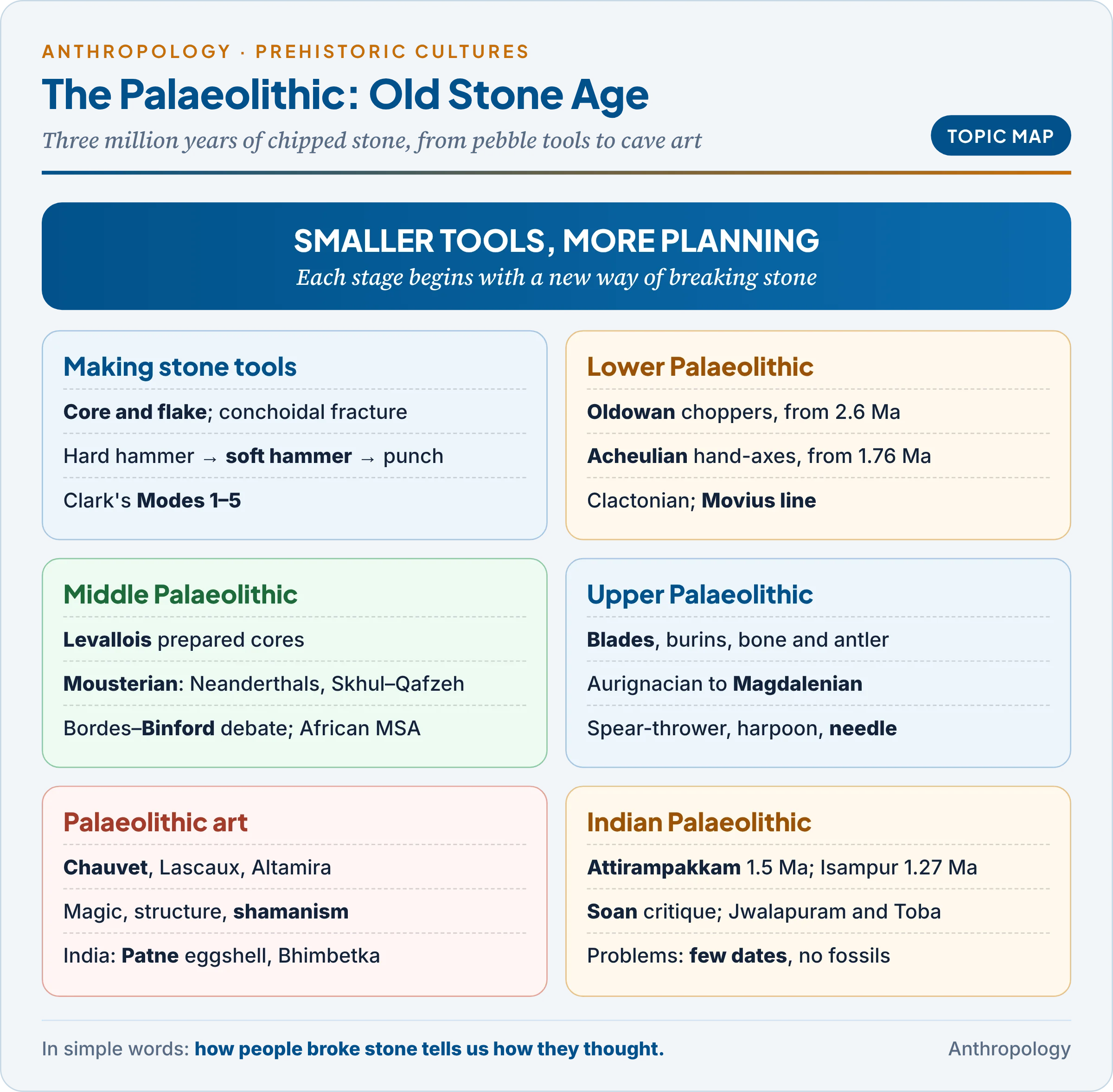
This article covers the Palaeolithic (Old Stone Age): its tool traditions and techniques, its three stages in the world and in India, and its art. Unit 1.8a explained how these cultures are dated: in brief, layers give their order, and radiocarbon, luminescence, ESR, argon and burial dating give ages in years. The makers were described in Units 1.6a–c: early Homo and perhaps Paranthropus (Oldowan), H. erectus and H. heidelbergensis (Acheulian), Neanderthals and early H. sapiens (Middle Palaeolithic), and H. sapiens (Upper Palaeolithic). The Mesolithic onwards follows in Unit 1.8c.
1. The Palaeolithic and the Making of Stone Tools
In simple words
The Palaeolithic is the long age, from over 3 million to about 12,000 years ago, when people lived by hunting and gathering and made tools by chipping stone. Over this time tools became smaller, more varied and more carefully planned. Each stage is recognised by a new way of breaking stone.
1.1 Meaning and divisions
Example first. At Isampur in the Hunsgi valley, Karnataka, the Indian archaeologist K. Paddayya and the American archaeologist Michael Petraglia (late 1990s) excavated an Acheulian quarry-workshop where people split slabs of limestone, shaped hand-axes and cleavers, and left the broken cores, flakes and hammerstones lying where they worked, about 1.27 million years ago. A Palaeolithic culture is reconstructed from exactly such debris: how stone was broken tells who broke it and how they thought.
- Term: John Lubbock coined Palaeolithic (“old stone”) in 1865 for the age of chipped stone tools, against the Neolithic of polished tools.
- Span: from the first stone tools (Lomekwi, Kenya, about 3.3 million years; the Oldowan from about 2.6 million years) to the end of the Pleistocene, about 11,700 years ago. It covers over 99% of human history.
- Three stages, defined by technology, not by fixed dates, so they begin at different times in different regions:
- Lower Palaeolithic: pebble tools and hand-axes (Oldowan, Acheulian)
- Middle Palaeolithic: prepared-core flake tools (Levallois, Mousterian)
- Upper Palaeolithic: blades, bone and antler tools, and art
- Other names: Africa uses Earlier, Middle and Later Stone Age (John Goodwin and Clarence van Riet Lowe, 1929); H.D. Sankalia spoke of Series I, II and III at Nevasa.
The British prehistorian Grahame Clark (World Prehistory, 1969) replaced regional culture names with five technological modes, which allow comparison across continents.
| Mode | Technology | Typical industry | Approximate start |
|---|---|---|---|
| Mode 1 | Simple cores and flakes, choppers | Oldowan, Soanian | 2.6 million years |
| Mode 2 | Large bifaces: hand-axes, cleavers | Acheulian | 1.76 million years |
| Mode 3 | Prepared cores, flake tools | Levallois, Mousterian, MSA | About 400,000–300,000 years |
| Mode 4 | Prismatic blades, burins | Upper Palaeolithic | About 50,000–45,000 years |
| Mode 5 | Microliths in composite tools | Late Upper Palaeolithic, Mesolithic | India about 48,000 years |
The modes show a long trend: more cutting edge per kilogram of stone, smaller tools and more planning before the final blow. They describe technique, not people: one mode appears among several species.
1.2 Techniques of stone working
Good tool stone (flint, chert, quartzite, basalt, obsidian) breaks with a conchoidal fracture, a shell-shaped break that gives a sharp, predictable edge. The piece struck is the core; the piece removed is the flake, with a striking platform and a bulb of percussion (a swelling below the point of impact) that let archaeologists tell a man-made flake from a naturally broken stone.
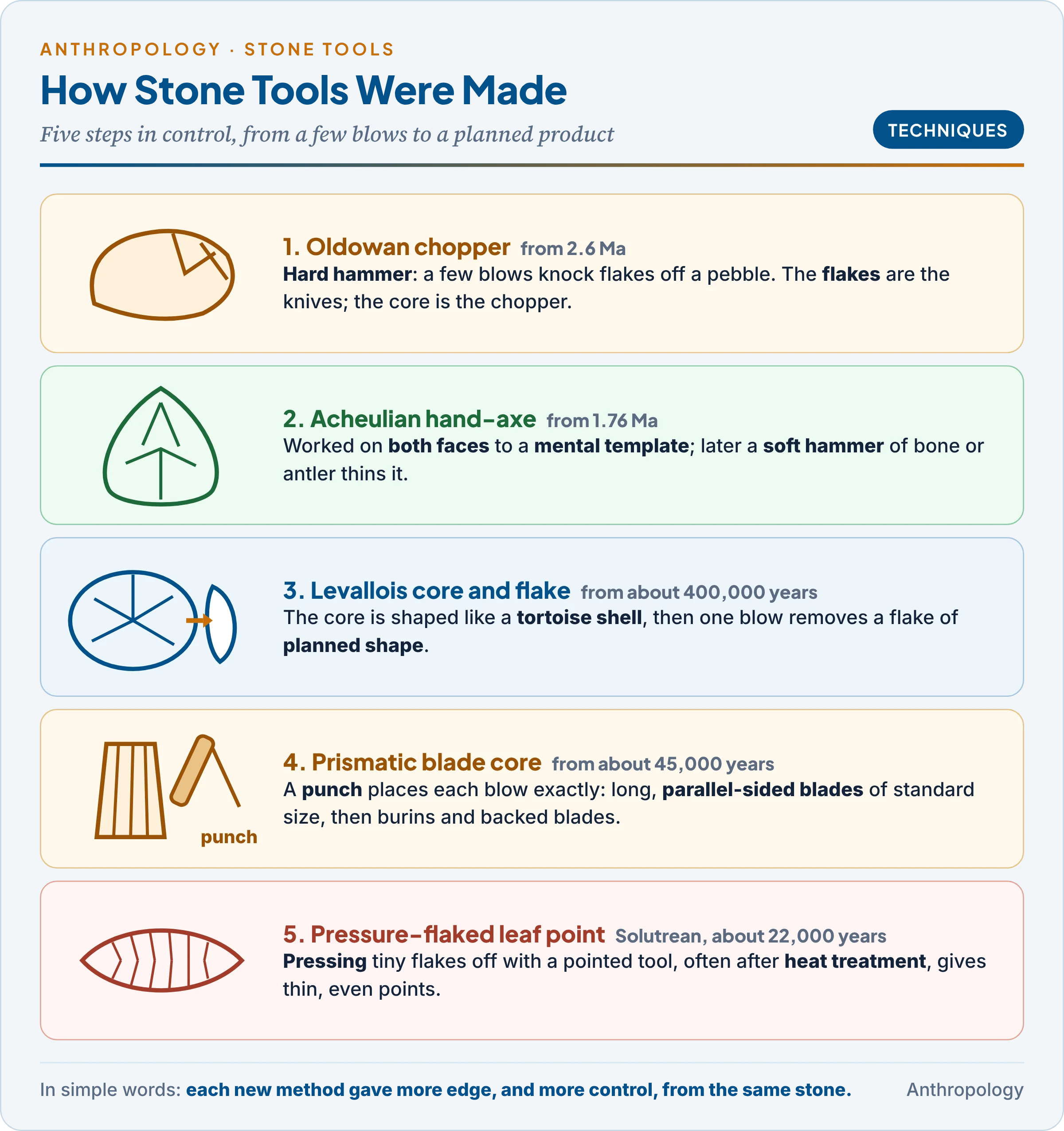
The table lists the main techniques in roughly the order they appeared; each gave more control over the shape of the product.
| Technique | How it is done | Where it marks |
|---|---|---|
| Direct hard-hammer percussion | Striking a core with a hammerstone | Oldowan, early Acheulian |
| Anvil (block-on-block) | Swinging the core against a fixed stone | Clactonian, large flakes |
| Bipolar | Core rested on an anvil and struck from above | Small quartz pebbles (Soanian, Indian quartz industries) |
| Soft-hammer (cylinder hammer) | Striking with bone, antler or wood | Thin, symmetrical late Acheulian hand-axes |
| Prepared core (Levallois, discoid) | Shaping the core so one blow gives a planned flake | Middle Palaeolithic |
| Indirect percussion (punch) | A punch of antler set on the core and struck | Upper Palaeolithic blades |
| Pressure flaking | Pressing tiny flakes off with a pointed tool | Solutrean leaf points, microliths |
| Heat treatment | Heating stone to make it flake more evenly | Solutrean; South African MSA |
The soft hammer spreads the force, removing long, shallow flakes that thin a biface without breaking it; the punch places each blow exactly, so blade after blade of standard size comes from one core. Each step trades more time and skill for better, more economical tools.
2. The Lower Palaeolithic
In simple words
The Lower Palaeolithic is the age of the first stone tools: sharp flakes and pebble choppers, and later the teardrop-shaped hand-axe. It lasted well over two million years. Its people scavenged and hunted, gathered plants and slowly learned to use fire.
2.1 The Oldowan tradition
- Name and discovery: from Olduvai Gorge, Tanzania, where Louis and Mary Leakey worked from the 1930s. Mary Leakey’s classification (1971) gave the types: choppers (an edge worked on one or both faces), polyhedrons, discoids, spheroids, scrapers and burins.
- Date: from about 2.6 million years (Gona, Ethiopia) and 3.03–2.58 million years at Nyayanga, Kenya, to about 1.7 million years; a Developed Oldowan with more scrapers and crude bifaces continued later.
- Technique: a hammerstone knocked a few flakes off a water-worn pebble about the size of a tennis ball. The flakes, held between thumb and fingers, were the real cutting tools; the remaining core was a chopper. Toolmakers carried good stone over kilometres and chose basalt, quartz or chert, showing they recognised raw-material quality.
- Makers: early Homo (H. habilis, “handy man”, named 1964); Paranthropus teeth at Nyayanga raise the possibility that it also used tools (Unit 1.6a).
- Uses: cut marks and percussion marks on bones show butchery and marrow extraction; use-wear shows plant processing.
- Spread: Oldowan tools at Dmanisi, Georgia, about 1.8 million years ago, are the first evidence of toolmakers outside Africa.
Life of the Oldowan hominins. Sites lie by lakes and streams in savanna-woodland. Glynn Isaac read the bone-and-tool scatters of Koobi Fora as home bases where food was shared; Sherwood Washburn and C.S. Lancaster (1968) made hunting the driver of cooperation. Lewis Binford objected that the bones showed scavenging from carnivore kills. The current view combines both: scavenging and some hunting, with sharing at favoured spots.
2.2 The Acheulian tradition
The Acheulian hand-axe was examined with Homo erectus in Unit 1.6b: in brief, it is a biface worked on both faces to a mental template, with cleavers and picks, first at Kokiselei (Kenya, about 1.76 million years), and the most long-lived tool form in history, lasting to about 200,000–170,000 years. Points to add here:
- Name: after Saint-Acheul, near Amiens, France, by the French prehistorian Gabriel de Mortillet; the cruder early bifaces of Europe were once called Abbevillian (after Abbeville).
- Development: early hand-axes are thick (hard hammer); later ones thin and symmetrical (soft hammer), as at Boxgrove, England (about 500,000 years). Late Acheulian knappers also shaped cores to get large flakes of planned form for cleavers, the root of the Levallois method (Hunsgi, Attirampakkam).
- Uses: butchering large animals, skinning, digging and woodworking; experiments show the hand-axe is an efficient butchery knife.
- Sites: Olorgesailie (Kenya), Kalambo Falls (Zambia), Gesher Benot Ya’aqov (Israel), Boxgrove; in India, Attirampakkam, Isampur, Didwana, Bhimbetka and the Narmada and Son valleys (§6).
2.3 Industries without hand-axes
- Clactonian (Clacton-on-Sea, England, about 400,000 years): heavy flakes struck by the anvil technique, notched pieces and choppers, but no hand-axes; a wooden spear tip was found there.
- Chopper–chopping tool complex: the American archaeologist Hallam Movius (1948) grouped the pebble-tool industries of Asia, the Soanian (Siwaliks), Anyathian (Myanmar), Patjitanian (Java), Choukoutienian (Zhoukoudian, China) and Tampanian (Malaya), east of the “Movius line“, where hand-axes were rare (Unit 1.6b).
- Why two traditions? Raw material (poor stone or bamboo in East Asia), environment (the British prehistorian Desmond Collins: chopper-tool groups in wooded, colder country, Acheulian groups on open grassland), activity or an early dispersal. Hand-axes about 803,000 years old in China’s Bose Basin show the line marks a difference of frequency, not a barrier.
2.4 Life in the Lower Palaeolithic
- Fire: traces at Wonderwerk Cave, South Africa (about 1 million years), and Gesher Benot Ya’aqov (about 790,000 years); hearths become common after about 400,000 years. Fire gave warmth, protection, light and cooked food.
- Wooden tools: the Schöningen spears of Germany (about 200,000 years, by 2025 re-dating) show planned hunting of horses with throwing spears.
- Groups: small, mobile bands of perhaps 20–30 people, following game and water; Acheulian groups moved into cold Europe and the Indian monsoon belt, avoiding dense rainforest and true desert.
3. The Middle Palaeolithic
In simple words
In the Middle Palaeolithic, toolmakers learned to shape a stone core first so that one blow produced a flake of the size and shape they wanted. Tools became smaller and more varied, and were often fixed to handles. Neanderthals in Europe and early modern humans in Africa and Asia made these tools.
3.1 The Levallois technique
Example first. At Attirampakkam, Tamil Nadu, layers dated by luminescence to 385,000–172,000 years contain small Levallois flakes and points instead of the big hand-axes below (Kumar Akhilesh and colleagues, 2018). The change is as old as similar changes in Africa, so the Middle Palaeolithic did not arrive late in India.
- Name: after Levallois-Perret, a suburb of Paris where such flakes were first found in the 19th century.
- The steps:
- Flake the edges of a nodule all round.
- Remove flakes across the upper face to make it gently domed, like a tortoise shell (“tortoise core”).
- Prepare a faceted striking platform at one end.
- One strong blow detaches a thin, broad flake of predetermined shape, sharp all round, ready for use or retouch.
- Variants: Levallois points (triangular), Levallois blades, and the discoid method (flakes removed round a disc-shaped core).
- Why it matters: the knapper must imagine the product inside the stone and plan several steps ahead. It also uses stone economically, giving long edges from small nodules.
- Date: from about 400,000–300,000 years in Africa, the Levant and Europe, growing out of late Acheulian prepared-core methods.
3.2 The Mousterian
Example first. The rock shelter of Le Moustier in the Vézère valley, Dordogne, France, gave its name to the Mousterian: flake tools of the Neanderthals, among them finely retouched side-scrapers and points. A Neanderthal youth was buried there.
- Date and range: about 300,000/250,000 to 40,000 years ago, from Europe through the Levant, Iraq and Central Asia to the Altai, with related industries in North Africa.
- Tool types: side-scrapers (many kinds), points, denticulates (saw-toothed tools), notches, borers and knives; few or no hand-axes, except in one variant.
- Composite tools: points and scrapers were hafted to wooden shafts and handles with birch-bark tar or resin, so a spear had a stone point, a wooden shaft and a binding: more parts, more planning.
- Variability: the Bordes–Binford debate. The French prehistorian François Bordes listed about 60 tool types and found five recurring Mousterian variants in France:
- Typical Mousterian: scrapers and points, few hand-axes
- Quina-Ferrassie (Charentian): very rich in scrapers
- Denticulate Mousterian: dominated by toothed tools
- Mousterian of Acheulian Tradition (MTA): type A with hand-axes, type B with fewer hand-axes and more knives and denticulates
- Micoquian (an eastern variant): lance-shaped hand-axes
The variants were read in four ways, and the debate shaped modern archaeology.
| Explanation | Scholar | Argument | Weakness |
|---|---|---|---|
| Cultural | François Bordes (1950s–60s) | Each variant is a separate tribe with its own tradition | Variants alternate in one cave without merging |
| Functional | Lewis and Sally Binford (1966) | Variants are tool kits for different tasks (butchery, woodworking) | Use-wear does not match the kits neatly |
| Chronological | Paul Mellars | Variants follow each other in time | Fits only some regions |
| Reduction | Harold Dibble (1980s) | Scrapers change shape as they are resharpened; “types” are stages of wear | Cannot explain all variation |
The debate shows that a tool type is not automatically a people. The present view combines function, raw material, resharpening and local tradition.
3.3 The makers and their way of life
- Neanderthals made the Mousterian of Europe and West Asia; but in the Levant, early modern humans at Skhul and Qafzeh (about 120,000–90,000 years) made almost the same Mousterian. One industry, two kinds of human: technology and biology need not coincide.
- Way of life (Unit 1.6c in detail): close-range hunting of reindeer, horse, bison and mammoth, often one species at a time; regular use of caves and rock shelters, hearths and skin coverings; burial of the dead (La Chapelle-aux-Saints, Kebara, Shanidar); care of the injured; pigments and pierced shells; speech probable.
- Cold adaptation: groups followed herds between summer tundra and winter forest; scrapers and awls show hide working, and lice genetics suggests clothing from about 170,000 years ago.
3.4 The Middle Stone Age of Africa
The African equivalent, the MSA (about 300,000–40,000 years), was made by early Homo sapiens (Jebel Irhoud, about 315,000 years). It shows “modern” behaviours long before the European Upper Palaeolithic:
- Pinnacle Point: shellfish and ochre, about 164,000 years; Blombos Cave (Christopher Henshilwood): engraved ochre and shell beads, about 75,000–73,000 years; Howiesons Poort (about 65,000–60,000 years): backed blades and engraved ostrich eggshell flasks.
- The American archaeologists Sally McBrearty and Alison Brooks (2000) called the idea of a sudden “Upper Palaeolithic revolution” in Europe “the revolution that wasn’t“: modern behaviour accumulated gradually in Africa.
The table compares the three stages, the comparison asked in 2020; read it across to see each trend grow.
| Feature | Lower Palaeolithic | Middle Palaeolithic | Upper Palaeolithic |
|---|---|---|---|
| Time (world) | 3.3 Ma – about 300,000 years | 300,000 – 40,000 years | 45,000 – 12,000 years |
| Main makers | H. habilis, H. erectus, H. heidelbergensis | Neanderthals, early H. sapiens | H. sapiens |
| Technology | Choppers, hand-axes, cleavers | Prepared cores, flake tools | Blades, burins, bone and antler |
| Key technique | Hard and soft hammer | Levallois | Punch, pressure flaking |
| Hafting | Rare | Common | Standard; spear-thrower, harpoon |
| Symbol and art | Almost none | Pigment, burial, ornaments | Cave art, figurines, music |
| Settlement | Small mobile bands | Caves and open sites | Larger camps, huts, seasonal rounds |
| Indian example | Attirampakkam, Isampur | Attirampakkam, Jwalapuram | Patne, Baghor, Kurnool caves |
4. The Upper Palaeolithic
In simple words
In the Upper Palaeolithic, people struck long, narrow blades from stone and made needles, harpoons and spear-throwers from bone and antler. They painted caves, carved figurines and buried their dead with ornaments. Groups grew larger and spread to every continent except Antarctica.
4.1 Blade technology and new materials
Example first. In September 1940, four teenagers in the Dordogne found the painted cave of Lascaux: hundreds of horses, aurochs, deer and signs, painted about 17,000 years ago by Magdalenian hunters. On the cave floor lay the tools that made such a life possible: blades, burins and pieces of worked antler.
- A blade is a flake at least twice as long as it is wide, with parallel sides, struck from a prismatic core (a cylinder of stone) usually with a punch. One kilogram of flint gives several times more cutting edge as blades than as Levallois flakes.
- Blade tools:
- burins: chisel-ended blades for grooving bone, antler and ivory
- end-scrapers for hides; borers for piercing
- backed blades and bladelets: one edge blunted so it can be set in a shaft
- points: Châtelperron, Gravette, shouldered and leaf points
- New materials and tools: with burins, people worked bone, antler and ivory into points (sagaies), eyed needles (tailored clothing), barbed harpoons, spear-throwers (the atlatl, which lengthens the arm and multiplies a spear’s speed) and bâtons percés (perforated antler rods, perhaps shaft-straighteners). The bow appears late.
- Why this mattered: projectiles killed from a distance, fishing gear opened rivers and coasts, and tailored clothing opened the coldest steppes.
4.2 The Upper Palaeolithic traditions of Europe
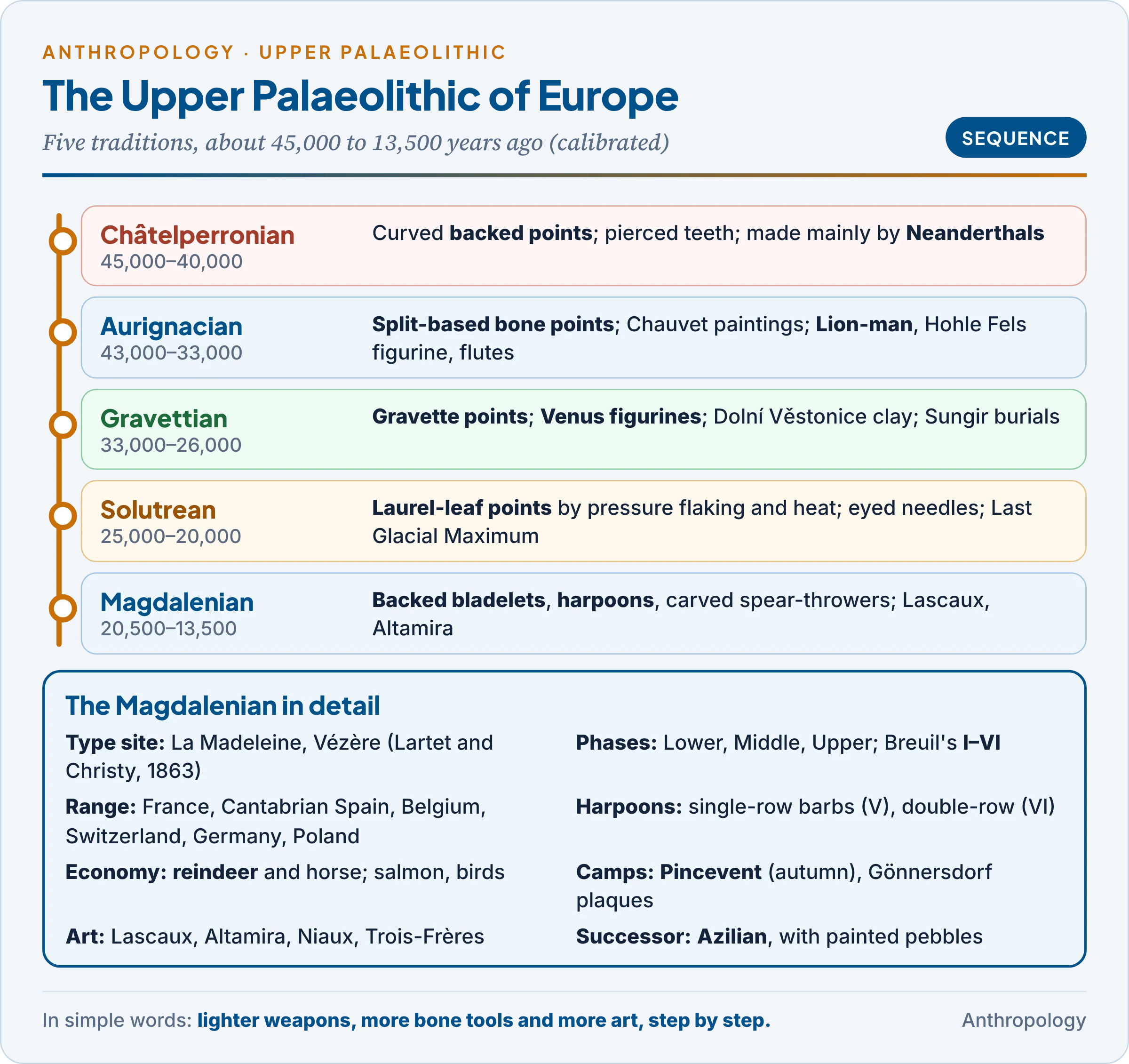
The French sequence, the best known, runs through five traditions. Dates are approximate calibrated years before present; the older scheme of Denis Peyrony called the first and third the Lower and Upper Périgordian.
| Tradition | Approximate date (cal BP) | Type site | Hallmark tools | Art and life | Makers |
|---|---|---|---|---|---|
| Châtelperronian | 45,000–40,000 | Châtelperron, France | Curved backed points, blades | Pierced teeth at Grotte du Renne | Neanderthals (mostly accepted) |
| Aurignacian | 43,000–33,000 | Aurignac, France | Split-based bone points, carinated scrapers | Chauvet paintings; ivory Lion-man, Hohle Fels figurine and flutes | H. sapiens |
| Gravettian | 33,000–26,000 | La Gravette, France | Gravette backed points | Venus figurines (Willendorf, Lespugue); fired-clay figures at Dolní Věstonice; rich burials (Sungir) | H. sapiens |
| Solutrean | 25,000–20,000 | Solutré, France | Laurel-leaf and willow-leaf points by pressure flaking and heat treatment; eyed needles | Lived through the Last Glacial Maximum | H. sapiens |
| Magdalenian | 20,500–13,500 | La Madeleine, France | Backed bladelets, harpoons, decorated spear-throwers | Lascaux, Altamira, Niaux | H. sapiens |
Read down the table and three trends stand out: projectile points become lighter and more varied, bone and antler take a larger share of tools, and art moves from rare ivory carvings to the great painted caves. In eastern Europe the sequence ends in the Epigravettian, with mammoth-bone huts at Mezhyrich, Ukraine (about 15,000 years).
4.3 The Magdalenian tradition
Example first. At Pincevent, on the Seine near Paris, the French prehistorian André Leroi-Gourhan (from 1964) uncovered, centimetre by centimetre, the hearths, flint-knapping spots and reindeer bones of a Magdalenian autumn camp. The scatters showed where families sat round each fire, where bones were cracked for marrow and where flint was worked: a snapshot of a hunting camp after 15,000 years.
- Characteristic features: the last and most elaborate Upper Palaeolithic tradition of western Europe, marked by microlithic backed bladelets set in bone points, a rich bone and antler industry and the peak of cave art.
- Chronology: about 17,500–12,000 radiocarbon years BP, roughly 20,500–13,500 calibrated years ago, from the end of the Last Glacial Maximum into the Late Glacial warming.
- Lower Magdalenian (with the related Badegoulian): about 17,500–15,000 BP
- Middle Magdalenian: about 15,000–13,500 BP; engraved and carved spear-throwers
- Upper Magdalenian: about 13,500–12,000 BP; barbed harpoons and small geometric armatures
- The French prehistorian Henri Breuil divided it into Magdalenian I–VI by the shapes of bone points and harpoons (single-row barbs in V, double-row in VI).
- Type site: La Madeleine, a rock shelter on the Vézère, Dordogne, excavated by Édouard Lartet and Henry Christy from 1863.
- Geographical distribution: France (Dordogne, Pyrenees, Paris Basin), Cantabrian Spain (Altamira, El Castillo), Belgium, Switzerland, Germany (Gönnersdorf, Andernach) and Poland, with related late groups in Britain (Creswellian). East of the Rhône, the contemporary tradition was the Epigravettian.
- Tool types:
- stone: backed bladelets, burins, end-scrapers, borers, and late triangles and other geometric microliths
- bone and antler: sagaies (spear points), uniserial and biserial harpoons, spear-throwers carved with animals (the “fawn with birds” of Mas d’Azil), bâtons percés, eyed needles
- Lifeways:
- Economy: specialised hunting of reindeer (dominant in the south-west) and horse (more in the north-east), with ibex, red deer, salmon and birds; reindeer at La Madeleine were killed in every season (Laure Fontana, 2017), while Pincevent was an autumn camp.
- Settlement: a seasonal round of small family camps and larger aggregation sites for exchange, marriage and ritual; skin huts; engraved slate plaques of animals and women at Gönnersdorf.
- Exchange: shells and good flint moved hundreds of kilometres.
- Art: the great painted caves (Lascaux, Altamira‘s polychrome bison ceiling, Niaux, Font-de-Gaume), the “Sorcerer” of Les Trois-Frères, the clay bison of Le Tuc d’Audoubert, and decorated tools.
- End: with Late Glacial warming, reindeer moved north, forests spread and the Magdalenian gave way to the Azilian (with painted pebbles) and other final Palaeolithic groups, the bridge to the Mesolithic (Unit 1.8c).
4.4 Upper Palaeolithic life
- Larger groups: far more sites than in the Mousterian, some with long-used huts.
- Social difference: at Sungir, Russia (about 34,000–30,000 years), a man and two children were buried with thousands of mammoth-ivory beads, each taking perhaps an hour to make. Such investment suggests status and inherited rank in some groups.
- Expansion: H. sapiens reached Australia by about 65,000–50,000 years (by sea), the Siberian Arctic by about 32,000 (Yana) and the Americas across Beringia (footprints at White Sands, New Mexico, about 23,000–21,000 years).
Common confusion
Is the Upper Palaeolithic the work of a new, smarter species that arrived suddenly? Not quite. In Europe, the Upper Palaeolithic does arrive with H. sapiens about 45,000 years ago and looks sudden. But in Africa the same capacities (blades, beads, engraving, pigment) appear piecemeal from 300,000 to 50,000 years ago in the Middle Stone Age, and Neanderthals made some ornaments too. The European “revolution” is a migration effect, not the birth of a new mind.
5. Palaeolithic Art
In simple words
Palaeolithic people painted and engraved cave walls and carved small figures of animals and women. The oldest art is over 50,000 years old. No one can ask the artists what it meant, so scholars have offered several explanations, from art for pleasure to hunting magic and the visions of shamans.
Example first. In Chauvet Cave, Ardèche, France, found in 1994, lions, rhinoceroses, horses and mammoths were drawn in charcoal with shading and perspective about 36,000 years ago, as skilful as the Magdalenian paintings made 20,000 years later. Art did not “evolve” from crude to fine; it appears fully formed with the first modern humans in Europe.
- Two kinds: parietal art on walls (paintings in ochre, charcoal and manganese, engravings, bas-reliefs, hand stencils) and mobiliary art on portable objects (figurines, plaques, decorated tools, beads).
- Earliest dated art: engraved ochre at Blombos (about 73,000 years); a painted pig and human-like figures at Leang Karampuang, Sulawesi (at least 51,200 years); hand stencils in Spanish caves claimed to be Neanderthal (over 64,000 years, disputed; Unit 1.6c).
- Venus figurines: small carvings of women with large breasts and hips, from the Hohle Fels figurine of Germany (at least 35,000–40,000 years) through the Gravettian Willendorf, Lespugue and Dolní Věstonice (fired clay) to Siberia.
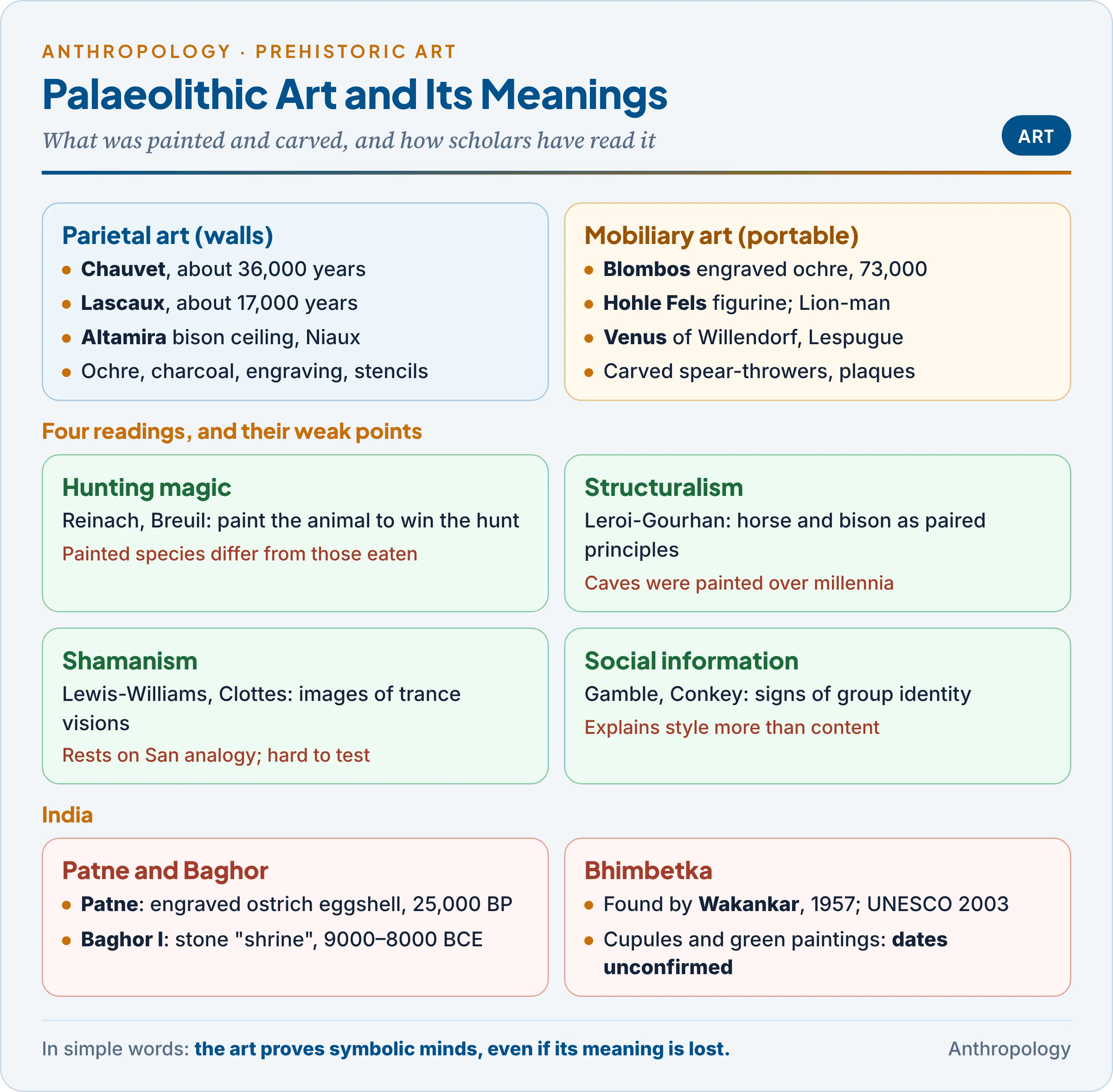
Scholars have read the same images in very different ways. The table sets the main interpretations beside the evidence that tests them.
| Interpretation | Scholars | Argument | Criticism |
|---|---|---|---|
| Art for art’s sake | Édouard Lartet, Gabriel de Mortillet (19th century) | Decoration by hunters with leisure | Images lie in deep, dark, hard-to-reach chambers, not living areas |
| Sympathetic (hunting) magic | Salomon Reinach (1903), Henri Breuil | Depicting an animal, sometimes wounded, ensured success in the hunt and the herds’ fertility | Painted species (horse, bison) often differ from those eaten (reindeer); few animals are shown wounded |
| Structuralist | Annette Laming-Emperaire (1962), André Leroi-Gourhan (1965) | Caves are planned compositions; horse and bison stand for paired male and female principles | The pairings are imposed by the analyst; dating shows caves were painted over thousands of years |
| Shamanistic | David Lewis-Williams, Jean Clottes (1990s) | Geometric signs and half-human figures record trance visions of shamans | Rests on analogy with the San of southern Africa; hard to test |
| Social information | Clive Gamble, Margaret Conkey | Art and ornaments marked group identity and alliance networks | Explains style better than content |
Each interpretation captures part of the evidence. Most specialists now accept that Palaeolithic art had many meanings, varying between caves and periods, and that it proves symbolic thought, shared conventions and the passing of knowledge across generations.
India. Indian Palaeolithic art is scarce and much of it is debated.
- Patne, Maharashtra: ostrich eggshell fragments with cross-hatched engraving and eggshell beads, about 25,000 BP by radiocarbon (S.A. Sali), the best-dated Palaeolithic art object in India.
- Bhimbetka, Madhya Pradesh: discovered by V.S. Wakankar in 1957; a UNESCO World Heritage Site (2003) with hundreds of painted shelters. Wakankar assigned large green and dark red linear animals (bison, tiger, rhinoceros) to the Upper Palaeolithic; this dating is not confirmed by direct methods. Cupules (cup-shaped hollows) in the Auditorium Cave and at Daraki-Chattan (Chambal valley) are claimed by Robert Bednarik and Giriraj Kumar as Lower Palaeolithic petroglyphs, a claim not yet securely dated.
- Baghor I, Son valley: a circular platform of sandstone around a natural triangular stone with concentric bands, very like stones still worshipped by local communities as the goddess (Shakti); dated to the terminal Upper Palaeolithic, about 9000–8000 BCE (Jonathan Mark Kenoyer, J. Desmond Clark, J.N. Pal and G.R. Sharma, 1983).
- Singi Talav, Rajasthan: six quartz crystals collected by Acheulian people, possibly the oldest non-utilitarian objects in India (Francesco d’Errico, Claire Gaillard and V.N. Misra, 1989).
- First discovery: the British archaeologist Archibald Carlleyle found rock paintings in Mirzapur (Uttar Pradesh) in 1867–68, about a decade before Altamira (1879) was recognised; those paintings are mostly Mesolithic and later (Unit 1.8c).
6. The Indian Palaeolithic
In simple words
India has one of the richest Palaeolithic records in the world, from hand-axes 1.5 million years old near Chennai to microliths 45,000 years old in central India. But most sites are scatters of stone tools without bones or dates, so scholars still argue about how the stages fit together and who made the tools.
6.1 History of research
- Robert Bruce Foote found the first Indian Palaeolithic tool at Pallavaram, near Chennai, in 1863, and soon after hand-axes at Attirampakkam (with William King).
- The Yale–Cambridge expedition of Helmut de Terra and T.T. Paterson (1935; report 1939) defined two Lower Palaeolithic traditions: the Soan pebble tools of the north-west and the Madras (Madrasian) hand-axes of the south, and tied the Soan to Himalayan glaciations.
- H.D. Sankalia (Deccan College) found a Middle Palaeolithic flake industry at Nevasa on the Pravara in the 1950s, the Nevasian, and made Indian prehistory a field science.
- From the 1970s: V.N. Misra (Bhimbetka, Didwana), G.R. Sharma (Belan and Son valleys), K. Paddayya (Hunsgi), S.A. Sali (Patne) and M.L.K. Murty (Renigunta, Kurnool caves) established the Upper Palaeolithic and a regional picture.
- Since 2000: luminescence, ESR and burial dating (Shanti Pappu, Michael Petraglia, Ravi Korisettar, James Blinkhorn) pushed the record back and tied it to monsoon history.
6.2 The Lower Palaeolithic in India
The Soanian. Named after the Soan (Sohan) river, a tributary of the Indus in the Potwar plateau, Pakistan.
- De Terra and Paterson’s scheme: Pre-Soan (large, heavily rolled flakes of doubtful human work), Early Soan on Terrace 1 (pebble choppers worked on one face and chopping tools worked on both, with flakes), Late Soan A (refined pebble tools and Levallois flakes) and Late Soan B (Levallois flakes and blades, no Acheulian elements), each matched to a glacial or interglacial stage. At Chauntra, hand-axes and cleavers lay with Soan pebble tools.
- Critique: Robin Dennell and Helen Rendell (1980s) found no independent Soanian tradition; V.N. Misra (1989) showed the terraces are erosional and cannot be dated by their tools. Most dated Mode 1 assemblages in India are younger than the Acheulian, so the Soanian is better seen as a raw-material and activity facies (pebble tools where quartzite cobbles abound) than as an older, separate culture.
- Indian Siwaliks: pebble tools on comparable terraces of the Beas, Banganga and Sutlej (B.B. Lal and B.S. Karir), and in the Hoshiarpur–Chandigarh Siwaliks, where G.C. Mohapatra (1976) argued that Soanian groups lived in the duns (valleys) and Acheulian groups on the frontal ridges.
The Acheulian. Found from the Siwaliks to Tamil Nadu, densest in central India and the south-eastern Eastern Ghats, but almost absent from the Western Ghats and west coast, Kerala, the Ganga plains and the North-East, where heavy rainfall, dense forest, alluvium or poor stone left few traces.
- V.N. Misra (1978) divided it into two stages by typo-technology:
- Early Acheulian: choppers, polyhedrons, spheroids, thick hand-axes, few crude cleavers, hard hammer, no Levallois (Singi Talav, Chirki-Nevasa, Hunsgi–Baichbal, Anagwadi, Kortallayar valley).
- Late Acheulian: fewer bifaces, more cleavers than hand-axes, many flake tools, soft hammer, Levallois and discoid cores (Bhimbetka, Raisen district, Tirupati valley, Hunsgi–Baichbal).
- Other regions: Odisha (Kuliana, Mayurbhanj), West Bengal (Sisunia, Bankura), the Krishna basin of Andhra Pradesh (Nagarjunakonda, Karempudi) and Adamgarh near Hoshangabad (Madhya Pradesh).
- Raw material decided form: quartzite at most sites, dolerite and basalt in western Maharashtra, limestone at Hunsgi and Isampur, granite in Bundelkhand. Indian cleavers made on large flakes are especially common, a regional hallmark.
- Dates: Attirampakkam 1.51 million years; Isampur 1.27 million years; the latest Acheulian at Singi Talav about 177,000 years and in the Son valley about 140,000 years, among the youngest in the world.
6.3 The Middle Palaeolithic in India
- Recognition: only after Sankalia’s Nevasa work (1950s); his Nevasian of scrapers, points and borers on chert, jasper and chalcedony was later shown by Sheila Mishra (1995) to include late Acheulian material.
- Features (Parth Chauhan, 2006): smaller artefacts; a shift from large bifaces to specialised flake tools; more prepared-core working (Levallois, discoid); and a preference for fine-grained stone. Tools: side and end scrapers, points, borers, denticulates, notches, flake-blades.
- Distribution: the Luni valley, Didwana and Budha Pushkar (Rajasthan); the Belan, Son and Narmada valleys; the Chota Nagpur plateau; the Deccan (Nevasa, the Godavari and its tributaries); the Eastern Ghats; often on dune surfaces in the Thar and in rock shelters in central India.
- Dates: Attirampakkam 385,000–172,000 years; Singi Talav 85,000–65,000; Jwalapuram, Kurnool district, Andhra Pradesh, tools below and above the Toba ash of about 74,000 years (Michael Petraglia and colleagues, 2007); Dhaba, Son valley, an unchanging industry from 80,000 to 65,000 years.
- Makers: unknown, since no hominin fossil accompanies these tools. Some link Jwalapuram and Dhaba to an early wave of H. sapiens before 74,000 years; others to archaic humans, with modern humans arriving with microliths about 50,000 years ago. The question is open.
6.4 The Upper Palaeolithic in India
- Late recognition: long denied because Indian sites lacked the bone tools and art of Europe. Work in the Belan valley (G.R. Sharma), at Patne (S.A. Sali) and at Renigunta (M.L.K. Murty, 1960s) established it.
- Distribution: the Belan and Son valleys (Baghor), Chota Nagpur, upland Maharashtra (Patne), Odisha, Bhimbetka, Gujarat (Visadi) and the Eastern Ghats (Renigunta, the Kurnool caves, Jwalapuram).
- Tools: blades and flake-blades from prismatic cores, burins, many kinds of scrapers, backed blades, points, lunates and triangles, and bored stones. Regional variety is marked: backed blades dominate in the Eastern Ghats.
- Bone tools: the Kurnool caves of Andhra Pradesh (Billa Surgam, explored by Foote in 1884; Muchchatla Chintamani Gavi, excavated by Murty) yielded bone and antler scrapers, awls and points.
- Microliths early: microlithic technology appears at Dhaba about 48,000 years, at Mehtakheri (Narmada valley) about 45,000 and at Jwalapuram about 35,000 years. In South Asia, microliths therefore begin in the Upper Palaeolithic, blurring the old line with the Mesolithic.
- Life and environment: grinding stones suggest processing of wild plants; fauna (wild water buffalo Bubalus, wild cattle Bos namadicus, hippopotamus Hexaprotodon, deer) shows grassland with forest patches; ostrich eggshells at 44 sites in Rajasthan, Madhya Pradesh and Maharashtra, radiocarbon-dated to about 40,000–25,000 BP, show drier conditions in western India.
- Ethnoarchaeology: bored stones like Upper Palaeolithic ones are still used as net-sinkers by Yanadi fishermen of Andhra Pradesh.
6.5 Palaeolithic sites of the Himalaya and sub-Himalaya
The northern sites form a distinct zone: quartzite pebble industries in river terraces and fans, with hand-axes in some places, set in a landscape shaped by Himalayan uplift and glaciation.
| Area | Sites | Typo-technology | Note |
|---|---|---|---|
| Potwar plateau (Pakistan) | Soan valley, Chauntra, Adiala; Riwat | Pebble choppers, chopping tools, flakes; hand-axes at Chauntra | Riwat flakes claimed at about 1.9 Ma (1988), disputed |
| Kangra and Beas–Banganga (Himachal) | Guler, Dehra Gopipur, Kangra; Nalagarh (Sirsa–Sutlej) | Soanian-type choppers on terraces; some bifaces | Terraces comparable to Potwar’s |
| Hoshiarpur–Chandigarh Siwaliks | Atbarapur; Masol | Soanian in duns, Acheulian on frontal range (Mohapatra) | Masol cut marks claimed at 2.6 Ma (2016), doubted |
| Kashmir | Pahalgam (Liddar valley); Balapura (Rembiara); Manasbal | A massive flake and a crude hand-axe (Sankalia, 1969); nine more tools including borers (1970) | Middle Pleistocene boulder bed; chopper-chopping tools at Balapura |
| Nepal Siwaliks | Dang-Deokhuri | Acheulian bifaces and pebble tools | Explored by Gudrun Corvinus |
The zone shows the Indian problem in miniature: rich tool scatters, weak dating, and terraces once tied to glacial stages that are now doubted.
6.6 Key Indian Palaeolithic sites
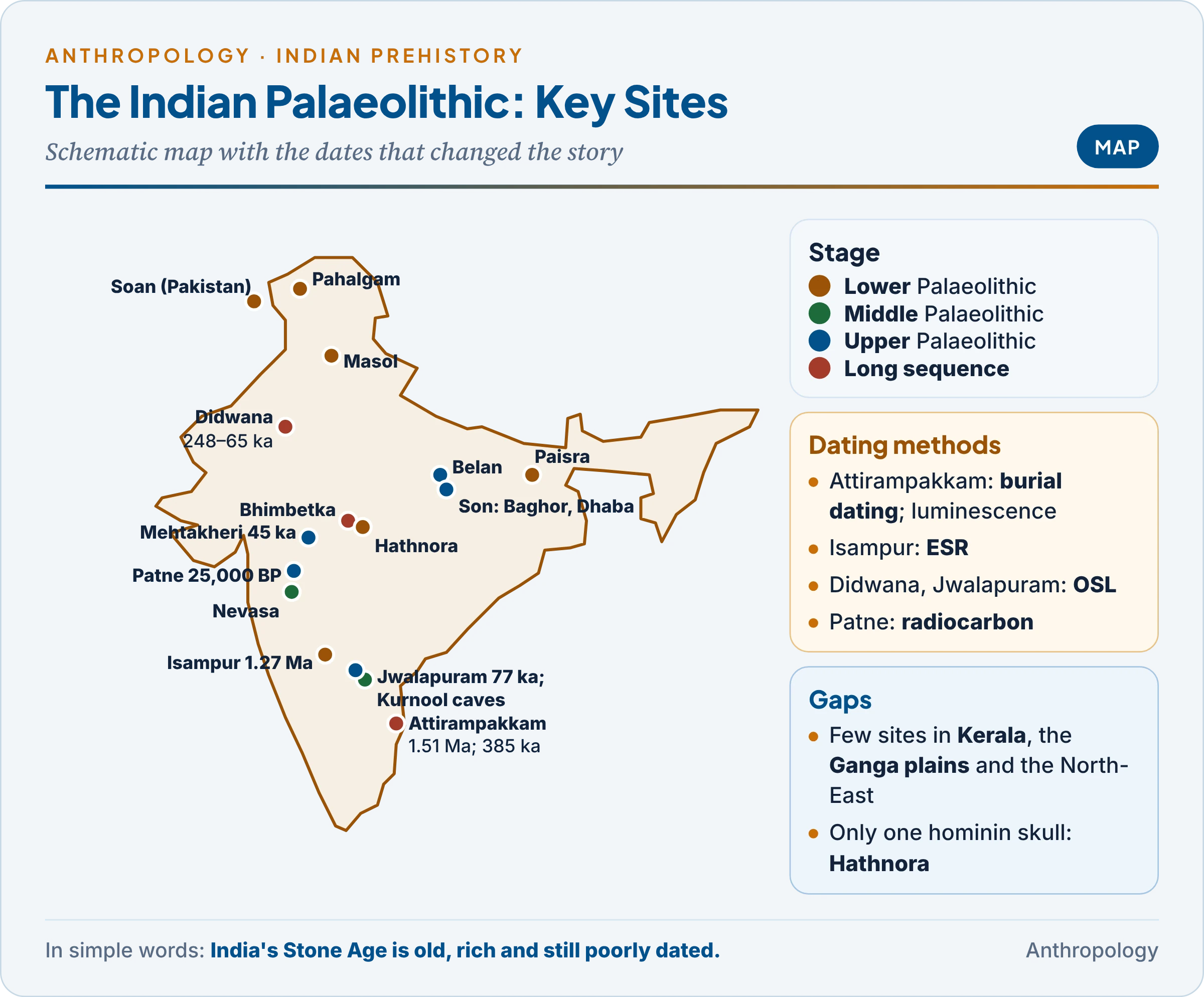
The table lists the sites most used in answers. Read the date column with its method: the newer dates (luminescence, ESR, burial) have changed the story most.
| Specimen / Culture | Site | Date (method) | Traits | Significance |
|---|---|---|---|---|
| Early Acheulian | Attirampakkam, Tamil Nadu | 1.51 ± 0.07 Ma (burial dating, palaeomagnetism) | Hand-axes, cleavers on quartzite | Oldest dated Acheulian in India; first found by Foote, 1863 |
| Early Middle Palaeolithic | Attirampakkam | 385,000–172,000 years (luminescence) | Levallois flakes and points | MP as early as Africa’s |
| Acheulian quarry-workshop | Isampur, Hunsgi valley, Karnataka | 1.27 ± 0.17 Ma (ESR) | Limestone slabs, cores, bifaces, hammerstones | Reconstructs the whole knapping process |
| Late Acheulian to MP | Didwana (Singi Talav, 16R dune), Rajasthan | 248,000–65,000 years (OSL) | Bifaces; MP flakes; quartz crystals | Occupation at the edge of the Thar |
| Acheulian to microlithic | Bhimbetka, Madhya Pradesh | Sequence by stratigraphy | Acheulian at base, then MP, UP, microliths | Long cultural continuity; rock art |
| MP and the Toba ash | Jwalapuram, Andhra Pradesh | About 77,000 years (OSL) | Tools below and above ash | People survived the super-eruption |
| Upper Palaeolithic | Patne, Maharashtra | About 25,000 BP (radiocarbon) | Blades; engraved ostrich eggshell, beads | Earliest dated Indian art object |
| Terminal UP | Baghor I, Son valley | About 9000–8000 BCE (by stratigraphy) | Blade tools; stone platform | Possible earliest shrine |
| Archaic human | Hathnora, Narmada valley | Middle Pleistocene | Skull with Acheulian tools | Only hominin skull of its age in South Asia (Unit 1.6b) |
6.7 Problems of the Indian Palaeolithic
The Indian Palaeolithic, as a 2013 question put it, is neither chronologically homogeneous nor a uniform cultural phase. The problems are of three kinds.
- Typo-technological problems:
- European labels fit badly: “Lower, Middle, Upper” and “Mousterian” were defined in France; Indian assemblages often mix traits (Soanian pebble tools with Acheulian bifaces at Chauntra; Levallois within the late Acheulian; microliths within the Upper Palaeolithic).
- Raw material shapes typology: coarse quartzite and quartz limit fine retouch, so Indian tools look “cruder” and resist classification by European types.
- The Soan–Madras dichotomy of two separate traditions has collapsed under dating.
- Surface finds: many sites are assigned to a stage by typology alone, which is circular when typology itself is in question.
- Chronological problems: few datable materials, acidic soils that destroy bone, reworked river gravels and rare volcanic ash; and dated sites show long overlaps (the Acheulian lasting to about 140,000 years while Levallois began by 385,000).
- Environmental hypotheses: de Terra and Paterson linked cultures to glacial–interglacial terraces, and the German geologist Frederick Zeuner (1950) to pluvial–interpluvial phases in Gujarat. Both were abandoned. The present view links occupation to the monsoon: wetter phases filled lakes and rivers and drew people into the Thar (Singi Talav, 16R), while arid phases emptied the desert margins. The Toba eruption tested whether a sudden environmental shock broke the sequence; Jwalapuram and Dhaba suggest it did not.
- No makers: apart from the Narmada skull, there are no hominin fossils, so tool traditions cannot be tied to species.
6.8 The Palaeolithic environment of India
Example first. At Singi Talav, a small lake basin near Didwana, Rajasthan, phytoliths (silica bodies from grasses) and carbonate isotopes in the Acheulian layer of about 177,000 years show open grassland around a seasonal lake, in a monsoon wetter than today’s (James Blinkhorn and colleagues, 2021). The tools are the people; the sediments are their world.
The evidence for past environments comes from several sources, each with its own message.
| Evidence | What it shows | Indian example |
|---|---|---|
| Sediments | Gravels mean fast, high-energy rivers; silts mean floodplains; dunes mean aridity | Narmada and Son gravels; Thar dunes at 16R |
| Soils and calcretes | Red soils and laterites form in wet phases; calcrete in semi-arid ones | Singi Talav calcretes |
| Fauna | Hippopotamus and water buffalo need water; ostrich needs dry open land | Hexaprotodon in the Narmada; ostrich eggshells, 40,000–25,000 BP |
| Pollen and phytoliths | Vegetation type: forest, grassland, desert | Didwana lake pollen; Singi Talav phytoliths |
| Volcanic ash | A dated time line and a possible shock | Toba ash, about 74,000 years |
| Stable isotopes | Rainfall and C₃/C₄ vegetation | Carbonates and teeth from the Son and Thar |
Together they show a Pleistocene of wetter and drier monsoon phases, not ice ages. People favoured river valleys, lakes and hill edges with stone and water, avoided dense rainforest and entered the Thar in wet phases; the Last Glacial Maximum (about 26,000–19,000 years) was dry and cool, with spreading dunes and ostrich in western India.
Key Terms
| Term | Meaning in simple words |
|---|---|
| Core / flake | The stone struck / the piece knocked off it |
| Chopper / chopping tool | A pebble with an edge worked on one face / on both faces |
| Biface (hand-axe) | A stone shaped on both faces to a pointed oval |
| Cleaver | A biface with a straight cutting edge instead of a point |
| Soft hammer | A bone, antler or wood striker that removes thin flakes |
| Levallois technique | Shaping a core so one blow gives a flake of planned shape |
| Mousterian | The Middle Palaeolithic flake industry of Neanderthals |
| Blade | A flake at least twice as long as wide, with parallel sides |
| Burin | A chisel-ended stone tool for grooving bone and antler |
| Backed blade | A blade with one edge blunted for hafting |
| Microlith | A tiny stone insert, often geometric, set in a composite tool |
| Spear-thrower (atlatl) | A hooked rod that lengthens the arm to throw spears faster |
| Parietal / mobiliary art | Art on cave walls / on portable objects |
| Movius line | The old boundary between hand-axe and chopper-tool regions |
Contemporary Developments
- Chhajoli, Rajasthan (April 2026): luminescence dating of feldspar placed stone tools with bifaces, Levallois cores, bifacial hierarchical cores and blades at Chhajoli, Nagaur district, between 269,000 and 78,000 years, adding a second Middle Pleistocene site near Singi Talav at the edge of the Thar.
- New surface sites, undated (2026): over 500 quartz tools in Tiruchi, Pudukottai and Namakkal districts, Tamil Nadu (February), and Levallois tools in Deogarh, Odisha (April), were assigned to the Lower and Middle Palaeolithic by typo-technology alone, the Indian dating problem in action.
- Son valley periphery (September 2026): a 2012–2025 survey by the ASI’s Praveen Kumar and colleagues around the Middle Son valley recorded 787 artefacts, stratified Acheulian assemblages dominated by cleavers and hundreds of painted rock shelters in the Kaimur range (Journal of Lithic Studies).
- Mousterian in Dalmatia older (July 2026): OSL dates from Mujina pećina, Croatia, put Mousterian occupation at about 80,000–70,000 years, some 30,000 years earlier than thought (Ivor Karavanić and colleagues, Antiquity).
- Geometry on ostrich eggshell (February 2026): analysis of 112 engraved ostrich eggshell fragments from Diepkloof, Klipdrift and Apollo 11 (over 60,000 years old) showed that over 80% follow regular geometric rules (parallel lines, right angles, grids), comparable to the later engraving at Patne (PLOS One).
Diagrams to Master
- Topic map: techniques → Lower → Middle → Upper → art → India.
- Technique sequence: chopper, soft-hammer hand-axe, tortoise core and flake, blade core with punch, pressure-flaked point.
- European Upper Palaeolithic: Châtelperronian → Aurignacian → Gravettian → Solutrean → Magdalenian, each with dates, a hallmark tool and an art work.
- Art panel: parietal and mobiliary; four interpretations with one criticism each; Patne, Bhimbetka, Baghor.
- Indian map: Pahalgam, Soan, Masol; Didwana; Bhimbetka, Hathnora, Belan, Son; Nevasa, Patne; Isampur, Jwalapuram, Kurnool caves, Attirampakkam, with dates.
Revision Grid
| Scholar | Work (year) | Key idea |
|---|---|---|
| Robert Bruce Foote | 1863 | Pallavaram and Attirampakkam |
| de Terra and Paterson | 1935; report 1939 | Soan and Madras traditions |
| Movius | 1948 | Chopper-chopping tool complex; Movius line |
| Sankalia | 1950s | Nevasian Middle Palaeolithic; Series I–III |
| Bordes | 1950s–60s | Mousterian variants |
| Leroi-Gourhan | 1964–65 | Pincevent; structuralist reading of art |
| Binford and Binford | 1966 | Functional view of the Mousterian |
| V.N. Misra | 1978; 1989 | Early and late Acheulian; Soan critique |
| McBrearty and Brooks | 2000 | “The revolution that wasn’t” |
| Pappu and colleagues | 2011 | Attirampakkam 1.5 Ma |
| Akhilesh and colleagues | 2018 | Indian MP 385,000 years |
Previous Year Questions
Unit 1.8: Palaeolithic cultures
- 2026Give the distribution of Palaeolithic sites around the Himalayan and Sub-Himalayan areas, highlighting the typo-technologies of the tools.
- 2026Write a detailed note on the characteristic features, chronology, geographical distribution, tool types and lifeways of Magdalenian cultural tradition of Europe.
- 2025Write a note on Mousterian tool tradition, Mousterian culture and its makers.
- 2024Discuss the Acheulian and Oldowan traditions of Indian Paleolithic cultures with suitable illustrations.
- 2023Discuss the Paleolithic environment in light of available evidences with special reference to India.
- 2022Discuss with suitable examples the typo-technological problems in Indian palaeolithic industry with reference to environmental hypotheses.
- 2020Differentiate between Lower Palaeolithic culture and Middle Palaeolithic culture with suitable examples.
- 2019Discuss briefly the major traditions in the Upper Palaeolithic culture of Europe.
- 2015Write a note in 150 words on Palaeolithic culture.
- 2013Give a broad outline of Paleolithic culture emphasizing upon its tool technology. (250 words).
- 2012Discuss the typology and distribution of Upper Paleolithic cultures in India.
- 2006Write a note on Lower Paleolithic Culture.
Related questions from other units and Paper II
- 2025Unit 1.1: Write notes on: ‘Soanian cultural’ tradition.
- 2025Unit 1.1: Describe the distinctive features and distribution of Upper Palaeolithic of India.
- 2024Unit 1.1: Describe the important Paleolithic sites from South India with suitable examples. What is the significance of South Indian Paleolithic cultures?
- 2021Unit 1.1: Give the distribution and characteristic features of Upper Paleolithic culture in India.
- 2019Unit 1.1: Describe the Palaeolithic culture with special reference to Soanian tradition. Indicate the problems of describing the Indian Palaeolithic.
- 2015Unit 1.1: Write a note in 150 words on South Indian Paleoliths.
- 2015Unit 1.1: Write a note in 150 words on Prehistoric Rock Art of Central India.
- 2013Unit 1.1: Indian Paleolithic culture can neither be conceived chronologically homogeneous nor as a uniform cultural homogeneous nor as a uniform cultural phase. Discuss. (250 words).
- 2013Unit 1.1: Discuss the contributions of H.D. Sankalia to prehistoric anthropology in lndia. (250 words).
- 2012Unit 1.1: Write a note in 150 words on Palaeolithic Art.
- 2012Unit 1.1: Compare the salient features and distribution of the Mid.die Palaeolithic and Upper Palaeolithic cultures in India. Add a note on the tool traditions of the Upper Palaeolithic period.
- 2012Unit 1.2: Write a note in 150 words on Soan culture.
- 2011Unit 1.1: Discuss the significance of Sohan in Indian Prehistory.
- 2010Unit 1.6: Why are Neanderlands called Premodern humans ? The Upper Palaeolithic period provides evidence of their coexistence with modern man. Discuss.
- 2004Unit 1.1: Write a note on Typo-technology of Indian Palaeolithic Culture.
- 2001Unit 1.1: Critically examine evidence of Upper Paleolithic in India. Discuss its characteristics.
- 1996Unit 1.1: Discuss the cultural characteristics of Upper Palaeolithic period. Indicate. Its genesis and development in Indian context pointing to distribution and chronology.
- 1995Unit 1.1: Bring out the salient features of Lower Palaeolithic Culture complex in the Peninsular and extra Peninsular India.
- 1994Unit 1.1: Point out the salient features of Middle Palaeolithic industries and their makers. Illustrate your answer with examples from India.
- 1989Unit 1.1: Discuss the stratigraphic and chronological position of the Middle Stone Age industries in India and describe their significant features.
- 1987Unit 1.1: Bring out the features which make the Indian palaeolithic complex distinctive.
- 1984Unit 1.1: Place the Soan culture in the palaeolithic chronology in India and point out how it is distinguished from the Madrasian culture.
- 1982Unit 1.1: Examine the evidence of upper paleolithic cultures in different regions of India. ·.