

1.8 Principles of Pre-historic: Archaeology, Chronology, Relative and Absolute Datings Methods; Cultural Evolution – Broad Outlines of Prehistoric cultures: Paleolithic, Mesolithic, Neolithic, Chalcolithic, Copper-Bronze Age and Iron Age
Official Syllabus: Paper I, Unit 1.8
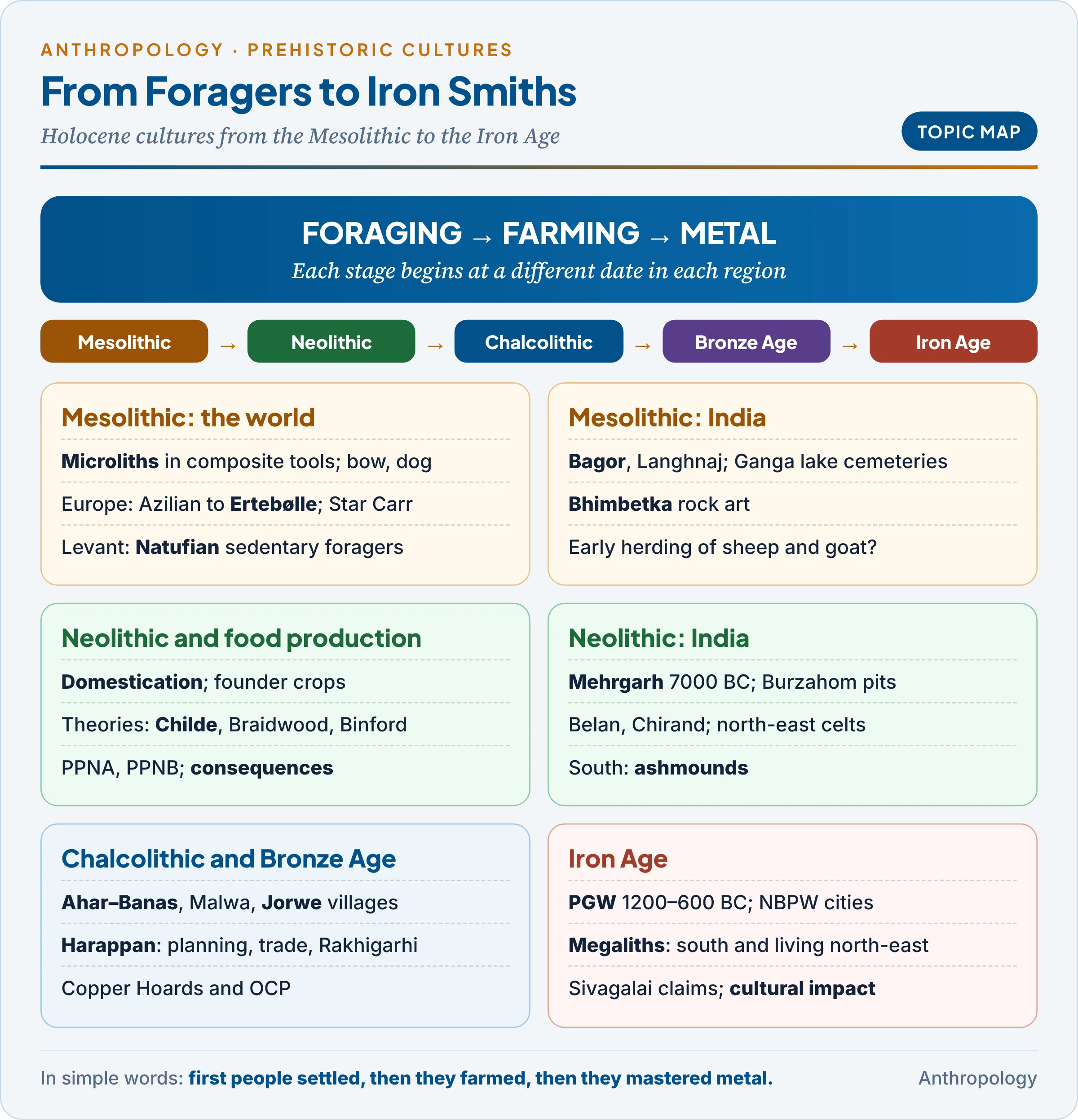
This article follows culture from the end of the Ice Age to the beginning of history. Unit 1.8a explained the dating methods used here: mainly radiocarbon (on charcoal, seeds and bone) and, for pottery and sediments, luminescence. Unit 1.8b covered the Palaeolithic, ending with Upper Palaeolithic blades and the first Indian microliths (Mehtakheri, about 45,000 years). The story now begins in the Holocene, the present warm epoch, from 11,700 years ago.
1. The Mesolithic: Hunter-Gatherers of the Holocene
In simple words
When the last Ice Age ended, forests replaced open grasslands and the big herds disappeared. People adjusted by hunting smaller animals, fishing, collecting plants and making tiny stone blades that were fitted into arrows and sickles. This adjustment, between the Old Stone Age and farming, is the Mesolithic.
1.1 Meaning, environment and technology
- Term: Mesolithic (“middle stone”) was proposed by Hodder Westropp in 1866. The French archaeologist Édouard Piette filled the gap between Palaeolithic and Neolithic in 1887 with the Azilian layers of Mas d’Azil.
- Environment: a warmer, wetter climate, rising seas and spreading forests; mammoth and the great reindeer herds vanished, so game became smaller and scattered (red deer, boar, elk).
- Broad-spectrum economy: the American archaeologist Kent Flannery (1969) named the response a broad-spectrum revolution: people ate many more kinds of food (fish, shellfish, birds, nuts, seeds). A wide diet lowers the risk that one food fails, so groups could stay longer in one place.
- Microliths: tiny pieces of 1–5 cm, non-geometric (backed bladelets, points) or geometric (triangles, trapezes, lunates). In the microburin technique a blade is notched and snapped at the notch, leaving a waste piece (the microburin) and a sharp segment for trimming.
- Composite tools: several microliths set with resin in a wooden or bone shaft made arrows, harpoons, knives and sickles; a broken insert was simply replaced.
- Bow, dog and boat: the bow let hunters kill from a distance in forest; the dog (tamed from the wolf over 15,000 years ago) helped track game; dugout canoes (Pesse, Netherlands) and nets opened rivers and coasts.
- Late features: ground stone axes and, among some foragers, pottery (Ertebølle, Jomon): pottery does not require farming.
Decline or adaptation? Older writers called the Mesolithic a degeneration because art became small and schematic. The British prehistorian Grahame Clark, excavator of Star Carr (1949–51), showed a successful adaptation: planned seasonal movement, carpentry, boats and organic tools.
1.2 The European Mesolithic traditions
The term began in Europe, and bogs there preserve wood and bone, so the European sequence is the classic one. Read the table as a set of local adaptations to coast, lake and forest.
| Tradition | Area and type site | Hallmarks |
|---|---|---|
| Azilian | Mas d’Azil, French Pyrenees | Short backed points, flat antler harpoons, painted pebbles |
| Sauveterrian | Sauveterre-la-Lémance, south-west France | Very small geometric triangles (Early Mesolithic) |
| Tardenoisian | Fère-en-Tardenois, northern France | Geometric microliths dominated by trapezes |
| Asturian | Cantabrian coast, northern Spain | Pebble picks for prising shellfish; shell middens |
| Larnian | Larne, Northern Ireland | Heavy flint flakes and blades on raised beaches |
| Maglemosian | Danish bogs to England (Star Carr) | Bone and antler harpoons, axes, dugouts, paddles |
| Ertebølle | Denmark, 5400–3950 BC | Kitchen middens (køkkenmøddinger, shell heaps), pointed-base pottery, near-sedentary villages |
| Campignian | Campigny, northern France | Heavy picks and tranchet axes |
The diversity shows that the Mesolithic was many regional cultures, not one. Ertebølle foragers traded with neighbouring farmers for centuries before farming themselves, a classic forager–farmer frontier.
- Star Carr (Yorkshire, about 11,000 years ago): a wooden lakeside platform and 21 red-deer antler headdresses for ritual or hunting disguise. Cemeteries at Skateholm (Sweden) with dog burials, and the skull nests of Ofnet (Bavaria), show claimed territories and violence.
1.3 The Near East: Kebaran and Natufian
In the Levant (the eastern Mediterranean coast) this stage is called the Epipalaeolithic, because the change began before the Holocene.
- Kebaran (about 20,000–14,500 years ago): mobile foragers with narrow microliths; at earlier Ohalo II (about 23,000 years) wild grass seeds and a grinding stone show cereal gathering long before farming.
- Natufian (about 15,000–11,700 years ago), named by the British archaeologist Dorothy Garrod after Wadi an-Natuf (1928):
- Villages of round, partly sunken stone houses, as at Ain Mallaha: the first sedentary foragers.
- Sickle blades with sickle gloss (a polish left by silica in cereal stalks), basalt mortars, storage pits; wild barley and wheat, acorns, gazelle.
- Burials under houses: a woman buried with a puppy at Ain Mallaha; an elderly woman with tortoise shells at Hilazon Tachtit, read as a shaman.
- Why it matters: the Natufians lived in villages and depended on cereals without domesticating them. When the cold, dry Younger Dryas (12,900–11,700 years ago) thinned wild stands, the Israeli archaeologist Ofer Bar-Yosef argued, such settled groups began to sow what they had gathered. The Natufian is the bridge between foraging and farming.
1.4 The Mesolithic of India
Example first. At Bagor, on the Kothari river in Bhilwara, Rajasthan, V.N. Misra excavated (1968–70) a dune-top camp with floors of stone slabs, thousands of geometric microliths of quartz and chert, and bones of wild deer and boar beside bones of sheep and goat. Phase I lasted from about 5000 to 2800 BC; in Phase II the same people used pottery and copper arrowheads; in Phase III, iron. One site shows foragers slowly drawing herding, pottery and metal from their neighbours.
- Discovery and date: A.C. Carlleyle found microliths in Vindhyan shelters in 1867; H.D. Sankalia‘s Gujarat expedition (1941–42) reached Langhnaj. The Mesolithic runs from about 10,000 BC to 2000 BC or later, beside farming villages.
- Raw materials: chert, chalcedony, agate, jasper, carnelian and, in the south and east, quartz.
The table groups the main regions; western India and the Ganga plain give the best evidence of settled life, central India of art, while the south and east are known mostly from surface finds.
| Region | Key sites (excavator) | What they show |
|---|---|---|
| Western India | Bagor (V.N. Misra); Langhnaj (Sankalia), Loteshwar | Dune camps by seasonal lakes; claimed sheep and goat; flexed burials |
| Central India | Bhimbetka (V.S. Wakankar), Adamgarh (R.V. Joshi) | Painted rock shelters; claimed domestic animals |
| Ganga plain | Sarai Nahar Rai, Mahadaha, Damdama (G.R. Sharma, J.N. Pal) | Oxbow-lake settlements, hearths, querns, cemeteries |
| Vindhya–Belan | Chopani-Mando, Lekhahia (G.R. Sharma) | Huts, wild rice, early pottery |
| East and South | Birbhanpur (B.B. Lal); Teri sites (Zeuner and Allchin) | Quartz microliths; coastal red-dune camps |
Typo-technology and economy
- Stages: an early non-geometric phase gives way to a geometric one; late phases add pottery and some ground stone. At Chopani-Mando (Belan valley) the sequence runs from the Palaeolithic to an advanced Mesolithic with beehive huts, ring-stones and hand-made cord-impressed pottery.
- Food: deer, nilgai, boar, rhino, wild cattle, fish and turtle; many querns at Mahadaha show heavy use of plant foods.
- Settlement: post-hole huts, stone paving and windbreaks, reoccupied season after season: a step towards sedentism (living in one place). The Ganga-plain lake sites combine hearths, storage pits and graves, which implies long stays.
Burials and the people
- Sarai Nahar Rai (1972–73): eleven graves of extended skeletons oriented west–east, one with four individuals; a date of 10,345 ± 110 BP on charred bone is doubted, because burnt bone often gives unreliable ages (Unit 1.8a).
- Mahadaha: double burials of a man and a woman, bone ornaments; AMS date 6320 ± 80 BP. Damdama: some forty graves.
- Grave goods imply belief in an afterlife; the American physical anthropologist Kenneth Kennedy found the people tall and robust.
Animal domestication in the microlithic industry. Sheep and goat at Bagor and Loteshwar, and dog, cattle, goat and pig at Adamgarh (about 5500 BC), have been claimed as South Asia’s earliest herding.
- For: wild sheep and goat never lived on the plains of Rajasthan and Gujarat, so their bones there must come from domestic animals, herded or obtained by exchange.
- Against: many identifications predate modern criteria (size reduction, culling profiles), and “cattle” could be wild aurochs; Adamgarh’s claims are widely treated as unproven.
Most likely some groups kept a few sheep and goats from farming neighbours, while hunting stayed the main source of meat.
Mesolithic rock art. Bhimbetka (Raisen, Madhya Pradesh), found by V.S. Wakankar in 1957 and a UNESCO World Heritage Site since 2003, has about 750 shelters.
- Themes: hunting with bows and barbed spears, animals driven over cliffs, honey collection, dances, masked figures and mourning scenes.
- Style: mostly red ochre and white; large patterned animals, small stick-like humans; later layers add historic horse riders.
- Other regions: the Kaimur hills of Mirzapur and Lakhudiyar near Almora (Uttarakhand). The paintings record daily life and, like Palaeolithic art (Unit 1.8b), are also read as ritual imagery.
Common confusion
Is every microlithic site Mesolithic? No. Microliths began in India about 45,000 years ago in the Upper Palaeolithic and continued among Chalcolithic farmers. The Mesolithic is a cultural stage: Holocene foragers whose tool kit is dominated by microliths. Africa’s “Middle Stone Age” is different again: the African equivalent of the Middle Palaeolithic.
2. The Neolithic and the Origins of Food Production
In simple words
In the Neolithic, people began to grow plants and keep animals instead of only collecting and hunting them. Farming tied them to their fields, so they built villages, stored grain in pots, and polished stone axes to clear forest. It changed population, property and social life more than anything before it.
2.1 Meaning: the “Neolithic Revolution”
- Term: John Lubbock (Prehistoric Times, 1865) defined the Neolithic by ground and polished stone tools; Miles Burkitt listed four traits: agriculture, domestic animals, polished stone and pottery.
- Childe’s revolution: the Australian-born archaeologist V. Gordon Childe made the phrase Neolithic Revolution famous in Man Makes Himself (1936) and called the Neolithic a “self-sufficient food-producing economy”: a community that grew and stored its own food. The second revolution, the Urban Revolution, produced cities (§4.1).
- Why “revolution”: not because it was sudden (it took 2,000–4,000 years) but because its consequences were as deep as the Industrial Revolution’s (§2.5).
Is it “self-sufficient”? For subsistence, yes; otherwise, no: villages traded obsidian, shell and stone axes over long distances. The traits also come apart: Near Eastern farmers lived without pottery for 2,000 years, while Jomon foragers made pottery without farming. Food production is the defining trait.
Universal stages? Childe’s revolutions echo Morgan‘s savagery–barbarism–civilization (Unit 6a); in Social Evolution (1951) he concluded that only the broad economic stages are universal, while regional sequences differ (neo-evolutionism, Unit 6h).
2.2 What domestication is
Domestication is a genetic change in a plant or animal produced by human selection, often unintended.
- Plants: wild wheat and barley have a brittle rachis (the stalk holding the grains), so ripe grains scatter. Sickle harvesters gathered the plants that held their grains; resown, these became fields of non-shattering cereals that need people to spread their seed. Seeds also grew larger and lost dormancy (delayed sprouting).
- Animals: herded animals become smaller and show culling profiles (young males killed, females kept); bones are judged domestic by such signs, not by the species alone.
- Founder crops: the Israeli botanist Daniel Zohary named eight: einkorn, emmer, barley, lentil, pea, chickpea, bitter vetch and flax.
Farming began independently in several centres, each with its own plants and animals. The table gives approximate dates.
| Centre | Earliest domesticates | Approximate date |
|---|---|---|
| Fertile Crescent | Wheat, barley, lentil; sheep, goat, cattle, pig | Plants 11,500; animals 10,500 years |
| China | Millets (Yellow river, later Yangshao); rice (Yangtze) | Millet 10,000–8,000; domestic rice 7,000 years |
| New Guinea | Taro, banana (Kuk Swamp) | 10,000–7,000 years |
| Mesoamerica | Squash (Guilá Naquitz), maize from teosinte, beans | Squash 10,000; maize 9,000 years |
| Andes | Potato, quinoa; llama, alpaca | 8,000–5,000 years |
| Africa | Sorghum, pearl millet; teff; cattle (debated) | 5,000–4,000 years |
| South Asia | Barley, zebu (Mehrgarh); rice, pulses, millets (Ganga, Deccan) | 9,000 years (Mehrgarh) |
Farming was invented several times, which rules out a single origin. Rice was first domesticated in China’s Yangtze valley, not in Thailand; the Ganga valley cultivated its own rice.
2.3 Why did people start farming? Theories of origin
Example first. The !Kung San of the Kalahari, studied by the American anthropologist Richard Lee (1960s), spent about 20 hours a week getting food, while early farmers worked harder and were often less healthy (§2.5). Why, then, farm? Each theory answers differently.
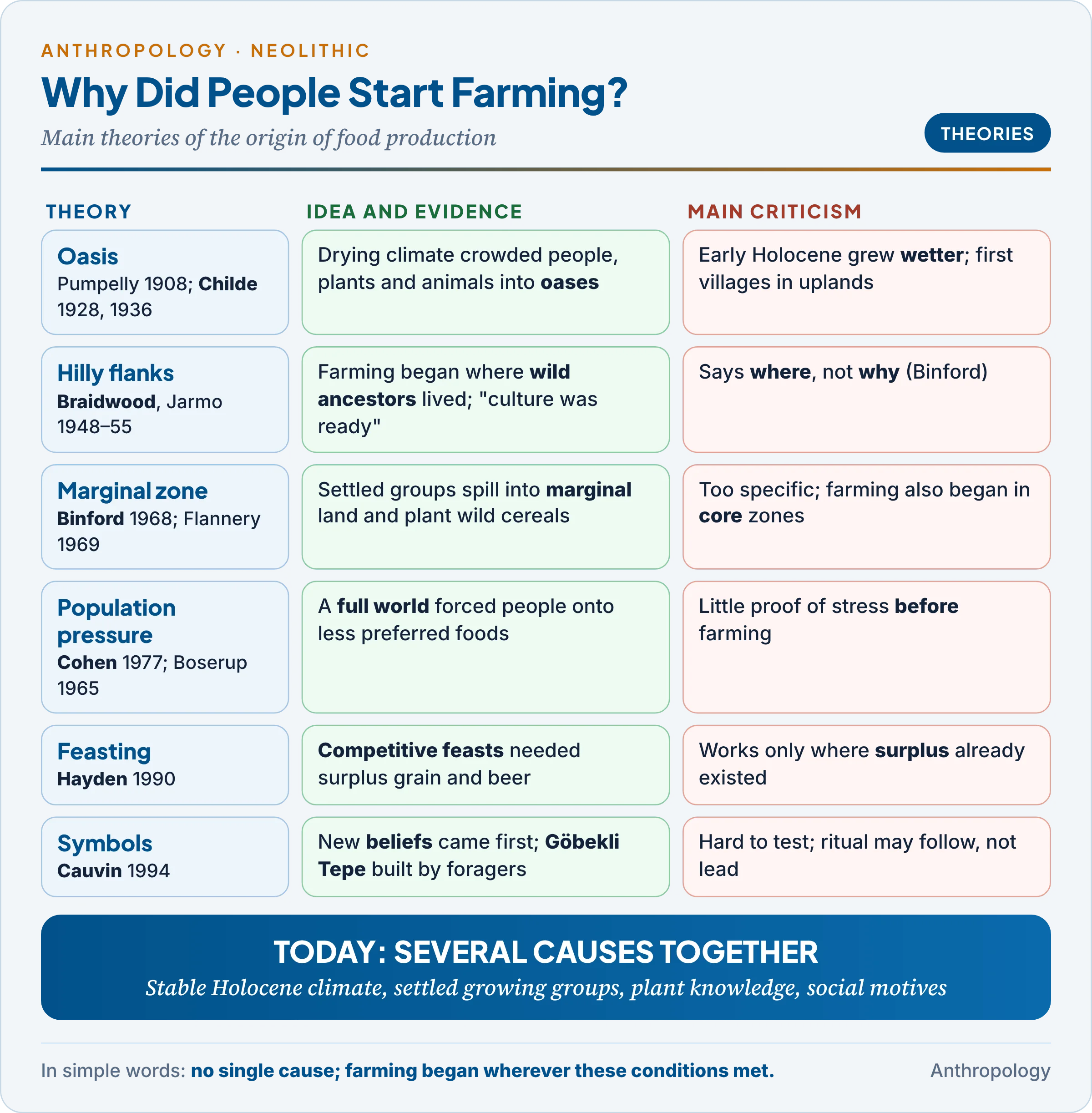
- Oasis theory (Raphael Pumpelly, 1908; Childe, 1928, 1936): a drying climate crowded people, animals and plants into oases, and this forced closeness led to taming and sowing.
- Criticism: the early Holocene Near East became wetter; the first villages (Jarmo) lie in rain-fed uplands; and earlier dry phases produced no farming.
- Hilly flanks or nuclear zone theory (Robert Braidwood, 1948–60s): from his excavations at Jarmo (Iraq), the American archaeologist argued that farming began where the wild ancestors of wheat, barley, sheep and goat lived together, the hilly flanks of the Fertile Crescent, once “culture was ready”.
- Criticism: it says where, not why; Lewis Binford objected that “readiness” names no cause.
- Marginal zone model (Lewis Binford, 1968; Kent Flannery, 1969): foragers keep numbers below what land supports; balance breaks when people from rich, settled coastal or lakeside zones spill into marginal zones and plant wild cereals to copy the dense stands they left.
- Criticism: too specific (it requires immigration as the trigger), and early farming also appears in core zones.
- Population pressure (Mark Cohen, The Food Crisis in Prehistory, 1977, after Esther Boserup, 1965): by the end of the Palaeolithic foragers had filled the world; growing numbers forced them onto less preferred foods and then to grow them. Circumscription (William Sanders and Barbara Price) applies this to closed valleys such as Tehuacán, Mexico.
- Criticism: evidence of food stress before farming is uneven; population growth is as much a result of farming as a cause.
- Feasting (Brian Hayden, 1990): ambitious individuals in rich settings held competitive feasts, needing surplus and special foods such as grain for beer.
- Criticism: it works only where surplus already existed.
- Revolution of symbols (Jacques Cauvin, 1994): a change in religion and thought came first: people began to see themselves as able to dominate nature. Göbekli Tepe (Turkey; Klaus Schmidt, from 1995), with carved T-shaped pillars raised by foragers about 11,500 years ago, suggests ritual gatherings preceded farming.
- Climate stability (Peter Richerson, Robert Boyd and Robert Bettinger, 2001): the unstable Pleistocene ruled farming out; the stable Holocene allowed it, and competition then made it almost compulsory.
Evaluation. No single cause fits every centre. Most archaeologists combine a changing then stable climate, growing, settled populations (the Natufian), knowledge of wild plants from the broad-spectrum Mesolithic, and social motives such as feasting and ritual; these met at different dates in different centres.
2.4 The Near Eastern sequence
The Near East shows the best-documented route from foraging to farming villages; read the table from top to bottom as a slow build-up.
| Stage | Date (approximate) | Key sites | What changes |
|---|---|---|---|
| Natufian | 15,000–11,700 years ago | Ain Mallaha | Sedentary foragers harvesting wild cereals |
| Pre-Pottery Neolithic A | 9600–8800 BC | Jericho, Göbekli Tepe | First cultivation; round houses; Jericho’s wall and tower |
| Pre-Pottery Neolithic B | 8800–7000 BC | Jarmo, Ain Ghazal, Ganj Dareh | Domestic cereals, goat, sheep; rectangular houses; plastered skulls |
| Pottery Neolithic | From about 7000 BC | Çatalhöyük, Hassuna, Halaf | Pottery, large villages, shrines, copper beads |
| Ubaid to Uruk | 6500–3100 BC | Eridu, Uruk | Irrigation, temples, then cities and writing |
- Jericho (Kathleen Kenyon, 1952–58): an 8.5-metre stone tower in the PPNA and plastered skulls of ancestors under PPNB floors. Çatalhöyük (Anatolia, about 7100–6000 BC; James Mellaart, Ian Hodder): houses entered through the roof, wall paintings, bull horns and obsidian trade.
2.5 Consequences of food production
Example first. Skeletal studies collected by Mark Cohen and George Armelagos (Paleopathology at the Origins of Agriculture, 1984) found early farmers had more tooth decay, anaemia and infection and shorter stature than earlier foragers, yet farmers multiplied and spread. Worse health but more people: this paradox explains the Neolithic’s consequences.
- Population growth: fields yield far more food per hectare, and soft foods (porridge, milk) allowed earlier weaning and shorter birth intervals.
- Sedentism and property: fields, stores and houses tied families to one place; land became property to inherit and defend.
- Surplus and inequality: stored surplus could be controlled and redistributed by lineage heads; leadership slowly became an office (Unit 4a), visible in house size and grave goods.
- Division of labour and gender: part-time potters, weavers and stone-workers; where the plough and herding passed to men, women’s status often fell, whereas it stayed high where women farmed (Iroquois).
- Disease: crowding and animals spread zoonoses (animal-to-human diseases such as measles and tuberculosis); Jared Diamond (1987) provocatively called farming “the worst mistake in the history of the human race”.
- Conflict and technology: walls and massacre sites; pottery, weaving, querns, later the wheel and plough.
- Secondary products revolution: the British archaeologist Andrew Sherratt (1981) argued that animals were first kept for meat; from the fourth millennium BC their milk, wool, dung and traction were used, opening plough farming and pastoral nomadism.
Neolithic Europe. Farming reached Europe from Anatolia about 6500 BC and spread with the Linearbandkeramik (LBK) farmers from about 5500 BC; ancient DNA shows a demic spread (by migrating people of Anatolian ancestry) more than by copying. Atlantic farmers later built megalithic tombs.
2.6 The Neolithic of India
India has no single Neolithic: regions began farming at different times, with different crops and neighbours. The table summarises them.
| Region | Key sites | Date (approximate) | Distinctive features |
|---|---|---|---|
| North-west | Mehrgarh | From about 7000 BC | Earliest farming: barley, wheat, zebu, mud-brick |
| Kashmir | Burzahom, Gufkral | 3000–1700 BC | Pit dwellings, bone tools, dog burials |
| Vindhya–Belan | Koldihwa, Mahagara | Disputed; probably 3rd–2nd millennium BC | Rice impressions on pottery, cattle pen |
| Middle Ganga | Chirand, Senuwar, Lahuradewa | 2500–1500 BC (Lahuradewa claimed earlier) | Rice, wheat, lentil; bone and antler tools |
| North-east | Daojali Hading (North Cachar hills), Sarutaru | About 2000–1000 BC | Shouldered celts, cord-marked pottery |
| South | Sanganakallu, Utnur, Budihal, Hallur, Brahmagiri, Maski, Tekkalakota | 3000–1200 BC | Ashmounds, cattle, native pulses and millets |
| East | Kuchai, Golbai Sasan (Odisha) | 2nd millennium BC | Shouldered celts, cord-impressed pottery |
The north-west and Kashmir share crops and animals with West and Central Asia, the north-east and east link with South-East Asia (shouldered celts, rice), and the Deccan and Ganga built largely on local plants and cattle.
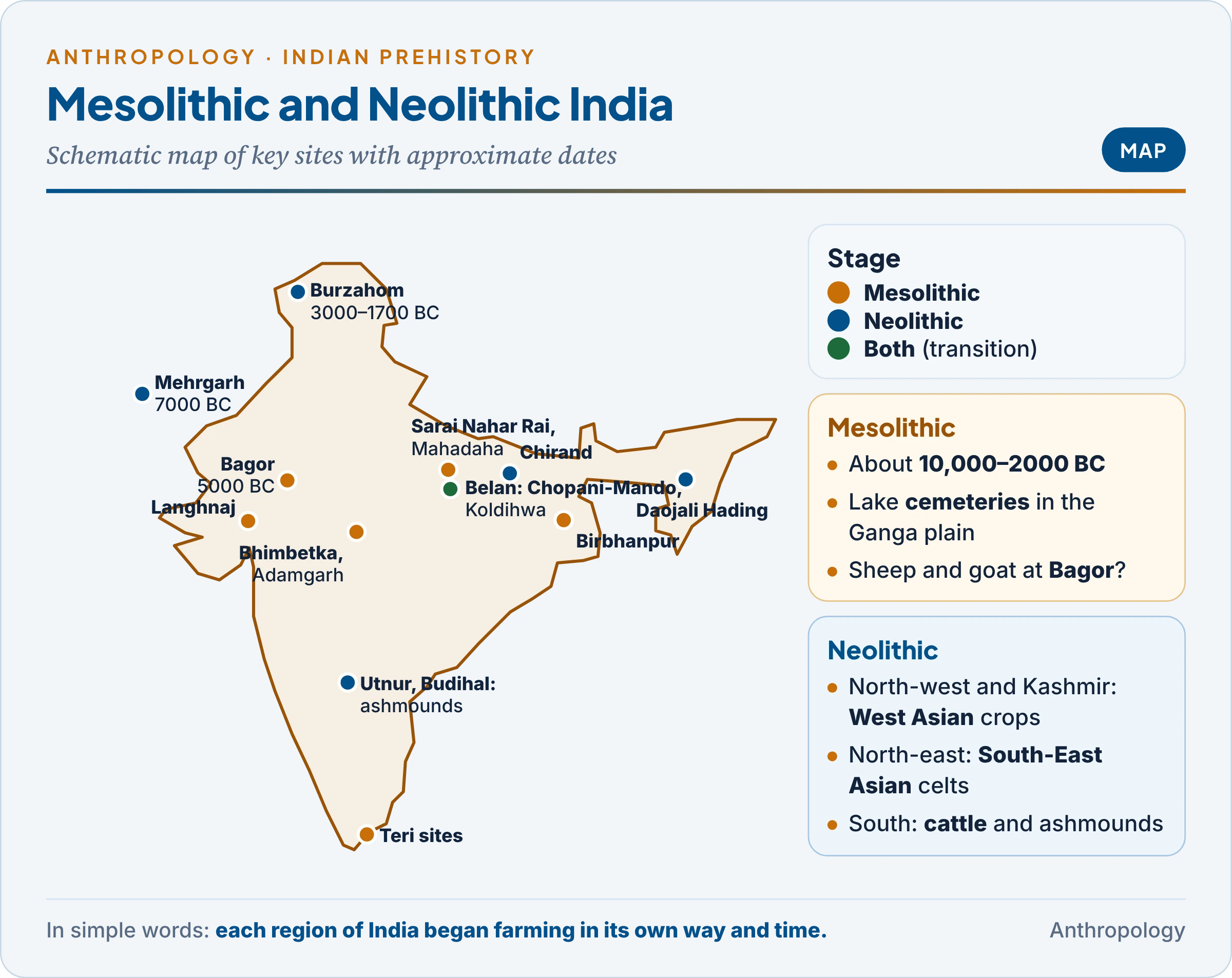
Mehrgarh
- Site: at the foot of the Bolan Pass, Kachi plain, Baluchistan; excavated by Jean-François Jarrige and Catherine Jarrige from 1974.
- Period I (aceramic, about 7000–5500 BC): mud-brick houses with small compartments used as granaries; mainly six-row barley, with einkorn and emmer; sickle blades set in bitumen; bones change from wild gazelle and deer to domestic goat, sheep and zebu.
- Local domestication: zebu bones grow smaller through Period I, which the American zooarchaeologist Richard Meadow read as local domestication.
- Burials: turquoise, lapis lazuli and sea-shell ornaments; drilled molars from 9,000–7,500 years ago, the oldest dentistry (Andrea Coppa and colleagues, Nature, 2006); a copper bead with cotton thread, the earliest cotton in the Old World.
- Significance: South Asia had its own early centre of food production, and Mehrgarh’s later pottery, copper and seals lead into the Early Harappan.
Burzahom
- Site: near Srinagar, Kashmir; excavated by the ASI under T.N. Khazanchi (1960–71).
- Period I: pit dwellings up to about 4 m deep, narrow at the mouth, roofed on posts, a protection against cold; coarse pottery, ground axes, many bone tools, and pierced rectangular stone harvesters like those of north China.
- Period II: houses at ground level; burials inside the settlement, some with dogs or wolves; trepanned skulls (holes cut in the skull); a slab engraved with a hunting scene and two suns; a Kot Diji-type pot and a hoard of carnelian beads from the plains.
- Significance: Kashmir was a meeting ground of north China and Central Asia (pits, harvesters, dog burials) and the Indus plains (beads, pottery).
The Belan and Ganga valleys
- Koldihwa and Mahagara (Allahabad; G.R. Sharma): rice husk in pottery and a cattle pen with hoof marks; the excavator’s 7th–5th millennium BC dates for domestic rice are not accepted by most specialists.
- Lahuradewa (U.P.; Rakesh Tewari, 2001–06): rice with bulk charcoal dates of about 7000–6000 BC; critics, including Dorian Fuller and Irfan Habib, note that other dates from the level are much later and the rice may be wild-gathered.
- Chirand (Saran, Bihar): wattle-and-daub huts, rice, wheat, barley and lentil, and an outstanding bone and antler industry.
The Southern Neolithic
- Ashmounds: mounds of burnt cattle dung at Utnur, Kupgal and Budihal; Raymond Allchin (Utnur, 1957) showed they were cattle pens periodically burnt, perhaps also in seasonal rituals.
- Economy: cattle-keeping with native crops (horsegram, mung and small millets, identified by Dorian Fuller); wheat and barley came later from the north. Early reports of African ragi have mostly not survived re-examination.
- End: the late phase overlaps the megalithic Iron Age (§5.3).
3. The Chalcolithic: The First Use of Copper
In simple words
In the Chalcolithic, or Copper Age, farming villages began to use copper tools alongside stone blades. Copper was scarce, so stone still did most of the work. In India these were the first large farming villages of central India and the Deccan, with painted pottery and planned houses.
3.1 Meaning and world evidence
- Term: “copper-stone” (Greek khalkos + lithos), also Eneolithic: a phase between the Neolithic and the Bronze Age in which copper, unalloyed or with natural arsenic, is used beside stone.
- Steps: native copper hammered into beads (Çayönü, Anatolia); smelting (extracting metal from ore by heat) from about 5000 BC (Belovode, Serbia); harder arsenical copper; then tin-bronze.
- World examples: the Varna cemetery (Bulgaria, about 4500 BC) with the oldest worked gold; Ötzi the Iceman (Alps, about 3300 BC) with a copper axe; the Old Copper Complex of North America.
- Why stone continued: ores were localised, smelting needed fuel and skill, and soft copper blunts quickly, so copper first served prestige and ornament.
3.2 The Chalcolithic cultures of India
Example first. At Inamgaon on the Ghod river near Pune (H.D. Sankalia, M.K. Dhavalikar and Z.D. Ansari, 1968–83), a village of over a hundred houses had a large central house with grain pits (perhaps the chief‘s), an embankment and channel diverting floodwater to fields, fire altars, and children buried in urns under floors; a headless female figurine was buried in a pot as a goddess. Chalcolithic villages already had leaders, public works and shared rituals.
Outside the Harappan area, the Indian Chalcolithic consists of regional village farming cultures named after type sites and known by their painted pottery.
| Culture | Region and sites (excavator) | Date (approximate) | Hallmarks |
|---|---|---|---|
| Ahar–Banas | South-east Rajasthan: Ahar (Sankalia), Gilund (B.B. Lal), Balathal (V.N. Misra) | 3000–1500 BC | White-painted black-and-red ware; copper smelting (Tambavati, “place of copper”); fortified Balathal |
| Kayatha | Chambal valley: Kayatha (V.S. Wakankar) | 2400–2000 BC | Chocolate-slipped ware; copper axes |
| Prabhas and Rangpur | Saurashtra | 2000–1200 BC | Lustrous red ware; post-Harappan villages |
| Malwa | Navdatoli (Sankalia), Eran, Nagda | 1700–1400 BC | Orange pottery painted black; wheat, barley, rice, lentil |
| Savalda | Daimabad I, north Maharashtra | 2200–1800 BC | Painted pottery; early Tapi-basin farming |
| Jorwe | Jorwe, Inamgaon, Daimabad, Nevasa | 1400–700 BC | Red ware painted black, spouted vessels; urn burials |
The cultures differ in pottery but share one way of life.
- Economy and tools: wheat, barley, rice, millets and pulses, cattle, sheep and goat; a few copper tools (copper from Khetri), mostly chalcedony blades.
- Villages: mud and wattle houses, some sites reaching 20 hectares (Inamgaon, Daimabad), in a settlement hierarchy of central villages and hamlets.
- Religion and burial: mother goddess figurines, the bull, fire altars; adults extended and children in urns under floors with food pots: belief in an afterlife.
- Daimabad bronzes: four heavy bronzes, a chariot with driver, rhinoceros, elephant and buffalo (found 1974), of debated date.
- Decline: many Malwa and Jorwe villages shrank about 1000–700 BC, probably through a drier climate. A Balathal skeleton (about 2000 BC) shows the oldest known leprosy (Gwen Robbins and colleagues, 2009).
Copper Hoards and Ochre-Coloured Pottery (OCP). Over a thousand copper objects lie in hoards at about 90 places in the Doab and eastern India, the largest at Gungeria (Madhya Pradesh): shouldered celts, harpoons, antennae-hilted swords and human-shaped anthropomorphs. In the Doab they occur with OCP (a harpoon with OCP at Saipai, Etawah), an orange, poorly fired ware dated by thermoluminescence to about 2000–1500 BC (identified by B.B. Lal, 1950–51). At Sanauli (Baghpat, U.P.; 2005–06, 2018) graves of this horizon held copper-sheathed coffins, swords and wheeled vehicles read as chariots.
4. The Bronze Age
In simple words
Bronze is copper mixed with a little tin, which makes it harder and easier to cast. The Bronze Age is the time when such metals came into wide use, and when the first cities, kings, writing and long-distance trade appeared. In South Asia it is the age of the Harappan, or Indus, civilization.
4.1 Meaning and world outline
- Three-age system: the Danish curator Christian Jürgensen Thomsen ordered the Copenhagen collections (1836) into Stone, Bronze and Iron ages. Being technological, each age starts at different dates in different regions; much of Africa went from stone straight to iron.
- Bronze: about 90% copper and 10% tin; harder than copper and easily cast. Early bronze was often arsenical (Maykop, North Caucasus); tin was rare, so tin-bronze required long-distance trade.
- Centres: Mesopotamia (cuneiform about 3200 BC), Egypt, the Indus, the Aegean and China (Erlitou, then Shang); a collapse about 1200 BC opened the Iron Age.
- Childe’s Urban Revolution (1950): farmers’ surplus, concentrated by rulers and temples, supported full-time specialists in cities with monuments, writing, science, trade and a state. His ten criteria are examined with the concept of civilization in Unit 2.1.
4.2 The Harappan civilization as the Bronze Age of South Asia
Example first. At Dholavira, on Khadir island in the Rann of Kutch, R.S. Bisht (1990–2005) uncovered a city in three walled parts (castle, middle town, lower town), a huge open ground, and stone-cut reservoirs storing monsoon water in a desert; a fallen signboard of ten large Indus signs had stood above the north gate. Dholavira, a UNESCO World Heritage Site since 2021, shows the planning, engineering and literacy of a civilization.
- Discovery: Daya Ram Sahni excavated Harappa (1921) and R.D. Banerji Mohenjo-daro (1922) under John Marshall, who announced the civilization in 1924.
- Phases: Early Harappan about 3300–2600 BC (Hakra, Kot Diji, Amri, Sothi; ploughed field at Kalibangan); Mature about 2600–1900 BC; Late about 1900–1300 BC.
- Extent: from Sutkagen Dor (Makran) to Alamgirpur (Meerut), and from Manda (Jammu) to Daimabad, with an outpost at Shortughai (Afghanistan): the largest in area of the first civilizations. Indian sites include Rakhigarhi, Kalibangan (B.B. Lal and B.K. Thapar), Lothal (S.R. Rao) and Banawali.
Town planning. The table lists the elements and the sites that best show them.
| Element | Evidence |
|---|---|
| Citadel and lower town | Raised walled citadel on the west, larger lower town on the east; Dholavira has three parts |
| Grid streets | Main streets north–south and east–west, forming blocks (Mohenjo-daro); Banawali radial |
| Standard bricks | Fixed ratio 1 : 2 : 4 across the whole area |
| Drainage | Covered brick street drains with inspection holes; house drains, soak pits, bathing platforms |
| Water | About 700 wells at Mohenjo-daro; reservoirs at Dholavira |
| Public buildings | Great Bath (about 12 × 7 m, 2.4 m deep, sealed with bitumen); large halls once called granaries, now debated |
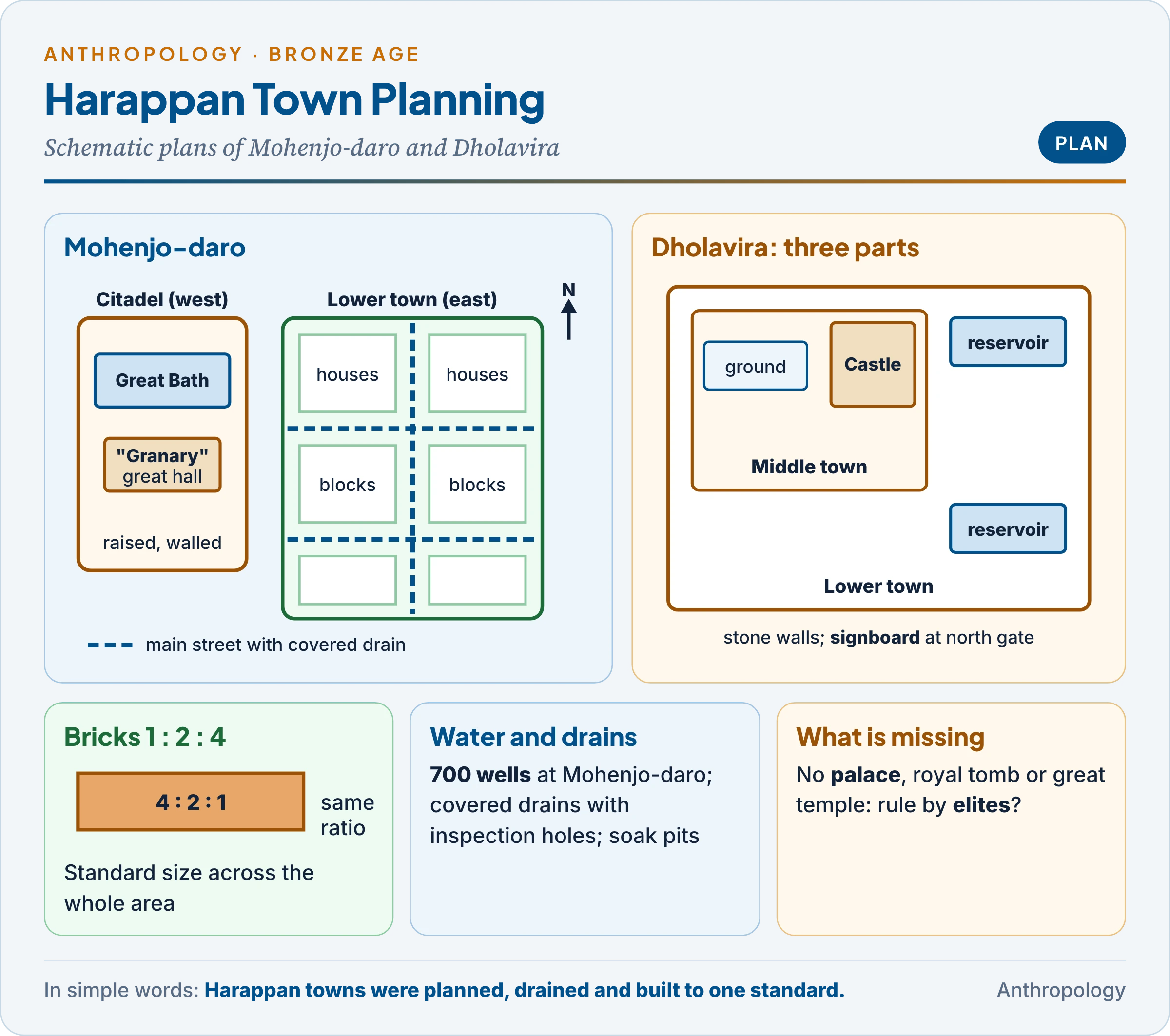
Uniform bricks, weights and drains over a vast area imply shared rules, yet no palace, royal tomb or great temple has been found. The American archaeologist Jonathan Mark Kenoyer therefore suggests that cities were run by competing merchant, landowning and ritual elites, not one king.
Economy, crafts and bronze
- Farming: wheat and barley; rice and millets in Gujarat and Haryana; sesame and cotton; the plough (Kalibangan furrows). Animals: zebu, buffalo, sheep, goat; the horse (claimed at Surkotada) is not securely attested.
- Metallurgy: copper from Khetri and Baluchistan alloyed with tin or arsenic; lost-wax casting (a wax model in clay, melted out and replaced by metal), as in the “dancing girl”; stone blades still common.
- Crafts and weights: drilled carnelian beads (bead workshops at Chanhudaro and Lothal), shell bangles, faience, steatite seals; chert weights binary for small units (1, 2, 4 … 64) and decimal above (160, 320, 640).
- Script: about 400 signs, mostly right to left, averaging five signs per inscription, undeciphered; Asko Parpola and Iravatham Mahadevan argue for a Dravidian language.
Harappan maritime trade
- Texts: inscriptions of Sargon of Akkad (about 2300 BC) mention ships of Meluhha (the Indus), Magan (Oman) and Dilmun (Bahrain) at his capital; Meluhha sent carnelian, timber, ivory and gold.
- Objects: Indus seals at Ur and Susa, etched carnelian beads in Ur’s royal graves, Indus weights at Dilmun, Harappan pottery at Ras al-Jinz (Oman); a Persian Gulf seal at Lothal; lapis lazuli from Badakhshan.
- Lothal: a brick basin about 222 × 37 m, called a dockyard by S.R. Rao (1955–60), beside a warehouse with about 70 sealings; Lawrence Leshnik (1968) saw an irrigation tank; recent landscape study favours the dockyard (Contemporary Developments).
- Coastal crafts: Gola Dhoro, Kuntasi and Nageshwar in Gujarat worked shell and carnelian for export.
Rakhigarhi
- Site: Hisar district, Haryana, by a former Drishadvati (Chautang) channel; seven mounds over about 350 hectares, among the largest Harappan cities; excavated by Amarendra Nath (ASI, 1997–2000), Vasant Shinde (2011–16) and the ASI from 2021, with Early Harappan (Hakra, Sothi) levels below.
- Ancient DNA: a woman’s genome from the cemetery (Shinde, Narasimhan, Reich and colleagues, Cell, 2019) mixes Iranian-related hunter-gatherer and indigenous South Asian hunter-gatherer ancestry, with no steppe and no Anatolian or Iranian farmer ancestry.
- Significance: farming in South Asia arose locally or by spread of ideas, not by mass migration of western farmers, and steppe ancestry arrived after the Mature Harappan.
Religion and decline
- Religion: no temples, but mother goddess figurines, a seated horned figure among animals (Marshall’s “Proto-Shiva”, now read cautiously), the humped bull, pipal leaves, fire altars (Kalibangan, Lothal) and ritual bathing.
- Causes proposed for the end of the cities (about 1900 BC): Aryan invasion (Mortimer Wheeler; rejected, since George Dales, 1964, showed the “massacre” skeletons belong to different periods), floods (R.L. Raikes), shifts of the Indus (H.T. Lambrick), drying of the Ghaggar–Hakra (D.P. Agrawal and R.K. Sood), ecological overuse (Walter Fairservis), loss of Mesopotamian trade, and a weaker monsoon about 4,200 years ago.
- Current view: gradual de-urbanisation: cities shrank, writing and weights vanished, and settlement shifted east to Haryana, the Doab and Gujarat, carrying crafts and beliefs into later Indian life.
Common confusion
Copper-Bronze Age or Chalcolithic: which is the Harappan? Chalcolithic cultures are village farmers using a little copper beside stone (Ahar, Malwa, Jorwe). The Harappan is urban, with writing, standard weights, specialists and true bronze, so it is the Bronze Age (or Copper-Bronze Age, since much of its metal was unalloyed copper). The two overlapped: Ahar–Banas villages traded with Harappan cities.
5. The Iron Age
In simple words
Iron ore is found almost everywhere, so once people learned to smelt it at very high heat, tools and weapons became cheap and common. Iron axes and ploughs helped clear forests and farm more land. In India the Iron Age brought new pottery cultures, great stone burials in the south and the rise of kingdoms and towns.
5.1 Meaning and world outline
- Meaning: the stage in which iron becomes the main material for tools and weapons; in India it ends with the early historic period of the Mauryas.
- Meteoric before smelted: the first iron is meteoric (nickel-rich), as in Tutankhamun‘s dagger; smelted iron appears in Anatolia, was used by the Hittites (14th–13th centuries BC) and spread after the collapse of about 1200 BC.
- Technology: a bloomery furnace reduces ore with charcoal at about 1,200 °C into a spongy bloom, hammered into wrought iron; carburising (adding carbon) and quenching give steel. China alone made cast iron early.
- Why iron replaced bronze: iron ore is abundant, copper and tin rare; a tin shortage after 1200 BC (Anthony Snodgrass) pushed smiths to iron. Cheap iron put metal tools in the hands of ordinary farmers.
- Regions: Hallstatt and La Tène in Europe; the Haya of Tanzania made carbon steel in preheated furnaces about 2,000 years ago (Peter Schmidt and Donald Avery, 1978).
5.2 Iron in India: dates and pottery cultures
- Dates: iron appears in Painted Grey Ware levels at Atranjikhera (Etah, U.P.; R.C. Gaur) and at Hallur (Karnataka) about 1200–1000 BC; Rakesh Tewari reported iron at Malhar, Raja Nal-ka-Tila and Lahuradewa from the early second millennium BC. Dilip Chakrabarti argued that India was an independent centre of iron working.
- Sivagalai and the Tamil Nadu claims (with caution): in January 2025 the Tamil Nadu State Department of Archaeology’s report Antiquity of Iron gave radiocarbon dates of 3345–2953 BC on charcoal found with iron in burial urns at Sivagalai (Thoothukudi district). If confirmed, these would be among the world’s oldest iron. Archaeologists such as Parth Chauhan urge caution: the dates are on associated charcoal, not the iron; old wood can give older dates than the burial; and full peer-reviewed publication is awaited.
- Painted Grey Ware (PGW): fine grey wheel-made pottery painted in black, at over a thousand sites in Haryana, Punjab, the upper Ganga plain and north Rajasthan, about 1200–600 BC; excavated at Hastinapura (B.B. Lal, 1950–52), Ahichchhatra, Atranjikhera and Bhagwanpura (overlapping Late Harappan). Wattle-and-daub villages, iron arrowheads, spearheads, sickles, horse bones, rice, wheat and barley. Lal’s link of PGW with the Later Vedic people and Mahabharata sites is a hypothesis.
- Black-and-Red Ware (BRW): black inside, red outside, from inverted firing; between OCP and PGW in the Doab, and with megaliths in the south.
- Northern Black Polished Ware (NBPW): a glossy luxury ware of about 700–200 BC, the pottery of the second urbanisation: fortified cities (Kaushambi), punch-marked coins and abundant iron.
5.3 The megaliths
A megalith (“large stone”) is a monument of large stones, usually for the dead. India has an ancient tradition, mainly of the Iron Age Deccan and south, and a living one among tribes of the north-east and central India.
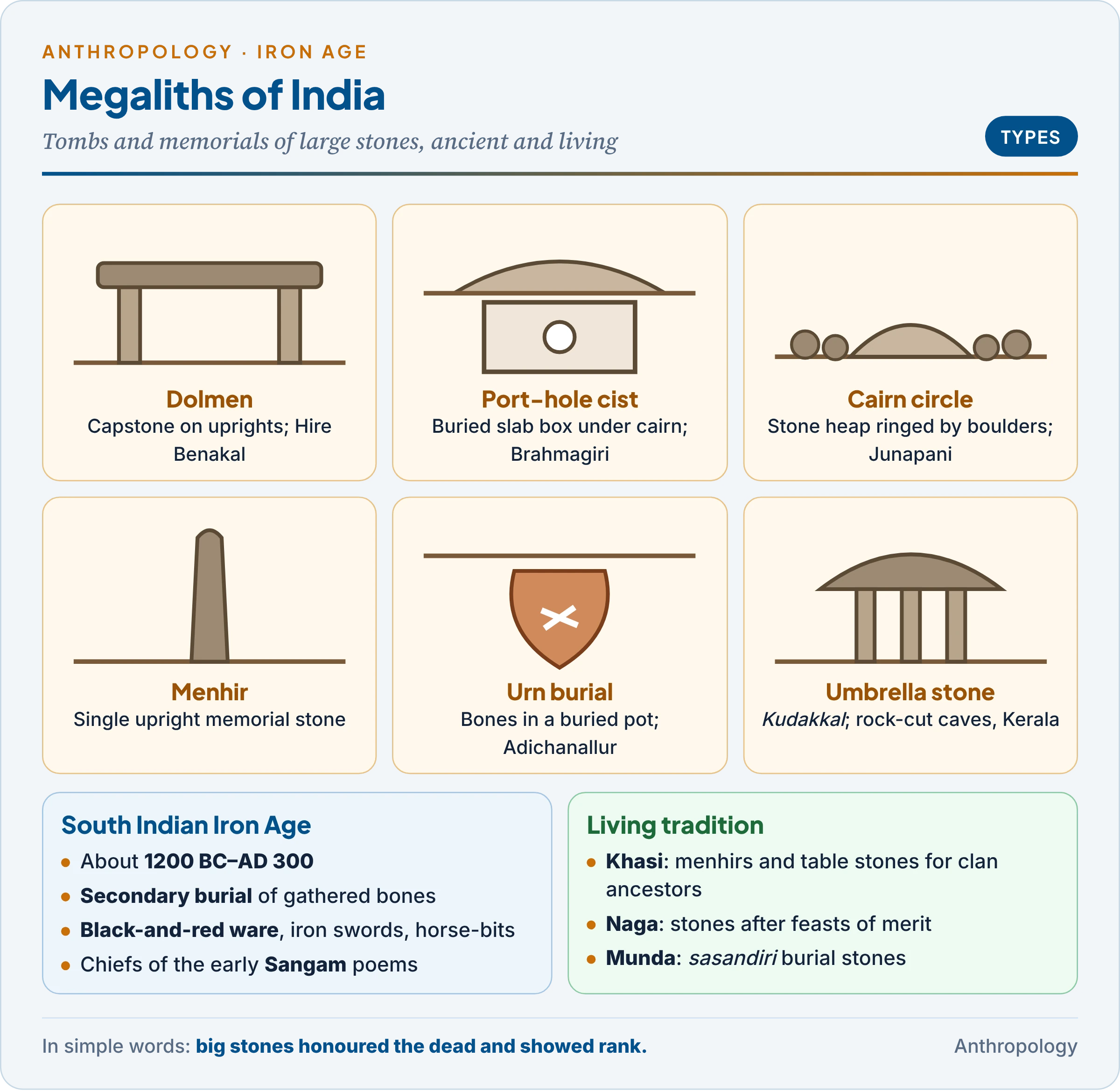
The table names the main types; most held secondary burials, bones gathered after the flesh had decayed or been exposed.
| Type | Description | Examples |
|---|---|---|
| Dolmen | Capstone on upright slabs | Hire Benakal (Karnataka), Tamil Nadu, Kerala |
| Cist | Stone-slab box, often with a port-hole, under a cairn | Brahmagiri, Junapani |
| Cairn circle | Stone heap over a pit, ringed by boulders | Vidarbha (Junapani, Mahurjhari, Naikund) |
| Menhir | Single upright memorial stone | Burzahom III; Karnataka; Khasi hills |
| Urn burial | Bones in a large buried pot | Adichanallur, Sivagalai |
| Rock-cut cave, umbrella stone | Laterite chamber; mushroom capstone (topikal, kudakkal) | Kerala (Porkalam) |
- Dates: mostly 1200 BC–AD 300; Mortimer Wheeler‘s Brahmagiri date (1947) of about 300 BC–AD 50 has since been pushed earlier.
- Contents: BRW, iron swords, arrowheads, sickles, tridents and horse-bits, carnelian and gold beads; Adichanallur (Alexander Rea, 1899–1905; ASI from 2004) gave gold diadems and bronze vessels.
- Iron technology: a furnace at Naikund (Vidarbha) and steel crucibles at Kodumanal (Tamil Nadu), roots of wootz steel.
- Society: graves of unequal wealth show iron-using farmers, herders and chiefs, often linked with the chiefdoms of early Tamil (Sangam) poems, which mention urn burial (mudumakkal thazhi).
- Origin: Christoph von Fürer-Haimendorf and Childe proposed arrival by sea from West Asia; most archaeologists now see local growth from the Southern Neolithic, which underlies megaliths at Brahmagiri and Hallur.
The living tradition. In the north-east and central India megaliths are still raised, showing meanings archaeology alone cannot recover.
- Khasi and Jaintia (Meghalaya): menhirs and flat table stones for clan ancestors after the bones are gathered into a clan ossuary (Nartiang); S.N. Rao divides them into funerary and memorial stones.
- Naga (Angami, Sema): stones raised after feasts of merit, marking a man’s wealth and status.
- Munda and Ho (Jharkhand): flat burial stones (sasandiri) over clan bones and upright memorials (biridiri).
- Meaning: honouring ancestors, marking clan land and claiming status; Haimendorf derived this tradition from South-East Asia (Austroasiatic speakers), unconnected with the south Indian megaliths.
5.4 The cultural impact of the Iron Age
Example first. The Agaria and Asur of central India and Jharkhand smelted iron in small clay furnaces until recent times (Verrier Elwin, The Agaria, 1942). Their furnaces show that small groups could make iron from local ore and charcoal, so iron, unlike bronze, needed no long-distance trade; that is the root of its social impact.
- Agriculture: iron axes helped clear the middle Ganga forests and iron ploughshares and sickles extended farming; with wet rice this gave a large surplus.
- Second urbanisation and states: from about 600 BC towns (Kaushambi, Rajgir, Shravasti), guilds, punch-marked coins and trade; the sixteen Mahajanapadas and the rise of Magadha with iron weapons and land revenue.
- Religion: R.S. Sharma argued that plough farming needed cattle, making large Vedic sacrifices wasteful, so Buddhism and Jainism, preaching non-violence, suited the new peasants and merchants.
- Debate: D.D. Kosambi and R.S. Sharma made iron the driving force; A. Ghosh and Dilip Chakrabarti replied that iron is scarce in early PGW levels, forests could be burnt, and rice and trade mattered more. Iron was one enabling factor among several.
- South India: iron, horses and chiefly graves of the megalith builders led to the early historic chiefdoms of the Sangam age.
Key Terms
| Term | Meaning in simple words |
|---|---|
| Holocene | The present warm geological epoch, from 11,700 years ago |
| Microlith | A tiny stone blade or geometric piece set in a composite tool |
| Microburin technique | Notching and snapping a blade to make geometric microliths |
| Broad-spectrum economy | Living on many kinds of wild food instead of a few big animals |
| Sedentism | Living in one place for most or all of the year |
| Domestication | Genetic change in plants or animals caused by human selection |
| Non-shattering rachis | A cereal stalk that keeps its ripe grains, the mark of domestic cereals |
| Secondary products | Milk, wool, dung and pulling power from living animals |
| Ashmound | A mound of burnt cattle dung at a south Indian Neolithic site |
| Chalcolithic | A stage of farming villages using copper with stone |
| Lost-wax casting | Casting metal in a clay mould round a wax model that is melted out |
| Meluhha | The Mesopotamian name for the Indus region |
| Painted Grey Ware | Fine grey pottery painted black, of the early Iron Age in north India |
| Megalith | A monument of large stones, usually for burial or memorial |
Contemporary Developments
- Lothal (2024): a multi-sensor satellite study (Ekta Gupta, V.N. Prabhakar and Vikrant Jain, Journal of Archaeological Science) traced a former Sabarmati channel and over 140 palaeochannels round Lothal, supporting the dockyard and an inland route to Kutch.
- Bahaj, Deeg (2024–25): ASI excavations in Rajasthan found a sequence from OCP and BRW through PGW to the Kushan period, a buried palaeochannel, and sealings with pre-Mauryan Brahmi in late PGW levels.
- Kashmir Neolithic dated (August 2026): twenty AMS dates from Gufkral, Hariparigam and Qasim Bagh (Archaeometry) put most Neolithic occupation between 2500 and 2200 BC, the first direct dates on bone and ash there.
- Nagaland Neolithic (2026): Chiphur caves (Noklak district) gave cord-marked pottery, ground stone tools and charred foxtail millet and Job’s tears, dated by AMS to about 3,500 years ago, supporting the north-eastern link with South-East Asia.
Diagrams to Master
- Topic map: five stages, each with a world and an Indian anchor.
- Food-production theories: six theories, each with evidence and one criticism.
- Indian sites map: Mesolithic and Neolithic sites with dates.
- Harappan town plan: citadel (west), lower town (east), grid, drains, Great Bath; Dholavira’s three parts; bricks 1 : 2 : 4.
- Megalith types: dolmen, port-hole cist, cairn circle, menhir, urn; label secondary burial and iron grave goods.
Revision Grid
| Scholar | Work (year) | Key idea |
|---|---|---|
| Lubbock | Prehistoric Times (1865) | Palaeolithic and Neolithic |
| Garrod | 1928 | Natufian culture |
| Childe | Man Makes Himself (1936); 1950 | Neolithic and Urban Revolutions; oasis |
| Braidwood | Jarmo (1948–55) | Hilly flanks, nuclear zones |
| Binford; Flannery | 1968; 1969 | Marginal zones; broad spectrum |
| Cohen | 1977 | Population pressure |
| Sherratt | 1981 | Secondary products revolution |
| Hayden; Cauvin | 1990; 1994 | Feasting; revolution of symbols |
| Sankalia | Langhnaj, Navdatoli, Inamgaon | Indian Mesolithic and Chalcolithic |
| V.N. Misra | Bagor (1968–70); Balathal | Mesolithic herding; Ahar–Banas |
| G.R. Sharma | Sarai Nahar Rai, Koldihwa | Ganga and Belan sequences |
| Jarrige | Mehrgarh (1974–) | Earliest South Asian farming |
| B.B. Lal | Hastinapura (1950–52) | PGW; OCP |
| Shinde, Reich and colleagues | Cell (2019) | Rakhigarhi genome |
Previous Year Questions
Unit 1.8: Mesolithic to Iron Age
- 2025What are the major theories proposed in support of the origin of food production? How the change in subsistence economy brought revolution during this period?
- 2024Write notes on: Harappan maritime trade.
- 2024Describe the evidences of food production and domestication of animals with special reference to Mehrgarh. Throw light on its significance.
- 2023Identify the major Mesolithic sites and describe the typo-technological features with special reference to India.
- 2023Write notes on: Prehistoric significance of Rakhigarhi.
- 2023Write notes on: Cultural impact of Iron Age.
- 2022Write notes on: Mesolithic rock art in Indian subcontinent.
- 2022Enumerate the evidence of animal domestication in Indian microlithic industry.
- 2021Describe the features of early farming cultures and Neolithic of the Near East.
- 2021Discuss the salient features of different traditions of European Mesolithic.
- 2020Write notes on Natufian culture in about 150 words.
- 2019Elucidate’ Mesolithic culture and associated rock art with examples from India.
- 2019Discuss with examples the Megalithic culture of India in the archaeological context.
- 2018Give an account of the consequences of food production of Neolithic culture.
- 2018Write a note in 150 words on Town Planning of Harappan Culture.
- 2017Write a note in 150 words on salient features of Mesolithic culture.
- 2016Delineate the salient features of Chalcolithic cultures.
- 2016Write a note in 150 words on Neolithic Cultures of India.
- 2014Describe the Neolithic culture of India.
- 2007Write a note on Neolithic.
- 2005Write a note on Microlith.
- 2004Write a note on Chalcolithic Culture.
- 2002Write a note on Neolithic Culture.
- 2002Write a note on Universal Cultural Evolution.
- 2001Write a note on Mesolithic culture in India.
- 2000Write a note on Copper-Bronze Age.
- 1999Describe any chalcolithic site in India with particular reference to mdustry and town planning.
- 1998Neolithic is a ‘self-sufficient food producing economy.’ Critically examine this expression.
- 1995What is the neolithic phase of culture in Europe called revolution ? Describe its distinctive features.
Related questions from other units and Paper II
- 2026Unit 1.1: Make a critical appraisal of the mesolithic culture of Ganga basin with reference to artifacts, faunal and human skeletal remains excavated from different sites.
- 2026Unit 1.1: What are the evidences available regarding crops and domesticated animals of Indus Valley Civilization? What are the views of the scholars regarding Indus script?
- 2025Unit 1.1: Write notes on: Lothal dockyard and international trade relations.
- 2024Unit 1.1: Critically describe evidences from Rakhi Garhi and its linkages to Harappan civilization.
- 2023Unit 1.1: Write notes on: Prehistoric rock arts from Uttarakhand.
- 2023Unit 1.1: “The Indus Valley was the first settlement of the big civilization.” Comment Critically.
- 2023Unit 1.1: Was Mesolithic culture the first step towards sedentary way of life? Illustrate your answer by citing suitable examples.
- 2022Unit 1.1: Make a critical appraisal of Megalithic tradition in India with special reference to North-East India.
- 2022Unit 1.1: Describe briefly the proto-history of Gujarat. Discuss the significance of Gujarat proto-history in international trade.
- 2021Unit 1.1: Write short notes on “Harappan seals” in about 150 words.
- 2021Unit 1.1: Critically discuss the origin of Indus Valley Civilization. Mention the evidences of its endogenous origin from the pre-Harappan sites.
- 2020Unit 1.1: Discuss the characteristic features of ‘Neolithic culture’ in India.
- 2019Unit 1.1: What kind of society may be reconstructed from the archaeological evidences of Harappan culture ?
- 2019Unit 1.1: Write a note in 150 words on Distribution of Neolithic sites in India.
- 2018Unit 1.1: Examine the regional variations of mesolithic cultures of India.
- 2017Unit 1.1: Write a note in 150 words on Neolithic cultures of South India.
- 2017Unit 1.1: Describe the salient features of chalcolithic cultures of the Deccan.
- 2017Unit 1.1: Describe various aspects of trade and religion of Harappan civilization.
- 2016Unit 1.1: Write a note in 150 words on Significance of Mesolithic findings from Belan Valley.
- 2016Unit 1.1: Give a detailed appraisal of skeletal remains from Chalcolithic culture of undivided Punjab.
- 2015Unit 1.1: Write a note in 150 words on Prehistoric Rock Art of Central India.
- 2015Unit 1.1: Discuss the significance of Harappan Civilization sites from India.
- 2014Unit 1.1: Write a note in 150 words on Neolithic cultures of N-E India.
- 2014Unit 1.1: Describe what is known of Harappan Religion. Have some of its elements continued into later Hinduism? Discuss.
- 2013Unit 1.1: Write a note in 150 words : Discuss salient features of Mesolithic culture in India with special reference to western India.
- 2011Unit 1.1: Write a note in 150 words on Iron Age in Gangetic region.
- 2011Unit 1.1: Describe the characteristic features of Mesolithic Cultures in India.
- 2010Unit 2.1: What stage is known as the incipient stage of food production ? Point out major features of this cultural stage. Illustrate your answer with suitable examples from a specific area in the old world.
- 2010Unit 1.1: Write a note in 150 words on Neolithic culture in India.
- 2010Unit 1.1: Write a note in 150 words on Urban planning in Harappan culture.
- 2010Unit 1.1: Examine Gordon Childe’s statement, “Neolithic culture is a revolution”.
- 2009Unit 1.1: Examine the contribution of Mesolithic culture to rise of Neolithic culture.
- 2008Unit 1.1: Write a note on ‘Langhnaj’
- 2007Unit 1.1: Write a note on Neolithic Culture.
- 2006Unit 1.1: Write a note on Burzahom.
- 2005Unit 1.1: Write a note on Mesolithic culture in India.
- 2005Unit 1.1: Discuss the economic basis of Indus Civilisation. What were the factors of its decline ?
- 2003Unit 1.1: Write a note on Town planning in Indus cultures.
- 2002Unit 1.1: Name a few Chalcolithic sites in India and describe their most salient features.
- 2001Unit 1.1: Write a note on Ecological adaptation during Mesolithic.
- 1999Unit 1.1: Write a note on Proto-Neolithic.
- 1998Unit 1.1: Describe the socio-cultural characteristics of the Neolithic period in India with suitable examples.
- 1997Unit 1.1: Describe the distinguishing characteristic features of South Indian Megaliths and compare these with either Central Indian or North-eastern Indian Megaliths.
- 1996Unit 1.1: Write a note on Neolithic tool typology and technology of fabrication.
- 1993Unit 1.1: To what extent could the Mesolithic culture be attributed to a phase of transition between Palaeolithic and Neolithic cultures? Illustrate the answer with apt. examples.
- 1992Unit 1.1: Describe the salient features of the Neolithic culture of the Indian subcontinent.
- 1991Unit 1.1: Discuss the nature of urbanization in the Indus Valley Civilization. What factors led to its decline ?
- 1986Unit 1.1: What is meant by Neolithic Revolution ? What kind of evidence do we get about Neolithic revolution in india.
- 1985Unit 1.1: What are the main features of Mesolithic cultures in general ? What do you know about the origin and distribution of Mesolithic cultures in India ?
- 1984Unit 1.1: Write a note in 200 words : Neolithic revolution in India.
- 1983Unit 1.1: What are the important features of mesolithic phase of Indian prehistory ?).