

1.6 Phylogenetic status, characteristics and geographical distribution of the following: (A) Prepleistocence fossil primates- Oreopithecus. (B) South and East African hominids-Plesianthropus/Australopithecus Africau Paranthropus, Australopithecus. (C) Paranthropus, Australopithecus. .Paranthropus-Homo erectus-Homo erectus javanicus, Homo erectus pekinensis. (D) Homo Heidelbergensis. (E) Neanderthal man-La-chapelle-aus-saints (Classical type), Mt.Carmelites types (Progressive type). (F) Rhodesian man. (G) Homo sapiens-Cromognon, Grimaldi, Chancelede.
Official Syllabus: Paper I, Unit 1.6
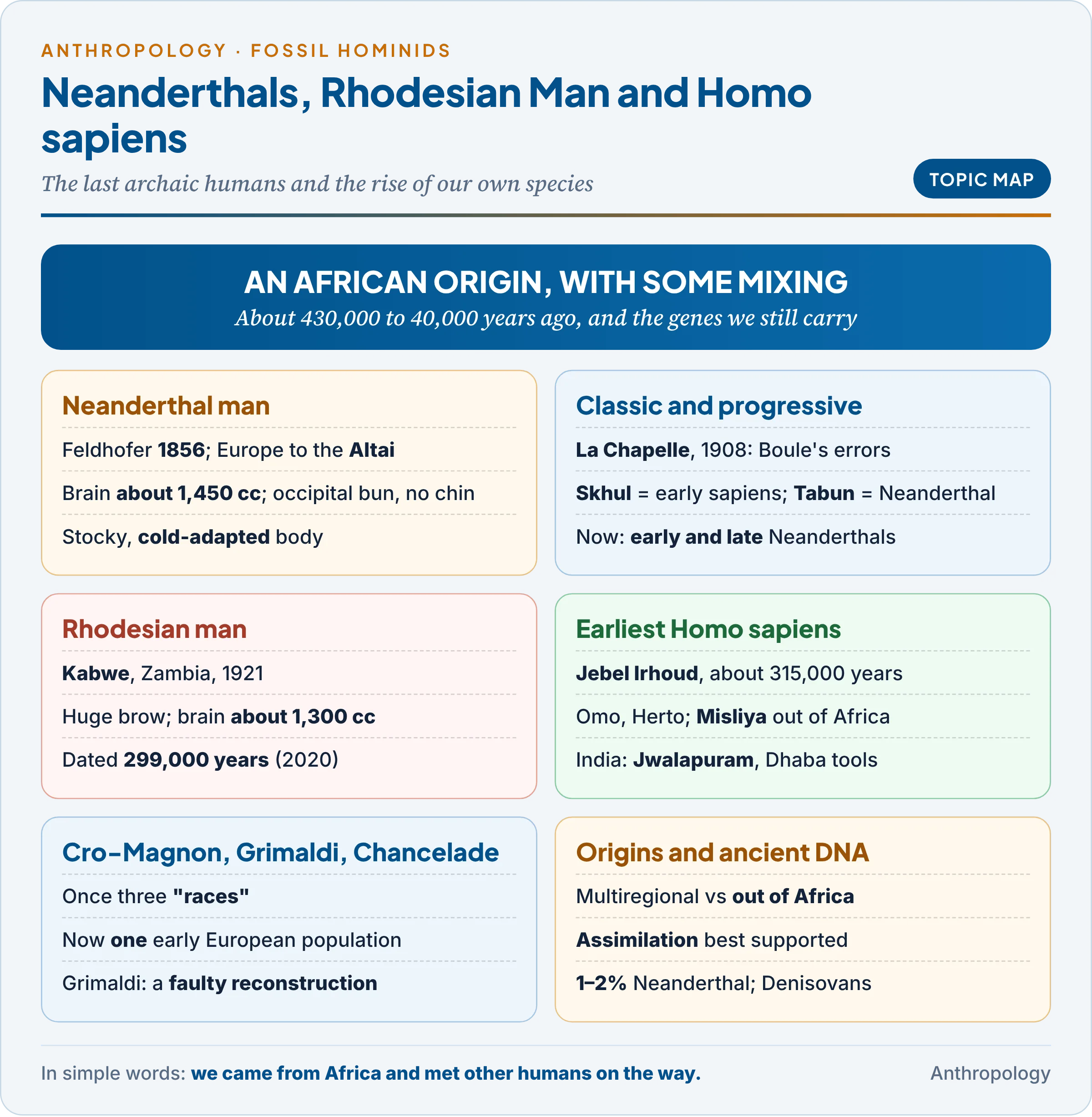
This article covers Neanderthal man, Rhodesian man and Homo sapiens, with the debate on modern human origins and what ancient DNA has added. The earlier forms are in Units 1.6a and 1.6b. In brief: the australopithecines (4.2–1 million years ago) were small-brained bipeds; Homo erectus (about 2 million to 110,000 years ago) was the first human with a modern body and the first to leave Africa; and Homo heidelbergensis (about 700,000–200,000 years ago) was the large-brained grade from which, on the usual view, both Neanderthals and modern humans descend.
1. Neanderthal Man: Discovery and Distribution
In simple words
Neanderthals were humans who lived in Europe and western and central Asia from about 400,000 to about 40,000 years ago. They had big brains, strong stocky bodies and a long, low skull, and they survived several ice ages. They are our closest extinct relatives, and most people outside Africa still carry a little of their DNA.
1.1 The first finds
In August 1856 quarrymen clearing the Feldhofer cave in the Neander valley (Neanderthal, “Neander’s valley”) near Düsseldorf, Germany, dug out a thick skullcap with a heavy brow. Johann Carl Fuhlrott and Hermann Schaaffhausen (1857) saw an ancient human, while the pathologist Rudolf Virchow insisted on a modern man deformed by rickets: in 1856 no theory of evolution (Darwin’s Origin came in 1859) gave an ancient human a place.
- Earlier, unrecognised finds: Engis, Belgium (1829–30), and Forbes’ Quarry, Gibraltar (1848).
- The name: the Irish geologist William King named Homo neanderthalensis in 1864; two skeletons from Spy, Belgium (1886), with stone tools and extinct animals, proved it a real ancient population.
1.2 Time span and geographical distribution
- Time: Neanderthal features appear piecemeal from about 430,000 years ago (Sima de los Huesos, Spain; Unit 1.6b); “classic” Neanderthals lived from about 130,000 years ago through the last (Würm) glaciation, and the last disappeared about 41,000–39,000 years ago (radiocarbon dating of about 40 sites; Tom Higham and colleagues, 2014).
- Range: from Spain, France and Britain through Italy, Croatia and the Caucasus to the Levant, Iraq, Uzbekistan and the Altai mountains of Siberia. No Neanderthal fossil is known from Africa, South or East Asia.
The table lists key specimens by region; read each date with its method, because several revisions changed the arguments.
| Specimen | Site | Date (method) | Traits | Significance |
|---|---|---|---|---|
| Neanderthal 1 | Feldhofer, Germany (1856) | About 40,000 years (radiocarbon) | Skullcap | Type specimen |
| Krapina (about 80 individuals) | Croatia (Dragutin Gorjanović-Kramberger, 1899–1905) | About 130,000 years (ESR, uranium-series) | Early, less extreme | Eagle-talon ornaments |
| La Chapelle-aux-Saints 1 | Corrèze, France (1908) | About 60,000–47,000 years | Classic skull; arthritic | The “old man” (§3.1) |
| Tabun C1 | Mount Carmel, Israel | About 122,000 years (ESR, uranium-series) | Female; lighter build | Levantine Neanderthal (§3.2) |
| Kebara 2 | Mount Carmel, Israel (1983) | About 60,000 years (luminescence) | Hyoid bone | Speech (§4) |
| Shanidar 1–10, Z, A | Iraqi Kurdistan (Ralph Solecki, 1953–60) | About 75,000–45,000 years | Healed injuries | Care, burial |
| Teshik-Tash; Denisova 5, Chagyrskaya | Uzbekistan (Okladnikov, 1938); Altai, Siberia | About 120,000–60,000 years (Altai) | Child; bones, teeth | Eastern range; high-coverage genomes |
- Why this range? A cold-temperate people, they spread east in warm phases and retreated to southern refuges (Iberia, Italy, the Balkans) in the coldest.
- India: there is no Neanderthal fossil in South Asia; the old idea that a “degenerate” Neanderthal people brought the Mousterian to India rests on tool resemblances alone. India’s Middle Palaeolithic (from about 385,000 years at Attirampakkam, Tamil Nadu; Kumar Akhilesh and colleagues, 2018) was made by an unidentified hominin (Unit 1.8b).
2. Characteristics of the Neanderthals
In simple words
A Neanderthal’s head was long and low, with a bun at the back, a heavy double brow, a big projecting nose and face, and no chin; its brain was as large as ours or larger. Its body was short, wide and very muscular, with short forearms and shins. Much of this build fits life in cold climates and very hard physical work.
2.1 The skull
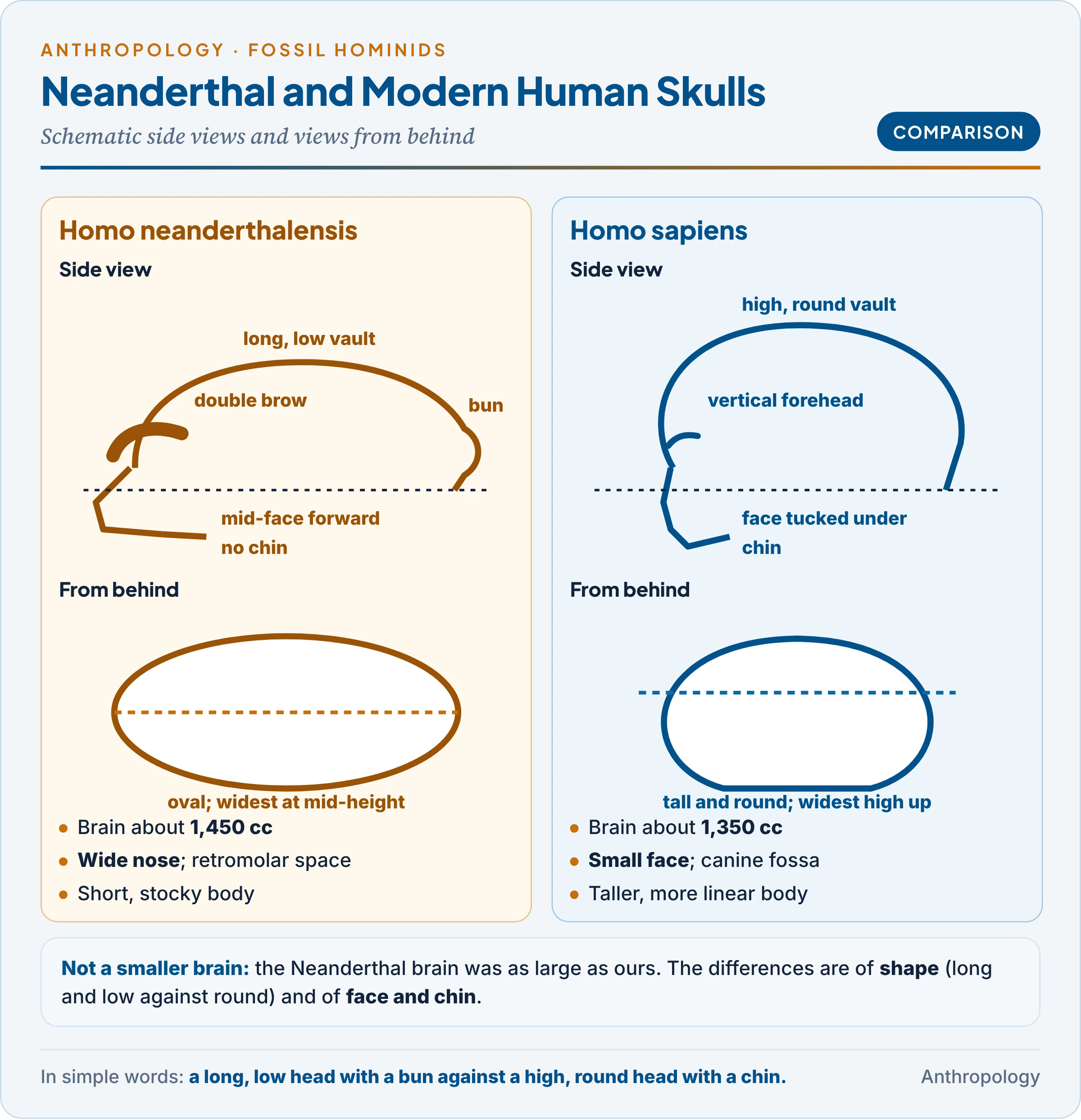
- Brain: about 1,200–1,750 cc, average about 1,450 cc, larger than ours (about 1,350 cc) but long and low, matching a big, heavy body.
- Vault: long, low and broad, round to oval from behind (the erectus skull is pentagonal; ours is tall and round).
- Occipital bun (chignon): a bulge at the back, with a small hollow above it (the suprainiac fossa), found only in Neanderthals.
- Brow: a double-arched torus (a curved bar over each eye, not one straight bar as in H. erectus); a receding forehead.
- Mid-facial prognathism: the centre of the face and the nose are pulled forward, so the cheekbones sweep back and there is no canine fossa (the hollow below our eye). The very wide nose probably warmed and moistened cold air.
- Jaw and teeth: no chin; a retromolar space (a gap behind the last molar) because the teeth sit forward; front teeth worn as if used as a “third hand” to grip skins; taurodont molars (large pulp chambers), which the Turkish anthropologist Muzaffer Şenyürek showed are not unique to Neanderthals.
2.2 The body
- Short and stocky: men about 1.65 m, women about 1.55 m; a barrel-shaped chest; short forearms and shins (a low crural index, shin length as a percentage of thigh length); thick bones and large joints.
- Why this build? A short body with short limb ends has less skin surface for its volume, so it loses less heat (Bergmann’s and Allen’s rules, Unit 9.7), as in the Inuit today. The heavy bones and healed injuries record lifelong hard work and close-range hunting; the cost was a very high energy need, estimated at 3,500–5,000 kilocalories a day.
2.3 Neanderthals and modern humans compared
The comparison answers the classic “distinguish” question; its lead point is that the differences are of shape and build, not brain size.
| Feature | Homo neanderthalensis | Homo sapiens |
|---|---|---|
| Brain | About 1,450 cc; long and low | About 1,350 cc; globular (round) |
| Vault | Long, low, broad; occipital bun | High, short, rounded |
| Forehead and brow | Receding; double-arched torus | Vertical; small brow |
| Face | Mid-face projecting; no canine fossa | Small, tucked under the brain |
| Chin | Absent | Present |
| Body | Short, stocky; short limb ends | Taller, more linear |
| Culture | Mousterian flakes | Upper Palaeolithic blades, figurative art |
The old picture of a “brutish” Neanderthal is therefore wrong: what sets the two apart is the shape of the brain case, the face and the chin, and a build suited to cold.
3. Classic and Progressive Neanderthals
In simple words
Early scientists divided Neanderthals into two kinds. The “classic” type of western Europe, best seen in the old man of La Chapelle-aux-Saints, had the most extreme skull. The “progressive” type of the Mount Carmel caves in Israel looked more like us. New dating and DNA studies have shown that this division mixed up two species and two periods.
3.1 La Chapelle-aux-Saints: the classic type
On 3 August 1908 three priests, the brothers Amédée and Jean Bouyssonie and Louis Bardon, found an almost complete skeleton in a shallow pit in the small cave of Bouffia Bonneval at La Chapelle-aux-Saints (Corrèze, France), with Mousterian scrapers and bones of woolly rhinoceros, reindeer, horse and bison. The French palaeontologist Marcellin Boule described it (1911–13), and it became the type of the classic (or “conservative”) Neanderthal.
- Skull: brain about 1,600 cc; long, low, flattened vault; immense brow ridges; bun-shaped occiput; long, projecting face with a broad nose; a powerful jaw with a rudimentary chin but no “simian shelf” (the bony plate behind the front teeth of apes).
- Health: an elderly male with severe osteoarthritis, a healed rib fracture and most teeth lost long before death.
Boule’s errors. Boule reconstructed a bent-kneed, stooping creature with a forward-thrust head, a grasping big toe and a spine without human curves: a brute on a side branch of evolution. The image fixed the popular “cave man” for forty years.
- The correction: in 1957 William Straus and A.J.E. Cave showed that the stoop came from arthritis and from errors of reconstruction; posture did not differ significantly from ours, and a Neanderthal “bathed, shaved and dressed” would pass unnoticed in a New York subway. Erik Trinkaus (1985) traced the errors to the fragmentary bones, and Martin Haeusler and colleagues (2019) rebuilt a fully upright spine.
- Why Boule erred: he expected a dead end, believing that modern-looking humans already lived alongside (the pre-sapiens view, §5.1). C. Loring Brace (1964) called this “hominid catastrophism“, replacing one human type by another instead of seeing evolution. The case shows how expectations shape the reading of fossils.
- The burial: new excavation (William Rendu and colleagues, 2014) showed that the pit was dug deliberately.
3.2 The Mount Carmel skeletons: the progressive type
From 1929 to 1934 the British archaeologist Dorothy Garrod excavated the caves of Mount Carmel (then Palestine, now Israel); Theodore McCown and Sir Arthur Keith described the fossils in The Stone Age of Mount Carmel (1939). Both caves had the same Levalloiso-Mousterian tools.
- Skhul (“cave of the kids”): about ten individuals, several apparently buried, with higher vaults, rounded occiputs, divided brows, faces not projecting, developing chins and tall men (about 1.75 m).
- Tabun (“cave of the oven”): an adult woman (Tabun C1), short and stocky with a low vault, close to the classic type.
The old interpretations. Keith and McCown placed both in one variable population, Palaeoanthropus palestinensis: Neanderthals turning into H. sapiens, or, for Earnest Hooton, hybrids of the two.
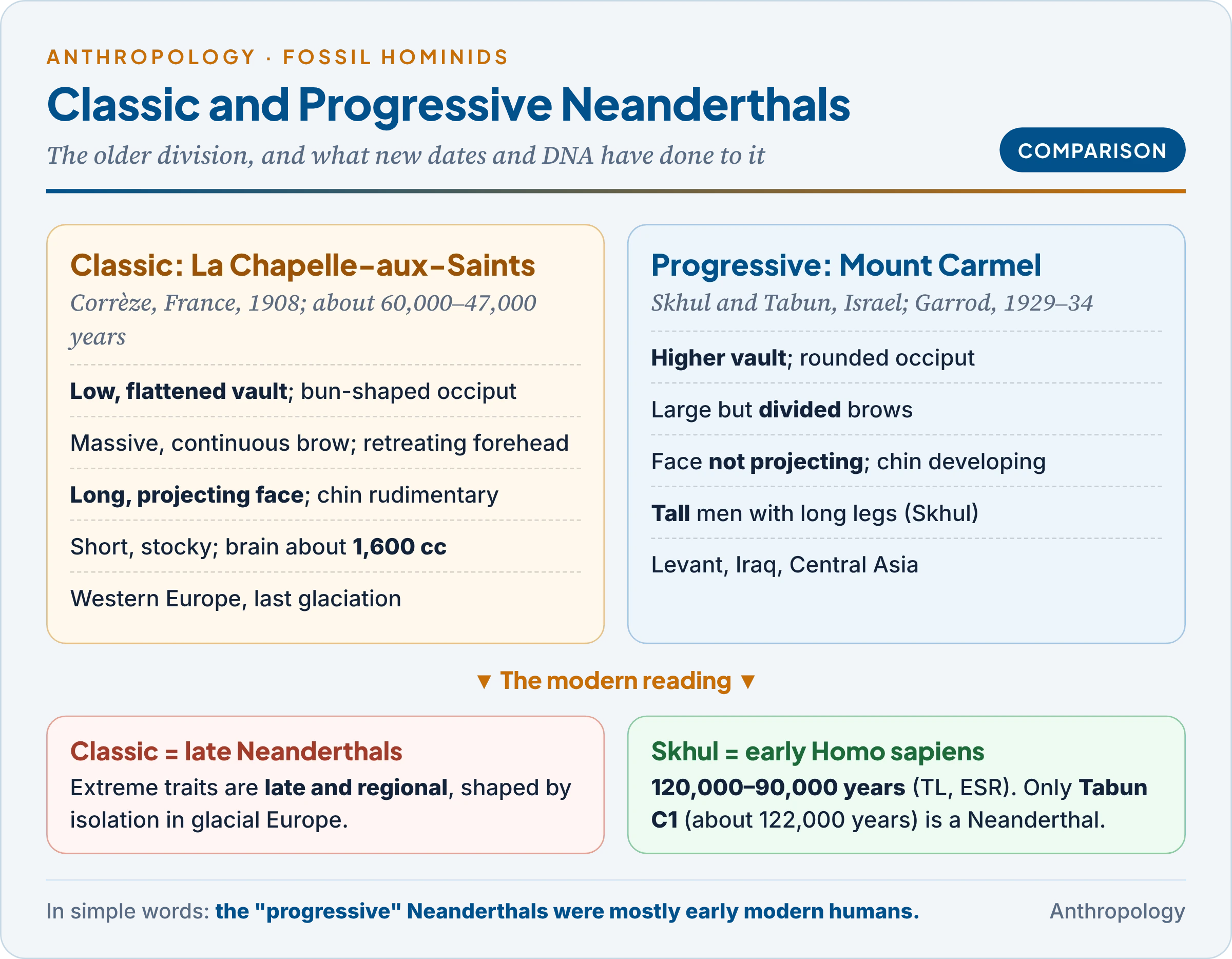
The modern reading. Thermoluminescence and ESR dating (Hélène Valladas and colleagues, 1988, and later work) put the modern-looking people of Skhul and nearby Qafzeh at about 120,000–90,000 years, and Tabun C1 at about 122,000 years. So Skhul and Qafzeh are early Homo sapiens from an early dispersal out of Africa, and Tabun C1 is a Neanderthal: the two species occupied the Levant alternately or at times jointly, with the same tools. These Levantine Neanderthals are also older than the classic Europeans, so they cannot be a later, more advanced stage of them.
The table sets out the old contrast, with today’s status in the last row: the “progressive” column largely describes early modern humans.
| Feature | Classic (La Chapelle, western Europe) | Progressive (Skhul, Mount Carmel) |
|---|---|---|
| Date (now) | About 60,000–47,000 years | Skhul about 120,000–90,000; Tabun about 122,000 |
| Vault | Low, flattened; bun-shaped occiput | Higher; rounded occiput |
| Forehead and brow | Retreating; continuous, massive brow | Not receding; brow divided |
| Face and chin | Long, projecting; chin rudimentary | Moderate, not projecting; chin developing |
| Body | Short, stocky; short limb ends | Taller, longer legs |
| Distribution | France, Spain, Germany, Belgium, Italy | Levant, Iraq (Shanidar), Central Asia |
| Status today | Late Neanderthals, cold-adapted | Skhul = early H. sapiens; Tabun = Neanderthal |
3.3 Should the distinction be kept?
F. Clark Howell and Wilfrid Le Gros Clark (1950s) saw the “progressive” forms as less specialised early Neanderthals. The distinction is now largely abandoned, for four reasons:
- It mixed two species: Skhul and Qafzeh are early H. sapiens.
- It reversed the time order: the extreme classic traits are late and regional, the result of long isolation in glacial Europe.
- Variation is continuous: early Europeans such as Krapina and Saccopastore (Italy) are less extreme than La Chapelle; Shanidar is intermediate.
- Genetics gives better groupings: DNA separates early from late and western from eastern (Altai) Neanderthals (§10).
The useful replacement is early versus late Neanderthals, with a regional label.
Common confusion
Were the “progressive Neanderthals” of Mount Carmel our ancestors? No. The skeletons that looked “progressive”, from Skhul and Qafzeh, are early Homo sapiens, about 120,000–90,000 years old, who had come out of Africa. The real Neanderthal at Mount Carmel is Tabun C1. So the “progressive” type is not a stage between Neanderthals and us; it is us.
4. Culture and Behaviour of the Neanderthals
In simple words
Neanderthals made skilful stone tools, hunted large animals at close range, used fire, made glue from birch bark, cared for injured people and buried some of their dead. How far they used symbols and art is still argued, but the evidence for some symbolic behaviour has grown.
- Mousterian technology (after Le Moustier, France): flakes made by the Levallois technique, in which a core is shaped first so that a flake of planned shape can be struck off; side-scrapers, points and denticulates (toothed tools). It needs planning several steps ahead (Unit 1.8b).
- Glue, wood and food: points were hafted with birch-bark tar, made by heating bark without air; wooden tools were common (Abric Romaní, Spain, 2026). Isotopes show a diet high in meat hunted at close range, and starch grains in dental calculus (hardened plaque) show cooked plants too.
- Care: Shanidar 1, a man with a withered right arm, a crushed eye socket and a damaged leg, survived for years, so the group cared for the disabled.
- Burial: bodies at La Chapelle, La Ferrassie, Kebara and Shanidar lay flexed in pits, widely accepted as deliberate burials, without certain grave goods. The “flower burial” of Shanidar 4 (pollen read as flowers by Arlette Leroi-Gourhan, 1975) is now traced to burrowing bees.
- Violence: a wound in the shoulder blade of Shanidar A (about 75,000 years) may be the earliest known spear wound inflicted by another person (2026).
- Speech: the Kebara 2 hyoid (the small bone anchoring the tongue and larynx muscles) is modern in shape, and Neanderthals share our version of the speech-related gene FOXP2; most specialists accept some spoken language.
- Symbols: cut eagle talons from Krapina (about 130,000 years), probably jewellery; pigment-stained shells in Spain (about 115,000 years); rings of broken stalagmites deep inside Bruniquel cave, France (about 176,000 years; Jacques Jaubert and colleagues, 2016); red marks in Spanish caves dated to over 64,000 years (2018), a disputed claim of Neanderthal painting.
Were Neanderthals “less capable”? The case for a real difference rests on what modern humans brought: blade and bone tools, figurative art, long-distance exchange and denser populations, with which they replaced Neanderthals within a few thousand years. The case against inferiority rests on the list above, and on survival through several glacial cycles. The balanced view is that Neanderthals were fully human in capacity but lived in small, scattered groups (their genomes show a small effective population), which limited the build-up and spread of innovations. The gap lay less in individual intelligence than in demography and social networks.
5. Phylogenetic Status and Fate of the Neanderthals
In simple words
For 150 years scientists argued whether Neanderthals were our ancestors, a dead-end side branch, or a race of our own species. Most now see them as a separate lineage that split from ours over half a million years ago, yet close enough to interbreed with us. They disappeared about 40,000 years ago, soon after modern humans arrived in Europe.
5.1 The three classical hypotheses
The older literature summed up the debate in three hypotheses. The table states each with its evidence and its fate.
| Hypothesis | Proposed by | Claim | Status |
|---|---|---|---|
| Neanderthal phase of man | Gustav Schwalbe (1904); Aleš Hrdlička (1927); revived by Brace (1964) | All humans passed through a Neanderthal stage; Neanderthals evolved into modern Europeans | Rejected: Europe shows replacement |
| Pre-Neanderthal | Howell, Le Gros Clark, Stringer | An early population split into a specialised classic line in Europe and a modern line elsewhere | Broadly accepted |
| Pre-sapiens | Boule (1911–23), Henri Vallois (1954) | A modern line (Swanscombe, Steinheim) lived alongside Neanderthals | Rejected: those skulls are Neanderthal-like (Stringer 1974; Hublin 1982) |
The pre-Neanderthal idea, in modern dress, won: the Neanderthal line formed in Europe, the modern line in Africa. Yet the “phase” hypothesis was partly right in a way it did not foresee: the two lines interbred (§10).
5.2 Species or subspecies, and “pre-modern humans”
- Homo sapiens neanderthalensis (common in the 1960s–90s and in PYQs) makes them a subspecies, since they interbred with us; Homo neanderthalensis (usual today) a species, with a long separate history and a distinct anatomy. Genetics cuts both ways: the lineages diverged about 550,000–765,000 years ago, yet produced fertile offspring.
- “Pre-modern humans” (2010 PYQ): the phrase places Neanderthals between archaic and anatomically modern humans: modern in brain size, technology, care and burial, but not in skull shape, chin, gracile skeleton or full Upper Palaeolithic culture.
5.3 Coexistence and disappearance
Modern humans entered Europe briefly about 54,000 years ago (Grotte Mandrin, France; 2022) and in numbers from about 47,000–45,000 years ago, while Neanderthals had gone by about 41,000–39,000 years ago: the two overlapped for several thousand years, region by region.
- Evidence of coexistence: the Châtelperronian industry of France (about 44,000–40,000 years), with blades and ornaments, is linked to Neanderthals, perhaps as a response to modern neighbours; the Oase 1 jaw from Romania (about 40,000 years) had a Neanderthal ancestor four to six generations back (Qiaomei Fu and colleagues, 2015).
- Causes proposed for the disappearance: competition with modern humans, who had larger networks and better projectiles; climate swings that fragmented small groups; a small population vulnerable to chance; assimilation through interbreeding; and disease, without direct evidence. A 2026 study found no genetic decay in late Neanderthals.
Evaluation. No single cause suffices. The likeliest picture is a thin, scattered population under climatic stress, outnumbered and partly absorbed by expanding modern humans; through the genes they left, Neanderthals are in a real sense among our ancestors.
6. Rhodesian Man (Kabwe)
In simple words
Rhodesian man is a single, well-preserved skull found in a zinc and lead mine in Zambia in 1921. It has enormous brow ridges like a very archaic human, but a large brain and a skull base like ours. Once thought very old, it is now dated to about 300,000 years ago, when the first Homo sapiens were already appearing in Africa.
6.1 Discovery and date
- Discovery: on 17 June 1921 the Swiss miner Tom Zwiglaar found a nearly complete cranium about 18 m below ground in the Broken Hill mine, Northern Rhodesia (now Kabwe, Zambia): the first early human fossil found in Africa. Leg, sacrum and pelvic bones and a second upper jaw, recovered by A.S. Armstrong (1921) and Aleš Hrdlička (1925), represent at least two individuals.
- Names: Arthur Smith Woodward named it Homo rhodesiensis (1921); W.P. Pycraft’s Cyphanthropus (“stooping man”, 1928) was rejected.
- Date: older texts placed Kabwe in the early Pleistocene or late Pliocene. Direct uranium-series and ESR dating gave about 299,000 years (± 25,000; Rainer Grün, Christopher Stringer and colleagues, Nature, 2020).
6.2 Characteristics
- Archaic traits: brow ridges the largest of any human fossil; a low, receding forehead; a long, fairly low vault with an occipital torus; a very large face.
- Advanced traits: a vault broader and higher than in H. erectus, with parietal expansion; a brain of about 1,280–1,300 cc; a central foramen magnum (a skull balanced on an upright spine); teeth of modern proportions; a straight, human femur.
- Disease: caries in ten upper teeth, among the oldest known, and a hole by the left ear, read by the otologist Macleod Yearsley as a chronic mastoid infection, by others as a wound or a carnivore bite.
6.3 Phylogenetic status
- Older views: an African Neanderthal (Hooton; Boule); closer to apes than Pithecanthropus (Keith); near the divergence of the Neanderthal and modern lines (von Bonin).
- The current view places Kabwe in the Middle Pleistocene grade of large-brained humans: H. heidelbergensis in the broad sense, or the African species H. rhodesiensis. In brief from Unit 1.6b (§7.4): if the Mauer jaw belongs to the Neanderthal line, splitters keep Woodward’s 1921 name for the African branch.
- Why the new date matters: at about 299,000 years, Kabwe lived at the same time as the earliest H. sapiens at Jebel Irhoud, Morocco (about 315,000 years) and the small-brained Homo naledi of South Africa (about 335,000–236,000 years). Africa held several human lineages at once, so Kabwe is better seen as a late member of an ancestral grade than as our direct ancestor.
- Not an “African Neanderthal”: the big brow and face are primitive traits shared by Middle Pleistocene humans; Kabwe lacks the occipital bun and mid-facial projection that only Neanderthals have.
7. Homo sapiens: Definition and the Earliest Fossils
In simple words
Homo sapiens, “wise human”, is our own species. Its skeleton has a high, round skull, a vertical forehead, a small face tucked under the brain and a chin. The oldest fossils with some of these features come from Africa about 300,000 years ago, and modern humans spread over the rest of the world mainly after about 60,000 years ago.
7.1 What makes a skeleton “anatomically modern”
- Globular braincase with expanded parietal regions; vertical forehead; small or no brow ridges.
- Small, flat face tucked under the brain; a chin (mental eminence), found only in H. sapiens; small teeth.
- Gracile skeleton (thinner bones, long limbs) and slow growth with a long childhood.
Terms. Older books split our species into “archaic Homo sapiens” (a catch-all for Neanderthals, Kabwe and others) and “Homo sapiens sapiens” (anatomically modern humans); the PYQs use both. Today the archaic forms are mostly separate species.
7.2 The earliest fossils of Homo sapiens
The table gives the record in time order. The first rows show that our species is older than once thought; the later rows show early journeys out of Africa long before the main one.
| Specimen | Site | Date (method) | Traits | Significance |
|---|---|---|---|---|
| Jebel Irhoud 1–11 | Morocco (1961; new finds 2004–17) | About 315,000 years (thermoluminescence of burnt flints) | Modern face, long archaic braincase | Oldest H. sapiens (Jean-Jacques Hublin, 2017) |
| Omo Kibish 1 | Ethiopia (Richard Leakey’s team, 1967) | At least 233,000 years (argon dating of volcanic ash, 2022) | Rounded vault | Eastern Africa |
| Herto | Middle Awash, Ethiopia (Tim White, 1997) | About 160,000 years (argon dating) | Large modern skull | Named H. sapiens idaltu (2003) |
| Misliya jaw | Mount Carmel, Israel | About 194,000–177,000 years | Modern jaw and teeth | Earliest H. sapiens outside Africa (Israel Hershkovitz, 2018) |
| Skhul, Qafzeh | Israel | About 120,000–90,000 years (TL, ESR) | High vault, chin | Early dispersal; burials with ochre and shells |
| Bacho Kiro, Ranis, Zlatý kůň | Bulgaria, Germany, Czechia | About 47,000–45,000 years (radiocarbon) | Teeth, bones, genomes | Earliest Europeans |
- What the table shows: modern features arose in a mosaic: Jebel Irhoud has a modern face but an archaic braincase. Hence the “pan-African” view (Eleanor Scerri and colleagues, 2018) that our species arose in many connected populations across Africa, not in one cradle.
- The main dispersal: genes trace all living non-Africans to a dispersal about 60,000–50,000 years ago, which reached Australia by about 50,000 years ago. The earlier Levantine groups left little or no trace in living people.
7.3 India and the dispersal
- Fossils: India has no securely dated early H. sapiens fossil; the oldest South Asian modern remains are in Sri Lanka (Fa-Hien Lena, about 48,000–45,000 years).
- Tools: at Jwalapuram, Kurnool (Andhra Pradesh), Middle Palaeolithic tools lie below and above the ash of the Toba super-eruption of about 74,000 years ago (Michael Petraglia and colleagues, 2007); at Dhaba, Middle Son valley (Madhya Pradesh), one industry spans 80,000–65,000 years across the Toba ash, with microliths from about 48,000 years (Chris Clarkson and colleagues, 2020). If H. sapiens made these tools, modern humans reached India before 74,000 years, but the makers are not proved.
- Genes: the Andamanese carry deep, unique mitochondrial lineages (M31, M32) that split from other Asian lineages soon after the dispersal, supporting an early southern coastal route (Kumarasamy Thangaraj and colleagues, 2005).
8. Upper Palaeolithic Homo sapiens of Europe: Cro-Magnon, Grimaldi and Chancelade
In simple words
The modern humans of ice-age Europe are often called Cro-Magnons, after a French rock shelter. Three famous finds, from Cro-Magnon, Grimaldi and Chancelade, were once said to show three “races”: a European, an African and an Eskimo type. Re-study has shown that all three belong to one variable population of early Europeans.
8.1 Cro-Magnon man
- Discovery: in 1868 the French geologist Louis Lartet excavated the rock shelter of Cro-Magnon at Les Eyzies, Dordogne, exposed during railway building: at least four adults and an infant, among them the “old man” (Cro-Magnon 1), with shell beads, later studied by Paul Broca.
- Date: the earliest Gravettian, about 30,000 years ago (radiocarbon dating of the shell ornaments; Dominique Henry-Gambier, 2002); older texts said Aurignacian.
- Skull: large and dolichocranial (long-headed; cranial index about 73.7); brain about 1,600 cc (Keith 1,660; Boule 1,590); a broad forehead, moderate brows, a bulging occiput; a short, broad face with a long, narrow head (cranial disharmony); low, rectangular orbits; a narrow, high nose (leptorrhine); a prominent chin.
- Body: tall, about 1.70–1.80 m, with long forearms and shins, proportions old texts called “Negroid” and now read as a heritage of tropical African ancestors (Allen’s rule); flattened thigh (platymeria) and shin (platycnemia) shafts.
- Culture: the Upper Palaeolithic (Unit 1.8b): blades, bone needles, cave painting (Chauvet, about 36,000 years; Lascaux, about 17,000), figurines and burials.
The “Cro-Magnon race”. Armand de Quatrefages and Ernest Hamy (1870s) found descendants of a “Cro-Magnon race” in the Dal people of Sweden, the Basques and the Guanches of the Canary Islands. Such typological thinking (classifying people by an ideal type) is disproved by ancient DNA: western European hunter-gatherers had dark skin and often blue eyes (“Cheddar Man”, Britain, about 10,000 years), and their genes were later largely replaced by those of incoming farmers and herders.
8.2 Grimaldi man
- Discovery: in June 1901 the canon Léonce de Villeneuve, digging for Prince Albert I of Monaco, found a double burial in the Grotte des Enfants (“cave of the children”), one of the Balzi Rossi caves at Grimaldi, Italy, beside Menton.
- Traits described by René Verneau (1906) for the old woman and adolescent boy, buried flexed with shell ornaments: long, narrow, high skulls (cranial index about 68–69, hyperdolichocranial); brains of about 1,265 cc (woman) and 1,454 cc (boy); a broad, flat nose (platyrrhine); strong alveolar prognathism (projecting tooth-bearing jaws); a weak chin; long forearms and shins; statures about 1.60 m and 1.56 m.
- The “Negroid” claim: Verneau, Boule and Vallois saw a “Negroid” type related to the San of southern Africa; Keith and Grafton Elliot Smith called it a primitive variant of the Cro-Magnon stock.
- The reassessment: the French anatomist Pierre Legoux showed that the woman’s jutting upper jaw followed the loss of her back teeth, and that the boy’s face had been wrongly reconstructed (Boule drilled the jaws to free the unerupted wisdom teeth and built an exaggerated face). Without these errors the “Negroid” traits disappear, and the Grimaldi people fall within the early European Upper Palaeolithic range.
8.3 Chancelade man
- Discovery: on 1 October 1888 Michel Hardy found a skeleton at the base of the Raymonden rock shelter, Chancelade (Dordogne), below Magdalenian layers, about 17,000–12,000 years old.
- Traits: a man of 55–65 years, buried flexed and coated with red ochre; short, about 1.55 m; a long, narrow, high skull (cranial index about 71) with a sagittal keel (a ridge along the top) and a vertical forehead; brain about 1,530 cc (Keith; Léo Testut gave 1,710 cc); a long, broad face with forward-facing cheekbones that make it look flat; a narrow nose; a strong chewing apparatus.
- The “Eskimo” claim: the French anatomist Léo Testut (1889) found the skull closest to the Inuit (Eskimo) and, citing Magdalenian bone needles and harpoons, made the Magdalenians the ancestors of the Inuit, following the retreating ice north.
- The objections: Keith called Chancelade a European type; Hooton found similar “Eskimo” features in medieval Icelanders; and the British statistician Geoffrey Morant (1930) showed that it lies within the range of Upper Palaeolithic Europeans. The resemblance is convergence: a broad, flat face and strong jaw suit cold climates and heavy chewing.
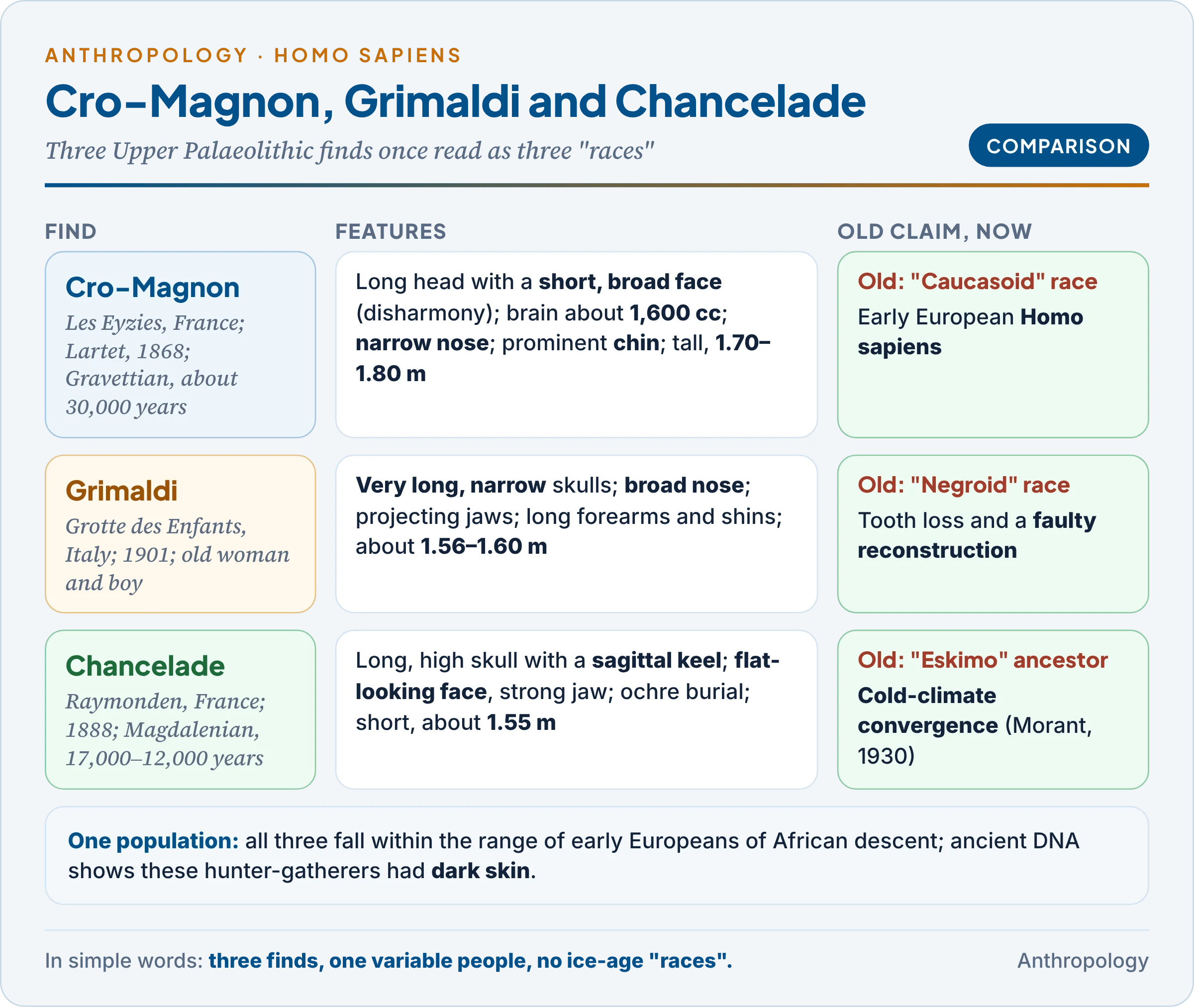
The table brings the three together; the last two rows show each once made into a separate “race” and now placed in one population.
| Feature | Cro-Magnon | Grimaldi | Chancelade |
|---|---|---|---|
| Site | Les Eyzies, France, 1868 | Grotte des Enfants, Italy, 1901 | Raymonden, France, 1888 |
| Culture and date | Gravettian, about 30,000 years | Upper Palaeolithic | Magdalenian, 17,000–12,000 years |
| Skull | Long; disharmonic face | Hyperdolichocranial; elliptical | Long, high; sagittal keel |
| Nose | Narrow (leptorrhine) | Broad (platyrrhine) | Narrow |
| Stature | Tall, 1.70–1.80 m | About 1.56–1.60 m | Short, about 1.55 m |
| Old claim | “Caucasoid” ancestor of Europeans | “Negroid” | “Eskimo” |
| Modern view | Early European H. sapiens | Same population; reconstruction errors | Same population; cold-climate convergence |
Common confusion
Do Cro-Magnon, Grimaldi and Chancelade prove that modern races go back to the Ice Age? No, though some books cite them for the multiregional model. All three belong to one population of early Europeans with African-derived roots; the “Negroid” and “Eskimo” looks came from a faulty reconstruction and cold-climate convergence. Living “races” are recent, overlapping and shaped by later migrations (Unit 9.5).
9. Models of Modern Human Origins
In simple words
Where and how did people like us arise? One model said modern humans evolved slowly on every continent from local ancestors, linked by interbreeding. A second said they evolved once, in Africa, and replaced all other humans. The evidence now supports a middle view: an African origin, with some interbreeding with Neanderthals and Denisovans as modern humans spread.
Start from your own genome. An Indian, European or Chinese person carries about 1–2 per cent DNA from Neanderthals; a Papuan about 3–5 per cent from Denisovans as well; most Africans far less. These figures are the sharpest test of the models: most of the genome is African in origin, and a small part came from mixing.
9.1 The multiregional model
- Origin: the German anatomist Franz Weidenreich (1943), who described Peking man, proposed a “trellis“: populations in Africa, Europe and Asia evolved in parallel from H. erectus to H. sapiens, joined by gene flow that kept them one species. Milford Wolpoff, Wu Xinzhi and Alan Thorne restated it in 1984.
- Evidence claimed: regional continuity, such as shovel-shaped incisors and flat faces in East Asia from Peking man onwards, and robust brows in Australia from Java.
- Problems: genetic diversity is highest in Africa and falls with distance from it; mtDNA and Y-chromosome lineages of all living people trace to recent African ancestors; and “regional” traits also occur elsewhere.
9.2 The recent African origin model
- Origin: William Howells (1976) called it the “Noah’s Ark” model; Christopher Stringer and Peter Andrews set it out in 1988. Modern humans evolved in Africa and replaced archaic populations everywhere with little or no interbreeding.
- Mitochondrial evidence: Rebecca Cann, Mark Stoneking and Allan Wilson of the University of California, Berkeley, compared the mitochondrial DNA of 147 people from five regions (Nature, 1987). African lineages were the most diverse and formed the deepest branches, and all traced to one woman in Africa about 200,000 years ago, “mitochondrial Eve” (not the only woman alive, but the one whose maternal line survived unbroken).
- Other evidence: the oldest modern fossils are African (§7.2), and diversity falls with distance from Africa, the signature of a serial founder effect (Sohini Ramachandran and colleagues, 2005). The strict claim of no interbreeding was disproved in 2010.
9.3 The assimilation model
The German anthropologist Günter Bräuer (1984) proposed an African origin with some hybridisation during replacement; the American Fred Smith and colleagues (1989) argued that modern humans arose in Africa but absorbed local archaic people through gene flow, so that some archaic traits and genes persist regionally (“leaky replacement“).
The table compares the three models; the last row is the verdict of present evidence.
| Point | Multiregional | Recent African origin | Assimilation |
|---|---|---|---|
| Proponents | Weidenreich; Wolpoff, Wu, Thorne (1984) | Stringer and Andrews (1988); Cann et al. (1987) | Bräuer (1984); Fred Smith (1989) |
| Where moderns arose | Everywhere, in parallel | Africa only | Africa |
| Fate of archaic humans | Evolved into moderns | Replaced | Mostly replaced, partly absorbed |
| Interbreeding | Continuous | None or trivial | Limited |
| Status | Rejected in strong form | Core accepted; “no mixing” rejected | Best supported |
The models differ less on where than on how much mixing occurred, which ancient DNA has now measured.
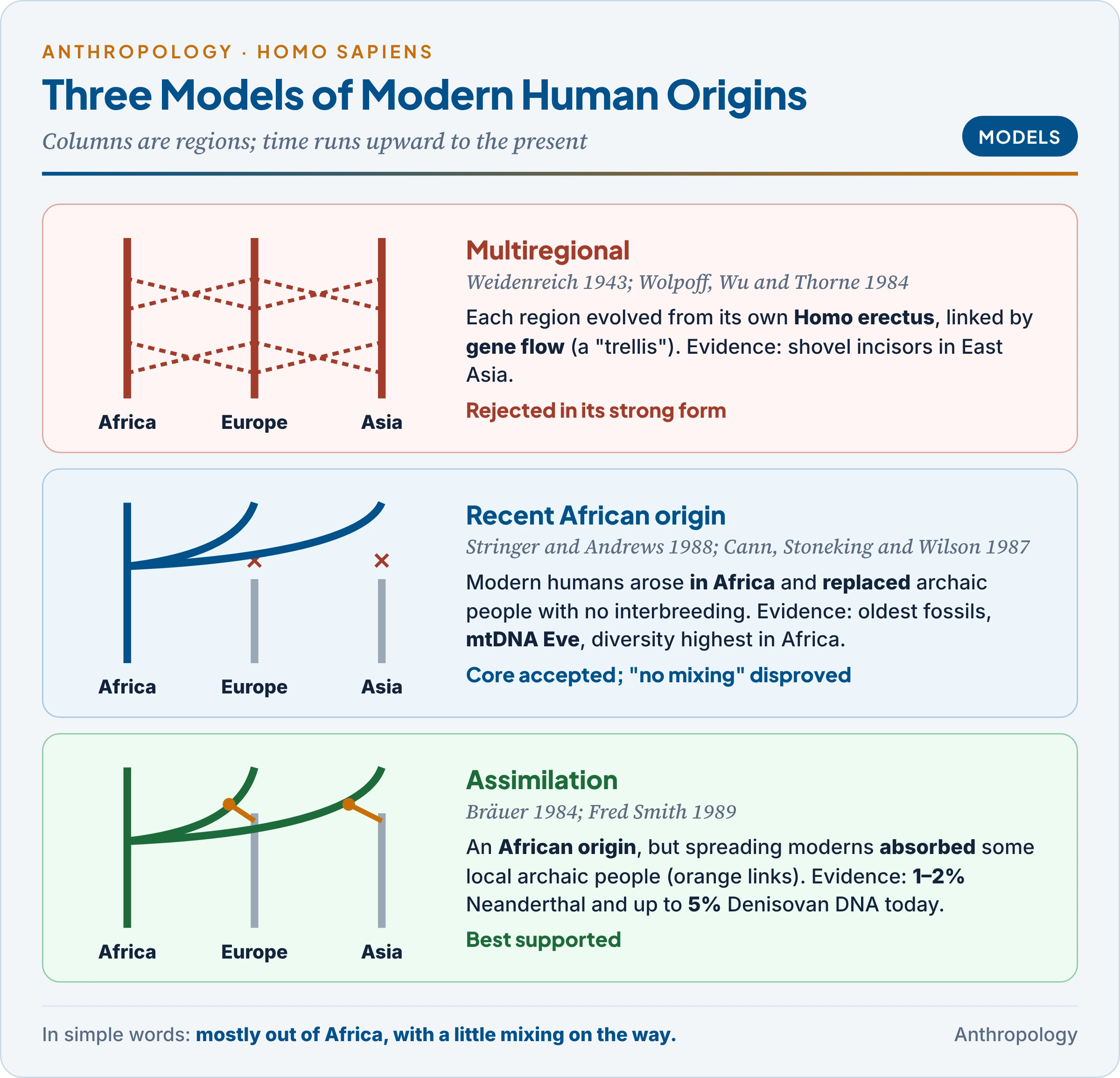
9.4 Evaluation
The African origin is beyond reasonable doubt: fossils, the diversity gradient and gene trees all point to Africa, and about 98 per cent of a non-African genome traces to the out-of-Africa population. The strong multiregional model is rejected, yet its intuition that gene flow between regions mattered was vindicated unexpectedly, through interbreeding with Neanderthals and Denisovans. The best summary is African origin with assimilation, with two refinements: the origin was itself “multiregional within Africa“, with input from unknown archaic “ghost” populations; and an early dispersal to the Levant (Misliya, Skhul, Qafzeh) left little trace, while the main one, about 60,000–50,000 years ago, gave rise to all living non-Africans.
10. Ancient DNA: Neanderthals, Denisovans and Us
In simple words
Scientists can now read DNA from bones tens of thousands of years old. It has shown that Neanderthals were a separate lineage from us, that another group, the Denisovans, lived in Asia, and that modern humans interbred with both. Some of the genes we inherited from them still help or harm us.
10.1 The Neanderthal genome
- First sequences: mitochondrial DNA from the Feldhofer specimen (Matthias Krings, Svante Pääbo and colleagues, 1997) lay outside the range of living humans.
- Nuclear genome: the Neanderthal Genome Project of the Max Planck Institute for Evolutionary Anthropology, Leipzig, published a draft genome from Vindija Cave, Croatia, in May 2010 (Richard Green and colleagues, Science); high-coverage genomes followed from 2014.
- What the genomes show:
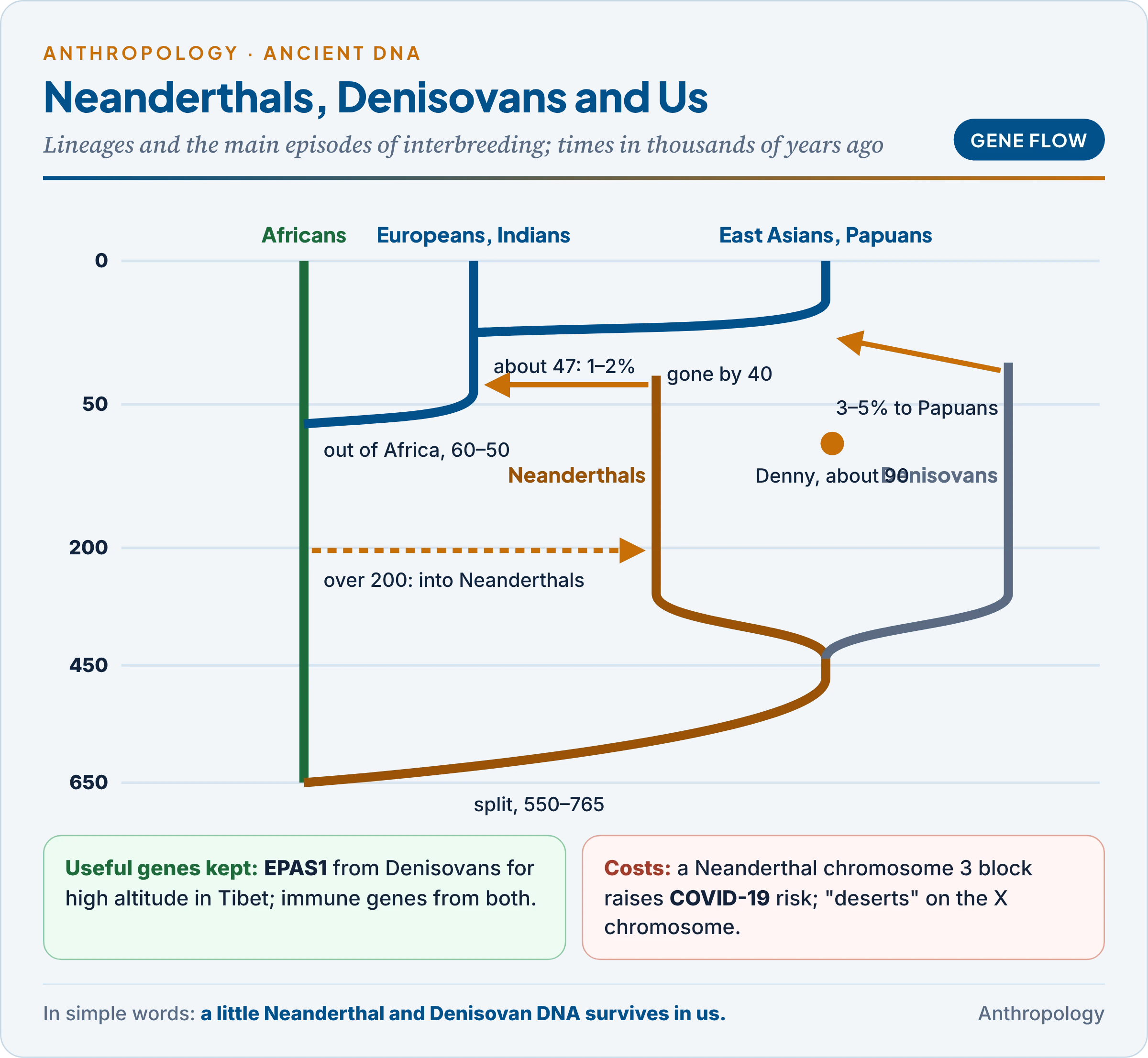
- The lineages split about 550,000–765,000 years ago; non-Africans carry about 1–2 per cent Neanderthal DNA.
- The mixing is dated to about 47,000 years ago, one extended period of several thousand years (Leonardo Iasi and colleagues, Science, 2024), confirmed by the oldest modern genomes from Ranis and Zlatý kůň (Arev Sümer and colleagues, Nature, 2024).
- Gene flow also ran the other way: early modern humans passed DNA to Neanderthals over 200,000 years ago, giving late Neanderthals modern-human-like Y chromosomes (Martin Petr and colleagues, 2020).
- Long “deserts“, notably on the X chromosome, lack Neanderthal DNA, suggesting reduced hybrid fertility and selection against harmful variants.
10.2 “Europeans are closer to Neanderthals”
The claim (2019 PYQ) seems natural, since Neanderthals lived in Europe, but the evidence says otherwise. East Asians carry about 10–20 per cent more Neanderthal DNA than Europeans, because Europeans received much ancestry from “Basal Eurasians“, an early-splitting population with little Neanderthal DNA, which diluted their share. Even Africans carry a little, brought by West Eurasians who migrated back into Africa. The mixing therefore happened early, in a population (probably in West Asia) ancestral to all non-Africans, before Europeans and Asians separated. No living population is especially “Neanderthal”, and the African origin of humankind stands; the archaic share is a small addition to an African-derived genome.
10.3 The Denisovans
- Discovery: in 2010 a finger bone from Denisova Cave in the Altai yielded mitochondrial DNA (Johannes Krause and colleagues) and a genome (David Reich and colleagues) from an unknown human group, a sister of the Neanderthals: the first human group identified from DNA before its skeleton was known.
- A hybrid child: Denisova 11 (“Denny”), a girl of about 90,000 years ago, had a Neanderthal mother and a Denisovan father (Viviane Slon and colleagues, 2018).
- Fossils: a jaw from Baishiya Karst Cave, Tibetan Plateau (about 160,000 years); a jaw dredged off Penghu, Taiwan (2025); and the Harbin skull of north-east China, at least 146,000 years old and once named Homo longi, shown by proteins and mitochondrial DNA to be Denisovan (Qiaomei Fu and colleagues, 2025), which gave the Denisovans a face: a long, low skull, a brain of about 1,420 cc and very large molars.
- Legacy: Papuans and Aboriginal Australians carry about 3–5 per cent Denisovan DNA, the Philippine Ayta the most. Whole genomes of 2,762 Indians (Elise Kerdoncuff and colleagues, Cell, 2025) found 1–2 per cent combined Neanderthal and Denisovan ancestry and the largest variety of Neanderthal segments of any population studied, because India’s many endogamous groups preserved different fragments (Unit 1.4b).
10.4 Archaic genes in living people
The archaic genes that survive are a selected sample: some were kept because they helped in new environments, a process called adaptive introgression (gain of useful genes from another population by interbreeding); others carry costs.
| Gene or region | From | Effect today |
|---|---|---|
| EPAS1 | Denisovans | Lets Tibetans live at high altitude without excessive red-cell production (Emilia Huerta-Sánchez and colleagues, 2014) |
| Immune genes (TLR, HLA) | Neanderthals, Denisovans | Faster defence against local pathogens |
| Chromosome 3 haplotype | Neanderthals | Higher risk of severe COVID-19, common in South Asia (Hugo Zeberg and Svante Pääbo, 2020) |
Svante Pääbo received the Nobel Prize in Physiology or Medicine in 2022 for founding palaeogenomics, the study of ancient genomes.
Key Terms
| Term | Meaning in simple words |
|---|---|
| Classic Neanderthal | The late, extreme western European form, such as La Chapelle-aux-Saints |
| Progressive Neanderthal | Older label for modern-looking Levantine fossils, now partly reclassified as H. sapiens |
| Occipital bun | A bulge at the back of the skull |
| Mid-facial prognathism | Forward projection of the centre of the face |
| Crural index | Shin length as a percentage of thigh length |
| Mousterian | The Neanderthal flake-tool industry, made by the Levallois technique |
| Anatomically modern human | A human with a round skull, small face and a chin |
| Cranial disharmony | A broad face combined with a long, narrow head |
| Assimilation model | An African origin with some absorption of local archaic people |
| Mitochondrial Eve | The latest woman from whom all living people inherit their mitochondrial DNA |
| Introgression | Movement of genes into a population by interbreeding |
| Denisovans | An Asian sister group of the Neanderthals, first known from DNA |
Contemporary Developments
- A Neanderthal spear wound (October 2026): a round hole in the shoulder blade of Shanidar A, Iraqi Kurdistan, about 75,000 years old, may be the earliest known spear wound inflicted by another person; the same individual had survived an earlier facial injury (Emma Pomeroy and colleagues, Scientific Reports).
- The first Denisovan forearm (September 2026): proteins identified skull fragments, teeth and a radius from Bianfu Cave, Yunnan, about 167,000–134,000 years old, as Denisovan (Qiaomei Fu and colleagues, Nature).
- Late Neanderthals were not genetically decaying (June 2026): data from 27 Neanderthals at ten sites in Belgium and France showed well-connected groups and no build-up of harmful mutations (Alba Bossoms Mesa and colleagues, Nature).
- The Denisovans get a face (June 2025): proteins and mitochondrial DNA showed that the Harbin skull, once called Homo longi, is Denisovan (Qiaomei Fu and colleagues, Science and Cell).
- Dating the interbreeding (December 2024): the earliest modern European genomes, from Ranis and Zlatý kůň, dated the main Neanderthal mixing to about 47,000 years ago (Sümer and colleagues, Nature; Iasi and colleagues, Science).
Diagrams to Master
- Topic map: the six themes of the article.
- Two skulls: label occipital bun, double brow, mid-face, no chin; against round vault, forehead, chin.
- Classic and progressive: mark new dates and Skhul = H. sapiens.
- Three Upper Palaeolithic finds: site, date, nose, stature; old label and modern view.
- Origin models: trellis; one African tree; African tree with side arrows.
- Gene flow: out of Africa; Neanderthal input about 47,000 years (1–2 per cent); Denisovan input (3–5 per cent in Papuans).
Revision Grid
| Scholar | Work (year) | Key idea |
|---|---|---|
| Marcellin Boule | L’Homme fossile de La Chapelle-aux-Saints (1911–13) | Stooping Neanderthal; pre-sapiens |
| Arthur Smith Woodward | 1921 | Named Homo rhodesiensis |
| McCown and Keith | The Stone Age of Mount Carmel (1939) | Skhul and Tabun as one variable population |
| Franz Weidenreich | 1943 | Trellis (multiregional) model |
| C. Loring Brace | 1964 | “Hominid catastrophism”; Neanderthal phase revived |
| Wolpoff, Wu and Thorne | 1984 | Modern multiregional model |
| Cann, Stoneking and Wilson | Nature (1987) | Mitochondrial Eve in Africa |
| Stringer and Andrews | 1988 | Recent African origin |
| Green, Pääbo and colleagues | Science (2010) | Neanderthal genome; interbreeding |
Previous Year Questions
Unit 1.6: Neanderthal man, Rhodesian man and Homo sapiens
- 2022Should we still distinguish between ‘classic’ and ‘progressive’ Neanderthals? Discuss the controversy surrounding Neanderthal’s position in human evolution.
- 2020Critically evaluate the contesting theories of the emergence and dispersal of modern Homo Sapiens.
- 2019“Europeans are closer to Neanderthals”. Critically discuss in view of the African origin of humankind.
- 2016Write a note in 150 words on Rhodesian Man.
- 2011Write a note in 150 words on Neanderthal Man.
- 2010Why are Neanderlands called Premodern humans ? The Upper Palaeolithic period provides evidence of their coexistence with modern man. Discuss.
- 2006Write a note on Rhodesian Man.
- 2004Write a note on Neanderthal Man.
- 1996Write a note on Homo sapiens sapiens.
- 1995Discuss the question of single sources vs. multiple sources of the origin of Homo sapiens. Which one of the two hypotheses do you think is more tenable? Give reasons in support of your answer.
- 1994Write a note on Homo Sapiens – Neanderthalensis.
- 1993Compare the fossil remains of ‘Progressive’ and ‘Classic’ Neanderthal men for anatomical characteristics and spatial distribution. Examine their phylogenetic position in human evolution.
- 1991Write a note on La Chapelle-aux-Saints.
- 1989Write what you know about Homo sapiens and Neanderthalensis.
- 1986Write a note on Homo Sapiens Sapiens and Homo Sapiens neanderthalensis.
- 1985What do you understand by the term ‘homo sapiens’ ? Give an account of the distribution and physical features of the earliest fossil homo sapiens.
- 1984Distinguish between : Homo sapiens and Homo Neanderthalensis.
- 1982Homo Sapiens Neanderthalensis was less capable than Homo Sapiens to Survive. Critically examine the views.
Related questions from other units and Paper II
- 2026Unit 1.8: Write a detailed note on the characteristic features, chronology, geographical distribution, tool types and lifeways of Magdalenian cultural tradition of Europe.
- 2025Unit 1.7: Write notes on: Mitochondrial DNA and human evolution.
- 2025Unit 1.8: Write a note on Mousterian tool tradition, Mousterian culture and its makers.
- 2025Unit 1.1: Describe the distinctive features and distribution of Upper Palaeolithic of India.
- 2019Unit 1.8: Discuss briefly the major traditions in the Upper Palaeolithic culture of Europe.
- 2010Unit 1.4: What are the major craniofacial changes that occurred during Hominid evolution ? Discuss.